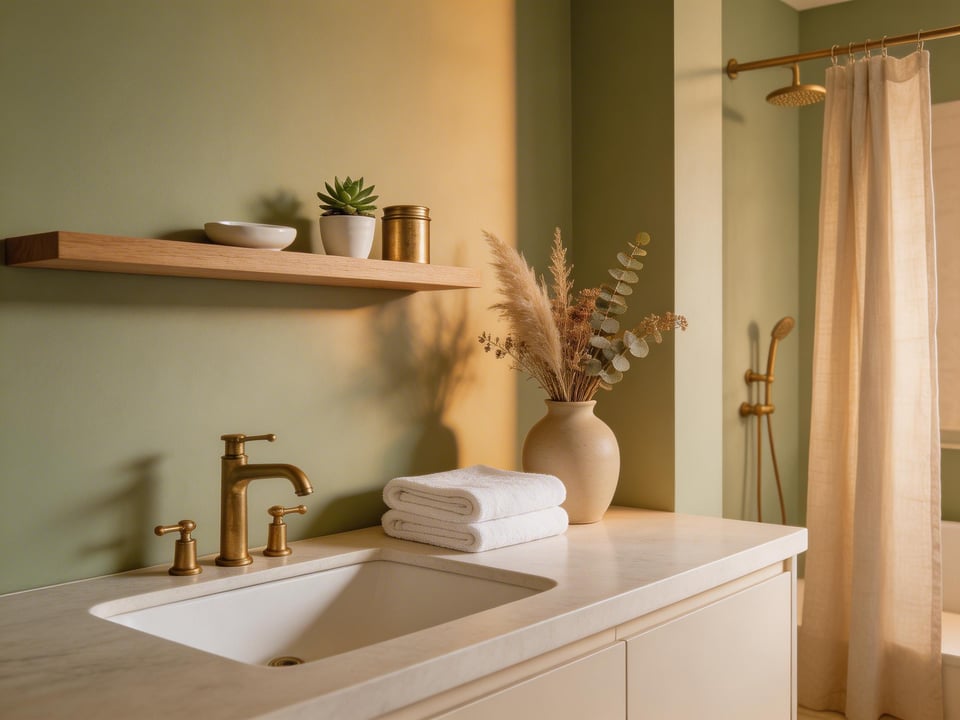
There’s a particular kind of quiet that happens when a bathroom is designed rather than assembled. You step in, and something shifts — the lighting is warm instead of clinical, the surfaces have texture instead of polish, the air carries a faint trace of dried lavender. That shift is not accidental. It’s the result of small, deliberate choices that accumulate into a room your nervous system actually responds to.
Most bathrooms don’t get that treatment. They get a toilet, a sink, whatever tile was on sale, and a chrome towel bar. The result is a functional room that does nothing beyond the basics.
The bathroom is the first and last space many of us enter each day. It sets the tone for the morning and closes the day at night. From a wellness design perspective, that makes it one of the most influential rooms in the home — and one of the most under-invested. These bathroom decor ideas aren’t about expensive renovations. They’re about choosing the right materials, the right light, and the right level of visual calm to turn a functional room into something that genuinely supports how you feel. Every item on this list is a bathroom decor idea you can implement without structural work — some for as little as $12.
1. Earthy Linen Shower Curtains to Soften Hard Bath Surfaces
The shower curtain is the single largest textile in a bathroom, and in most homes it’s a white polyester panel that does its job and nothing more. Replacing it with an earthy linen curtain is among the quickest bathroom decor ideas for introducing natural warmth into a room dominated by hard, reflective surfaces — tile, mirror, chrome.
Linen is a genuinely breathable fibre. It allows air to circulate in a way that polyester does not, which helps manage the closed, damp feeling that lingers in small bathrooms after a shower. That said, linen needs help in low-ventilation bathrooms. The practical solution is a separate PEVA-free fabric liner that takes the moisture contact while the linen curtain stays dry. Look for OEKO-TEX certified linen to avoid the chemical treatments that some natural fabrics carry.
Colour and Care
Undyed natural linen — flax beige, stone grey, oatmeal — coordinates with virtually any existing bathroom palette without requiring a full refresh. The natural slub texture reads differently in different light: warm and honeyed in the morning, cooler and more refined in the evening. Hang it with rust-resistant stainless rings and weight the hem with clip-on curtain weights for a clean drape.
The one care habit that prevents mold: push the curtain fully to one side after every shower rather than leaving it bunched. Air circulation is everything with natural fibres.
2. Layered Natural Stone Accessories for a Grounding Effect
Stone accessories do something that ceramic and plastic cannot — they anchor a bathroom. The visual weight of a travertine soap dish or a soapstone tray creates a grounding effect that reads immediately as considered rather than assembled.
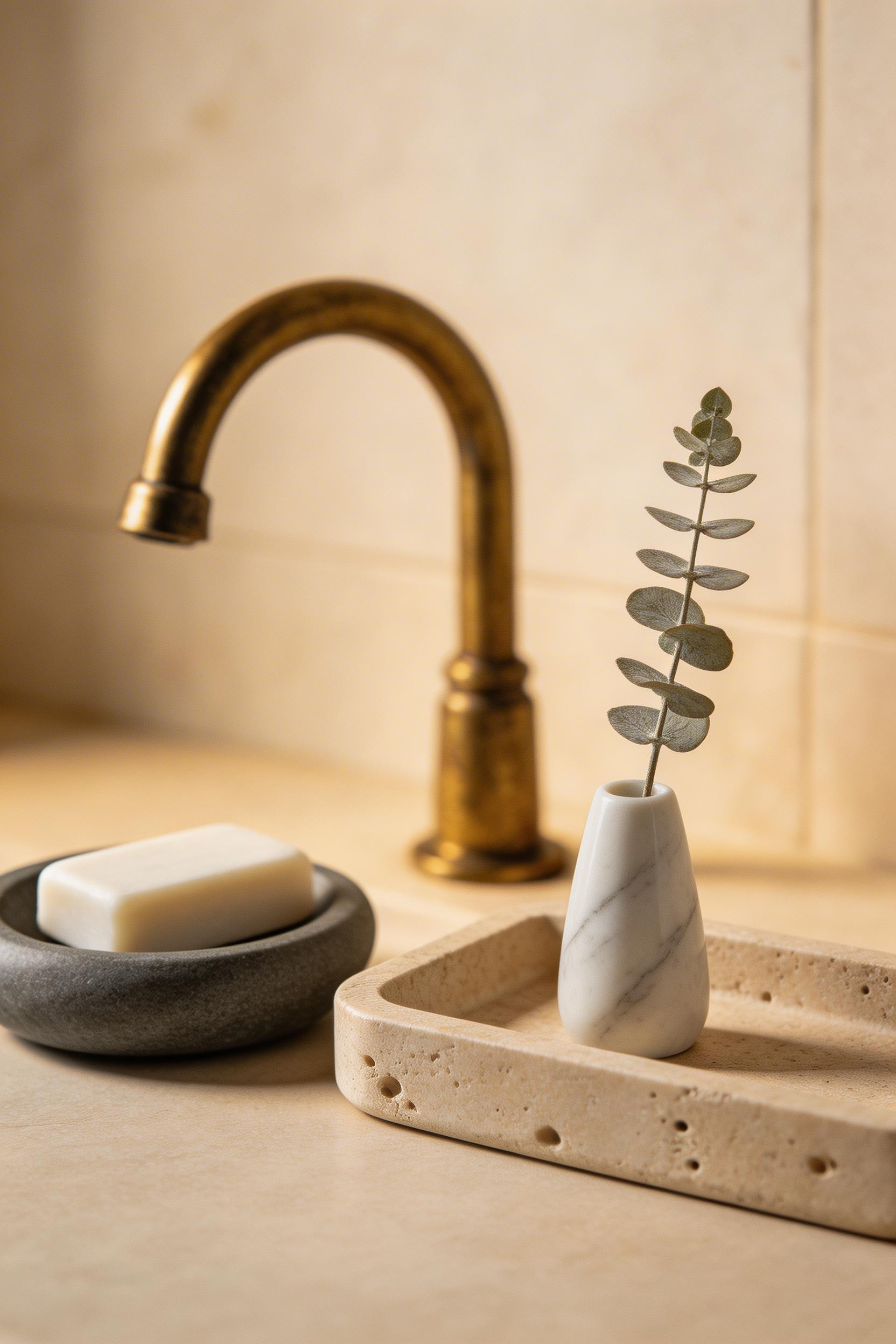
Not all stone performs equally in a humid bathroom. Soapstone is the most practical choice: naturally non-porous, waterproof without additional sealing, and resistant to bacteria. It has a soft, matte surface that doesn’t show water marks the way polished marble does. Granite is a close second — low porosity, easy to clean, and widely available in small accessory form. Travertine handles humidity well but needs to be chosen carefully; avoid pieces with unfilled pits or holes, as water pools there over time.
Marble is the most sought-after option and the highest maintenance. It needs sealing every six to twelve months and will stain if coloured soap or cleaning products sit on it. Use it for decorative trays held away from direct water contact rather than as your primary soap dish.
Layering Without Clutter
The layering principle is simple: three stone pieces in the same tonal family — a soap dish, a catch-all tray, a small dispenser — create a cohesive vignette. Pair them with one warm organic texture (a linen hand towel, a rattan basket) and one cool hard texture (a glass bottle, a ceramic bud vase). The three-texture rule: never combine more than three texture families on one surface.
3. Bathroom Decor Ideas: Sculptural Concrete or Terrazzo Vessels
Concrete and terrazzo have moved out of the industrial sector and into the decorative one, and the bathroom is one of the best rooms for them. A terrazzo soap dish — marble chips and glass aggregate suspended in a cement matrix — carries a pattern at a small scale that earns its place on a vanity the way a printed cushion earns its place on a sofa. As bathroom decor ideas go, this one is both accessible and distinctive.
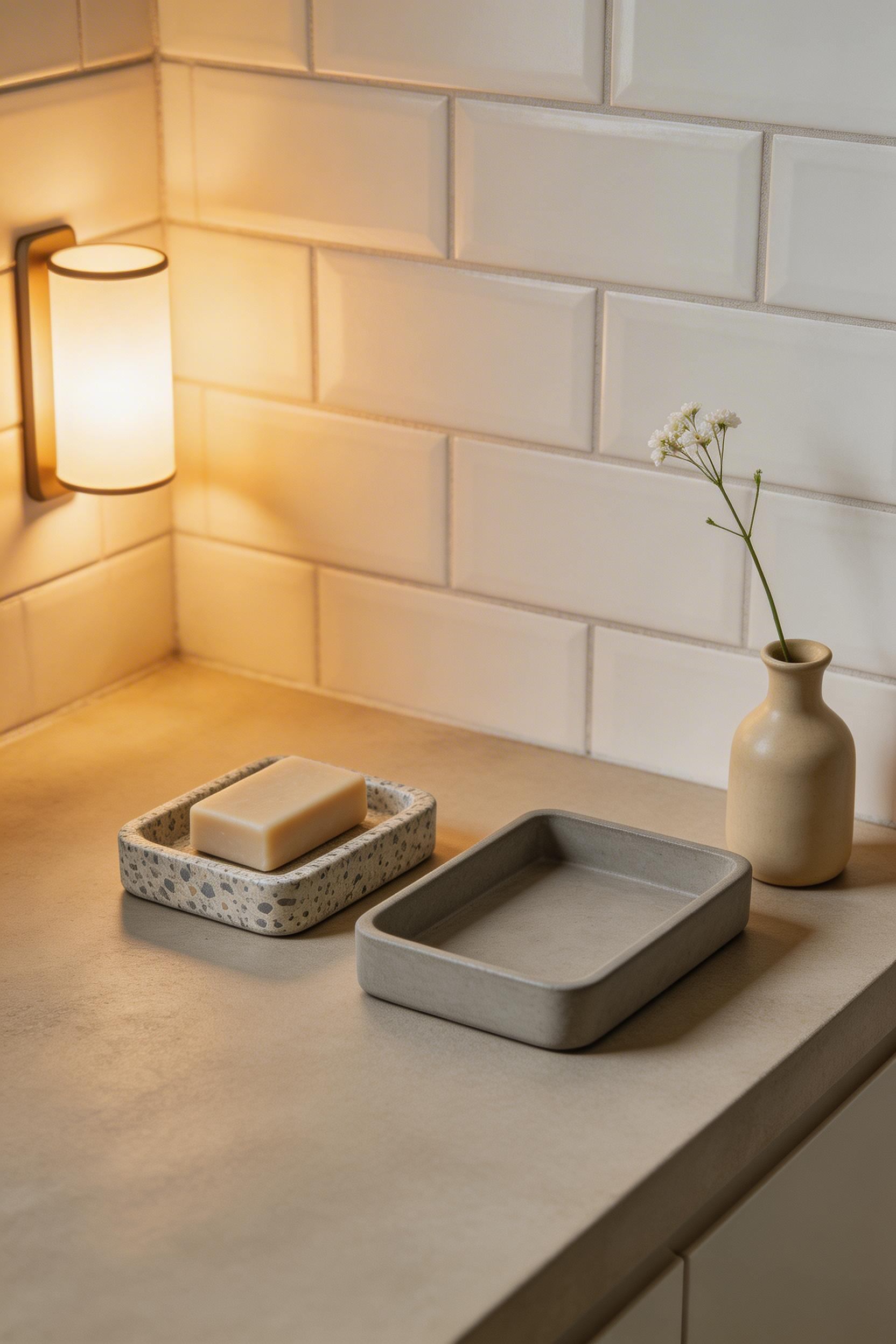
The material works because it’s honest. Concrete and terrazzo are what they look like: dense, weighty, mineral. In a bathroom full of synthetic materials, that honesty has a grounding quality. Sealed concrete and terrazzo are chemically inert once cured — no off-gassing, no artificial coatings to worry about.
DIY or Buy?
Weight is the practical consideration. A concrete soap dish can run 300-500 grams; a catch-all tray can reach a kilogram or more. Choose a matte sealed finish rather than polished — polished concrete shows water marks and requires more frequent wiping.
The DIY option is worth considering. Terrazzo kits from craft suppliers allow you to choose your own aggregate colour; using silicone rectangle moulds, you can produce 2-3 custom trays for $25-40 in materials — a fraction of artisan pricing. If you’d rather buy, artisan options on Etsy run $30-80 per piece. For those who want even more approachable bathroom decor ideas alongside this material route, simple bathroom decor ideas is worth reading alongside this one.
4. Warm Amber Lighting to Replace Cold Overhead Bathroom Fixtures
This is the most research-supported bathroom decor idea on this list and also, often, the cheapest. Replacing a cold white bathroom bulb with a 2700K warm LED costs $12 to $20. The perceptual difference is immediate and significant.
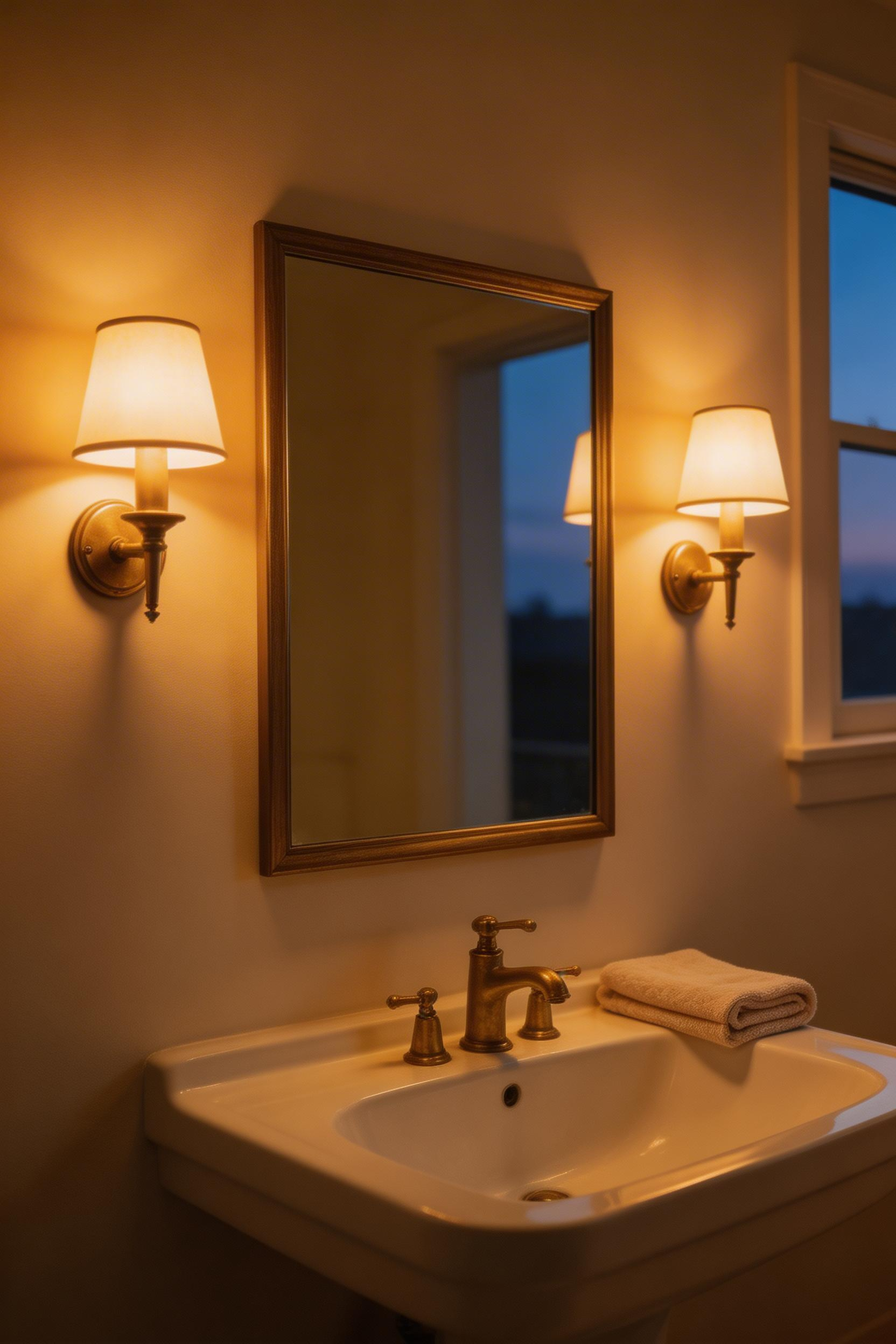
Colour temperature is measured in Kelvin. At 2700K, light is warm and amber — close to candlelight in tone. At 4000K it becomes neutral white, the light of an office. At 5000K and above, it enters cold blue-white territory — the colour of a hospital corridor. Most standard bathroom fixtures come with 4000-5000K bulbs, which is the temperature at which a bathroom most effectively undermines your morning.
Why the Science Matters
Blue-heavy light above 3500K actively suppresses melatonin production. A cold bathroom light encountered first thing in the morning is an environmental disruption to your circadian rhythm. A 2700K equivalent puts your body in a physiologically gentler starting position before the day has even begun.
Practically: swap the existing overhead bulb first (damp-rated LED, 2700K, around 800 lumens for a small bathroom). Then consider a secondary source. LED strip lights running behind a mirror at 2700K add depth and eliminate the harsh shadows that a single overhead light casts on the face. A plug-in cordless wall sconce on either side of a mirror — no electrician needed — is another option. For those who want to go further, the bathroom vanity lighting principles approach is worth building on from there.
5. Biophilic Plants Styled Into the Vanity and Shelving
The case for plants in a bathroom is sometimes overstated. The NASA Clean Air Study showing that plants remove VOCs was conducted in sealed test chambers — in a real room, you’d need somewhere north of a hundred plants to replicate those results. That honest caveat aside, the case for bathroom plants is still strong.
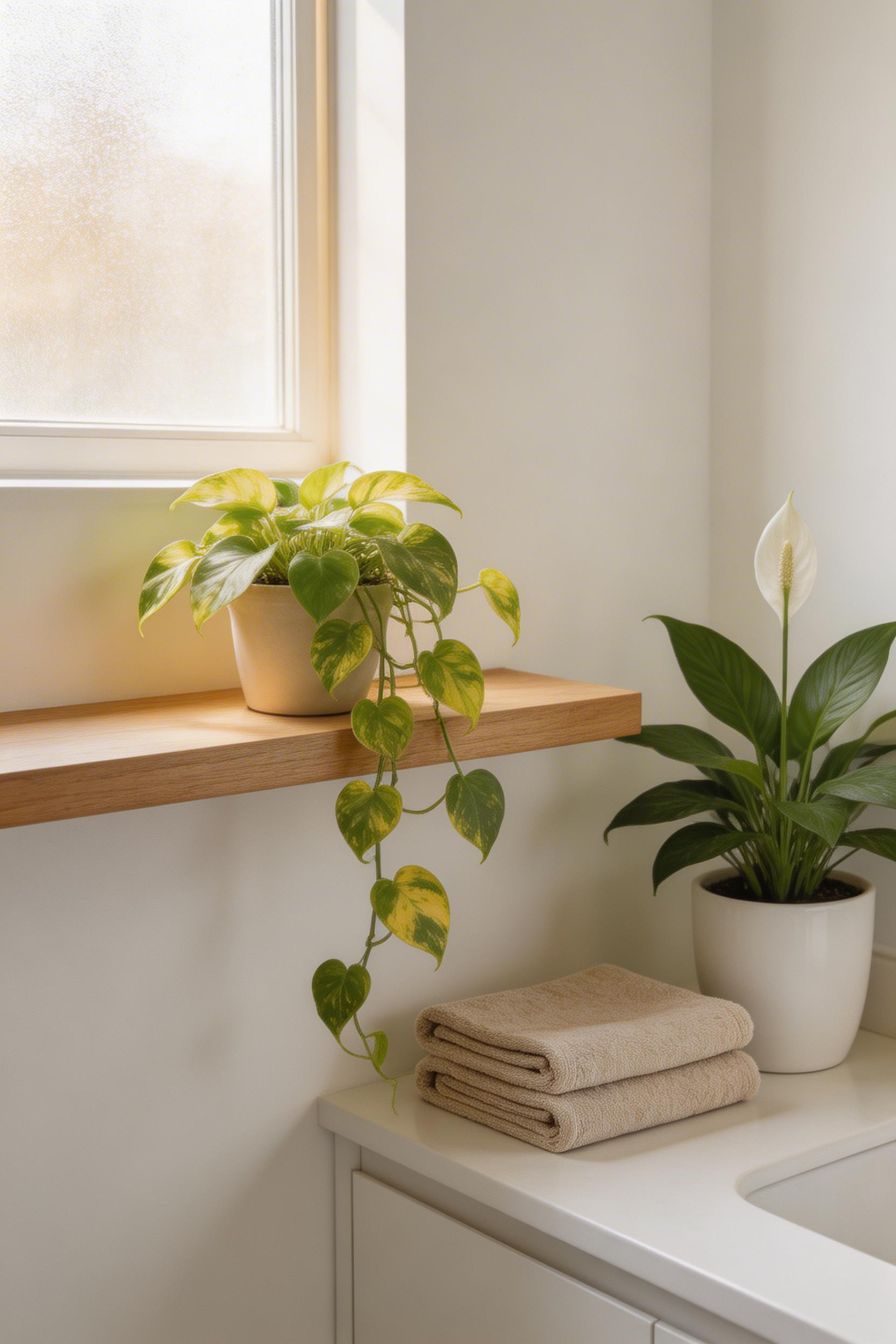
Plants increase relative humidity (useful in dry winter bathrooms), improve mood measurably in small-scale studies, and create the biophilic connection to living things that human neurology responds to — regardless of whether you’re consciously aware of it. One well-chosen plant on a bathroom shelf is worth having, and the species you choose matters.
Which Plants Actually Thrive
For a bathroom with some natural light: Boston fern (Nephrolepis exaltata) genuinely loves humidity above 50% relative humidity and will thrive where other plants struggle. Peace lily (Spathiphyllum) is the choice for near-zero natural light — it’s one of very few plants that prefers those conditions and will bloom in a windowless bathroom. Golden pothos does well on an upper shelf in low light, with trailing vines adding architectural interest. ZZ plant is effectively indestructible in any light condition.
Style them simply. One larger specimen placed with intention is more effective than three small pots crowded together. Choose a planter that sits within the bathroom’s colour story — a matte white or grey ceramic pot in a neutral bathroom, a terracotta in a warm-toned space.
6. Bathroom Decorating Ideas Using Aged Brass and Warm Metals
Chrome dominated bathroom design for thirty years because it was cheap, easy to clean, and went with everything. It also reflects blue-white light, amplifies the clinical feeling of a bathroom, and has no warmth. Aged brass — and its more expensive relative, unlacquered brass — corrects all three of those things. This is one of the most transformative bathroom decorating ideas that doesn’t require any plumbing work.
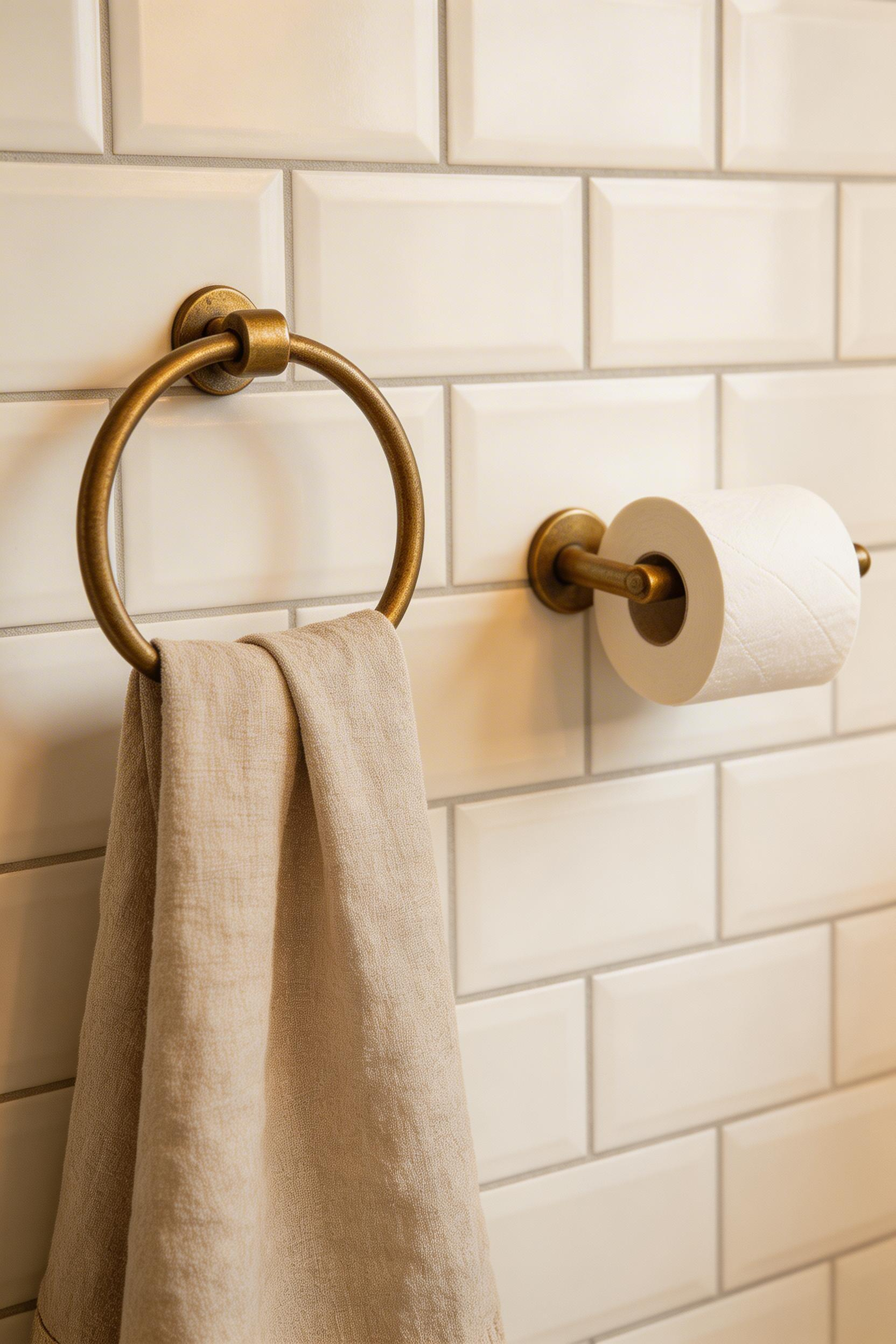
Warm metals reflect amber tones rather than cool ones, making them natural partners for 2700K lighting. A brass towel ring under a warm light source glows in a way that chrome simply cannot. The patina that develops on unlacquered brass in a humid bathroom is not damage — it’s character, and in a space where authentic materials are the point, that character is precisely what you’re after.
How to Introduce Brass Without Replacing Your Faucet
Start with the lowest-stakes elements: a towel ring, a toilet paper holder, a door hook. These are screw-mount pieces that take fifteen minutes each and cost $20-80 in aged brass finishes. Cabinet hardware — pulls and knobs on a vanity — are the next step. A set of four aged brass drawer pulls runs $30-120 and transforms a standard vanity into something that looks designed. For those looking at bathroom light fixtures that complement warm metals, warm metal sconces with aged brass finishes create a coherent look that chrome alongside warm accessories cannot.
The metal mixing rule: choose one warm metal as the dominant (aged brass) and one neutral as the secondary (matte black or brushed nickel). Three metal finishes in one bathroom is too many. Chrome and aged brass together is a combination to avoid — the cooler chrome clashes with warm brass rather than complementing it.
7. Steam-Resistant Matte Paint in Calming Earthy Palettes
Matte paint and bathrooms had a long, troubled relationship because most flat paints couldn’t handle humidity. The paint would bubble at the ceiling line, peel behind the toilet, and generally make clear it was the wrong tool for the job. That problem is solved, and the solution opens up a genuinely different kind of bathroom atmosphere.
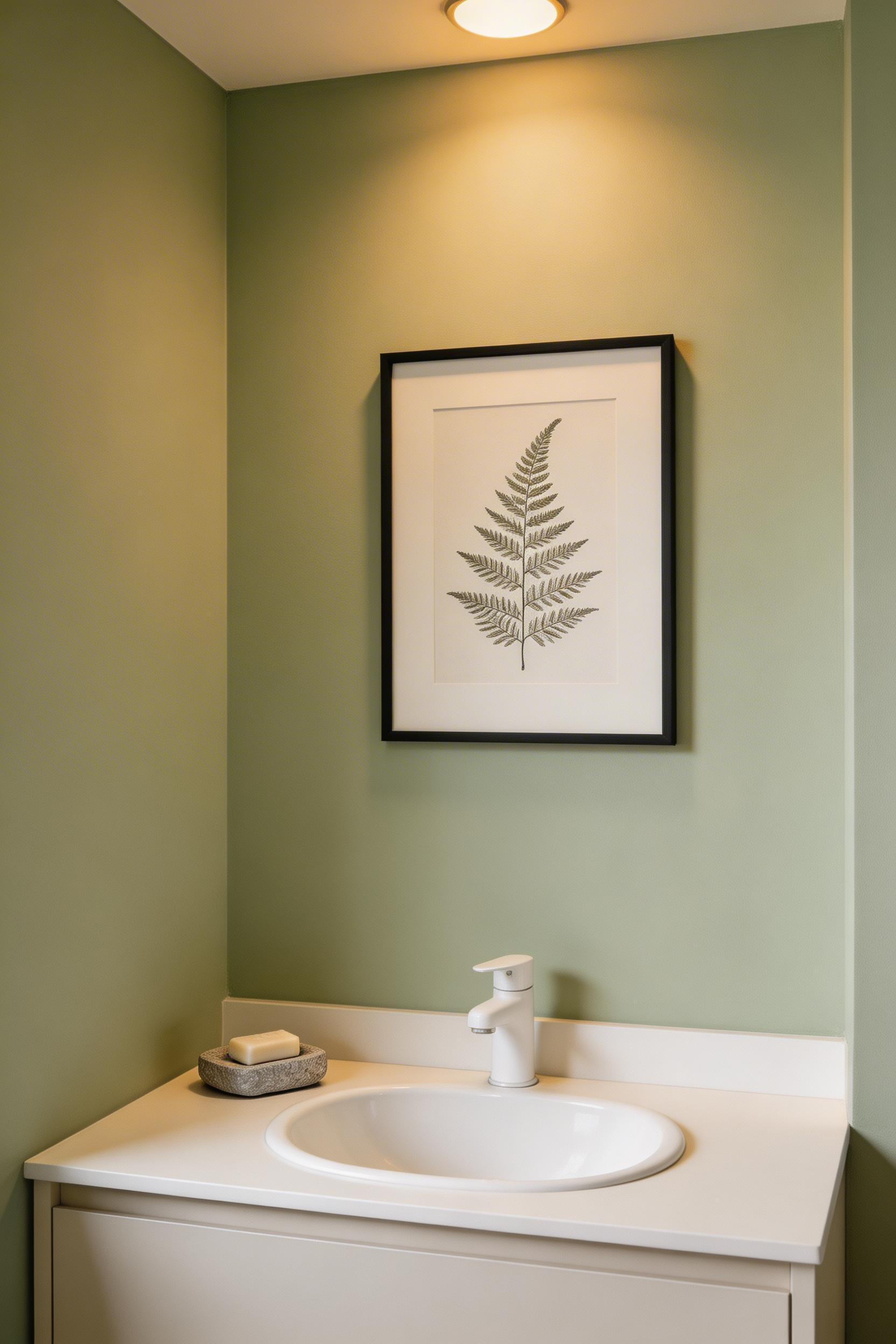
Benjamin Moore Aura Bath & Spa is the benchmark: zero VOC, specifically formulated for high-humidity environments, mildew resistant, and available in any Benjamin Moore colour. At approximately $88-92 per gallon it is not cheap, but it’s the paint that delivers on what it promises. Sherwin-Williams Emerald Interior in matte has similar properties at a slightly lower price point. Farrow & Ball Modern Emulsion is not specifically a bathroom paint but performs well with adequate ventilation, and its pigment depth in colours like Elephants Breath and Mole’s Breath is in a different category from standard off-the-shelf options.
Choosing Colours for a Wellness Bathroom
Light Reflectance Value matters in a small, often artificially lit room. Colours in the 30-55 LRV range — medium depth — hold their character under warm artificial light without going too dark. Benjamin Moore Pale Oak (OC-20), Collingwood (OC-28), and Balboa Mist (OC-27) are proven performers in the greige and warm taupe family.
For the wellness dimension: green and blue-green tones are the most researched for active stress reduction. Sage green and dusty eucalyptus consistently outperform neutrals in studies measuring perceived calmness in small rooms. If you want the bathroom to actively lower your heart rate, paint it a muted sage rather than a warm beige. Avoid saturated red, orange, or high-chroma yellow — these are activating colours that work against the calming atmosphere you’re building.
8. Woven Baskets and Rattan Storage That Look Like Decor
The difference between bathroom storage that functions and storage that also decorates comes down almost entirely to material. A plastic bin under the sink holds as many towels as a seagrass basket. The seagrass basket changes the room.
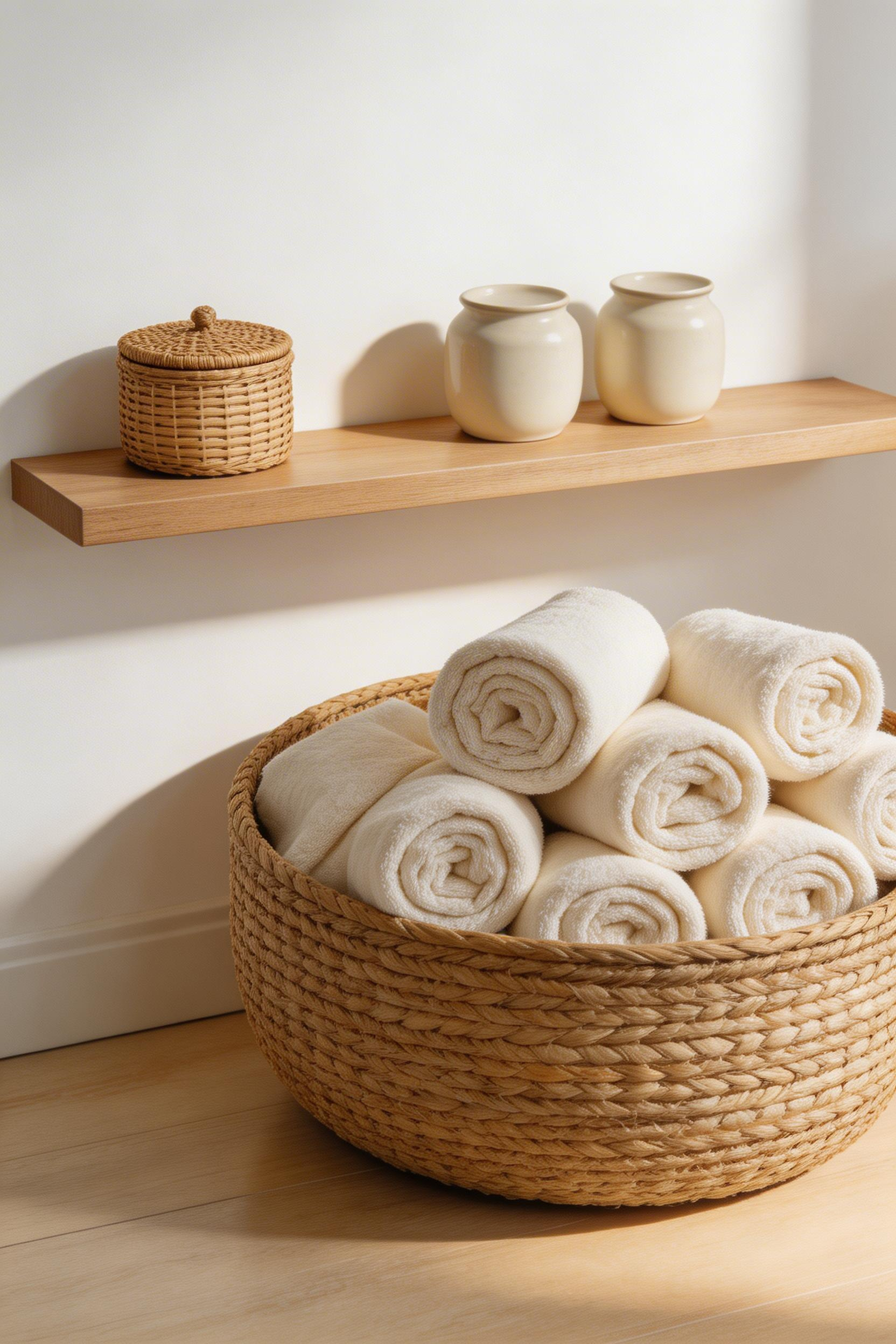
Natural fibre baskets — seagrass, rattan, water hyacinth — do need some thought in a humid bathroom. Seagrass absorbs moisture if placed in direct steam or used to store wet towels; musty odours develop quickly in that scenario. The solution is simple: store only dry items in open natural fibre baskets, use the exhaust fan consistently, and avoid placing baskets directly in the path of shower steam. Water hyacinth has a tighter weave and slightly better moisture resistance than loose seagrass; rattan, especially when lacquered or sealed, handles humidity well.
What Goes Where
For rolled bath towels, a floor basket with a minimum 30cm diameter and 25cm height holds four to six rolled hand towels without compression. Open weave is better than dense — air circulates around the towels and they don’t develop a closed, stored smell. Open baskets: rolled towels, toilet paper — items benefiting from visibility and quick access. Lidded containers: cotton pads, medications, cleaning supplies — things that are functional but not decorative. For more organised bathroom vanity ideas, combining baskets with drawer organisation addresses both the visible and the hidden surfaces.
9. Bathroom Decor for Small Spaces: Japandi-Style Floating Shelves
Japandi — the design fusion of Japanese wabi-sabi minimalism and Scandinavian functional warmth — is the most useful design framework for a small bathroom because its core principles solve the small-space problem directly. Negative space is part of the design. Natural materials express quality. Editing down to what is genuinely needed eliminates the visual noise that makes small rooms feel cramped. As a bathroom decor idea for small spaces, it works better than almost anything else because the aesthetic is fundamentally about doing more with less.
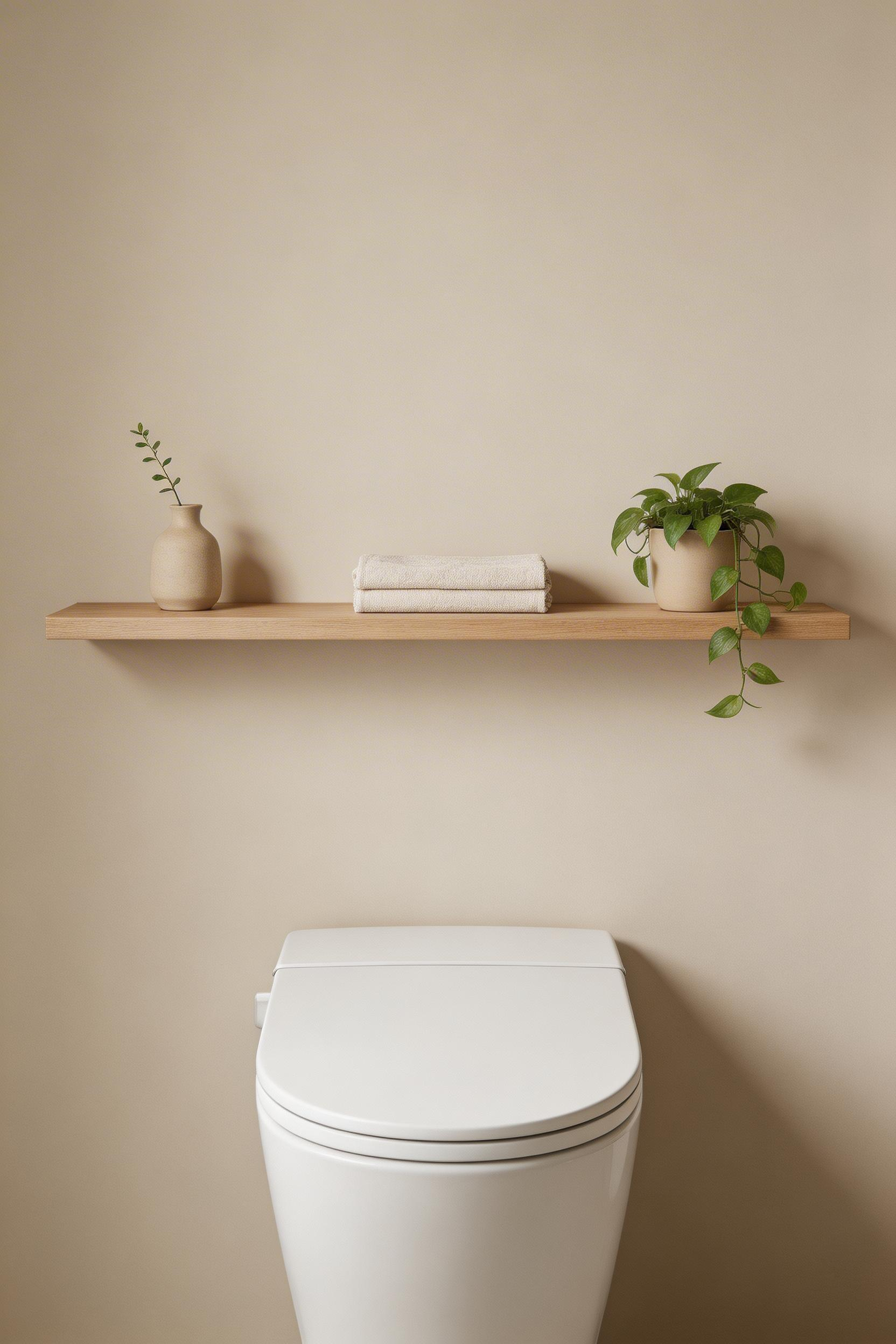
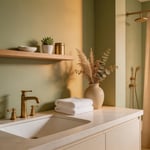
A floating shelf in light oak or bamboo, installed above the toilet or beside the vanity, is the signature Japandi bathroom move. The material brings warmth without visual weight; the floating format lifts the floor visually; the styling — three to five objects maximum, leaving 30-40% of the shelf surface empty — creates calm rather than clutter.
The Edit Principle
What goes on the shelf: a handmade ceramic bud vase, a small plant in a matte pot, a folded linen hand towel, a stone tray. Four items, which is about right. What does not go on the shelf: the electric toothbrush, the medication, the charging cable, the collection of half-used travel products. These belong in a cabinet. The edit is the hard part — and it’s also the part that separates a bathroom that looks like a spa from one that looks like a shelf in a chemist.
10. Handmade Ceramic Soap Dishes and Coordinating Vanity Trays
There is a tactile quality to a well-made ceramic piece that mass-produced resin simply cannot replicate. The slight irregularity in a hand-thrown bowl, the texture of a matte glaze under your fingertips, the weight of stoneware versus the lightness of plastic — these are small sensory differences that accumulate into a felt experience of quality. As bathroom decor ideas go, this one operates through touch as much as sight.
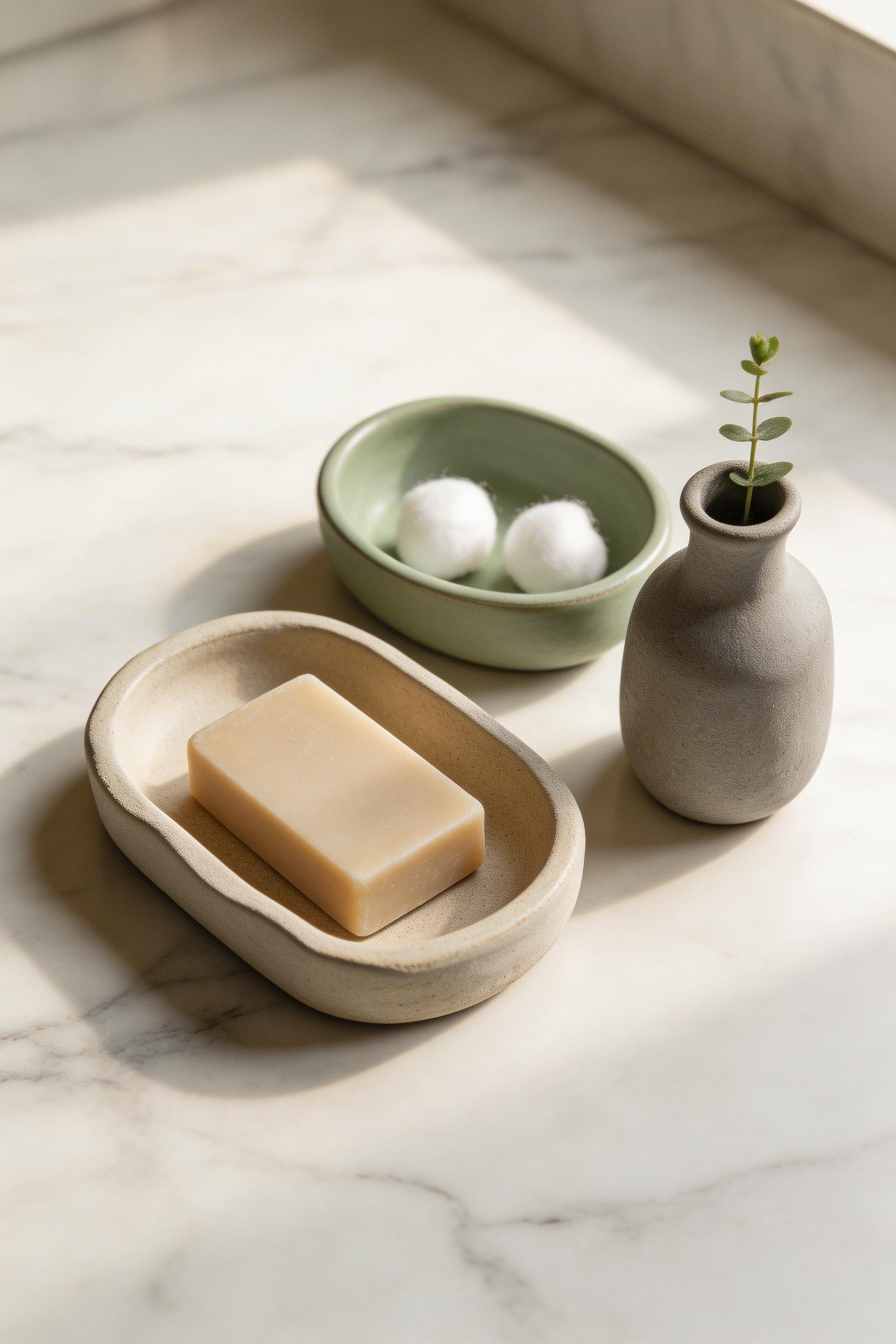
Stoneware and porcelain fired above 1200°C are non-porous materials. The glazes used by contemporary studio potters at these firing temperatures are lead-free and food-safe — the concern about toxic glazes belongs to low-fired earthenware, not to carefully made pieces from established Etsy sellers and studio pottery brands. A self-draining soap dish — raised ridges, a slight tilt, or a small drainage spout — extends soap life and keeps the surface below dry.
Building a Collection Without Buying a Set
A matching set from a mass-produced range is the least interesting approach and reads as corporate rather than personal. Instead, choose pieces in the same glaze family: if one piece has a matte oatmeal glaze, the next can have a matte sage green and the third a matte stone grey. The shared surface quality (matte) and tonal family (earthy neutrals) create cohesion across pieces from completely different makers.
For sourcing: Etsy is the best starting point at the entry to mid-level ($15-60 per piece); filter for stoneware, ratings above 4.8, and a self-draining design for the soap dish. East Fork Pottery’s Everyday range in Graphite or Eggshell is a reliable mid-investment choice ($45-90). Hasami Porcelain (Japan) makes minimalist slip-cast pieces that are exactly right for a Japandi-styled bathroom.
11. A Steam-Safe Gallery Wall of Art Prints and Botanical Prints
A bathroom gallery wall is achievable in a room that gets regular steam exposure — but the material choices are non-negotiable. Paper prints in wooden frames will buckle and swell within months. The right formats are metal prints (dye-sublimated onto aluminium — the image is part of the metal, cannot peel), acrylic prints (image encased in non-porous acrylic), and canvas prints with UV coating hung with a gap behind to allow airflow.
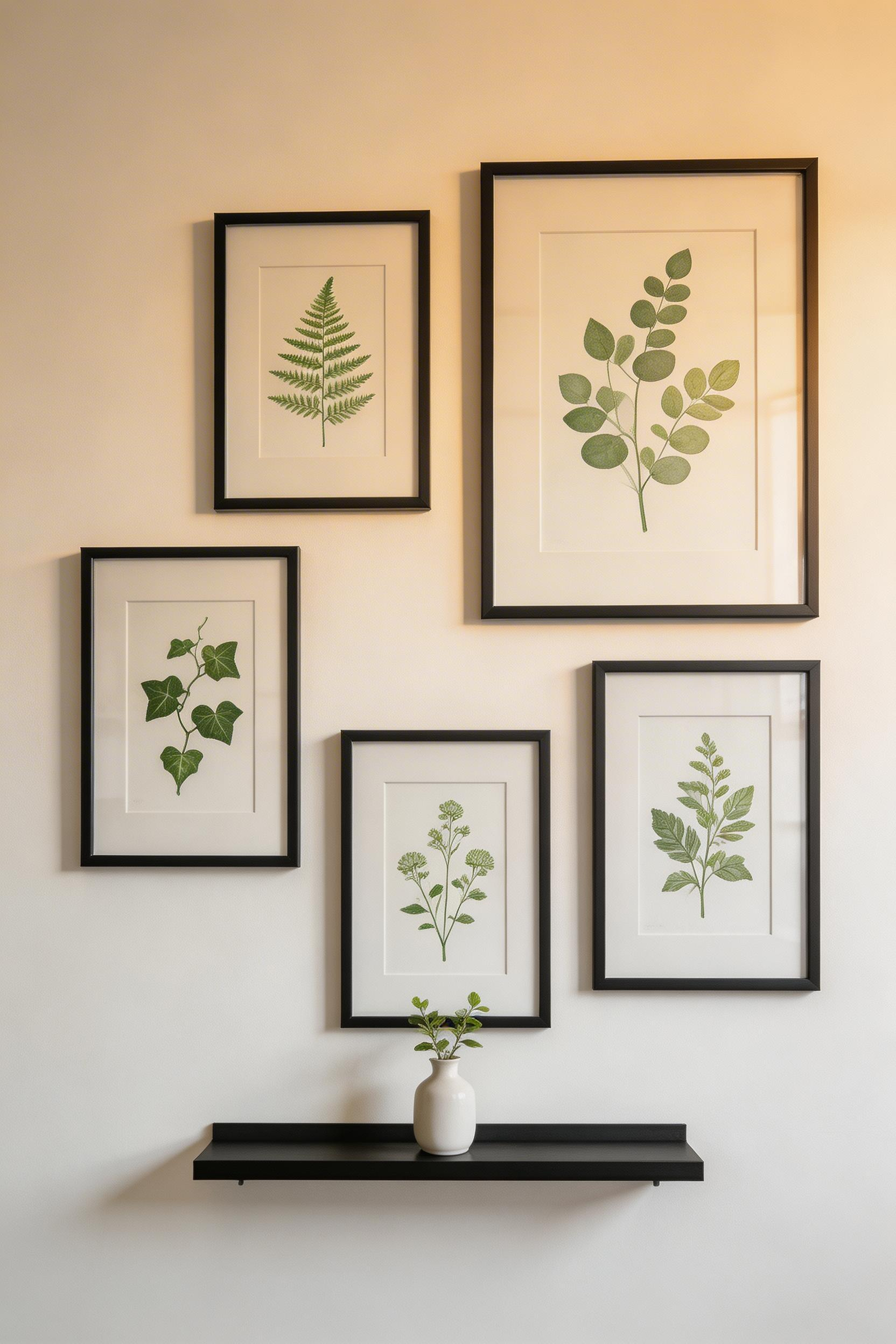
For framed prints, acrylic glazing outperforms glass in a bathroom on every dimension: it’s lighter, it doesn’t shatter, and it’s more moisture-resistant. Metal frames or high-quality resin frames handle humidity better than wood. If you prefer the look of a wood frame, choose one with a sealer or lacquer finish and avoid placing it directly in the steam path above a shower or bath.
Planning Without 20 Mistakes
Arrange the frames on the floor until the layout feels right, photograph it, then cut paper templates in each size and tape them to the wall. This approach lets you adjust spacing (2-3 inches between frames works well at bathroom scale) without committing to nail holes. For those working with a small bathroom, wall decor tricks for small bathrooms has specific guidance on making the most of limited wall space.
Botanical prints are the most natural fit for a wellness-designed bathroom — botanical illustrations, pressed flower studies, watercolour leaf prints. They extend the biophilic theme in a way that is visually calm without being literal. Society6, Desenio, and Juniper Print Shop all offer digital download options so you can size to fit your exact frames. One oversized abstract in watery blues or warm ochres also works well as an anchor piece with smaller botanicals arranged around it. These art-based bathroom decor ideas cost as little as $8 for a digital download and custom-size print.
12. Bathroom Decor Ideas in Cotton and Linen for Sensory Softness
Skin contact is the differentiating factor between bathroom textiles and every other kind of decor. A beautiful rug can be appreciated visually from across a room. A towel that scratches is felt immediately, every time. The quality of your bathroom textiles is the most physically experienced element of the space — and the most frequently overlooked in bathroom decor planning. These are bathroom decor ideas that you feel before you see.
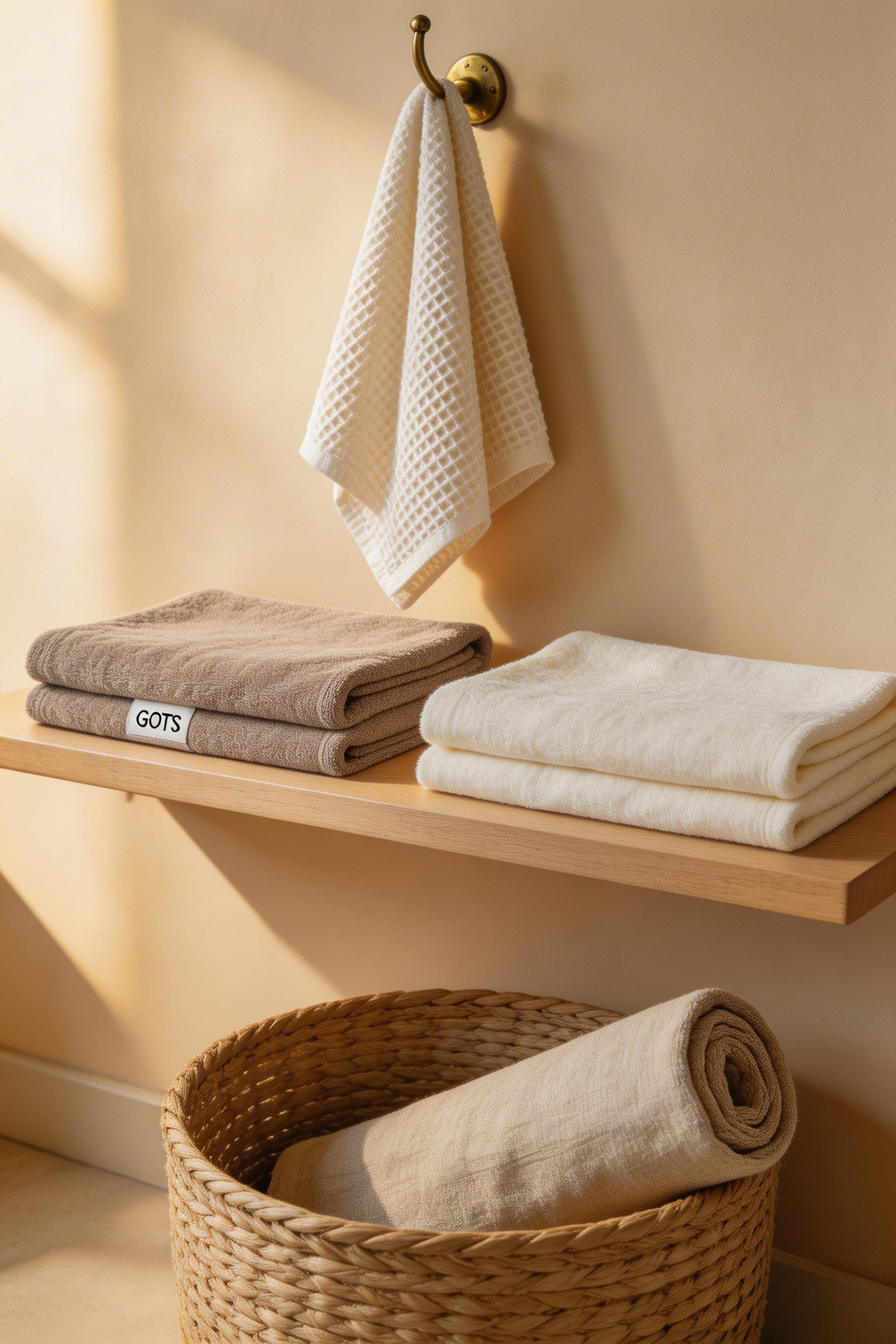
Turkish long-staple cotton is the standard used by the brands that do this right. The longer fibres create a smoother, softer surface than standard short-staple cotton; they also pill less and maintain their absorbency through many washes. Parachute’s 100% GOTS-certified organic Turkish cotton bath towels at 450 GSM are a reliable daily-use option at $25-40 per towel. Coyuchi’s Temescal collection at 600 GSM is the plush end of their range — genuinely spa-weight. Brooklinen now offers a GOTS and OEKO-TEX certified organic collection, including an 820 GSM hotel-style bath towel worth the investment if you’re building toward a longer-term bathroom refresh.
GOTS Certification and Colour Coordination
GOTS certification (Global Organic Textile Standard) means the cotton was grown without synthetic pesticides and processed without harmful chemicals at every stage. Conventional cotton is one of the most pesticide-intensive crops globally; those residues don’t fully wash out. This is a bathroom decor idea that is also a health decision.
Colour is the easiest place to express personality within a calm palette. Undyed natural, stone, and warm white work with any bathroom. Dusty sage, soft clay, and muted denim blue all sit within a spa palette without demanding attention. The GSM guide: 300-400 for quick-drying lightweight towels; 400-600 for the everyday sweet spot; 600+ for the luxury experience that needs good drying conditions to work.
13. Dried Botanicals as Natural Low-Maintenance Statement Decor
Dried botanicals solve a real problem: the desire for the warmth and life of plants in a bathroom where fresh flowers won’t last a week and high-maintenance living plants require more than the space can offer. A well-chosen dried arrangement in a tall narrow vase can hold a bathroom’s attention for two to four years.
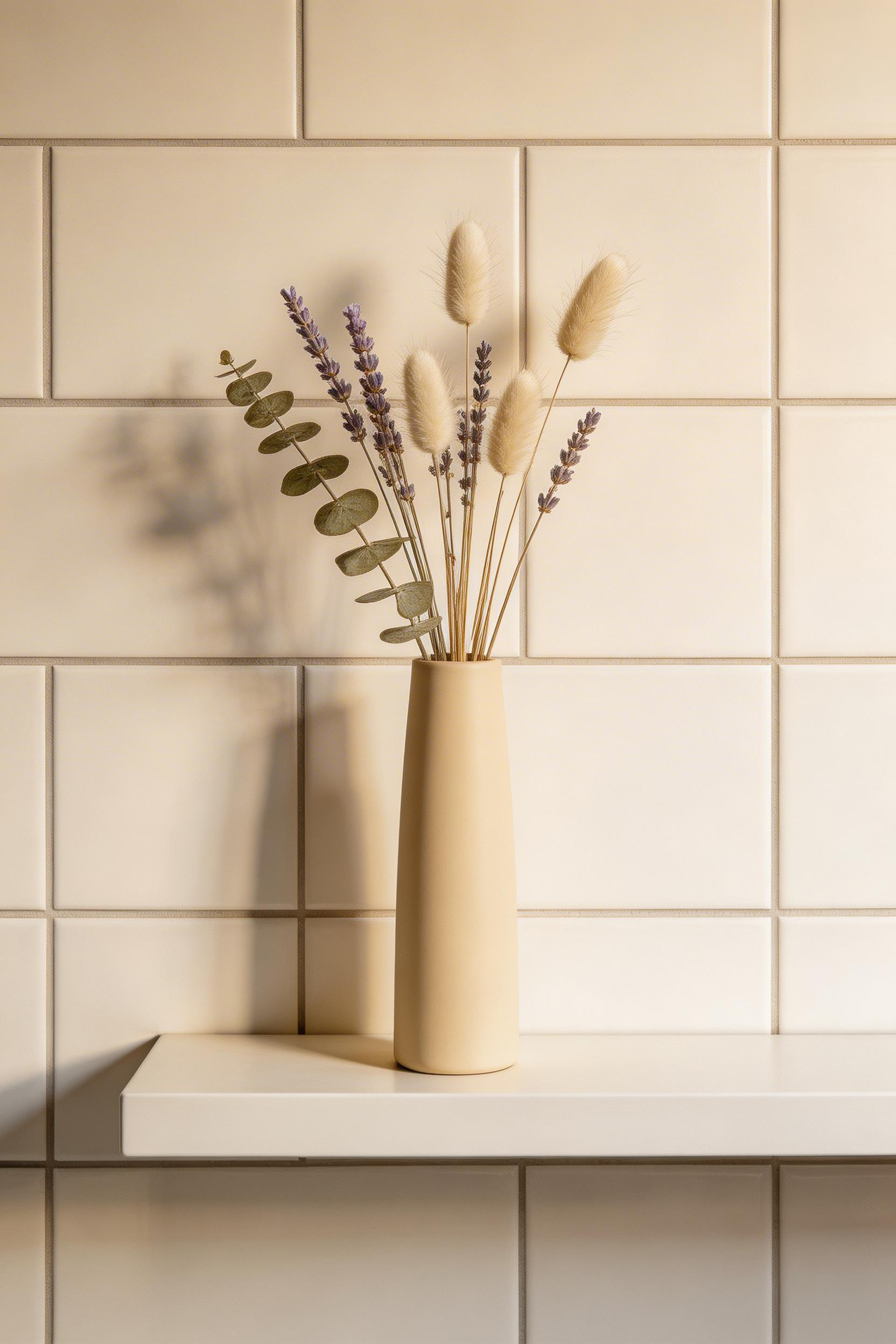
The species choice matters more in a bathroom than anywhere else because humidity is an active concern. Pampas grass is the most popular dried botanical of recent years, but in a bathroom it’s a maintenance challenge — the fronds absorb moisture, become limp in consistent steam, and shed feathery fibres onto dark surfaces and into grout lines. If you love the look, lightly hairspray the fronds to reduce shedding and position the arrangement away from the direct steam path.
Better Bathroom Botanical Choices
Bunny tails (Lagurus ovatus) are the smarter bathroom choice: compact, almost non-shedding, available in natural cream or soft dyed tones, and they hold their structure well in moderate humidity. Dried lavender is another strong option — the visual softness works in warm-toned bathrooms, and the dried scent is gentle rather than overpowering. Eucalyptus retains a mild fragrance for several months and pairs naturally with any earthy bathroom palette.
For arranging: use a tall, narrow-necked vase that holds the stems upright without effort. The arrangement should rise to approximately 1.5 times the height of the vase for natural visual balance. Mix textures within one vessel — three to five bunny tails, a few lavender stems, a dried seed pod or two — and allow some stems to angle at different directions. Perfectly upright looks artificial; slightly loose and varied looks foraged and alive. Afloral.com has the widest specialist range in the US; local florists can often source stems to order.
14. A Floating Vanity Shelf Vignette Styled With Intention
The difference between a bathroom shelf that looks like a flat surface where things land and one that looks designed comes down to three elements: height variation, odd numbers, and editorial discipline about what actually belongs there.
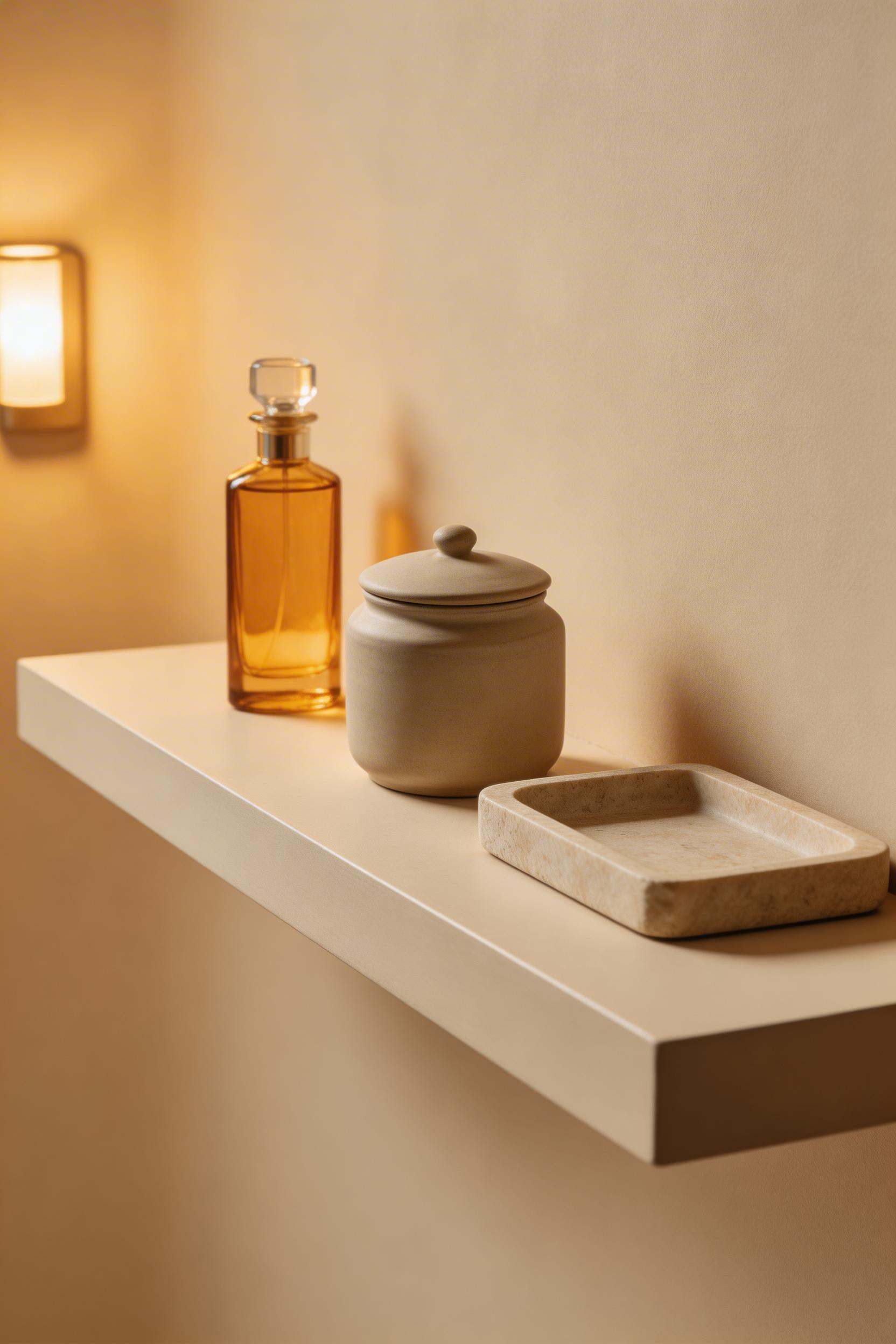
The three-tier principle: one tall element (a candle in a tall holder, a glass perfume bottle, a single dried stem in a bud vase), one mid-height element (a handmade ceramic dish, a small plant, a decorative jar), and one low element (a stone tray, a soap dish, a small book laid flat). These three tiers create rhythm and visual movement that a flat collection of similarly-sized objects cannot. Three objects, or five — never four or six.
What Belongs Here and What Doesn’t
Texture contrast within the vignette: smooth ceramic glaze against rough natural stone, the shine of glass against the matte of linen. Colour restraint: two or three tones, all from the same earthy family.
The editorial discipline is the hardest part. The question for each object is not “does it fit?” but “does it genuinely belong here, or does it live here because I haven’t found somewhere else for it?” An electric toothbrush on a styled shelf immediately undermines the effect — not because it’s ugly but because its presence signals that the styling was incidental rather than intentional. Move it to a drawer and suddenly the shelf has space to breathe. That negative space between objects is not a sign that you need more things. It’s the element that makes everything else visible.
Display on the vanity: quality hand soap in a ceramic or glass dispenser, a favourite scent, a candle in a matte holder, one small plant. Store in a cabinet: everything else.
15. The Statement Mirror That Anchors All Your Bathroom Decor
A statement mirror is unique among bathroom decor elements because it is simultaneously functional, architectural, and decorative. It reflects light — doubling the apparent brightness and warmth of any lighting scheme. It creates depth in a small room by implying space beyond the wall. And its shape and frame carry the room’s personality in a way that nothing else at this scale can. In terms of bathroom decor ideas with high visual return, a well-chosen mirror may be the single most impactful one on this list.
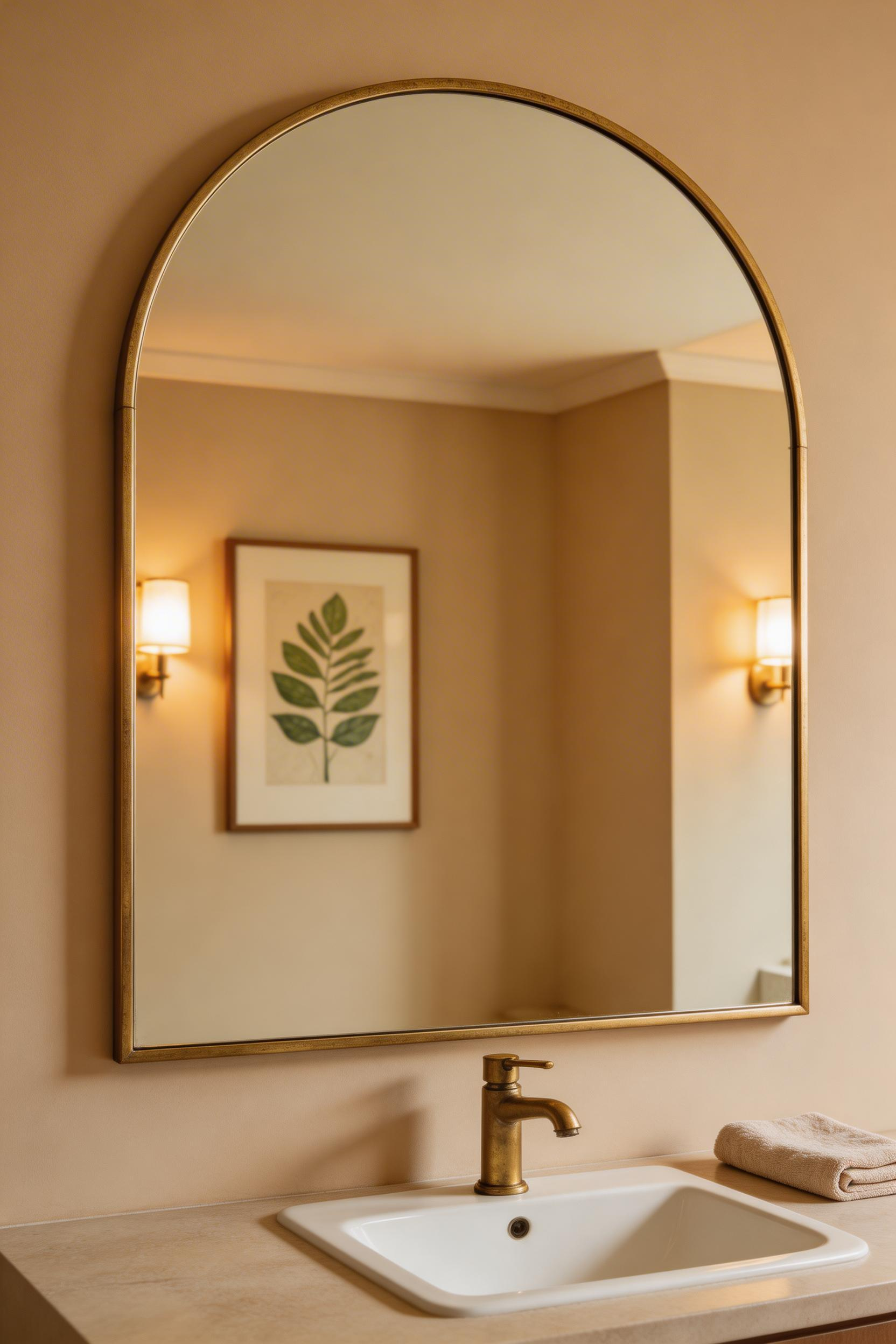
The sizing rule is reliable: mirror width should be 70-80% of the vanity width. For a 36-inch vanity, that means a mirror between 25 and 29 inches wide. This proportion leaves a frame of wall on each side that prevents the mirror from overwhelming the space. Installation height: hang so the bottom sits 5-10 inches above the top of the faucet, and the mirror’s centre is at approximately 57-65 inches from the floor — average eye level for a standing adult.
Choosing the Right Shape
An arch mirror softens a bathroom with lots of straight edges and tile grids — it’s the most universally flattering shape for modern bathroom design and works in rooms of any size. A sunburst or starburst frame works best when the rest of the bathroom is minimal; the mirror is the decorative moment and shouldn’t compete with busy tile or multiple accessories. An oversized rectangular mirror running the full width of a double vanity is the most space-expanding option — in a narrow master bathroom, a mirror at this scale can transform the perceived dimensions of the room.
Hanging a Heavy Mirror Safely
A large decorative mirror can run 15-25 kilograms. Bathroom humidity affects drywall strength over time, making a French cleat system (interlocking bevelled boards, one to the wall, one to the mirror) the most reliable hanging method for heavy pieces. It distributes weight across more wall surface and allows easy repositioning without new holes. For specific mirror shapes and styles to consider, bathroom mirror ideas for every style covers the full range from minimal to statement. Anthropologie, CB2, and West Elm carry reliably well-reviewed arch and statement mirrors; Etsy is worth exploring for handmade rattan and reclaimed wood frames that carry exactly the kind of handcrafted authenticity a wellness-designed bathroom calls for.
Choosing the Bathroom Decor Ideas That Work for Your Space
The most common question at the end of a list like this is where to start — and the honest answer is that it depends almost entirely on what you feel most acutely in your current bathroom.
If the lighting is harsh and clinical, start there. A 2700K LED bulb and a secondary warm light source costs less than $50 and changes the room immediately. If the bathroom feels chaotic, start with an edit — removing what doesn’t belong before adding anything new. If the textiles are scratchy or worn, replace the towels. The body registers textile quality before anything visual.
As a practical sequence for these bathroom decor ideas: lighting and textiles first (reversible, high sensory impact, accessible budget), then accessories — ceramics, stone pieces, a basket or two (medium investment, cumulative effect), then mirror and wall art if the budget allows (larger purchases that benefit from knowing the palette you’re building first), and paint last if you’re going to do it at all, because paint is the commitment that makes everything else read differently.
The wellness principle that guides this sequence: start with what your body touches and what your eyes see first. The light quality when you walk in is the first impression, every morning. The towel you reach for when you step out of the shower is a sensory experience, every day. Both are addressable for under a hundred dollars. The statement mirror and the painted walls come later — they reward patience and a clear sense of the palette you’re building toward.
A bathroom that feels like a retreat is not an expensive room. It’s a deliberate one.