Introduction: The Cocoon Paradox
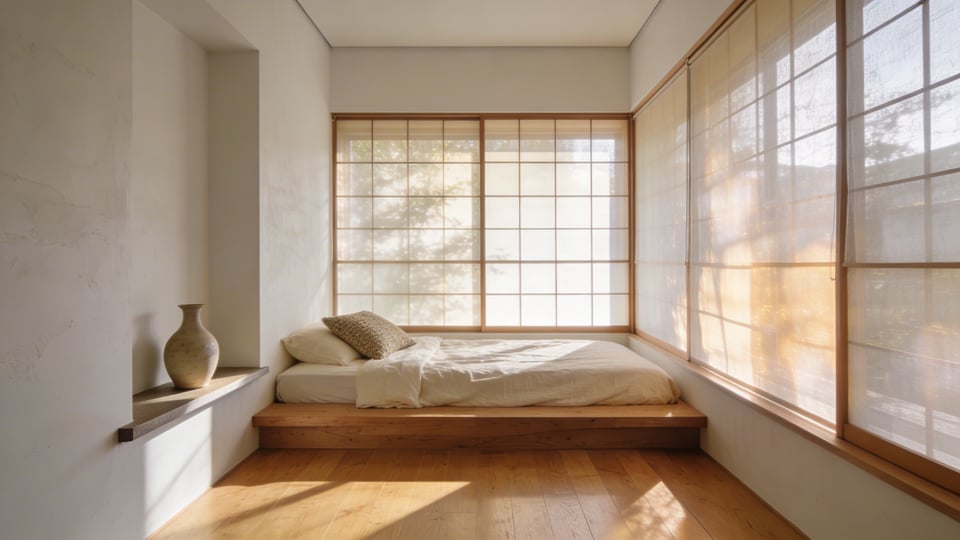
The “Cocoon Paradox” reveals a fascinating tension within small bedroom design. For the homeowner seeking sophisticated bedroom decor for small rooms, this concept balances our primal need for protection with a modern fear of confinement. Historically, this concept appears in focused environments like monastic cells or the Japanese *Chashitsu*. In these spaces, physical restriction intentionally fostered mental expansion and bespoke aesthetics. Smallness becomes a tool for spiritual quietude rather than a simple limitation.
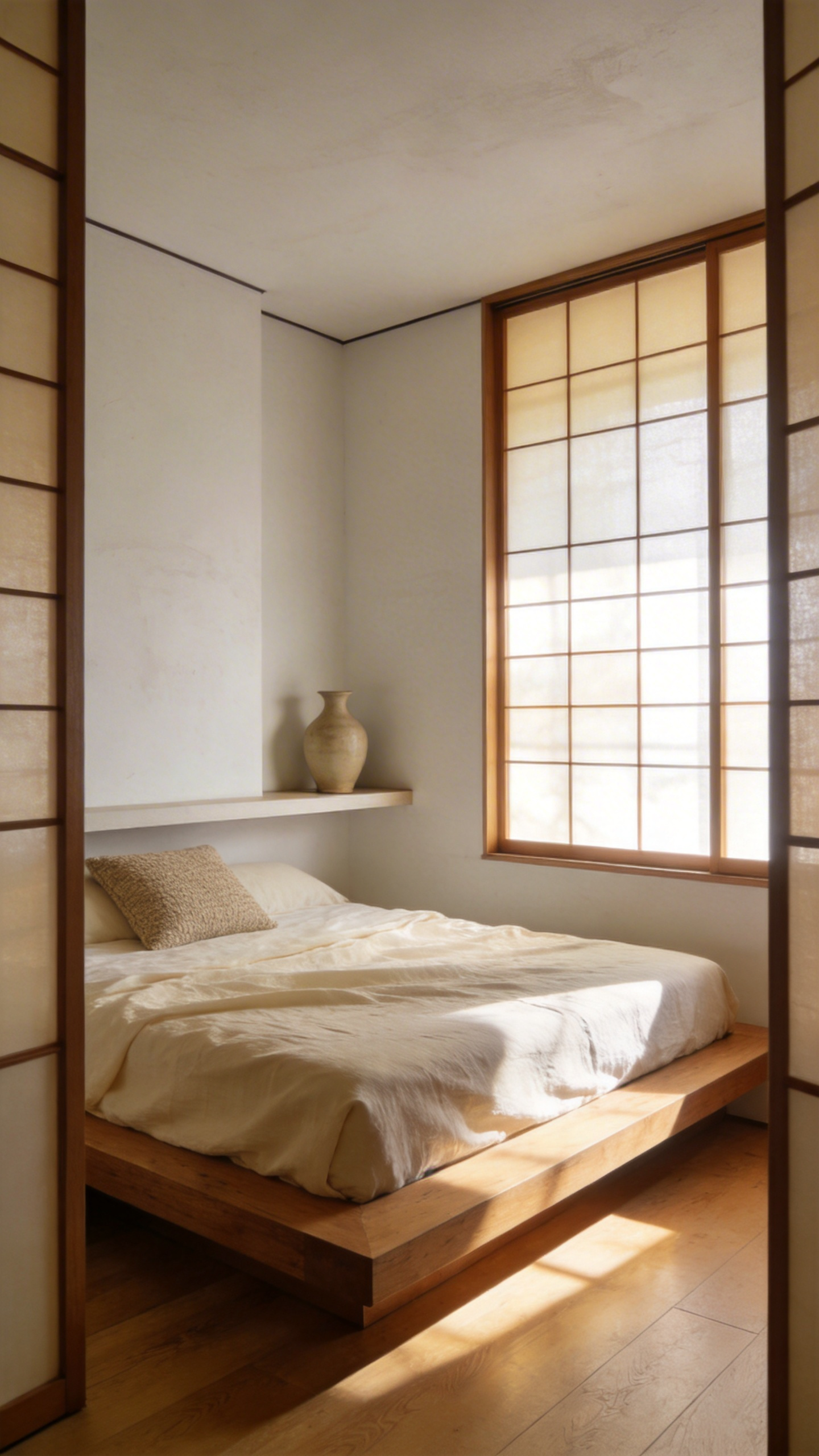
From a neuro-architectural perspective, this phenomenon involves the “peripersonal bubble.” This safety zone extends roughly 15 inches from the body. When a room aligns with this bubble, it creates a “hugging” sensation. This naturally lowers cortisol levels. Conversely, sharp angles or visual noise can trigger the brain’s threat detection loop. Indeed, introducing curved lines and soft textures is essential to prevent claustrophobia.
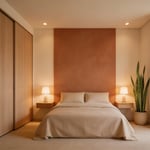
Designers often utilize “color drenching” to master this effect. By painting walls and ceilings the same mid-to-dark tone, you remove visual boundaries. Incorporating tricks to maximize style in small bedrooms like this ensures the eye cannot discern where the room ends. The space feels infinite. Additionally, low-level, warm lighting mimics the safety of an ancestral campfire. These elements transform a potentially cramped cage into a restorative sanctuary.
Myth: Small bedrooms are claustrophobic limitations that must be visually forced open with stark white walls.
For decades, standard advice for small bedrooms has been rigid. Homeowners are told to paint everything stark white to avoid claustrophobia. This mandate stems from the Modernist movement’s obsession with hygiene and neutrality. Later, reality television reinforced white walls as a “safe” choice for resale value. However, this rule is an oversimplification. In rooms with poor natural light, white paint frequently appears gray, muddy, or cheap.
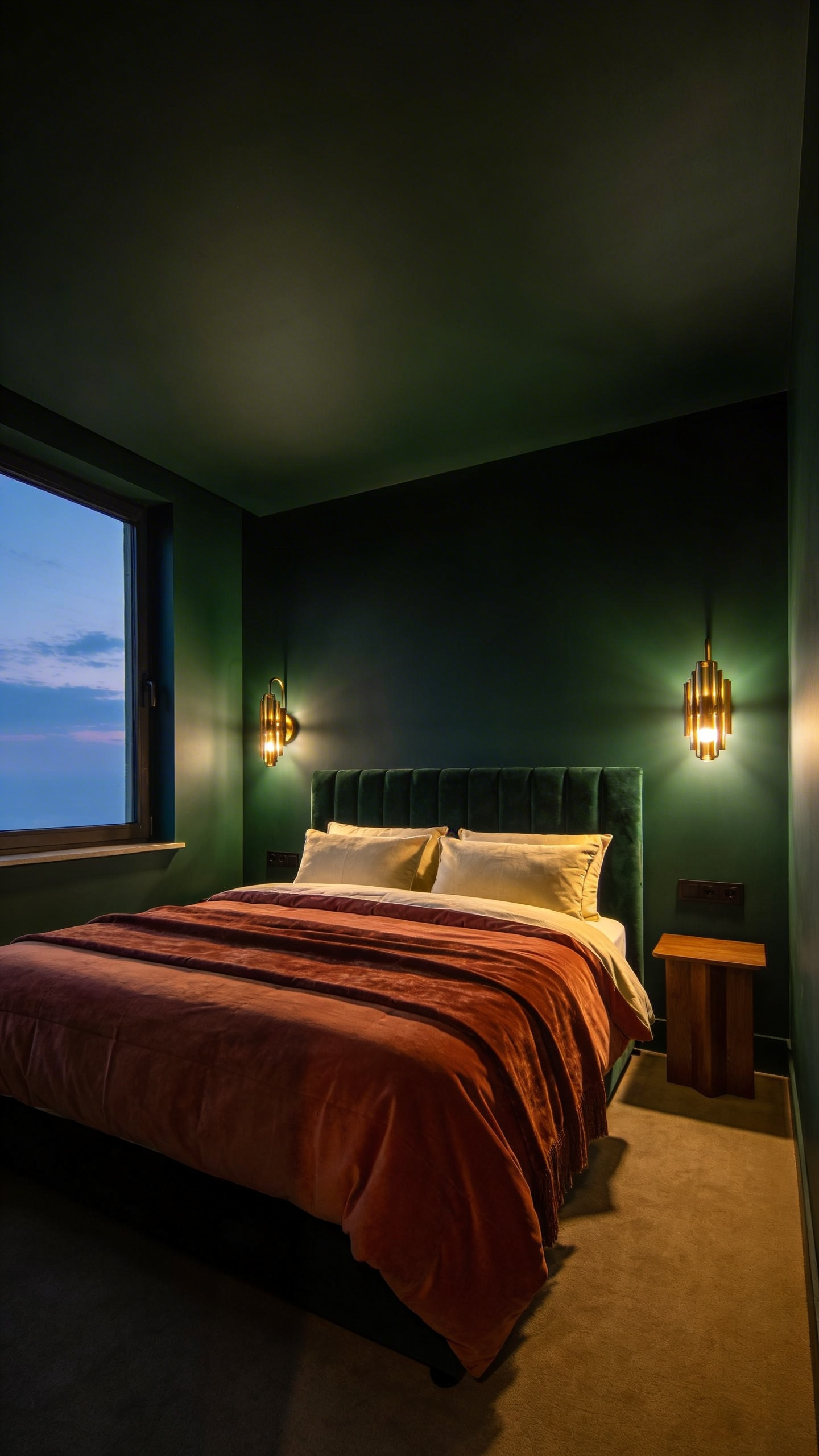
Deep colors can paradoxically make a space feel larger. Designers call this the “Recession Paradox.” Dark, matte walls absorb light and blur the room’s boundaries. Consequently, the eye cannot easily locate corners or edges. This creates a limitless “Jewel Box” effect rather than a cramped box. This technique also supports physical wellbeing. According to the “Prospect-Refuge Theory,” humans find comfort in enclosed, secure spaces.
A dark bedroom acts as a restorative “cocoon.” Unlike a sterile white room that keeps the brain alert, deep tones signal the nervous system to downshift. This promotes melatonin production and restful sleep. However, proper execution is critical. To prevent a gloomy atmosphere, you must utilize specific lighting ideas to brighten your small bedroom to highlight textures. Shadows provide architectural depth, turning a small footprint into a nurturing sanctuary.
The Counter-Intuitive Truth: From an evolutionary wellness perspective, smaller spaces offer superior opportunities for ‘containment’—a psychological state necessary for deep restorative sleep.
We often view small bedrooms as design liabilities. However, evolutionary wellness reveals they are actually superior for restorative rest. This benefit relies on a psychological state called “containment.” Biologically, the human brain never truly shuts off. Instead, it maintains a “sentinel response.” It scans the environment for threats. In expansive rooms, this surveillance area is vast, keeping the nervous system alert.
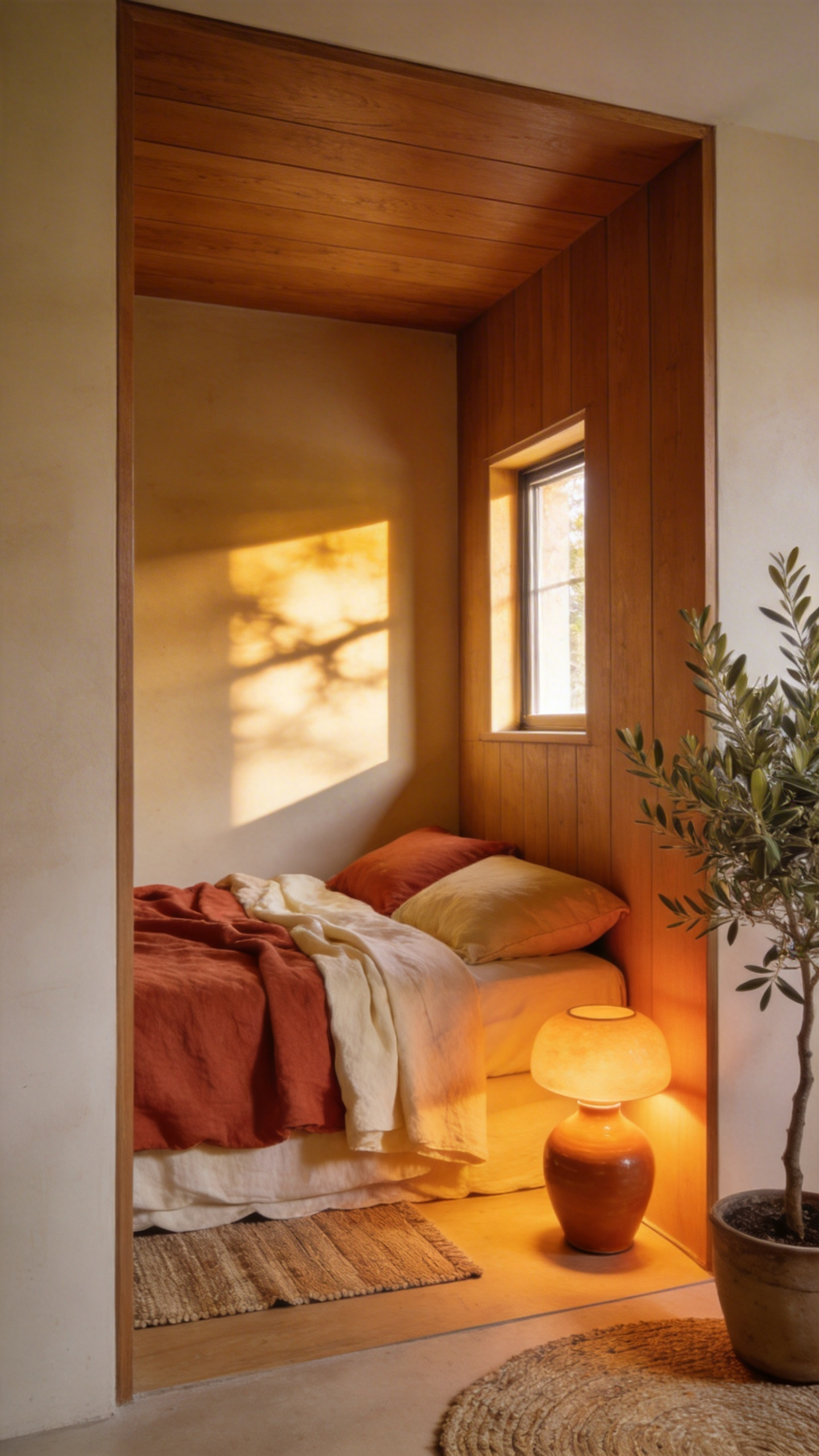
Smaller spaces naturally limit what the brain must patrol. When walls are closer, the brain perceives the space as resolved and safe. This shift allows the body to enter deep, slow-wave sleep faster. Indeed, this instinct is known as “thigmotaxis,” or a preference for enclosed “nooks.” Our ancestors sought caves for protection. Modern biology still demands this security.
We can use decor to enhance this natural “denning” instinct. Darker colors and tactile textures function like a “secondary skin.” These elements signal the amygdala that the environment is a refuge. By dampening sensory input, you stimulate the Vagus nerve. A small bedroom is not cramped. It is a biologically optimized sleep sanctuary.
The Expert Perspective: Leveraging biophilic principles and spatial psychology to transform ‘cramped’ into ’embracing’.
Transforming a small bedroom requires more than simple aesthetic tricks. It demands addressing our primal neurological responses to enclosed spaces. We must leverage the “Prospect-Refuge” theory. Humans crave environments where they can see without being seen. However, small rooms often block clear sightlines. This triggers a subconscious state of high vigilance. To counter this, anchor your headboard against a solid wall while facing the entry. The room shifts from a perceived “trap” to a protective haven.
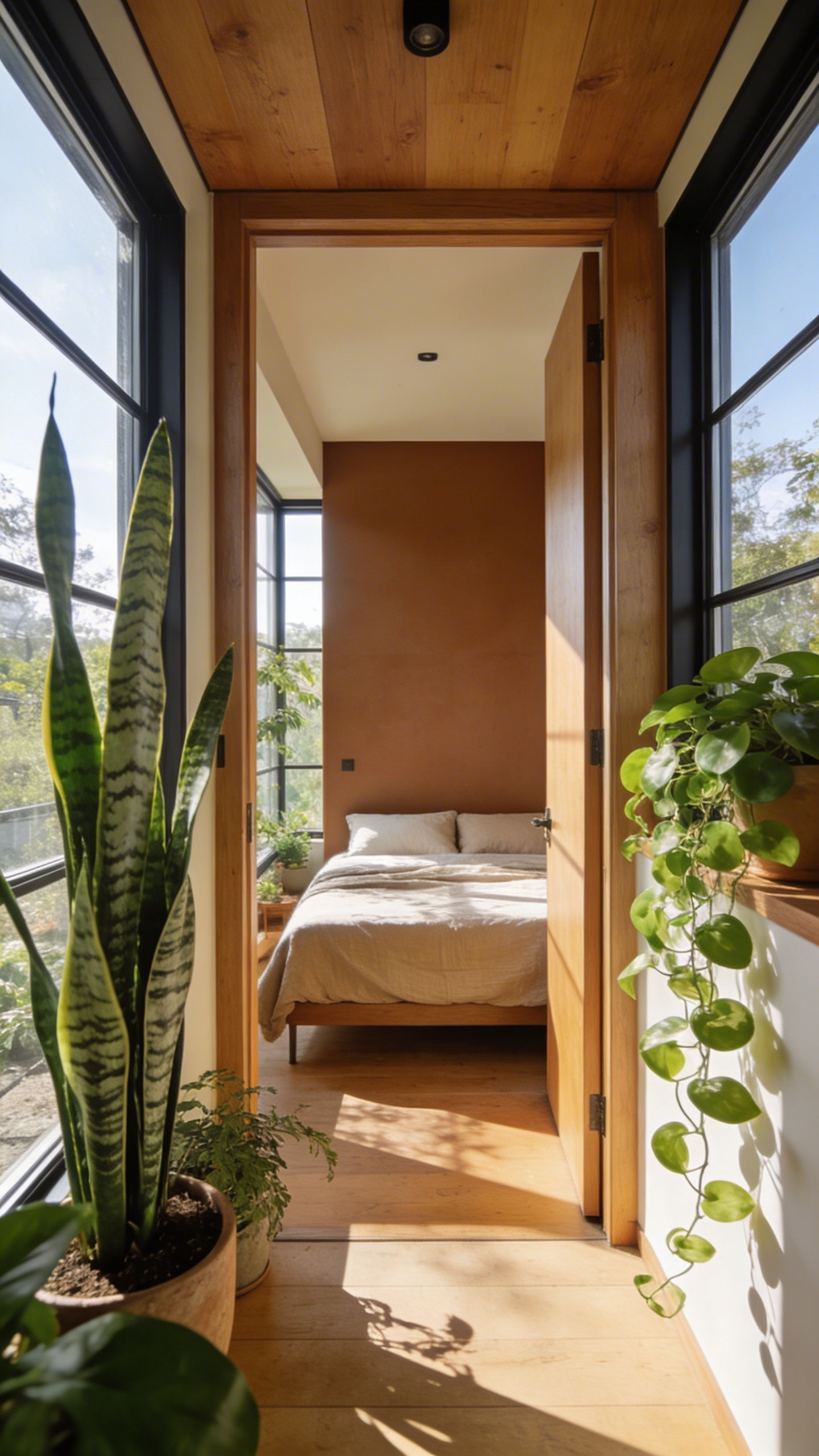
The visual narrative plays a crucial role in mental restoration. Small rooms often suffer from chaotic clutter or sterile boredom. Therefore, designers utilize “soft fascination” through fractal patterns. Incorporate natural textures like wood grain, linen weaves, or botanical prints. Biologically, our brains process these specific organic ratios effortlessly. As a result, the eye remains occupied, yet the mind is allowed to rest.
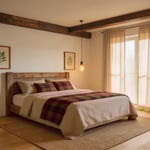
Finally, do not neglect the psychological impact of touch. Spatial psychology suggests we perceive room size through our skin. Using “low-processed” materials like heavy wool or unpolished wood provides “haptic grounding.” Research indicates that touching these authentic surfaces can effectively lower cortisol levels. This tactile depth makes a room feel intentional rather than temporary. The space transforms from cramped to deeply embracing.
Phase 1: Atmospheric Expansion (Managing Light & Air Quality)
Atmospheric expansion creates space by manipulating a room’s “invisible architecture”—light and air. This practice overrides physical boundaries to make small quarters feel unconfined. Biologically, humans crave “prospect and refuge.” Placing a mirror opposite a window isn’t merely a visual trick. Instead, it artificially lengthens sightlines. This effectively reduces the brain’s cognitive load. Furthermore, you must treat light as a physical material. Techniques like “wall-washing” illuminate vertical surfaces to eliminate dark corners. The brain interprets shadowed areas as “dead space,” making the room feel smaller.
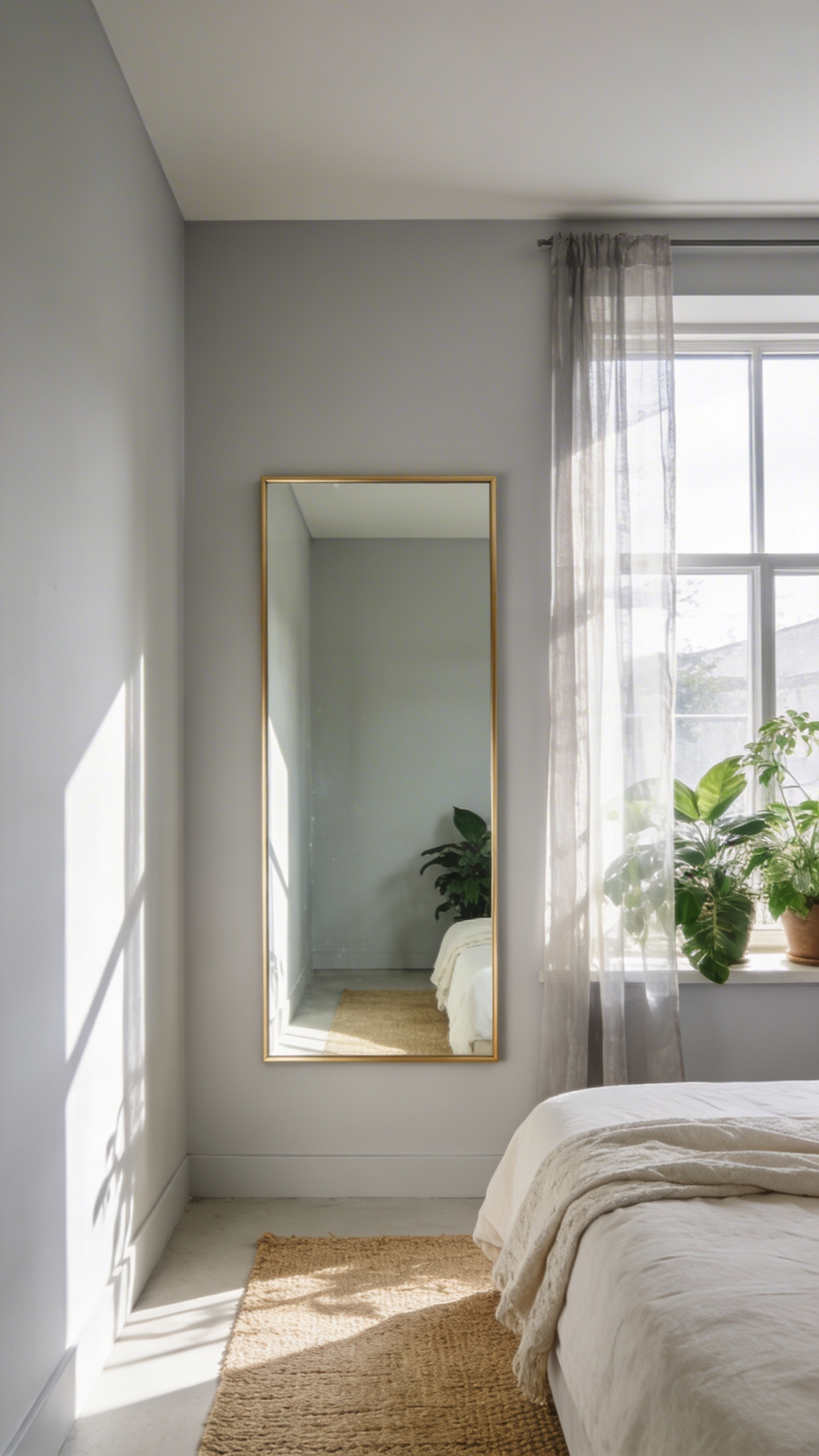
Similarly, air quality dictates how confined a room feels physically. High CO2 levels often cause lethargy and headaches in small spaces. Design must encourage natural wind paths to keep oxygen circulating. Choose “leggy” bed frames to allow airflow underneath furniture. This prevents stagnant pockets that create a “stuffy” sensory experience. Additionally, incorporate hygroscopic materials like linen or unfinished wood. These natural elements regulate humidity, allowing the room to “breathe” comfortably.
Prioritize your circadian rhythm with proper illumination standards. Use warm bulbs (2700K) to mimic natural sunset wavelengths. These lights soften physical edges, making the boundaries less distinct. Ultimately, this creates a biological sense of expansion that square footage cannot provide.
1. Circadian Synchronization: Layering automated blackout shades with sheer linen to honor natural sleep-wake cycles.
In small bedroom decor, window treatments act as a biological bridge. Layering automated blackout shades with sheer linen is a vital strategy for circadian health. Abrupt light often triggers harsh cortisol spikes. However, sheer linen effectively acts as a gentle filter for morning light. Automating the blackout shade to rise early allows for “Natural Dawn Simulation.” This low-intensity light gently suppresses melatonin, effectively preventing groggy sleep inertia.
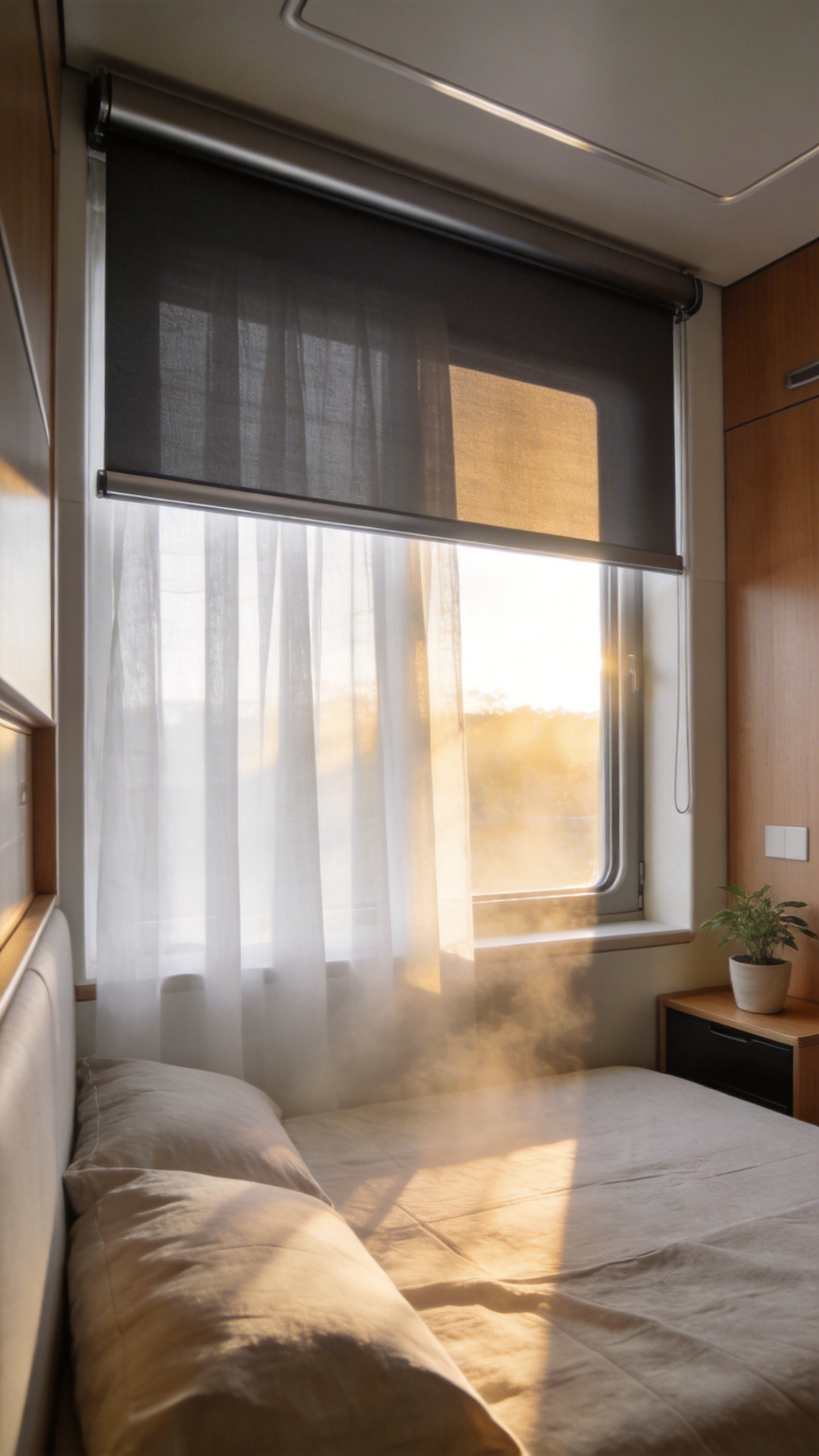
Beyond mechanics, the choice of textile material matters significantly. Linen historically served as a survival fabric for heat regulation. In tight quarters, its high breathability prevents uncomfortable air stagnation. Its irregular texture dampens sound waves, creating a quiet auditory sanctuary. Psychologically, this “open heart” layer connects you to the outdoors without sacrificing privacy.
Modern “Slim-Stack” hardware also solves common spatial issues. An inside-mounted roller shade disappears completely into a small cassette. Meanwhile, a ceiling-mounted linen track creates a spacious “high and wide” illusion. Ideally, you should program these systems to follow “Astronomical Time.” The blackout layer closes exactly at sunset to block light pollution. Technology and textiles work together to honor your natural rhythm.
2. Vertical Liberation: Mounting drapery floor-to-ceiling to draw the eye upward and encourage deep breathing.
“Vertical Liberation” is more than a styling trick; it is a wellness tool. This concept taps into the “Cathedral Effect.” This phenomenon links perceived ceiling height to cognitive processing. Research indicates that architectural volume signals freedom from confinement. Drawing the eye upward with drapery cues a parasympathetic nervous system shift.
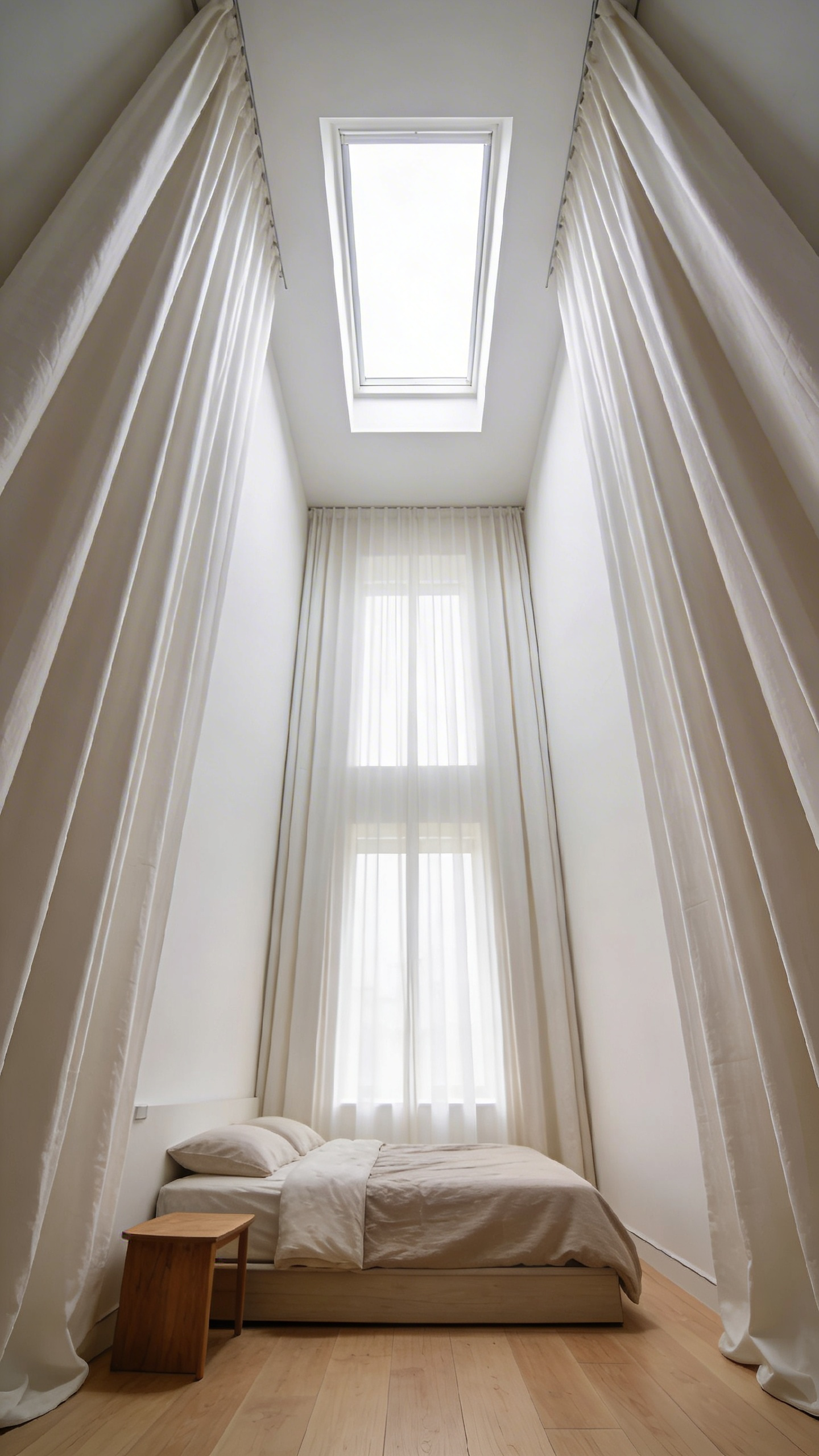
Precise installation is critical. Utilize a “zero-gap” mount by placing rods 1–3 inches below the ceiling. Even better, use ceiling-mounted tracks to make the fabric appear structural. Extend the hardware 8–12 inches wider than the window frame. This “stack back” rule ensures open drapes rest against the wall, not the glass. You maximize serotonin-boosting natural light while creating an illusion of expansive space.
The fabric’s materiality influences the room’s atmosphere. Ideally, select linen or linen-blends for their ability to hold vertical folds. These creases act like architectural columns, reinforcing the upward gaze. Also, maintain a “kiss” length where the hem barely touches the floor. Unlike heavy “puddles” that collect dust, a tailored line feels clean and breathable. This approach echoes Le Corbusier’s “liberation of the interior,” freeing your sanctuary from its physical limits.
3. The ‘Floating’ Principle: utilizing wall-mounted nightstands to clear floor space and reduce visual anxiety.
The “Floating” Principle is more than a minimalist trend. In reality, it is a sophisticated strategy leveraging neuro-architecture to combat claustrophobia. By detaching furniture from the ground, you fundamentally alter how your brain maps the environment. The brain uses visible floor area to measure safety and scale.
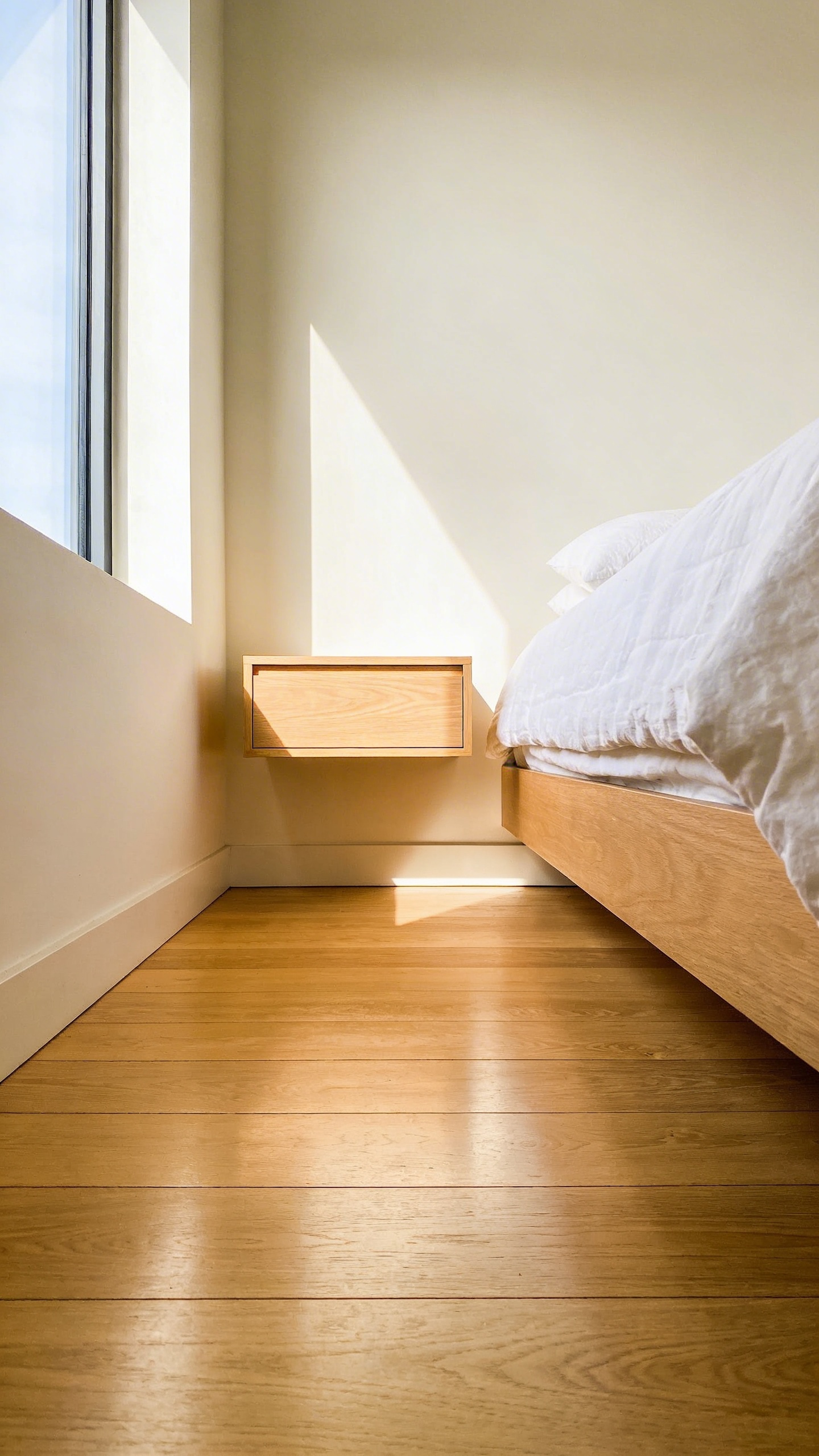
When bulky furniture sits on the floor, it creates a visual “dead zone.” Choosing modern bedroom furniture ideas for small rooms that emphasize transparency or floating designs enhances navigability. Mounting a nightstand creates a critical “shadow gap.” This allows the eye to travel uninterrupted to the wall. The brain perceives the space as navigable rather than cluttered. Expert consensus suggests this continuity alleviates “visual vertigo” and lowers cortisol levels.
This design approach supports Prospect-Refuge Theory. Your bed serves as a “refuge,” while the floating shelf ensures a clear view. You maintain a sense of “prospect,” or awareness, over the room. Consider the sensory impact of light. Installing under-mounted LED strips enhances the illusion of weightlessness.
Proper installation is essential for reducing visual anxiety. Mount the unit level with your mattress top. Typically, this sits 24 to 28 inches from the floor. A rock-solid mount prevents the subtle stress caused by a sagging shelf.
4. Biophilic Breath: Integrating specific air-purifying plants (like Snake Plants) on vertical shelving to oxygenate the ‘sleep bubble’.
In small bedrooms, air volume is inherently limited. The “sleep bubble”—a specific one-meter radius around your head—becomes critical for air quality. Through biophilic design, we can address this. Snake Plants (*Dracaena trifasciata*) offer a unique biological solution. Unlike most flora, they utilize Crassulacean Acid Metabolism (CAM) photosynthesis. They absorb CO₂ and release oxygen specifically during the dark hours.
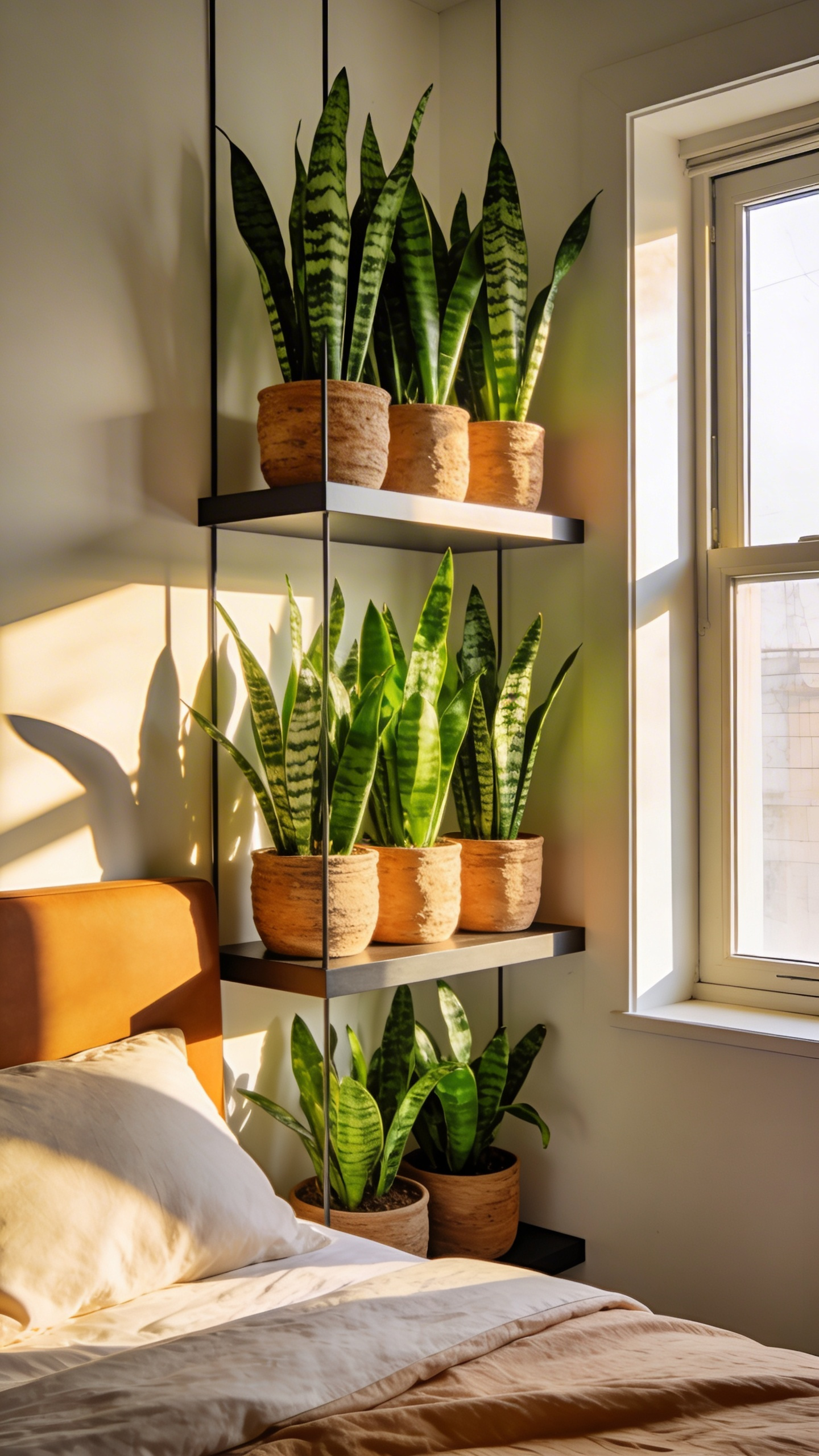
Strategic placement is essential. Positioning these plants on vertical shelving near the headboard creates a beneficial “downstream” oxygenating effect. Verticality serves a functional purpose beyond simply saving floor space. Landmark research by Dr. Bill Wolverton reveals that root-zone microbes actually handle the majority of toxin removal. Thus, elevated, slatted shelving allows air to circulate through the pot’s base, creating a passive bio-filter.
Beyond function, the plant offers psychological support. Historically, its upright form earned it the name “Saint George’s Sword,” symbolizing protection. In design psychology, this vertical structure provides “visual silence” amidst potential clutter. Additionally, the leaves’ repeating fractal patterns help lower heart rates. This triggers the parasympathetic nervous system before sleep. This “Biophilic Breath” strategy transforms a small room from a stagnant box into a restorative sanctuary.
5. Mirror Positioning for Qi Flow: Placing mirrors to reflect light and views, avoiding direct reflection of the bed to maintain energetic calm.
In Feng Shui, mirrors act as powerful “energy aspirins.” They introduce active Yang energy into a space to expand it. However, a bedroom requires calm Yin energy for restorative sleep. Precise placement is essential to balance these opposing forces.
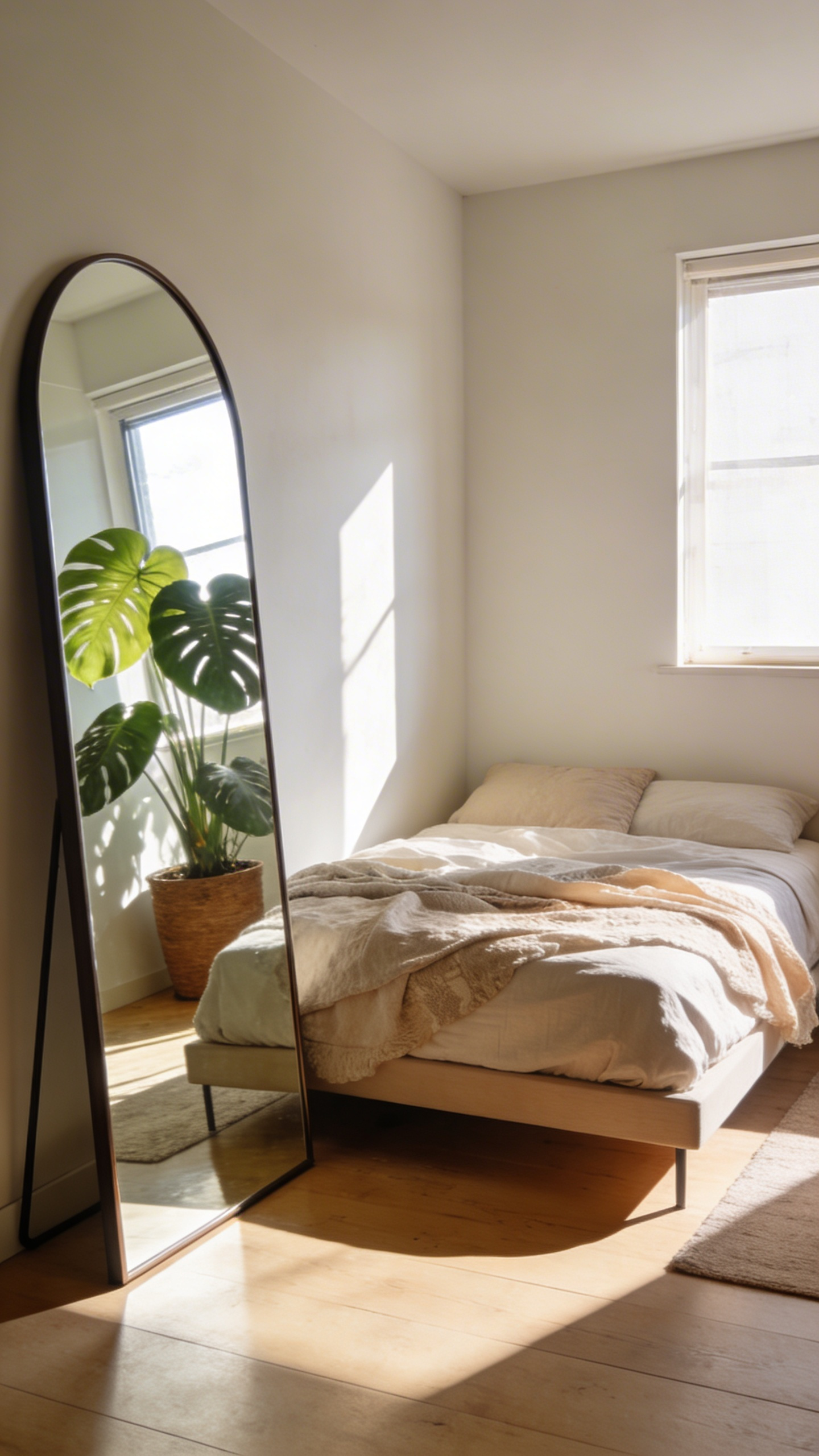
Most importantly, avoid positioning mirrors directly opposite the bed. Biologically, this recommendation roots in the “Orienting Response.” Even during sleep, your primal brain monitors movement for survival. A facing reflection keeps the nervous system on high alert. This prevents the body from sinking into deep, restorative rest. Low light causes the brain to misinterpret reflections, creating unsettled feelings known as the “Caputo Effect.”
Instead, use mirrors to import positive Sheng Chi. Position glass to reflect a window view of the sky or trees. This symbolically brings vital, life-affirming energy indoors. Conversely, never reflect cluttered corners or work desks. Doing so merely doubles the visual stress, making small rooms feel chaotic.
Consider the mirror’s geometry. Round or oval shapes encourage gentle, circular energy flow. These soft edges prevent the Qi from feeling aggressive. Alternatively, mount full-length mirrors inside closet doors. This clever solution allows you to utilize the mirror by day, then “shut out” its active energy at night.
Phase 2: Material Resonance (The Physiology of Touch)
In small bedrooms, the proximity of walls often triggers a subconscious “enclosure stress.” We utilize “Material Resonance” and haptic textures to create a sense of safety. Your skin’s mechanoreceptors rely on tactile feedback to map the environment. Therefore, avoiding “cold” or inert materials like laminate is crucial. Introduce high-resonance materials like open-pore wood or heavy linen. Touching a rough-woven throw creates a grounding effect that actually lowers cortisol levels.
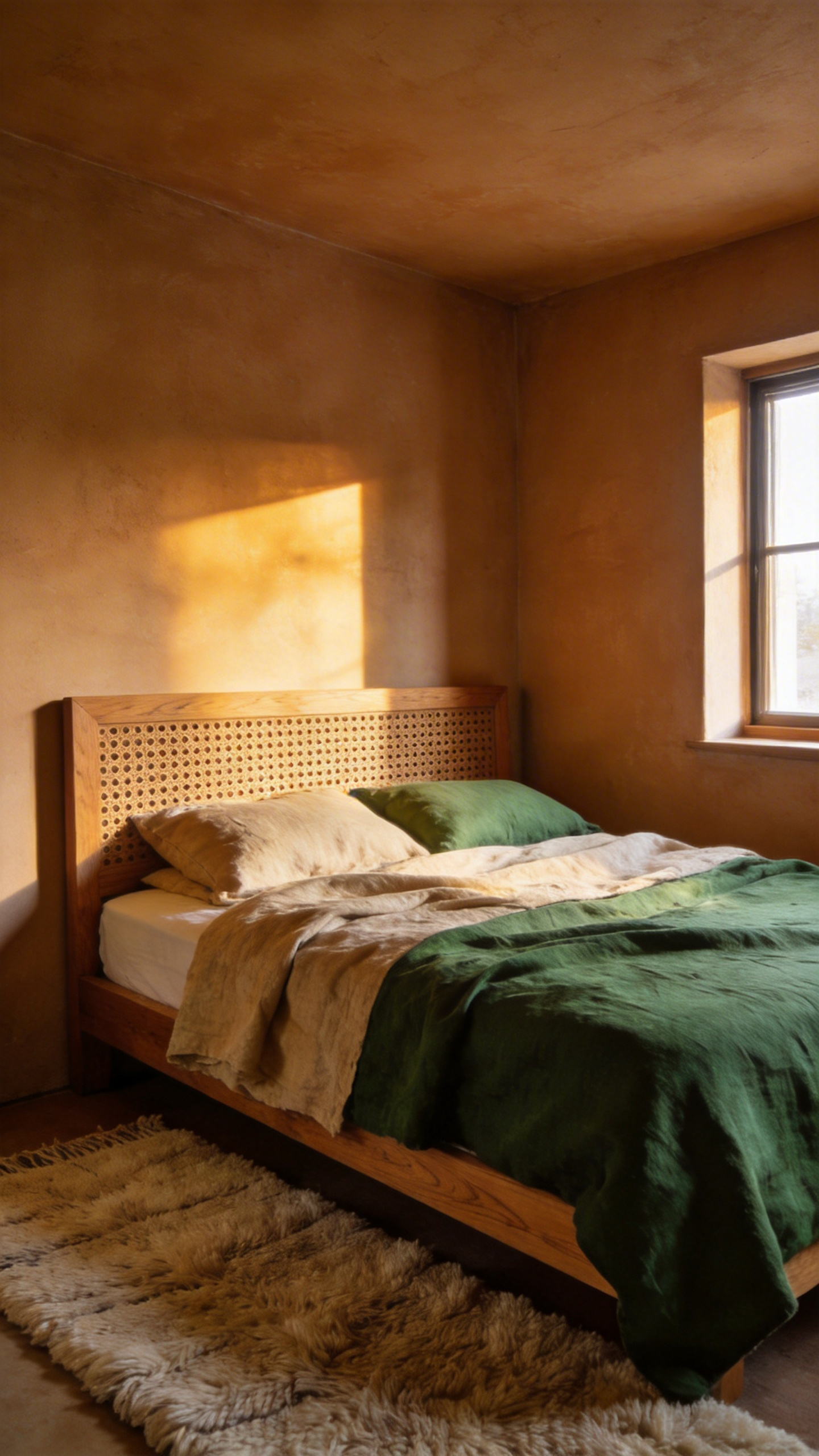
You should apply the Japanese concept of Shitsukan. This refers to sensing material quality through visual texture alone. In cramped spaces, high-gloss finishes create an unsettling visual glare. Conversely, matte textures offer “Tactile Modulation,” softening the room’s visual impact. Material density significantly affects acoustics. Research in maritime ergonomics supports this finding; replacing vinyl with heavy textiles can reduce ambient noise by up to 30 decibels.
Prioritize “material honesty” to combat the feeling of confinement. Natural fibers possess microscopic fractal patterns that synthetic materials lack. Evolutionarily, our eyes are tuned to these complex, natural irregularities. Moreover, materials like wool possess high thermal inertia, preventing the “thermal shock” of touching a cold wall. A textured, resonant room feels restorative rather than cell-like.
6. The Non-Toxic Foundation: Prioritizing organic latex or wool mattresses to eliminate off-gassing in confined air volumes.
In small bedrooms, the volume of air is strictly limited. The “pollution-to-oxygen” ratio shifts dramatically compared to larger suites. Unlike spacious master bedrooms where airflow dilutes toxins, small spaces function as “tight boxes.” Standard memory foam acts as a chemical “off-gassing engine.” It releases Volatile Organic Compounds (VOCs) directly into your stagnant air. Sleepers often inhale a concentrated bubble of chemicals like formaldehyde throughout the night.
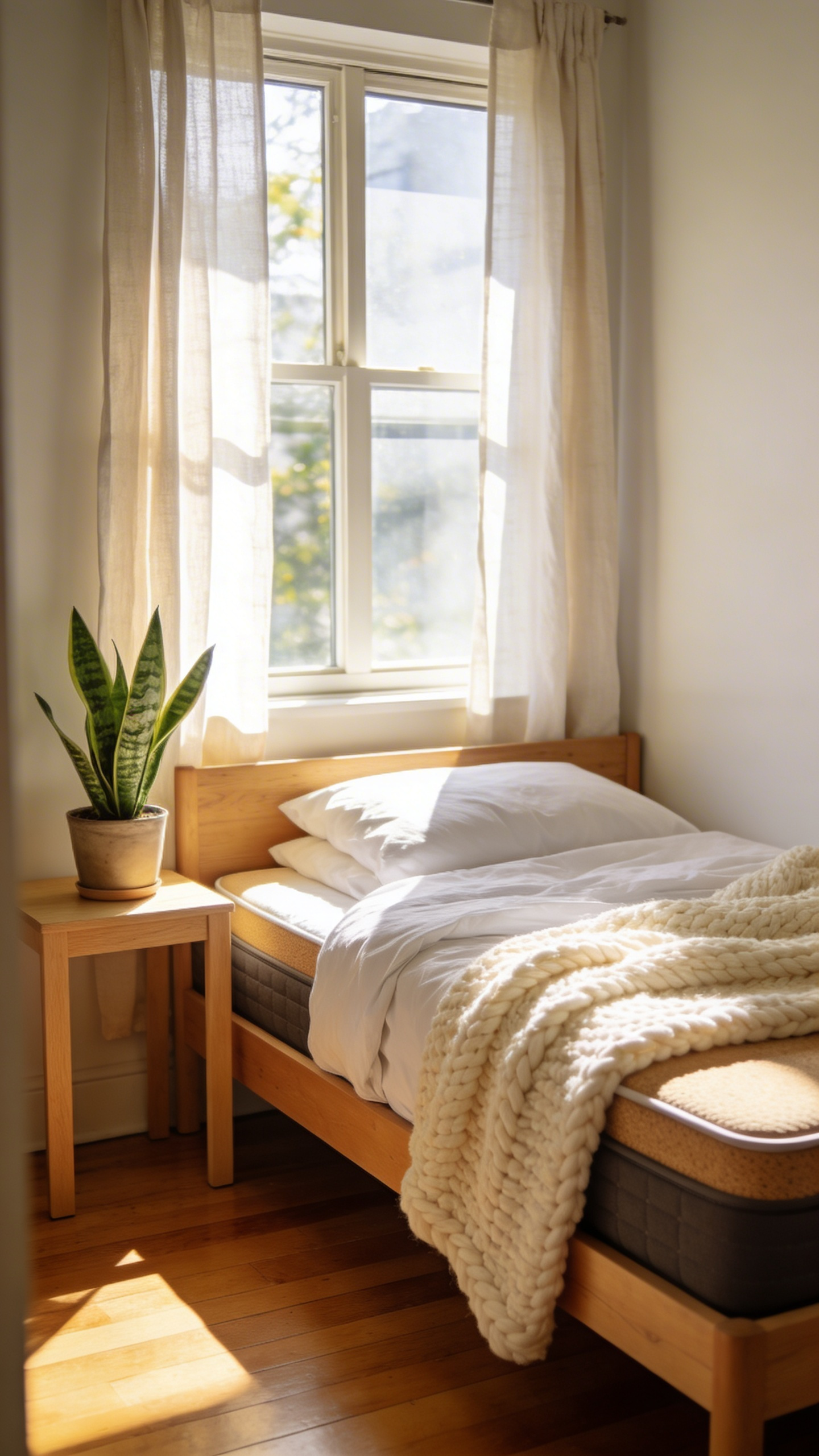
Prioritize organic latex and wool foundations. Natural latex is harvested from rubber trees rather than petrochemical labs. Thus, it avoids the harsh solvents found in synthetic foams. Furthermore, wool acts as a superior, natural fire barrier. This eliminates the need for toxic flame retardants often drenched over conventional beds.
Beyond safety, these materials heavily influence the room’s atmosphere. For instance, wool effectively wicks away moisture. This prevents the “swamp effect” caused by trapped body heat in confined spaces. Organic latex lacks the sharp, medicinal smell of synthetics. Instead, it offers a “sensory neutral” scent that makes small rooms feel airy and clean.
This approach aligns with the concept of “invisible luxury.” A GOTS-certified mattress maintains a crisp structural silhouette for decades without sagging. In a small room, every molecule counts. Eliminating toxins at the foundation is the most critical step in wellness architecture.
7. Acoustic Softening: Using high-pile wool rugs and upholstered headboards to dampen sound reverberation in small boxes.
In compact bedrooms, sound waves reflect rapidly off parallel hard surfaces. Technicians call this phenomenon “flutter echo.” Unfortunately, this creates a subtle auditory “glare” that often causes subconscious mental fatigue. Acoustic softening is essential for a truly restorative environment. This involves introducing dense, high-surface-area textiles to neutralize the room’s “boxy” audio signature.
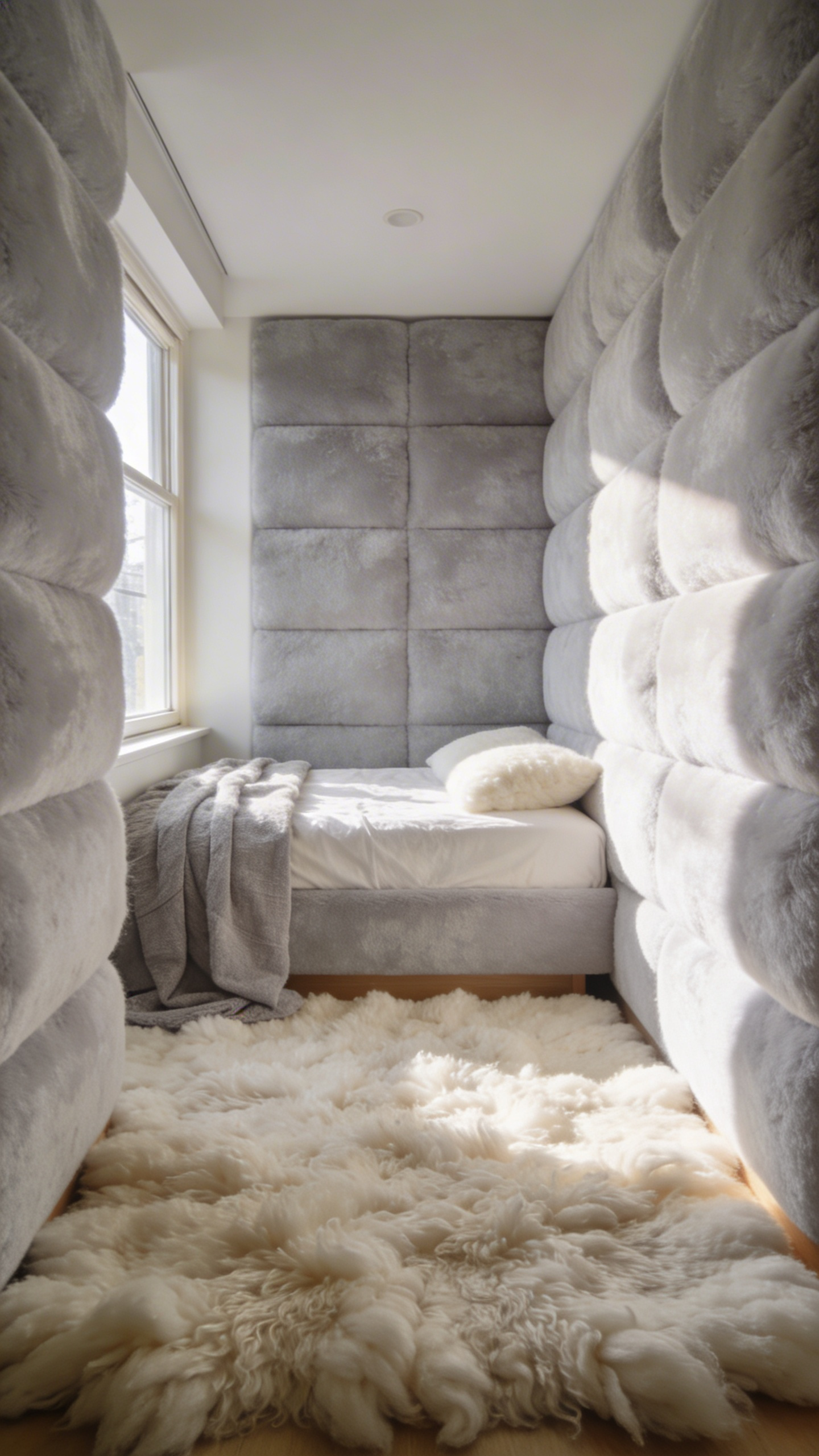
Start by anchoring the room with high-pile wool. Wool acts as a complex acoustic instrument rather than just a rug. Naturally, its crimped fibers create a microscopic labyrinth that traps air. When sound hits a tufted wool rug, the energy dissipates through friction. Research indicates that heavy wool effectively tames the “shrill” frequencies of modern electronics. Adding a dense felt underlay further decouples the rug from the floor, stopping vibrations.
Address the wall behind your bed to prevent “slapback.” This acoustic issue occurs when sound bounces back and forth at head height. An upholstered headboard serves as a necessary strategic buffer. Ideally, look for a dual-layer core featuring high-density upholstery foam. Specifying fabrics like velvet or mohair provides a textured “nap” that diffuses reflections before they hit the padding.
These layers work together to lower the room’s reverberation time. This “hushed” atmosphere directly impacts your autonomic nervous system. The reduction in noise signals safety to the brain, lowering cortisol levels. The bedroom transforms from a noisy box into a cocoon meant for deep sleep.
8. The Psychology of Soft Edges: Selecting curved furniture silhouettes to prevent the subconscious ‘fight or flight’ response triggered by sharp corners in tight spaces.
Biologically, the human brain often perceives sharp angles as potential physical threats. Neuro-aesthetic research indicates that jagged edges activate the amygdala, our internal fear center. This subconscious reaction intensifies within the intimate confines of a small bedroom. Your body experiences a primitive “collision anxiety” when navigating tight spaces near pointed corners. Selecting furniture with curved silhouettes becomes an essential act of environmental de-escalation.
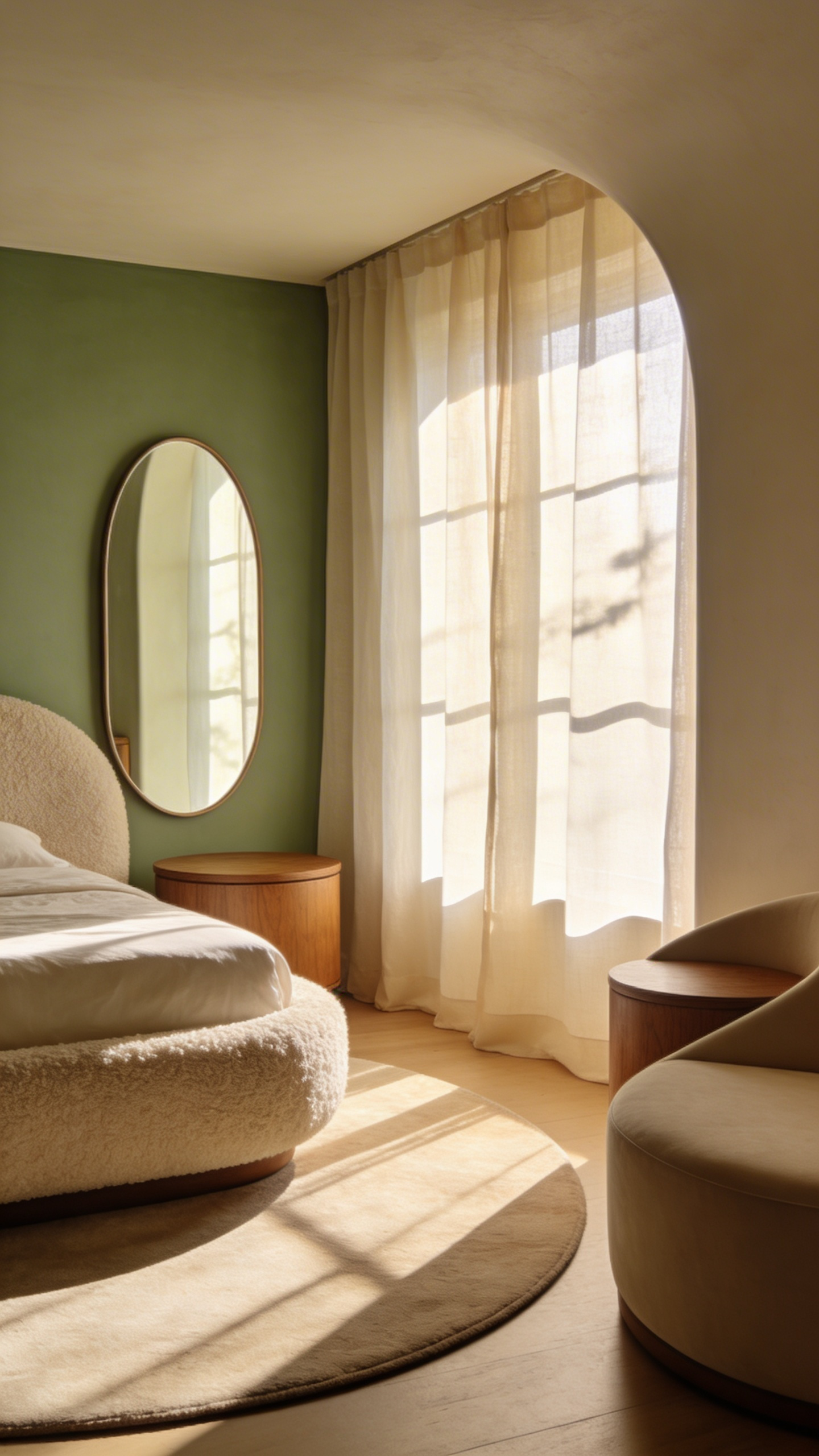
Replacing a square nightstand with a round pedestal model removes the physical hazard. Your nervous system shifts from a high-alert state to deep relaxation. Additionally, soft edges influence how we visually process spatial volume. Unlike sharp corners, which act as visual stop signs, curves encourage an uninterrupted gaze. The eye glides across surfaces, creating an illusion of infinite flow.
This design choice appeals to haptic perception, or our sense of touch. Naturally, a smooth, bullnose edge feels safer against the skin than a rigid corner. Ultimately, organic lines transform a cramped room from a confining cell into a nurturing nest.
9. Grounding Textures: Incorporating raw wood and stone elements to foster a connection to nature’s stability.
In the context of bedroom decor for small rooms, incorporating raw materials is a vital wellness strategy. Adding raw wood and stone creates a necessary “grounding” effect. This tactile approach helps counteract the psychological claustrophobia often felt in limited square footage. In fact, neuro-aesthetic research refers to this visual relief as “soft fascination.” Your brain processes natural patterns with remarkably little effort.
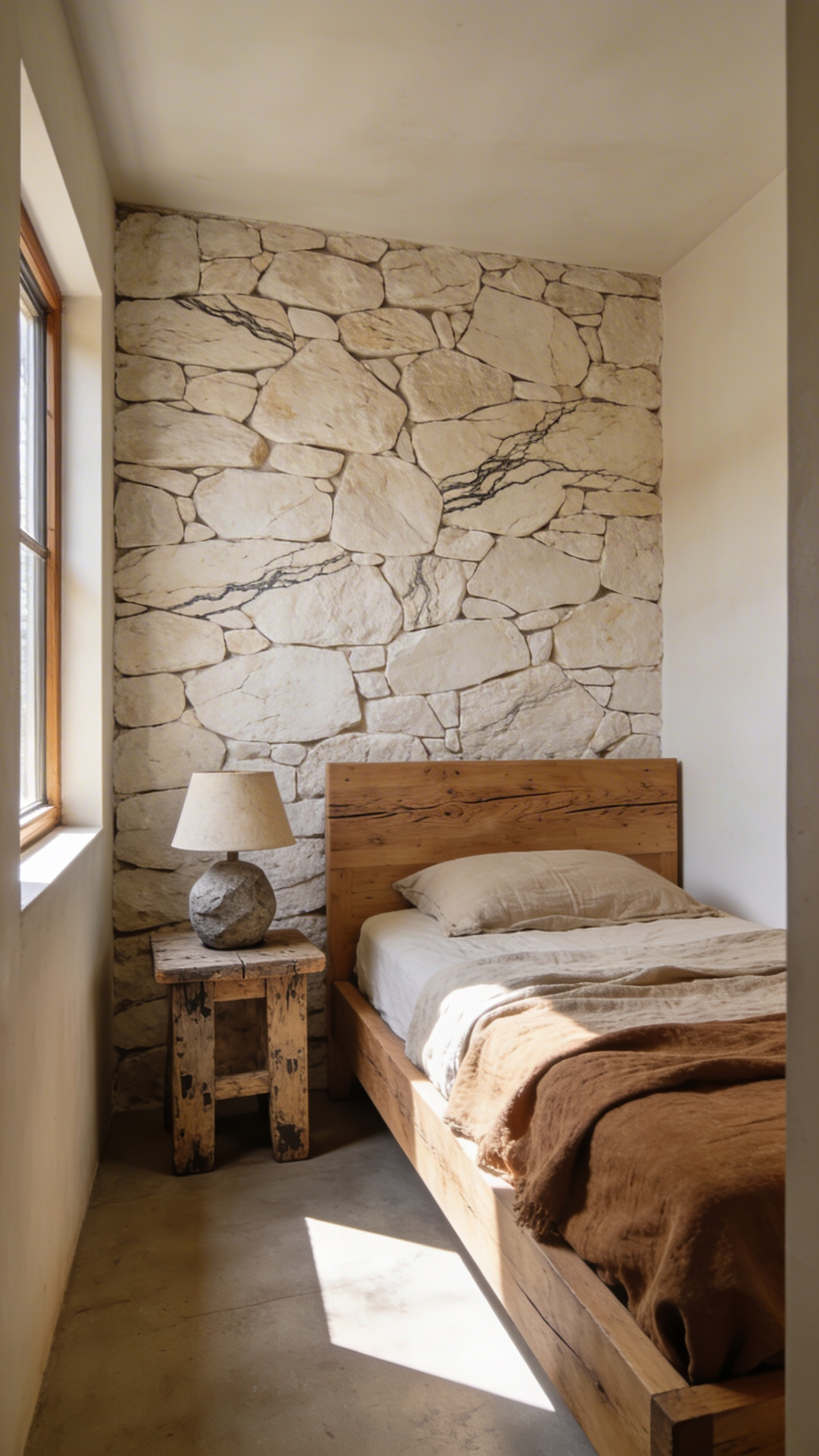
Effective design requires balancing thermal warmth with physical weight. Touching raw wood activates pressure receptors that signal your nervous system to rest. Conversely, stone elements provide “quiet weight,” acting as a psychological anchor within the room. This material combination prevents a small space from feeling temporary or flimsy.
To maintain open floor space, utilize vertical planes for these grounding elements. Install a live-edge floating shelf rather than a heavy, boxy dresser. Proper lighting is essential to reveal the depth of these surfaces. Use “grazing” light to cast long shadows across the ridges of wood or stone. These aging materials channel the Japanese philosophy of Wabi-Sabi. They provide a narrative of endurance that fosters deep emotional comfort and stability.
10. Layering Natural Fibers: Mixing chunky knits, silk, and washed cotton to create sensory richness without visual clutter.
Layering natural fibers offers a sophisticated design solution for small bedrooms. This method prioritizes tactile variety over ornamental clutter to manipulate the room’s “visual temperature.” Silk possesses a unique triangular fiber structure. It refracts light and creates a luminous depth. Conversely, washed cotton and chunky knits absorb light. They provide a grounding effect known as “visual weight” without shrinking the perceived space.
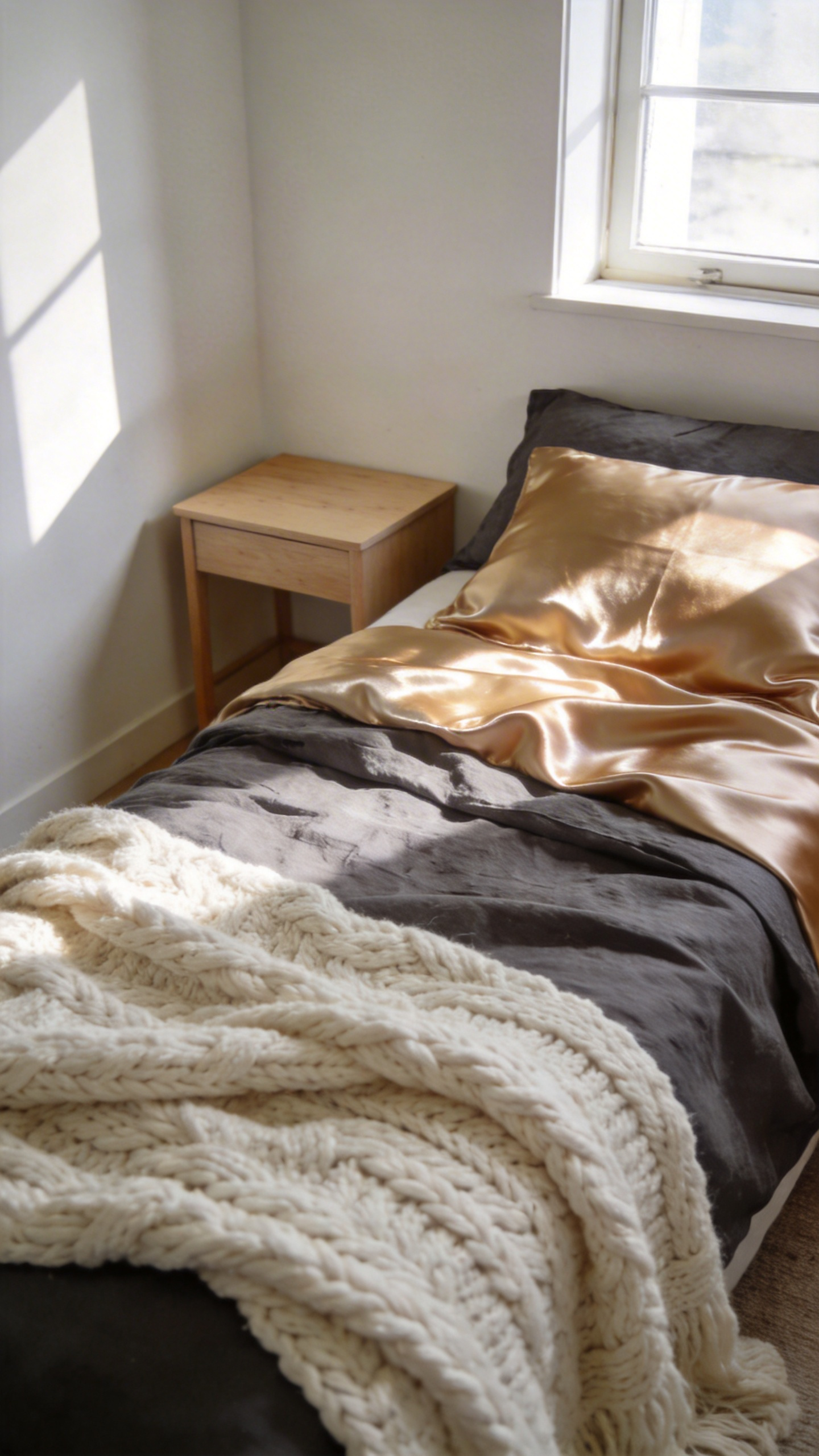
Beyond aesthetics, this trio supports biological thermal harmony. Research indicates that wool helps regulate the body’s microclimate. As a result, you may fall asleep faster. Silk reduces “tactile noise” against the skin. This friction reduction can lower cortisol levels and promote oxytocin release. The environment actively supports deeper REM cycles.
To implement this effectively, apply the 60-30-10 rule. First, use washed cotton as your 60% matte foundation to hide wrinkles. Next, add a chunky knit as the 30% sensory bridge for 3D relief. Finally, use silk sparingly as a 10% luminous accent. Additionally, use the “triple-fold” technique with your knit throw. Placing this folded layer across the bottom third of the bed creates a horizontal line. This widens the bed visually while merging “Imperial Luxury” with “Rustic Utility.”
Phase 3: Psychological Depth (Color & Curation)
True wellness architecture moves beyond storage hacks to address your neurological experience. We must shift a room’s perception from cramped to intentionally curated. Consider your color strategy to manipulate spatial awareness. Traditionally, small spaces demanded white paint to reflect light. However, modern psychology offers two distinct, effective paths. The “Expansive Cloud” approach uses cool, receding tones like misty lavender. The eye flattens these colors, effectively tricking the brain into perceiving physical distance.
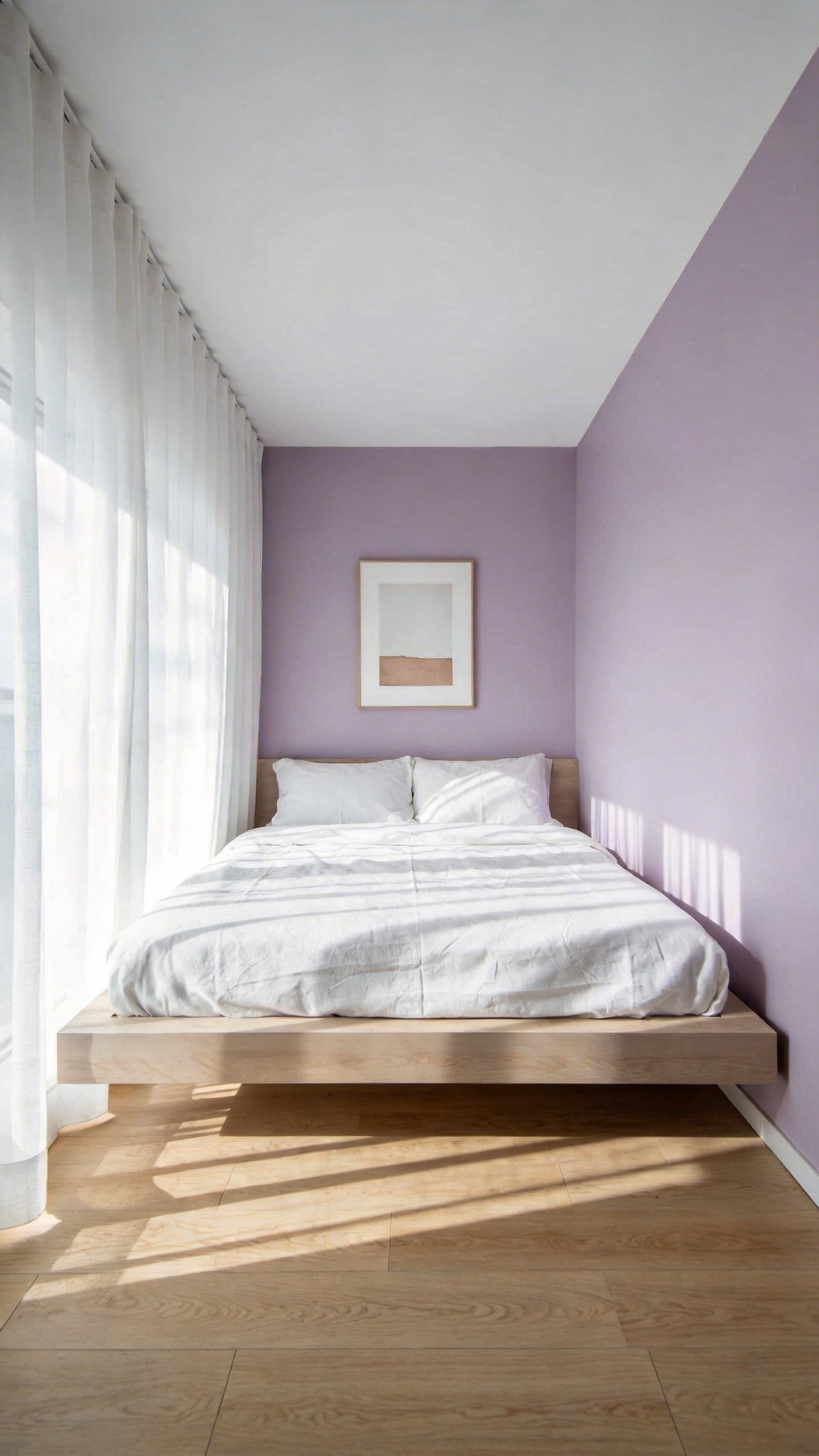
Conversely, the “Jewel-Box” effect utilizes “color drenching” with dark, saturated hues. By painting walls and ceilings identical shades, you successfully blur the room’s hard boundaries. Therefore, the space feels infinite and moody rather than strictly enclosed. Effective curation acts as a form of cognitive offloading. Visual clutter naturally creates decision fatigue. Finding small bedroom decor ideas that actually work requires balancing hard surfaces with soft triggers like velvet or linen.
Leaving a nightstand bare provides a necessary reset point for the eyes. In fact, this lack of stimuli equates space with freedom from urgency. Focus on tactile hierarchy to lower cortisol levels. This “Hugging Home” strategy balances hard surfaces with soft triggers. Mixing these textures signals emotional safety to the brain, turning a small room into a restorative sanctuary.
11. Color Drenching: Painting walls, trim, and ceiling the same hue to erase boundaries and induce a ‘womb-like’ security.
Color drenching involves painting your walls, trim, doors, and ceiling in a single, unified hue. This technique does more than look stylish; it fundamentally alters how your brain processes space. Traditional white trim creates “visual noise” by forcing your eyes to register constant stops and starts at every edge. By erasing these high-contrast boundaries, you effectively blur the room’s physical limits. The corners seem to recede into shadow. This creates a sense of depth that paradoxically makes small rooms feel larger.
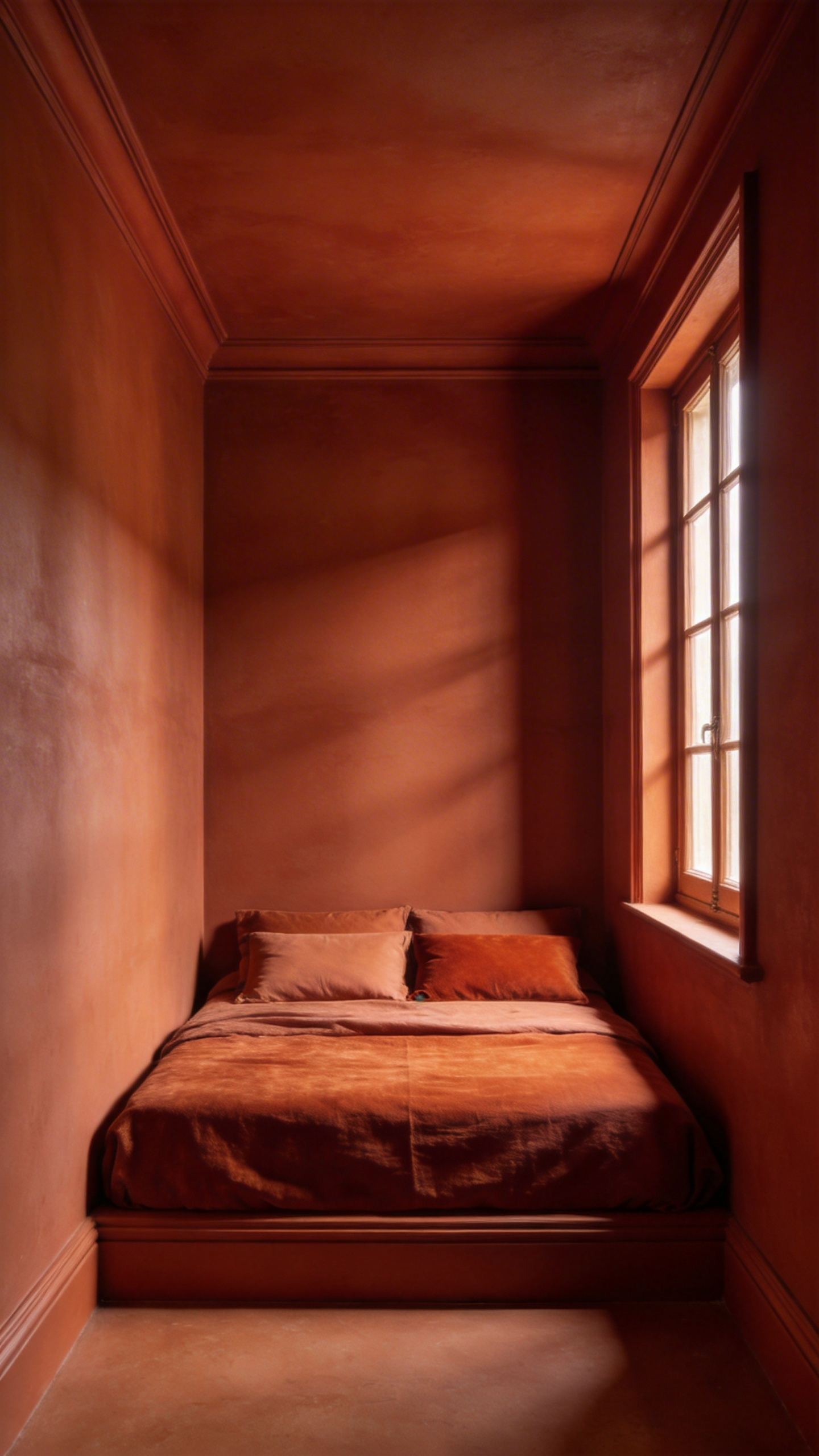
This envelopment fosters a “womb-like” atmosphere of sensory containment. For individuals with sensory sensitivities or ADHD, this drastic reduction in visual fragmentation signals safety. As a result, the mind stops bracing for interruption and can finally settle into a restorative state of rest. To execute this successfully, however, you must manipulate texture to avoid a flat appearance. Professional designers recommend varying the paint sheens while keeping the color code identical.
Use a flat or ultramatte finish on walls to absorb light and soften the visual field. Conversely, apply a satin or semi-gloss finish in the exact same color to the trim and doors. This subtle contrast catches the light, adding architectural definition without breaking the monochromatic spell. Ensure you incorporate warm lighting and natural materials like wood or linen. These elements act as essential anchors, ensuring your soothing cocoon never crosses the line into feeling like a claustrophobic cave.
12. The Case for Darkness: Utilizing deep, saturated hues (charcoal, forest green) to visually recede walls and signal melatonin production.
Contrary to popular belief, dark colors do not always make small rooms feel smaller. Deep, matte hues can actually cause walls to visually recede. Colors like charcoal and forest green possess a low Light Reflectance Value (LRV). They absorb light instead of bouncing it around the room. This optical physics creates a “shadow-box” effect where sharp corners blur. Therefore, the eye cannot easily distinguish where the room ends, creating a sense of infinite depth.
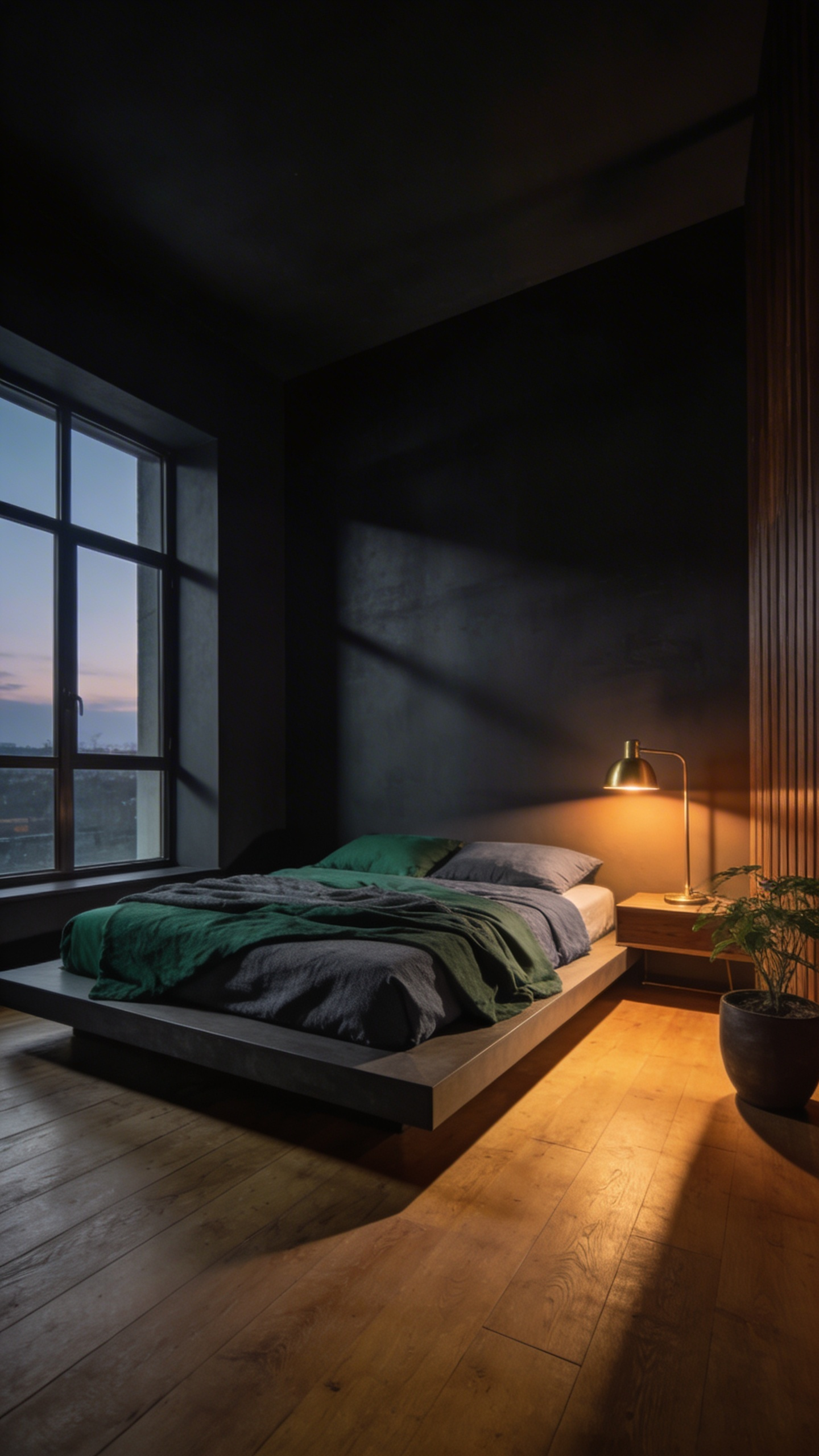
Beyond aesthetics, this “case for darkness” is a strategic physiological intervention. Fundamentally, a dark environment signals the brain to prepare for rest. By reducing “visual noise,” deep colors help the hypothalamus transition from cortisol to melatonin production. Forest green triggers a biophilic response, mimicking a safe, natural canopy. Charcoal provides a cinematic stillness that anchors the room. Thus, the space becomes a sanctuary for deep sleep.
To execute this correctly, designers often use a technique called “color drenching.” This involves painting the walls, trim, and ceiling the same saturated hue. It is critical to use a flat or matte finish. Because sheen reflects light and defines boundaries, a matte surface creates a velvety, soft-focus look. Ultimately, this turns a confined space into a sophisticated, restorative cocoon.
13. The Command Position: Orienting the bed to view the door without aligning with it, satisfying primal safety instincts.
The Command Position is not merely a trend; it is a biological necessity. This layout applies the “Prospect and Refuge” theory to interior design. Geographer Jay Appleton posits that humans instinctively crave environments offering visibility and shelter. Consequently, orienting your bed to view the door satisfies a primal “cave-dweller” safety instinct. Studies confirm that 83% of people naturally choose this protective arrangement.
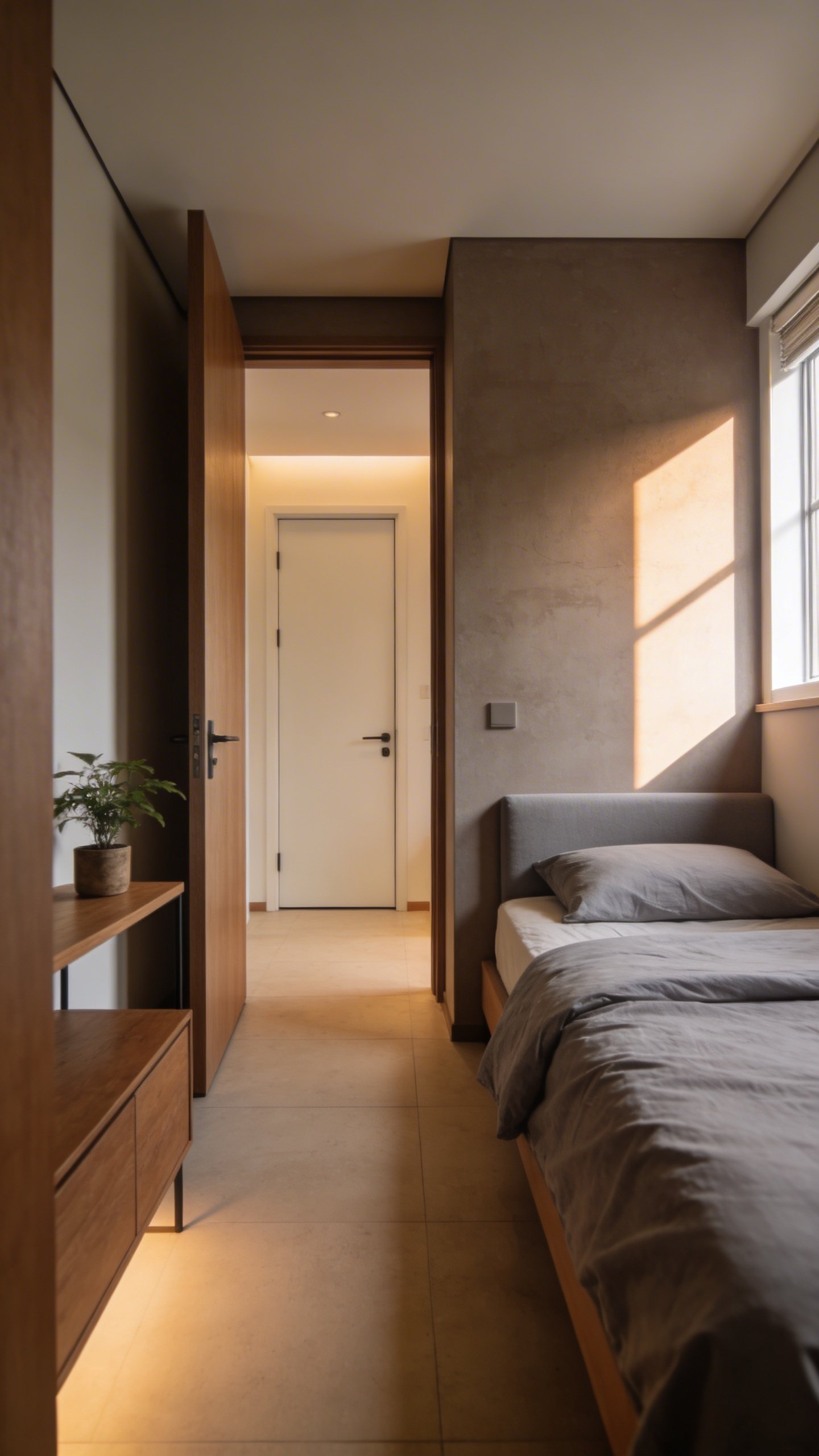
Without this alignment, your subconscious remains on guard. Therefore, the amygdala stays hyper-vigilant, preventing the nervous system from entering deep sleep. However, small rooms often create layout challenges. Ideally, you must avoid the “Coffin Position,” where your feet point directly through the doorway. Culturally, this alignment is believed to drain vital energy.
If space is limited, you can engineer psychological comfort. Place a bench or rug at the foot of the bed. This creates a symbolic buffer against the hallway’s chaos. Be mindful of “Poison Arrows” from nearby furniture. Sharp corners pointing at your head can trigger anxiety. Soften these angles with draped fabrics or trailing plants.
Use a “Command Mirror” if you cannot physically see the door. Position a mirror to reflect the entrance from your pillow. This “virtual” view satisfies your survival instincts without requiring extra square footage.
14. Cognitive Clarity Storage: Implementing closed storage solutions (under-bed drawers, built-ins) to hide visual noise that spikes cortisol.
In compact living environments, bedrooms often double as workspaces or dressing rooms. This functional overlap creates “visual noise,” which serves as a documented trigger for chronic stress. According to a landmark UCLA study, high “object density” directly correlates with elevated cortisol levels. Your brain perceives every visible item as an individual task requiring processing power.
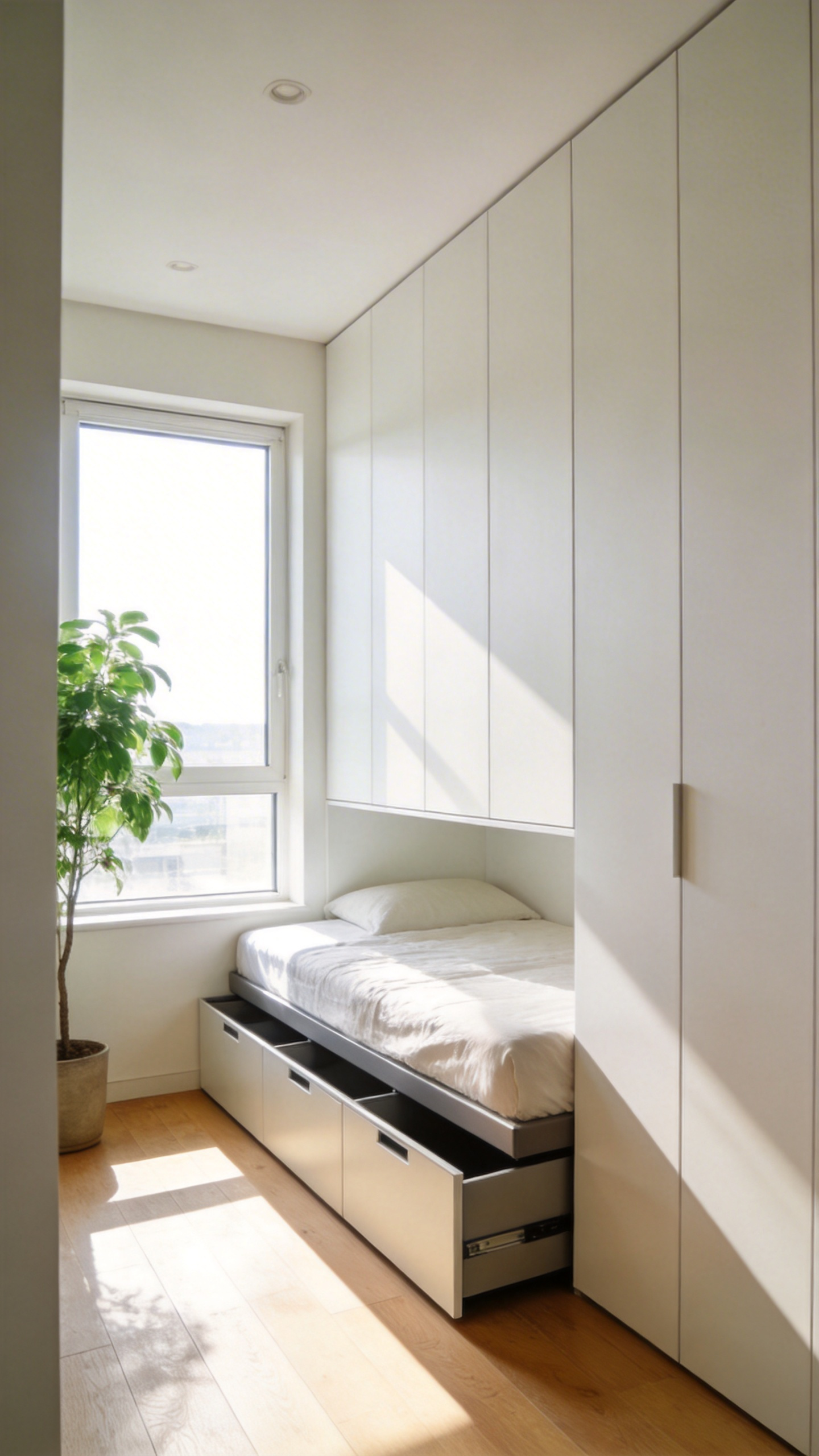
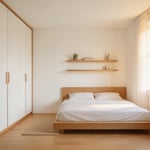
This psychological burden, known as the Zeigarnik Effect, keeps your mind in a state of high vigilance. Implementing closed storage acts as a necessary “cognitive mute button” for the nervous system. Floor-to-ceiling built-ins function as an “architectural cloak,” blending seamlessly into the surrounding walls. By utilizing push-to-open mechanisms, you remove distracting hardware, effectively reducing the room’s overall information density.
Utilize under-bed storage cautiously to maintain true cognitive clarity. Experts recommend storing only “passive” items, like soft linens, to avoid the psychological weight of “sleeping on problems.” Additionally, choose breathable canvas totes over plastic bins to ensure proper airflow and hygiene. Prioritize matte finishes over high-gloss surfaces to absorb light rather than reflect it. These design choices transform storage from a simple utility into a powerful tool for mental stillness.
15. The ‘Analog Zone’ Rule: designating the small bedroom as a tech-free sanctuary to reduce EMF exposure and mental stimulation.
In compact living spaces, the greatest challenge isn’t merely physical square footage; it is mental overlap. When a bedroom doubles as an office, the brain experiences “boundary dissolution.” You lose the ability to distinguish between high-stress work zones and restorative sleep areas. To combat this, the “Analog Zone” rule treats the small bedroom as a physiologically distinct environment. Digital devices act as “mental expanders,” preventing the mind from anchoring in the physical room. This design philosophy prioritizes “meaningful friction” over frictionless touchscreens.
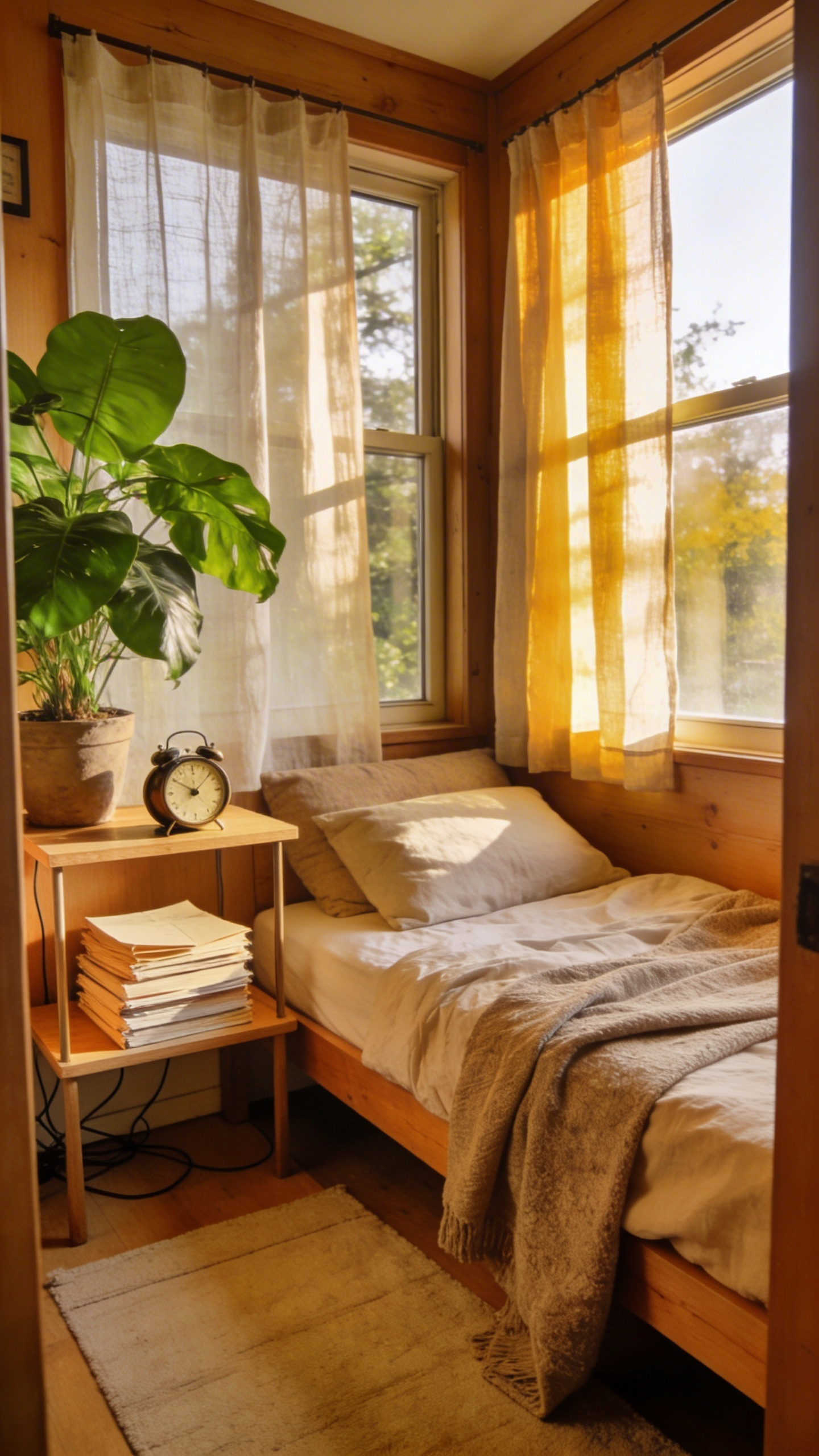
This approach addresses the “Precautionary Principle” regarding electromagnetic fields (EMFs). In micro-apartments, sleeping within three feet of a router or phone increases exposure significantly. Thus, you should establish a hard cutoff by moving charging stations to a separate room. This simple action eliminates both potential radiation exposure and the temptation of the “infinite scroll.”
Since physical walls are often impossible in small footprints, implementation relies on sensory cues. Ideally, utilize the “Amber Shift” by transitioning to warm, 2700K lighting after 8 PM. Replace digital tools with analog alternatives, such as a brass mechanical alarm clock. This removes the first point of digital contact in the morning. These shifts transform a cramped space into a luxurious, psychological refuge.
Phase 4: Intentional Curation (Mindfulness in Detail)
Intentional curation transforms a functional space into a curated sanctuary. This phase focuses on psychological “resonance” rather than simple utility. Experts refer to this as reducing “visual noise.” In fact, clutter in a resident’s immediate periphery triggers cortisol, the body’s stress hormone. The goal is “visual silence.” By keeping 80% of the room neutral, the remaining 20% of curated objects can truly “speak.”
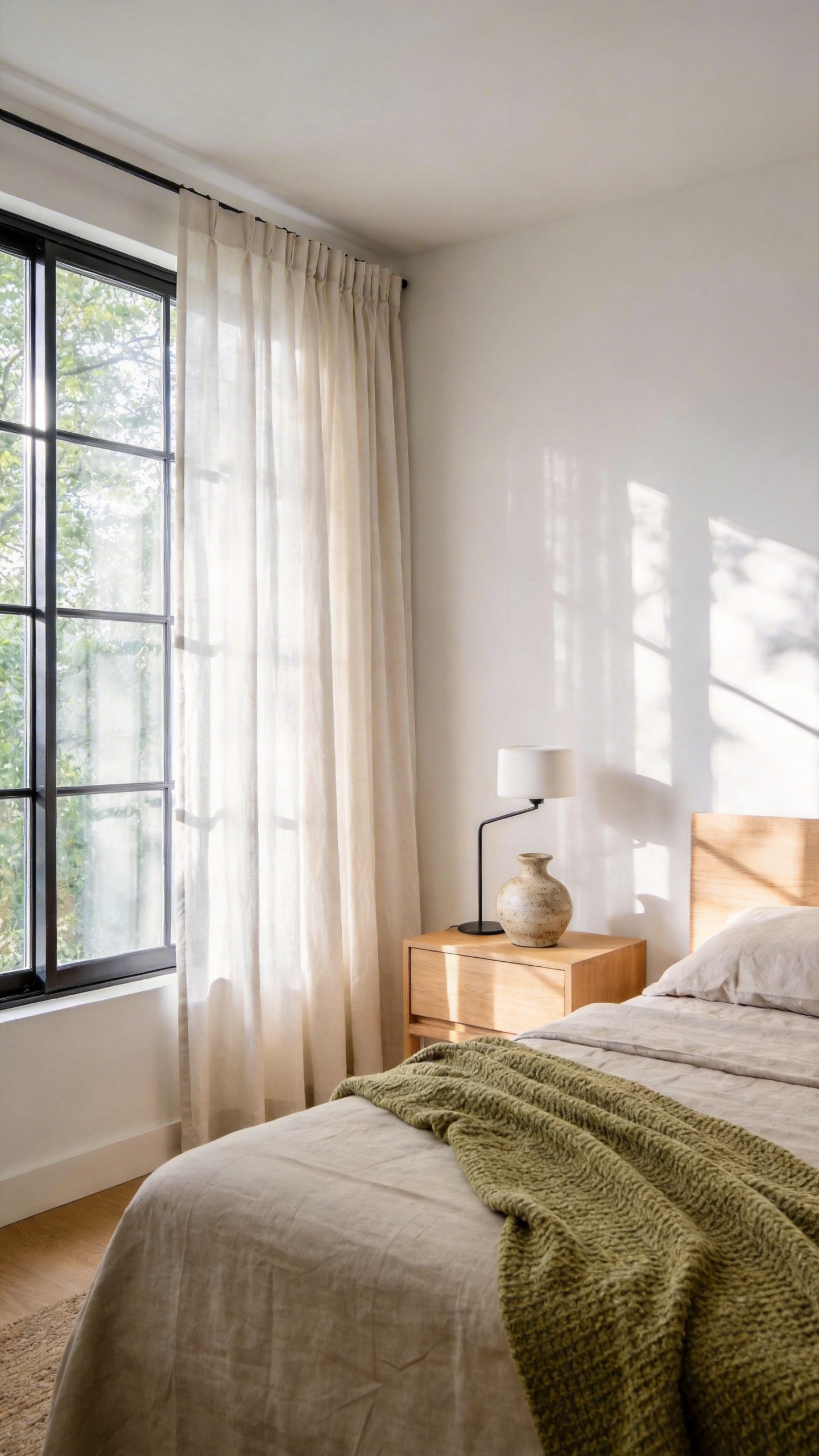
Consider the “First Object” principle. This concept focuses on the very first item seen upon entering. Ideally, this should be an “Identity Anchor,” such as a family heirloom or meaningful art. Research suggests repeated exposure to such narratives boosts emotional stability. Pay close attention to “Material Honesty.” In small rooms, you constantly brush against surfaces. Select authentic micro-textures like cool stone, rough clay, or real linen. Synthetic imitations create a subconscious sense of environmental dishonesty.
Embrace the “Slow Edit.” This approach rejects the fast furniture cycle. Instead, it mirrors the Japanese concept of *Ma*, respecting pure space as a functional element. Leave a corner empty until the absolute right piece appears. Arrange decor using “Scale Contrast.” Paradoxically, grouping one oversized piece with two smaller items makes a room feel generous. By prioritizing these details, a small footprint feels like a deliberate choice rather than a limitation.
16. Scent Architecture: Using diffusers with calming essential oils (lavender, bergamot) to define the space through smell rather than sight.
Scent architecture treats fragrance as a structural element rather than a mere decoration. It acts as an “invisible partition” that anchors a small bedroom. This approach moves beyond simple air freshening to actively manage spatial perception. Diffusing oils like bergamot can simulate sensory “brightness.” Because this citrus scent mimics the feel of natural daylight, it psychologically lifts the room’s weight. A cramped space feels significantly less claustrophobic.
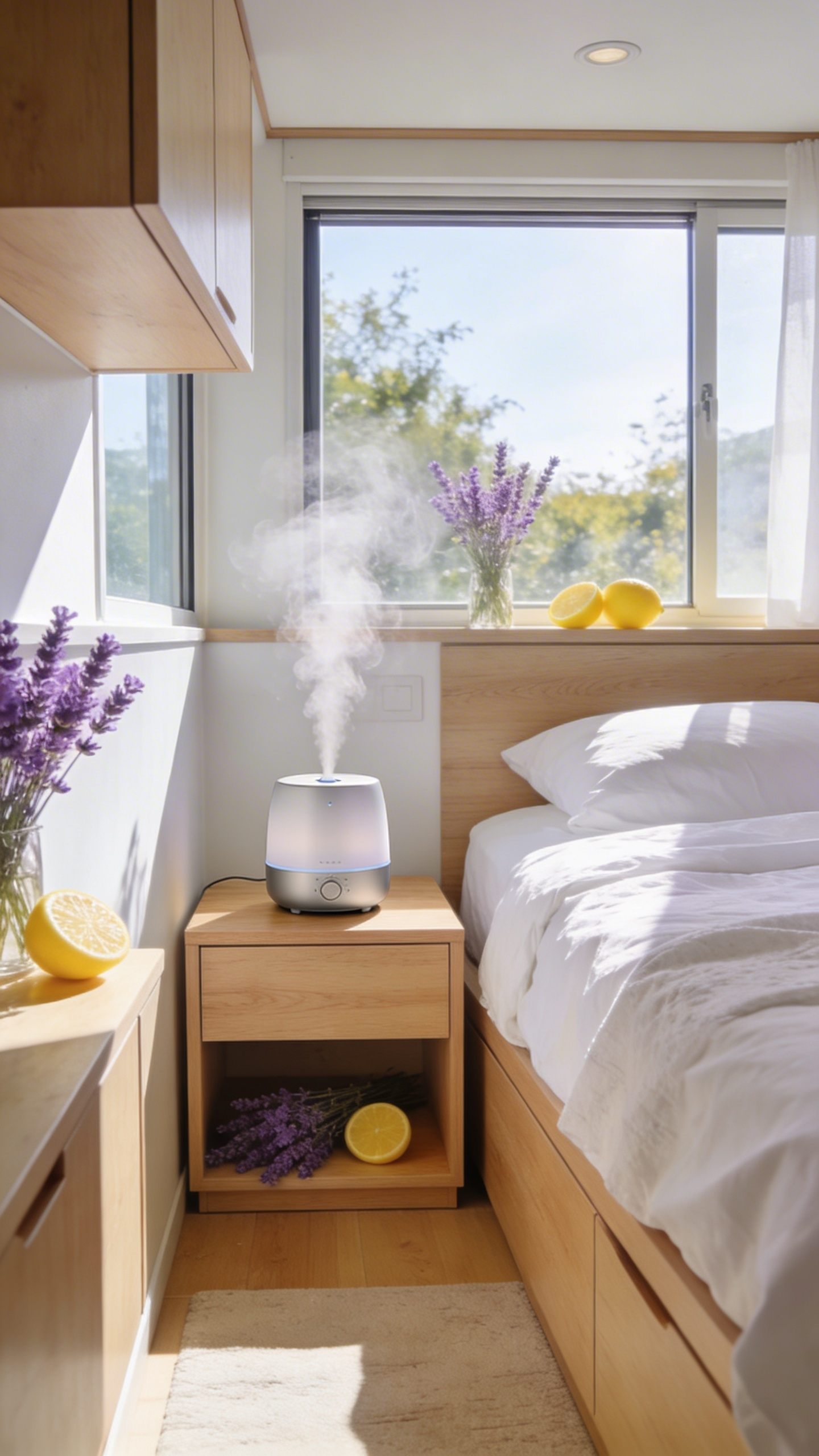
You can use “scentscaping” to create necessary boundaries. Placing a diffuser near the entryway effectively establishes a “scent gate.” The transition to lavender signals a crucial neurological shift to your brain. You knowingly cross from a productive zone into a restorative one. Biologically, this specific lavender-bergamot synergy decreases autonomic nervous system excitation. Thus, it physically lowers stress levels within the confined space.
Technical calibration is vital in smaller rooms to ensure the air remains breathable. To prevent “sensory crowding,” you must avoid heavy base notes like sandalwood. Instead, adopt a “micro-dosing” strategy for your diffuser. Utilize ultrasonic cycles to prevent scent saturation in your textiles. Ideally, the scent should fade into a soft background within ten minutes. This technique prevents olfactory fatigue, where the brain stops processing the smell. Historically, the Song Dynasty viewed fragrance as the “soul” of a room. Today, we apply this ancient wisdom to turn a small bedroom into a true sanctuary.
17. Strategic Negative Space: Deliberately leaving specific corners or surfaces empty to allow the mind to rest.
Strategic negative space functions as a “visual deep breath” for your home. In small bedrooms, we often fight for every square inch of storage. However, treating emptiness as a deliberate architectural element transforms the atmosphere. This mirrors the Japanese philosophy of *Ma*. Here, space acts as an active, intentional pause that gives meaning to surrounding objects.
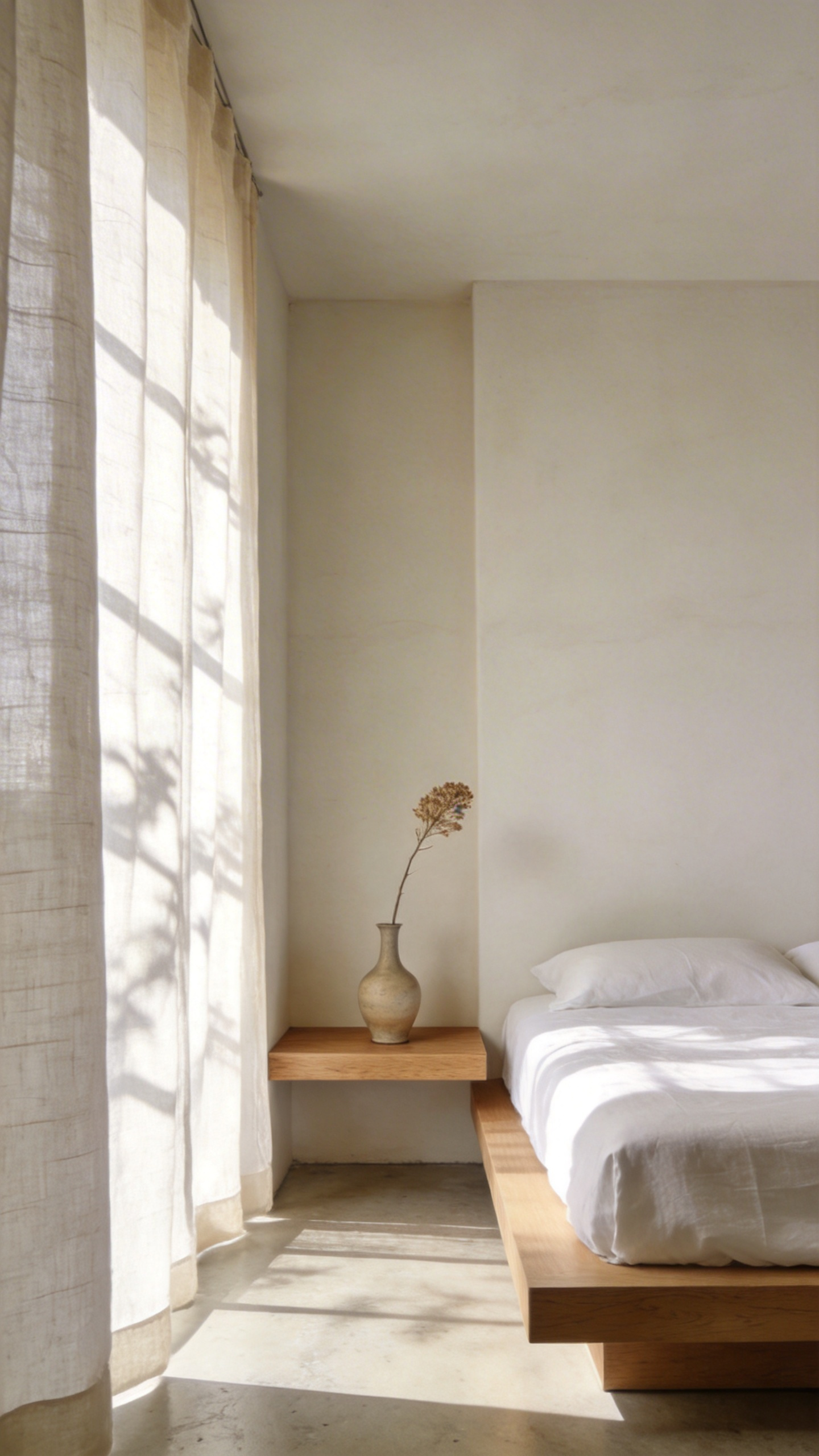
This approach is deeply rooted in wellness neuroscience. Remarkably, the brain continues processing visual data even in your peripheral view. According to Princeton University research, “visual crowding” competes for neural resources and triggers cortisol spikes. Providing empty surfaces offers a necessary “landing zone” for the eyes to rest.
Utilizing the “open corner” technique is highly effective. Simply, leave one corner of the room entirely free of furniture or decor. The eye follows the floor line uninterrupted to the wall. This “horizon effect” creates a sense of airiness, making the room feel significantly larger.
Apply the “360-Degree Spin” method to manage your layout. Ideally, alternate between textured focal points and calm, empty voids as you rotate. If a nightstand holds a lamp, leave the remaining surface bare. This rhythm prevents the room from “screaming” at you. It turns your sleeping environment into a true restorative sanctuary.
18. The Single Focal Point: Anchoring the room with one significant piece of art rather than a gallery wall to promote singular focus and calm.
In a compact bedroom, the brain constantly scans for spatial boundaries. A gallery wall of multiple small frames triggers rapid, jerky eye movements known as *saccades*. This high level of visual noise creates a subtle stress response. Conversely, a single, large-scale piece of art functions as a “visual anchor.” The eyes can finally rest, effectively lowering cognitive load and supporting the production of melatonin.
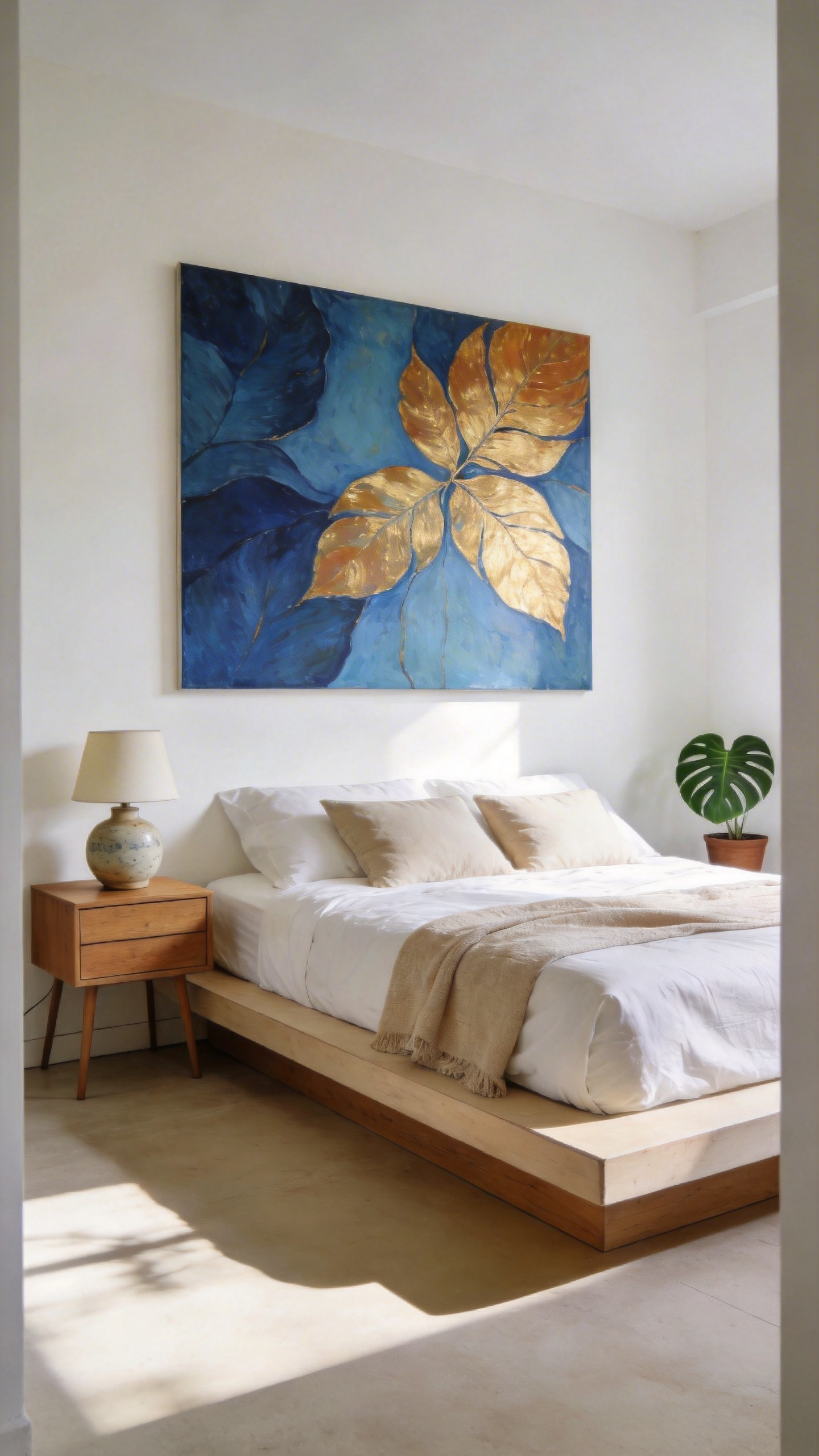
Designers utilize this “Scale Paradox” to make small rooms feel larger. Specifically, one oversized image creates an “Infinite Horizon” effect. This tricks the eye into perceiving depth rather than a flat wall. Unlike a busy collection, this approach honors the Japanese concept of *Ma*, or meaningful negative space. The surrounding empty wall becomes “breathing room” essential for a calming atmosphere.
To master this look, treat the artwork as a vertical extension of your headboard. Hang the piece six to ten inches above the mattress to firmly anchor the bed. Furthermore, ensure the art possesses “visual weight,” such as a textured canvas or a deep frame. Ultimately, mastering bedroom decor for small rooms is about more than organization. It is about creating a psychological retreat. By prioritizing quality over quantity and light over clutter, you transform a limited footprint into a bespoke, expansive haven.
Frequently Asked Questions
How do you make a small bedroom look expensive?
To make a small bedroom look expensive, focus on high-quality materials and “visual silence.” Use floor-to-ceiling drapery in natural linen to add vertical height, and invest in a single, large-scale piece of art to act as a sophisticated focal point. Layering textures like wool, silk, and washed cotton creates a rich, sensory experience that signals luxury without needing excessive square footage.
What colors make a small bedroom look bigger?
While white is the traditional choice, cool receding tones like misty lavender or light sage green can effectively trick the brain into perceiving more distance. Alternatively, the “color drenching” technique—painting walls, trim, and the ceiling the same saturated hue—erases hard boundaries and makes the room feel infinite and expansive rather than boxed in.
Is it better to have a big bed in a small room?
In a small room, a larger bed can actually make the space feel more intentional and luxurious if it is the primary focus. However, you must maintain “visual flow” by using low-profile platform frames and floating nightstands to keep the floor area visible. This satisfies the human need for “containment” and provides a sense of sanctuary without making the room feel overcrowded.