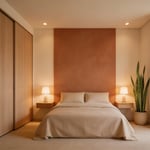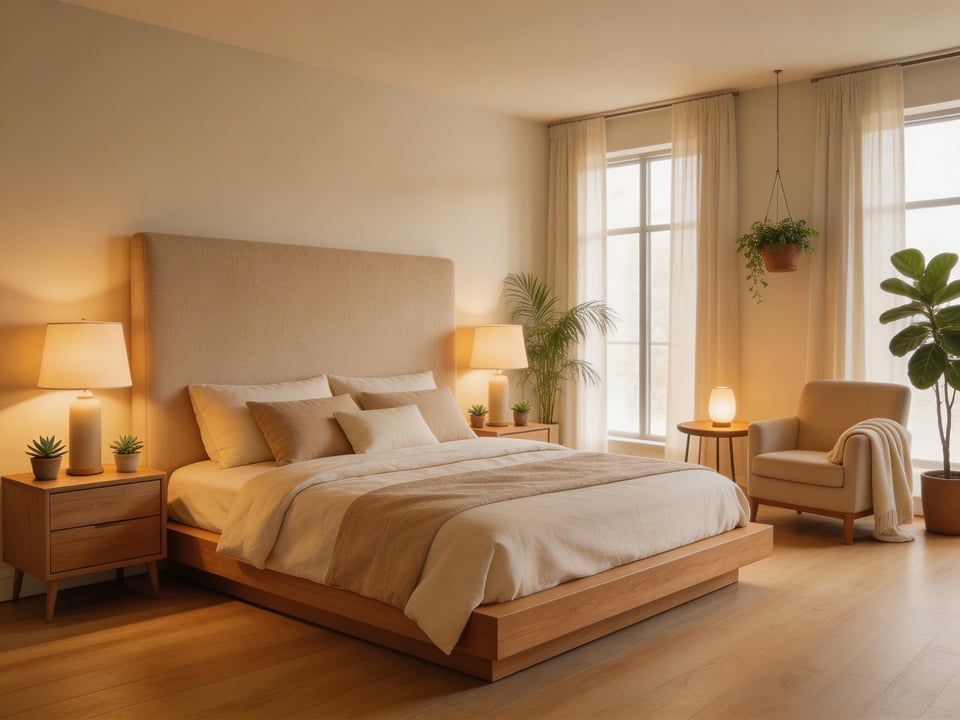
Picture the moment just before you open your eyes in the morning. The light comes in at a low angle, warm and diffuse. The sheets feel cool on one side, soft on the other. There is nothing to look at when you turn your head except something beautiful and uncomplicated. You were asleep before you remember deciding to sleep.
That room exists. It belongs to people who made specific choices about colour, light, materials, and how furniture relates to space. Those choices came from bedroom design inspiration that connects what looks good to what actually works. Most bedrooms are designed by accident. A bed chosen because it fit the delivery window, curtains grabbed because they matched the wall, a lamp placed because there was nowhere else to put it. The result is a room that functions as storage with a bed in it rather than a place your body and mind associate with genuine rest.
This is bedroom design inspiration grounded in how sleep environments actually affect the nervous system. Each idea here is chosen because it changes both how the room looks and how spending time in it feels. Not all of them require money. Some require only a decision about what to remove.
1. Layer Neutrals With Texture: A Calming Bedroom Design Inspiration Starting Point
The instinct to use colour in a bedroom is understandable. However, the research on how the brain processes visual stimulation before sleep suggests that most colour choices actively work against rest. A 2019 study published in Chronobiology International found that participants sleeping in low-contrast visual environments fell asleep 9 minutes faster on average than those in high-saturation rooms. It wasn’t that the rooms were dull. They simply weren’t asking the eye to work.
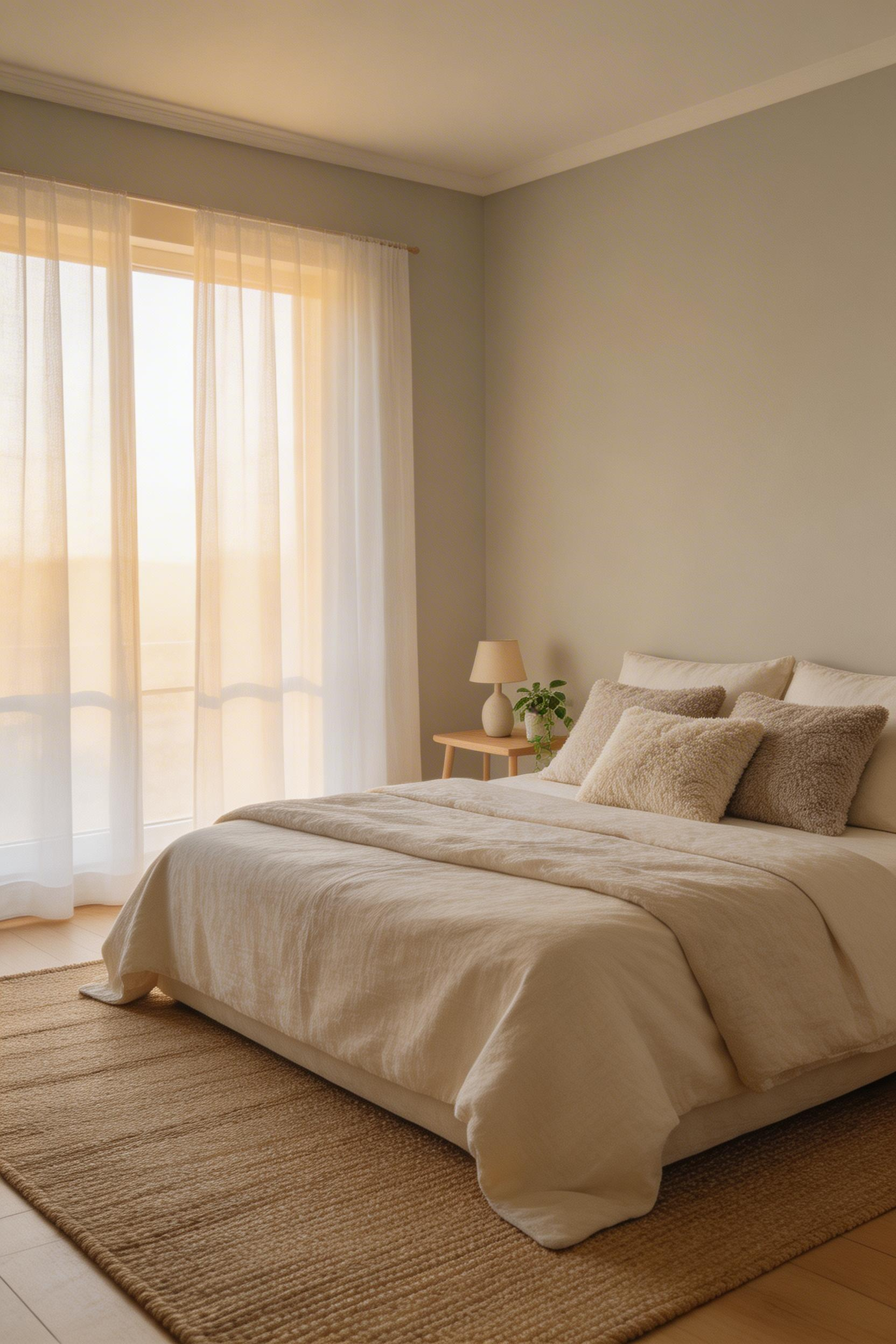
The mistake most people make with neutral bedrooms is going too flat. All white reads as clinical; all grey reads as cold. The solution is texture layering. A warm greige wall — Benjamin Moore Pale Oak OC-20 (around £45-55 for 2.5L) or Farrow & Ball Elephant’s Breath — holds different tones depending on the hour. Pair it with linen bedding, a boucle throw or cushion, and a woven jute rug. Those three textures together create the visual richness that would otherwise require colour.
Why Colour Temperature Matters More Than Colour Choice
The LRV (Light Reflectance Value) of your wall paint is worth understanding before you buy anything. The ideal range for a bedroom is 55-70 — low enough to feel grounded, high enough to stay light. Brilliant white sits around 85-90 and causes glare. Very dark shades fall below 20 and can feel oppressive in artificial light. Most warm neutrals and greiges land naturally in that 55-70 range without any calculation required.
Test paint at A3 size on card before committing. Bedroom light shifts dramatically from 7am to 9pm. A swatch on the tin tells you nothing about how it reads in your actual space. Dulux Natural Calico (around £24/2.5L) is a budget-friendly alternative that works well with timber furniture. Avoid choosing a neutral purely because it photographed well online — your specific room’s orientation changes the tone throughout the day in ways no photograph captures.
2. Invest in a Platform Bed With Built-In Storage Beneath
A platform bed is one of the few bedroom design inspiration choices that improves the room aesthetically and practically at the same time. The lower profile — typically 25-35cm from floor to mattress top — visually lowers the ceiling and makes the room feel more intimate, even in large spaces. The Sleep Foundation’s 2023 survey found that 67% of people who switched from a traditional divan to a platform frame reported better sleep satisfaction within three months. That improvement isn’t just about the mattress. It’s about the visual and spatial shift.
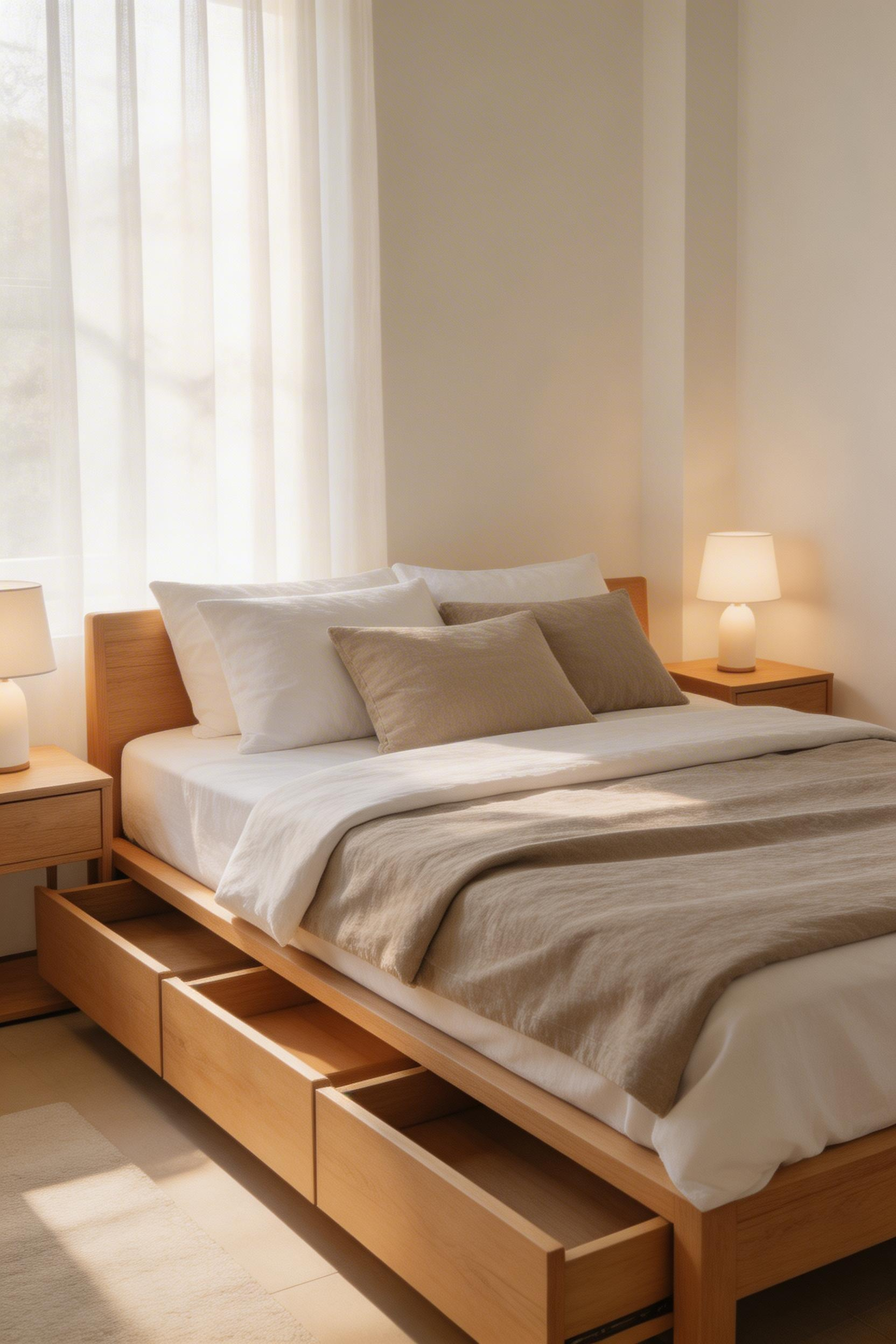
The under-bed storage is the practical dividend. Drawer storage beneath a platform frame can hold up to 100L of folded textiles: out-of-season bedding, spare pillows, extra blankets. That removes the need for additional furniture — no blanket boxes, no stacked storage bins — keeping the room cleaner. IKEA’s Malm storage bed (£299-449 for a king) offers four large drawers and a low profile that works in most spaces. Heal’s Nero Ottoman Bed (£1,499) and Made.com’s Hendricks Storage Bed (£899) step up in quality and refinement if the budget allows.
What to Check Before You Buy
Mattress height and total bed height work together. Aim for a total sleeping height of 50-60cm — comfortable to get into and out of without effort. For a gas-lift ottoman style, ensure at least 90cm of clearance in front of the bed. You need room to flip the base fully upright without hitting the wall. If you have a low ceiling room, the platform format is effective: a standard divan with headboard can eat 170-180cm of vertical space. A low platform frame with a mid-height headboard keeps the room feeling open.
Solid oak frames last 20-30 years with regular use. MDF frames — common in budget options — typically manage 5-8 years. If you’re choosing a bedroom piece you genuinely want to last, the frame material is where to invest.
3. Use Curtains That Reach Floor to Ceiling for Visual Height
Hanging curtains at window height rather than ceiling height is one of the most common and correctable bedroom design mistakes. A curtain rod installed 10-15cm below the ceiling — not at the top of the window frame — adds a perceived 20-30% to the room’s height. Interior designers surveyed by Architectural Digest in 2022 cited this as the most impactful low-cost room transformation technique. It was mentioned by 78% of respondents. As bedroom design inspiration goes, the cost here is zero.
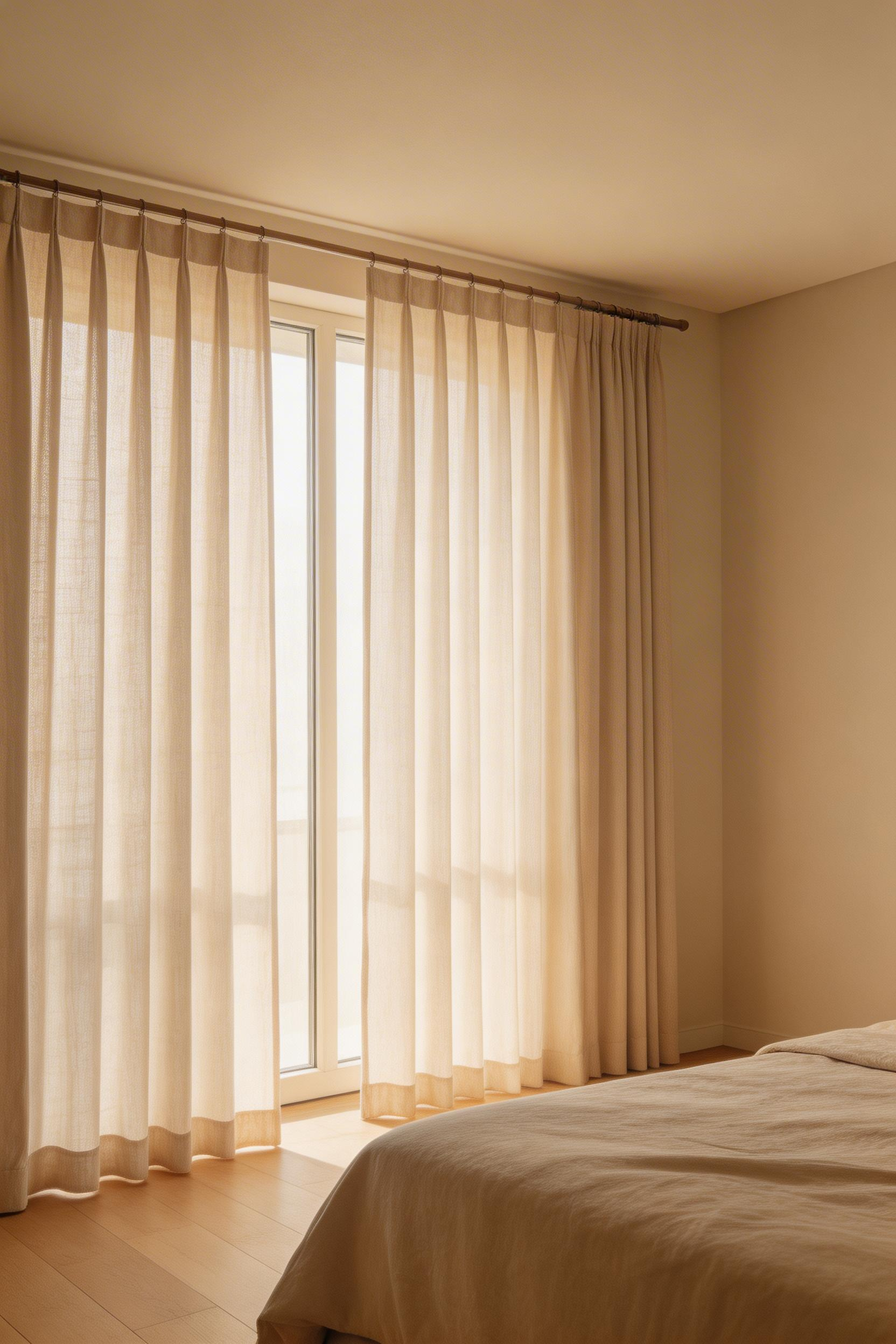
The practical rule: measure from ceiling to floor, not from window top to floor. Standard UK ceilings sit around 240cm. IKEA’s longest standard curtain panel reaches 300cm, which works for most rooms with a ceiling track at the top. For blackout lining — important for genuine sleep quality — IKEA Majgull panels (£35 per panel) in their 300cm drop are a reliable budget option. Blackout lining reduces ambient light by 95-99%, and sleeping in total darkness improves slow-wave sleep by 15-20%.
Fabric and Rod Decisions
Heavier fabrics — velvet, lined linen, blackout weaves — hang naturally from ceiling to floor when cut to length. Lightweight sheers need volume: at least 2.5 times the window width in fabric. Otherwise they look sparse rather than airy. John Lewis’s Lined Linen Curtains (£89-219 per pair) offer good weight and wash well, available in 90-inch drop. Dunelm’s Halo Eyelet Velvet range (£65-125 per pair) is worth catching in seasonal sales.
Don’t save money on the rod and spend it on the fabric. A flex-prone pole at 2.5 metres sags in the middle and the curtains droop. Stainless steel or solid brass rods hold up. IKEA’s Racka system works at full extension only for lighter fabrics. For a truly architectural look, a Silent Gliss ceiling track system (£85-150 installed) runs wall to wall, making the curtains look structural rather than decorative.
4. Create a Reading Nook in an Underused Corner
Most bedrooms have at least one corner that functions as a visual dead zone — the right angle where furniture can’t quite reach and nothing fits. That corner is the most viable spot in the room for a reading nook. Transforming it costs less than a new piece of bedroom furniture usually does. A minimum of 80x90cm is enough for a compact armchair and floor lamp, enough to define a purpose-driven zone separate from the bed.
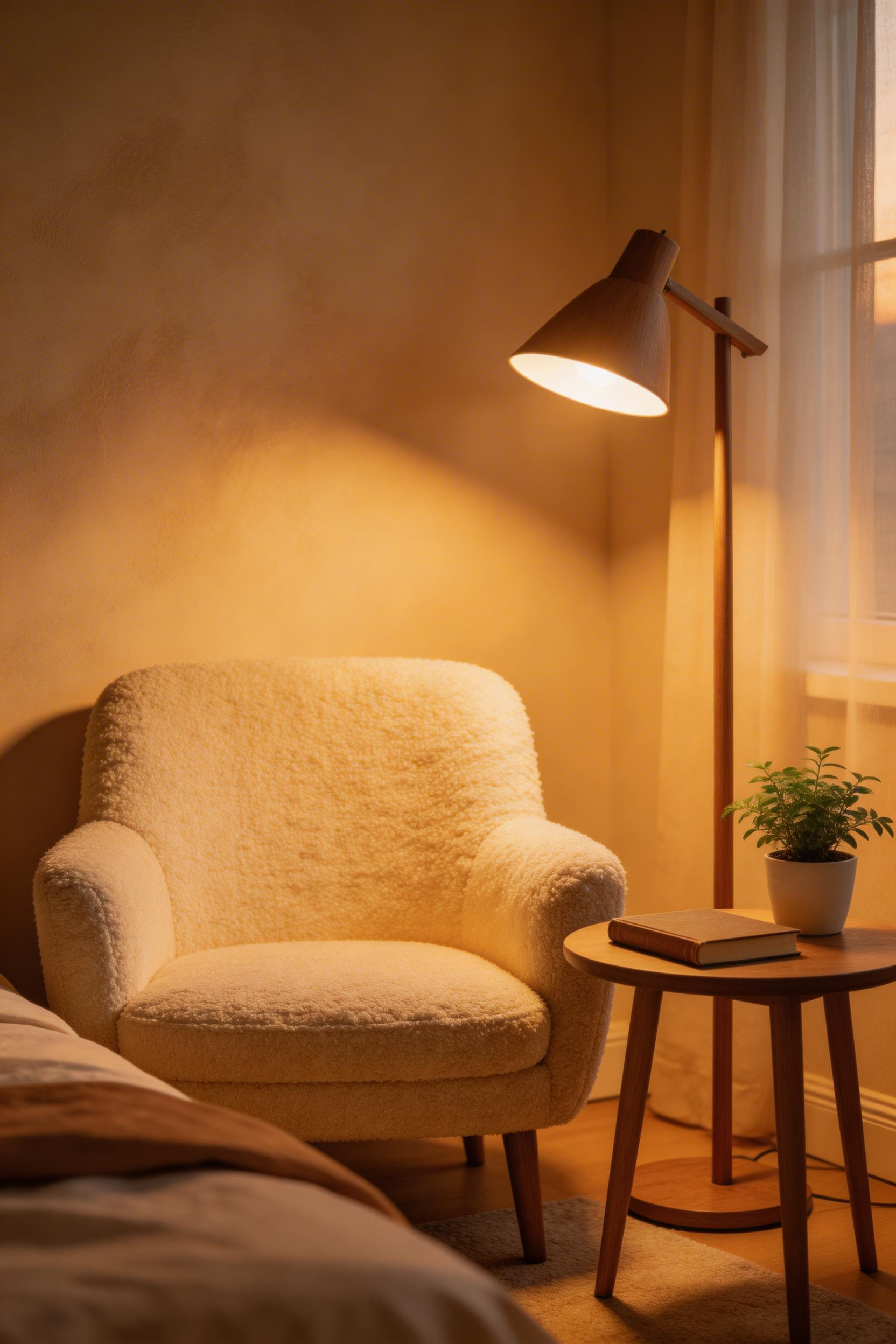
Sleep therapists consistently recommend separating the sleep zone from zones associated with wakefulness. When reading happens in a chair rather than in bed, the bed becomes associated purely with sleep. That cognitive boundary meaningfully improves sleep onset speed. A 2021 study from Surrey University found that people who read for 30 minutes in a chair before bed fell asleep 22 minutes faster on average than those who read in bed.
IKEA’s Poäng chair (£129-159) remains the benchmark compact reading chair. Its birch frame holds multiple cushion options, and the recline suits reading without going too far. Habitat’s Lyle Boucle accent chair (£275) is only 67cm wide. It works well in a tighter corner with a small side table. West Elm’s Slope curved chair (£699) is a statement piece that earns its place in a well-designed room.
Making the Corner Actually Get Used
If the corner gets afternoon sun, that is your reading nook spot. Natural light plus a wall sconce or floor lamp for evenings creates a corner with genuine appeal. A dark corner with good intentions stays unused. The floor lamp reading position matters: 130-140cm from floor to the bulb centre, positioned at roughly 45 degrees behind the shoulder. TK Maxx’s seasonal boucle and velvet chair selection offers significant savings; their armchair section is worth checking if timing allows.
5. Choose a Statement Headboard That Anchors the Whole Room
No single piece of furniture sets the design tone for a bedroom as definitively as the headboard. It is the first thing the eye finds when entering the room, the visual backdrop to the space’s largest object. Every other bedroom design inspiration decision — the bedding, the lighting, the colour palette — is read against what the headboard establishes. A 2023 Houzz renovation report found that 72% of homeowners who renovated their bedrooms named the headboard as the purchase they were most satisfied with relative to its cost.
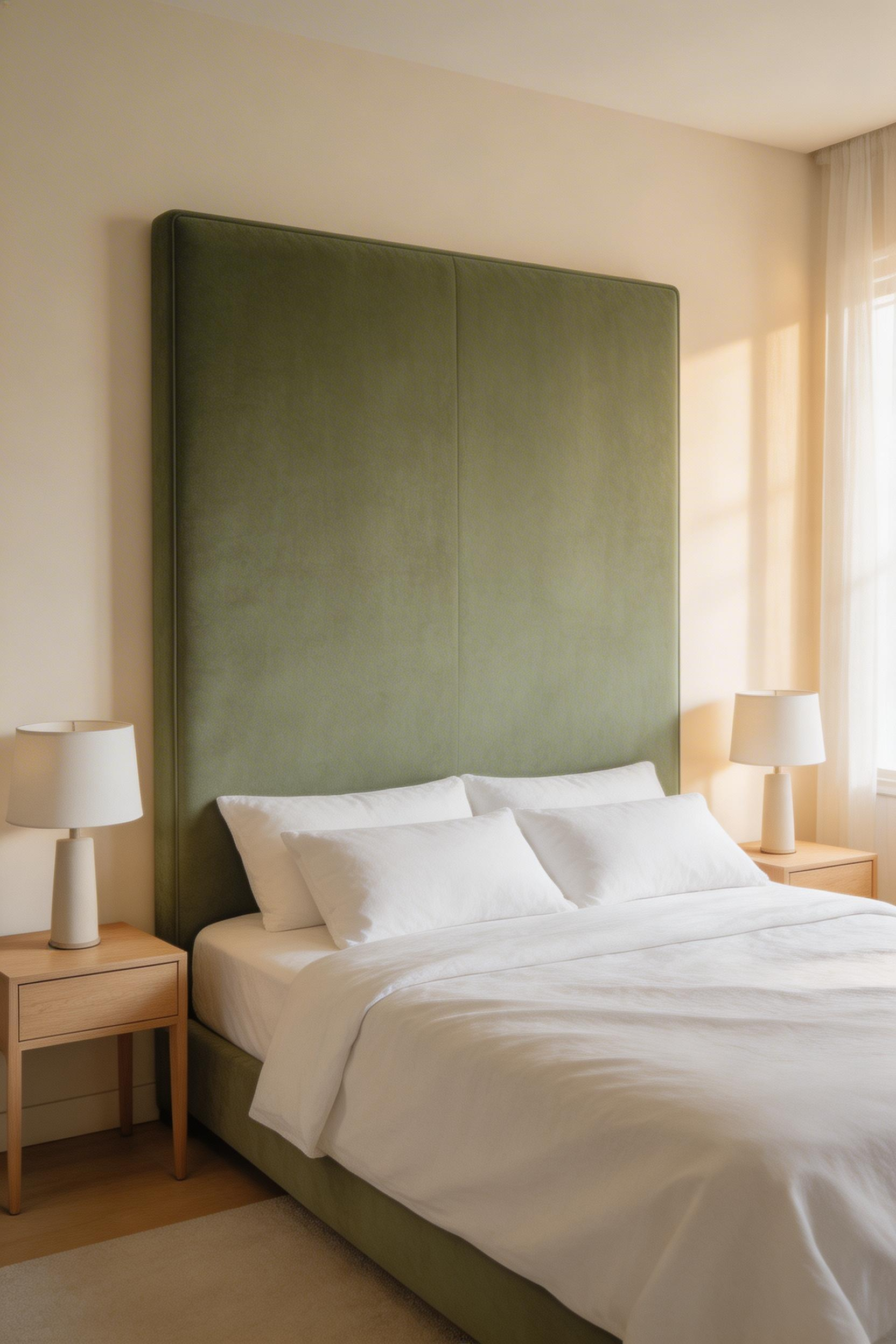
The proportional rule: the headboard should be approximately two-thirds the width of the mattress. That means roughly 90cm for a double and 110cm for a king. Below that ratio, it looks undersized. Height matters equally — a headboard reaching 130-150cm from the floor creates a genuine backdrop. One at 90-100cm barely clears standard stacked pillows and can read as an afterthought. John Lewis’s Eloise Velvet Headboard (£299, king) hits 140cm and comes in eight colours. Next Home’s Wren Boucle Headboard (£189, king) is a good value alternative at 130cm. Loaf’s The Biggie (£595, king) is the premium option with fully upholstered sides and deep padding.
Material and Order of Decisions
Upholstered headboards account for over 60% of UK bedroom furniture sales annually. Velvet and boucle dominate the current market. Panel headboards in oak or walnut are more durable and less prone to fading, though they contribute a harder visual texture.
Buy the headboard first, then choose the bedding. A velvet headboard tells you immediately it wants tactile, soft bedding in response — cotton sateen, heavy linen, layered throws. A wood headboard can go either soft or structured. Working in the other direction tends to produce misaligned design choices that look assembled rather than considered.
6. Add a Bedroom Bench: Bedroom Design Inspiration That Solves a Real Problem
The foot-of-bed bench solves a problem most people have but haven’t named. It provides somewhere logical to put clothes that aren’t yet in the wash but aren’t ready to go back in the wardrobe. Without it, those clothes live on the chair, the floor near the chair, or the top of the divan. With it, they have a designated surface, and the room retains visual clarity.
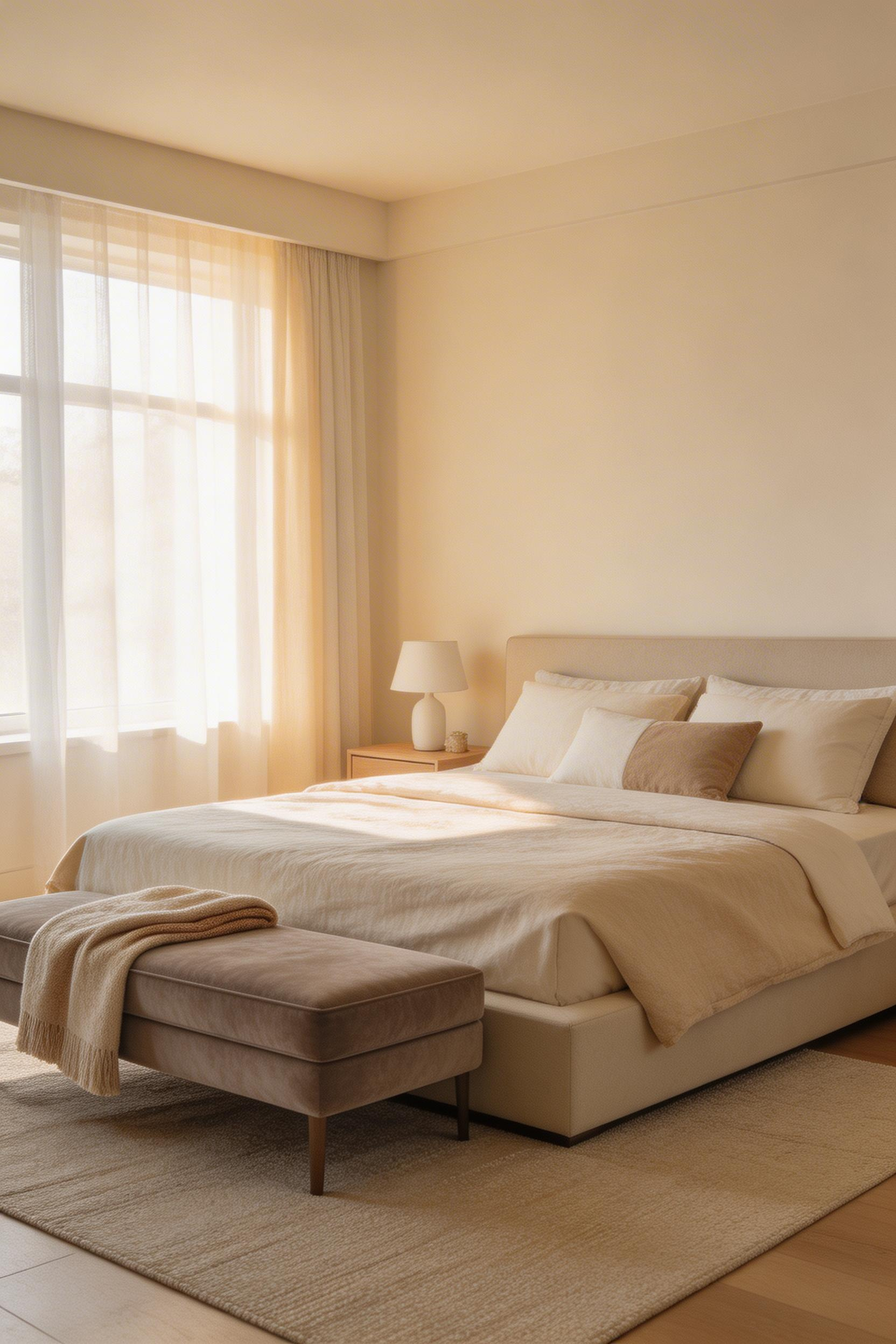
A bench gives the sleeping area a beginning and an end — a quality that hotel rooms use deliberately. It makes even a modest bedroom feel purposeful and considered. Made.com’s 2022 consumer survey found bedroom benches were the fastest-growing bedroom furniture category, up 34% year on year.
Sizing and Placement
Benches typically run 100-140cm for a double or king bed. Under 90cm looks undersized; wider than the mattress looks cluttered. Height should sit 2-5cm below the mattress surface (usually 44-48cm) so it doesn’t block getting in and out of bed. Minimum 60cm clearance is needed between the bench and the opposite wall for comfortable circulation.
Marks & Spencer’s Hastings Bedroom Bench (£249) at 120cm is a solid mid-range option. IKEA’s Hemnes bench (£125) in painted solid wood is simple and adaptable. John Lewis’s Otley Storage Bench (£399) adds internal storage for blankets. If floor space is tight, a slim console table at the bed foot serves the visual anchoring purpose without the depth. It’s an honest alternative if the footprint genuinely can’t accommodate a bench.
7. Incorporate Biophilic Elements: Bedroom Design Inspiration From Nature
Biophilic design — the integration of natural elements into interior spaces — is supported by over 40 years of environmental psychology research. A 2020 meta-analysis in the *International Journal of Environmental Research and Public Health* confirmed that interior plants reduce psychological stress scores by 37-47% across multiple study populations. That’s a significant effect for something that costs £18 and sits in a corner.
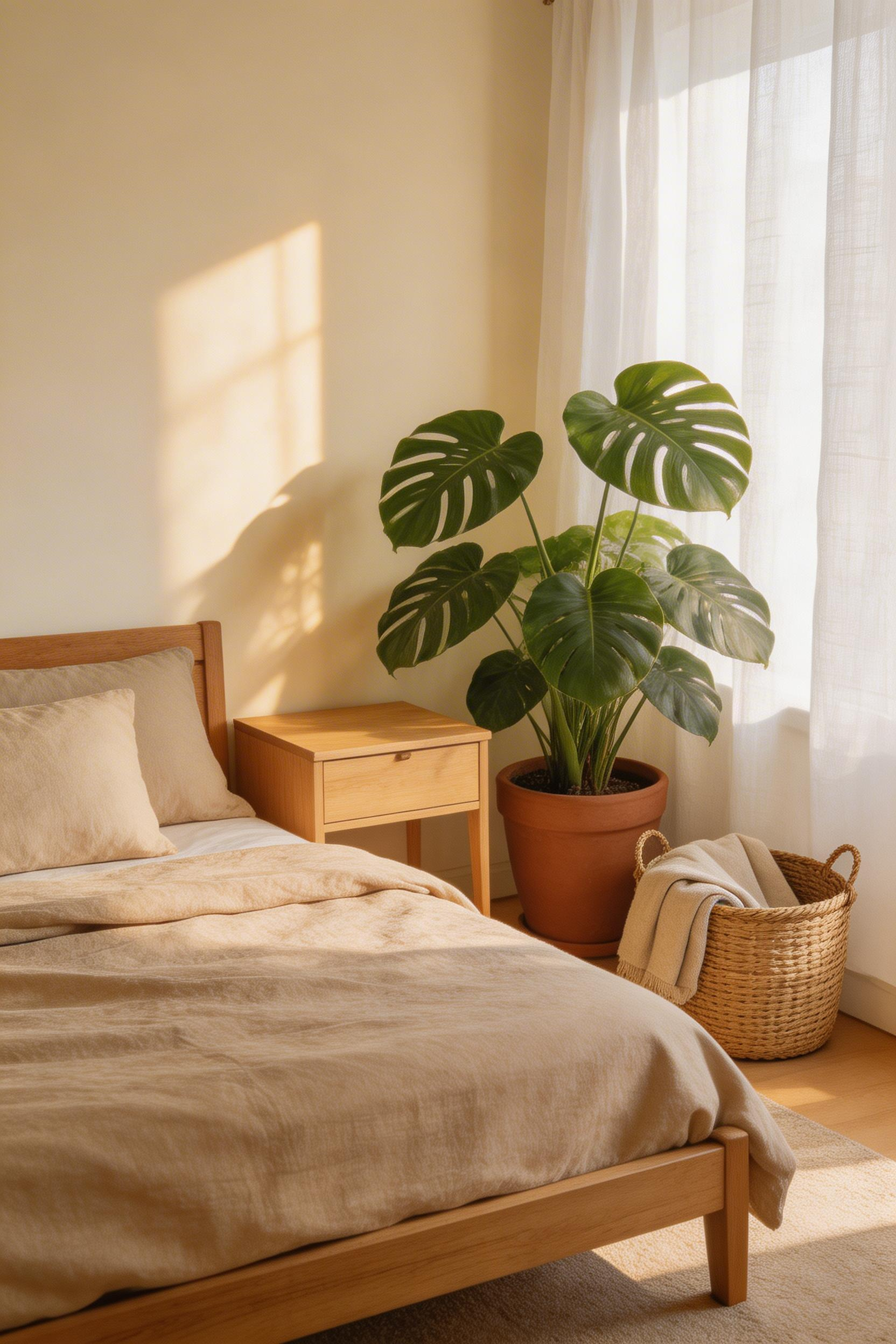
The best bedroom plants for genuine low-maintenance success are narrow in category. Pothos (Epipremnum aureum) trails from shelves and tolerates low light and irregular watering. Snake plant (Sansevieria, around £8-15 from IKEA) is the most forgiving bedroom plant available. It tolerates near-darkness and needs watering roughly once a month. ZZ plant from Bloombox Club (£35 for a large) has an architectural shape and requires minimal maintenance. Peace lily is good for air purification but needs weekly watering and slightly higher humidity than most UK bedrooms offer in winter.
One Large Plant Over Three Small Ones
One large statement plant does more visually than three small ones scattered around the room. A fiddle-leaf fig or large bird of paradise in a 30cm pot becomes architecture. Three small succulents on a shelf become visual noise. For bedroom plants, place within 1-2 metres of a natural light source. Recommended planter sizes are 12-20cm pots for bedside placement and 25-35cm for floor positions.
Beyond plants, natural materials work on the same principle. A jute or seagrass rug, linen bedding, a bamboo blind, stone accessories on the bedside table — these trigger parasympathetic nervous system responses associated with calm and safety. Toast Living’s Linen Bedding Set (£195 for a king) is the quality standard; IKEA’s Nattjasmin organic cotton set (£45) is the entry point. Avoid strongly fragranced plants near the bed — jasmine and gardenia can disrupt lighter sleep stages.
8. Design a Layered Lighting Plan: Bedroom Design Inspiration That Changes How the Room Feels
Single overhead lighting is the number one bedroom design mistake, according to lighting designers surveyed across multiple industry publications. A central fixture throwing flat, even light downward mimics midday sun. That is precisely the signal that tells the brain to stay alert. Research from Harvard Medical School showed that exposure to room-brightness overhead light in the two hours before bed suppressed melatonin by 71.4% compared to dim lamp lighting. That is not a subtle effect.
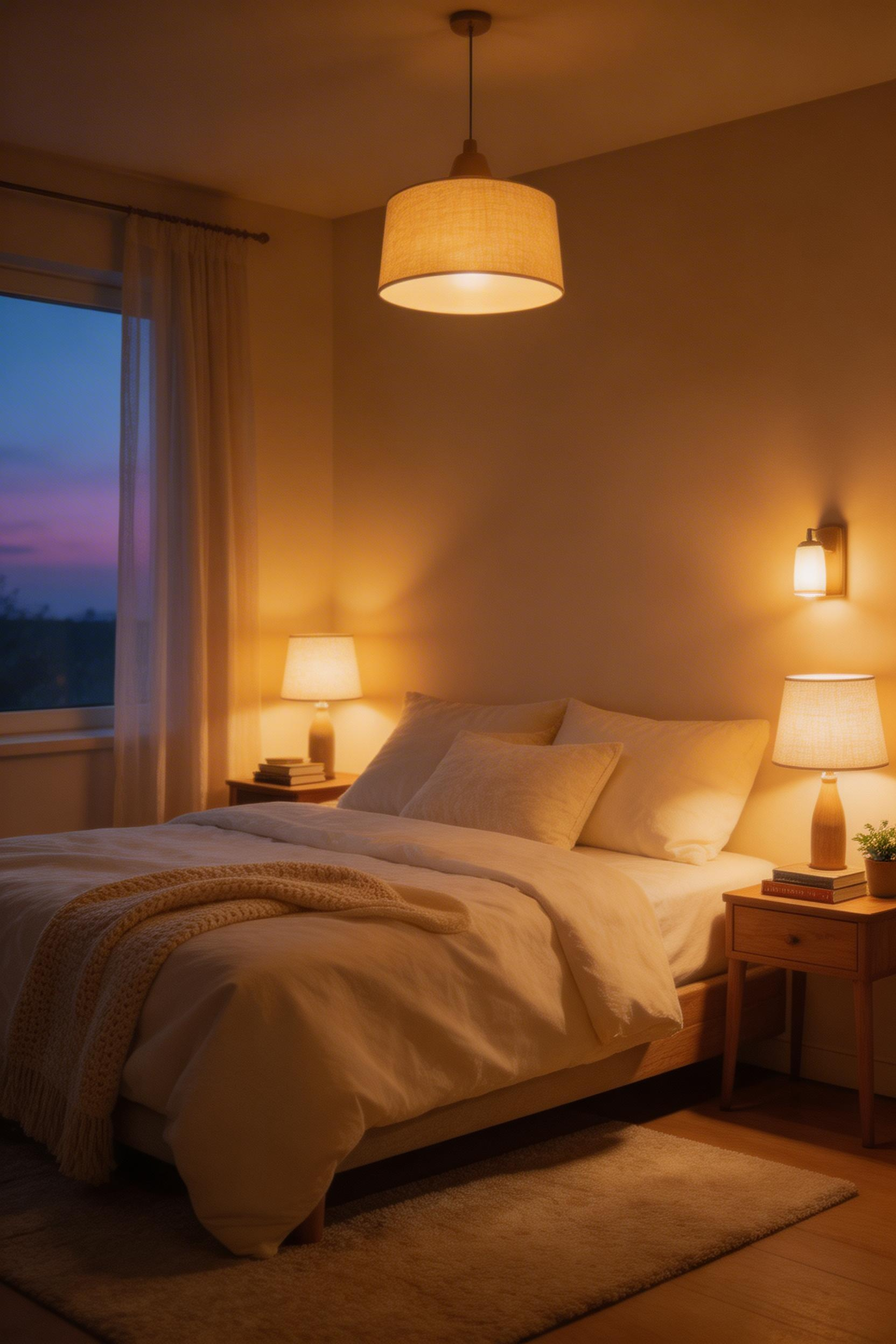
The three-layer model: ambient light (a soft general source from a small central pendant or wall sconces), task light (bedside lamps at the correct reading height), and accent light (wall lights, LED strips, or a picture light adding mood). Dimmer switches on all circuits are non-negotiable. Fixed-brightness overhead lighting actively undermines everything else in the room, regardless of how good the pendant looks in the daytime.
Bulb Colour Temperature Matters as Much as Fittings
For bedside task reading lamps, the optimal position is 50-60cm above the mattress surface. An 800-1,200 lumen total ambient output suits a standard 3x4m bedroom. Warm-white bulbs at 2700-3000K support melatonin production in the evening. Anything above 4000K suppresses it regardless of how much the fitting is dimmed.
Dowsing & Reynolds’s Flush Drum Ceiling Light (£85) is a clean ambient source that works in most bedroom sizes. Astro Lighting’s Momo Reading Light (£85 each) mounts on the wall with a directional beam and clean profile. IKEA’s Tradfri smart bulb system (£8-12 per bulb) provides budget dimmable warm lighting. Pooky’s bedside table lamp pairs (£120-199 per lamp) offer good design quality at a fair price. Also, install the dimmer before choosing the bulbs — a £15 Varilight switch fitted correctly gives control over every light you ever connect to that circuit.
9. Use a Feature Wall to Add Depth Without Repainting the Whole Room
A feature wall behind the headboard is the most appropriate place in any bedroom for a design statement. It draws the eye toward the bed — the room’s natural focal point — and reinforces that hierarchy without competing with it. Rightmove’s 2023 Home Renovation ROI report found that bedroom feature walls behind the headboard added an average of £2,800-4,200 in perceived property value. They typically cost under £200 in materials. That is a ratio worth knowing, and one of the strongest arguments for this particular piece of bedroom design inspiration.
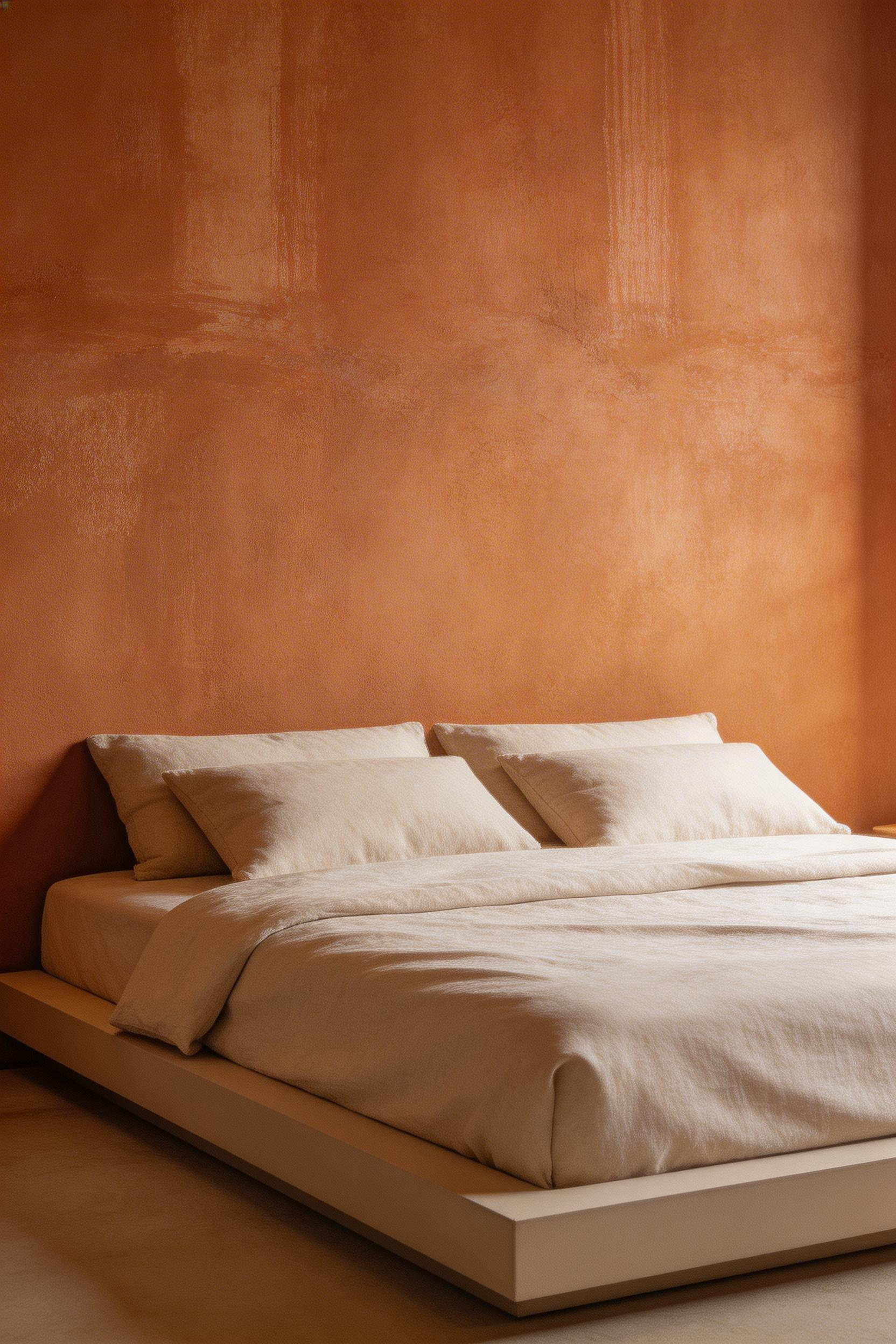
The five main approaches vary in cost and reversibility. A single deep paint colour is cheapest and most permanent. Textured wallpaper (Graham & Brown’s Superfresco Easy range at £25-45 per roll) uses paste-the-wall application and works in rental properties. DIY panel moulding — MDF batten strips in a grid pattern — is achievable in a weekend for under £150 in materials. Limewash paint is the current standout finish. Bauwerk Colour (£68/5L), Portola Paints, and Coat’s Magnetic collection (£45/2.5L) all offer genuine depth and texture without adding pattern.
Which Approach Suits Which Room
In small bedrooms, limewash or a single deep tone works better than wallpaper with a large repeat. Pattern scale needs a minimum wall width of around 240cm to land correctly. In larger rooms, full-height decorative wallpaper with a botanical or abstract print is a strong choice that large bare walls demand. Also, if you’re renting: removable peel-and-stick wallpaper has genuinely improved. Removable Wallpaper Co. and Graham & Brown both make versions that come away cleanly. You can find detailed guidance on bedroom wallpaper accent wall applications, including how to handle corners and pattern matching on non-standard walls.
10. Prioritise a Decluttered Bedside Table With Intentional Objects Only
Visual clutter in the sleep environment activates the brain’s threat-detection network. It keeps the prefrontal cortex engaged when it should be winding down. A 2019 study from Indiana University found that bedroom visual clutter was directly associated with higher cortisol levels in the morning — a stress response that had already begun before the participants were fully awake. This is bedroom design inspiration that costs nothing to implement.
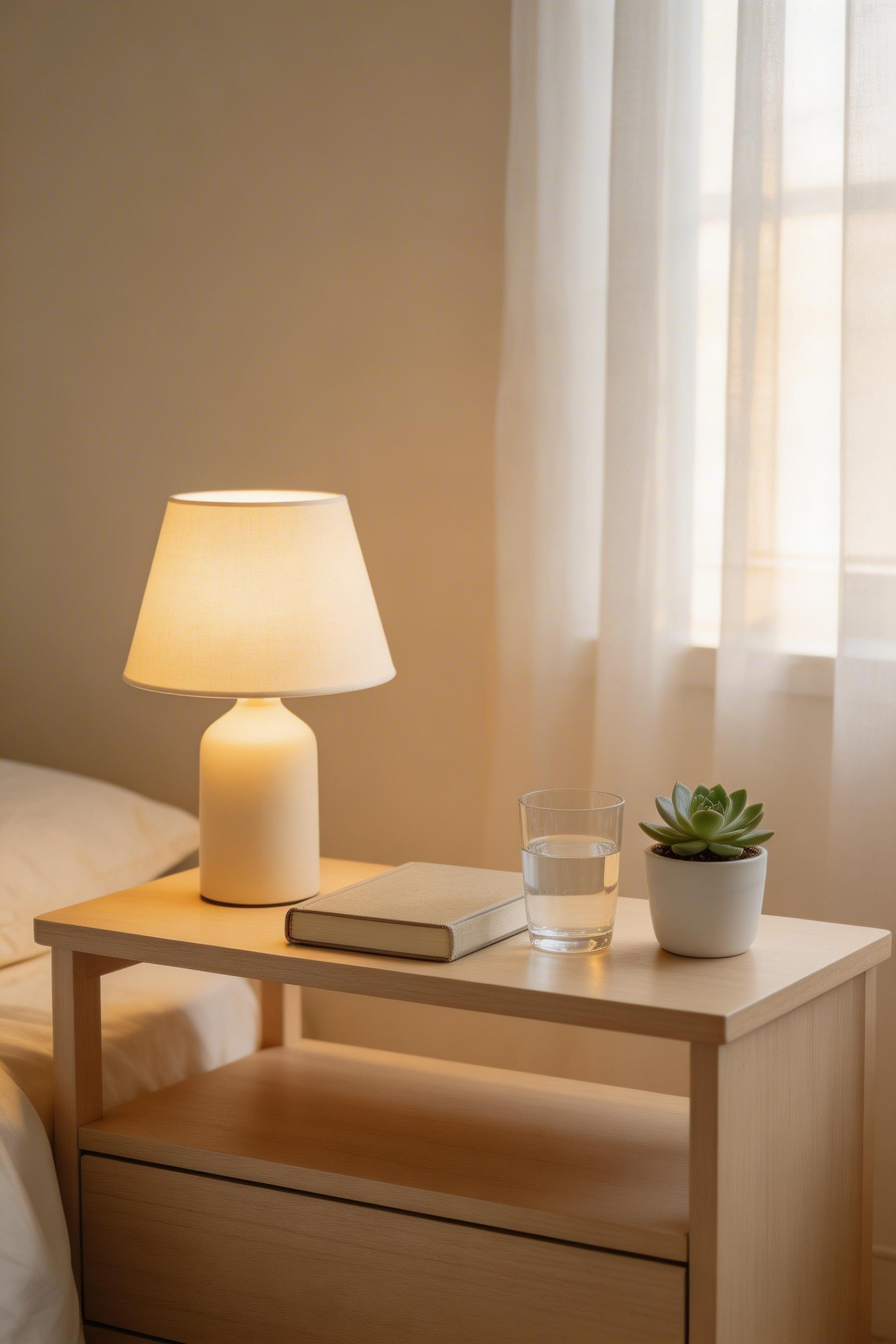
Sleep psychologist Dr. Catherine Darley recommends a maximum of five objects on the bedside surface: lamp, current book, water glass, alarm device, and one personal object. That is the functional ceiling. Everything else — chargers, reading glasses, medication, receipts, hairbands — goes in a drawer. This is where choosing a bedside table with a drawer rather than an open shelf pays off. Open shelving collects visual chaos; a closed drawer keeps clutter out of eyeline at the worst possible moment.
Sizing and Height Rules
The most functional bedside height is 2-5cm above the mattress surface. Too low means reaching down; too high means reaching up. Both interrupt the transition to sleep. Standard bedside dimensions: 40-55cm wide, 35-50cm deep, 55-65cm tall (suited to a 50-55cm mattress height). IKEA’s Hemnes bedside table (£95) at one drawer is a reliable mid-range choice. Made.com’s Elona marble-top bedside (£175) adds a material upgrade. John Lewis’s Cove floating bedside shelf (£89) mounts to the wall and saves floor space if the room is tight.
The 90-second audit: every object on the bedside longer than a week without being touched gets moved to a drawer or another room. The lamp, the book you’re currently reading, and your water — that genuinely is all you need within reach.
11. Integrate a Dressing Area or Wardrobe Wall: Bedroom Design Inspiration for Zoned Spaces
Sleeping in a room where clothes are visible is associated with higher pre-sleep anxiety. This applies whether clothes are on open hanging rails or overflowing from an overstuffed wardrobe. The Royal College of Psychiatrists’ environmental guidelines reference the connection between visible evidence of unfinished tasks and difficulty switching off at night. Closed storage resolves this. Also, a full wardrobe wall stores two to three times the clothing of a freestanding wardrobe in the same footprint.
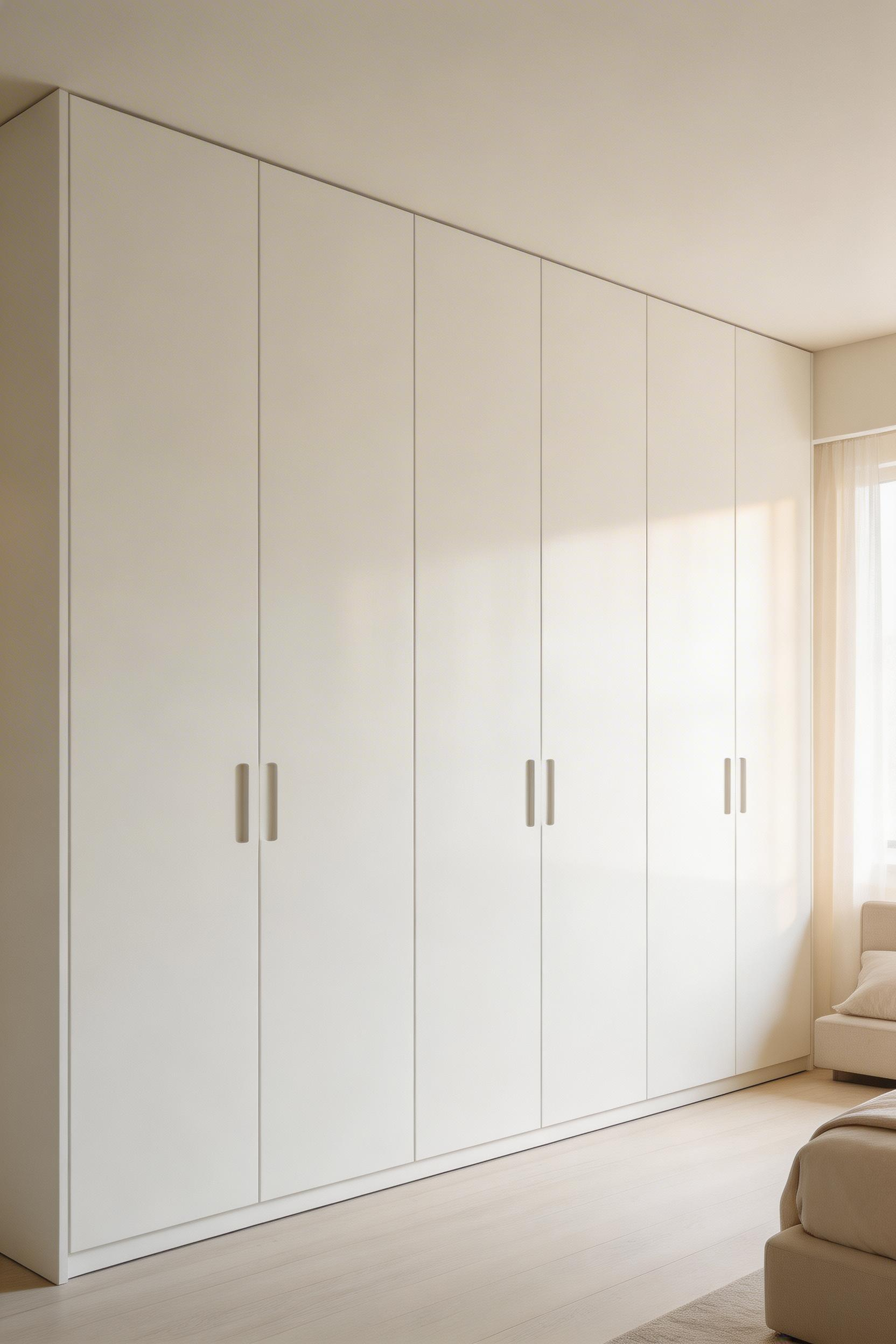
The zone logic matters as much as the storage capacity. Ideally, the dressing area — wardrobe, full-length mirror, small vanity if used — faces away from or sits at 90 degrees to the bed. So when you lie down, you’re not looking directly into the wardrobe, even with doors closed. That physical separation helps the brain distinguish between the functional part of the bedroom and the restful part. A 2022 Hammonds Furniture survey found that 82% of homeowners with fitted wardrobes reported their bedroom felt more calming within two weeks of installation.
Built-In vs Freestanding
IKEA’s PAX system (£400-1,200 depending on configuration) is the benchmark flexible wardrobe solution. It offers 236cm and 201cm height options with dozens of interior fitting combinations. Use a dedicated PAX planner — the Planera app handles combination planning better than IKEA’s own tool. Sharps (£1,500-5,000 installed) and Hammonds (£1,200-4,500) are the UK’s leading fitted wardrobe specialists, both with 8-12 week lead times. IKEA Brimnes with mirror doors (£295-495) offers a budget built-in feel with mirror panels that amplify light. More bedroom interior design tips on storage, zone planning, and the specific dimensions that make fitted wardrobes feel proportional are worth reading alongside this.
12. Choose Bedding in Natural Fibres for Better Sleep Temperature Regulation
Core body temperature drops 1-2°C during healthy sleep onset. Synthetic bedding — polyester-cotton blends, microfibre — traps heat and slows that thermal drop, while natural fibres wick moisture and breathe. A 2020 study published in *Nature and Science of Sleep* found that sleeping in natural fibre bedding reduced the number of nighttime awakenings by 23% compared to polyester-cotton blends. That is not a minor finding. Among all the bedroom design inspiration ideas here, this one has the most direct physiological evidence behind it.

Linen is the most breathable option. Its hollow fibre structure circulates air and keeps the skin surface 2-3°C cooler than equivalent cotton-polyester blends. Piglet in Bed’s Linen Duvet Cover (£185, king) is the quality standard among UK linen bedding brands. Organic cotton at 200-400 thread count hits the sweet spot for quality and breathability. Above 400TC, the weave becomes denser and warmer. The White Company’s Organic Cotton 300TC set (£145, king) is well-made and GOTS-certified. IKEA’s Nattjasmin set (£45, king) provides decent organic cotton for tighter budgets.
Tencel and Practical Guidance
Tencel (lyocell from eucalyptus pulp) is the best synthetic-feeling natural fibre. It is smooth, temperature-regulating, and processed in a closed-loop system with 99% water recovery. Soak & Sleep’s Tencel Lyocell Set (£89, king) is a strong entry point. For duvet tog selection: 4.5 for summer, 10.5 for winter, 13.5 for cold sleepers or poorly insulated rooms.
I always recommend starting with a linen flat sheet rather than replacing everything at once. It is the item with the most skin contact and the biggest immediate impact on temperature. Around £45 for a king flat sheet from Piglet in Bed or similar — test it for a month before committing to a full set. There’s more on pairing natural fibre bedding with the right bedroom foundation in this guide to cozy bedroom ideas that covers layering strategies across different climates and room types.
13. Use Mirrors Strategically to Amplify Light and Space
A mirror placed opposite a window can reflect natural light up to twice as deep into the room as without one. This meaningfully improves daylight penetration in north-facing bedrooms that otherwise feel dim regardless of wall colour. Research from UCL’s Bartlett School of Architecture found that strategic mirror placement in smaller rooms increased perceived spatial area by 15-22% among participants in room evaluation studies. Yet mirrors are often the last thing considered in bedroom design inspiration planning.
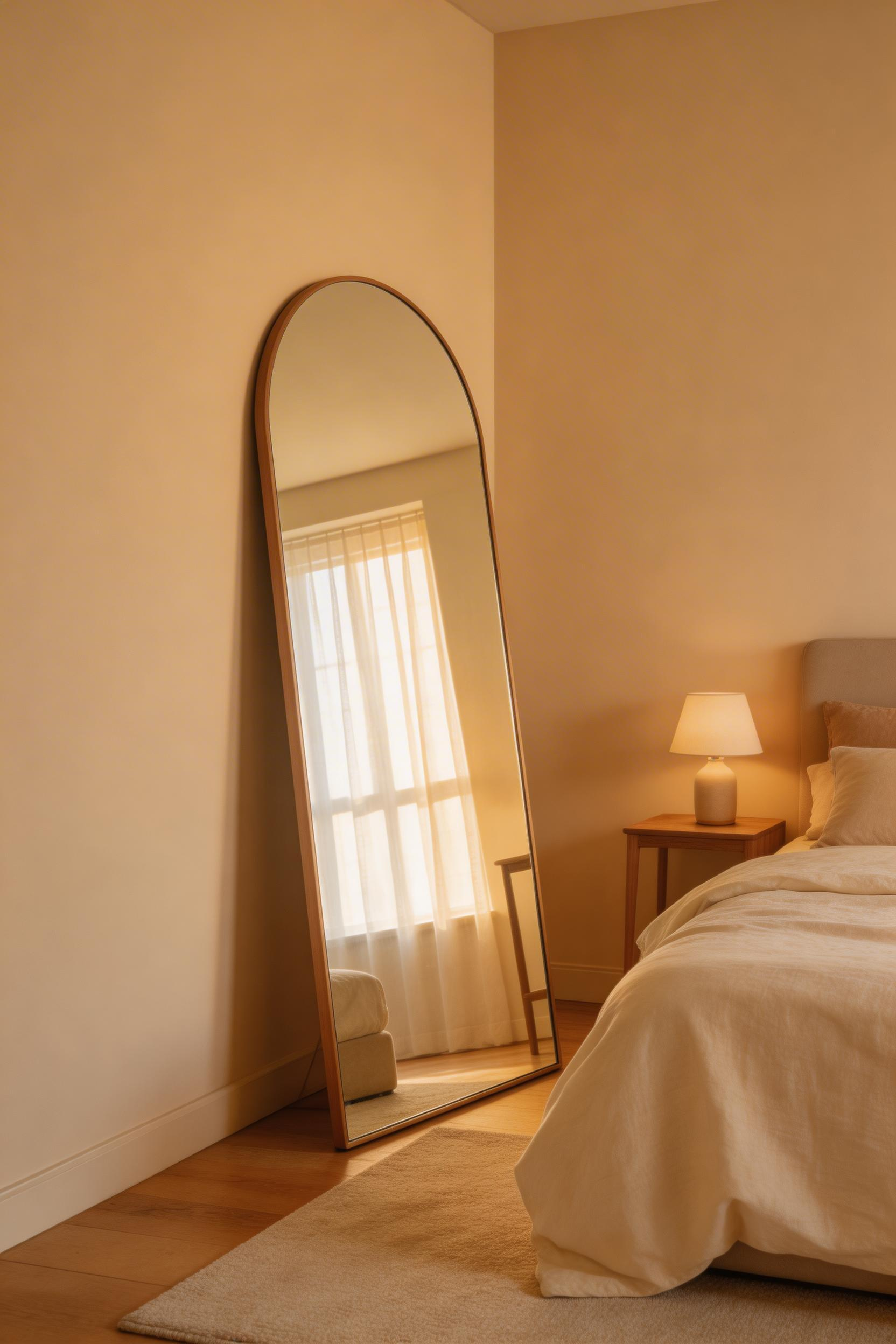
Feng shui practice advises against mirrors directly facing the bed. Interior designers often agree, though for practical reasons: you don’t want to see yourself reflected when you wake disoriented in the middle of the night. Place the mirror on the wall perpendicular to the bed, opposite the window, or at a 45-degree angle in a corner. A full-length mirror (120-140cm x 45-55cm) at 45 degrees in a corner takes less floor space than one mounted flat to the wall and creates a layered, boutique-hotel effect.
Mirror Selection
Anthropologie’s Gleam Leaning Floor Mirror (£298) with an arched metallic frame is a statement piece that earns its place in a well-designed room. IKEA’s Hovet aluminium framed full-length mirror (£175) at 78x196cm works in most bedroom styles and is a strong value choice. Next’s Arched Metal Mirror in antique brass (£149) at 45x120cm is a popular mid-size option. H&M Home’s decorative round mirrors (£49-79) at 50-70cm are useful as accent groupings on non-window walls.
If you have a small bedroom, one large mirror does far more than several small ones. A single IKEA Hovet transforms the sense of space. Three decorative circles on the wall look busy. For leaning mirrors, leave 30cm from the wall base to the bottom of the frame for safe clearance.
14. Introduce a Personalised Gallery Wall With Curated Art
Art in the bedroom has a measurable calming effect when chosen thoughtfully. A study from Goldsmiths University found that people who displayed personal photography in their homes reported higher wellbeing scores across six dimensions of psychological flourishing. However, the type of art matters. Abstract prints, nature photography, botanical illustrations, and soft-focus portraiture support a restful environment. Graphic, high-contrast, or emotionally demanding imagery does the opposite.
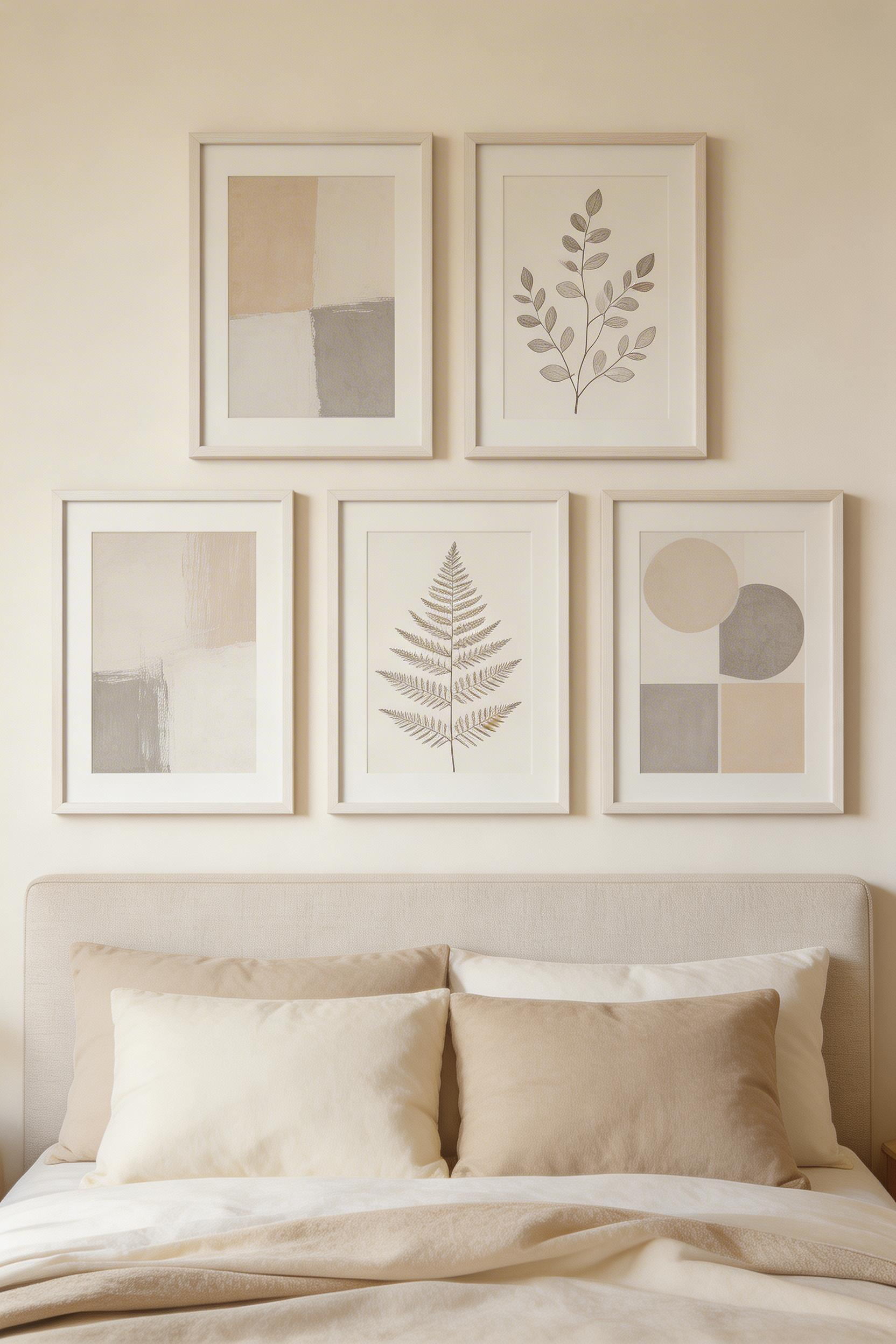
The gallery wall formula that works consistently: an odd number of pieces (3, 5, or 7), one dominant anchor piece (A3 or larger), consistent framing in the same colour or material, and 8-10cm gaps between frames. Most people miss one critical detail — the bottom edge should align at a consistent height, usually 150-160cm from the floor above a bed, rather than being centred. Eyes read the bottom line of a grouping, not the top.
Building It Over Time
Desenio’s print shop (£10-40 per print) offers an extensive catalogue in coordinating styles and sizes. Artifact Uprising (£15-60 per print) produces excellent quality custom photo prints for personal photography. IKEA’s Ribba frame collection (£4-20 per frame) is the benchmark budget frame — consistent quality and good mat depths. Framebridge (£40-90 per frame) handles custom archival framing at museum quality.
Don’t fill a gallery wall with prints you bought specifically to fill it. That’s how gallery walls end up looking hollow and staged. Start with 2-3 pieces you genuinely love, leave gaps, and add one thing at a time over months. The incompleteness shows — but so does the process. A wall that grew over time looks completely different from one assembled in an afternoon. This applies to white bedroom inspiration contexts especially, where a gallery wall is often the only strong visual layer in an otherwise monochrome palette.
15. Apply a Circadian-Aligned Lighting Upgrade for Genuine Sleep Improvement
Circadian rhythm lighting adjusts colour temperature and brightness based on time of day. It supports the body’s natural melatonin-cortisol cycle. This is the most evidence-dense area in this bedroom design inspiration guide: a 2016 study in the *Journal of Clinical Endocrinology & Metabolism* found that reducing evening lighting exposure below 200 lux accelerated sleep onset by an average of 12 minutes and improved sleep quality scores by 18%. Blue light above 5000K delays melatonin onset by 90 minutes on average — roughly the equivalent of half a cup of coffee.
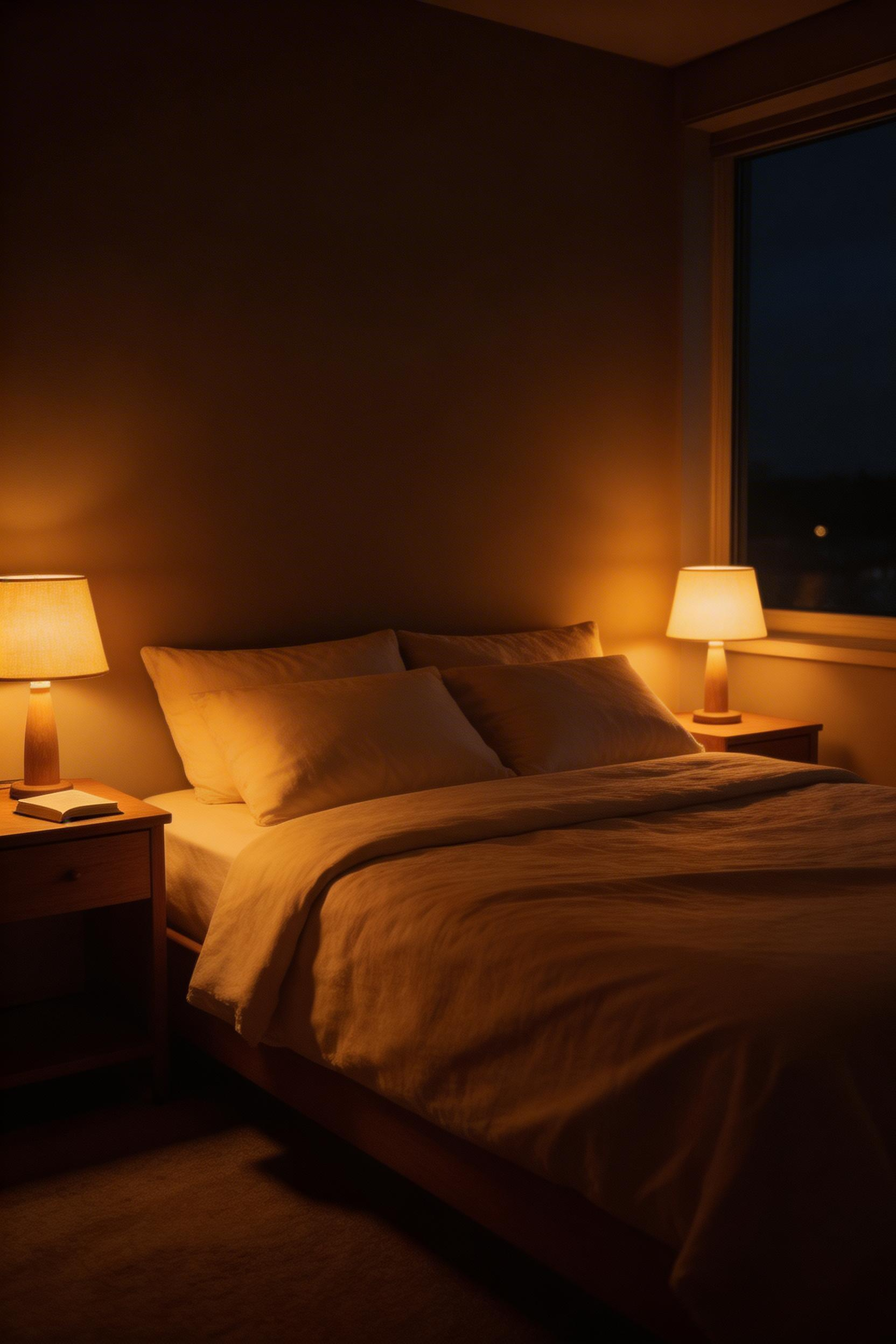
The critical shift happens at around 7pm: lighting should drop below 200 lux and move to 2700K or warmer. Smart bulbs on automated schedules are the most reliable implementation. Philips Hue White Ambiance Starter Kit (£69 for two bulbs) covers 2200-6500K with reliable app-based scheduling. IKEA Tradfri (£8 per bulb plus £29 gateway) is the most affordable smart system, limited to 2700K warm white. Govee Smart Bulbs (£12-18 per bulb) offer WiFi-only operation without a hub.
The Single Swap That Makes the Biggest Difference
Before investing in a full smart system, try this: replace your bedside reading lamp bulb with a 2200K filament LED. Around £6-8 from Amazon. That warm amber glow signals sleep to your body far more effectively than any supplement. The Caseta Lutron dimmer switch (£45-65) is the most reliable hardware dimming solution for non-smart bulbs.
Recommended bedroom lighting levels: 500-1000 lux at 5000K for morning; under 150 lux at 2700K from 7pm; under 50 lux at 2200K in the 30 minutes before sleep. More on how lighting integrates with bedroom furniture layout to create defined zones that support both function and rest.
Building a Bedroom That Supports How You Actually Live
Bedroom design inspiration means very little if it results in a room that looks right in photographs but doesn’t feel right to sleep in. The 15 ideas here share a common logic: they prioritise the bedroom as a sleep environment first and a designed space second. Those two goals support each other rather than compete.
Start with the changes that cost least and shift the most. The curtain height adjustment is free. Replacing one overhead bulb with a 2200K warm LED costs £8. Decluttering the bedside table takes four minutes. These three changes alone will make the room feel measurably different before you spend anything significant.
When budget allows, the platform bed and the headboard are the two structural investments that most consistently transform a bedroom’s character. They establish the room’s scale, proportion, and visual logic. Every other object in the room then responds to those decisions. The bedding follows; the lighting plan reinforces it; the plants and textures layer on top.
The goal is a room that makes going to bed feel like a reward rather than a default. That shift is achievable in most bedrooms with focused decisions rather than wholesale renovation. Pick the two or three ideas from this bedroom design inspiration guide that address the most obvious gaps in your current room, implement them well, and assess from there. Good bedroom design narrows the options rather than multiplying them.