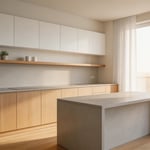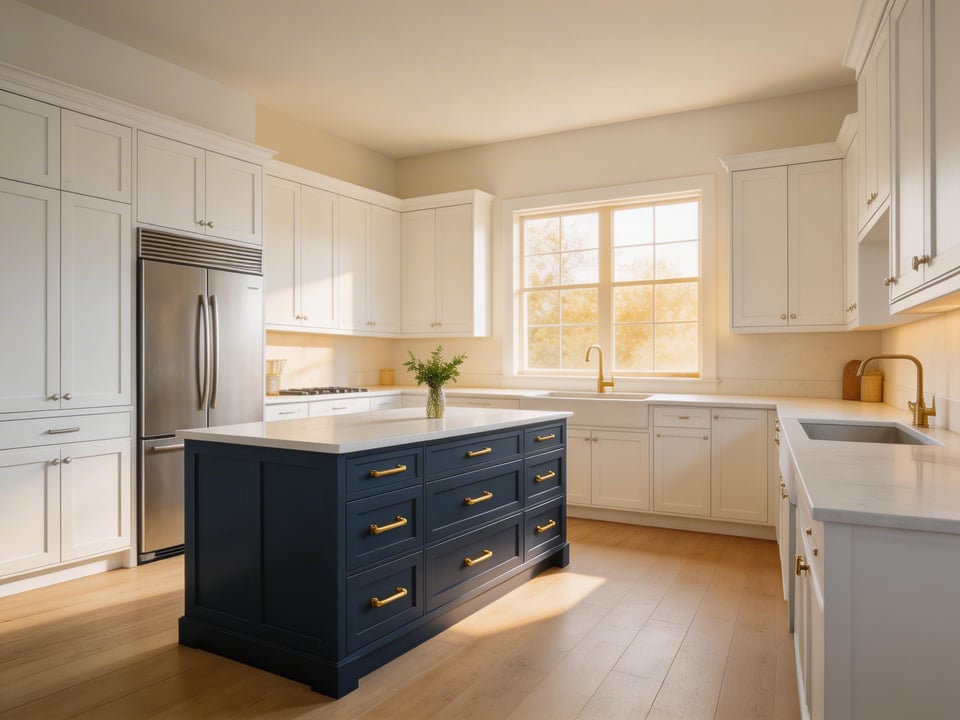
For centuries, skilled cabinetmakers understood something modern renovators are only beginning to rediscover: kitchen cabinet design is the single decision that determines how a kitchen feels for the next twenty years. Cabinets aren’t furniture you swap out when fashions shift. They’re architecture. The carpenters who built fitted Georgian and Victorian kitchens understood this. Proportions, material quality, and hardware choice were permanent investments — not seasonal accessories.
What’s changed is the range of options. You can now access the quality of a bespoke joiner’s workshop at semi-custom prices. Natural timber pairs with painted runs in ways that feel intentional rather than ad hoc. Hardware has reached precision-engineering standards at mainstream price points. That means cabinet decisions have more consequence than ever. A poor choice locks you into a compromise for a decade. A good one holds up through every trend cycle.
These 15 kitchen cabinet design ideas cover the full range. Each is chosen because it has actual design rationale behind it, not just because it photographs well. Each one is chosen because it has actual design rationale behind it, not just because it photographs well.
1. Shaker-Style Cabinets: The Design That Has Outlasted Every Trend
The Shaker religious community in 18th-century America built furniture on a single principle: make it simple, make it perfect. Their recessed-panel door became the most copied cabinet design in history. It’s still the most specified door profile today, accounting for roughly 41% of all kitchen cabinet orders according to a 2023 Houzz renovation survey. That isn’t an accident.
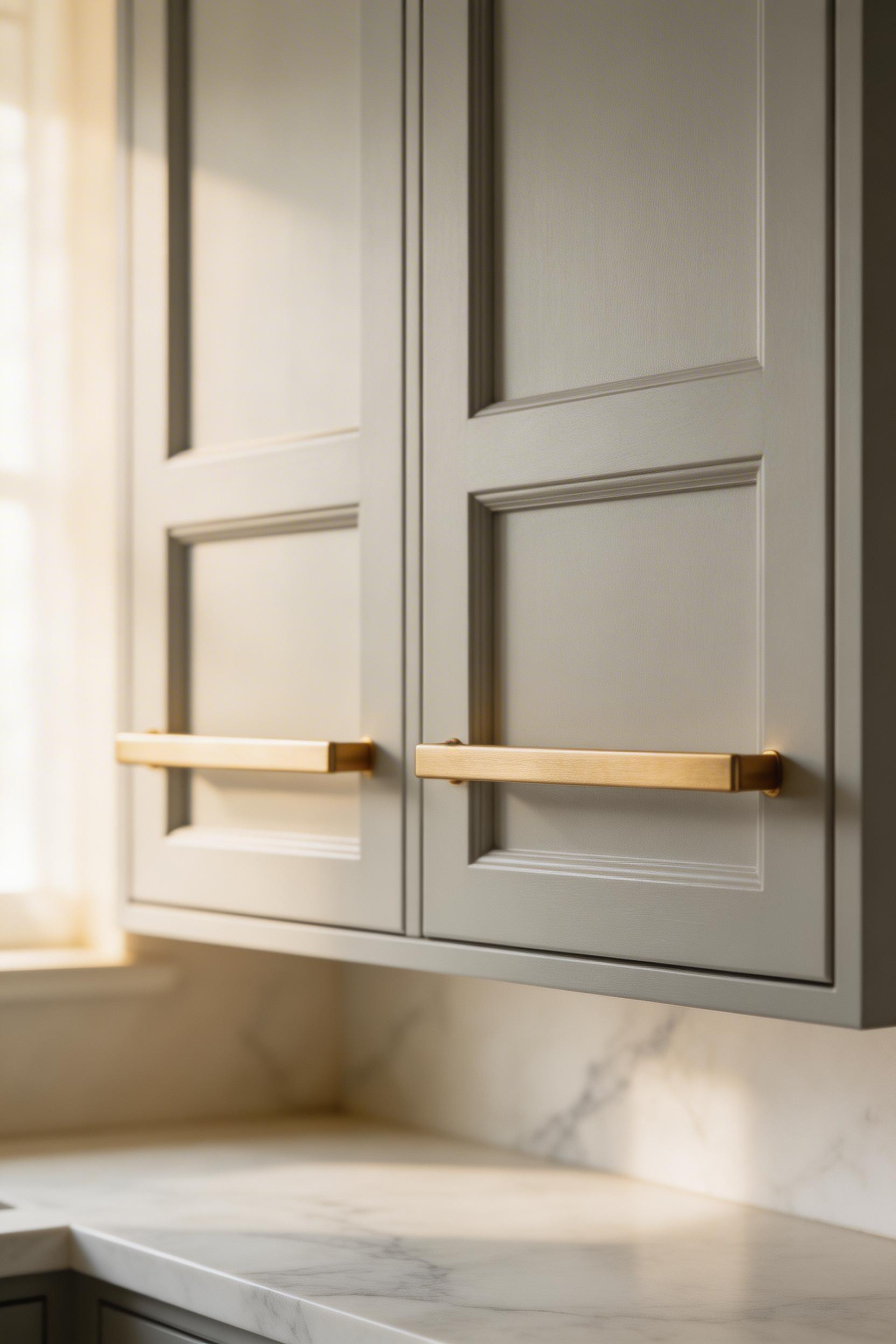
The Shaker door works because its proportions are genuinely neutral. The recessed centre panel creates depth and shadow without imposing a style. Pair it with flat-panel drawers and integrated pulls, and it reads as contemporary. Put it with cup pulls and a farmhouse sink, and it reads as traditional. Very few cabinetry decisions are this flexible. That’s exactly why designers reach for Shaker when they’re unsure what aesthetic a client will want to live with long-term.
What Actually Makes a Shaker Door Look Good
The detail most people miss is rail and stile proportion. Standard rails and stiles run 2.5″ to 3″ wide — the right width for most kitchens. But some budget cabinet lines push the stile to 3.5″ or wider, which makes the door feel heavy and dated. Premium lines bring it down to 2″, which produces a more refined, almost modern version of the profile.
The other decision is material. For painted cabinets, MDF-core Shaker doors are the better choice. They don’t expand and contract with humidity the way solid wood does, so the paint holds at the panel edges over time. For stained natural wood, solid or veneered hardwood is the right call, with hard maple being the most consistent option for its tight grain and paint-friendly surface. White oak in a Shaker profile stained to a warm natural tone is one of the most popular combinations right now. It bridges traditional and contemporary without committing to either.
Plain English Kitchens’ hand-painted Shaker runs from £800–£1,500 per linear foot. IKEA AXSTAD on a SEKTION carcass starts at £8 per door. The door profile is the same; the craftsmanship and materials are not.
2. Two-Tone Kitchen Cabinets: Upper-White, Lower-Colour for Visual Weight
Two-tone kitchens now account for roughly 25% of new kitchen installations in the US. The most common configuration is also the most logical: white or cream upper cabinets, with a stronger colour on the lowers. The logic here is borrowed from classical architecture, where the base of a structure is always heavier and more grounded than what sits above it.
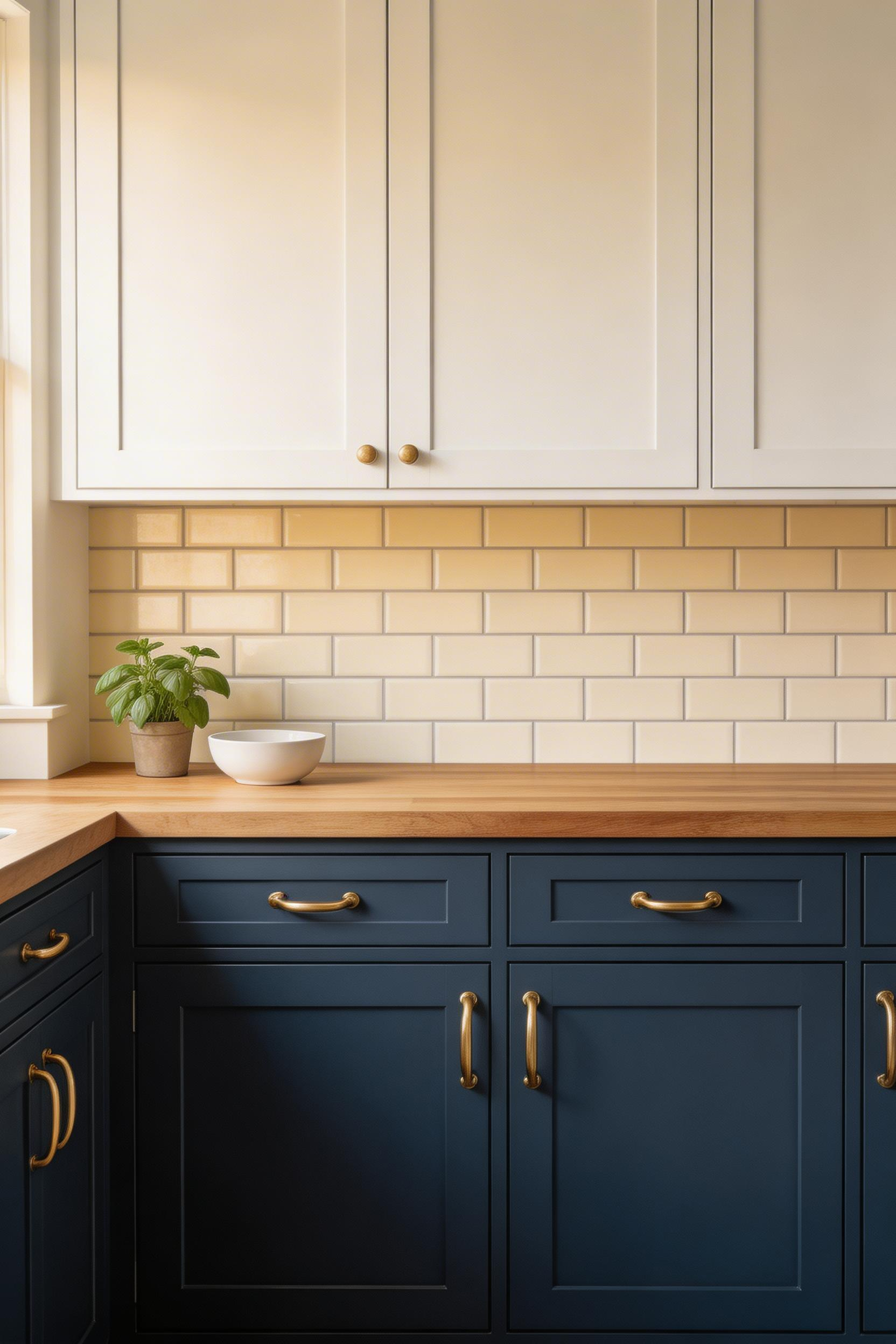
Dark lower cabinets anchor the room’s base while keeping the upper half light and open. This also means the eye travels upward, which is useful in kitchens with 9′ or taller ceilings. In an 8′ ceiling kitchen, the two-tone approach can feel compressed if the colours are too stark. In those situations, the stronger colour works better as a muted mid-tone rather than a saturated navy or forest green.
Colour Pairings That Actually Hold Up
The most reliable navy for lower cabinets is Farrow & Ball Hague Blue (No. 30). It has a slight green undertone that prevents the cold, corporate feeling that some blues carry. Against white uppers, it reads as warm and considered rather than graphic. Farrow & Ball Down Pipe works for those who want visual weight without committing to colour. It reads as almost-black in low light but reveals its grey-blue character in good daylight.
For the upper white, Benjamin Moore White Dove (OC-17) is the most versatile option. It’s warm enough to avoid the clinical feeling of a true white, but light enough to count as white in a mixed-material kitchen. Sherwin-Williams Alabaster (SW7008) is a softer alternative that suits natural wood floors particularly well.
The NKBA’s 2024 Design Trends report listed two-tone cabinetry as a top-five kitchen trend for the third year running — so this is clearly not a short-lived direction. That said, the specific colour choices matter. The approach holds up; a particular shade of avocado green does not.
3. Slab-Front Cabinets for a Seamless, Handleless Look
Flat-panel slab doors — no profile, no frame, just a continuous surface — are the backbone of minimalist and contemporary kitchen cabinet design. Their appeal is architectural: they create seamless, uninterrupted planes across the kitchen that push all the visual emphasis onto the material itself rather than the door construction.
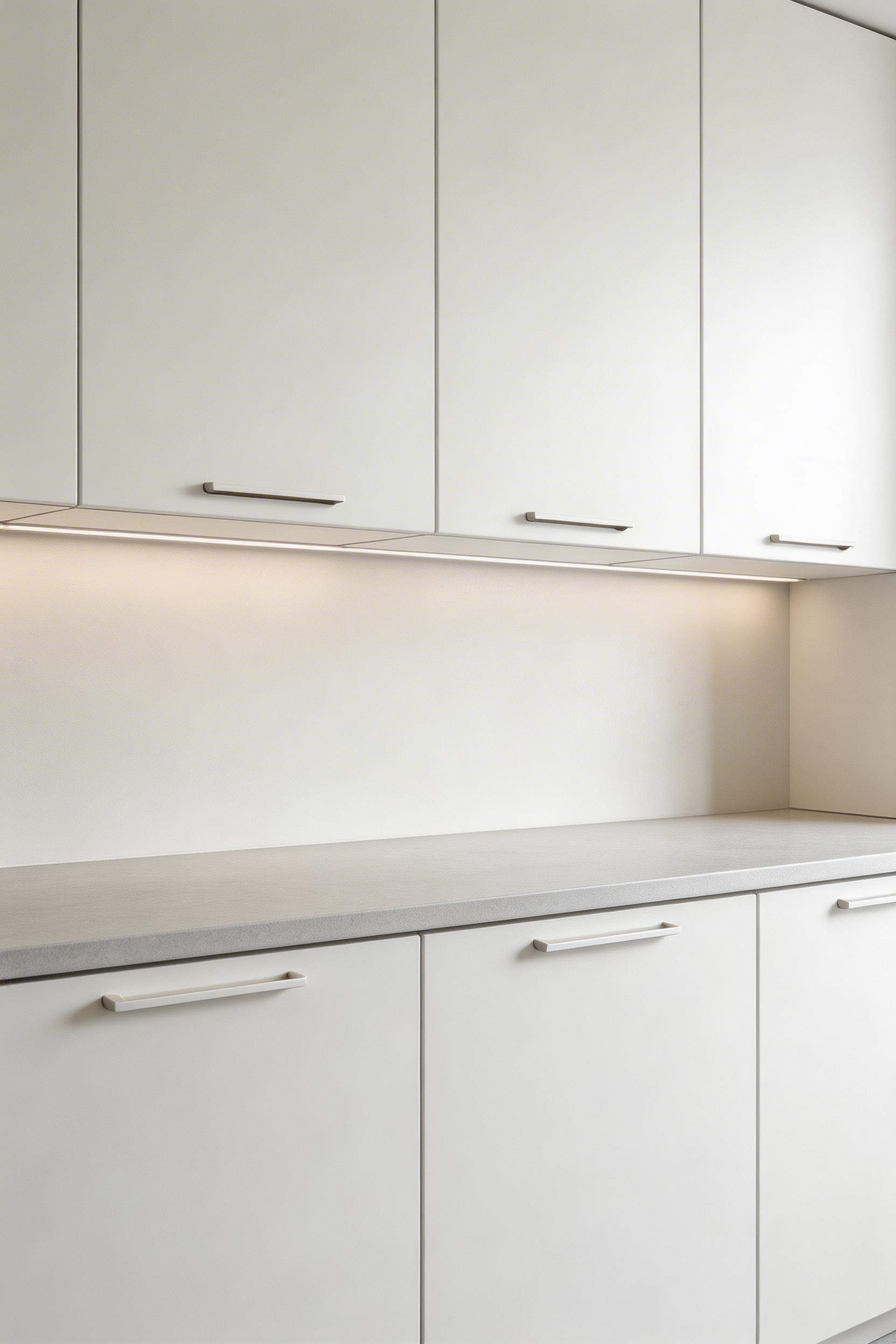
The handleless version requires either a push-to-open mechanism (Blum SERVO-DRIVE is the industry standard, rated for 50,000+ open/close cycles) or a J-pull routed groove integrated into the door. The J-pull is a practical compromise. It reads as seamless at a distance but provides a natural grip, and it doesn’t need the additional cost of a motorised opening system.
Finishes and the Fingerprint Problem
Slab doors show every fingerprint and mark, and this is not a minor consideration in a working kitchen. Acrylic-faced slab doors are the most reflective and the worst offenders. High-gloss lacquered MDF is better but still demanding. If you cook regularly, the most practical slab finish is a matte or satin lacquer — it photographs with the same clean aesthetic but forgives the inevitable contact.
Veneer slab doors cost more than painted lacquered options. But they introduce grain movement and natural variation that make each door slightly different. White oak and walnut are the dominant species. IKEA’s VOXTORP walnut veneer door starts at around £25 per door and is a reasonable entry point. Valcucine’s Artematica in rift-cut oak veneer sits at £1,200–£2,500 per linear foot. The grain consistency and door flatness are genuinely different at that level.
4. Glass-Front Cabinets to Break Up Solid Runs and Show Off Dishware
A solid run of 12 identical cabinet doors reads as storage infrastructure, not kitchen design. Glass-front doors break that repetition and introduce rhythm. They’re the visual pause in an otherwise uniform run — and they invite the cabinet’s contents to become part of the room’s aesthetic.
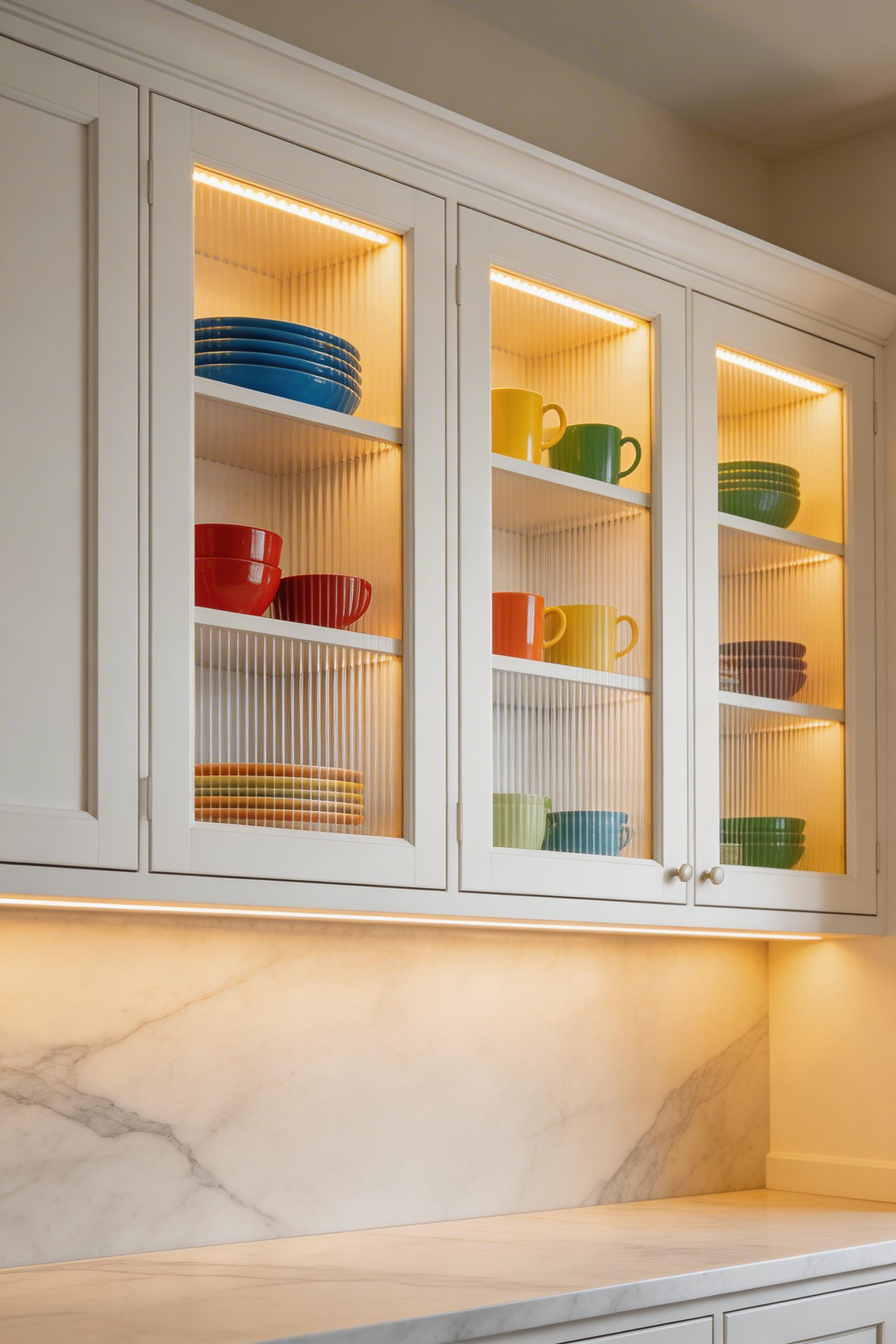
The key decision is glass type. Clear glass shows everything. That means the cabinet interior becomes part of the design — and it requires meticulous organisation. Ribbed or reeded glass diffuses the contents, showing shapes and colours without revealing mess. The vertical parallel channels in the surface scatter light rather than transmit it directly. Reeded glass is currently the most popular insert choice, driven by its prevalence in furniture and room dividers in the same period. Seeded antique glass suits period and farmhouse kitchen cabinet design — the small bubbles and imperfections in the glass have a historical quality that plain glass can’t replicate.
Lighting the Display
Interior cabinet lighting is essential with glass-front doors. Without it, even beautifully arranged dishware looks flat and dark. A warm-white LED strip (2700–3000K) mounted along the top inside of the cabinet is the standard installation. The light spills forward through the glass and lifts the display without looking theatrical.
Framing options are either wood (matching the door style of the rest of the kitchen) or aluminium for a more contemporary, architectural look. Lead-framed glazing exists but is almost exclusively a period restoration choice — it’s time-consuming to produce and very expensive. Most projects that want the visual texture of framed glass use thin aluminium extrusion instead.
Also worth noting: limit glass-front doors to 2–4 in a run. More than that requires a level of display discipline that most households can’t sustain.
5. Open Shelving as a Strategic Complement to Closed Cabinetry
Open shelving has had its moment of peak popularity. Now it’s settling into its correct role: a complement to closed cabinetry, not a wholesale replacement. When open shelves replace one or two upper cabinet runs rather than all of them, the result is a kitchen that feels more residential. The practical storage remains largely intact.
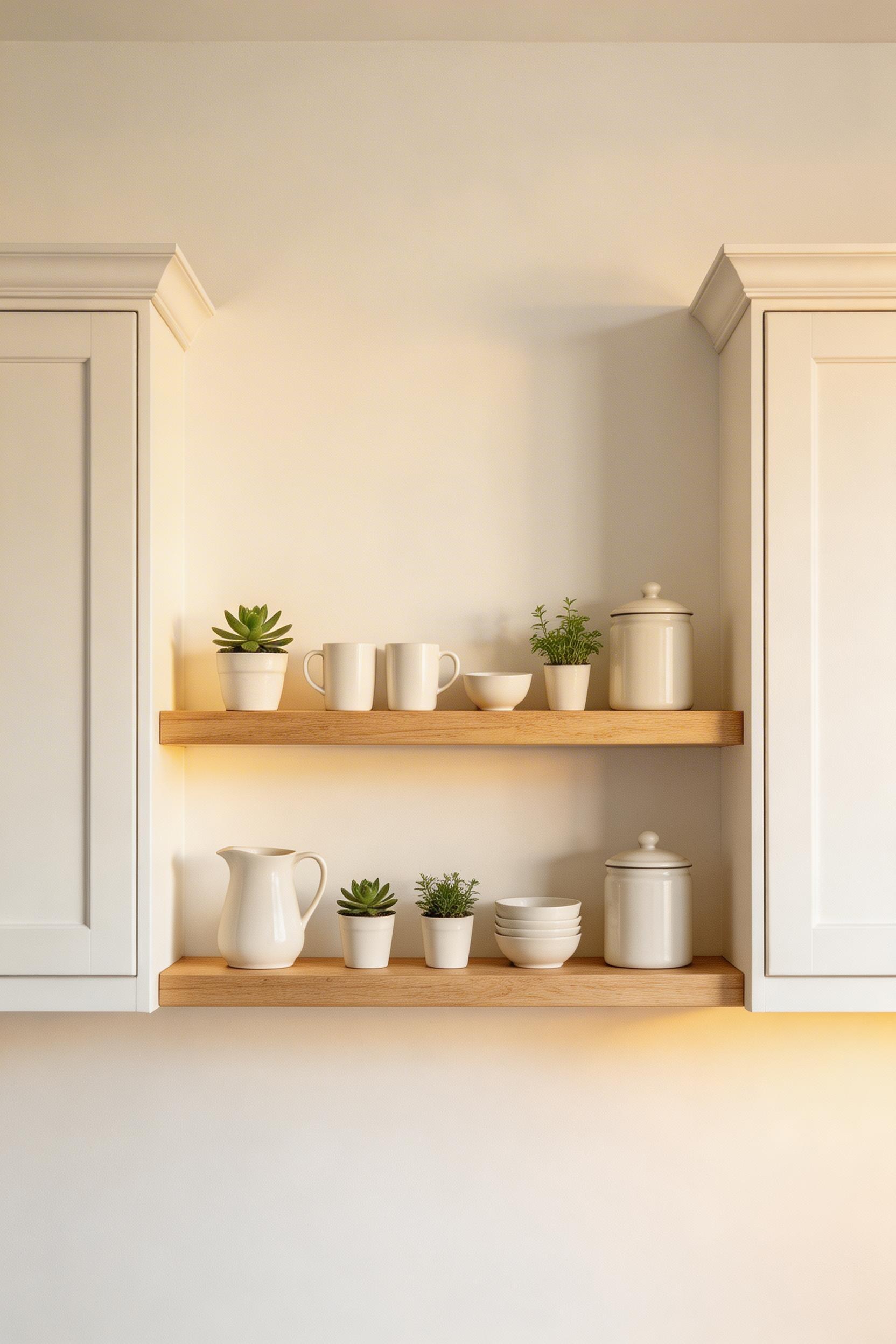
The standard shelf depth for a kitchen is 12″ — the same as a standard upper cabinet. This matters for two reasons. It matches the depth of adjacent cabinets so items move between shelf and storage easily. And it accommodates most everyday items — plates, glasses, small appliances — without wasting space at the back.
Supports, Materials, and the Maintenance Reality
Floating shelves in a kitchen need proper support. Hidden steel rod bracket systems (like Kistler’s) can support up to 100 lbs per shelf and leave no visible hardware. Standard shelf bracket spacing for a 12″ shelf is every 24″. Maximum unsupported span in 3/4″ material before visible sag: 36″. Beyond that, a third support point is needed.
White oak is the most popular material right now — it pairs with painted cabinetry, natural stone, and most hardware finishes without fighting any of them. Walnut reads darker and warmer. Butcher block is the more casual option, useful for kitchens with an intentionally lived-in character.
The honest caveat: open shelves near the stove collect grease and steam. A 2023 Kitchen Magazine survey found that 34% of homeowners who installed full open-shelf runs said they wished they had kept some closed cabinets within two years. That’s a significant number. It’s worth factoring into your planning before the shelves go up.
6. Cabinet Hardware as the Detail That Changes Everything
Hardware is the jewellery of a kitchen — the element touched daily, sitting at hand height and eye level. It defines the finish of the room more than almost any other detail. It’s also one of the last decisions people make and one of the first things you notice is wrong when a kitchen doesn’t quite come together.
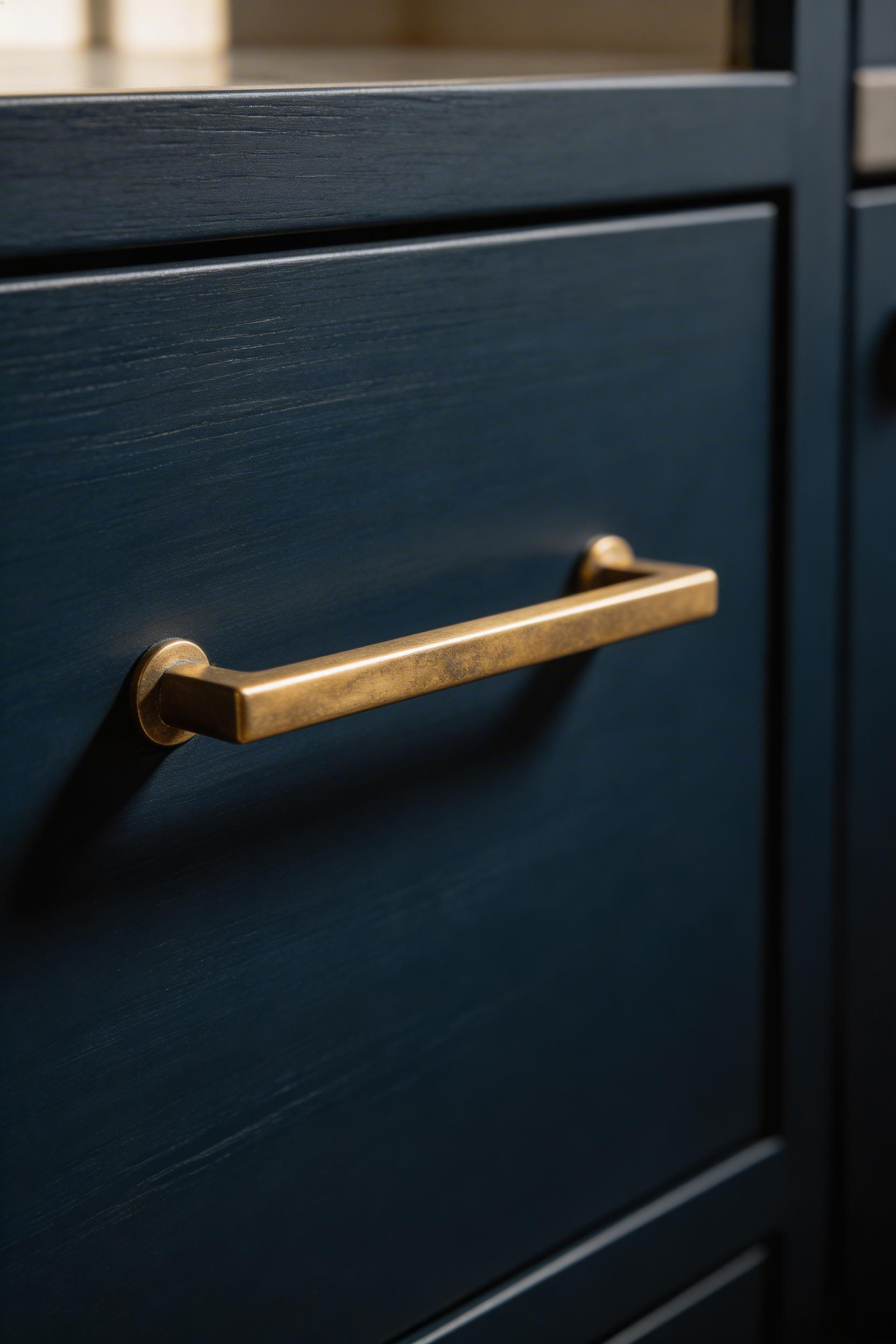
The current hardware landscape has shifted decisively. Matte black and brushed brass together now account for 58% of all cabinet hardware sales in North America, per a 2024 Cabinet Hardware Manufacturers Association report. That figure overtook brushed nickel, which led the category for 15 years. Unlacquered brass has gone from a period-restoration choice to a mainstream option because it develops a natural patina with use. That quality is now seen as desirable rather than a maintenance problem.
Proportioning Pulls to Drawers
Bar pull length matters. On a standard 18″–24″ drawer front, a 5″–8″ bar pull is the right scale. On a 30″+ drawer front, a 10″–12″ pull or a pair of smaller pulls is more proportional. The mistake is using 3″ bar pulls on large drawer fronts — they look like hardware meant for a different cabinet, even if the finish is right.
Cup pulls are worth considering for farmhouse and traditional kitchens — they’ve returned to regular use after a decade of being associated with dated cabinetry. Rejuvenation’s Classic Bin Pull in unlacquered brass at £18–£28 per piece is the most popular current example. Emtek’s Contemporary Bar Pull in flat black is the equivalent for a more minimal approach.
Before ordering a full kitchen set of hardware, buy one of each style being considered and install them on the actual cabinet for 48 hours. What looks right in a product photo often feels wrong at the scale of the room.
7. Painted Cabinets: Colour Choices, Prep Standards, and Durability Expectations
More than 65% of kitchen cabinet orders in North America are now for painted finishes — up from 48% in 2015, according to the Kitchen Cabinet Manufacturers Association. The painted kitchen is the dominant direction now. So it’s worth understanding not just which colours work, but what it takes to make painted cabinets actually last.
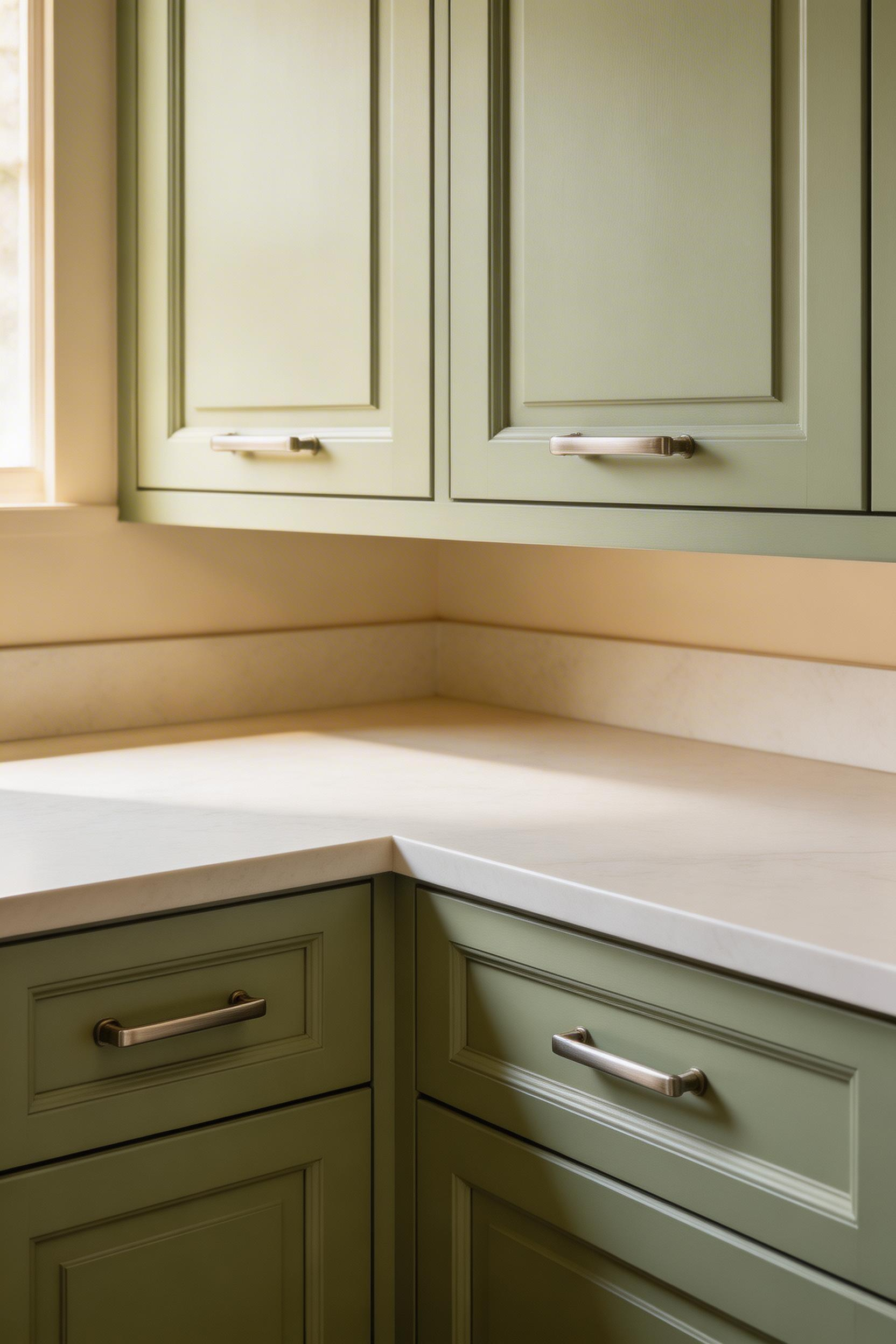
The durability of a painted cabinet finish is almost entirely determined by the prep and primer stage, not the topcoat. This is the thing most DIY cabinet painting projects get wrong. If the surface isn’t properly degreased and sanded, no amount of premium topcoat will prevent adhesion failure. Kitchen surfaces accumulate cooking oils that bond to factory finishes. The sequence that works: TSP substitute degreaser, sanded to 220 grit, followed by a shellac-based or bonding primer.
Paint Products and the Spray vs. Brush Reality
Benjamin Moore Advance (water-based alkyd) is the industry standard for painted cabinets. It levels to an almost spray-smooth finish with a brush and dries harder than standard latex. Full cure takes 30 days. Sherwin-Williams Emerald Urethane Trim Enamel is the main alternative: excellent scrubbability, dries harder, marginally faster cure time.
Professional spray application produces a harder, smoother finish than brush or roller work. The technique also matters: professional cabinet painters pull every door and drawer, label them, and paint flat on sawhorses. They leave a full week before reinstalling. That process — not the paint brand — is why the result looks different from a DIY job.
A cabinet repaint costs £1,500–£5,000. A full kitchen replacement runs £15,000–£60,000+. When the underlying cabinet construction is sound, a repaint using proper materials and technique is a legitimate renovation, not a compromise.
8. Natural Wood Cabinets: Species, Grain, and the Case for Going Unpainted
White oak overtook maple as the most-specified wood species for kitchen cabinets in the US in 2021, according to NKBA data. It has held that position since. There’s a reason for this shift, and it isn’t purely aesthetic. White oak’s open grain accepts stains predictably. Its tone sits comfortably between warm and cool, and it works alongside almost every countertop material and paint colour.
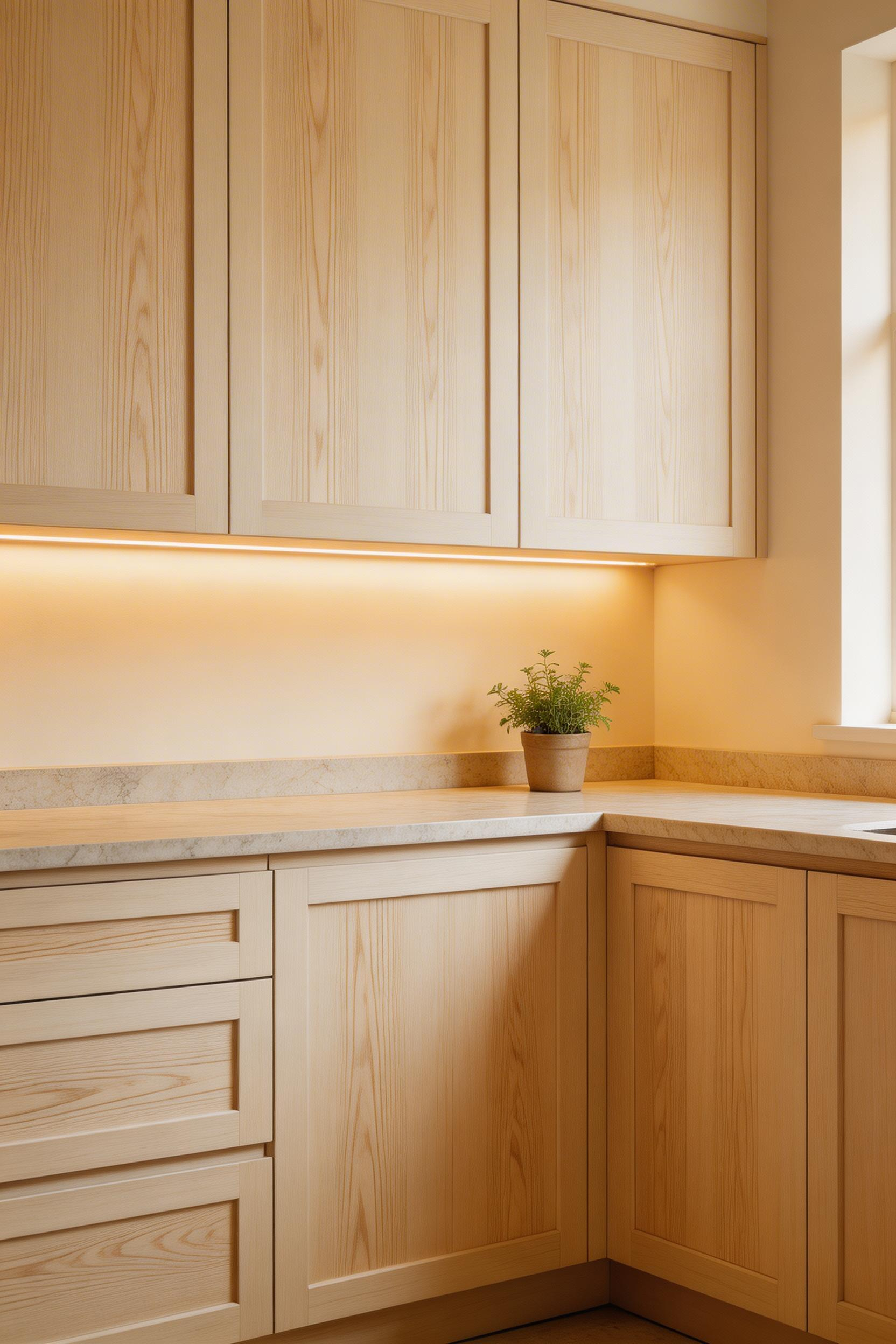
Walnut is the premium alternative: rich brown tones that deepen with age and take on a quality that no painted finish can replicate. One thing most people don’t know: walnut actually lightens slightly when exposed to UV light, which is the opposite of the expectation. If you’re installing walnut cabinets and planning on consistent natural light, that lightening process is part of the material’s character, not a flaw.
Species Comparison and the Grain Decision
Maple is the workhorse species: close-grained, consistent, harder than oak (Janka hardness 1450 vs. oak’s 1290), and excellent for paint if you want natural wood in some areas and painted elsewhere. Flat-sawn maple can show a figure (a chatoyant shimmer) that some find distracting on cabinet doors — quarter-sawn or rift-cut maple avoids this.
Quarter-sawn oak produces the distinctive ray fleck pattern — small silver-gold lines across the grain — that’s most associated with Arts and Crafts and Craftsman-style kitchens. If you’re renovating a period property, quarter-sawn white oak is the authentic choice. For contemporary kitchen cabinet design, rift-cut veneer gives a straight, even grain line without the cathedral arch of flat-sawn.
The mixing rule: keep natural wood in a defined zone — typically the island or a single run — and paint everything else. Alternating wood and painted doors across the same run looks scattered. Mixing alternating wood and painted doors across the same run looks scattered rather than intentional. This is the single most common mistake in otherwise well-executed natural wood kitchens.
9. Floor-to-Ceiling Cabinetry: Maximising Storage Without Wasting a Single Inch
Standard upper cabinets stop 36″ above the countertop, which in a 9′ ceiling kitchen leaves 12″–18″ of dead space between the cabinet top and the ceiling. That gap collects dust, stores nothing useful, and breaks the visual continuity of the wall. Floor-to-ceiling cabinetry eliminates it — and in doing so, adds 30–50% more storage volume to the same footprint.
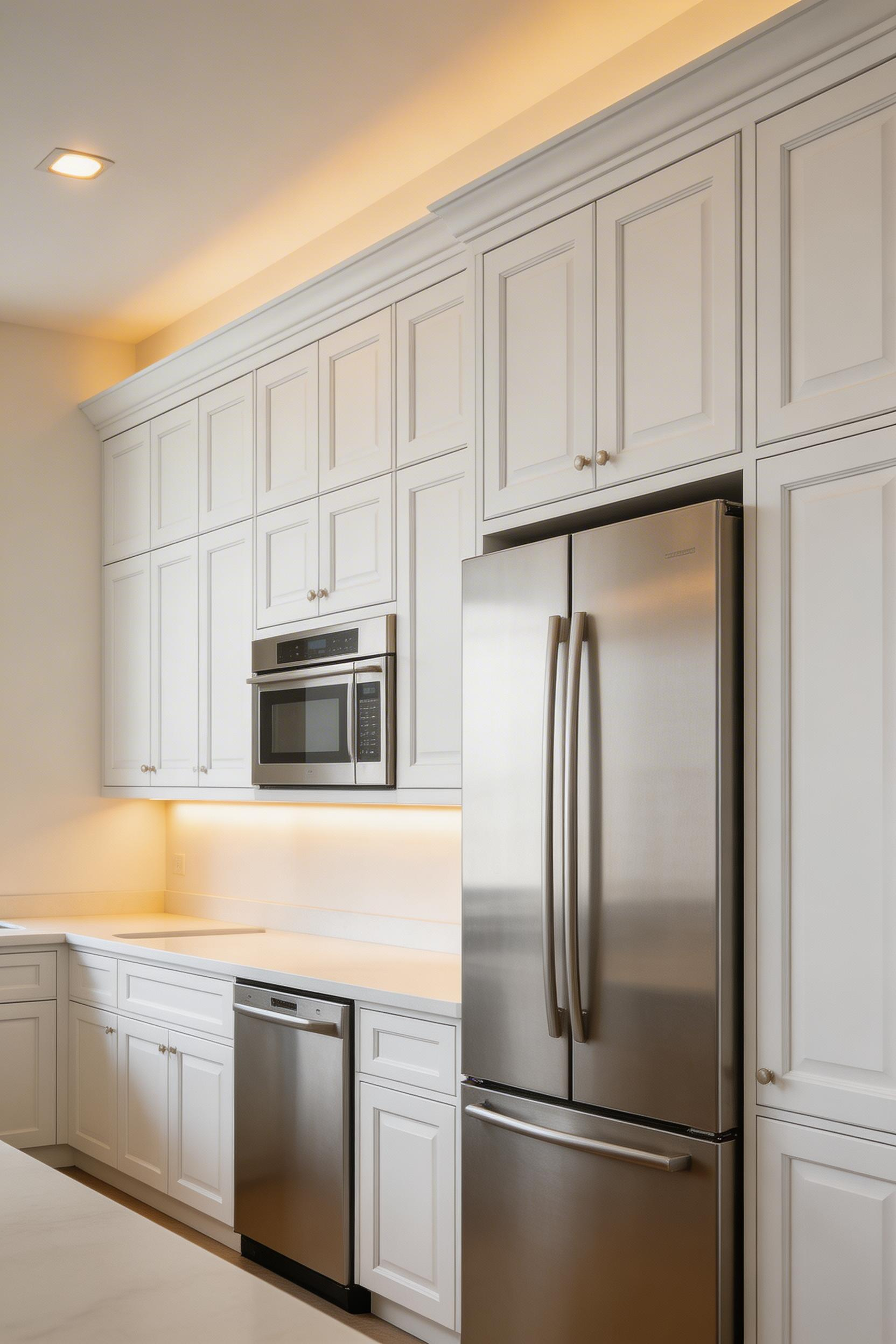
Beyond the practical storage gain, tall cabinetry produces something that standard-height cabinets can’t: a built-in furniture effect. A continuous run of floor-to-ceiling cabinets reads as architectural rather than utilitarian. The kitchen stops looking like appliances placed against walls. It starts to feel like a room that was designed from scratch — which is the impression that adds real perceived value.
Accessing the Upper Sections
The top section of a floor-to-ceiling cabinet — anything above 84″ — is most useful for items you reach infrequently: seasonal bakeware, rarely used serving pieces, spare appliances. For regular access, a ladder rail system (from Häfele or Rev-A-Shelf) is the professional solution. It runs on a floor-level rail and a ceiling-level track, allows sliding movement across the run, and is rated for typical household loads.
Standard tall cabinet heights are 84″, 90″, and 96″. In a 9′ ceiling kitchen, a 96″ cabinet leaves a 12″ gap. That’s enough for a recessed display niche with concealed LED strip lighting — how I typically resolve it on higher-spec projects. Wellborn Cabinet’s Integrated Tall Pantry unit, at £800–£2,500 per unit, is the semi-custom option for getting this right without going fully bespoke.
A 2023 Houzz report found that 29% of renovating homeowners chose floor-to-ceiling cabinetry, up from 18% five years earlier. That growth reflects a recognition that the kitchen wall is an architectural feature worth committing to.
10. Kitchen Island Cabinetry: When to Match the Perimeter and When to Contrast
The island gets more visual attention than any other element in the room. It’s surrounded by open space on at least three sides, it’s central to the traffic flow, and it’s where most social activity clusters. Given all that, the decision of whether to match or contrast the island against the perimeter cabinets is one worth thinking through carefully. If you’re exploring modern kitchen island design, the contrast approach tends to produce the most distinctive results.
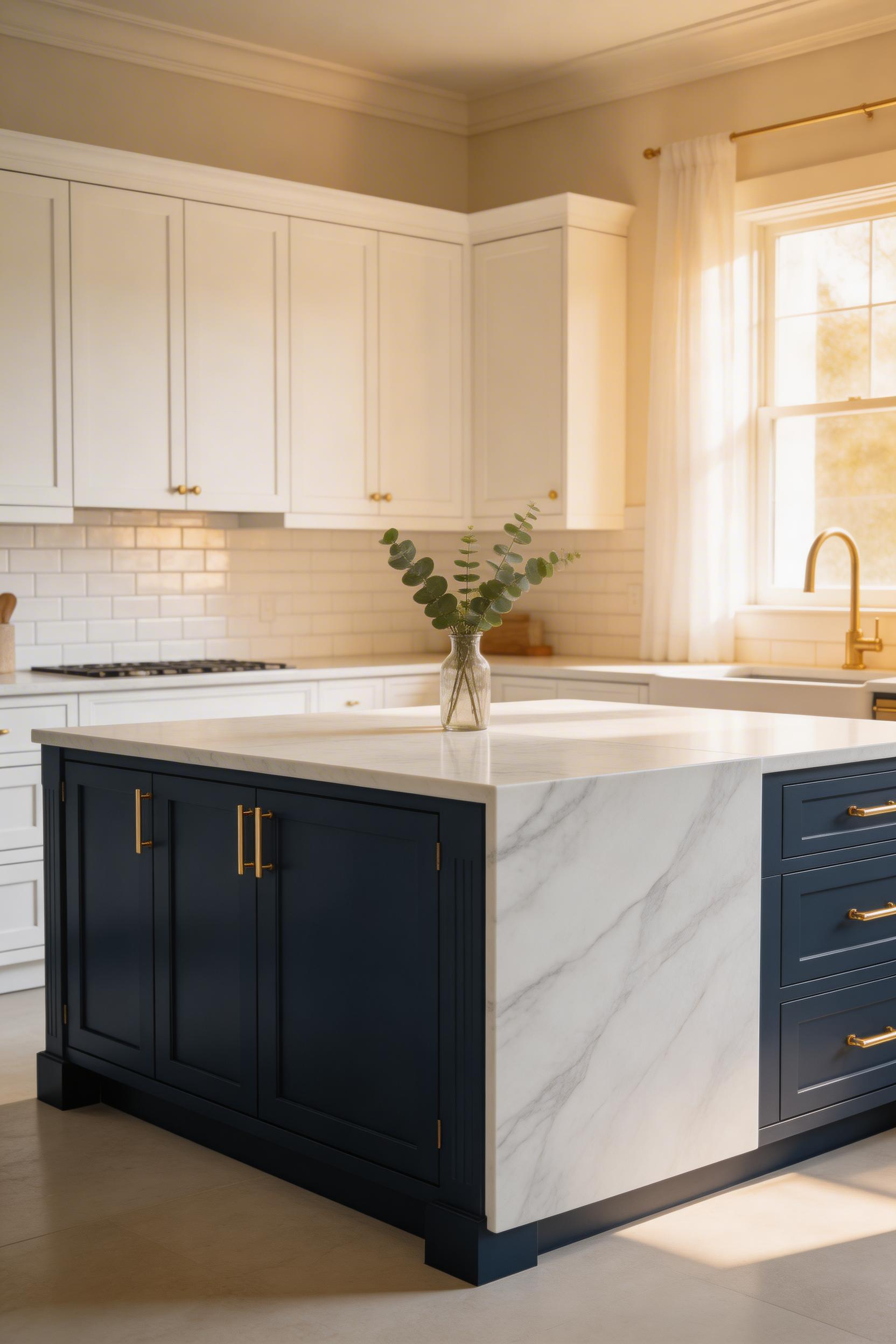
Contrast works when the island is clearly defined from the perimeter in terms of colour, material, or door style. The most popular combination right now: white or cream perimeter cabinets with a navy or dark green island base. Farrow & Ball Hague Blue on an island against White Dove perimeter cabinets is probably the most specced island colour combination of the past five years.
Proportions and the Waterfall Detail
The waterfall countertop — where the counter material falls vertically down the sides of the island to the floor — changes the proportions of the island entirely. It shifts the island from looking like a piece of furniture with cabinets inside it to looking like a solid architectural element. It also, practically speaking, hides the cabinet toe kick and any alignment issues at the base. Dekton and quartz are the most common waterfall materials; the surface needs to be consistent enough that the vertical face doesn’t show seam colour variation.
The one thing people underestimate is floor plan. NKBA specifies a minimum 42″ walkway clearance on all working sides of an island. Ideally, 48″. A beautiful island that leaves only 36″ of clearance makes the kitchen functionally worse. I’ve been called to redesign kitchens where this mistake was already built in.
11. Inset vs. Overlay Cabinet Doors: Understanding the Difference That Affects Your Budget
Most people shopping for kitchen cabinets don’t ask about door overlay — they don’t know it’s a variable. But the relationship between a cabinet door and its frame is one of the most visible quality signals in any kitchen. It affects price significantly. For a comprehensive overview of kitchen cabinet design options at different price points, the guide to choosing kitchen design cabinets covers this in more depth.
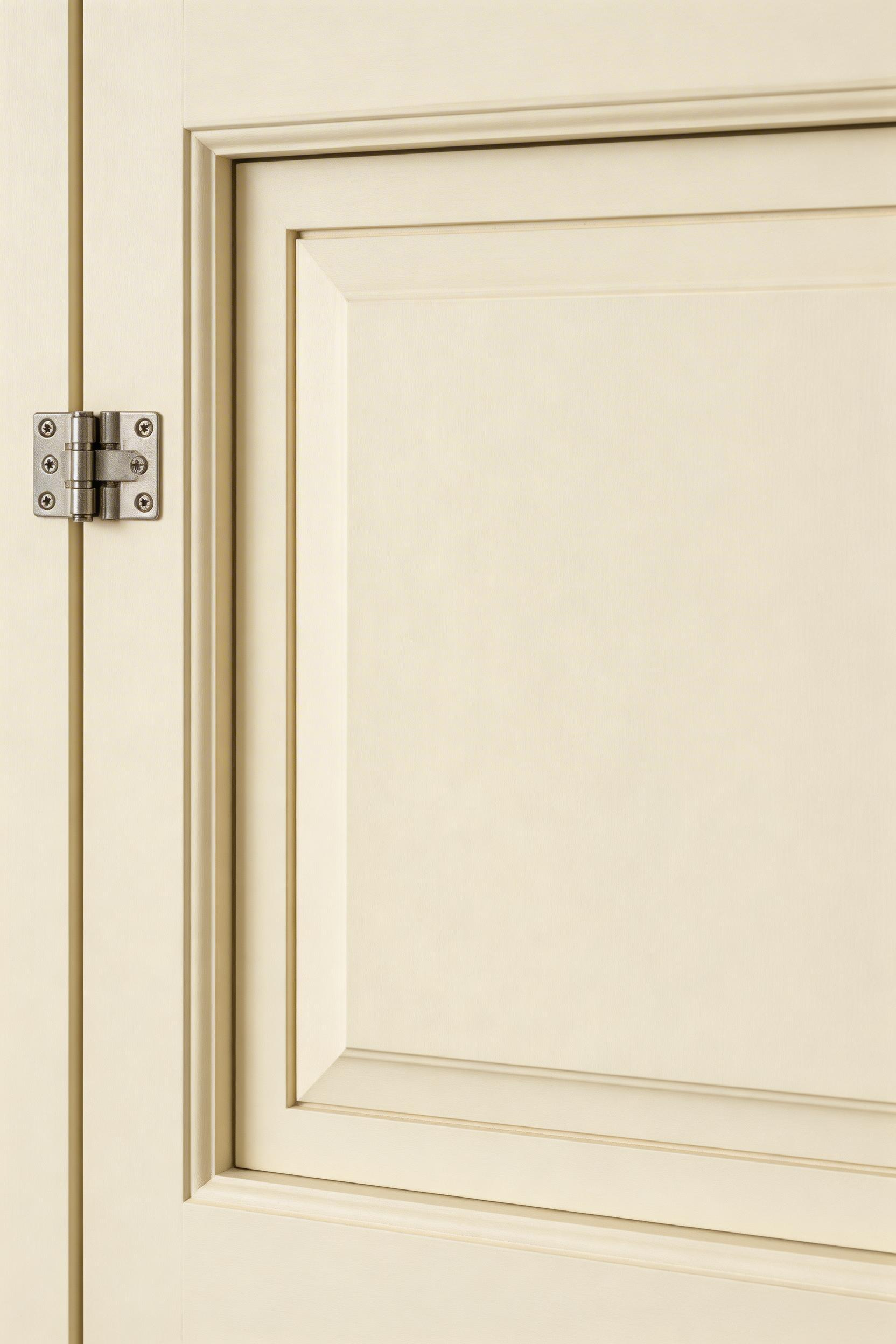
Full-overlay is the contemporary standard: the door covers the cabinet frame completely, the hinge is concealed, and the result looks clean and seamless. Partial overlay leaves some of the face frame visible between doors — the traditional North American look, still widely used in transitional kitchens. Inset is the most refined option: the door sits flush inside the face frame opening, creating a surface plane that is continuous across the entire cabinet wall.
The Craftsmanship Premium
Inset doors cost 20–40% more than full-overlay because of the tolerances required. Each door must be sized exactly to its opening — there’s no standard sizing. No two openings are identical. The gap around an inset door is 1/16″ to 3/32″ all round. In solid wood, that gap moves with seasonal moisture changes. For humid kitchens — near a dishwasher, in a basement — MDF-core doors with a real wood veneer are the practical solution. They hold the gap tolerances without seasonal wood movement.
Plain English Kitchens’ hand-built inset Shaker doors are the benchmark: £1,000–£2,500 per linear foot. CliqStudios at £150–£400 per linear foot is the semi-custom entry point that delivers most of the visual benefit. Full-overlay accounts for 72% of kitchen cabinet orders in North America; inset is only 6% — but it represents a disproportionate share of high-specification kitchen renovations.
12. Corner Cabinet Solutions: Lazy Susans, Blind Corners, and Magic Corner Units
The corner cabinet is where kitchen cabinet design most commonly fails in practice. A standard blind corner base cabinet loses 30–50% of its usable depth to the inaccessible zone. That’s the area only reachable by crouching down and reaching your arm into the dark. Every kitchen has one. Every kitchen has at least one corner. Most kitchens waste it.
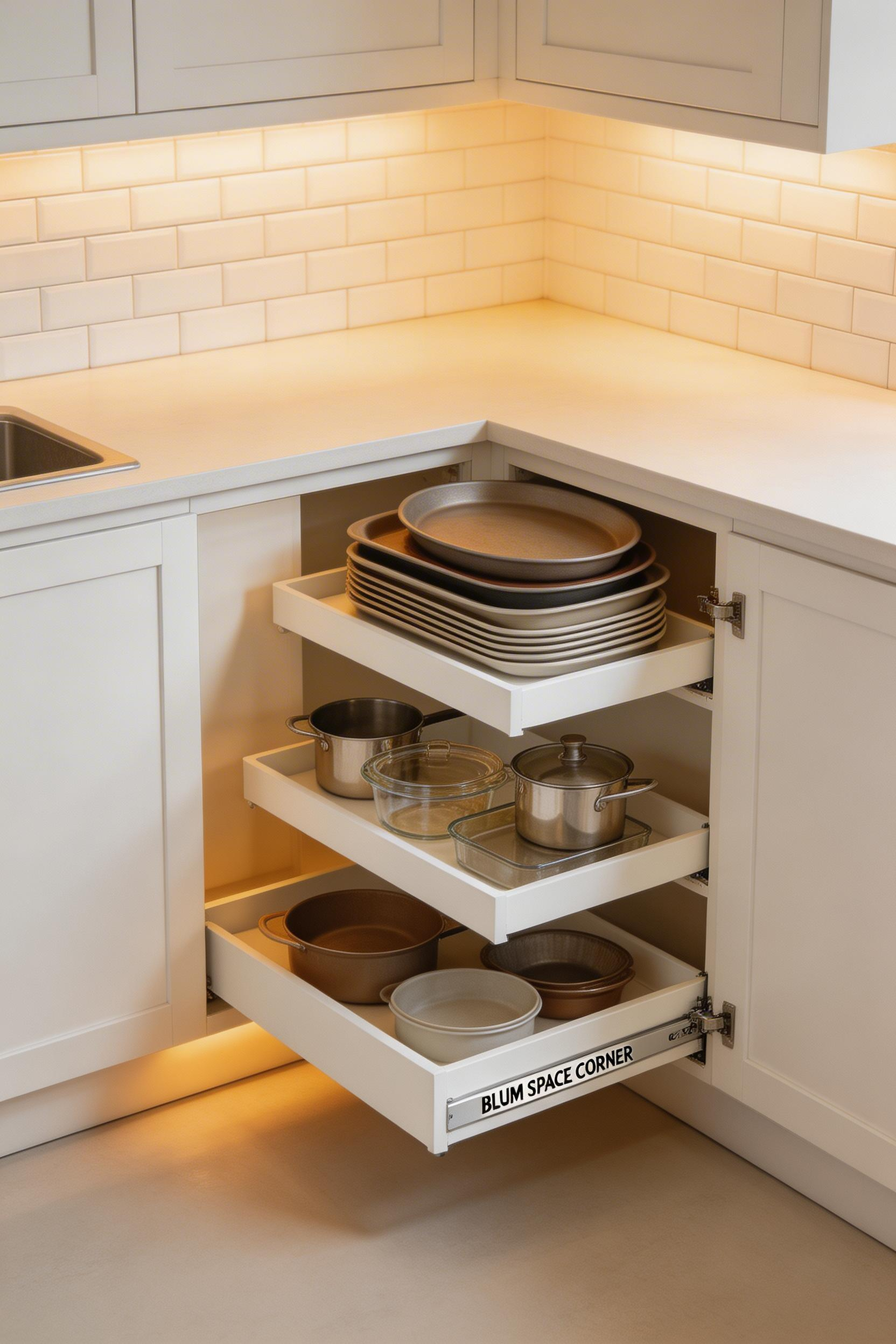
There are three main solutions. A Lazy Susan (rotating carousel), a Magic Corner pull-out (linked trays that swing to the front), and a diagonal corner cabinet with an angled face that eliminates the blind corner entirely. The Lazy Susan is the cheapest and most widely known — 28″ and 32″ diameter units are the most common sizes. The issue is that the rotating mechanism doesn’t make the back of the cabinet more accessible; it just rotates what was inaccessible to the front.
The Pull-Out Solution That Works Better
The Magic Corner or pull-out corner system (Häfele, Blum SPACE CORNER, Rev-A-Shelf) is the more functional choice. A linked tray system pulls out and swings to one side, bringing all stored items fully forward. Blum’s SPACE CORNER is the premium option at £600–£1,200 installed, with a motorised SERVO-DRIVE variant. It requires a minimum 36″ corner base cabinet opening, which is standard in most UK and US kitchens.
For an existing standard blind corner box, the Rev-A-Shelf Kidney-Shaped Lazy Susan (RV-12KF-BC series) is the easiest retrofit. It replaces the fixed shelf without any structural change. A 2023 NKBA consumer satisfaction study found corner storage was the second-most common kitchen complaint. Some 38% of respondents said they wished they had specified a pull-out corner system.
13. Dark-Painted Cabinets: Navy, Forest Green, Charcoal, and How to Balance Them
Dark kitchen cabinet design commands a room when done right and feels oppressive when it isn’t. The difference almost always comes down to light. The benchmark is 50 foot-candles measured at counter height. Below that, dark cabinets feel closed-in rather than dramatic. Reaching it means ceiling fixtures, task lighting under upper cabinets, and often island pendant lighting all working together.
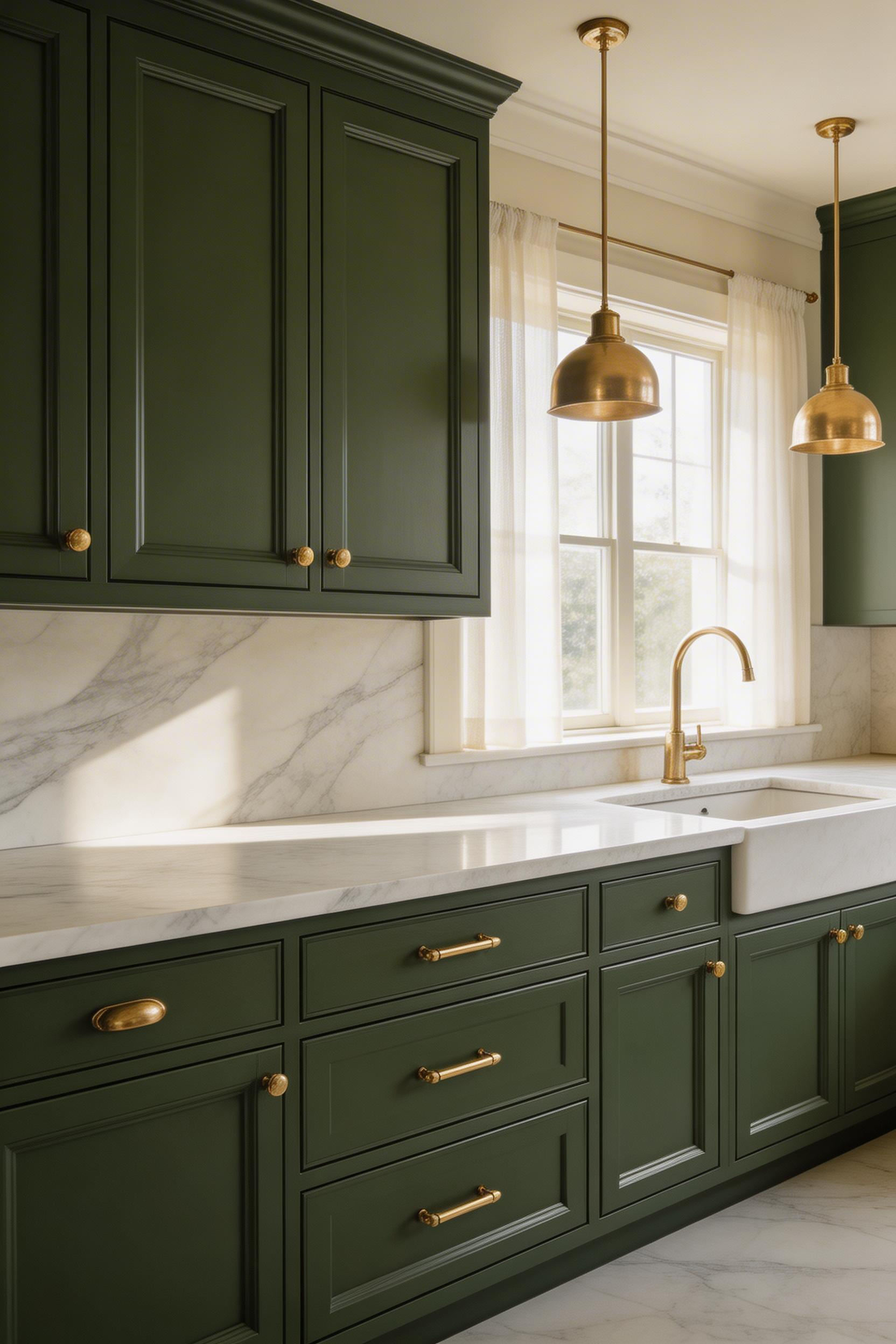
Farrow & Ball’s 2024 colour sales data showed their three most popular kitchen cabinet colours were all dark: Down Pipe, Hague Blue, and Railings. The move away from all-white cabinetry is real and sustained. But those three colours work partly because they’re complex. Each contains hints of warm or cool undertones that prevent them from reading as flat or industrial.
The one dark shade most designers avoid: pure black or near-pure black on all cabinets. It tends to read as an absence of design rather than a deliberate one, especially under kitchen lighting. Very dark grey (Down Pipe, LRV 6) achieves a similar dramatic effect while retaining some visible colour character. For ideas on how dark cabinetry works in a full kitchen scheme, the guide to kitchen remodeling ideas includes several well-documented examples.
Making Dark Cabinets Work in Practice
The balance principle: dark lower cabinets need a light countertop or a light backsplash — ideally both. A countertop with an LRV of 65–85 provides the contrast needed to prevent the lower half of the kitchen from feeling like a cave. White Calacatta quartz is the most common pairing. Warm natural stone (Arabescato or Bianco Carrara marble) softens the contrast while still providing the necessary lightness.
Dark green cabinets photograph well but are more context-dependent than most. I won’t specify a dark green without seeing the actual light levels at multiple times of day. What reads as jewel-like at noon can look flat at 7 PM.
14. Cabinet Interior Upgrades: Pull-Out Drawers, Bin Units, and Built-In Dividers
Cabinet interiors are where the overall scheme most often falls short of its potential. A standard base cabinet with a fixed shelf stores items in an inaccessible pile. Items at the back are invisible and unreachable without removing everything in front. Interior upgrades can add 30–50% more functional storage to an existing carcass with no structural changes. The guide to kitchen interior design ideas covers the broader context for how interior upgrades fit into a whole-kitchen approach.
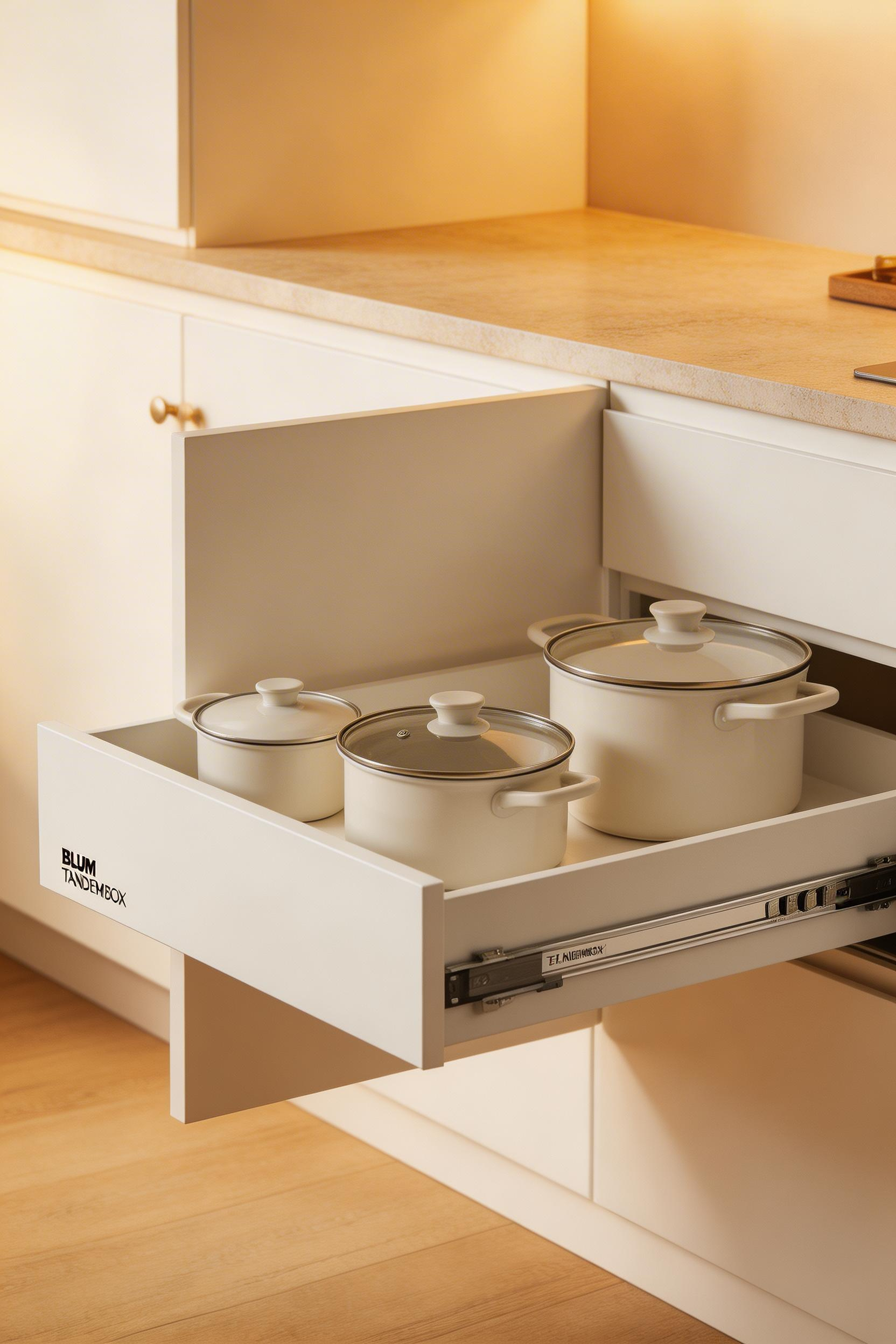
Pull-out drawer inserts (rollouts) convert a standard base cabinet shelf into accessible tiered storage — every item is visible and reachable from the front. They’re the single most impactful interior upgrade per pound spent. Blum’s 2023 consumer research found that 71% of homeowners said pull-out interior systems were among the features they most regretted not specifying during their renovation.
The Specific Upgrades Worth Prioritising
Blum’s ORGA-LINE cutlery insert system (£80–£200 per drawer) is the standard for cutlery drawers. The modular trays fit inside a Blum TANDEMBOX drawer and can be rearranged as needs change. Rev-A-Shelf’s 2-bin pull-out waste and recycling unit (£150–£250 installed) fits into an 18″ base cabinet and handles waste and recycling in a single pull. Häfele’s Kesseböhmer pull-out pantry (£400–£800 installed) converts a 24″ base cabinet into a full-extension, 4-tier storage unit for dry goods.
The replacing-a-fixed-shelf-with-a-rollout is a 2-hour DIY task. Hardware comes pre-assembled from Rev-A-Shelf and similar brands. The specification to use: a full-extension drawer rated for 65–88 lbs (Blum TANDEMBOX standard) with integrated soft-close. Not the cheap plastic-slide versions that come with most stock cabinets.
15. Mixed Material Cabinets: Combining Painted, Wood, and Metal Finishes
Three-material kitchens — painted cabinetry combined with natural wood elements and metal or glass accents — are the current direction in elevated kitchen cabinet design. Pinterest’s 2024 trend report identified ‘mixed material kitchens’ as a top-five emerging interior trend, with saves for ‘mixed cabinet finishes’ up 340% year-on-year. A single material applied to every surface produces a kitchen that reads as either a showroom or a rental. Materials in combination produce something that feels more like a considered room.
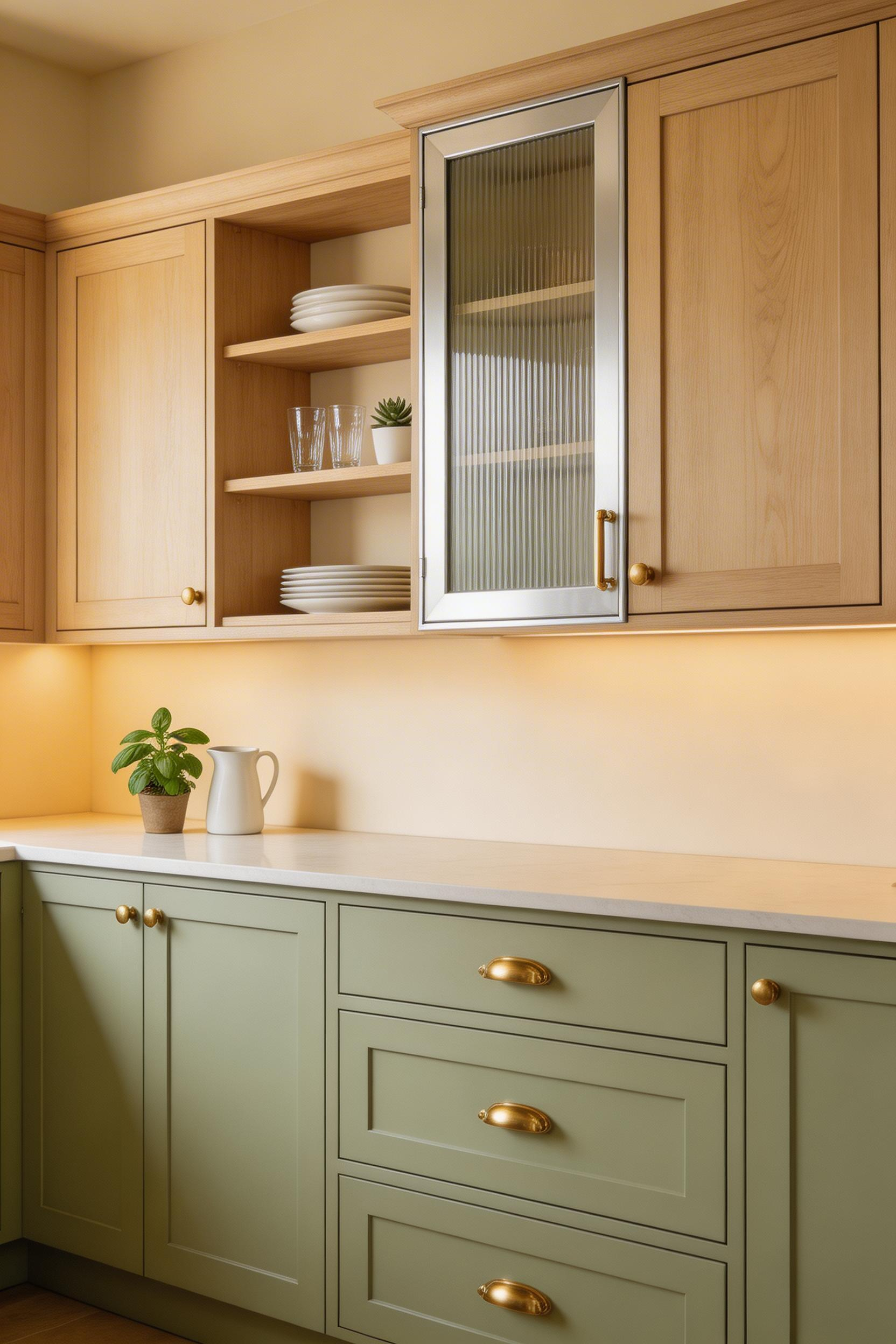
The proportional rule is 60-30-10: one material dominates, one supports, one accents. In practice, the painted cabinets occupy most of the run. Natural wood appears on the island or as open shelves. A metal or glass detail — a few steel-framed glass doors, a metal-fronted pantry, or aluminium-framed upper cabinets — provides the accent on a single wall.
The Combinations That Work and the One to Avoid
The most reliable three-material combination right now: white or cream paint + natural white oak + brushed brass hardware. It’s organic, light, and currently broadly popular without feeling trend-dependent. The darker version — navy or charcoal paint + walnut island + matte black hardware — works for kitchens that can carry dramatic contemporary kitchen backsplash choices alongside them.
The combination to avoid: warm-toned pine or honey oak alongside cool grey paint. The undertones fight each other. Warm wood needs warm or neutral paint. Cool grey works with neutral or white oak. In a finished kitchen, the mismatch is immediately visible and difficult to fix without repainting.
The mixing rule: if you can’t clearly explain why each material appears where it does, the mix looks accidental rather than composed. This is the wood zone, this is the painted zone, this is the metal detail — those distinctions need to be legible. Zoning by function or by architectural element is what separates intentional kitchen cabinet design from a room that tried too many things at once.
Choosing the Kitchen Cabinet Design That Will Still Work in Ten Years
Kitchen cabinet design decisions are among the most permanent choices in any renovation. Unlike paint colours or soft furnishings, cabinets aren’t changed on a whim. The right choice satisfies two things: it works for how you actually use the kitchen, and it doesn’t rely on a trend for its appeal.
Start with the door profile. A Shaker door in a proportion-appropriate width is the lowest-risk choice — not because it’s generic, but because it’s genuinely neutral. From there, the colour or material choice has more room to be personal. A sage green Shaker cabinet, a natural oak Shaker door, and a navy painted Shaker front are three different-feeling kitchens. The structure is the same; the expression is not.
For hardware, choose a finish that holds up for fifteen years. Unlacquered brass, matte black, and satin stainless have each demonstrated that longevity. Proportion the pull length to the drawer front size rather than defaulting to whatever’s most common.
Interior upgrades are worth factoring in at the specification stage rather than retrofitting later. Pull-out inserts, bin units, and cutlery trays cost more to retrofit into an installed kitchen than to include from the start.
The kitchen cabinet design that holds up is rarely the one that made the boldest statement in the showroom. It’s the one that still feels right to use three years after the newness has worn off.