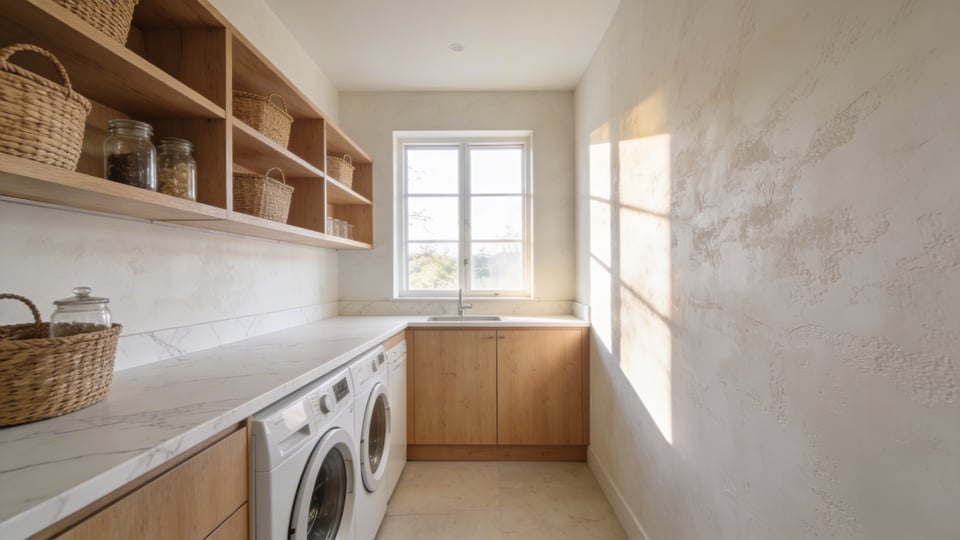
Most homeowners think a functional laundry room just needs efficient appliances and storage. However, modern laundry room ideas often ignore the impact these spaces have on our mental well-being. Historically, architects banished laundry to dark basements. This physically disconnected the chore from daily life. Unfortunately, this isolation creates a psychological burden. It transforms a necessary task into a lonely punishment. In fact, the resistance we feel is often a reaction to a sensory-deprived environment. Therefore, the stress of laundry isn’t just about the clothes; it is an architectural failure.
True functionality requires understanding how surroundings influence the nervous system. Surprisingly, the secret to a restorative space lies in “sensory architecture,” not just organization. For instance, biophilic elements and tactile materials ground the body during repetitive work. Additionally, managing “visual noise” reduces the cognitive load triggered by cluttered piles. By shifting focus from the product to the process, we change our mindset. Thus, the room becomes a sanctuary for a meaningful “ritual of purification.”
This guide reveals how to elevate the laundry experience through wellness-focused design. We will explore strategies to integrate natural light and soothing acoustics. Furthermore, we examine how scent architecture and “visual quiet” reduce cortisol levels. Ultimately, these choices transform a mundane chore into an act of self-care. By honoring the labor, you create a home that supports both order and peace.
Section 1: The Foundation of Healthy Materials
The laundry room has evolved from a basement afterthought into a “wellness scullery.” For those seeking high-end design ideas for a stylish space, material selection is preventative medicine. Specifically, we must prioritize how walls manage moisture. Modern high-gloss paints often act like a plastic bag. They trap dangerous humidity behind the surface. Conversely, historical materials like limewash are naturally vapor-permeable. This high-pH finish allows walls to breathe. It naturally resists fungi while offering a soft, matte glow.
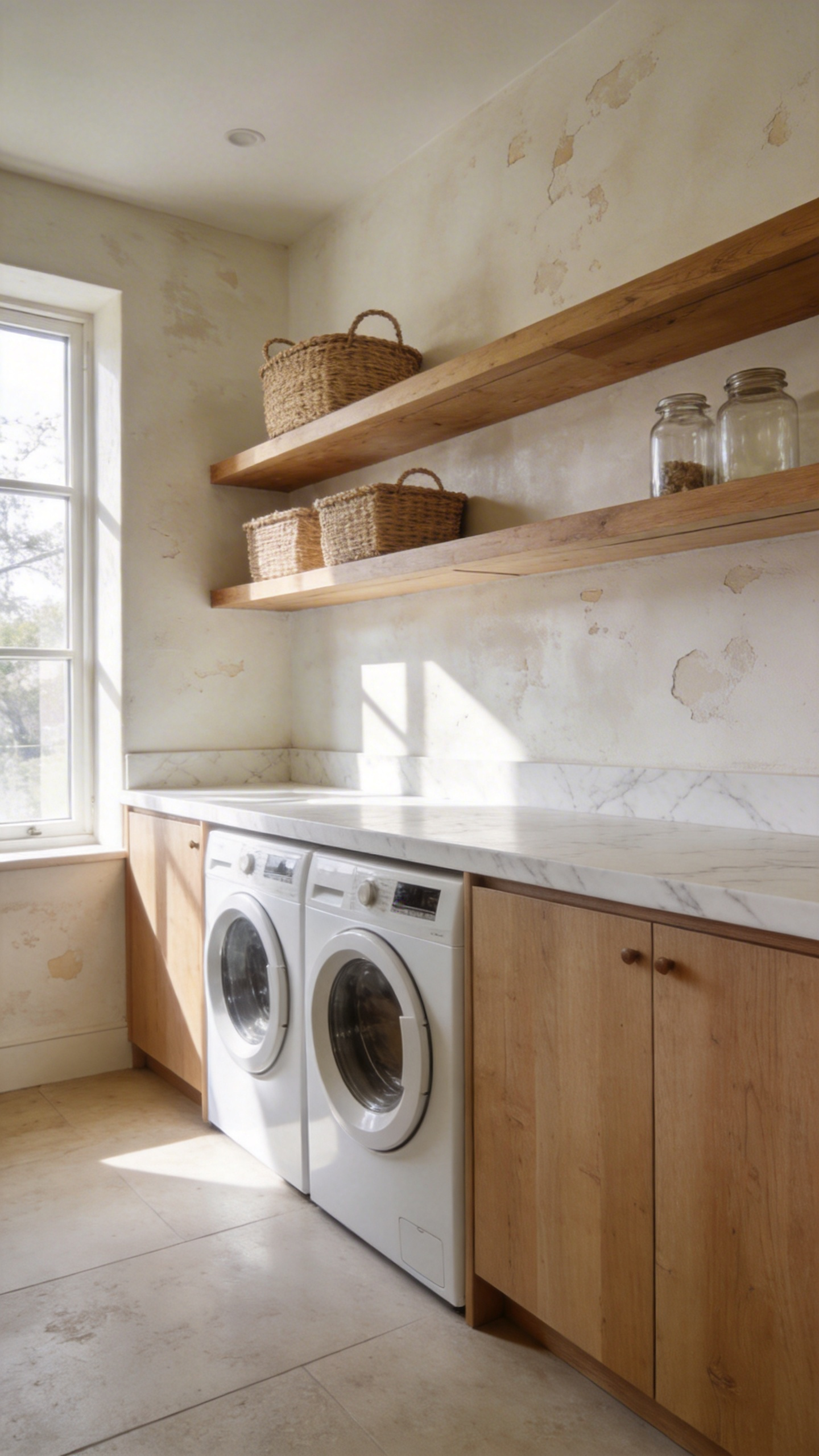
Next, we must address the cabinetry. Standard fiberboard often releases formaldehyde. This toxin is exacerbated by dryer heat. However, avoiding these volatile organic compounds (VOCs) is possible. You can mitigate this by incorporating creative storage ideas for the modern laundry room using soy-based plywood or E0-grade MDF. Furthermore, finishing these woods with natural Tung or Hemp oil replaces toxic polyurethanes. These living finishes saturate the wood fibers. They create a flexible, water-resistant barrier without off-gassing.
Finally, the foundation of a healthy room relies on “tactile grounding.” Chemically inert stones like soapstone offer a warm thermal mass. This feels restorative to the touch. Unlike clinical stainless steel, soapstone creates a sensory counterpoint to soft linens. Additionally, the unseen structure matters. Dryer vents can leak moisture and chemicals. Therefore, standard drywall is a risk. Instead, use cement-based boards to ensure walls provide no food source for mold. Ultimately, these elements protect air quality and mental wellbeing.
1. Opt for Zero-VOC Cabinetry Paint to improve indoor air quality in small, enclosed spaces.
Selecting Zero-VOC cabinetry paint is a critical intervention for indoor air quality. Laundry rooms are often the smallest, hottest areas in a home. Furthermore, the intense heat generated by appliances creates a unique chemical environment. Consequently, high temperatures act as a catalyst. They accelerate the off-gassing of volatile organic compounds found in traditional paints.
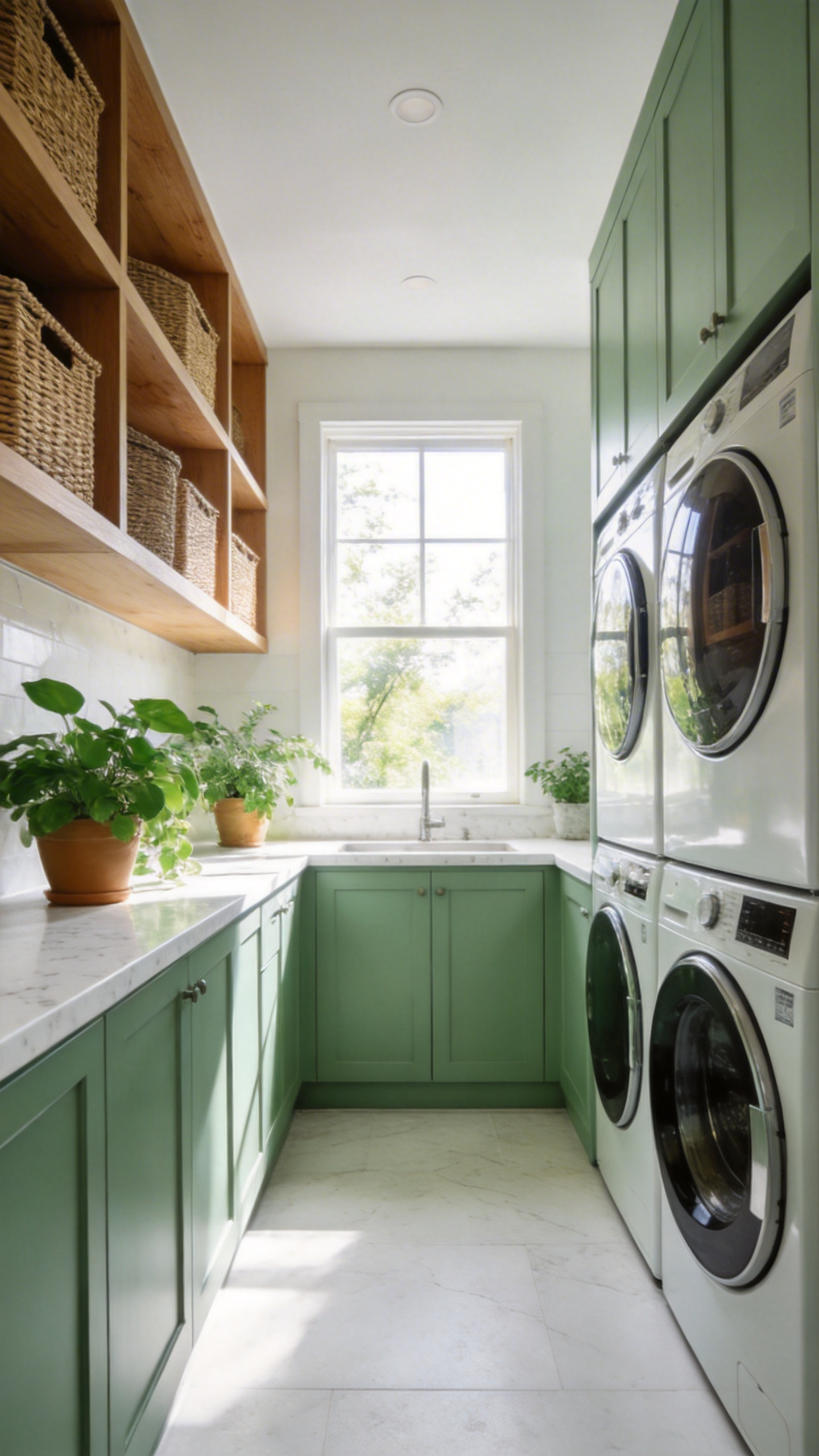
In fact, your dryer functions as a “smell vacuum.” It pulls in surrounding air to dry clothes. If your cabinets release toxins, the dryer heats these fumes. This potentially bakes them into your fabrics. Fortunately, technological advancements now allow for safer alternatives without sacrificing performance. Specifically, modern waterborne alkyd paints offer a “hybrid” solution. They provide a glass-smooth, scrubbable finish that withstands detergent spills.
Moreover, choosing the right sheen is vital for these “splash zones.” Professionals typically recommend a satin or semi-gloss finish. These create a non-porous shield against moisture. However, remain vigilant regarding the “pigment trap.” A base paint may be labeled Zero-VOC, but dark colorants often reintroduce chemicals. Therefore, seek products with GREENGUARD Gold certification or the Declare label. Ultimately, this ensures your design choices support a healthy sanctuary.
2. Select Naturally Antibacterial Countertops like soapstone or quartz over porous laminates.
Designing a healthy laundry room requires looking beyond aesthetics. You must consider the unseen microbial environment. High humidity and soiled clothing introduce significant bioburden. Therefore, surface selection becomes a critical health decision. Unfortunately, common laminates often fail this test. While the top layer is smooth, the seams remain vulnerable. Consequently, moisture seeps into the particle-board core. This causes swelling and creates hidden pockets for black mold.
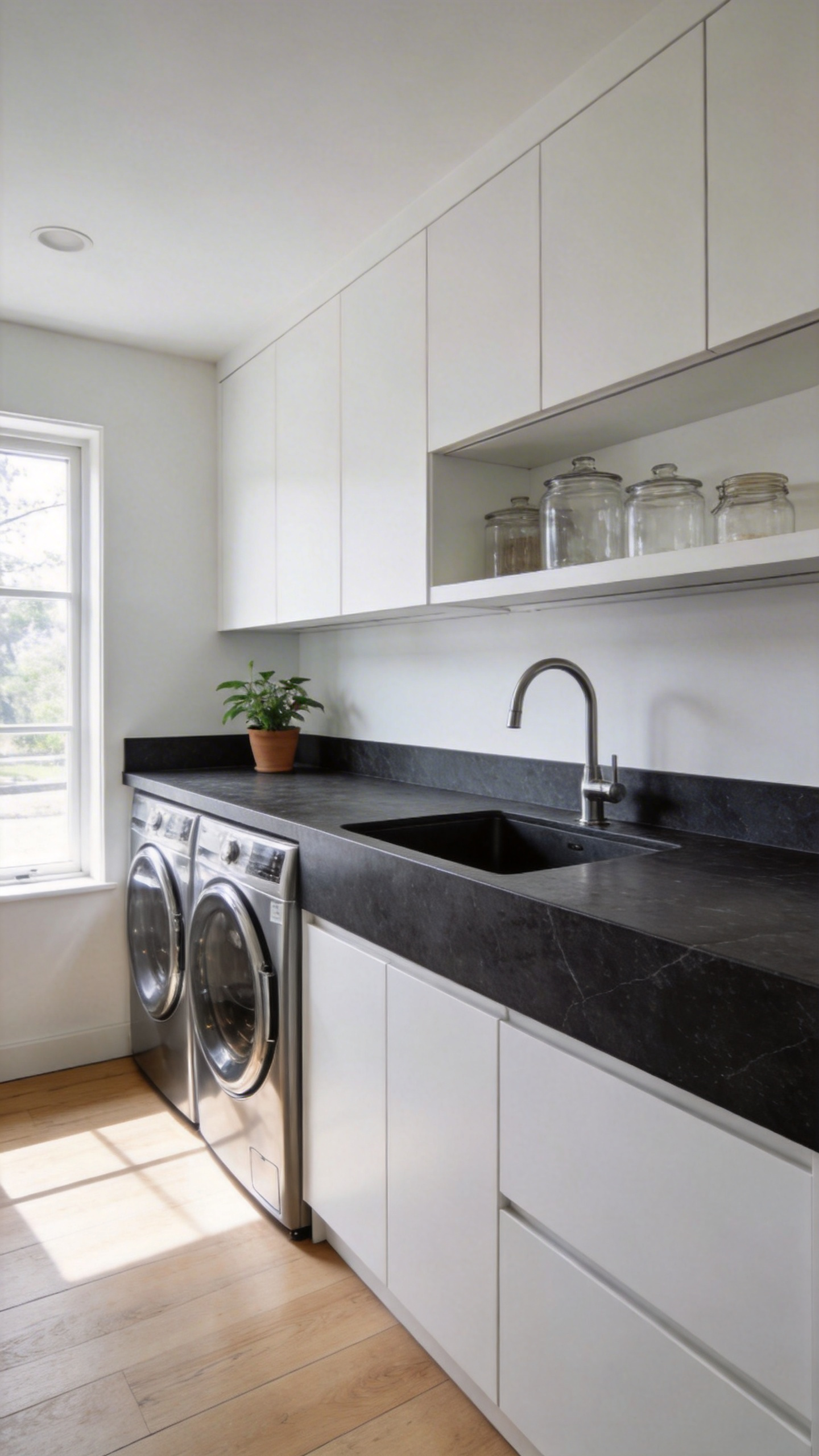
To combat this, wellness architecture prioritizes non-porous materials. Quartz, for example, is engineered to have zero entry points. As a result, bacteria cannot form slimy biofilms or burrow beneath the surface. Alternatively, soapstone offers a time-tested solution. Historically, this stone was the gold standard for sanitary sinks. It is chemically inert and withstands harsh bleach without etching. Furthermore, its magnesium content helps inhibit bacterial growth.
Beyond hygiene, soapstone adds a unique sensory element. Surprisingly, it feels warm and velvety to the touch. Thus, it makes the room feel inviting rather than clinical. Ultimately, both materials “starve” microbial colonies by eliminating moisture traps. By choosing solid-body surfaces, you effectively prevent respiratory irritants. You also gain the freedom to scrub surfaces rigorously.
3. Install Breathable Flooring options like cork or ceramic tile to prevent mold growth.
In a laundry room, flooring functions as more than just a surface to catch spills. Ideally, it regulates the room’s microclimate through hygrothermal buffering. Consequently, selecting materials like cork or unglazed ceramic is a vital health decision. These breathable options actively manage the high humidity inherent to laundry spaces.
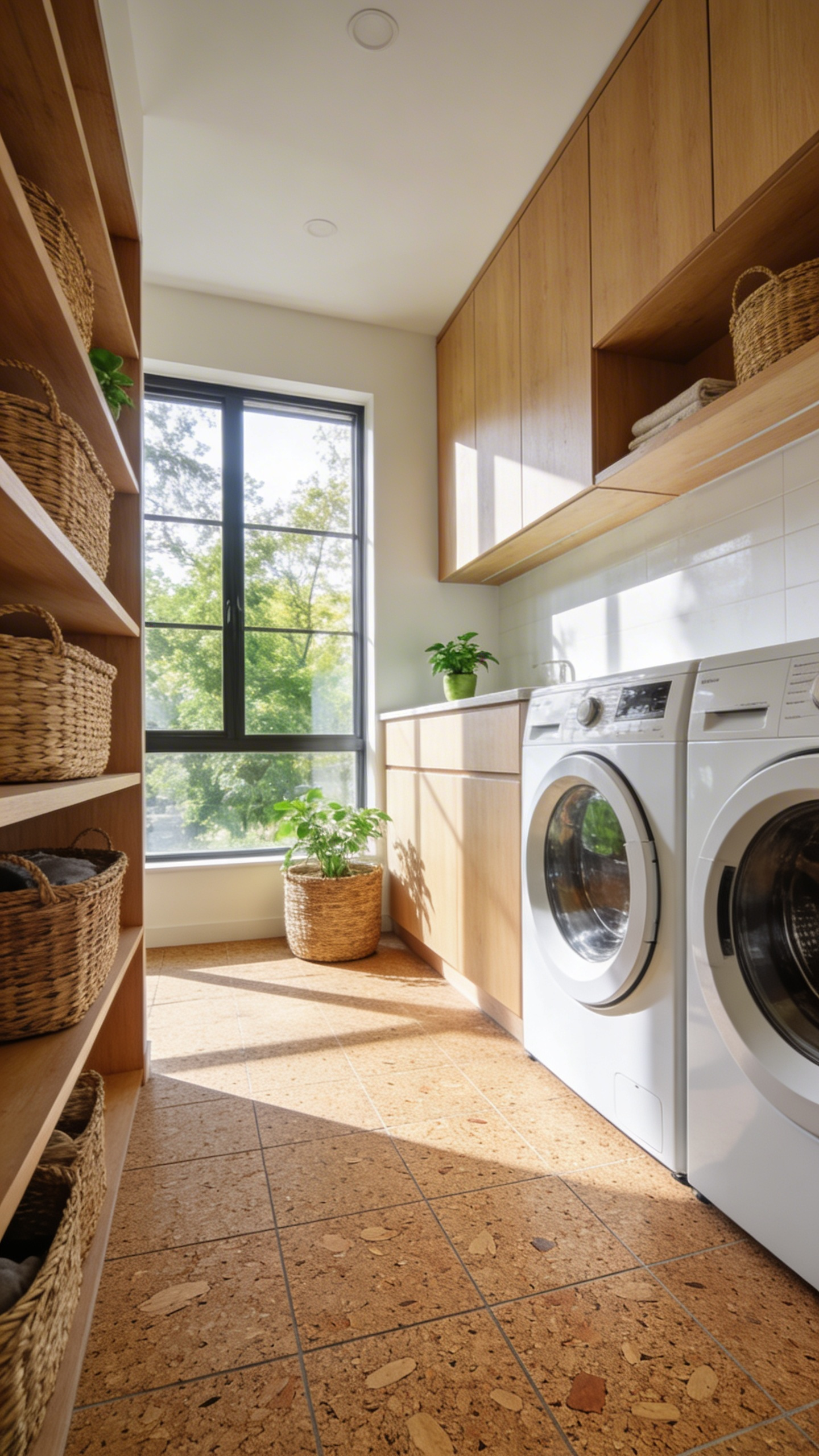
Specifically, cork offers a unique biochemical defense against mold. Its cellular structure is saturated with suberin, a natural waxy substance. Suberin repels liquid water while remaining vapor-permeable. Therefore, mold spores cannot find the stagnant moisture they require to take root. Furthermore, cork acts as a powerful thermal buffer. Unlike cold stone, it maintains a surface temperature close to ambient air. As a result, warm air from the dryer won’t condense on the floor.
Alternatively, ceramic and terracotta tiles provide a robust solution. However, the installation strategy matters immensely here. In basements, totally impervious floors can actually trap moisture rising from the concrete slab. To prevent sub-surface rot, opt for unglazed or vitreous tiles. Additionally, pair them with breathable, cementitious grout. This combination facilitates capillary active drying. Essentially, moisture moves through the floor and evaporates into the air. Ultimately, prioritizing breathability transforms your laundry area into a healthy environment.
4. Integrate a Microplastic Filtration System to align cleaning rituals with environmental health.
We often associate clean laundry with fresh scents and warm linens. However, a hidden issue currently lurks within our wastewater. A single load of laundry releases up to 700,000 microplastic fibers. Consequently, this “invisible avalanche” bypasses municipal treatment plants and enters our waterways. Therefore, integrating a filtration system transforms your laundry room from a pollution source into a site of environmental defense.
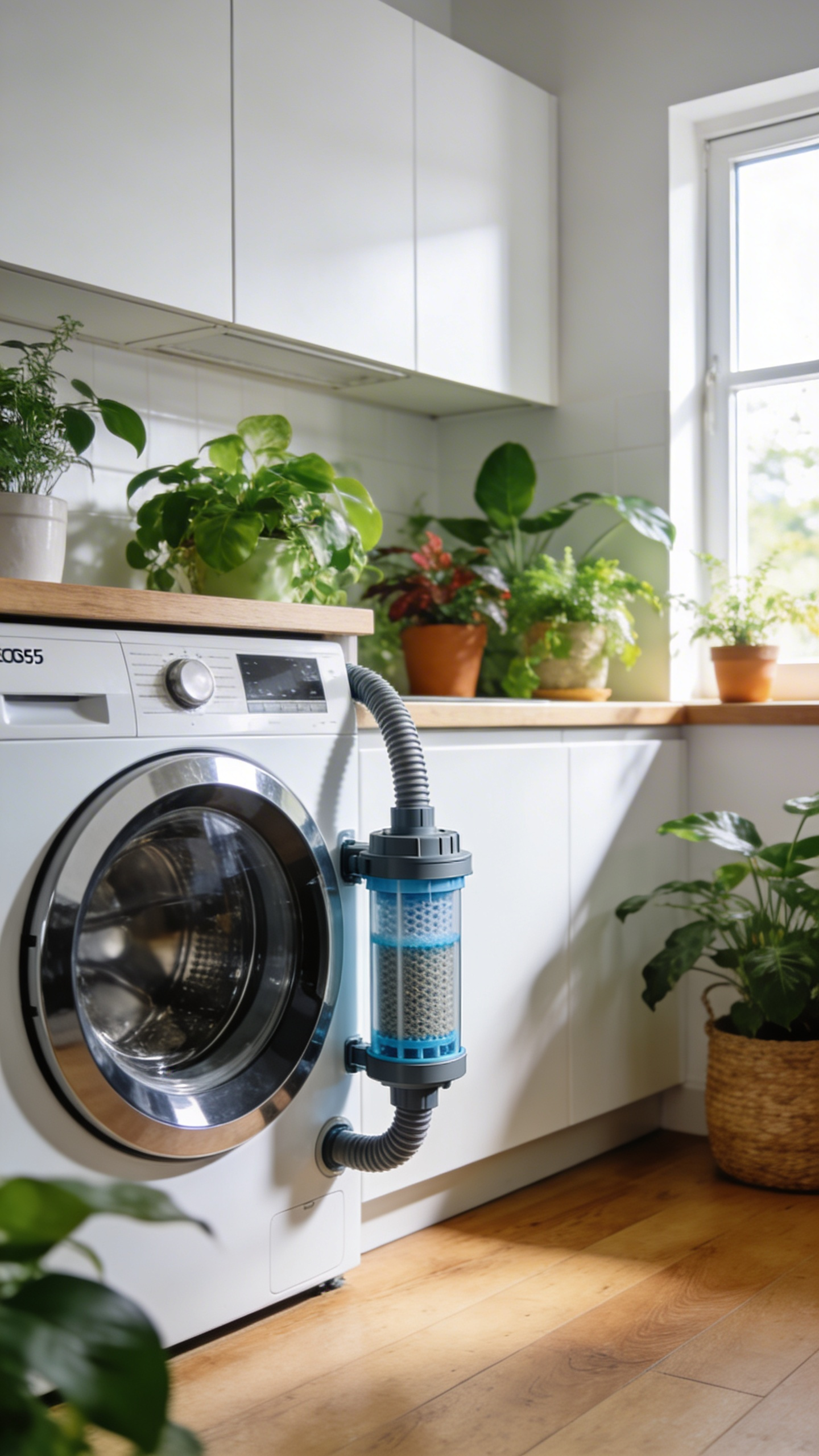
Legislation in regions like France is already making these filters mandatory. Thus, future-proofing your home now is a prudent design decision. To maintain a high-end aesthetic, designers are moving beyond clunky external canisters. Instead, consider “niche-in” placements that recess the filter into the wall. Ideally, install these units at eye level. This placement ensures easy maintenance while preventing drain pump stress.
Furthermore, maintaining the filter creates a new, grounding conservation ritual. Unlike dryer lint, the captured material is a dense, damp “micro-sludge.” Crucially, never rinse this residue in the sink. Simply scrape the dried fibers into a sealed bag for proper disposal. In fact, seeing this waste often inspires a shift toward natural fibers like organic cotton. Ultimately, this small addition creates a profound alignment between your home’s hygiene and global wellness.
Section 2: Ergonomics and Mindful Flow
Historically, laundry areas were hidden away in damp basements. They served only utilitarian functions. However, modern wellness architecture reclaims this space to support physical health. You can organize your laundry room like a pro by establishing a “Linear Kinetic Path.” Ideally, aim for a “Dirty-to-Done” stream. Arrange stations to sort, wash, dry, and fold in a straight line. Consequently, this one-directional flow prevents the “weighted twist,” a motion that often causes back strain.
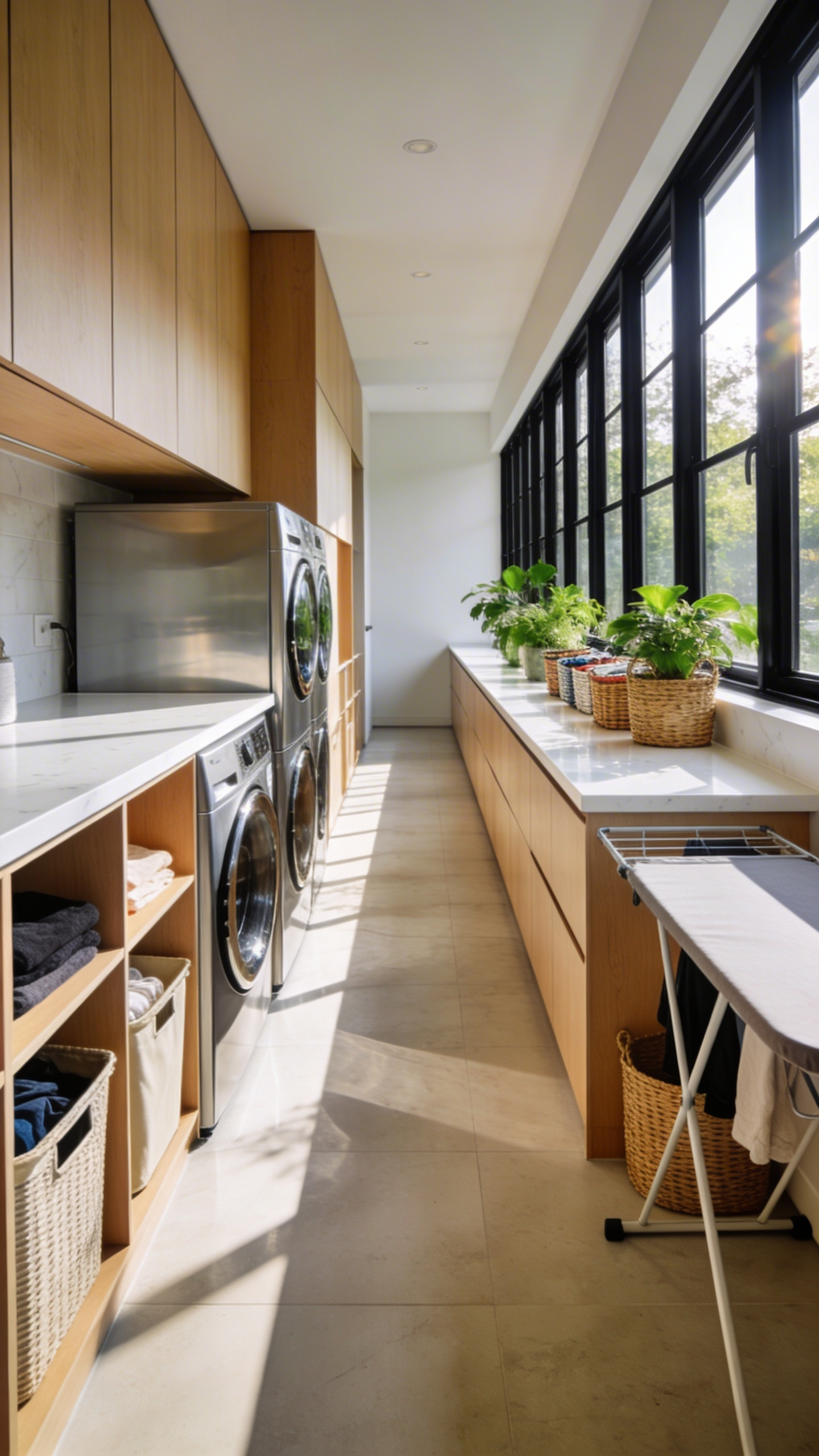
Furthermore, vertical alignment is just as critical as floor layout. Universal Design principles suggest elevating front-loading machines on a pedestal. This placement keeps the door in your “strike zone” between knuckles and shoulders. Therefore, you avoid the painful “hinge-and-reach” motion that stresses lumbar discs. Additionally, consider installing a slightly lower counter height for folding tasks. This allows you to use body weight rather than repetitive wrist motion.
Beyond mechanics, true wellness design must consider the nervous system. “Acoustic clutter” from vibrating machinery often triggers a low-level cortisol response. Thus, utilizing vibration decoupling pads is essential. Finally, replace cold plastic bins with natural materials. Research suggests that tactile feedback from organic textures grounds you in the moment. These sensory details turn a repetitive toil into a mindful ritual.
5. Elevate Appliances on Pedestals to reduce physical strain and promote better posture.
Elevating your washer and dryer is often viewed merely as a storage hack. However, its true value lies in ergonomic science. Standard front-loading machines force users into repetitive, uncomfortable bending. Consequently, this motion significantly increases pressure on the lumbar vertebrae. Experts recommend aiming for the “Golden Zone.” This ergonomic sweet spot sits between your knuckles and your shoulders. By raising appliances 12 to 15 inches, you protect your spine.
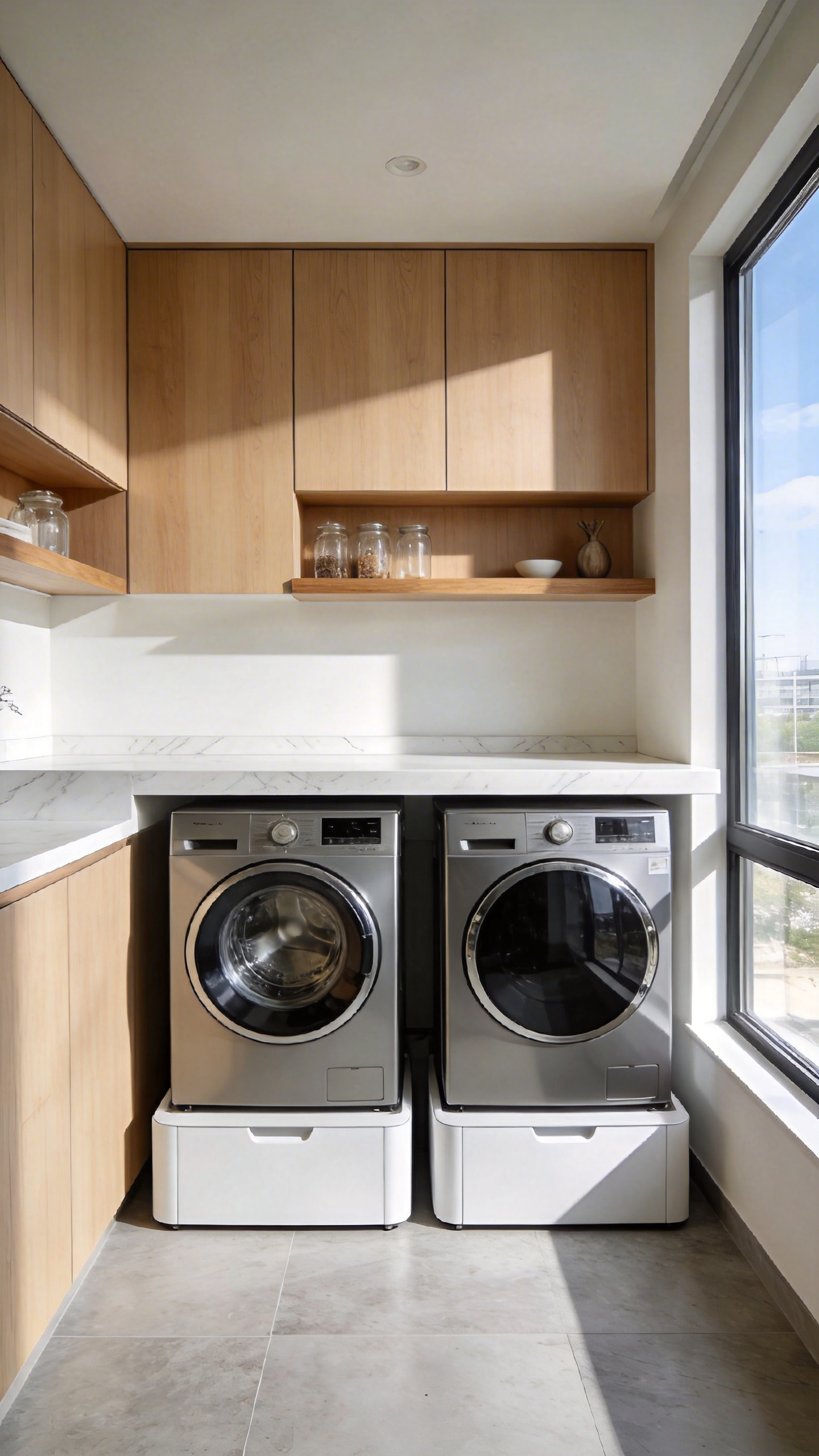
Furthermore, this design choice requires careful structural engineering. Modern machines generate intense G-forces during spin cycles. Thus, a simple DIY wooden box often creates dangerous instability. Conversely, professional steel pedestals provide necessary “structural decoupling.” This ensures the machine remains stable rather than “walking” across the room.
Finally, this upgrade supports the vital concept of “Aging in Place.” As we age, crouching to pull wet laundry becomes a fall risk. Elevation transforms the machine from a physical obstacle into an accessible tool. Additionally, high-end models now feature ventilated drawers to maximize utility. Ultimately, proper elevation merges physical wellness with architectural efficiency.
6. Design a ‘Zone-Based’ Workflow (Sort, Wash, Fold) to reduce cognitive load.
Designing a laundry room is often treated strictly as a plumbing challenge. However, through the lens of wellness architecture, it becomes a psychological endeavor. Specifically, we must reduce “Cognitive Load.” This is the mental fatigue caused by hundreds of micro-decisions. Therefore, a zone-based design transitions laundry from high-effort work to a low-effort “flow” state.
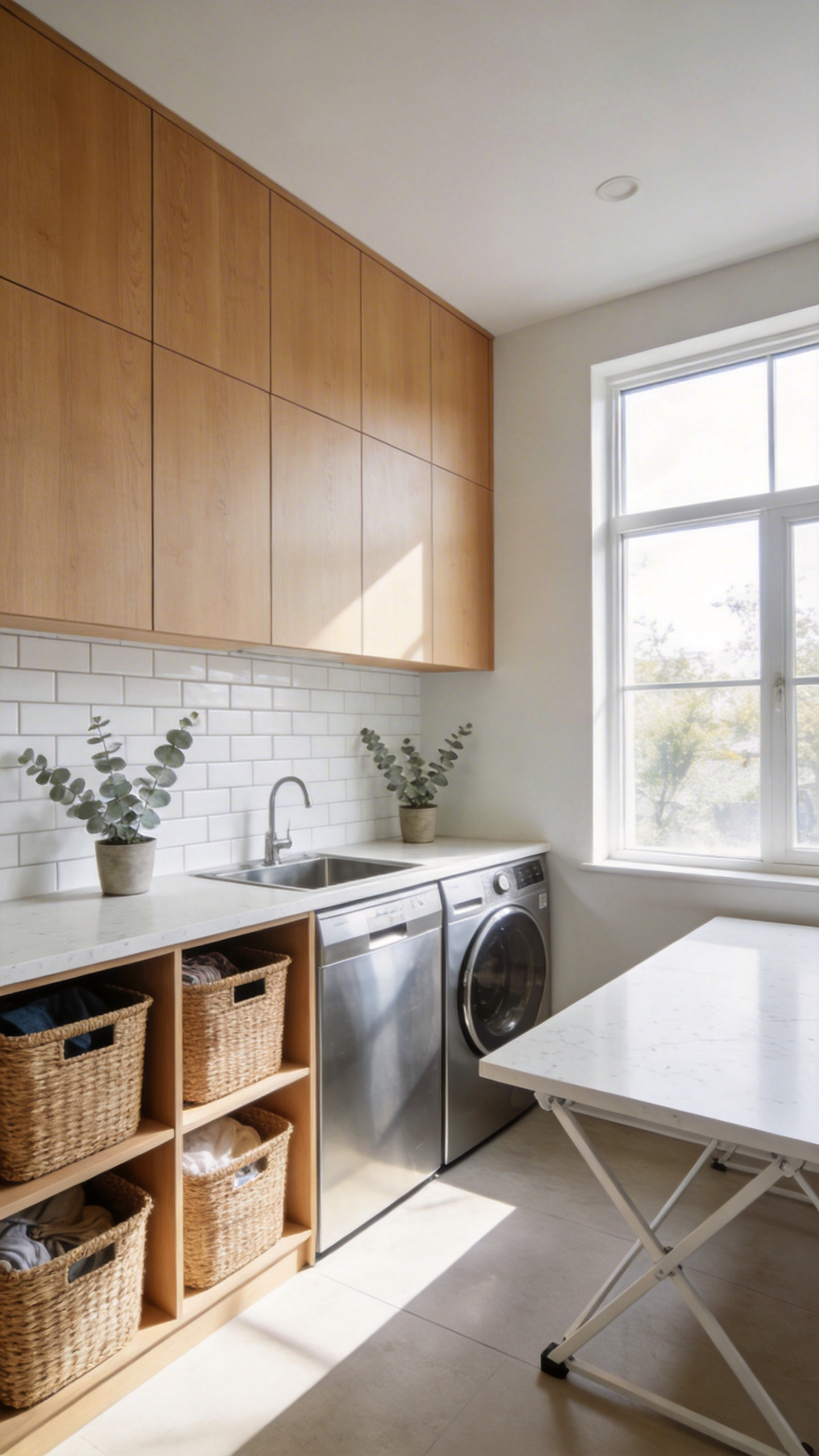
First, consider the “Sort Zone.” Sorting is typically the primary source of decision fatigue. To counter this, implement “Point-of-Origin Sorting” using integrated cabinetry bins. Consequently, the architecture makes the decision for you. This organization prevents the visual noise of overflowing baskets, a known cortisol trigger.
Next, connect the “Wash” and “Fold” zones. A common design failure is interrupted surfaces. Thus, we create a “Continuous Work Surface” similar to a professional kitchen. Ideally, position a countertop directly above front-loading machines. As a result, garments slide seamlessly from the dryer to the folding station. This eliminates heavy lifting and unnecessary pivots.
Finally, design a dedicated “Staging Area.” Without a specific exit strategy, laundry feels perpetually “in-process.” This creates subconscious open-loop stress. Therefore, install assigned cubbies or a valet rod as a visual “outbox.” Furthermore, incorporate sound-dampening insulation to manage acoustic stress. Closing this mental loop transforms the room from a space of labor into a place of kinetic meditation.
7. Install Pull-Out Folding Stations that disappear to maintain visual calm.
In wellness architecture, our primary goal is reducing daily stress. Unfortunately, laundry rooms often serve as visual reminders of unfinished business. Pull-out folding stations offer a brilliant solution for maintaining visual calm. Specifically, these retractable surfaces allow you to transform a chaotic workspace into a serene corridor instantly.
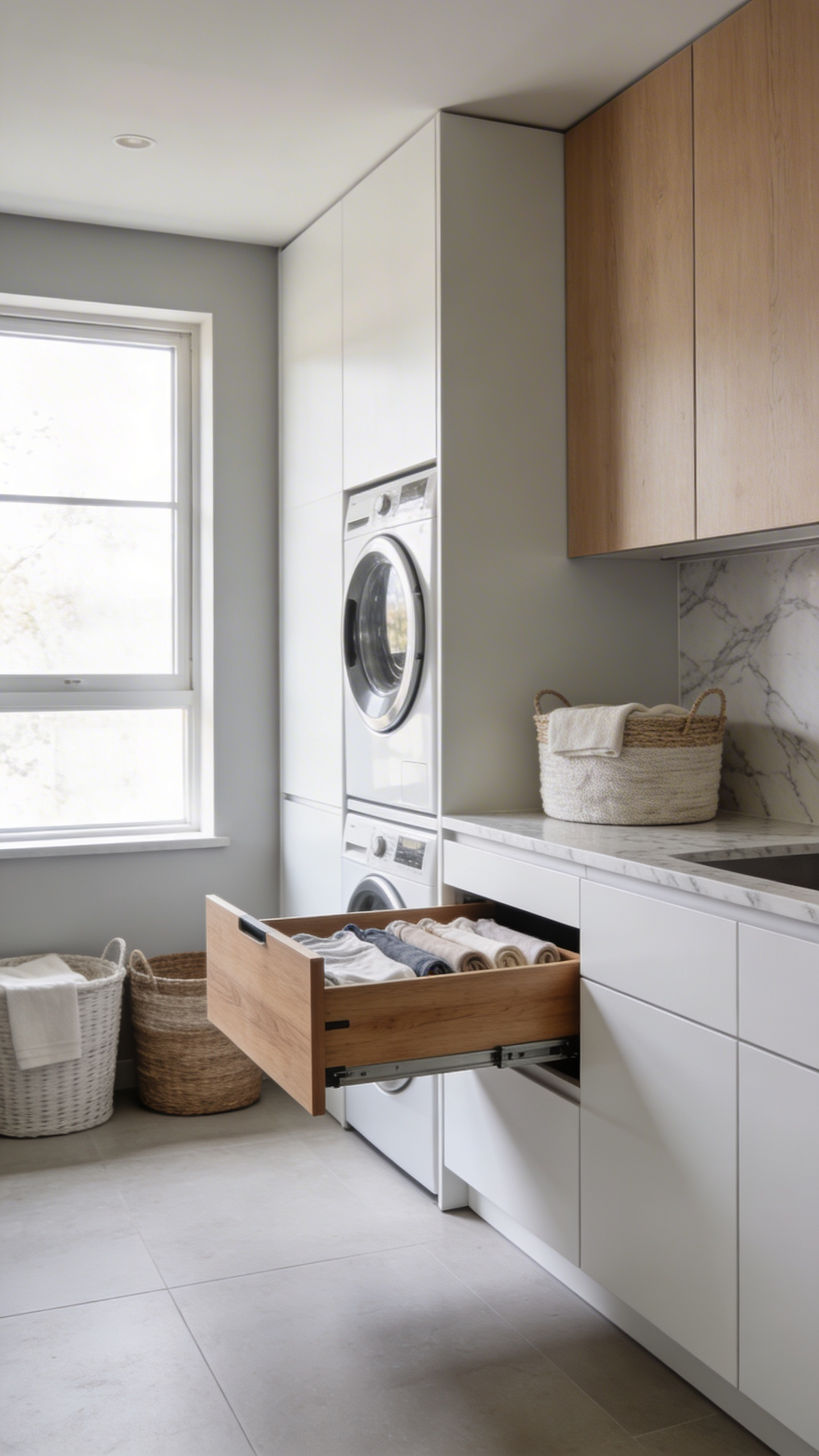
Psychologically, sliding the station back into its housing signals the completion of a task. Ideally, this physical act helps “close the tab” in your mental browser. However, achieving this effect requires authoritative design choices. Standard drawer slides cannot support the weight of leaning and folding. Instead, specify heavy-duty, full-extension ball-bearing slides.
Furthermore, look for “over-travel” mechanisms that extend beyond the countertop edge. This prevents awkward posture and protects your head from upper cabinets. Additionally, consider tactile materials like bamboo or butcher block. Unlike cold stone, these surfaces provide necessary friction. They keep delicate fabrics secure while adding warmth. Ultimately, this disciplined design choice prevents the dreaded “laundry mountain” by encouraging immediate action.
8. Implement Deep Utility Sinks with hands-free faucets for ergonomic hand-washing.
Historically, the laundry basin was merely a utilitarian “slop sink.” However, modern wellness architecture reimagines this fixture as a dedicated sanitization hub. Specifically, we now prioritize heavy materials like fireclay or enamel-coated cast iron. These dense materials naturally dampen the acoustic stress of rushing water. Furthermore, they offer superior thermal mass, keeping water warm longer for soaking linens.
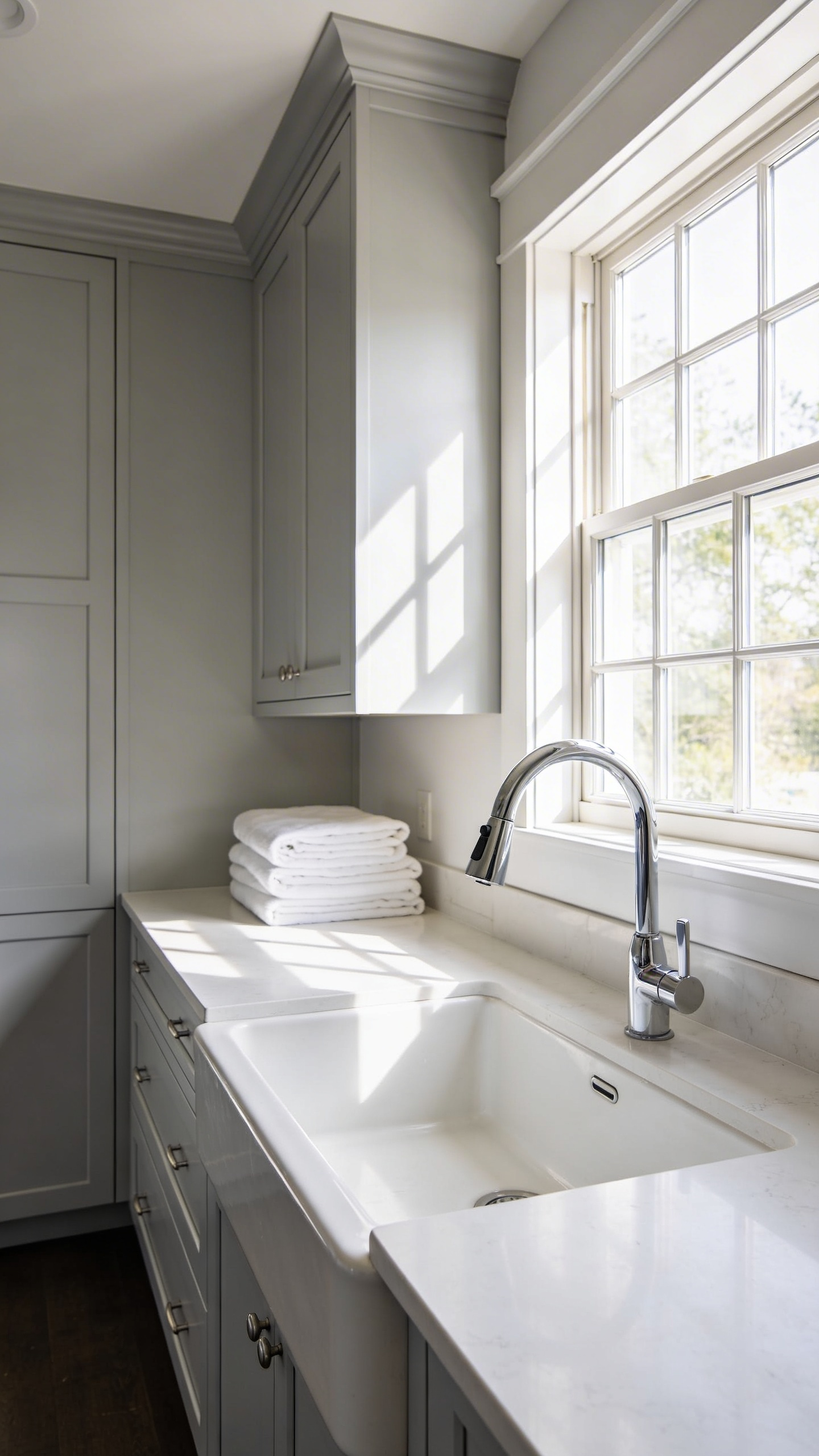
Nevertheless, a deep basin presents a unique ergonomic paradox. While depth prevents splashing, it often forces users to hinge painfully at the waist. Therefore, designers frequently mount these sinks in cabinetry raised 2–3 inches above standard height. This simple adjustment brings the “working floor” of the sink closer to your hands. Additionally, selecting a sink with a tapered front allows you to stand closer.
Functionally, the integration of hands-free technology creates a frictionless workflow. In fact, utilizing foot pedals or motion sensors eliminates the “dirty hand” problem entirely. You can wash gardening grime without contaminating the faucet handles. Ideally, pair this setup with a high-arc gooseneck faucet featuring a Laminar Flow aerator. Consequently, you gain vertical clearance while ensuring a clear, non-splashing stream. This transforms a chaotic chore into a clean, restorative ritual.
Section 3: Biophilic Integration and Sensory Calm
Traditionally, laundry rooms are treated as sterile, high-stress environments. However, wellness architecture transforms these utility spaces through restorative biophilic principles. This transformation begins with Acoustic Ecology. Standard design focuses strictly on lowering machine volume. Conversely, a biophilic approach prioritizes the quality of sound. For instance, incorporating cork wall coverings or timber baffles diffuses mechanical noise. This turns sharp rattling into a soft, restful hum.
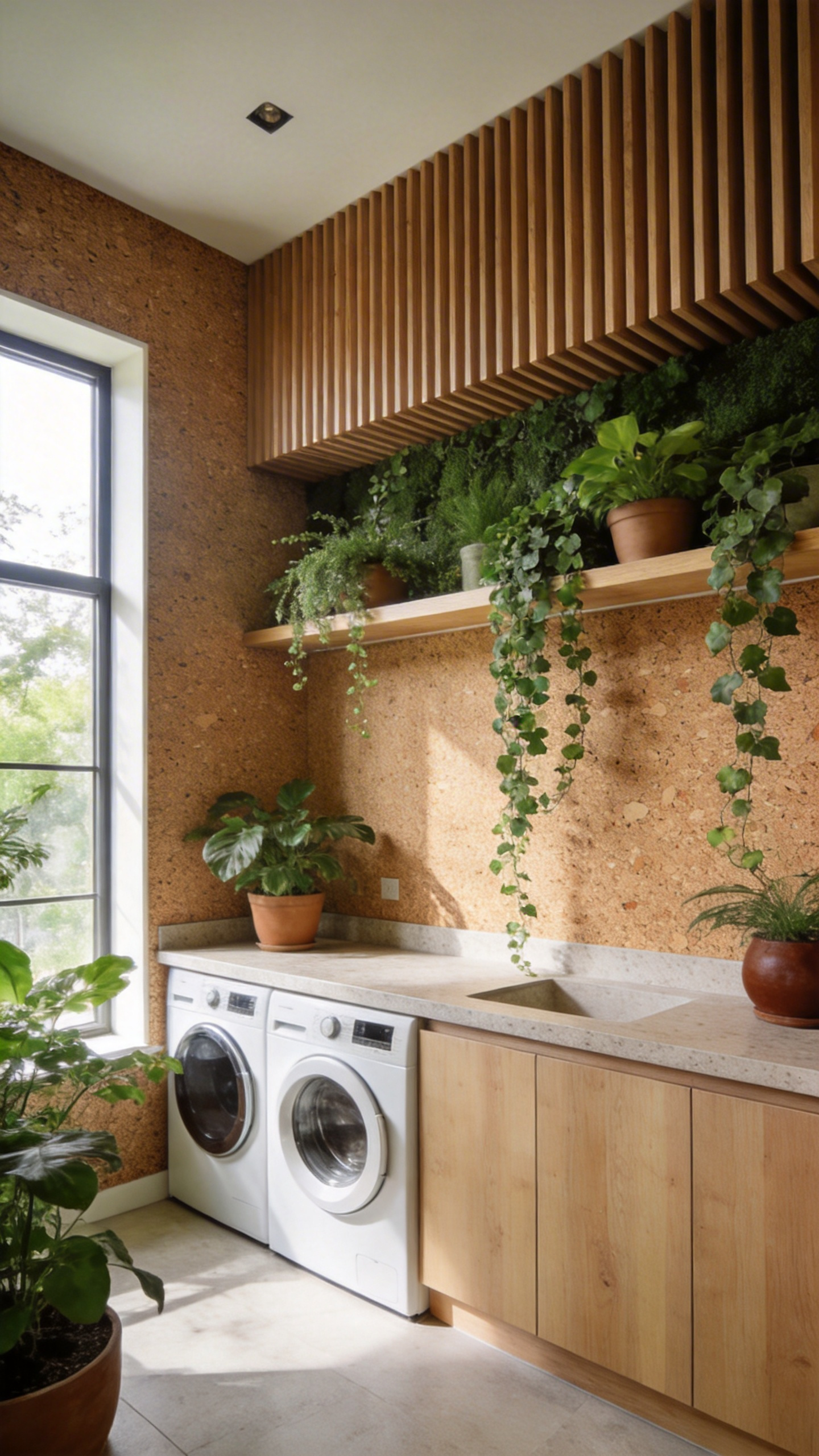
Beyond sound, we must also address visual stress. Flat, glossy white surfaces often create cognitive fatigue. Therefore, designers introduce “Fractal Fluency” using natural materials. Book-matched wood veneers or unfilled travertine countertops mimic nature’s complex patterns. The brain processes these textures effortlessly, effectively lowering cortisol levels.
Furthermore, olfactory health is essential for sensory calm. Synthetic fragrances frequently overwhelm the nervous system. Instead, integrating unfinished cedar shelving introduces beneficial phytoncides. These natural compounds regulate humidity and actually boost immune activity. Finally, lighting plays a crucial restorative role. Since many laundry rooms lack windows, human-centric Circadian lighting is vital. This technology mimics natural sunlight curves, preserving your sleep-wake cycle.
9. Incorporate Moisture-Loving Plants (like ferns) to purify air and add life.
Plants are often viewed merely as decorative accents. However, in a laundry room, they act as functional appliances. Moisture-loving flora like ferns serve as biological regulators. Through transpiration, these plants stabilize the heavy, humid air typical of laundry zones. This creates a breathable atmosphere, preventing that clingy, damp feeling. Furthermore, they combat the invisible “detergent cloud.”
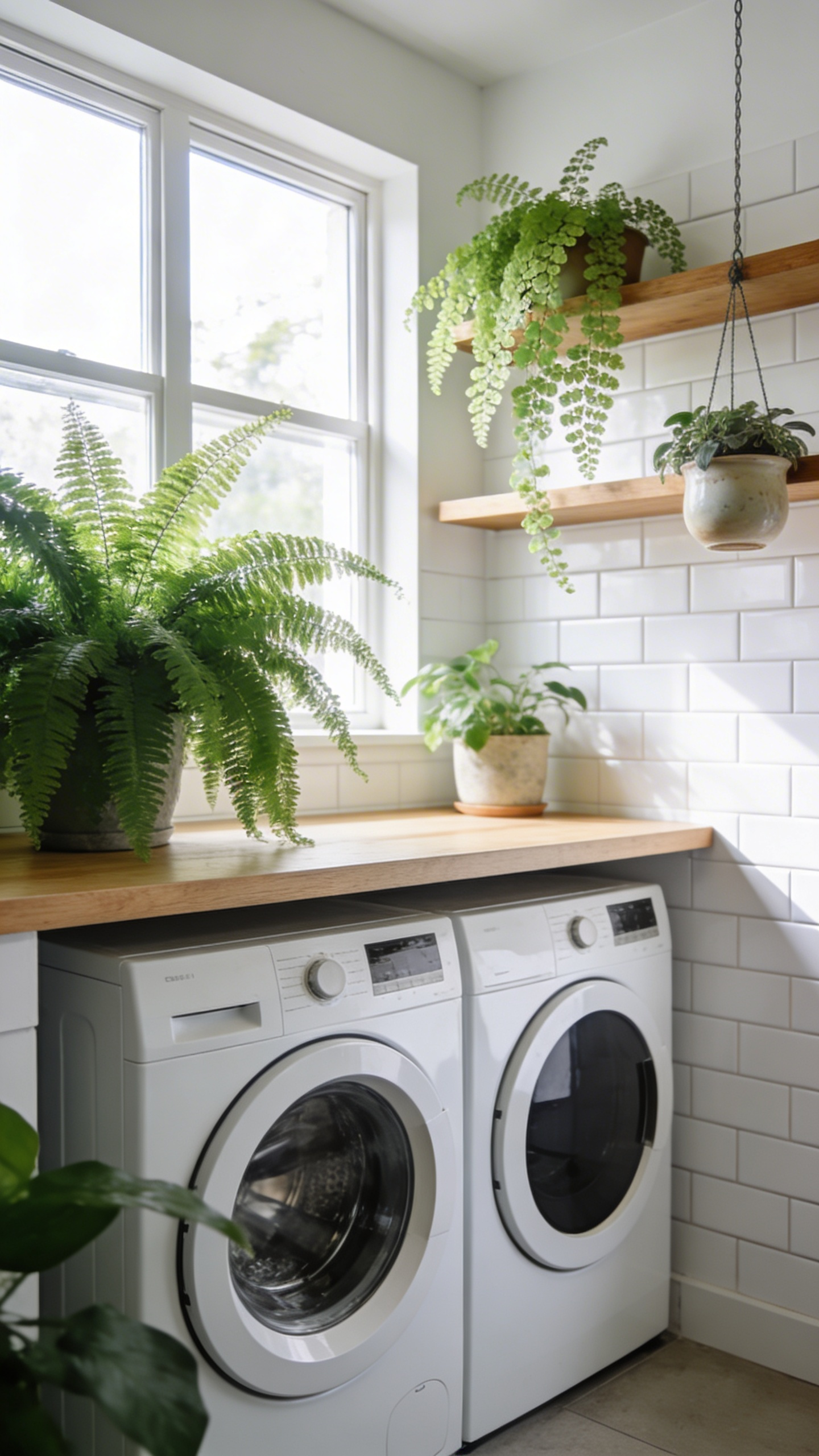
Modern cleaning agents frequently release Volatile Organic Compounds (VOCs) like formaldehyde. Fortunately, the Boston Fern acts as a potent living filter. Its fronds capture airborne particles, subsequently breaking down toxins. Therefore, incorporating plants creates a critical buffer zone between harsh chemical scents and your home.
Beyond air quality, these plants introduce necessary visual softness. Laundry rooms are traditionally defined by hard, sterile surfaces. Consequently, the intricate patterns of a Maidenhair Fern provide a welcome sensory shift. In environmental psychology, this visual relief creates “soft fascination.” It effectively allows your mind to recover from the mental fatigue of chores.
To maximize floor space, utilize the room’s unique verticality. Since heat and steam naturally rise, mount a Staghorn Fern high above the washer. If your room lacks windows, simply install a high-CRI LED bulb. This upgrade mimics daylight, helping you spot stains while fueling photosynthesis. Ultimately, this transforms a utilitarian chore zone into a restorative, biophilic retreat.
10. Maximize Natural Light with sheer window treatments to support circadian rhythms during daytime chores.
Historically, laundry was a sun-drenched task performed outdoors. However, modern designs often relegate this chore to dark, windowless corners. Consequently, the brain lacks the cortisol-triggering light needed for alertness. To counter this, treat your laundry room as a vital “circadian anchor.” Natural daylight stimulates specialized cells in the eye responsible for regulating energy. A mere ten minutes of exposure can boost serotonin and suppress sleep-inducing melatonin.
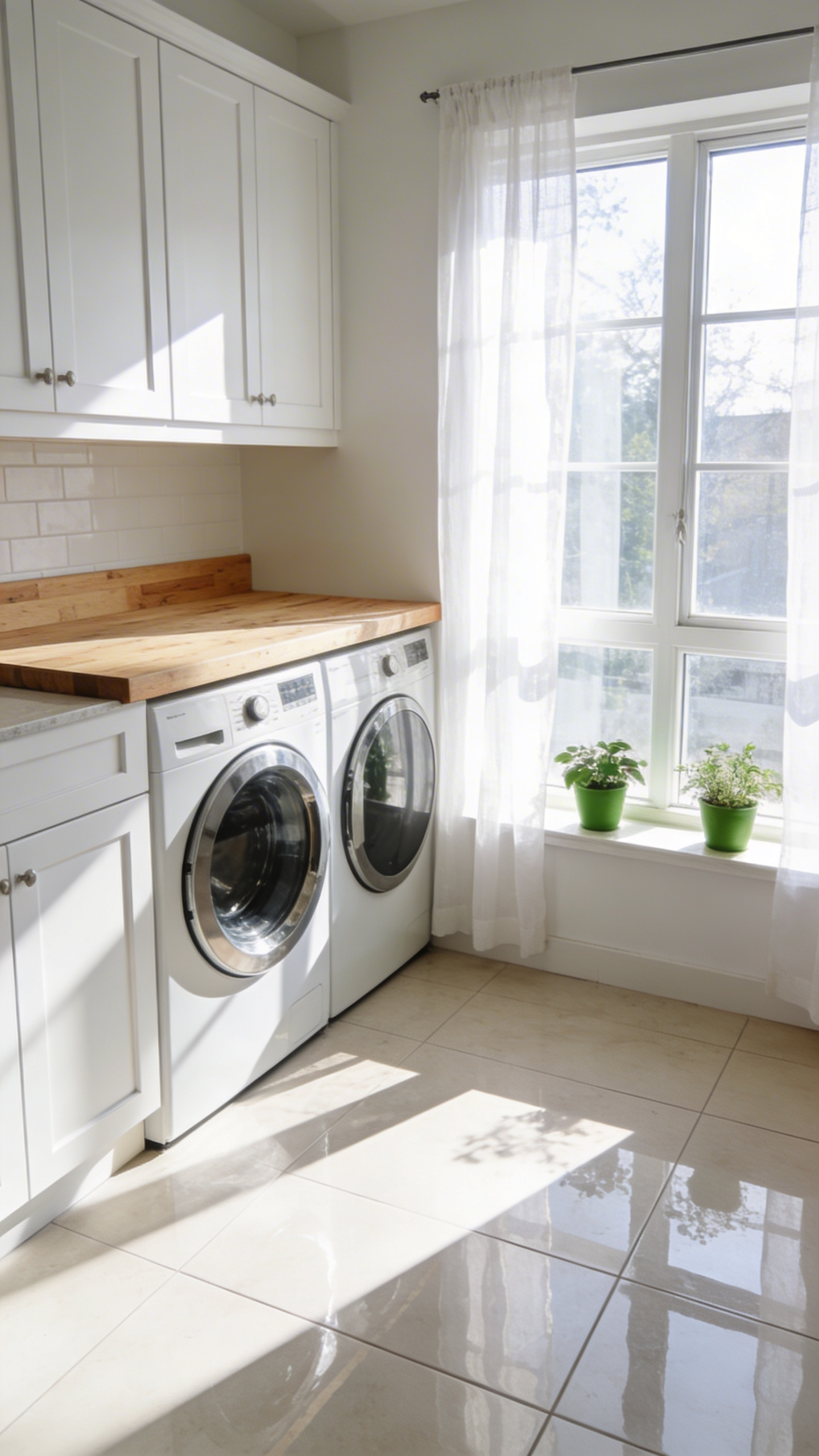
Yet, simply exposing bare glass is not the ideal solution. In fact, direct sunlight creates harsh contrast and glare on glossy appliances. Therefore, utilize sheer window treatments to optimize the space. Functionally, these fabrics act like a photographer’s “softbox.” They catch parallel light rays and scatter them deep into the room. As a result, you eliminate “hot spots” and reduce visual fatigue.
Furthermore, diffuse light improves color rendering for detailed work. Thus, spotting oil stains or distinguishing navy from black socks becomes significantly easier. Beyond utility, there is a sensory benefit. Aesthetically, using linen sheers creates a cohesive “linen on linen” atmosphere. Additionally, the fabric absorbs the sharp acoustic “ping” of buttons hitting the dryer drum. Ultimately, this transforms a daily chore into a moment of passive wellness therapy.
11. Utilize Woven Natural Fiber Baskets instead of plastic bins for tactile grounding.
Laundry often feels like a sterile, mindless obligation. Frequently, this sense of disconnection stems directly from the tools we use. Standard plastic bins are industrially smooth and chemically cold. Consequently, they offer “sensory monotony” that creates emotional distance from the task. In contrast, utilizing woven natural fibers introduces essential “tactile grounding” to the room.
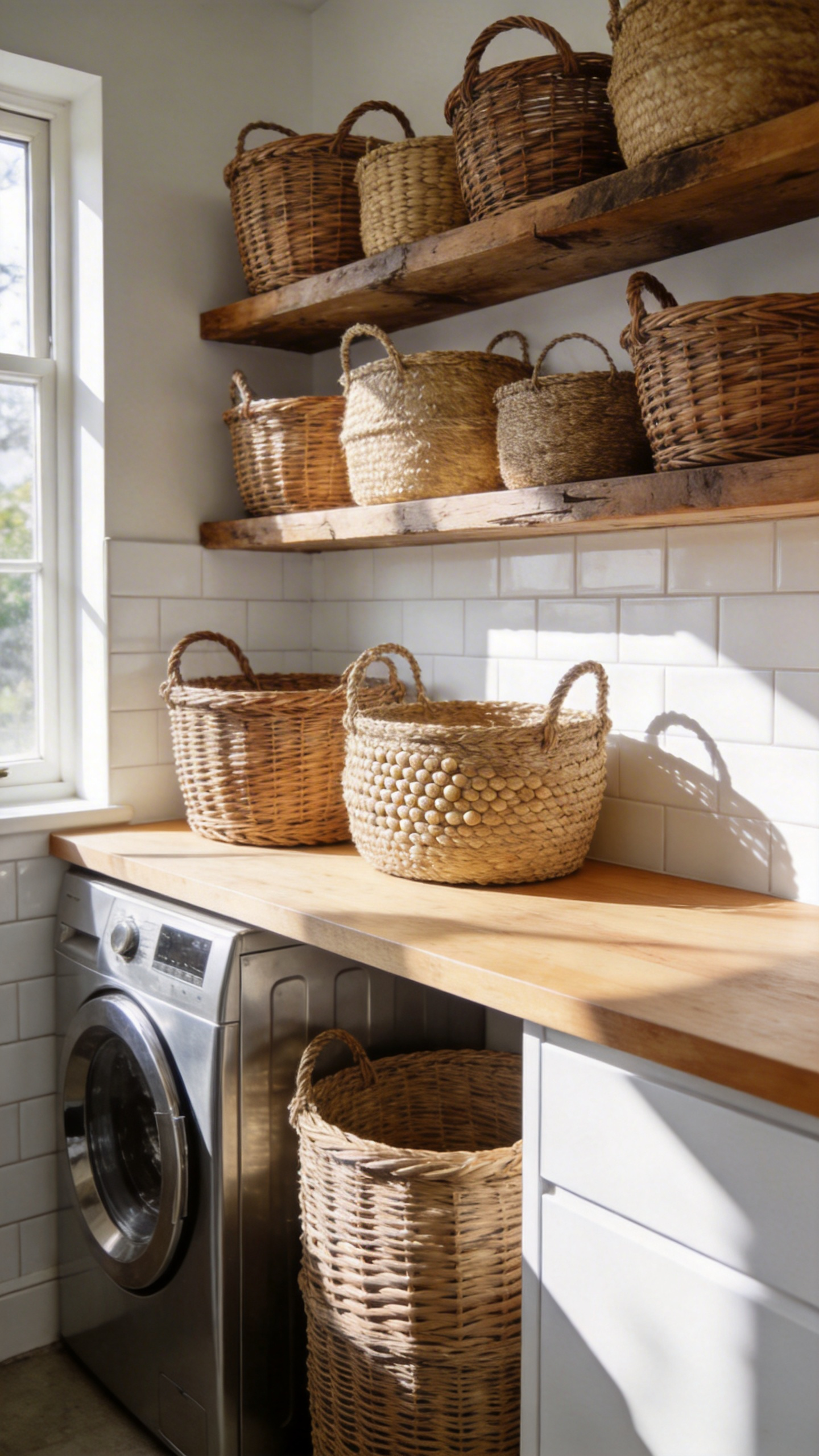
When you grip a hand-woven willow or seagrass basket, the uneven surface stimulates skin receptors. Specifically, this “micro-variation” in texture signals to the brain that the environment is organic. Therefore, the simple act of lifting the basket becomes a brief moment of mindfulness. You are physically connected to a natural material rather than a synthetic mold.
Furthermore, natural vessels provide superior functionality through passive ventilation. Unlike plastic, which often creates “dead air” zones, fibers like rattan are inherently porous. Thus, they allow moisture to escape, effectively preventing the anaerobic environment where mildew thrives. Additionally, these materials reduce the room’s overall “visual noise.” Plastic tends to reflect light harshly, whereas natural fibers absorb it gently. This switch transforms a utility closet into a calming, biophilic living space.
12. Apply Sound-Dampening Wall Treatments or solid core doors to reduce machine noise stress.
Modern floor plans frequently place laundry rooms near living areas. However, this proximity creates an unnoticed “Acoustic Shadow.” The repetitive thumping of machines triggers a subtle “fight or flight” response in your nervous system. Therefore, sound-dampening is a wellness necessity. Unfortunately, most laundry spaces are small boxes lined with hard surfaces. Consequently, they act as reverb chambers that amplify mechanical stress.
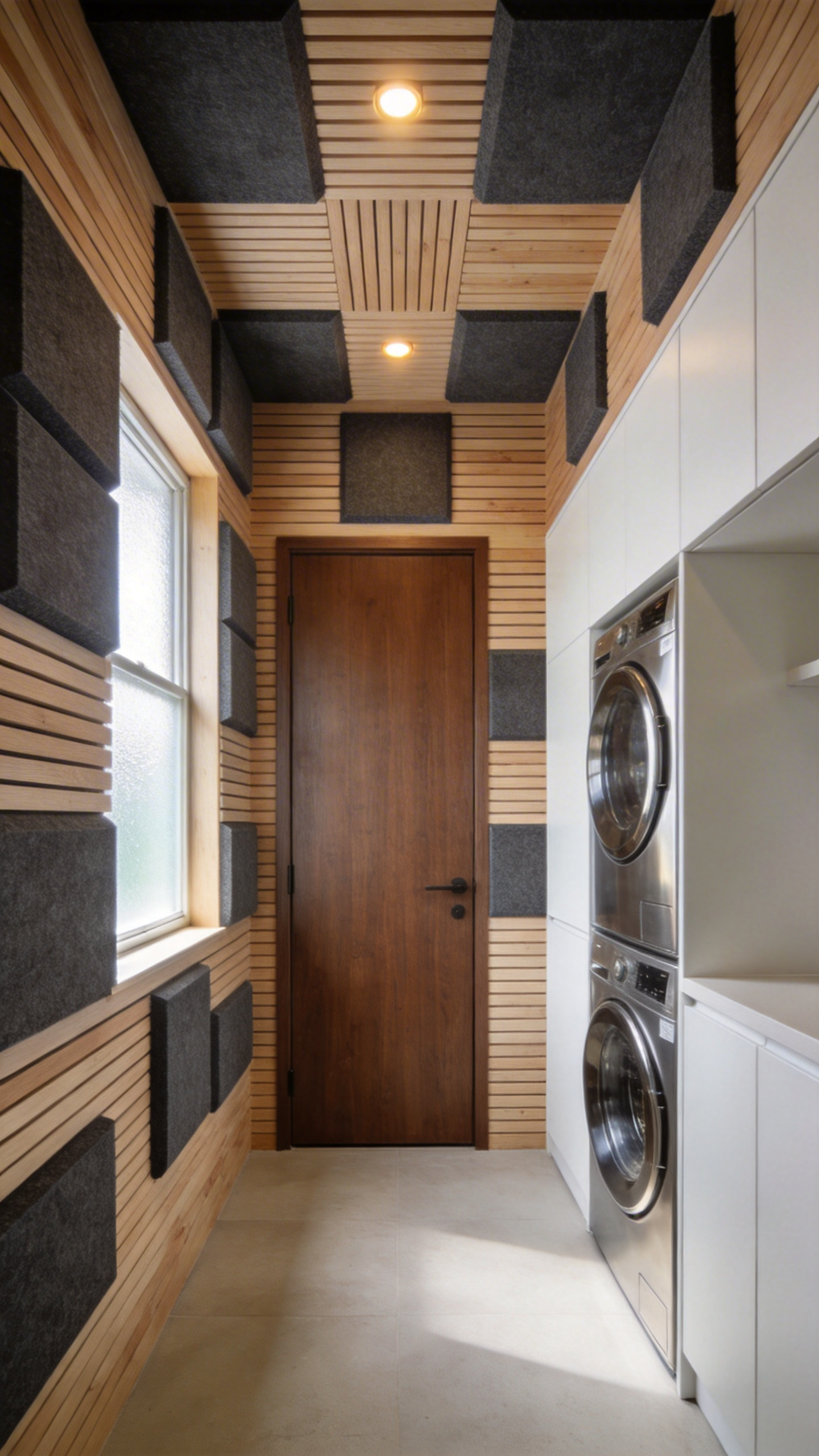
To fix this, first address the door. Standard hollow-core doors function like drums. They vibrate in sympathy with the noise. In contrast, solid-core doors provide “acoustic mass.” This density absorbs the kinetic energy of sound waves rather than passing them through. Furthermore, installing an automatic drop seal blocks the bottom gap where 30% of noise usually escapes.
Next, look beyond the door structure. High-end renovations often use “decoupling” methods inside the walls to break sound paths. Alternatively, you can integrate functional decor like acoustic felt panels or cork wallpaper. These soft, porous textures trap high-frequency motor whirrs. Ultimately, these treatments turn erratic clatter into ignorable white noise. By reducing this auditory load, you protect your home’s peace.
Section 4: Aesthetic Serenity and Organization
Historically, laundry spaces were purely functional and often neglected. However, modern wellness architecture dictates a shift toward “Soft Utility.” This movement replaces sterile surfaces with porous, natural materials. For instance, using honed limestone or terracotta provides tactile grounding. Consequently, these earthy textures transform repetitive labor into a calming ritual.
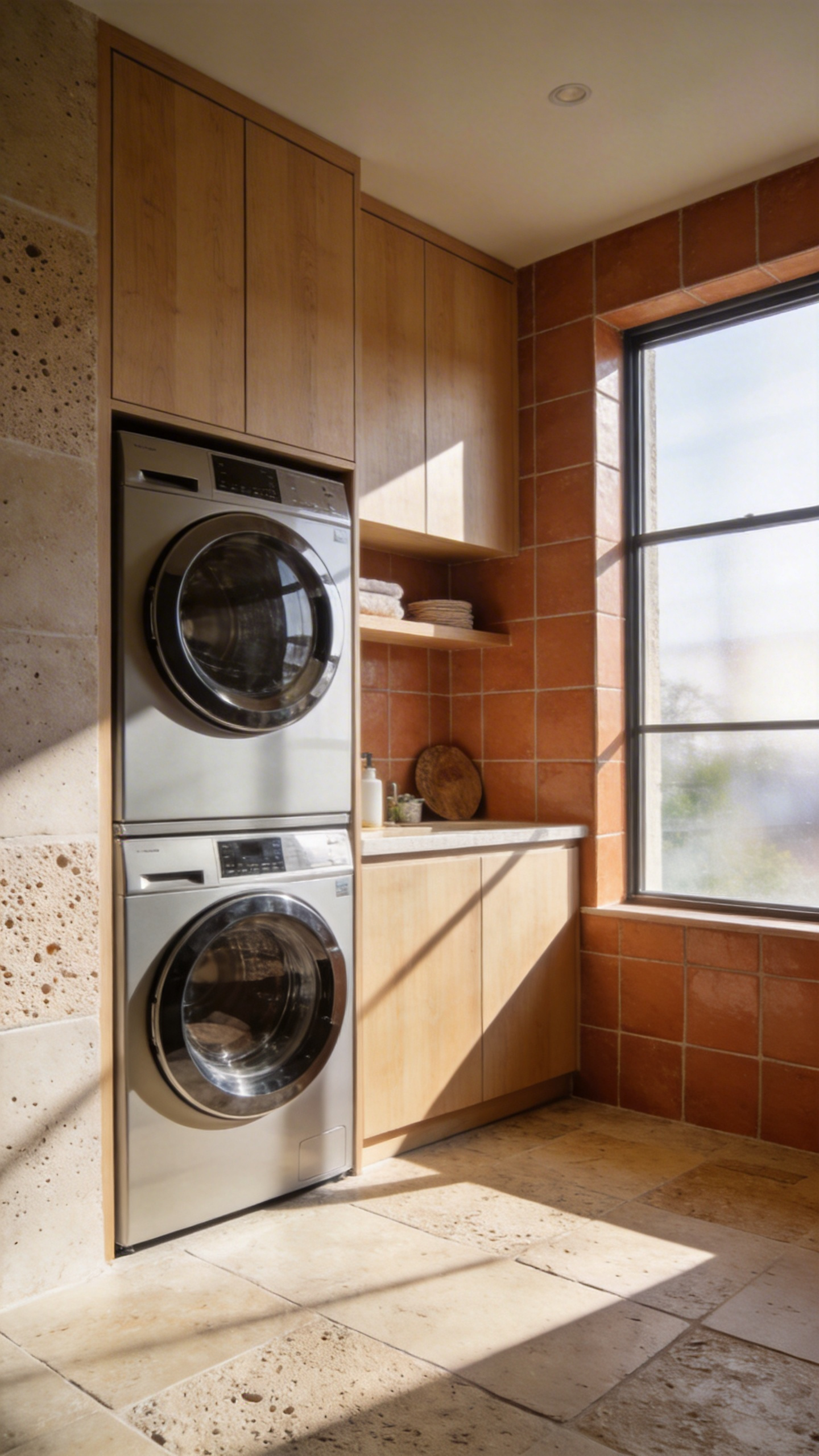
Furthermore, achieving mental clarity requires reducing “visual noise.” While functional, you might consider how laundry room wallpaper tips can add sophisticated texture without cluttering the floor plan. Moreover, the practice of “decanting” detergents serves a genuine cognitive purpose. By removing loud marketing text from sight, you reduce mental micro-distractions. Thus, the brain experiences less friction, facilitating a flow state during chores.
Finally, lighting transforms the room’s emotional impact. Harsh overhead bulbs often make environments feel clinical. Instead, a serene design relies on layered illumination. For example, under-cabinet LEDs provide task lighting for stain removal. Simultaneously, ambient pendants signal that this is a furnished, livable room. These elements combine to lower heart rates and elevate the daily experience.
13. Decant Detergents into Glass Vessels to remove visual noise and brand clutter.
Commercial detergent packaging is engineered to scream for attention on shelves. Consequently, aggressive neon colors and loud fonts create stressful “visual noise.” Environmental psychology suggests that ignoring these claims consumes mental energy. Therefore, decanting liquids into glass vessels acts as a necessary “mute button.” This practice transforms a utilitarian storage space into a curated sanctuary.
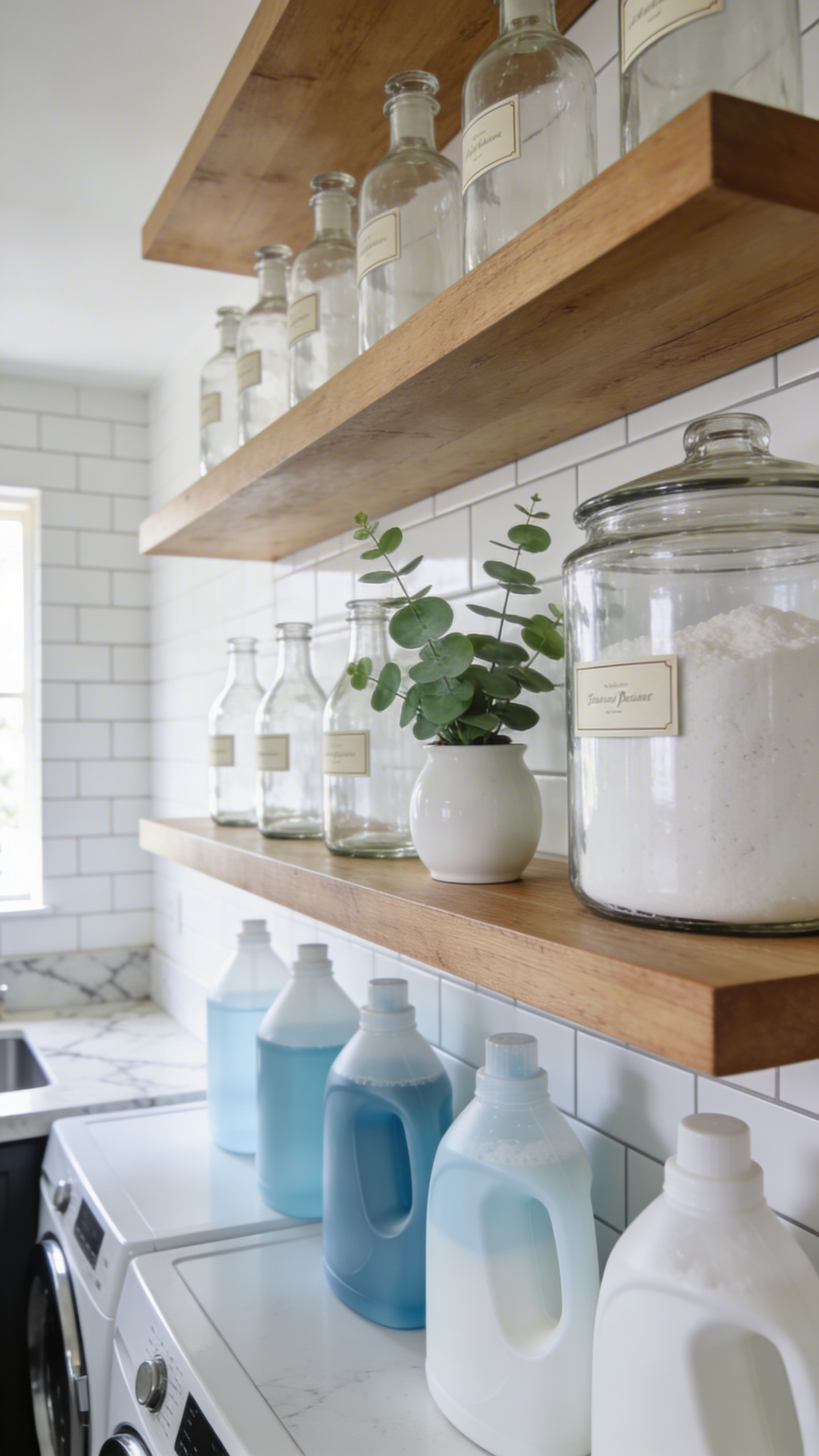
Beyond aesthetics, the material switch alters your interaction with the chore. Holding a heavy glass vessel offers a tactile sense of value that plastic cannot. As a result, the act of pouring becomes a precise ritual. Additionally, uniform glass containers create a cohesive “library effect” on your shelves. Thus, they establish a calming architectural rhythm that reduces cognitive load.
Furthermore, the transparency of glass offers a spatial advantage. Unlike opaque jugs, clear vessels allow light to pass through them. This transparency makes small laundry rooms feel airier. However, responsible design must always prioritize safety. Therefore, ensure you apply permanent, high-contrast labels to prevent confusion. Ultimately, removing brand clutter helps you reclaim your home’s visual landscape.
14. Choose a ‘Restorative’ Color Palette featuring soft sage, clay, or sky blue.
Laundry rooms often generate mechanical noise and mental stress. Therefore, your color choices should act as a “visual muffler.” Specifically, soft sage green taps into biophilic design principles. Environmental psychology suggests these muted greens allow the brain’s focus to recover. Consequently, this lowers cortisol levels during repetitive tasks like folding.
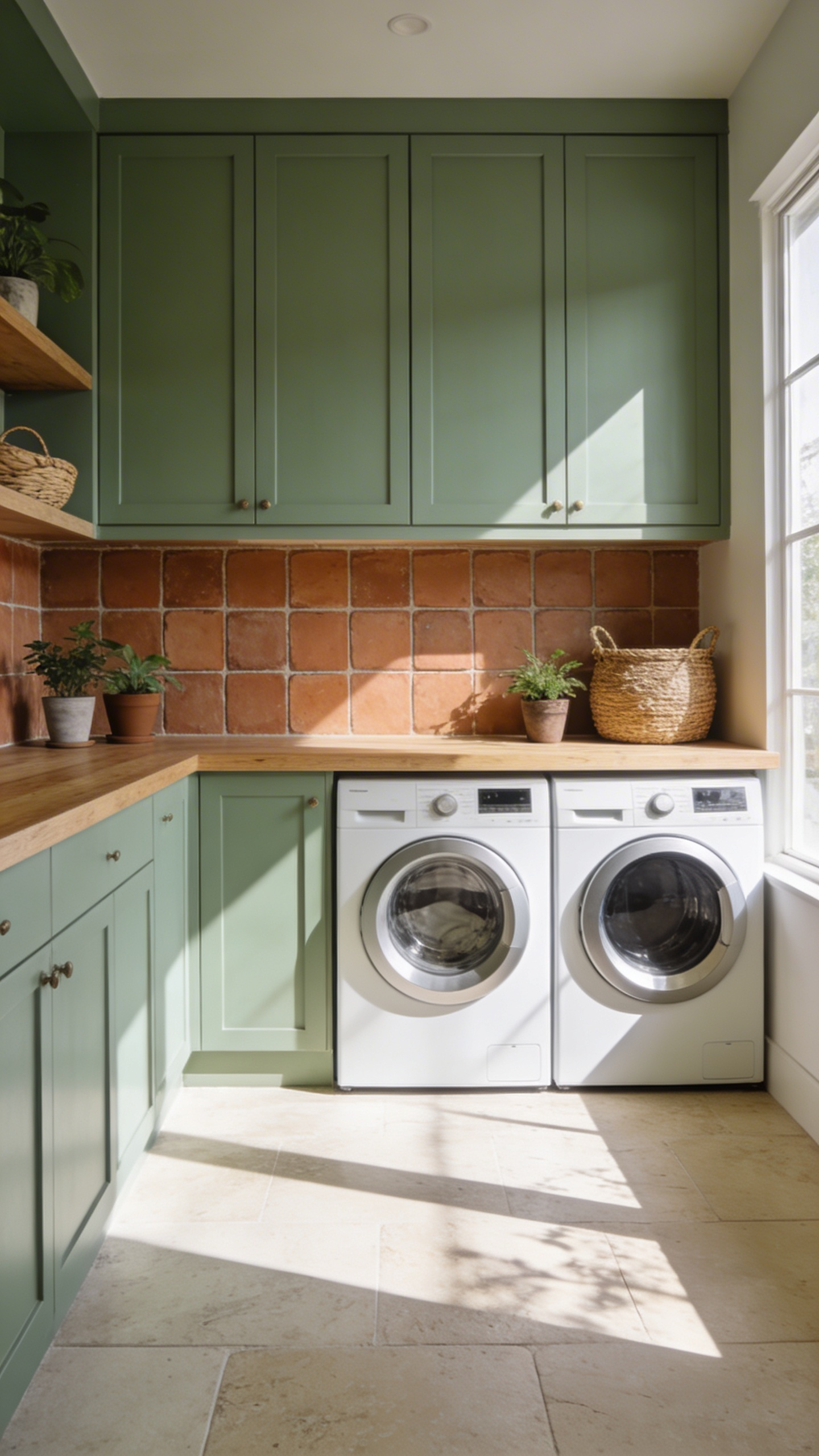
Alternatively, you might ground the space with clay or terracotta tones. Historically, washing was an earth-bound activity. Using these warm pigments transforms a sterile chore into a grounding ritual. Furthermore, a matte clay finish blurs the corners of small rooms. This makes the space feel expansive rather than restrictive.
For a breezier atmosphere, consider sky blue. This hue draws on the “Haint Blue” tradition of painting porch ceilings. As a result, it creates a “ceiling-less” feeling in windowless basements. Unlike the sharpness of stark white, sky blue offers a “soft-focus clean.” Finally, consider the texture. Prioritize mineral-based or matte finishes like limewash. This diffuses light rather than reflecting it, keeping the visual environment hushed.
15. Install Layered Lighting: Bright task lighting for stain removal, soft ambient light for folding.
Effective laundry design requires more than a single overhead fixture. Relying solely on ceiling lights often creates an ergonomic failure known as the “body block.” Standing at a counter blocks the light source, casting a shadow exactly where you work. To mitigate this, install under-cabinet LED strips to wash the workspace with front-facing light.
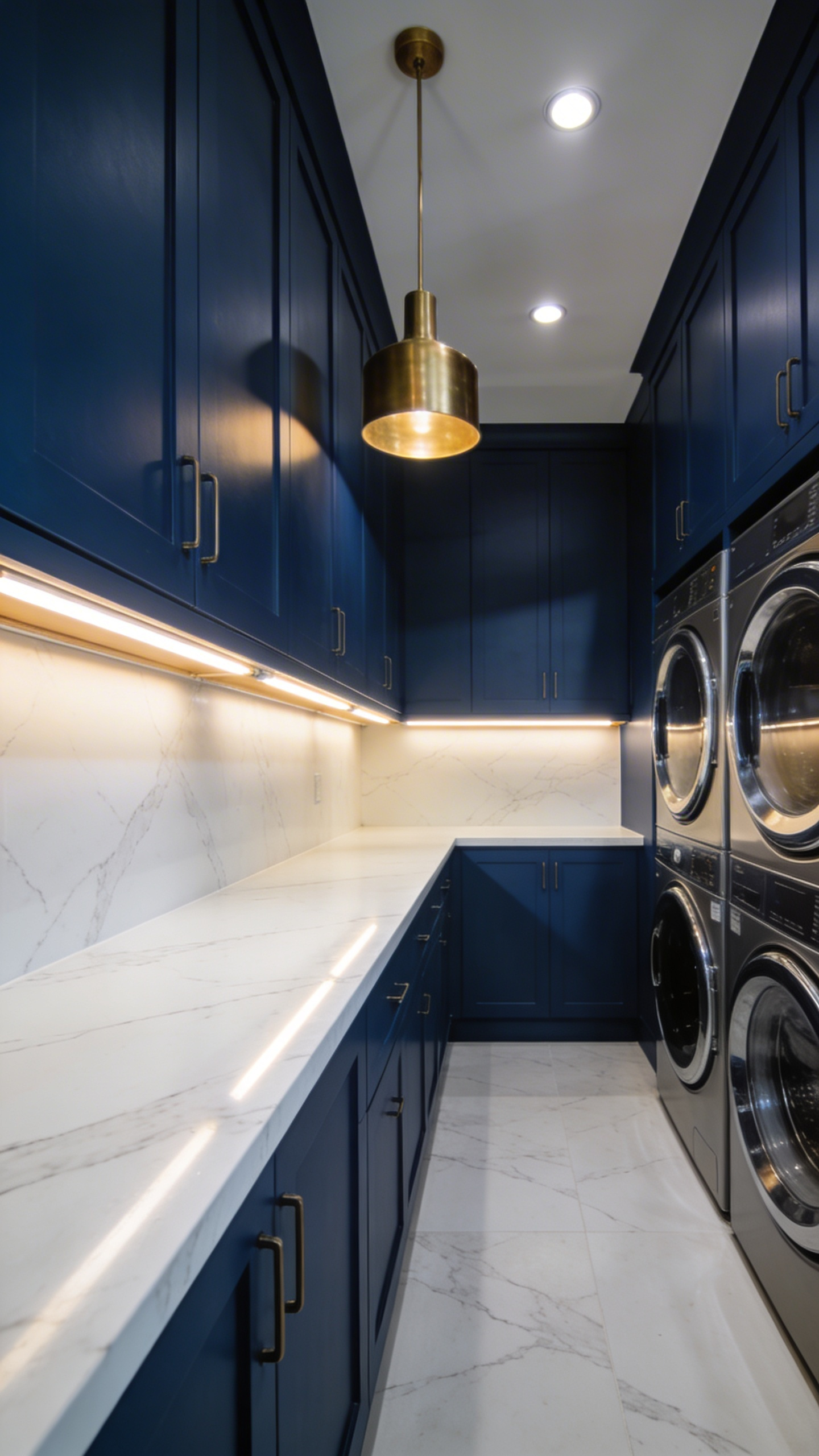
Furthermore, the quality of that task light matters immensely. Standard bulbs often flatten colors, hiding faint marks like oil. Therefore, experts recommend high-CRI LEDs with a cool temperature. This technical standard reveals the true vibrancy of fabrics. As a result, you avoid the “ghost stain” phenomenon where “cleaned” marks reappear in sunlight.
Conversely, folding requires a different psychological atmosphere. High-intensity light can eventually trigger stress. Thus, you should layer in ambient lighting to shift the room’s mood. Use warm, dimmable fixtures to soften the room’s edges. This shift creates a calming, residential feel. Ultimately, installing a dimmer switch allows you to toggle between high-focus work and meditative home management.
16. Hidden Drying Racks: Retractable layouts that preserve the room’s open energy.
In wellness architecture, “visual noise” impacts mental clarity. A permanent drying rack often signals incomplete labor to the subconscious brain. Consequently, hidden drying racks have become essential for maintaining serenity. These retractable units represent the “disappearing act of domestic labor.”
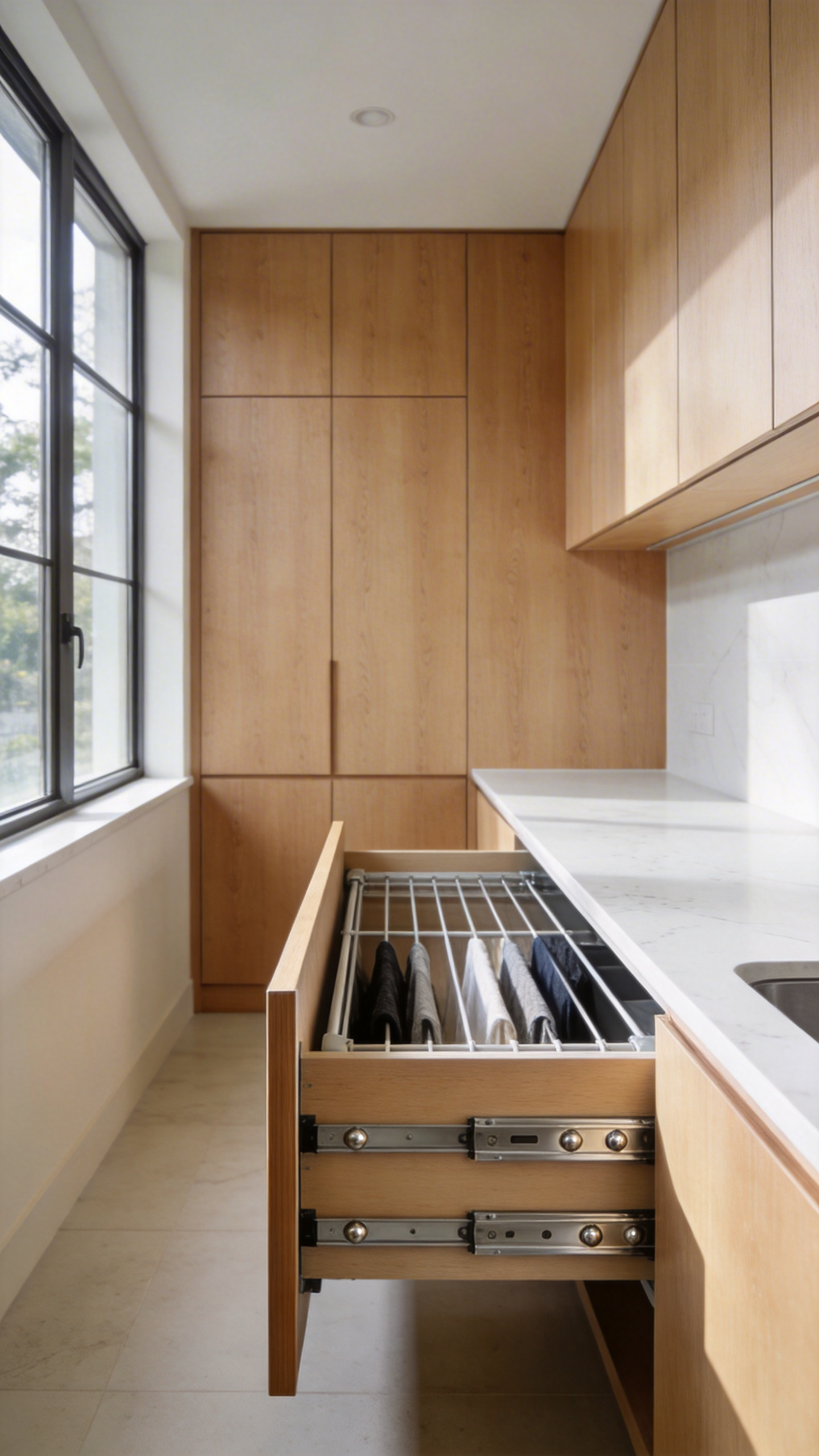
Modern designs utilize heavy-duty ball-bearing slides to support heavy, wet textiles effortlessly. Furthermore, they retract into a slim profile, instantly restoring the room’s open energy. Therefore, the space can pivot from a utility area to a calm sanctuary immediately.
Material choices also enhance this sensory experience. Sealed cedar or bamboo racks offer natural anti-fungal properties. Additionally, damp clothes release a faint, clean wood scent. Conversely, powder-coated stainless steel ensures a “silent” operation. However, proper engineering is vital to prevent trapped moisture. Expert layouts often incorporate perforated drawer fronts for cross-ventilation. Ultimately, these racks support the “Slow Laundry” movement by protecting delicate fibers.
Frequently Asked Questions
How can I make my laundry room feel more luxurious?
To achieve a high-end feel, focus on “sensory architecture.” Replace clinical plastic bins with natural fiber baskets and swap harsh fluorescent bulbs for layered, warm LED lighting. Utilizing premium, non-porous materials like soapstone or quartz for countertops and fireclay for utility sinks adds immediate tactile value and visual elegance.
What is the most efficient layout for a laundry room?
The most efficient layout follows a “Linear Kinetic Path,” arranging the workflow in a straight line from sorting to washing, drying, and finally folding. This “dirty-to-done” stream minimizes physical strain by preventing unnecessary pivots and heavy lifting, reducing the cognitive load of the chore.
How do you prevent mold in a small laundry room?
Prevention starts with moisture management and material selection. Use breathable, vapor-permeable wall finishes like limewash and porous flooring such as cork or unglazed tile. Additionally, incorporate moisture-loving plants like ferns to help regulate humidity and ensure proper ventilation with high-quality exhaust systems.
Conclusion: Reframing the narrative of the laundry room from a place of drudgery to a sanctuary of renewal.
Ultimately, the modern laundry room represents a profound shift in domestic life. No longer a hidden dungeon, this space has reclaimed its place on the main stage. Consequently, we transform a mundane chore into a vital ritual of care. By embracing the sensory laundry room ideas presented here—such as warm lighting and biophilic elements—we actively reduce stress. In fact, these design choices turn mechanical maintenance into a restorative practice for our “second skins.” Therefore, the environment itself validates the labor, proving that even cleaning deserves beauty.
Looking ahead, your home should serve as a holistic engine for wellbeing. Thus, integrating hobbies or nature into utility zones fosters a significantly healthier mindset. You simply need to prioritize intention over pure efficiency. To begin, audit your current sensory experience. Specifically, replace harsh chemicals with decanted natural alternatives to instantly elevate the atmosphere. Finally, allow this sanctuary of renewal to nurture both your garments and your peace of mind.