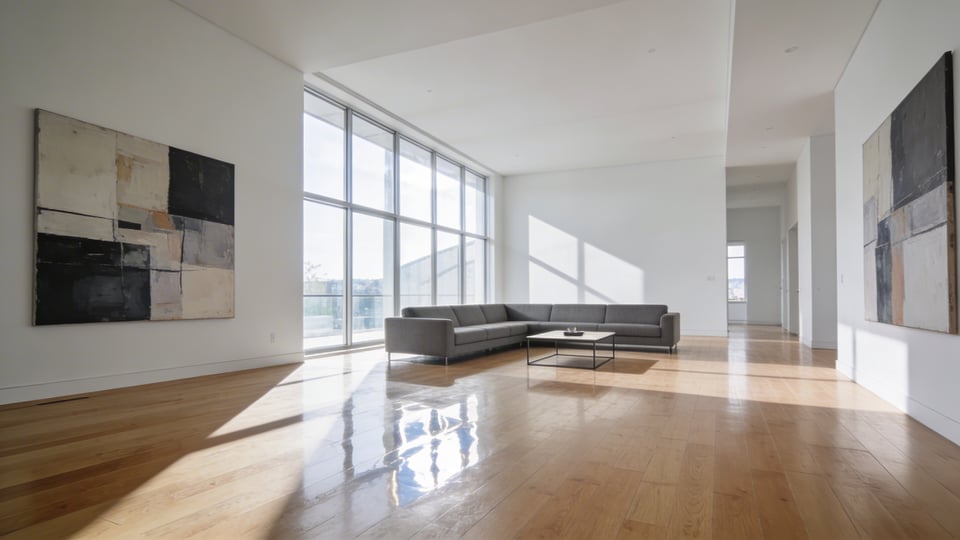
Exploring fresh living room rug ideas is about more than just aesthetics. It is about reclaiming the soul of your home. You painstakingly arrange your sofa, coffee table, and armchairs. Yet, the room often feels inexplicably incomplete. Designers describe this unsettling sensation as the “floating island” effect. Without a grounding element, furniture appears untethered on the vast hard flooring. Therefore, your brain experiences a high visual cognitive load. According to Gestalt psychology, the mind struggles to group these items without a defined boundary. Consequently, the arrangement feels like a collection of isolated objects rather than a unified environment.
However, this “something’s missing” moment is rarely just visual. It is also a profound auditory and historical issue. Hard surfaces cause sounds to reverberate, creating a cold, institutional echo. Indeed, the sharp “clack” of heels often signals an unfinished space. Historically, the shift from wall-to-wall carpet to area rugs during the Victorian era redefined this balance. Today, placing a rug introduces a necessary tactile “hush.” It acts as a nomadic anchor, locking pieces into a coherent composition. Thus, the rug transforms a vast open space into a safe conversation zone by incorporating 17 advanced living room styling ideas for a curated home.
This guide reveals the deep psychological layers behind successful interior design. We analyze the critical shift from “floating” furniture to grounded sanctuaries. Also, we explore how specific materials bring narrative depth to a sterile room. You will learn to distinguish between intentional minimalism and an “unintentional void.” Finally, we provide expert strategies to bridge the gap between a mere house and a finished home.
Relatable Moment: Standing in a fully furnished room that still feels echoing and cold.
You may recognize a specific, unsettling sensation often found in modern homes. Specifically, you stand in a fully furnished room that somehow still feels hollow. Although the sofa and art are present, the space remains emotionally empty. This discomfort often stems from the “unfurnished furnished” phenomenon. Consequently, the room likely suffers from a technical issue known as “flutter echo.”
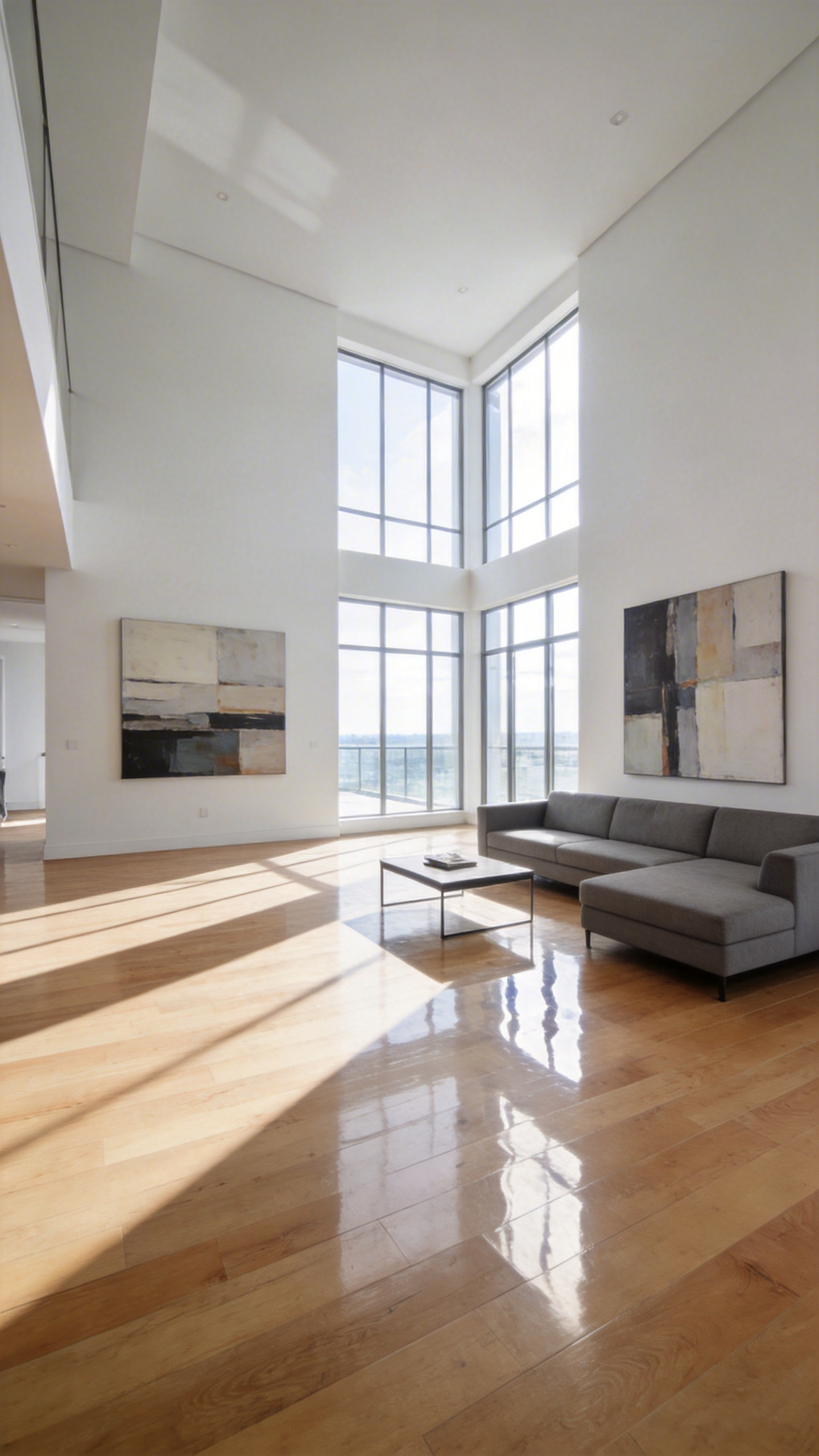
Without a rug, sound waves bounce rapidly between hard floors and ceilings. Therefore, the brain struggles to localize noise. This creates a subconscious state of low-level alertness. Fortunately, a rug serves as a corrective acoustic tool. Upon laying one down, the room virtually “sighs.” The sharp clatter of footsteps turns into soft thuds.
Moreover, a rug resolves the visual issue of “floating furniture.” Without a distinct boundary, chairs and tables seem to drift like isolated islands. In contrast, a rug acts as a frame. It satisfies our psychological need for grouped objects. It visually locks the furniture into a cohesive “room within a room.”
Additionally, the “cold” feeling is often literal. Hard surfaces like wood or tile possess high thermal conductivity. Thus, they draw heat away from the body rapidly. Ideally, a high-pile rug introduces a necessary insulating layer. Ultimately, this simple addition transforms a cold, echoing volume into a secure, human-scaled environment.
Universal Connection: The realization that furniture creates the function, but the rug creates the ‘home’.
Furniture serves the body’s physical needs. Yet, the rug serves the psyche’s deep desire for comfort. Historically, nomadic tribes used rugs as their primary architecture. They effectively created a portable home. Consequently, placing a rug today performs a primal ritual of “claiming the ground.” Without this foundation, modern living rooms often suffer from “floating sofa syndrome.” Specifically, furniture pieces feel disconnected. This makes the space feel transient rather than permanent.
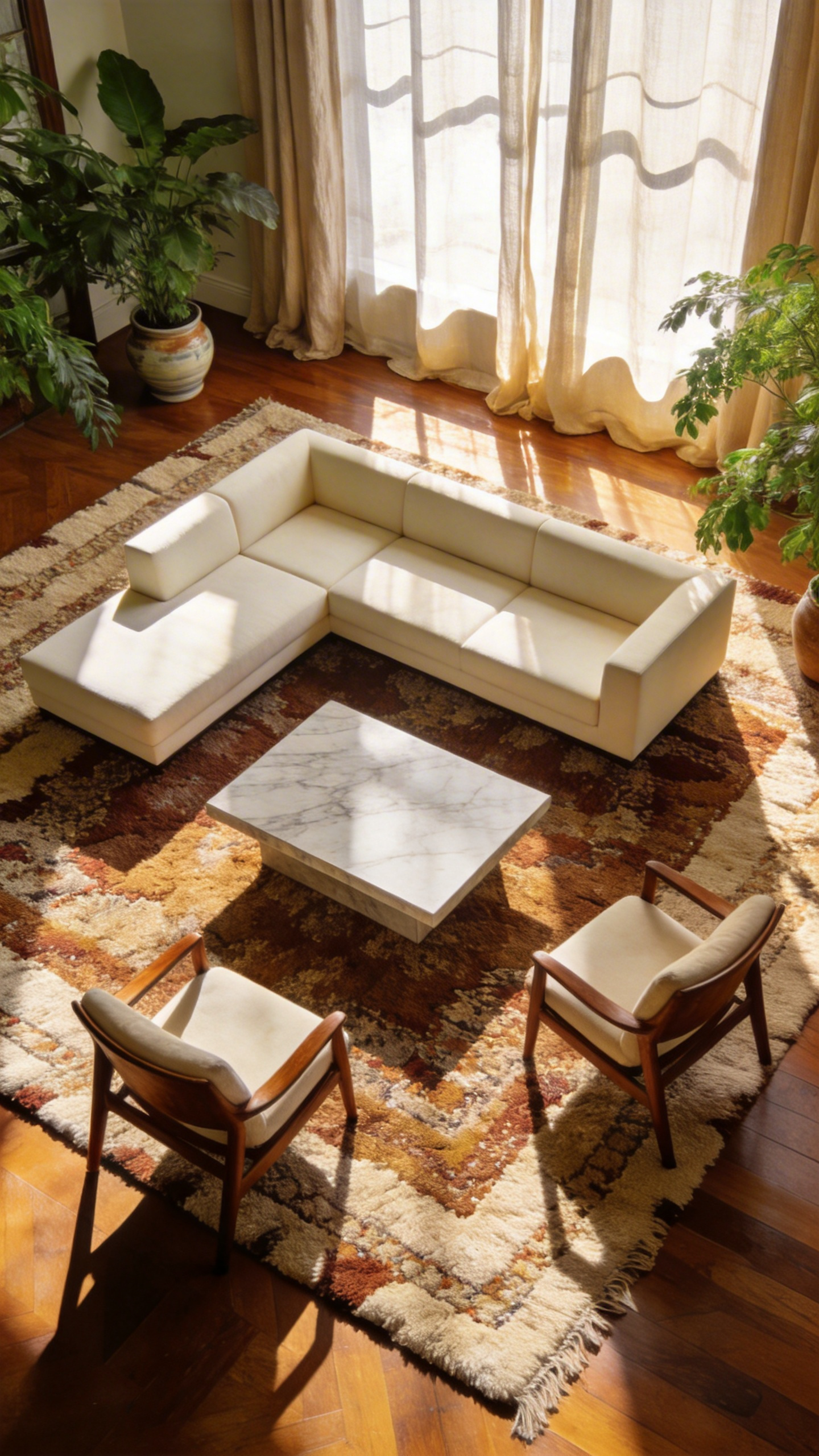
Therefore, a rug acts as a necessary visual anchor. Based on design principles, it groups disparate objects into a cohesive “micro-climate.” This boundary effectively defines the social zone. It pulls furniture into a huddle that invites connection. Beyond visual structure, rugs also provide a critical “acoustic hug.” In fact, hard floors reflect sound. This often creates a subtle sense of sonic chaos. Conversely, a thick wool rug absorbs this noise. It instantly creates a hushed sanctuary.
Furthermore, this softness triggers a biological shift known as the “barefoot transition.” Stepping onto a soft texture signals the nervous system to finally down-regulate. Thus, the rug becomes the tactile transition point where the outside world truly ends. Ultimately, furniture provides the function, but the rug provides the soul.
Thesis: How the ground layer separates intentional design from accidental furniture storage.
Ideally, a living room rug acts as a psychological and structural “container.” Without it, your furniture simply exists in a state of accidental storage. Essentially, these pieces become disconnected objects floating aimlessly on a vast sea of flooring. However, introducing a ground layer establishes a deliberate architectural zone. This signals the critical transition from a transit area to a space of inhabitation. This is a key step in choosing the right living room decor.
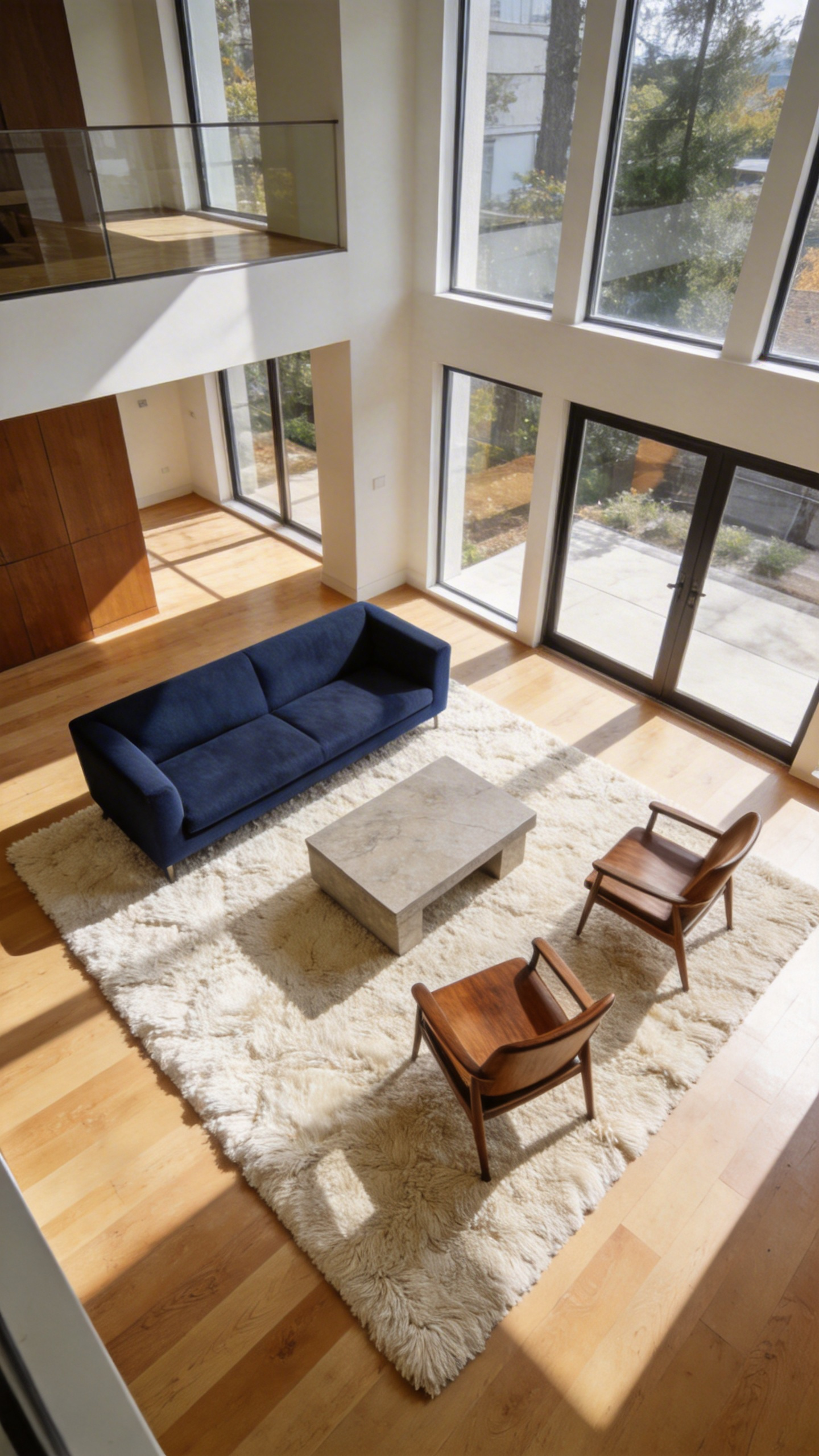
According to the Gestalt principle of “Common Region,” distinct boundaries create necessary order. Specifically, elements sharing a defined boundary are perceived as a cohesive group. Therefore, a rug provides a literal frame. It tethers the sofa and tables together. Consequently, this prevents “visual drift,” where the eye struggles to find a focal point. Instead of floating silhouettes, the furniture becomes a unified conversation island.
Furthermore, this separation is not merely visual; it is also auditory. Hard surfaces reflect sound, creating a harsh “warehouse effect” typical of empty rooms. In contrast, a high-quality rug acts as an acoustic dampener. It absorbs the echo of footsteps, creating a sense of intimacy. Additionally, the rug serves as a tactile “speed bump.” Stepping from hard timber onto soft fiber triggers a physiological shift. This encourages a slower gait.
Crucially, proper scale is required to achieve this intentionality. A “postage stamp” rug makes furniture appear to be huddled together for warmth. Conversely, an over-scaled rug creates a dedicated plinth. Thus, the ground layer elevates utility objects into a permanent, inviting destination.
Theme 1: Textural Foundations (The Cozy Factor)
In the search for living room comfort, a rug serves as the room’s psychological baseline. Specifically, high-texture rugs provide a continuous tactile feedback loop. This is known as “sensory anchoring.” Unlike wall paint, you experience a rug physically with every step. Consequently, this stimulation can lower cortisol levels. It effectively grounds you in the present moment. Furthermore, the “cozy factor” relies heavily on acoustic engineering. High-pile fibers catch sound waves, creating a hushed, cocoon-like atmosphere.
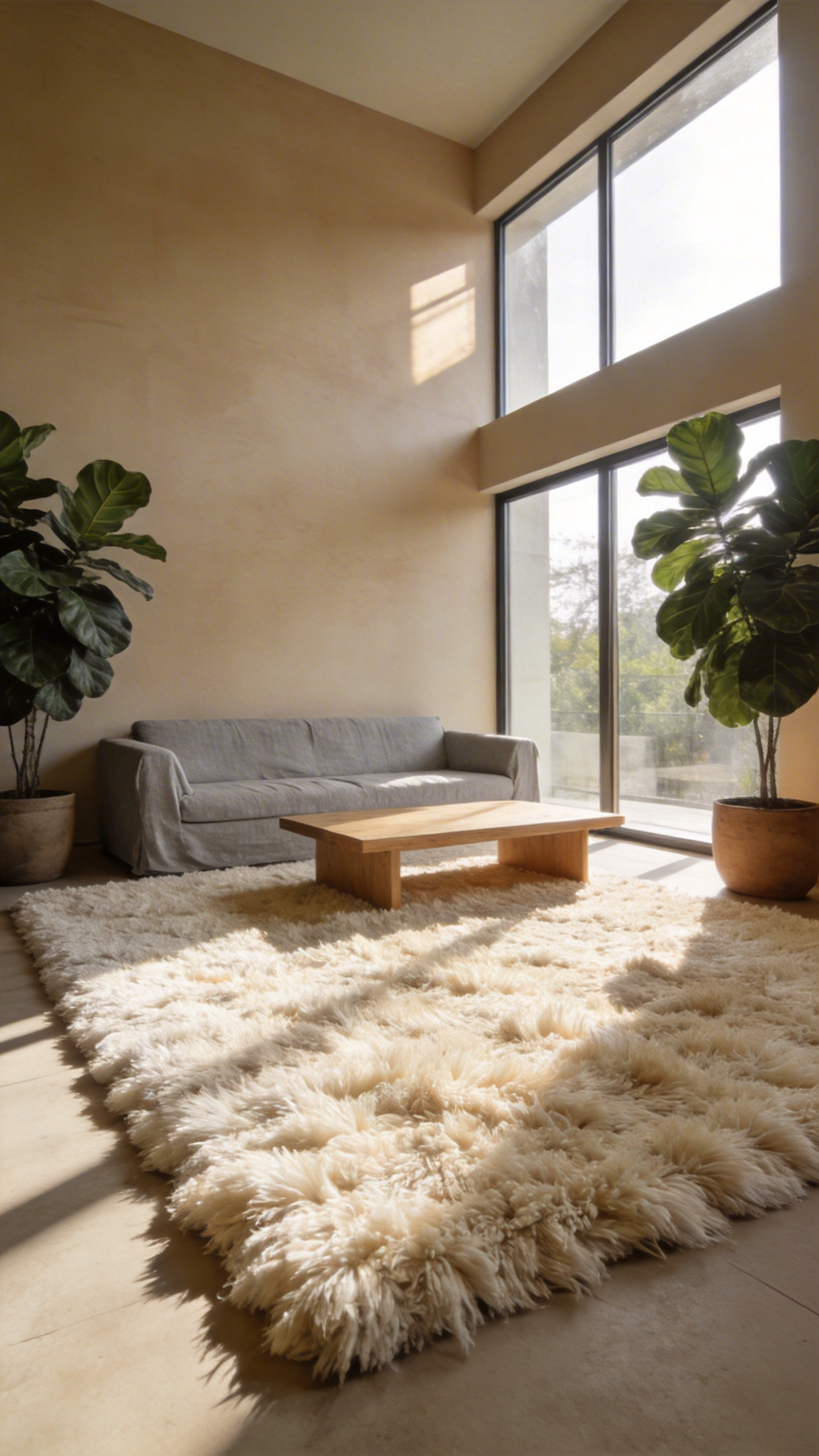
However, true comfort is a technical calculation, not just a visual style. It requires a balance of pile height and fiber density. For instance, wool remains the gold standard for textural foundations due to its natural crimp. Unlike flat synthetics, wool’s spring-like fibers trap air to regulate temperature naturally. Therefore, it stays warm in winter and cool in summer. Many designers are currently embracing texture trends to transform your living room into a cozy haven through these natural materials.
Finally, you can enhance this effect through a “Hygge” layering strategy. Simply place a rough base, like sisal, underneath a plush wool topper. In doing so, you create a sophisticated contrast between earthiness and softness. Ultimately, this varies the sensory landscape. It mimics the organic imperfection of the natural world.
1. The Chunky Wool Loop: Adding instant warmth and softness underfoot.
The chunky wool loop serves as far more than a simple stylistic choice. In fact, it acts as a structural anchor for modern living rooms. Designers call this “tactile grounding.” Specifically, the rug’s high-texture surface communicates directly with the nervous system. It signals comfort. Consequently, the “squidgy” feel of the thick loops stimulates the feet. This helps lower cortisol levels. Moreover, the irregular, oversized loops create visual depth. They effectively soften the rigid lines of contemporary furniture.
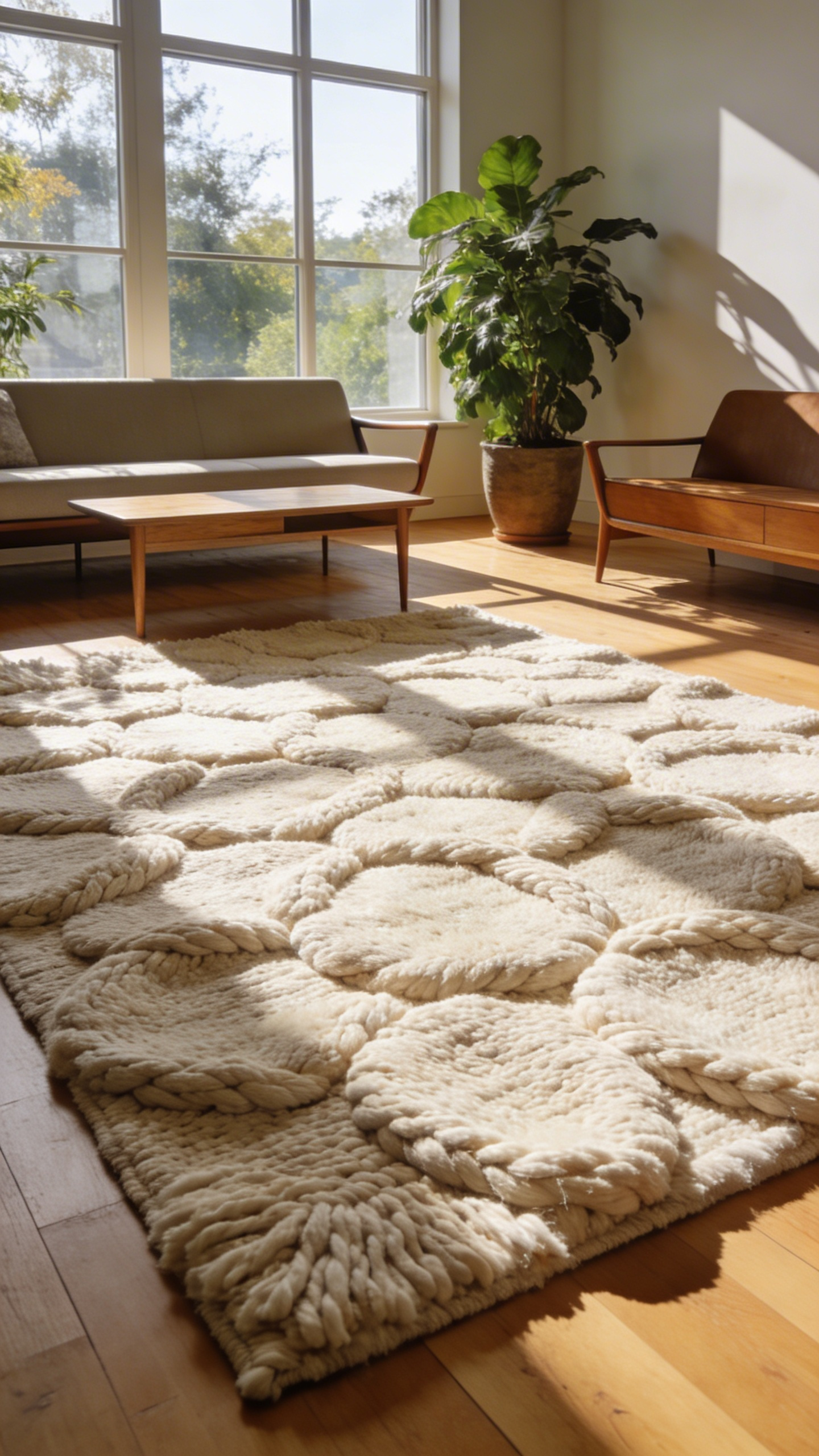
Beyond aesthetics, this rug style is a high-performance acoustic tool. For instance, the porous wool fibers naturally trap sound waves rather than reflecting them. As a result, impact noise is significantly reduced. This makes even echoing, open-plan spaces feel intimately quiet. Additionally, wool acts as a natural insulator for your home. Thus, the air trapped within the chunky structure helps regulate indoor temperatures. It keeps rooms warm in winter and cool in summer.
However, potential buyers must consider the “maintenance paradox” before purchasing. On one hand, the natural crimp of wool fibers offers incredible resilience against foot traffic. Therefore, these rugs bounce back quickly. They avoid the permanent “crush paths” often seen in plush carpets. Conversely, the loop structure presents a specific risk for households with pets. Unfortunately, claws can easily snag the woven ropes, leading to unsightly pulls. Instead, pet owners should opt for tighter micro-loops. This ensures longevity while maintaining that cozy aesthetic.
2. Natural Jute Braids: The perfect neutral canvas for seasonal adaptability.
Jute is far more than a generic natural fiber. In fact, this high-performance material originates from the *Corchorus* plant in the Bengal Delta. Through a distinct process called “retting,” stalks are submerged in water to soften the tissues. Consequently, the inner fibers become incredibly pliable. Unlike stiff sisal, jute feels surprisingly similar to wool.
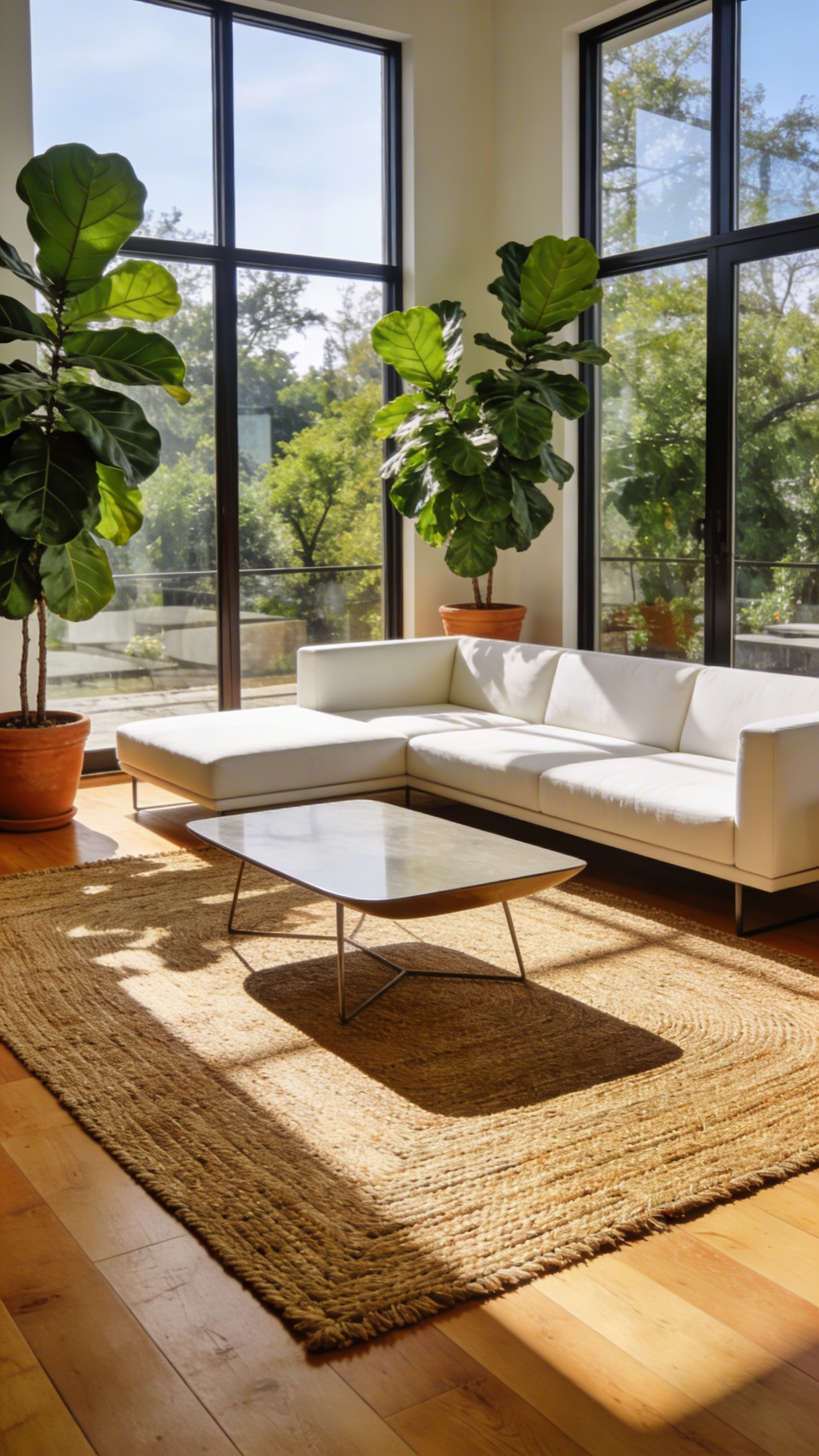
Therefore, it serves as an ideal structural baseline for your living space. The natural honey and caramel tones offer significant visual depth. Additionally, this organic variance camouflages dust effectively. The braided texture also provides a sensory anchor against smooth glass or leather furniture. Experts often call this the “white T-shirt” of home decor because it elevates everything around it.
Specifically, these rugs excel at seasonal adaptability through the technique of layering. During winter, the porous fibers trap heat efficiently. Simply layer a plush wool rug on top of the jute for added warmth. Conversely, remove the top layer when temperatures rise. The breathable weave keeps the room feeling airy and cool during summer months.
Furthermore, this choice supports a sustainable lifestyle. A single hectare of jute consumes massive amounts of carbon dioxide during growth. However, you must be careful with placement. Because the fibers absorb moisture easily, avoid using them in damp entryways. Ultimately, keeping the rug dry prevents permanent “browning” and ensures your canvas lasts for years.
3. High-Pile Moroccan Shag: Creating a luxurious ‘winter sanctuary’ vibe.
To create a “winter sanctuary,” look to the High-Pile Moroccan Shag. Specifically, the Beni Ourain style creates unparalleled coziness. However, these rugs are much more than just decorative floor coverings. Originally, the Berber tribes engineered them as “portable insulation” for survival. Consequently, they functioned as heavy blankets against sub-zero mountain temperatures.
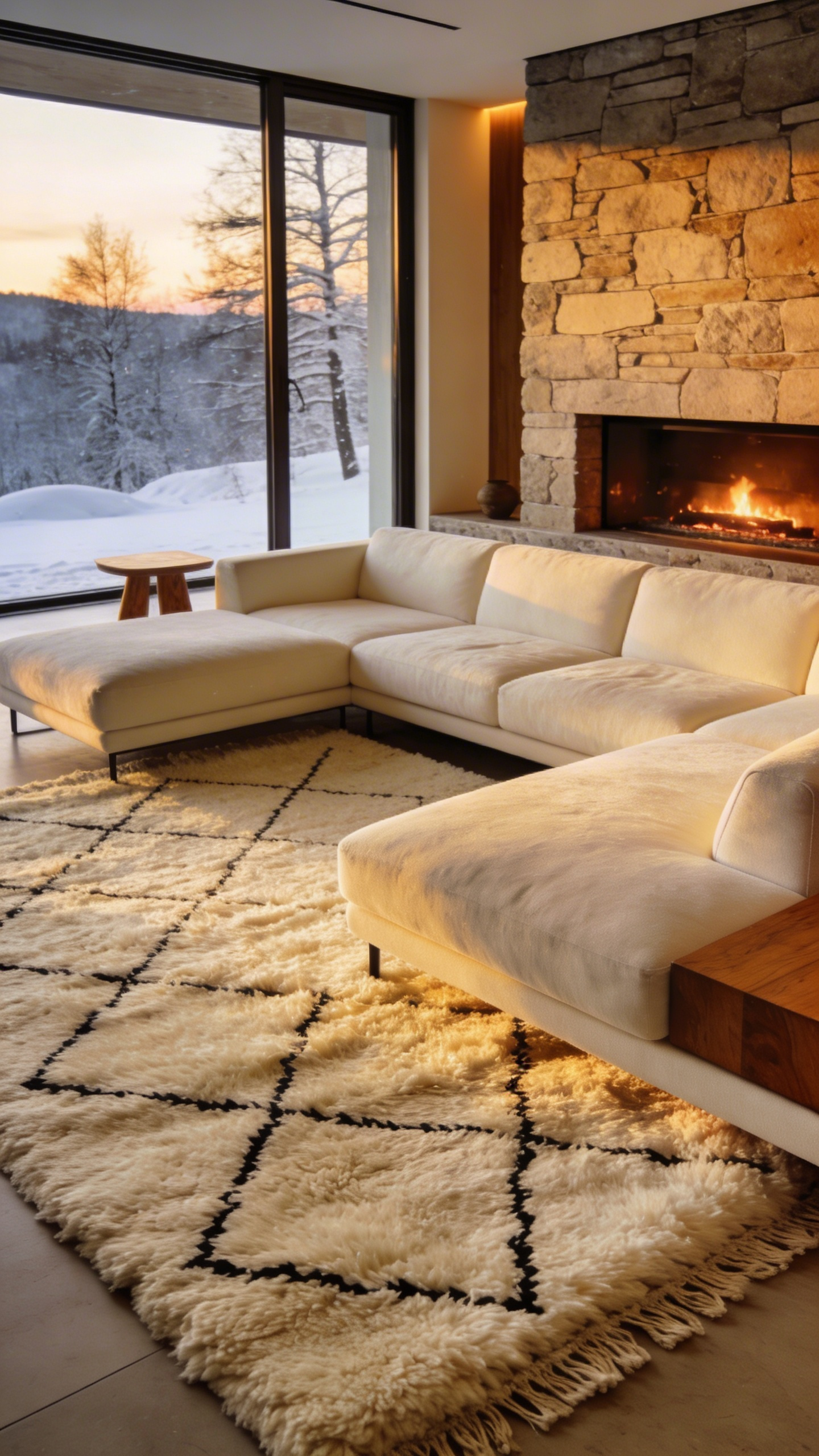
In a modern living room, this history translates into tangible warmth. Notably, the high-altitude wool contains exceptional levels of lanolin. This natural wax acts like a built-in shield against winter spills. Furthermore, the fibers possess a unique “coil spring” structure. Therefore, the pile bounces back comfortably rather than matting down like synthetics.
Beyond touch, these rugs transform the room’s actual atmosphere. The dense fibers absorb sound, effectively silencing echoes in open spaces. Thus, the rug acts as a thermal barrier against cold floors. Psychologically, this “sink-in” texture triggers a deep sense of nesting. For styling, pair this softness with a hard marble table to highlight the contrast.
However, proper maintenance is crucial for longevity. Specifically, never use a vacuum with a rotating beater bar. These brushes can quickly frizz the delicate, hand-spun wool. Instead, rely on suction-only attachments to preserve the knots. Ultimately, this care ritual ensures your sanctuary remains luxurious for decades.
4. Silk-Blend Sheens: Introducing subtle elegance that changes with the light.
Incorporating a silk-blend rug is more than a material choice. It is an architectural manipulation of light. Specifically, these rugs possess a “kinetic” quality that transforms based on perspective. Unlike the diffuse scatter of standard wool, Mulberry silk features a unique triangular fiber structure. Consequently, the rug acts as a series of micro-mirrors. Instead of creating harsh glare, these fibers refract light. This produces a soft, inner glow.
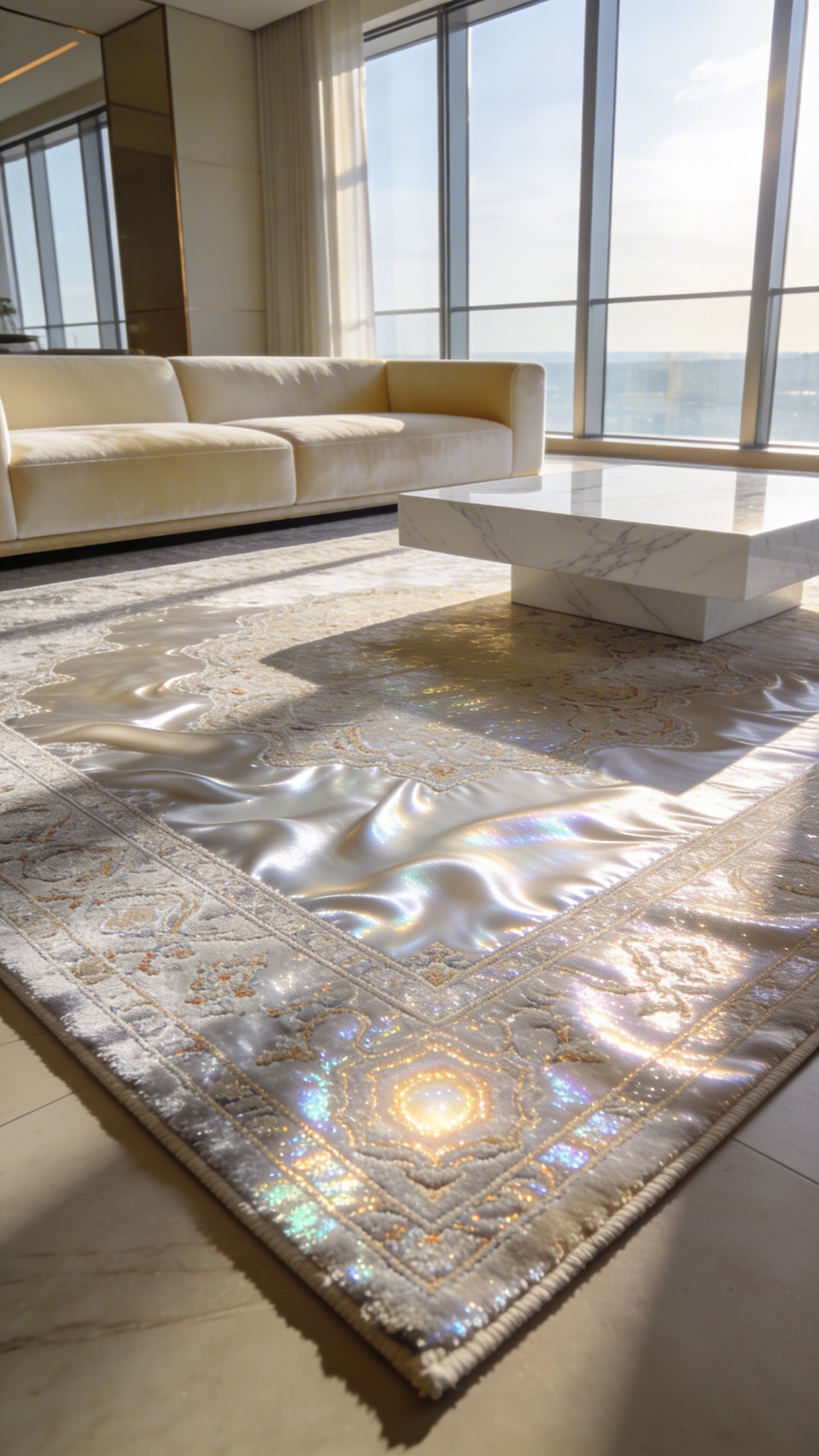
Interestingly, every hand-knotted silk rug features distinct “light” and “dark” sides. If you view the rug against the grain, colors appear deep and saturated. Conversely, viewing it with the grain reveals a silvery, high-sheen surface. Therefore, placement is crucial for defining the room’s atmosphere. You might position the “light side” facing the entrance for an airy, welcoming impression. Alternatively, face it toward the primary seating area to create a moody, rich focal point.
Practically, a wool-silk blend offers a sophisticated solution for high-traffic living rooms. The wool typically forms a sturdy, matte background. Meanwhile, the silk highlights specific patterns. This creates a dynamic matte-vs-glossy contrast. As you walk across the room, the wool remains static. However, the silk elements seem to dance. Ultimately, this interaction ensures the space adapts throughout the day. It shifts from deep morning saturation to an ethereal dusk radiance.
Theme 2: Visual Architecture (Pattern & Space)
Rugs function as much more than simple floor coverings. In fact, they serve as “soft architecture” within your living room. Historically, design theory suggests that textiles were the original walls used to define human spaces. Consequently, placing a rug essentially dresses the room’s structural skeleton. It provides a necessary visual anchor. Without this foundation, furniture arrangements often appear to float aimlessly.
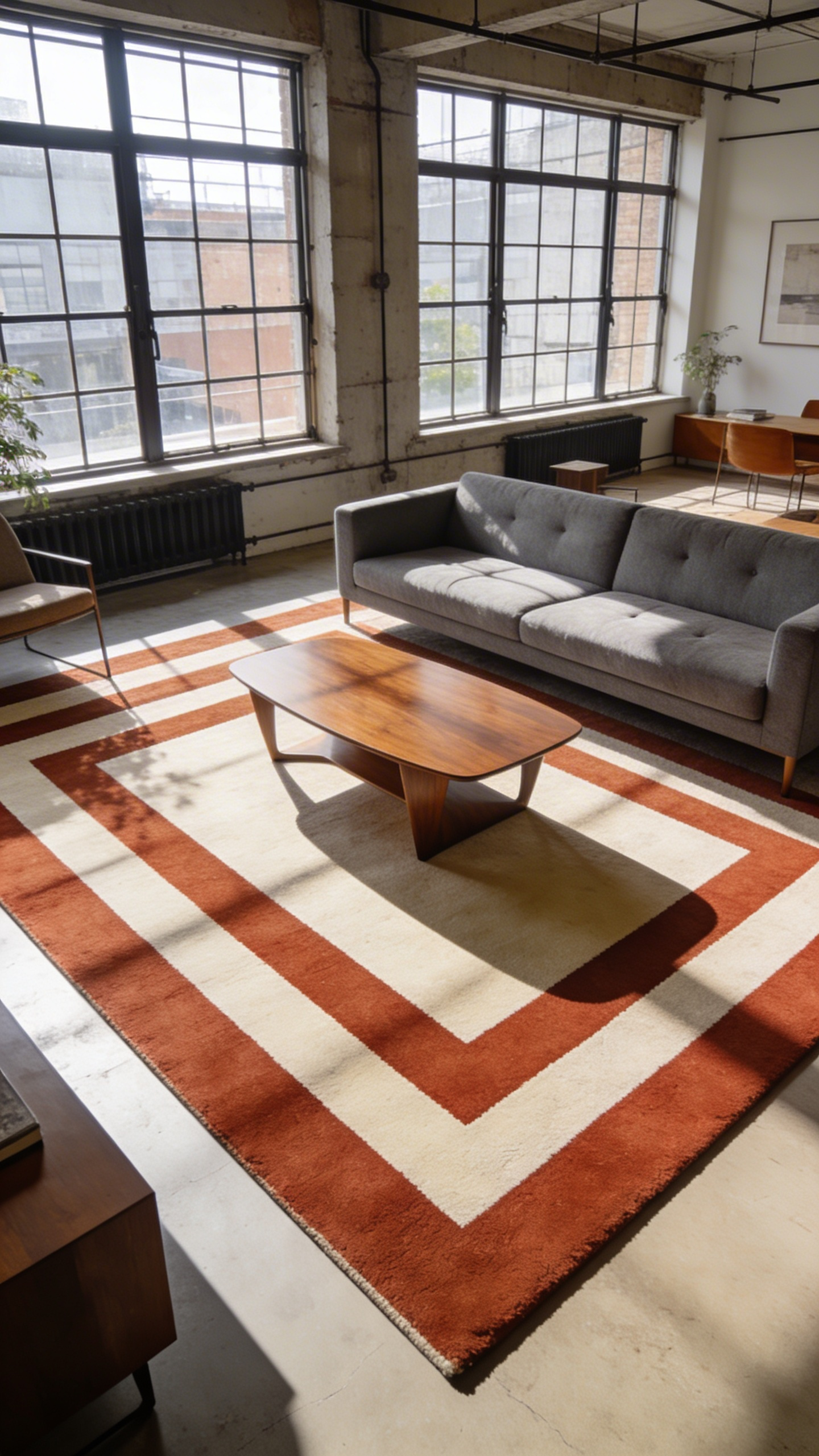
Furthermore, the specific pattern dictates the room’s perceived boundaries. This visual concept is known as spatial frequency. Specifically, large-scale patterns act as anchors that pull walls inward. Therefore, they create islands of intimacy within large, cavernous rooms. Conversely, small, high-frequency patterns draw the eye outward. As a result, compact apartments feel significantly wider and more expansive.
Additionally, patterns act as subconscious navigation maps. Linear designs create visual vectors that guide physical movement. For instance, stripes running away from you act as a runway. They pull guests directly into the heart of the conversation area. Moreover, organic designs introduce “fractal fluency.” These nature-inspired, repeating motifs reduce stress by allowing the eye to process complexity effortlessly. Finally, rugs define the “sonic architecture.” By absorbing sharp echoes, they make the air feel denser and warmer. Thus, the room becomes a truly private sanctuary.
5. The Oversized Geometric: Using large-scale patterns to expand small rooms.
Thinking of a large pattern in a tiny room often feels risky. However, the “Oversized Geometric” acts as an architectural wide-angle lens. In fact, this strategy relies on an optical principle called “perceptual spillover.” Essentially, a massive motif cannot be processed in a single glance. Because the walls cut off the design, your brain assumes the floor continues outward. Conversely, small, busy prints create a grid. This unfortunately highlights limited square footage.
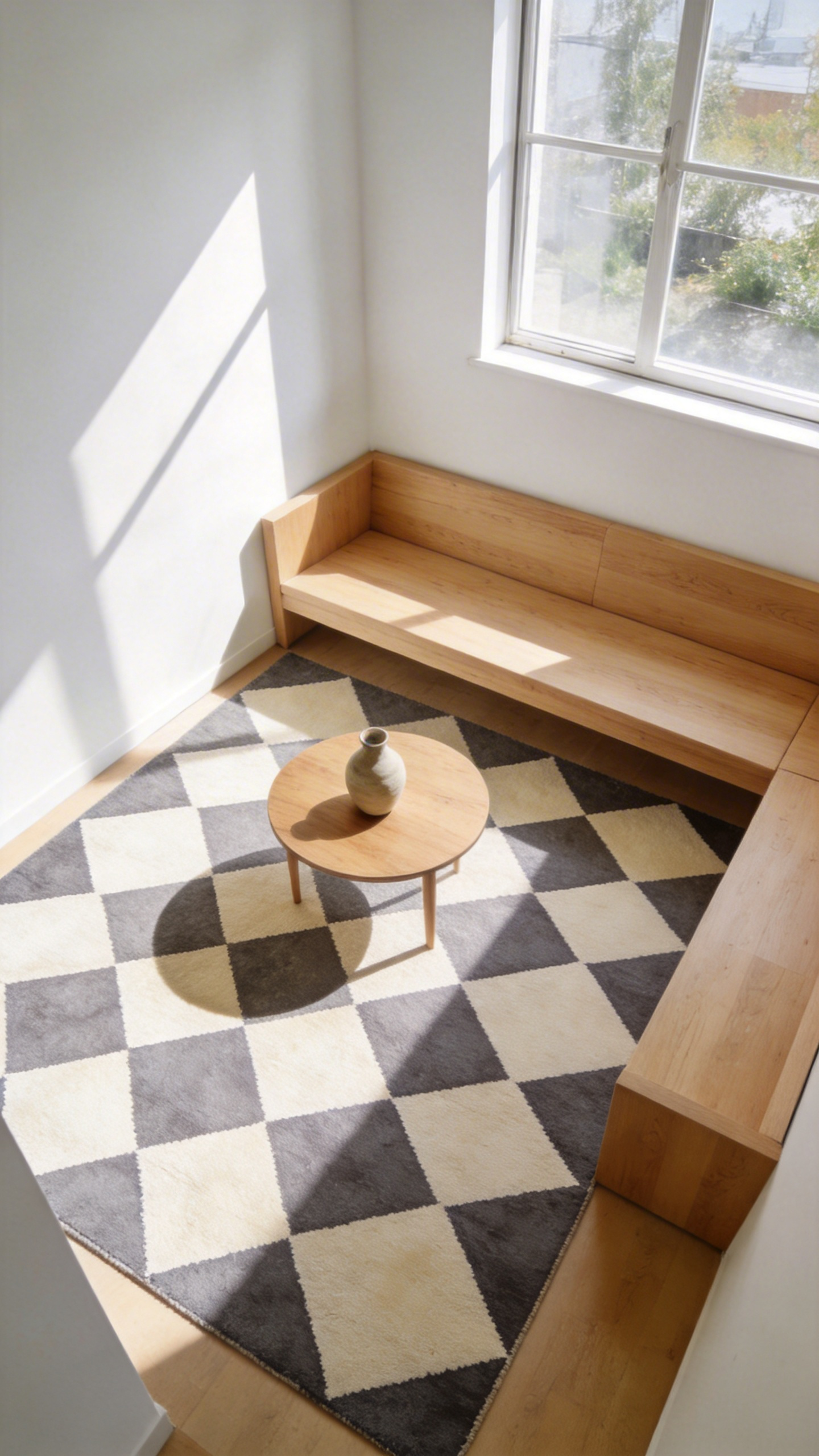
To execute this correctly, you must ignore the impulse to center a small rug. Instead, embrace the “Rule of Encroachment.” Specifically, ensure your furniture sits directly on top of the pattern. When a sweeping arc disappears under a sofa, it creates a visual bridge. Consequently, the room feels expansive enough to handle the scale. Furthermore, consider the impact of color carefully. High-contrast black and white often distracts from low ceilings. In contrast, low-contrast tones act as expanders. Ideally, try a monochromatic rug with carved pile heights. Ultimately, this adds sensory depth without making the space feel claustrophobic.
6. The Vintage Overdyed: Injecting history and color without overwhelming the space.
Consider the vintage overdyed rug as a sophisticated bridge between eras. Specifically, it unites 19th-century craftsmanship with modern color demands. The creation process is actually a fascinating form of preservation. Authentic vintage rugs are first sheared low to expose the knotting core. Subsequently, they are neutralized to remove the original, heavy dyes.

What remains is a “ghost pattern.” This faint, charcoal-like outline preserves the rug’s structural integrity. Then, the weaver saturates the wool in a vibrant new hue. However, the result is never flat or artificial. Because the vintage fibers vary in wear, they absorb pigment differently. Therefore, the rug displays a textured “watercolor” effect with natural highs and lows.
This depth is crucial for living room design. In fact, these rugs provide a “visual anchor.” This grounds furniture without adding clutter. You get the texture of a pattern without the distraction. Furthermore, an overdyed rug introduces a sense of history. It creates a “lived-in” atmosphere that new, synthetic rugs simply cannot replicate. Ultimately, it is the perfect solution for homeowners who value heritage but prefer a minimalist aesthetic.
7. Tone-on-Tone Textures: Adding depth to monochromatic minimalist schemes.
In the realm of minimalist design, a monochromatic palette risks appearing flat or clinical. However, you can avoid this specific pitfall by prioritizing tactile variation. Specifically, tone-on-tone textures in rugs act as silent architects. They create visual interest without adding chaotic color.
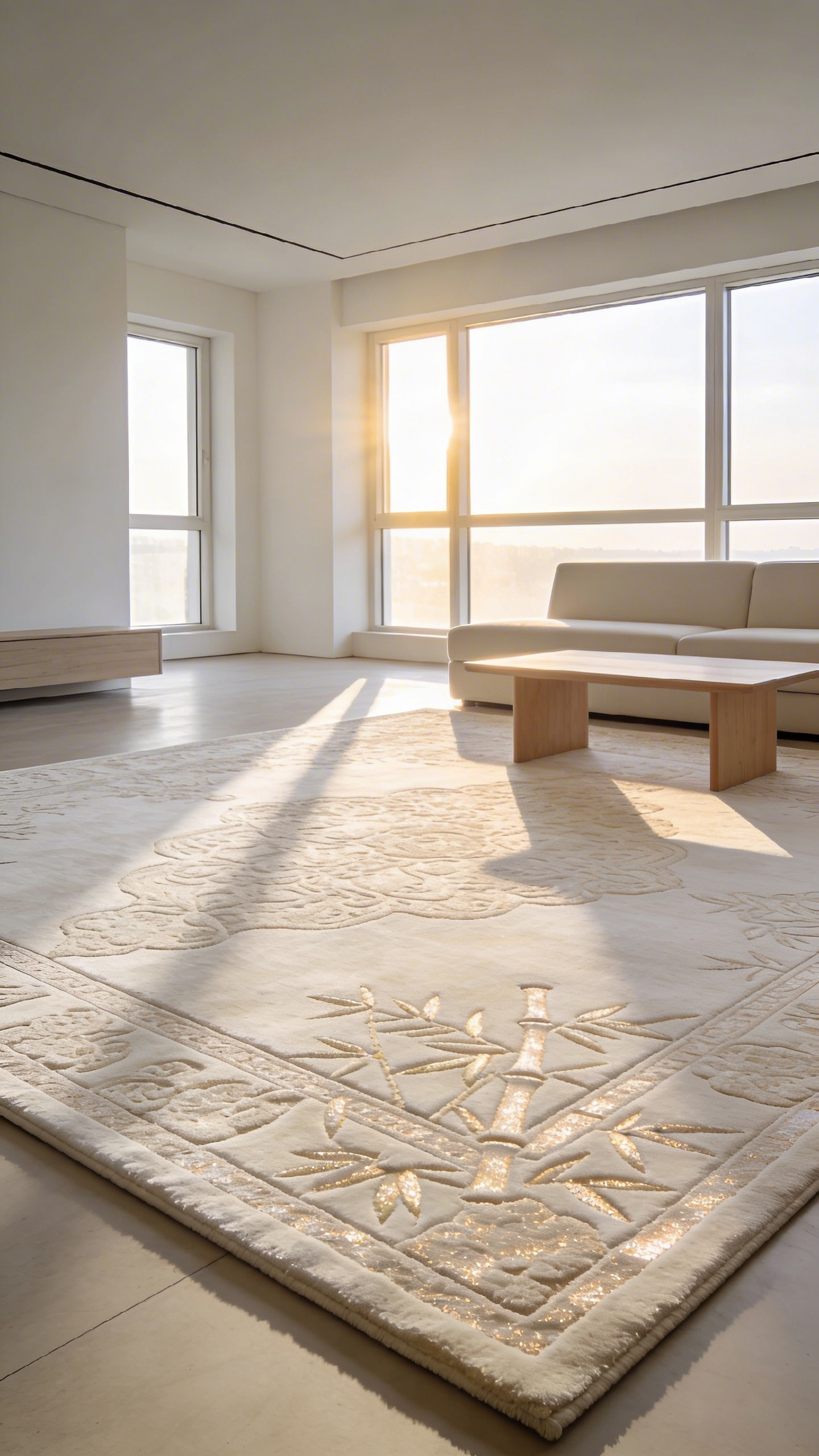
First, consider the physics of luster. Designers often blend matte wool, which absorbs light, with luminous fibers like bamboo silk. Consequently, these materials reflect light differently, even when dyed the exact same hue. Therefore, this contrast creates a dynamic “watermark” effect that shifts as natural light changes. Thus, the rug feels alive rather than functioning as a stagnant block of color.
Furthermore, depth is achieved through sculptural topography. For example, skilled artisans use “V-carve” techniques to physically shear patterns into the pile. As a result, the differing pile heights create shadow lines. These shadows function as a subtle, organic pattern within the solid color. Historically, this technique marks a significant pivot from cold, industrial surfaces to modern “Warm Minimalism.”
Finally, these deep textures serve a functional purpose beyond aesthetics. High-pile, textured rugs act as acoustic anchors in open-concept rooms. Ideally, they absorb noise clutter to match the room’s visual clarity. Ultimately, maximizing texture allows a space to feel full and cozy without compromising the “less is more” philosophy.
8. The Round Rug Breaker: Softening angular furniture in boxy rooms.
Introducing a round rug is often called a “visual exhale” by interior designers. Specifically, this simple addition softens the rigidity found in standard, boxy rooms. Neuro-aesthetics suggest our brains often view sharp angles as potential threats or hazards. In contrast, curves signal biological safety and warmth. Consequently, placing a circular rug triggers an immediate, subconscious sense of calm.
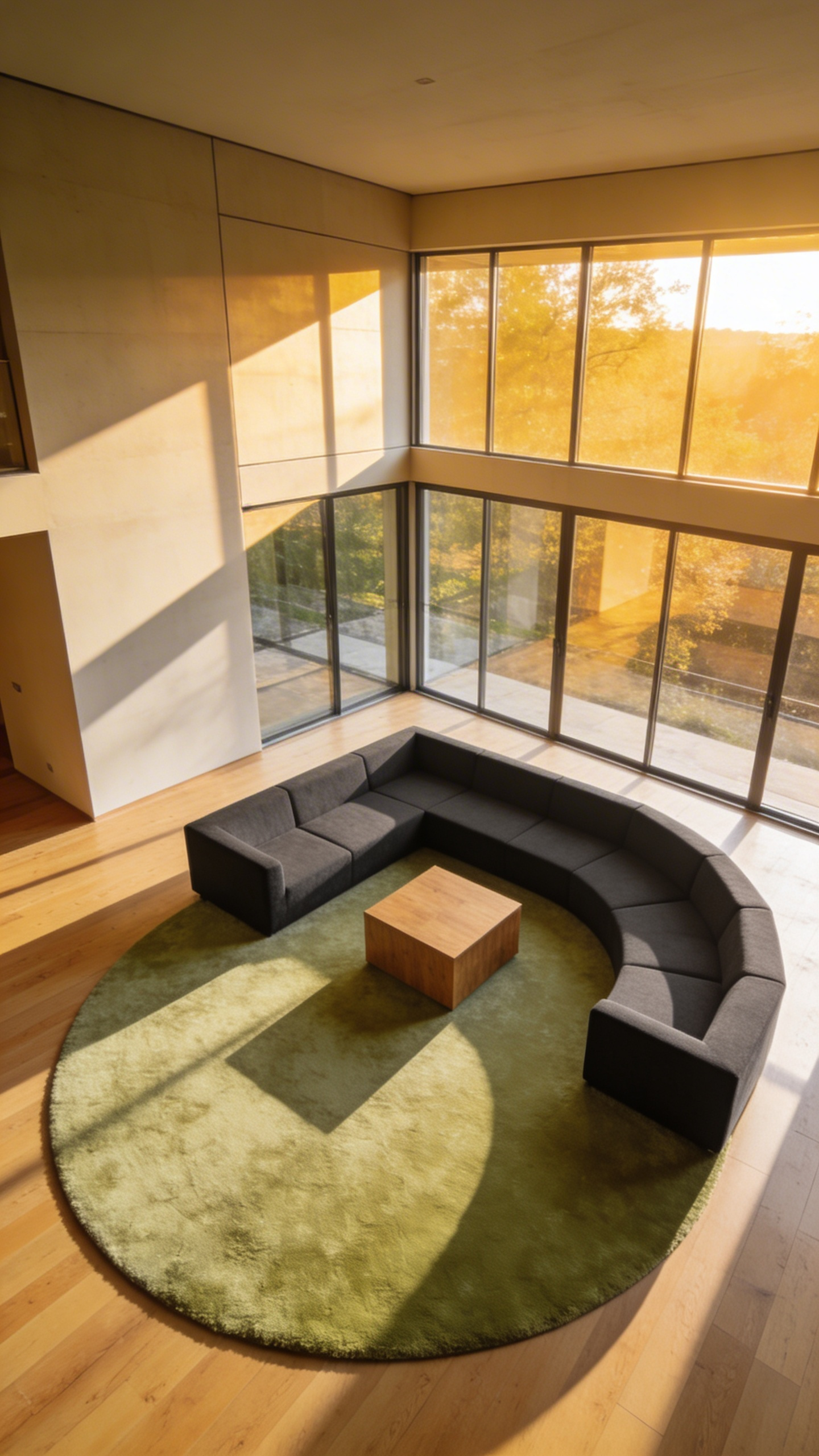
Functionally, these rugs disrupt the restrictive grid lines of boxy architecture. Instead of emphasizing distant walls, the curve draws the eye inward toward the center. Therefore, small apartments feel more expansive due to this “centripetal force.” To maximize this effect, consider the “zone-in-a-zone” technique. For example, use a round rug to corral a reading nook within a larger space.
However, you must ensure the front legs of furniture touch the rug’s edge. Otherwise, the rug may look like an unintentional floating island. For added texture, layer a plush round rug over a flat, rectangular jute base. Yet, be mindful of specific layout limitations. Distinctively, avoid pairing circles with large L-shaped sectionals. Unfortunately, those conflicting geometries often create visual tension rather than harmony.
Theme 3: The Art of Layering (Carley’s Seasonal Specialty)
To me, layering represents much more than a simple visual trend. In fact, it acts as a sophisticated storytelling device. It transforms a house into a sanctuary. Historically, nomadic tribes layered woven mats for insulation against cold desert nights. Similarly, modern layering creates necessary “sensory insulation” in our homes. It effectively muffles the acoustic chaos often found in open-plan living. Therefore, the space feels psychologically grounded rather than cluttered.
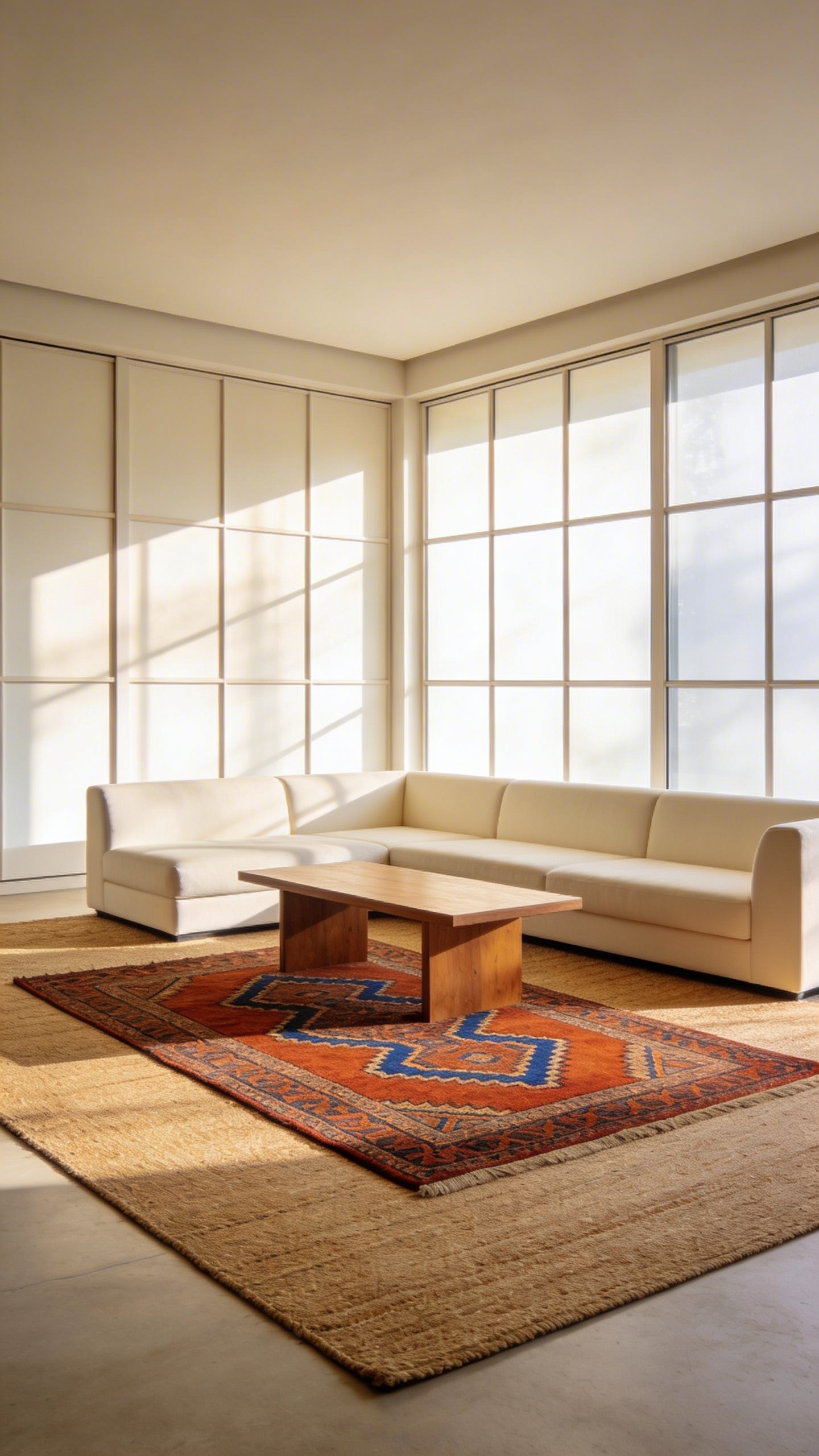
To execute this, I consistently rely on the “Base and Jewel” technical formula. First, anchor the room with a large, high-texture base. Specifically, materials like jute or sisal provide organic friction to keep layers in place. Next, position a smaller “jewel” rug on top to serve as the room’s personality. However, maintaining proper proportions is critical for visual balance. Consequently, you must follow the “12-inch Border Rule.” The base rug should extend at least one foot beyond the top layer on all sides. This framing prevents the top rug from appearing like a “floating island.”
Moreover, this approach facilitates effortless seasonal adaptability. During winter, I recommend “stacking for warmth” using high-pile wool or sheepskin. Conversely, summer calls for “light-layering” with breathable cotton dhurries. This switch maintains the room’s visual depth without retaining unnecessary heat. Additionally, layering acts as a budget-friendly “cheat code.” If a vintage rug is too small for a room, simply layer it over a neutral base. Thus, you give a modest piece the visual weight required to command a large space.
9. The Base Layer Technique: Sizing up with affordable seagrass.
The “Base Layer Technique” is a favorite strategy among professional designers. Specifically, this “high-low” hack bridges the gap between room scale and budget. Often, custom-sized carpets carry a prohibitive, five-figure price tag. Instead, utilize an affordable, room-sized seagrass rug as your foundation. Consequently, this neutral canvas allows you to layer a smaller, vintage rug on top. Essentially, the seagrass anchors the furniture, while the top layer acts as decorative jewelry.
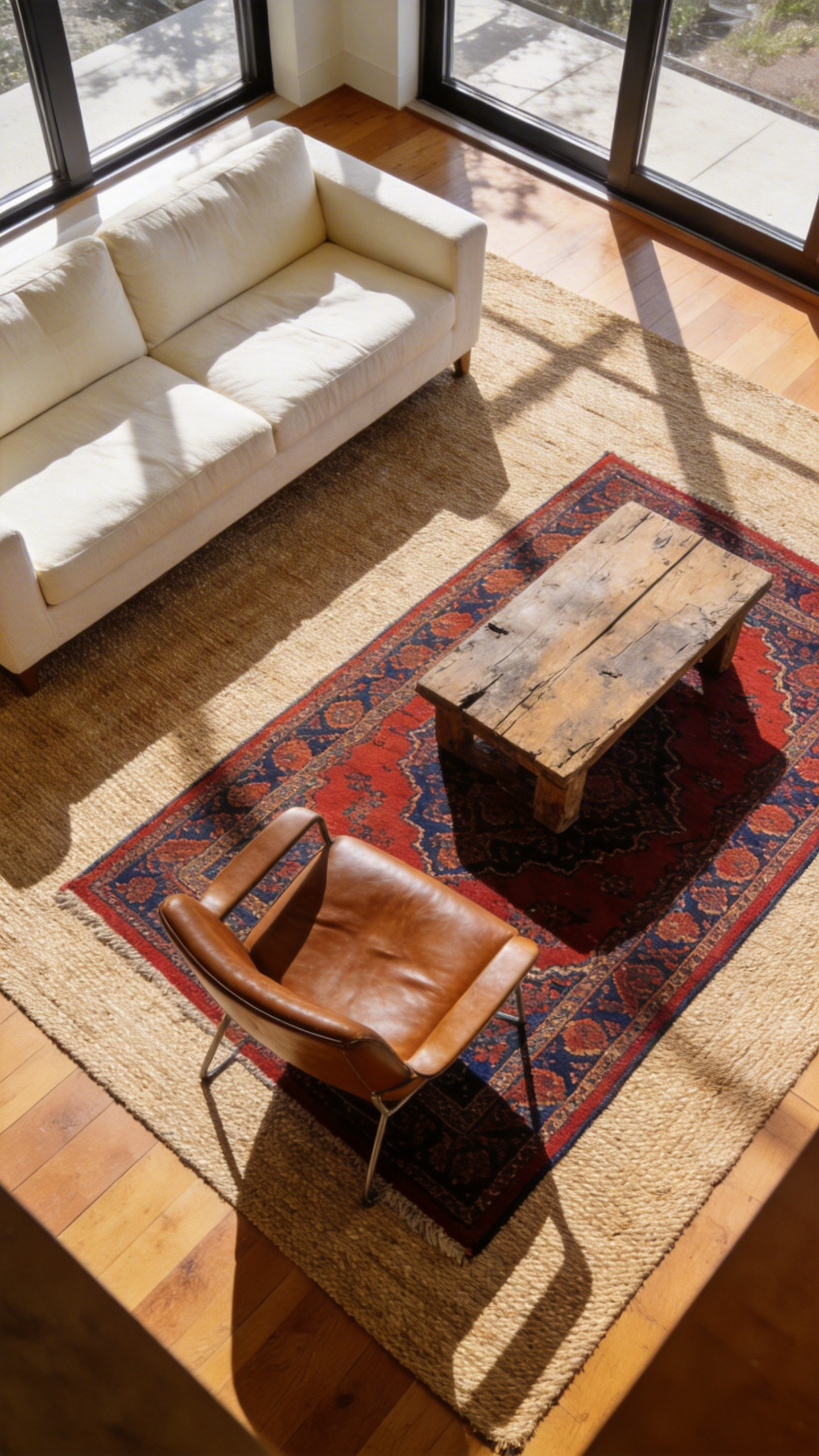
To achieve the perfect look, apply the designer’s two-thirds rule. The top rug should cover approximately two-thirds of the base layer. Furthermore, seagrass offers unique technical advantages over sisal or jute. Because it grows underwater, the fibers possess a natural waxy coating. Therefore, it is naturally non-porous and highly water-resistant. Liquids tend to bead on the surface, making cleanup surprisingly easy.
Additionally, this material contributes to the room’s sensory narrative. The color mellows from organic green to golden-hay over time. Simultaneously, the texture adds a firm, architectural element to the floor. Ultimately, this layering creates a sense of “undone luxury.” It feels sophisticated yet welcoming.
10. The Accent Top Layer: Floating a smaller vintage piece for a pop of color.
Floating a smaller, vibrant vintage rug over a neutral base is a strategic design move. In fact, this sophisticated technique creates what designers call an “Island of Intimacy.” While the large base rug defines the architectural perimeter, the floating layer identifies the social core. Consequently, this visual weight draws the eye inward. It signals exactly where the gathering happens. To achieve this, avoid tucking the top rug under sofa legs. Instead, allow it to “float” freely with a visible border of the base rug acting as a frame.

Furthermore, success relies on a sensory dialogue between opposing textures. Typically, you pair a coarse, grounding fiber like sisal with a soft, lived-in wool antique. As a result, the contrast creates a curated, layered experience underfoot. Additionally, this top layer introduces “saturated history” through complex vegetable dyes. Therefore, even a bold red Kilim feels grounded rather than jarring against a neutral backdrop. The rug’s natural patina softens the color, acting as a sophisticated focal point.
However, technical execution is vital for a permanent look. Specifically, select a low-profile or flat-weave rug to prevent potential tripping hazards. Moreover, utilize a felted rug-to-rug pad to lock the layers together securely. Ultimately, aim for the top rug to cover roughly 30-40% of the base layer. This “Golden Ratio” ensures the vintage piece looks intentional, not undersized.
11. Diagonal Layering: Creating dynamic movement and casual elegance.
Diagonal layering introduces a sophisticated sense of kinetic energy to a living space. Specifically, this technique breaks the rigidity of standard architectural lines. Consequently, the angled placement acts as a visual arrow. It guides the gaze dynamically, preventing a static or “museum-like” atmosphere. Furthermore, this strategy functions as a powerful architectural correction tool. Placing a rug at a 45-degree angle creates a diagonal axis across the floor plan. As a result, this elongated line tricks the eye. It makes narrow rooms appear significantly wider.
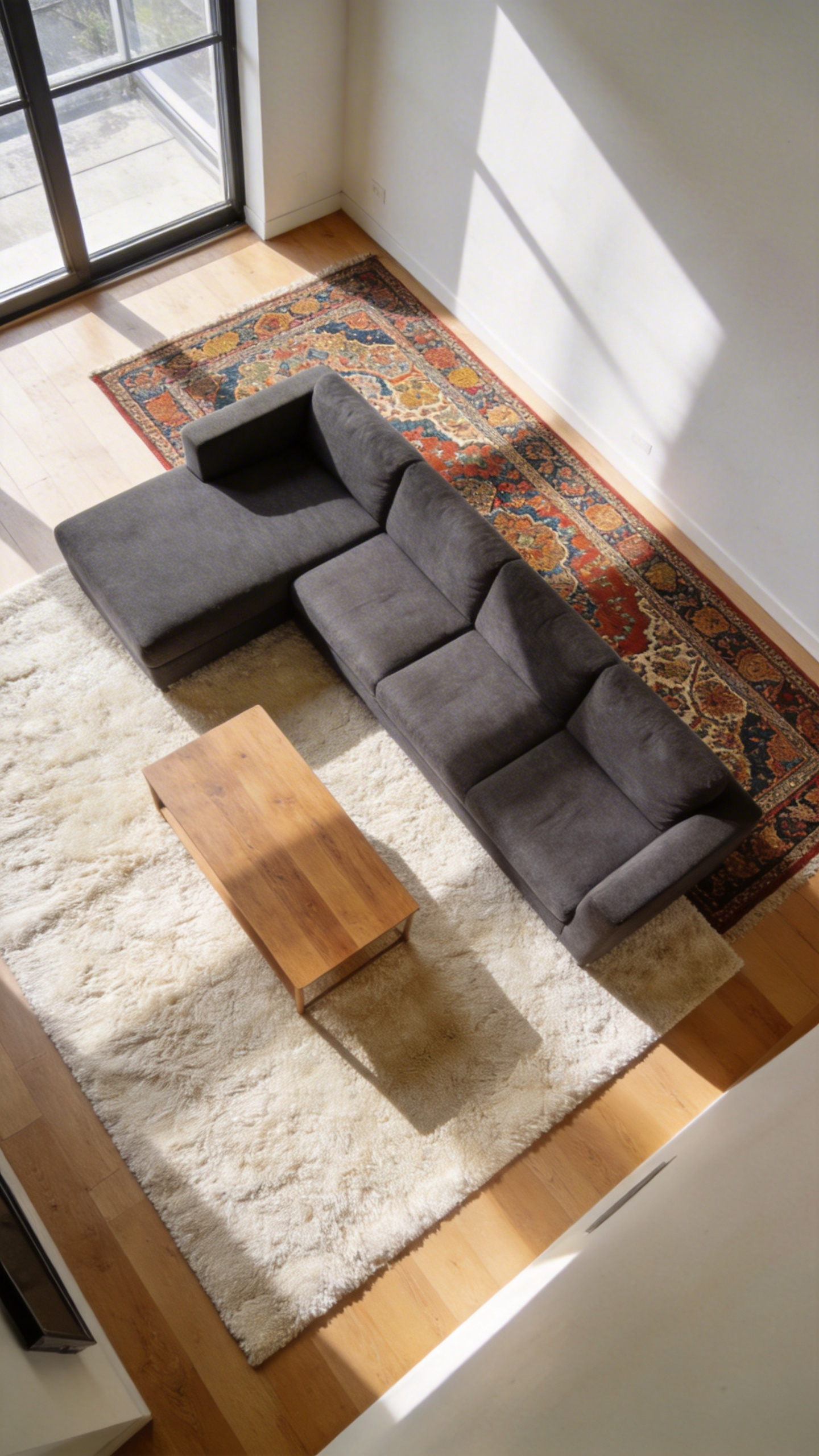
To truly master “casual elegance,” focus on material contrast. Typically, expert stylists utilize a sturdy, neutral base, such as jute or sisal. Then, a softer, luxurious accent rug is layered on top. Therefore, the transition creates “tactile friction,” enhancing the room’s sensory depth. However, maintaining balance requires strict adherence to proportion. Ideally, the top rug should be two-thirds the size of the foundation. Finally, anchor the arrangement by placing furniture legs on the angled piece. This prevents it from appearing to float aimlessly.
12. The Cowhide Overlay: Organic shapes to break up rigid grid layouts.
In interior design, living rooms frequently suffer from a phenomenon known as “rectilinear fatigue.” Consequently, the endless repetition of square coffee tables, boxy sofas, and rectangular floorboards creates a rigid atmosphere. To combat this, the cowhide overlay acts as a sophisticated visual “circuit breaker.” Specifically, its amoebic, organic silhouette disrupts the strict grid. This instantly signals a more relaxed environment.
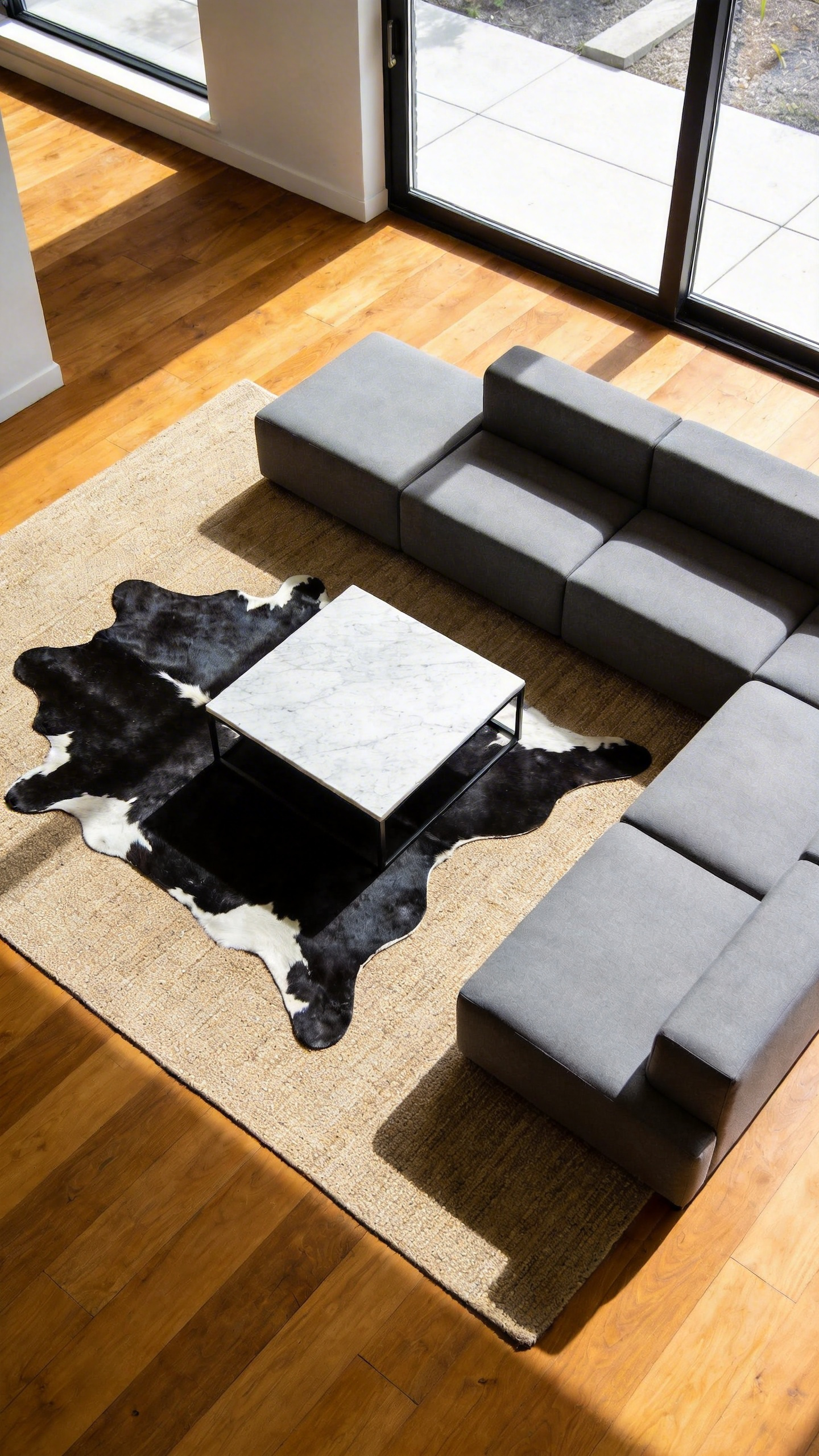
Ideally, you should execute this look by layering the hide over a large, natural fiber rug. For instance, pairing a coarse jute base with a smooth cowhide creates necessary “tactile friction.” Thus, the contrast establishes sensory depth that a single flat weave simply cannot match. Furthermore, the hide’s natural sheen captures light differently than matte fibers. This adds a soft, luxurious luster to the floor.
Beyond aesthetics, this layering technique solves practical layout issues. By tossing the hide at an angle, you introduce “intentional asymmetry” to the space. As a result, the diagonal lines trick the eye. This makes the room feel wider rather than like a narrow corridor. Additionally, this “anchor and pivot” method allows you to define micro-zones, such as a reading nook. Ultimately, the cowhide overlay is not merely a rustic trend. It is an architectural tool used to humanize modern spaces.
Theme 4: Functional Styling & Placement
In open-concept homes, rugs essentially act as “portable architecture.” Specifically, they define zones without requiring actual walls. Without a rug, furniture often appears adrift on the flooring. Therefore, designers rely on visual anchors to ground the space. For example, the “All-Legs-On” rule creates a self-contained island of intimacy. Conversely, placing just the front legs on the rug works better for smaller rooms. This technique effectively signals to the brain that the area is a safe conversational zone.
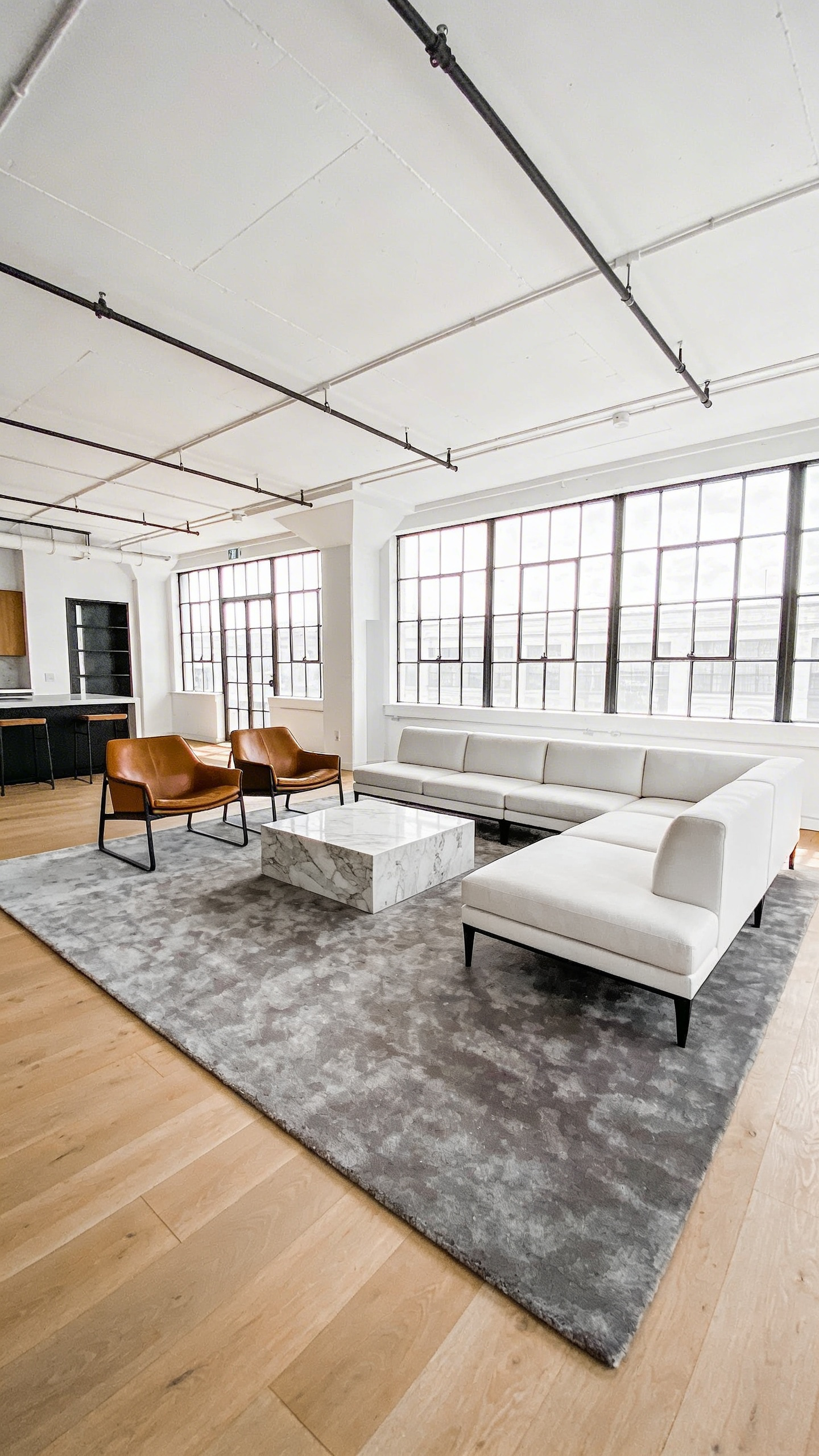
Beyond visual boundaries, functionality involves “sound sheltering.” Hard surfaces like tile or hardwood amplify noise. Consequently, a high-pile wool rug becomes a critical acoustic tool. In fact, dense fibers can absorb up to 30% of ambient sound. Moreover, the tactile experience influences behavior. Psychology suggests that unified soft surfaces encourage longer social interactions. Thus, the texture dictates how a room is used. You can explore 20 brilliant living room styling tricks that actually work to maximize these effects.
Finally, layering offers both adaptability and comfort. Typically, designers use a durable natural fiber rug as a base canvas. Then, they layer a vintage piece on top to define the conversation area. Functionally, this adds cushioning and thermal insulation. However, ensure the top layer is thin to prevent tripping hazards. Ultimately, smart placement creates a room that feels as good as it looks.
13. The ‘Front Legs On’ Rule: Anchoring furniture to create a cohesive conversation zone.
Consider the “Front Legs On” rule as the handshake of interior design. Specifically, it is the moment your furniture greets the floor covering to form a relationship. Without this visual tether, a sofa and chairs often feel like separate islands floating in a cavernous room. Consequently, the space creates subconscious visual anxiety. However, simply sliding the front legs onto the rug engages the psychological Law of Common Region. Instantly, the brain perceives the arrangement as a cohesive “conversation cocoon.”
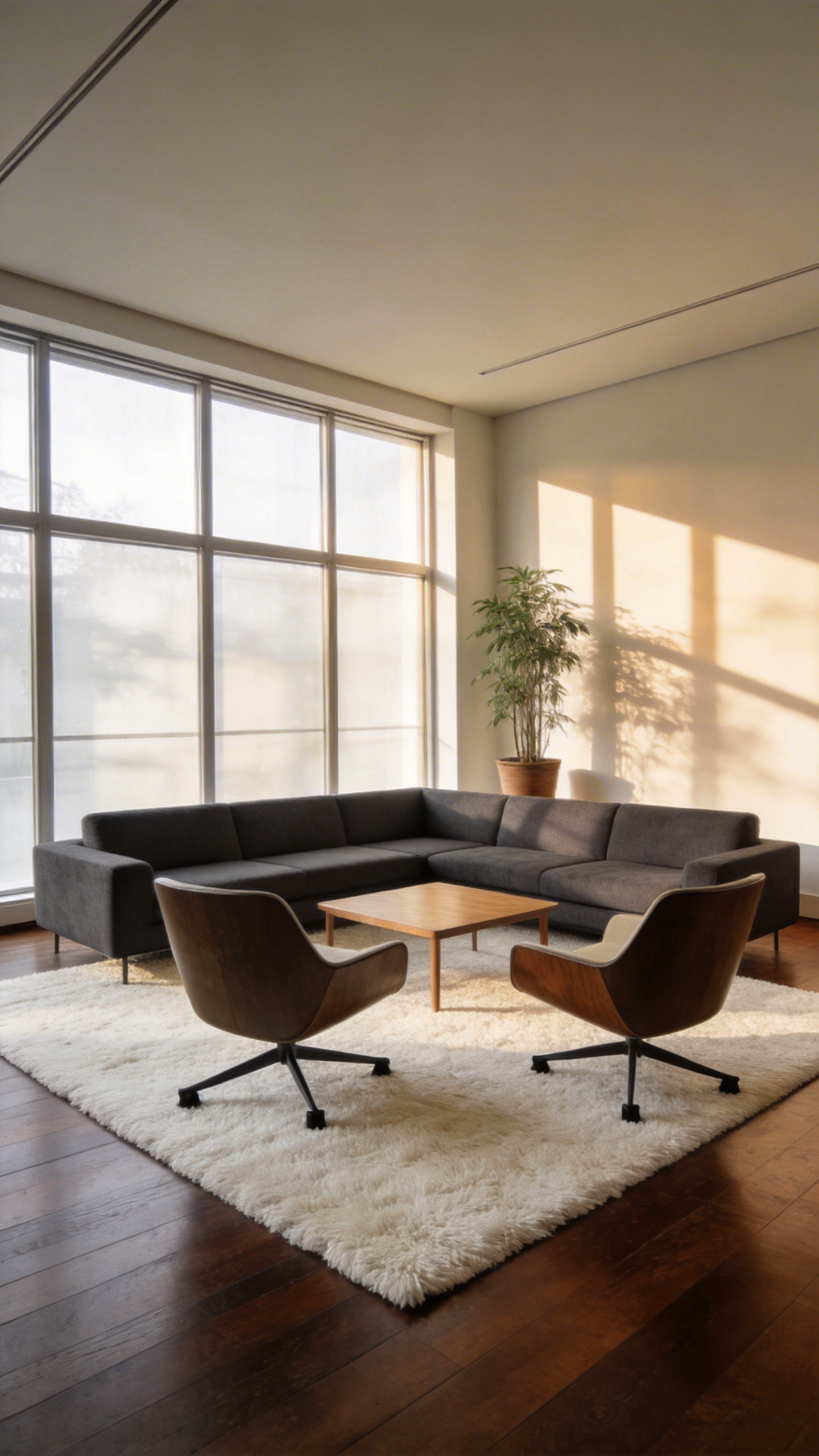
In fact, this approach is the ultimate compromise for modern open-concept homes. Huge, room-filling rugs often hide beautiful hardwood floors and cost a fortune. Conversely, small rugs look like postage stamps lost at sea. Therefore, overlapping the furniture by roughly 6 to 10 inches strikes a perfect balance. It locks the layout in place while maintaining an airy, adaptable perimeter.
Furthermore, this placement dictates traffic flow efficiently. It signals that the rug area is for stillness and connection. Meanwhile, the bare floor behind remains a walkway. Also, it ensures a comfortable sensory experience. Guests sitting down will always rest their feet on soft fibers rather than hard tile. If a thick rug causes a slight backward tilt, simply add felt pads to the back legs. Ultimately, this technique ensures the room feels both grounded and inviting.
14. Zoning Open Plans: Using contrasting rugs to define living vs. dining areas.
Open floor plans celebrate light and fluid movement. However, they often present a unique spatial challenge. Without walls, furniture can feel adrift in a sea of flooring. Therefore, using contrasting rugs acts as “invisible architecture” to define specific zones.
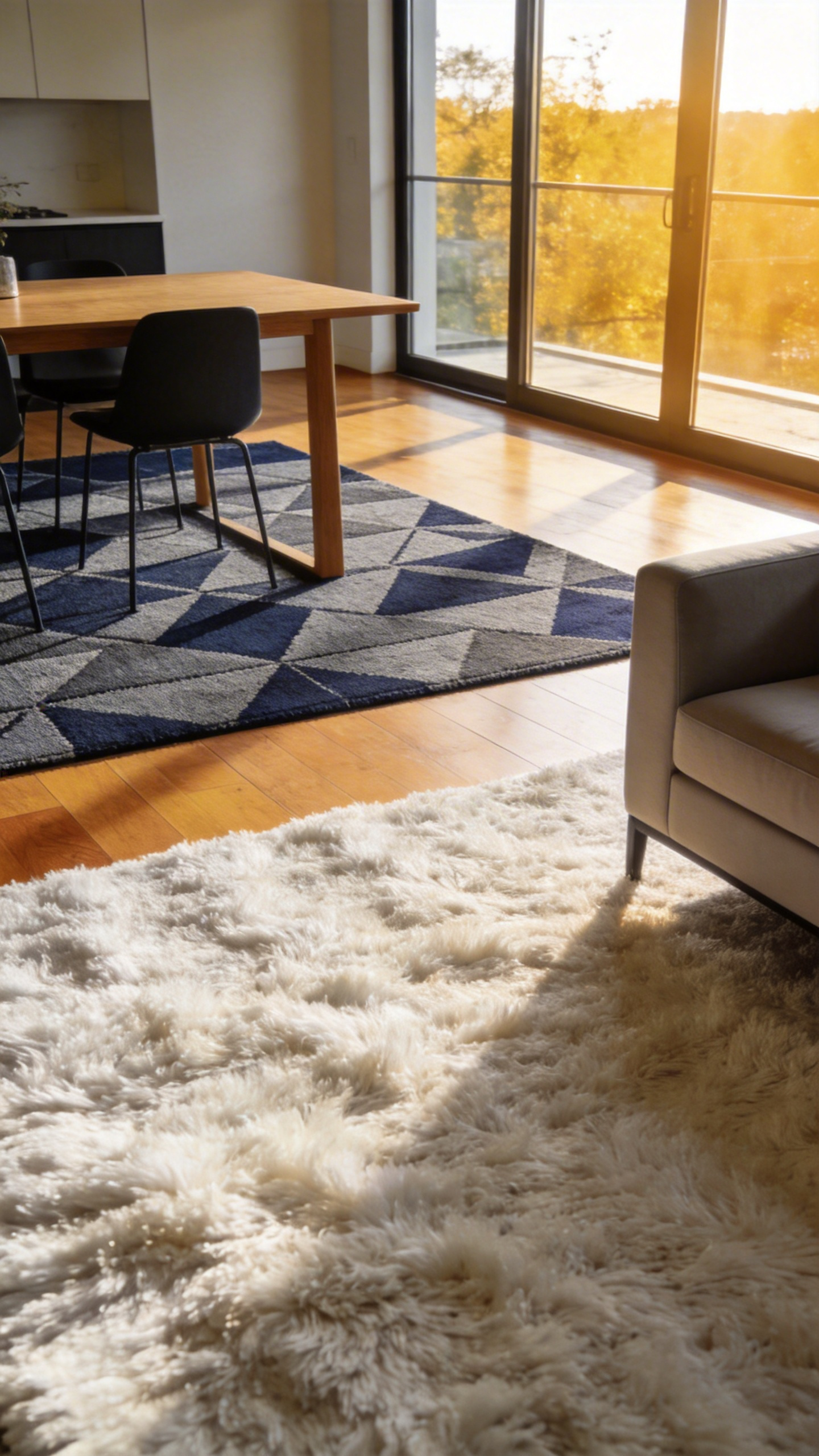
Specifically, this technique creates a necessary mental shift. A plush, high-pile rug in the living area signals relaxation. It invites the nervous system to linger and rest. Conversely, a firm flatweave under the dining table suggests engagement. This texture supports the active movement of pulling out chairs.
Furthermore, these distinct choices serve practical mechanical needs. High-pile wool absorbs sound, mitigating the “echo chamber” effect common in large rooms. In contrast, low-profile dining rugs prevent tripping hazards and trap fewer crumbs.
Crucially, you must manage the physical transition between these textures. Designers recommend leaving 12 to 18 inches of “naked floor” between rugs. This gap acts as a visual hallway or buffer zone. Finally, maintain harmony by finding a “common denominator.” For instance, ensure both rugs share a secondary color to link the distinct islands.
15. The Runner Behind the Sofa: Dressing the forgotten transition space.
In modern open-concept layouts, the area behind a floating sofa often feels untethered. Consequently, this “liminal space” creates a sense of exposure for those seated nearby. Therefore, introducing a runner serves as a sophisticated architectural tool. It effectively establishes a visual perimeter, signaling exactly where the living zone ends.
Beyond defining boundaries, this addition functions as an essential acoustic buffer. Designers frequently refer to this specific application as the “Soft Path.” Specifically, a flat-weave wool or dense kilim absorbs the distracting sounds of foot traffic. Thus, it protects the quiet atmosphere of the conversation area from the noise of passing household members.
For maximum impact, consider pairing the runner with a sofa console table. This arrangement creates a layered, vertical landscape. However, texture choice is critical here. If your main rug is plush, select a low-profile material like jute for the runner. This contrast prevents the room from feeling monotone. Furthermore, proper spacing ensures a polished look. Ideally, maintain a two-inch gap of visible floor between the sofa legs and the rug’s edge. Finally, because this is a high-traffic corridor, secure the runner with a hybrid felt-and-rubber pad. This simple addition prevents dangerous shifting while elegantly defining your home’s transition zones.
16. Washable Performance Blends: Style that survives holiday spills and pets.
Historically, living room rugs were delicate investments. They required a “formal room” mentality. However, a significant shift has occurred toward “indoor luxury” performance blends. Now, homeowners can enjoy an “heirloom aesthetic” without the associated anxiety. Specifically, designers utilize vintage-washed techniques on machine-washable polyester bases. This innovation allows style to survive holiday spills and daily life.

Technically, the secret lies in molecular nanotechnology. Unlike old sprays, these modern coatings create an invisible hydrophobic barrier. Consequently, liquids like red wine bead on the surface immediately. This reaction buys you crucial time to spot-treat before washing. Furthermore, modern blends avoid the stiff, “plastic” feel of outdoor rugs. Manufacturers often mix polyester for structure with cotton for tactile softness.
Additionally, these smooth fibers are superior for households with pets. Traditional wool scales trap hair, making vacuuming a difficult battle. Conversely, smooth performance synthetics release fur easily during cleaning. Also, tight power-looming prevents claws from snagging during a dog’s “zoomies.” Moreover, non-porous materials ensure that odors wash away rather than soaking in. In fact, many durable styles feature upcycled PET from plastic bottles. Therefore, this longevity prevents the rug from becoming a disposable landfill item.
Conclusion: From Floor Covering to Room Anchor
Ultimately, the modern rug has evolved far beyond simple utility. Instead, it serves as the essential invisible architecture of your home. By defining zones, this textile acts as a powerful social anchor. Consequently, the right choice transforms a disjointed area into a cohesive sanctuary. Moreover, it grounds us psychologically through distinct tactile and acoustic shifts. Therefore, viewing a rug as the room’s soul fundamentally changes your design approach.
Looking ahead, your floor covering must support your lifestyle’s daily flow. In fact, investing in generous scale creates a sense of expansive luxury. Additionally, a properly anchored room invites connection. It ensures lasting comfort. Thus, you should prioritize density and size over fleeting trends when exploring the ultimate living room rug ideas. To start, audit your current seating arrangement for visual gaps. Finally, upgrade to a rug that encompasses every front leg, unifying your space.
Recap: Rugs as the seasonal foundation of the home.
In interior design, the rug is often referred to as the “fifth wall.” However, it is more accurately described as the living room’s thermal and psychological regulator. Specifically, research reveals that 73% of homeowners feel a measurable “disconnect” when their environment ignores seasonal light changes. Therefore, treating your rug as a seasonal foundation is a biological necessity, not just a stylistic choice.
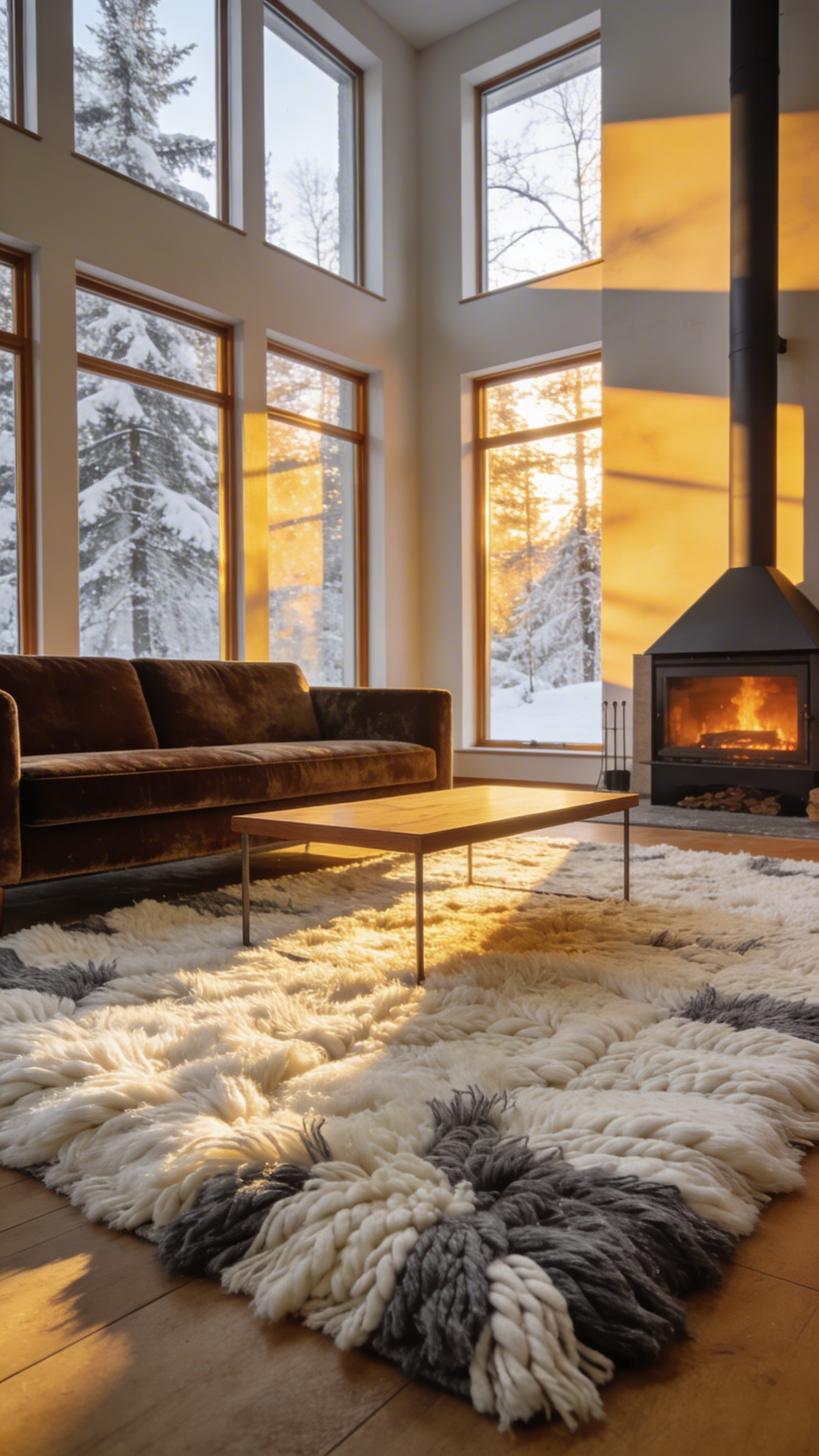
During winter, our brains naturally crave “visual weight” to feel safe and enclosed. Consequently, replacing a light cotton rug with high-pile wool acts as a visual punctuation mark. Technically, this swap also serves a functional purpose through thermal conductivity. Wool fibers feature natural crimps that trap heat within tiny air pockets. Thus, a wool rug effectively acts as nature’s insulation against cold subfloors.
Conversely, the transition to spring requires a shift toward breathability. For instance, natural plant fibers like jute or sisal provide a visceral cooling effect. Because they lack heat-trapping density, these materials allow air to circulate freely between the weave and the floor.
To achieve this adaptable foundation easily, many experts utilize the “Anchor and Accent” framework. Simply maintain a large, neutral base rug year-round. Then, layer a smaller, textured accent rug on top to recalibrate the room’s temperature. Ultimately, this approach ensures your living space remains a grounded, responsive sanctuary throughout the entire year.
Final thought: Don’t just cover the floor; curate the feeling of the room.
Ultimately, viewing a rug as a simple accessory misses its true architectural potential. Instead, consider it a foundational tool for sensory curation. Historically, rugs defined the home’s hearth. Therefore, they still serve as a psychological “sacred circle” for modern gatherings. Without this visual anchor, furniture often appears to float aimlessly. Consequently, the room creates a subconscious sense of instability.
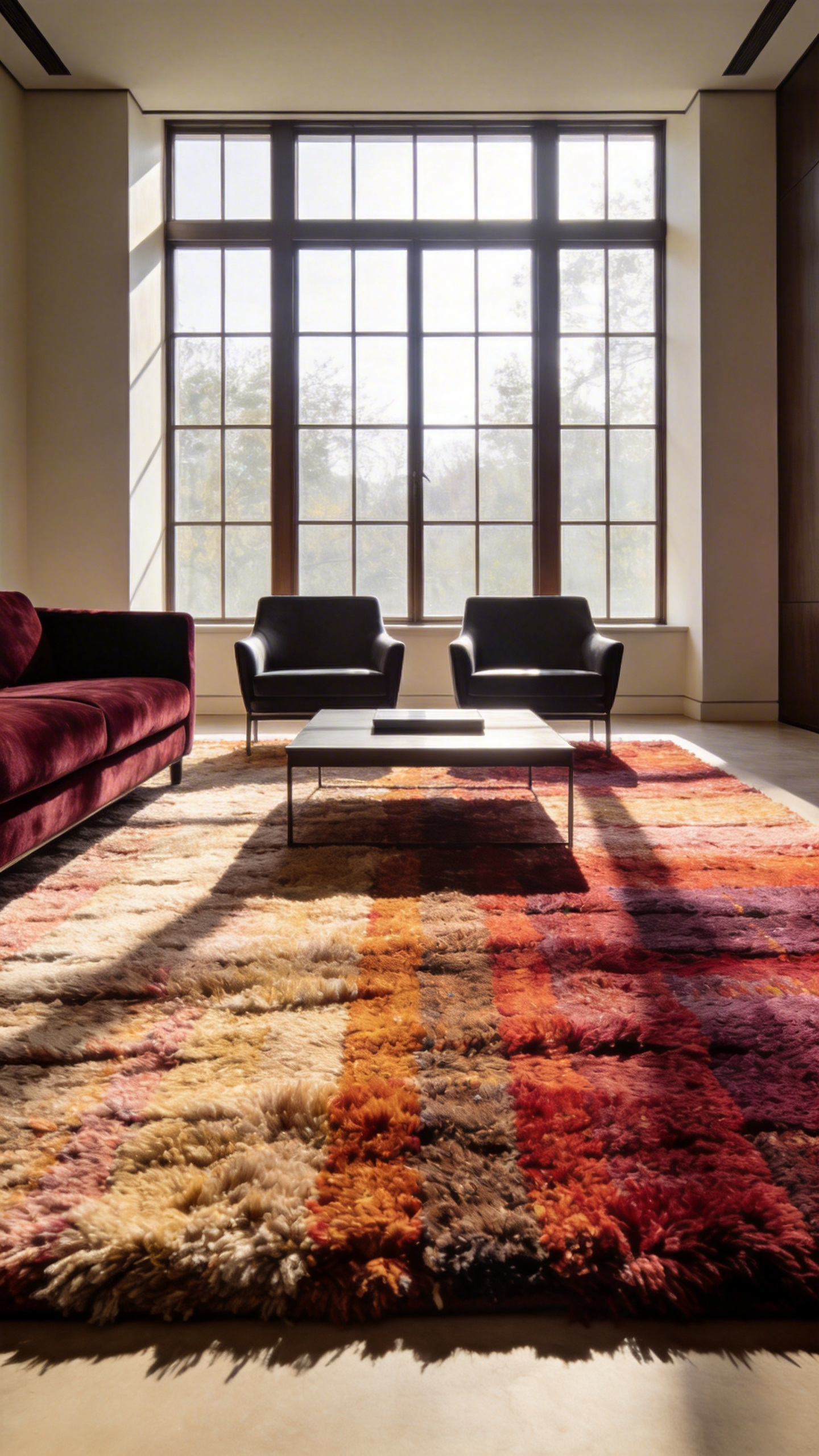
Beyond visuals, you must also curate the room’s auditory experience. Specifically, a rug functions as a volume knob for the home’s acoustics. For example, a high-pile wool rug absorbs up to 30% of ambient noise. As a result, the atmosphere shifts from a hollow hall to a quiet sanctuary. Alternatively, choosing jute introduces a tactile “grit.” This material choice immediately signals a casual, honest connection to nature.
Finally, pay close attention to scale to convey a specific mood. A rug that is too small creates immediate visual tension. In contrast, an expansive rug that extends beyond furniture legs signals unlimited hospitality. This “border of comfort” tells guests the room is indulgent rather than utilitarian. Therefore, stop focusing solely on color or pattern. Instead, use texture, sound, and size to dictate the room’s emotional temperature with the best living room rug ideas.
Frequently Asked Questions
How do you choose the right rug size for a living room?
To choose the right rug size, ensure the rug is large enough to anchor all main furniture pieces. In luxury design, the “All-Legs-On” rule is preferred. Here, the sofa and chairs sit entirely on the rug. At a minimum, the front legs of all seating should rest on the rug. This creates a cohesive conversation zone and avoids the “floating furniture” look.
Should a rug be lighter or darker than the sofa?
There is no strict rule. However, contrast is key to preventing a flat aesthetic. A darker rug can ground a light-colored sofa, creating a sophisticated focal point. Conversely, a lighter, textured rug can lift a dark sofa. This prevents the room from feeling too heavy. Focus on the tonal relationship and the amount of natural light in the room.
Can you put a rug on top of carpet in a living room?
Yes, layering a rug over wall-to-wall carpet is a professional styling trick. It is used to define zones and add personality. To execute this successfully, choose a lower-profile rug like a flatweave or kilim. Also, use a specialized rug-to-carpet pad to prevent the top layer from shifting or “creeping” over time.