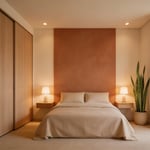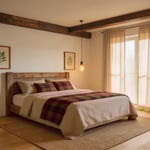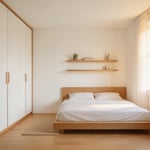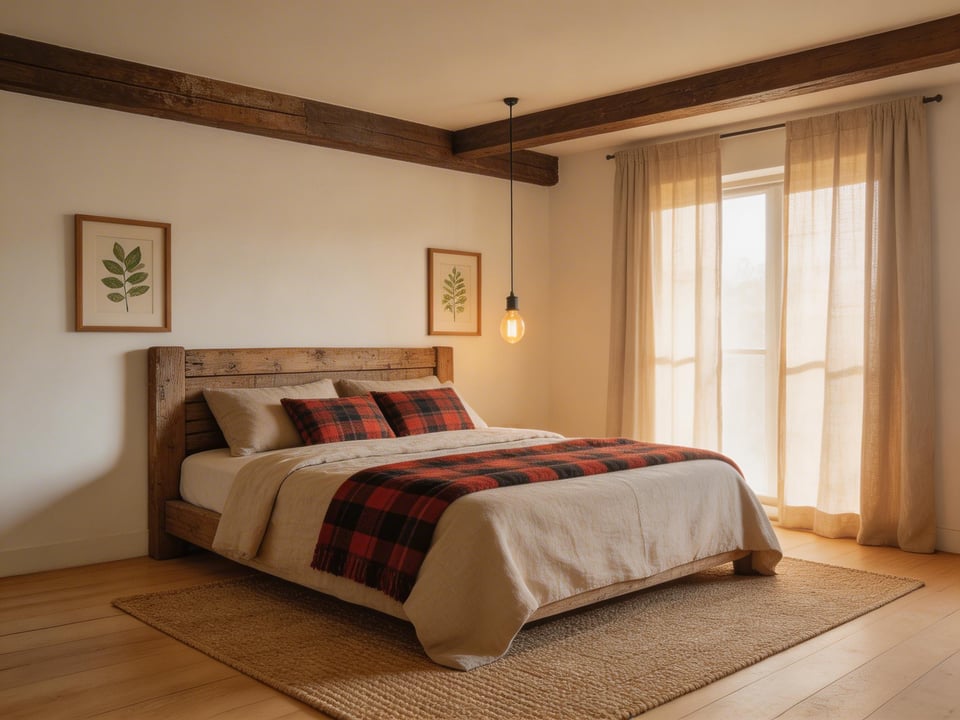
The first thing you notice, before you’re fully awake, is the texture. The grain of the headboard against the wall, the slight roughness of the linen pillowcase, the weight of a wool throw at your feet. Rustic bedroom decor is not about recreating a Pinterest board. It’s about building a room that feels like it has a history. One that settles around you the way a good coat does after years of wear. I’ve spent fourteen years working with period homes and salvage suppliers. The distinction comes down to the same thing every time: authenticity of material versus imitation of look. The ideas in this list lean on the former. They draw from farmhouse vernacular and craftsman tradition — spaces built before every room had a matching set. Some are investments. Some cost almost nothing. All of them are choices that will look better in five years than they do today. That is the whole point of rustic bedroom decor done right.
1. Reclaimed Wood Headboard: The Anchor of Rustic Bedroom Decor
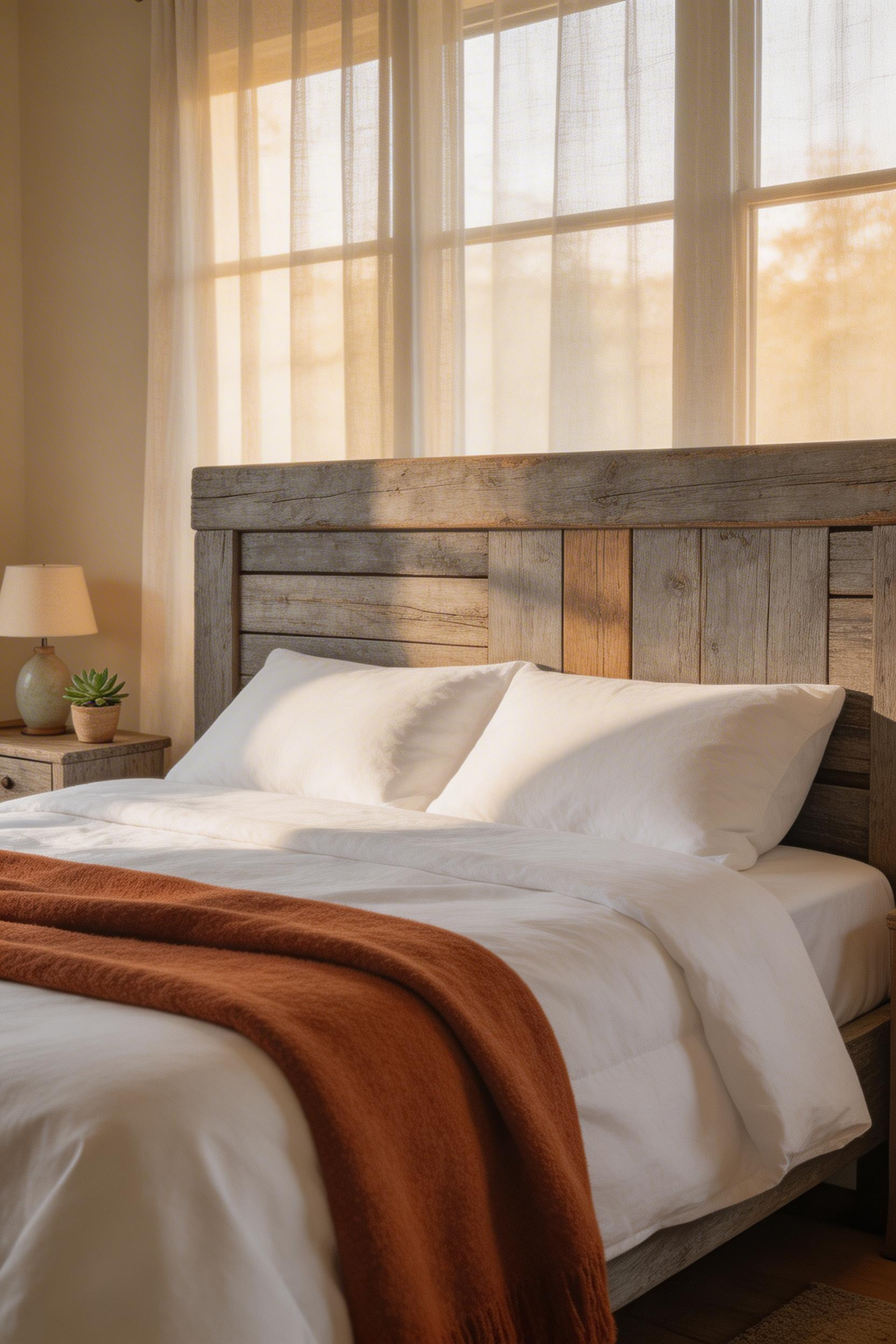
A reclaimed wood headboard does more work per square foot than almost any other element in rustic bedroom decor. It introduces grain, patina, nail holes, saw marks, and the slight imperfection of something that existed before the room did. That history reads immediately. It also reads differently from laminate faux-wood, which tends to look flat under natural light.
Choosing the Right Wood Species
Species choice shapes the whole room’s tone. Pine gives a lighter, honey-warm result — good for a farmhouse or cottage feel. Oak reads darker and more serious, with a pronounced grain that suits a lodge or craftsman bedroom. Grey barn elm weathers to silver over decades of exposure. It suits a coastal-rustic crossover and pairs well with blues and soft whites.
A genuine queen headboard in reclaimed oak runs $300-$900 from makers like Rustic Furniture Depot or independent Etsy artisans. That is a real price gap from a $150 faux-wood laminate. But the difference is obvious within a month of living with both. If budget is tight, consider a solid pine IKEA HEMNES headboard at $129 and age it yourself. Soak steel wool in strong black tea and apply to bare pine. It oxidises the tannins and produces a genuinely weathered grey-brown tone in 24 hours for about £2. It’s not reclaimed, but it’s honest wood — which is a better start than manufactured grain.
Mounting and Sizing Your Rustic Bedroom Headboard
A queen headboard should be 62-66 inches wide. Mount it so the bottom sits roughly 24 inches from the floor on a standard bed frame. A French cleat into wall studs is the most secure fix. If you want a DIY rustic headboard, plank-and-batten construction from salvage yard boards is well within a weekend’s work. You also get full control over sizing and finish.
2. Exposed Wooden Ceiling Beams — Real vs. Faux
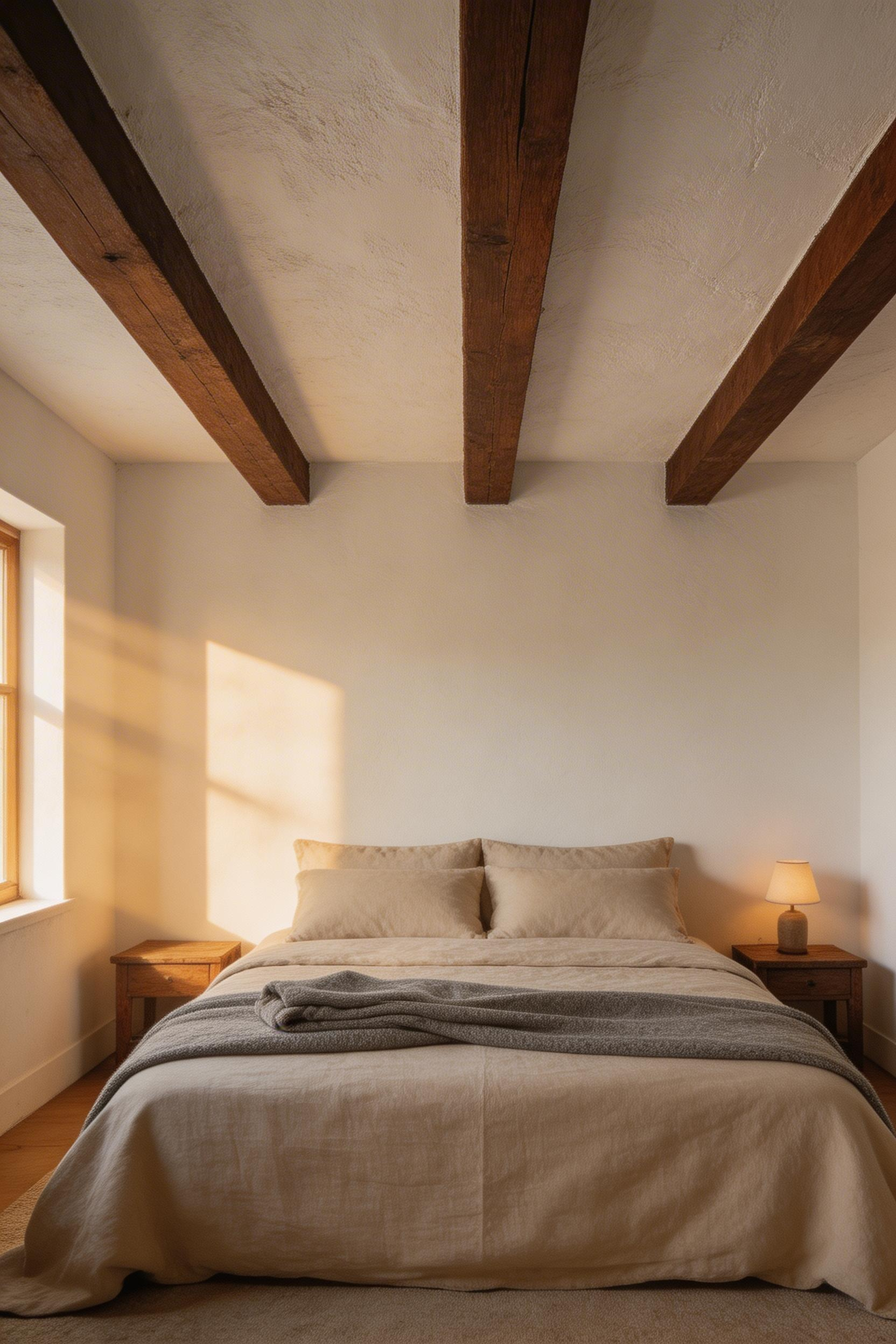
Ceiling beams change a bedroom’s character completely. Even a single beam running the long axis of a room introduces a sense of structure that flat white ceilings cannot provide. It pulls the eye upward, references a building tradition centuries old, and makes the room feel more enclosed in the best way. The question most people get stuck on is whether to use real salvaged timber or modern urethane faux beams. The answer is genuinely: it depends.
Real Timber vs. Urethane: The Practical Case
Authentic salvaged Douglas fir or oak beams cost $8-$25 per linear foot, and that’s before structural engineering if they’re load-bearing. For a typical 12-foot bedroom, three beams will run $300-$900 in materials plus professional installation. However, real beams add resale value and an irreplaceable quality. If anyone ever reaches up and knocks on your ceiling beam, they’ll hear the real thing.
Urethane faux beams from Ekena Millwork or Timber Tech cost $3-$8 per foot. They weigh almost nothing and screw directly into drywall with no structural work required. The Ekena Mountain Timber beam at $285 each has a convincing grain texture visible from floor level. Since that’s the only view anyone has of a ceiling beam, it does the job. For a bedroom where no one will touch the ceiling, faux beams are a completely defensible choice.
Installation Notes for Rustic Bedroom Beams
Three beams running the room’s long axis, spaced evenly, look proportionate in rooms over twelve feet wide. Paint faux beams with a dark grey tinted primer before the topcoat. This fills the micro-recesses in the urethane surface and removes the too-clean look that reads as synthetic. For real timber, a hardwax oil finish preserves the wood without the plastic sheen of polyurethane varnish.
3. Layered Wool Throws: Warmth at the Heart of Rustic Bedroom Decor
The bed in a rustic bedroom should look like it has been slept in by someone who owns good things. That means layering — a fitted sheet, a duvet, and a folded throw at the foot or draped over one corner. The throw is where the bedroom earns its warmth, both literally and visually.
Heritage Brands Worth Knowing
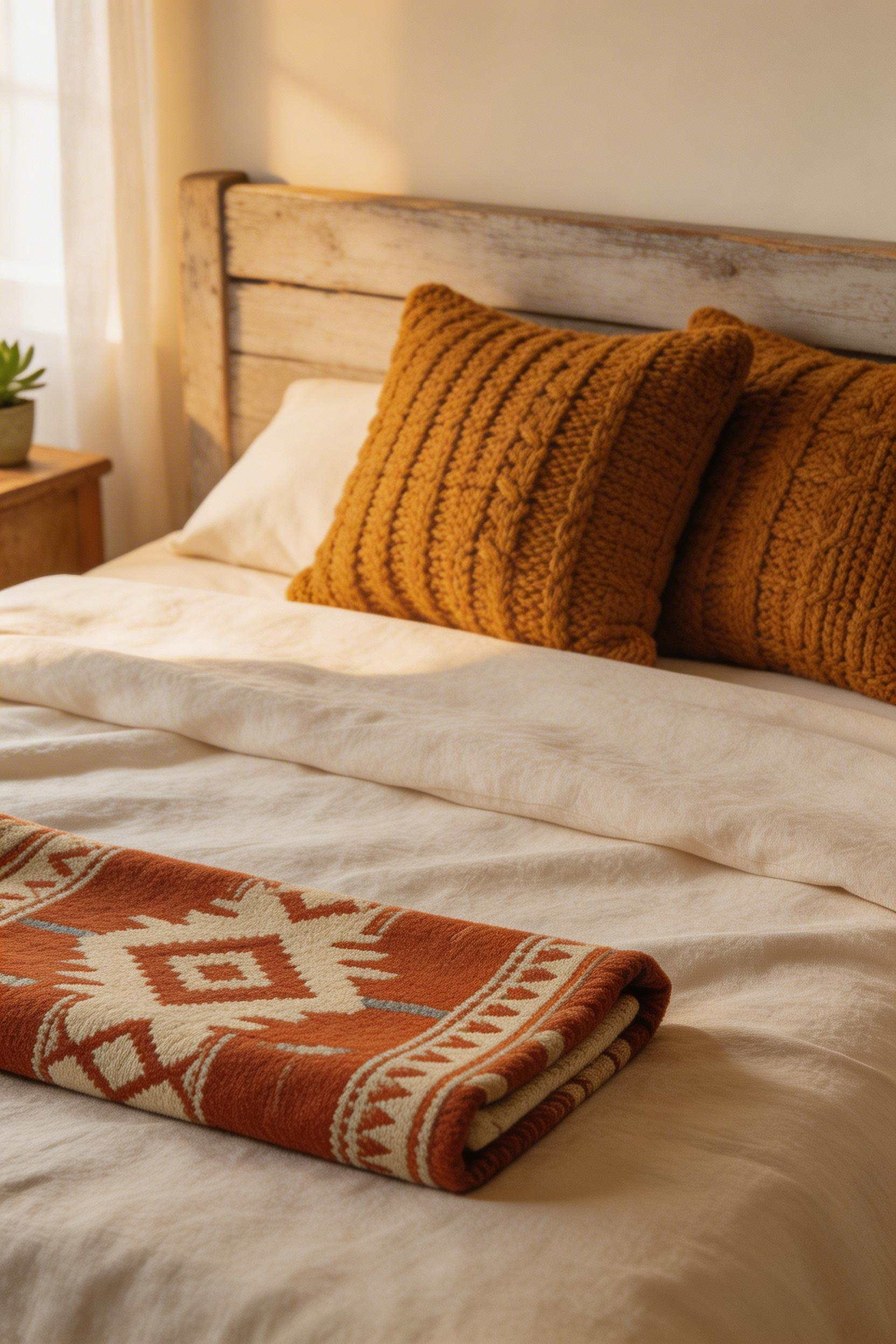
Pendleton Woolen Mills has been weaving blankets in Portland, Oregon since 1863. Their National Park throws ($89-$149) use authentic Native American-inspired patterns in wool. The Grand Canyon colorway — terracotta, cream, and deep rust — is one of the most useful palettes for this type of bedroom. Welsh wool mills (Melin Tregwynt, Cambrian Mills) have used the same jacquard looms since the 1850s. Their throws cost £75-£185 and improve with every wash. Both are considerably more useful than a fast-fashion throw in three months.
Layering Textiles Without Looking Catalogued
Mismatched throws in the same colour family layer far more convincingly than a matched set. The slight variation — a terracotta Pendleton next to a tobacco-brown chunky-knit — is what makes the bed feel curated rather than outfitted. A pro tip from years of photographing historic interiors: mix one structured woven throw with one loose-knit or chunky-weave. The contrast in texture keeps the eye interested without the room looking chaotic.
Also, weight matters more than people expect. A 500g+ throw holds its drape over the bedfoot in a way that lightweight fleece options simply do not. It looks generous. It looks considered. Both of those qualities are worth paying for in this kind of room.
4. Wrought Iron or Blackened Steel Light Fixtures
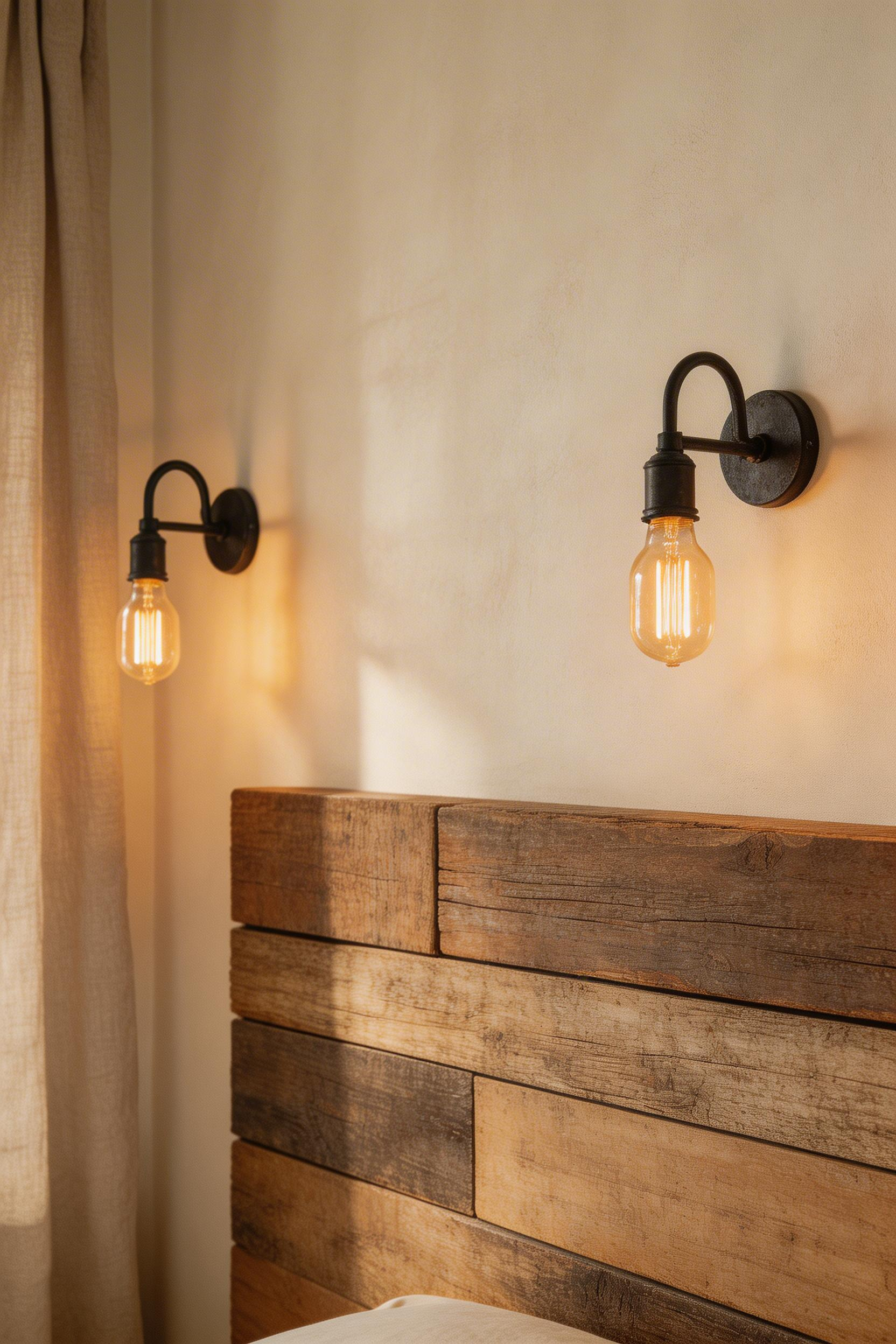
Light in a rustic bedroom should feel earned. The goal is warm, layered, low-level illumination that reads like candlelight rather than office overhead. The fixtures that carry this most convincingly are blackened steel or oil-rubbed bronze. Both have the right visual weight to anchor a room full of wood and textile.
What “Wrought Iron” Actually Means in 2025
True wrought iron (heated and hammered into shape) hasn’t been commercially manufactured since the 1970s. What is sold today as wrought iron is almost always mild steel with a hammered or forged finish treatment. That’s fine — the visual result is the same. Blackened steel and oil-rubbed bronze are the closest modern equivalents and have the right presence for rustic bedroom lighting.
Fixture Types That Work in a Rustic Bedroom
A bedside wall sconce with an articulating arm is more functional than a table lamp. It frees up nightstand surface and places the light exactly where you need it. Progress Lighting’s Irondale sconces in oil-rubbed bronze run $89 a pair and take standard E26 bulbs. For a statement ceiling fixture, the Kichler Barrington 3-light chandelier in distressed black ($219) takes three ST64 Edison bulbs. It reads correctly in both farmhouse and craftsman bedroom contexts.
For more detail on layered light schemes, the full guide to rustic bedroom lighting ideas covers fixture types, dimmer options, and placement geometry.
Getting the Dimmer Right
A dimmer switch is not optional in rustic bedroom decor. Without one, you’re stuck between off and full brightness, which undermines the atmosphere these fixtures are meant to provide. Lutron Caseta smart dimmer switches work with most LED Edison bulbs and require no neutral wire in older wiring setups. That’s a $60 switch that changes how the room feels at 9pm more than most $300 purchases.
5. Stone or Brick Accent Wall: A Striking Rustic Bedroom Decor Move
A textured wall behind the bed is one of the highest-impact moves in this type of bedroom. Fieldstone, stacked veneer, or brick slips all deliver. It adds mass and mineral character that painted plaster cannot replicate. It also anchors the bed visually in a way a headboard alone rarely achieves.
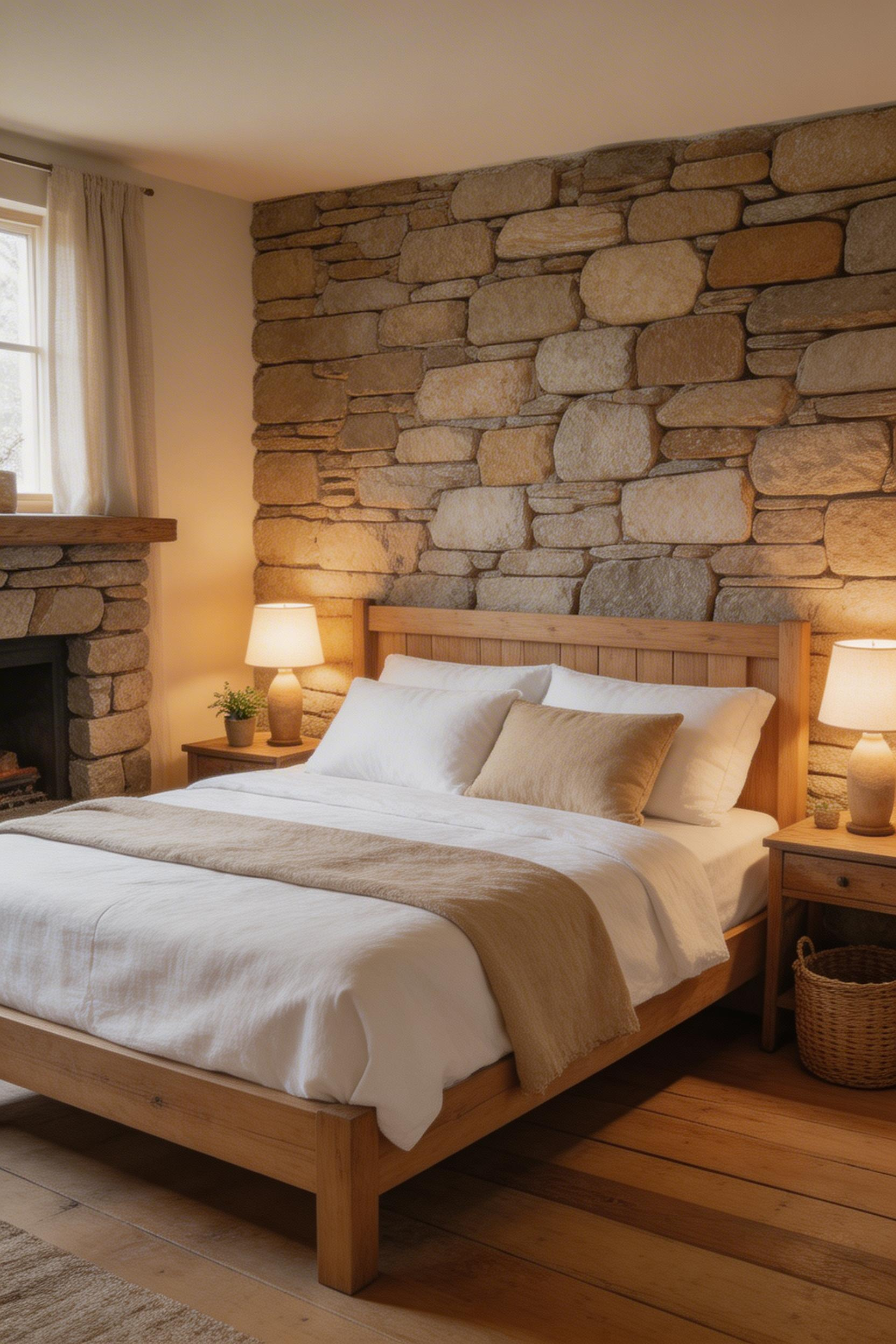
Real Stone vs. Veneer: Rustic Bedroom Decor Material Choices
Real fieldstone costs $20-$45 per square foot installed — an 8×10 ft bedroom wall runs $1,600-$3,600. It looks and feels authentic because it is, and it adds genuine resale value. But it requires a structural assessment in most cases and professional installation.
Stacked-stone veneer panels are polymer or aggregate-based and convincing at normal viewing distances. GenStone Mountain Ledge runs $4.50/sq ft; Eldorado Stone costs $11/sq ft. Both are DIY-friendly. The key installation detail: cut the first and last row of panels to irregular heights. That variation makes the result feel like real masonry rather than a panel job.
Thin brick slips (fired clay, $2.80-$8/sq ft) can be fixed with tile adhesive directly onto plasterboard. They’re the most accessible DIY option. The Z-Brick Old Chicago finish is period-accurate and produces a genuinely useful aged-industrial quality that reads well in rustic bedroom contexts.
Sealing and Maintenance
Seal any masonry wall with a matte masonry sealer before the bedroom is in use. This prevents chalk dust from transferring to bedding and keeps moisture from penetrating behind the veneer. A limewash paint finish (Bauwerk or Portola) over raw brick slips softens the tone. It suits French farmhouse and Scandi-rustic directions particularly well.
6. Vintage or Antique Dressers with Original Hardware
Bought furniture doesn’t have the same authority in a rustic bedroom as a piece that has genuinely lived somewhere before. A Victorian chest of drawers in mahogany — with its original bail pulls, slight asymmetry in the top drawer, and a back panel that tells you something about the sawmill that cut it — holds the room differently than any flat-pack equivalent.
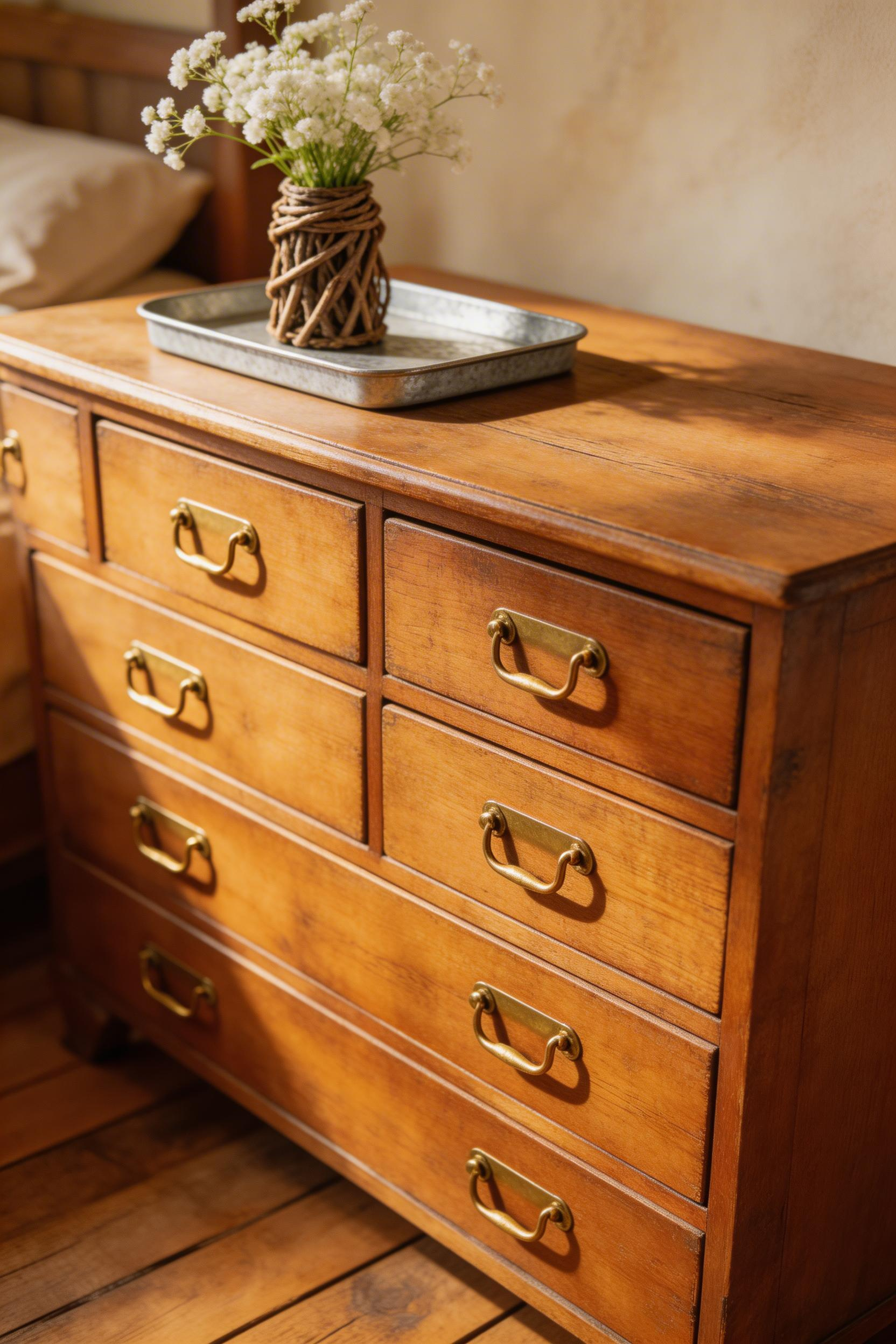
Where to Find Genuine Rustic Bedroom Furniture
Victorian chests of drawers in mahogany or walnut sell for $150-$500 at estate sales and $800-$2,000 at antique dealers — often the same piece, different margins. EstateSales.net and Maxsold are the best estate sale apps; Facebook Marketplace surfaces pieces in your immediate area, often with motivated sellers. For mid-century American dressers in solid walnut or maple (1950s-1960s), $200-$600 is realistic for a good example.
What to Restore vs. Leave
Original brass hardware — bail pulls, knob pulls, escutcheons — is worth preserving and polishing. Replace only if pieces are genuinely missing. Reproduction sets from D. Lawless Hardware run $3-$12 per pull and match original hole spacing in most Victorian and Edwardian cases. Refinishing strips antique value but creates cohesion; if you do refinish, French polishing (shellac) is period-appropriate for Victorian pieces and gives a depth of finish that polyurethane does not.
Sizing and Proportion in a Rustic Bedroom
A dresser slightly too large for the space works better in rustic bedroom decor than one that fits exactly. The slight imposition of a substantial piece reinforces the feeling that the room grew around its furniture. It’s the opposite of being outfitted from a box-store plan. That feeling of accumulated character is the whole logic of rustic bedroom design.
7. Plaid and Tartan Bedding in Heritage Colorways
Plaid bedding in a rustic bedroom reads as a design decision — not a default. The difference between plaid that looks considered and plaid that looks like a hunting cabin is almost entirely in the colorway and the material weight.
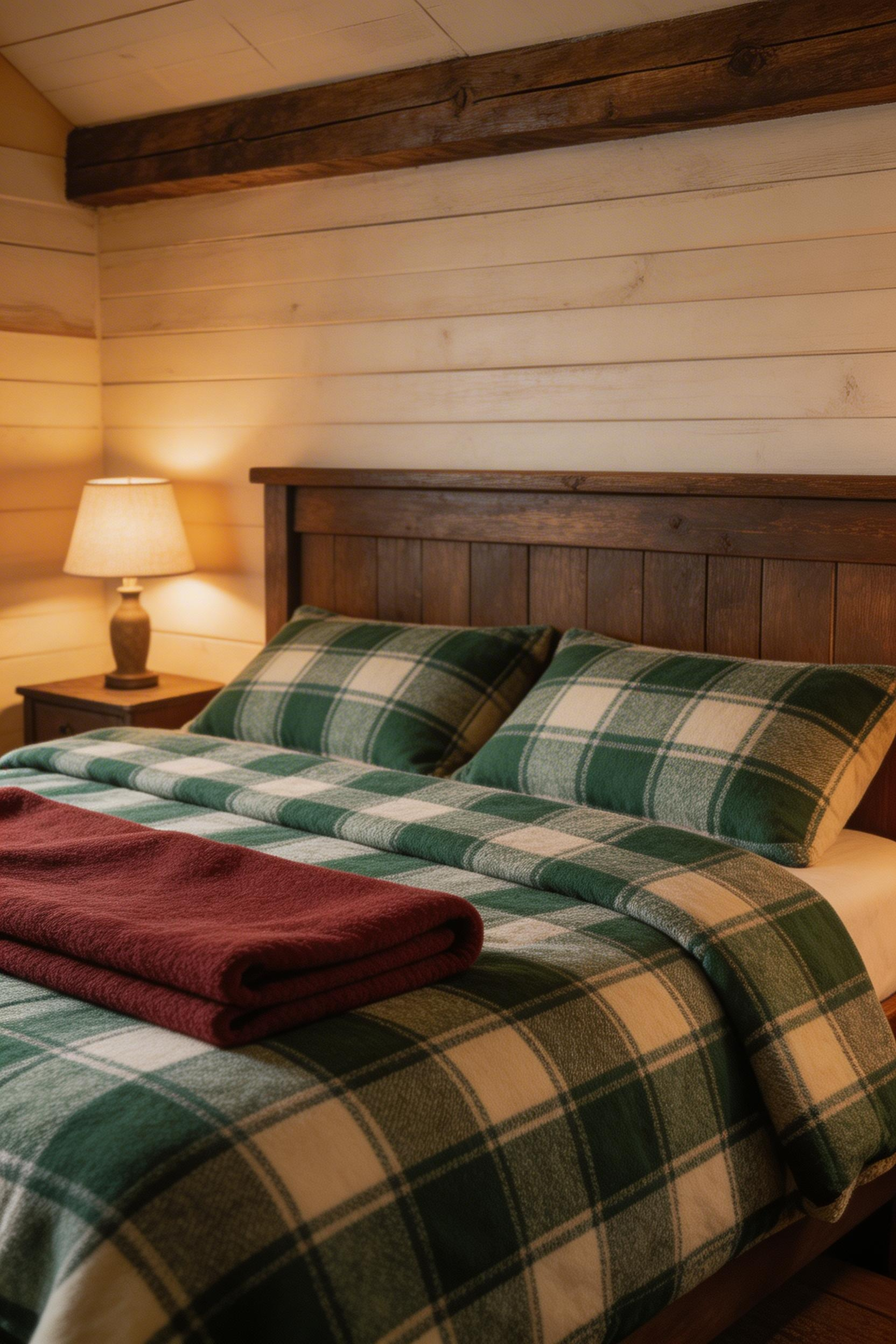
Heritage Colorways vs. Bright Plaids for Rustic Bedroom Bedding
Deep forest green, navy, burgundy, camel, and cream are the colorways that work in rustic bedroom decor because they reference the original domestic use of tartan and plaid — working environments with natural dye sources. Contemporary bright plaids (orange and lime, for instance) read as sportswear rather than home textile. L.L.Bean’s Scotch Plaid Flannel Duvet in forest or camel ($129) is a reliable choice; Pendleton’s Glacier National Park Duvet Set ($199, wool blend) is a genuine statement.
Wool vs. Flannel
Wool plaid bedding is warmer, heavier, and more visually authoritative but requires more careful washing. Cotton flannel (brushed or napped finish) is more practical for year-round use and softens further with each wash. For a hot-climate rustic bedroom, a cotton gauze plaid duvet cover in muted check works better than flannel — the print reads the same, the weight suits the room temperature.
Pattern Mixing Rule
Pair one large-scale plaid with one small-scale check or a solid. Mixing two large-scale patterns requires identical visual weight to avoid chaos, which is harder to achieve without designer experience. The practical shortcut: use the plaid as the main duvet cover, solid-coloured pillowcases in one of the plaid’s darker tones, and a plain linen throw. It grounds the pattern and stops the bed looking like a picnic blanket.
8. Woven Rugs: Grounding Rustic Bedroom Decor on Hardwood Floors
A rustic bedroom on bare hardwood needs a rug — not because the floor looks wrong, but because the rug does something structural in the room’s composition. It defines the sleeping zone, softens the acoustic environment, and introduces a layer of natural texture that connects to the wider bedroom language.
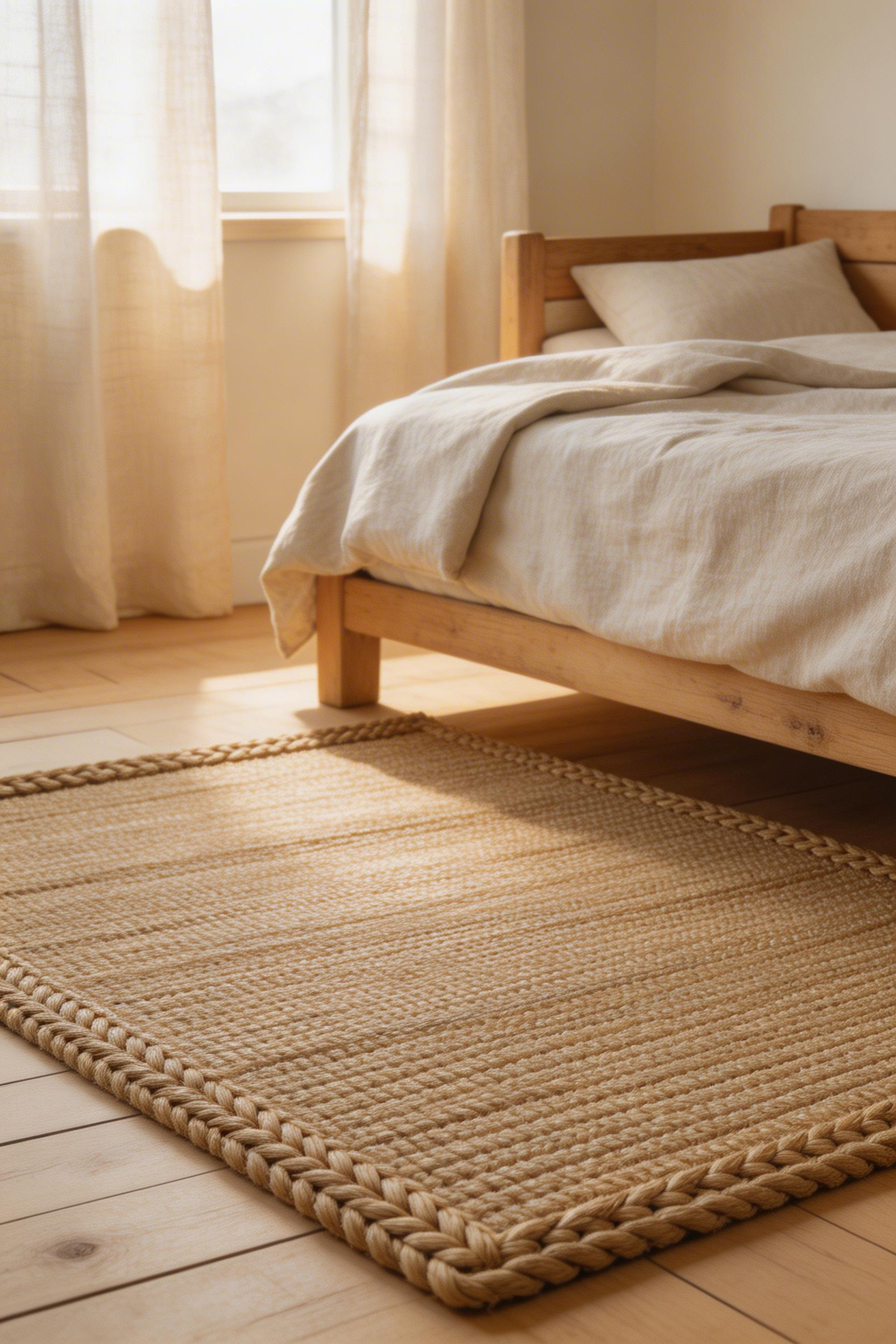
Material Guide: Rugs for the Rustic Bedroom Floor
Jute is the most popular natural fibre at $1-$4/sq ft. It’s biodegradable and visually warm. But it’s scratchy underfoot and moisture-sensitive. That’s a real disadvantage in a bedroom where you step out barefoot every morning. Sisal is harder and more durable, better suited to hallways than bedroom floors. For a rustic bedroom where softness matters, wool braided rugs are the practical choice. The Capel Rugs American Legacy range ($4-$12/sq ft) is durable, reversible, and comfortable underfoot.
For a complete guide to choosing the perfect rug for your rustic bedroom, there’s a dedicated resource covering pile height, durability, and placement options.
Sizing and Placement
A queen bedroom rug should be at minimum 8×10 feet. Position it so the front two legs of both bedside tables and the foot of the bed sit on the rug. A rug that only the bed legs touch looks undersized and makes the room feel smaller. Budget versions at World Market (8×10 jute, $179) work perfectly as a base layer; a smaller wool kilim layered on top adds colour and character without the expense of a full-size wool rug.
The Layered Rug Trick
A dark-bordered jute rug — standard jute weave with a leather or cotton binding edge — reads considerably more designed than an all-jute option at the same price. It’s the equivalent of a picture frame: the border defines the edge and gives the rug visual intention. That’s a free upgrade, requiring only that you choose a bordered version rather than a plain one.
9. Barn Door or Sliding Panel as a Room Divider or Wardrobe Door
The barn door is the most debated element in rustic bedroom decor — loved by some, used badly by many. Used well, it’s genuinely functional: it saves the swing clearance of a standard door, adds a visual focal point, and introduces the plank-and-rail vocabulary of agricultural buildings. Used carelessly, it looks like a trend chasing move that will date badly. The distinction is mostly in the hardware.
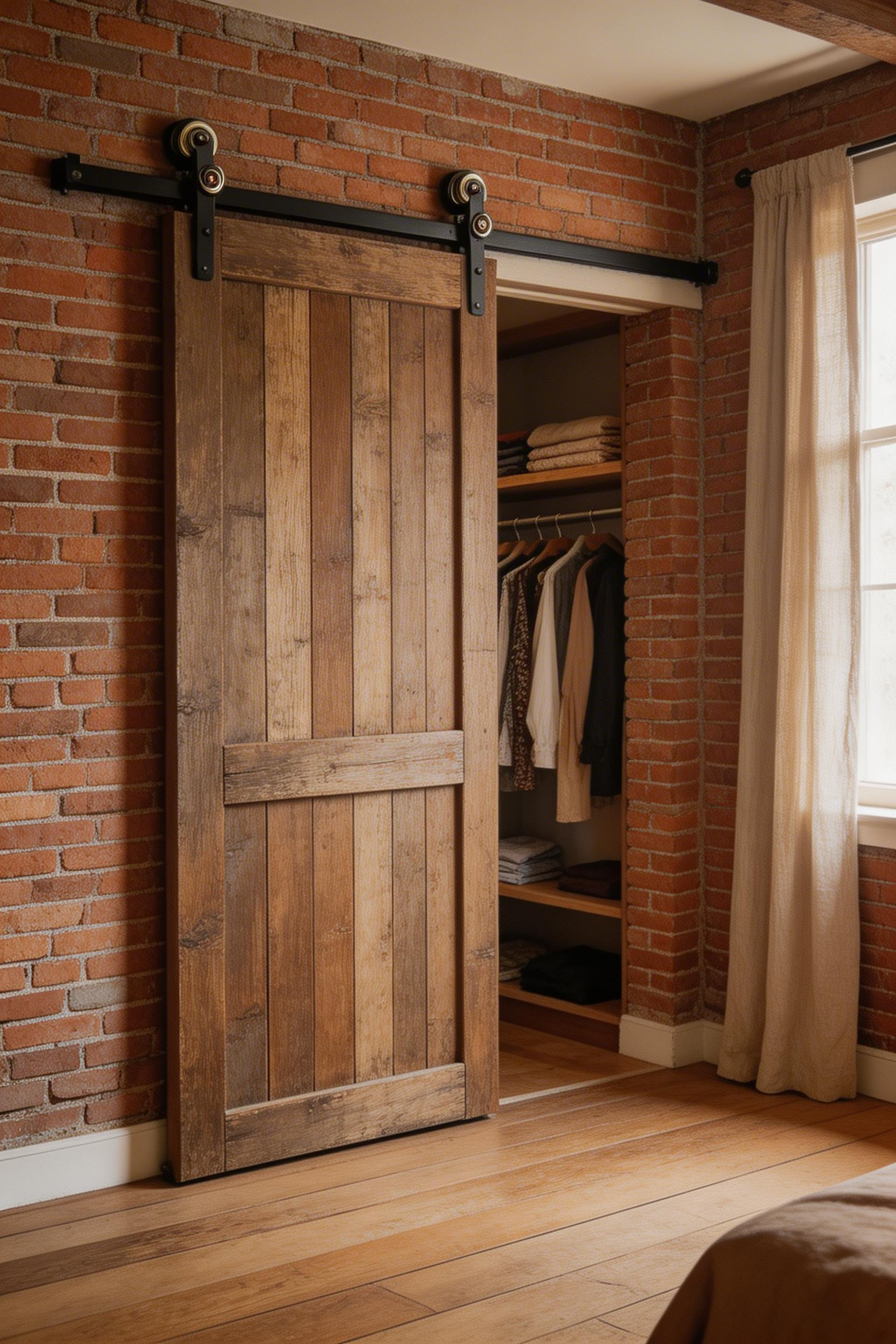
When It Works vs. When It Doesn’t
A barn door needs at least 1.5x its width in clear wall space to slide fully open. That requirement catches more people out than any other aspect of the installation — plan the wall carefully before ordering hardware. It also doesn’t seal: gaps top and bottom let light, sound, and air through. For a bedroom dividing a sleeping area from a dressing room, that’s usually fine. For a bathroom connection, it depends entirely on how much privacy matters.
Hardware Quality Is the Deciding Factor
Budget barn door tracks ($50-$100) flex under load and jump the rail over time. Rustica Hardware’s Flat Track kit ($199-$279) and Colonial Elegance systems ($150-$300) roll smoothly for decades. The difference is properly engineered bearings. The door itself can be stained or painted to any tone. Colonial Elegance’s unfinished knotty pine version (36×84 inches, $289) is a solid starting point. A soft-close add-on ($20-$40) prevents the door from banging and is worth the addition in every case.
If you’re resistant to the aesthetic but have a genuine door opening problem, a cleaner sliding panel option — a simple flat panel in a Mondrian-style grid — achieves the same function without leaning into the barn look.
10. Antler or Branch-Style Coat Hooks and Wall Accents
Natural material accents are where this style either tips into authentic warmth or slides into themed-room territory. An antler hook in the right spot — single, well-placed, near the bedroom door — is functional and atmospheric. Three antler pieces on the same wall tips over into taxidermy showroom, and the threshold is closer than most people expect.
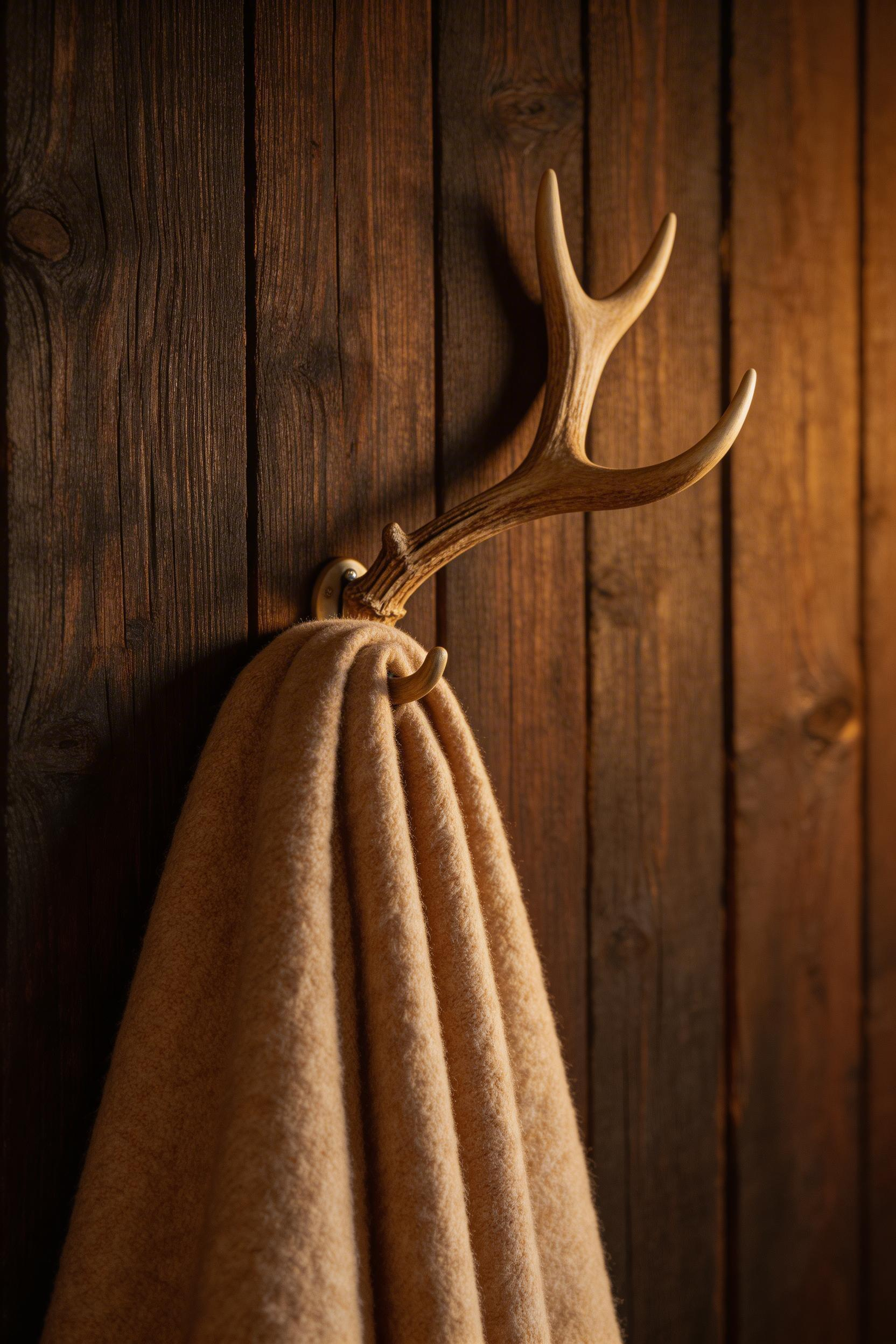
Genuine vs. Resin Cast
Shed antler (collected after natural shedding) is legal and sustainable. Each piece is unique. Genuine shed antler hooks on Etsy run $95-$180 for a large single piece with a steel wall plate. Pottery Barn’s resin-cast Faux Antler hook ($49) is indistinguishable from real antler at normal viewing distance. It’s a perfectly defensible option, particularly for anyone uncomfortable with actual animal material.
Branch-form steel hooks (Umbra Trigg, matte black, $35 for three) are a less literal take: the branching profile suggests the forest without using any organic material. They work better in modern-rustic rooms where the visual language is more abstract.
Placement
Install a single antler hook at 60-66 inches on a plain plaster or plank-effect wall, near the door or between two windows. A cluster of three or five hooks in a loose triangle reads as intentional arrangement. Odd numbers always work better than even. If you’re bringing the outdoors into your rustic bedroom through multiple natural accents, keep the antler as one voice among several. It shouldn’t be the loudest one in the room.
11. Galvanized Metal and Mason Jar Accents on Bedside Tables
The farmhouse farmhouse tradition that underlies this style used galvanized steel constantly — buckets, watering cans, storage tins — because it was cheap, functional, and waterproof. Bringing small-scale versions of those materials into the bedroom doesn’t require a theme room aesthetic; it requires restraint and an eye for proportion.
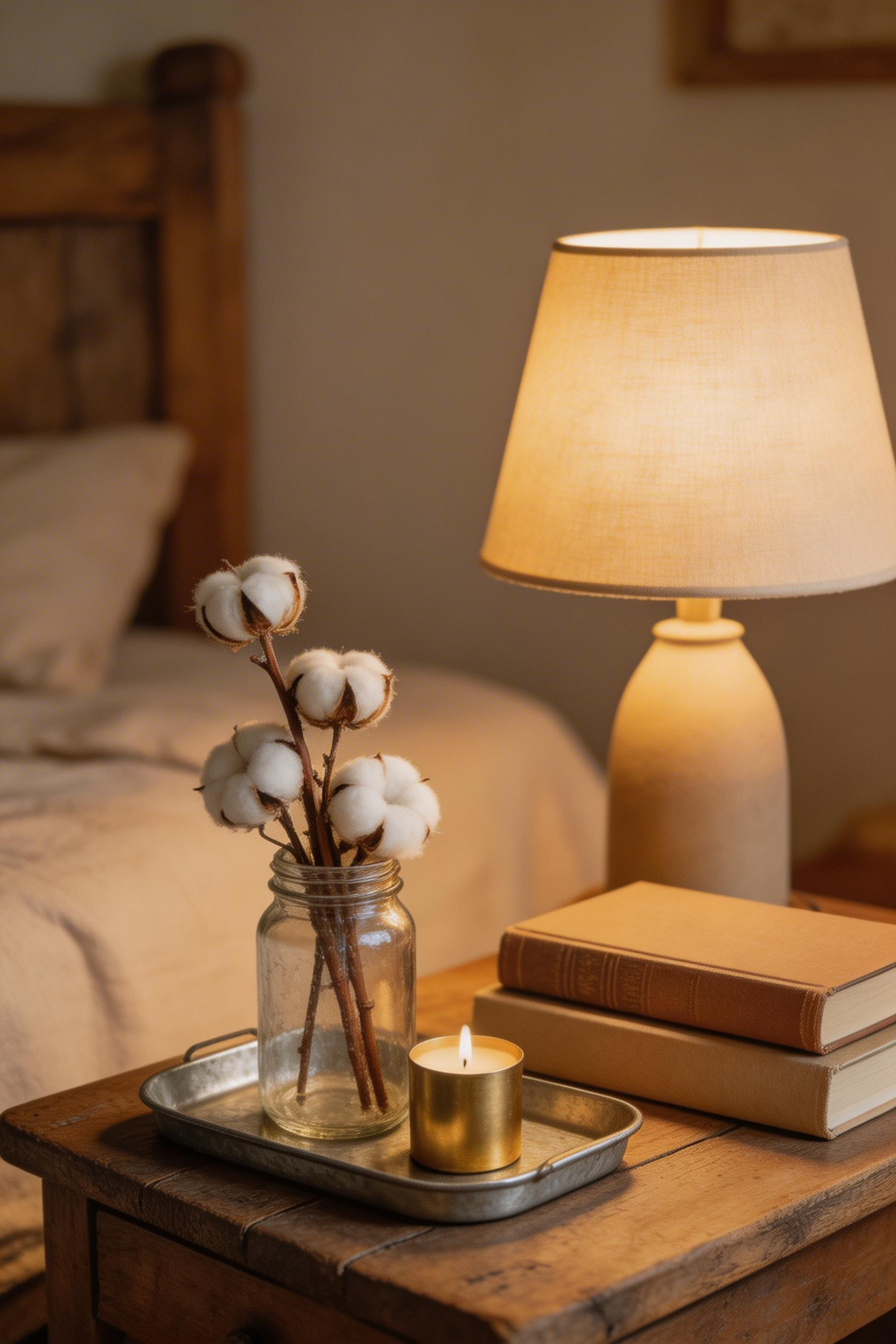
How to Use Metal Accents Well
A small galvanized tray ($12 at Target’s Hearth & Hand range) makes a useful bedside catch-all. Keys, lip balm, a watch — it looks organised rather than cluttered. A single dried stem in a squat galvanized vase beats an elaborate floral arrangement in a rustic setting; restraint signals confidence. A Ball Mason jar (32oz wide-mouth, $2.75 each from a 4-pack) used as a pen holder or small vase is historically accurate and costs almost nothing.
The key is mixing two or three metal tones rather than committing to all-matching. Galvanized silver-grey plus aged brass plus a small matte-black steel candleholder creates the same collected-over-time quality that vintage furniture brings to the room’s overall scheme.
What to Avoid
Matching galvanized sets — tray, vase, bin, all identical finish and brand — look retail-curated rather than genuinely rustic. The goal is the material, not the matchy coordination.
Also, cut edges of galvanized trays can rust at the corners if exposed to moisture. A coat of clear wax or spray lacquer on those edges prevents that and extends the piece’s life.
12. Linen Curtains: The Right Window Treatment for Rustic Bedroom Decor
Linen is one of the oldest textiles still in active domestic production — evidence of linen cloth appears in Egyptian tombs dated to 3000 BC, and it’s still woven essentially the same way. That longevity matters here because linen’s combination of texture, warmth, and natural drape is something no synthetic fabric has convincingly matched. It also improves with washing, which is unusual enough to be worth noting.
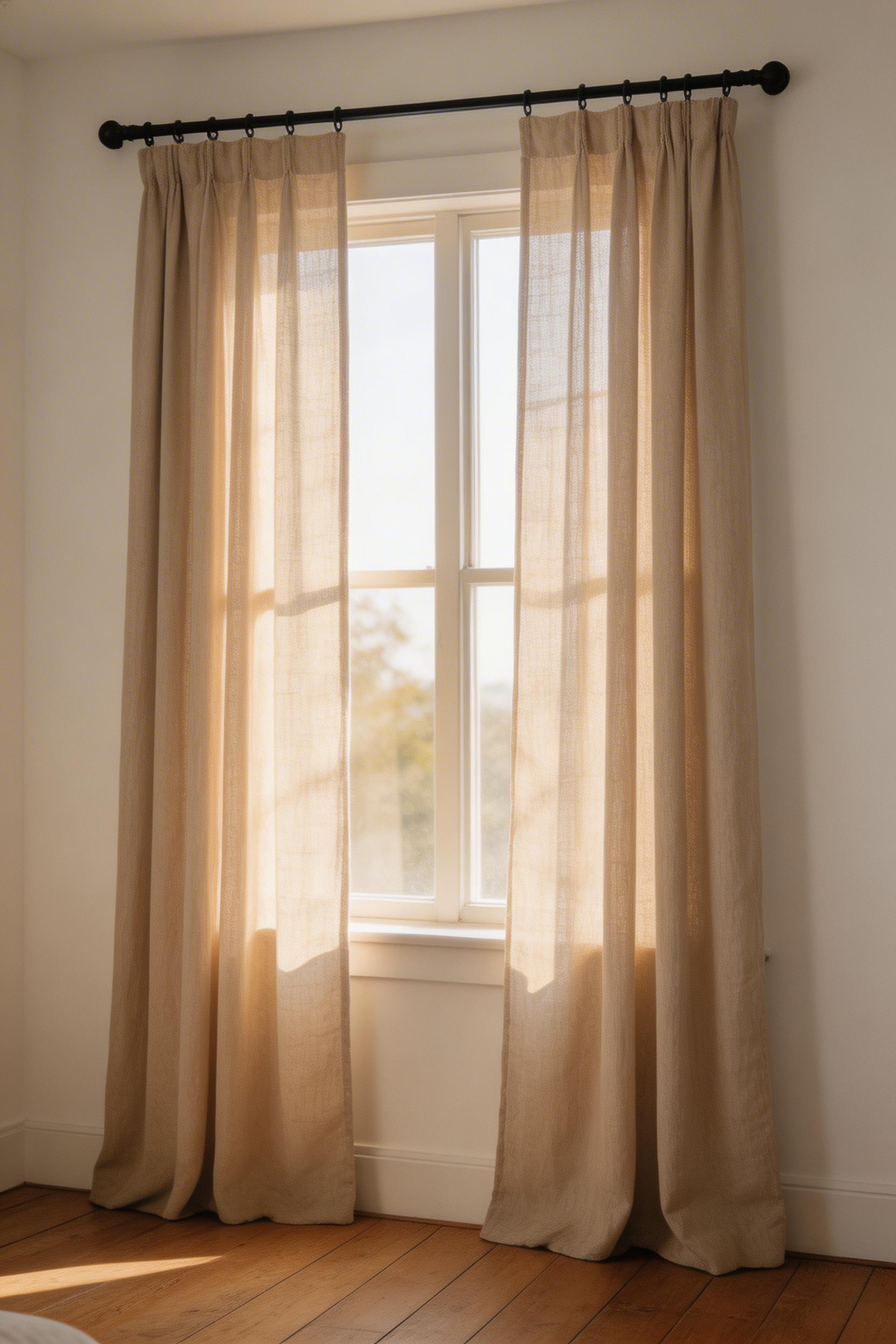
Why Linen Over Other Fabrics
Heavyweight linen in oatmeal, flax, stone, or flint provides light filtering, thermal insulation, and a natural drape that suits rustic bedroom windows better than cotton or polyester. It starts slightly stiff and rough but becomes suppler over three to six months of regular use. That improvement over time is very much in keeping with the rustic bedroom philosophy.
Header Style and Hanging
Grommet headers hang flat and modern — better for contemporary-rustic rooms. Rod-pocket headers give a gathered, softer result — more traditional, suits country and cottage directions. Tie-top headers are the most casual and suit low-ceiling rooms where a gathered header would feel heavy. For most rustic bedrooms, tie-top or rod-pocket on a simple wrought-iron or blackened steel rod is the right combination.
Hanging Notes
Hang the rod 4-6 inches above the window frame and 6-12 inches wider on each side — this makes the window look considerably larger without any structural change. Panels should be 2-2.5x the window width for adequate fullness. The Pottery Barn Belgian Linen Panel (50×96 inches, $79/panel) is the standard against which alternatives are measured. IKEA AINA curtains at $29.99 a pair are pure linen and work well as an inner layer over a separate blackout blind. Steam them on the window rather than ironing flat — linen’s natural wrinkle is part of its character.
13. Botanical and Nature-Themed Wall Art
The art in a rustic bedroom should feel found rather than selected from a wall-art category online. That’s a distinction in sourcing philosophy more than visual style — it means that a pressed-fern herbarium plate you made yourself reads differently from an identical-looking print from a mass-market decor retailer, even if they look similar in photographs.
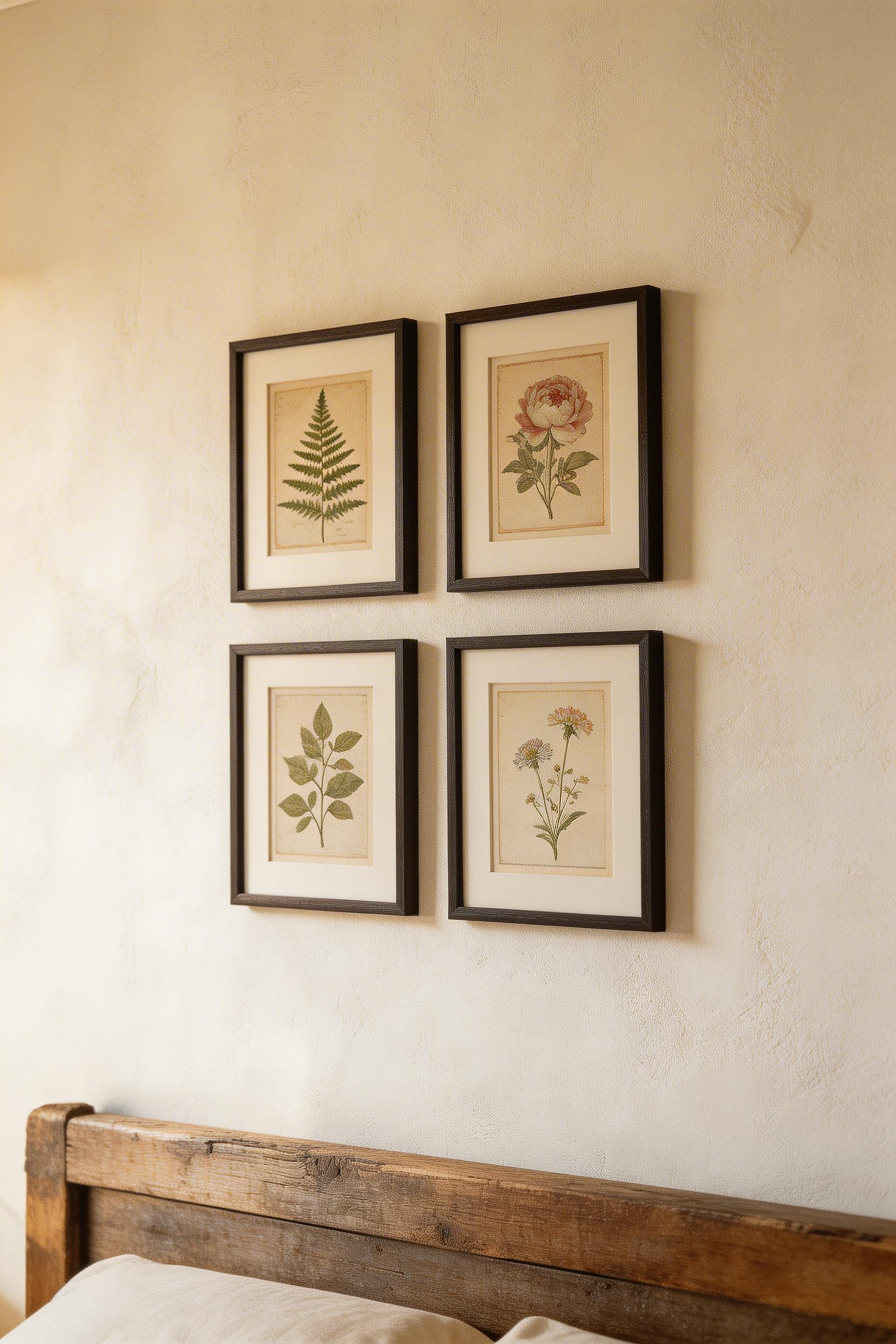
What Works: Art Categories for a Rustic Bedroom
18th and 19th century botanical illustration reproductions are available as high-quality prints for $20-$60 unframed. Redouté roses, Audubon bird plates, and Blackwell’s Curious Herbal are all strong choices. Simple dark wood or thin black frames suit rustic bedroom walls far better than elaborate gold. The IKEA RIBBA frame at $9.99 disappears into the wall and lets the print speak.
Pressed botanical specimens — dried plants mounted on cream card and framed in a shadow box — cost under $25. They’re among the most personal things you can put on a bedroom wall. Watercolour woodland scenes from independent Etsy artists ($45-$85) offer a custom alternative. Look for artists working in earthy, muted palettes rather than bright styles.
Scale and Arrangement
A single large print (20×24 or 24×30 inches) makes more impact than a cluster of small ones. However, a salon wall of six to nine prints in consistent frames, spaced at 2-3 inch gaps, also reads strongly. In that case, the collection itself is the point. One practical suggestion: a large antique-style topographic map of a forest or mountain region with personal significance works harder per square inch than most decorative prints. The geographic complexity keeps the eye moving in a way that a single illustration cannot.
14. A Freestanding Wooden Wardrobe or Armoire
Built-in closets became standard in American homes in the 1960s and 1970s. Before that, the wardrobe or armoire was the primary bedroom storage in most of the world, and it still is in older UK and European properties. In this type of bedroom, a freestanding solid-wood wardrobe works better than a built-in for the same reason the vintage dresser does. It has presence, weight, and suggests a room with a history.
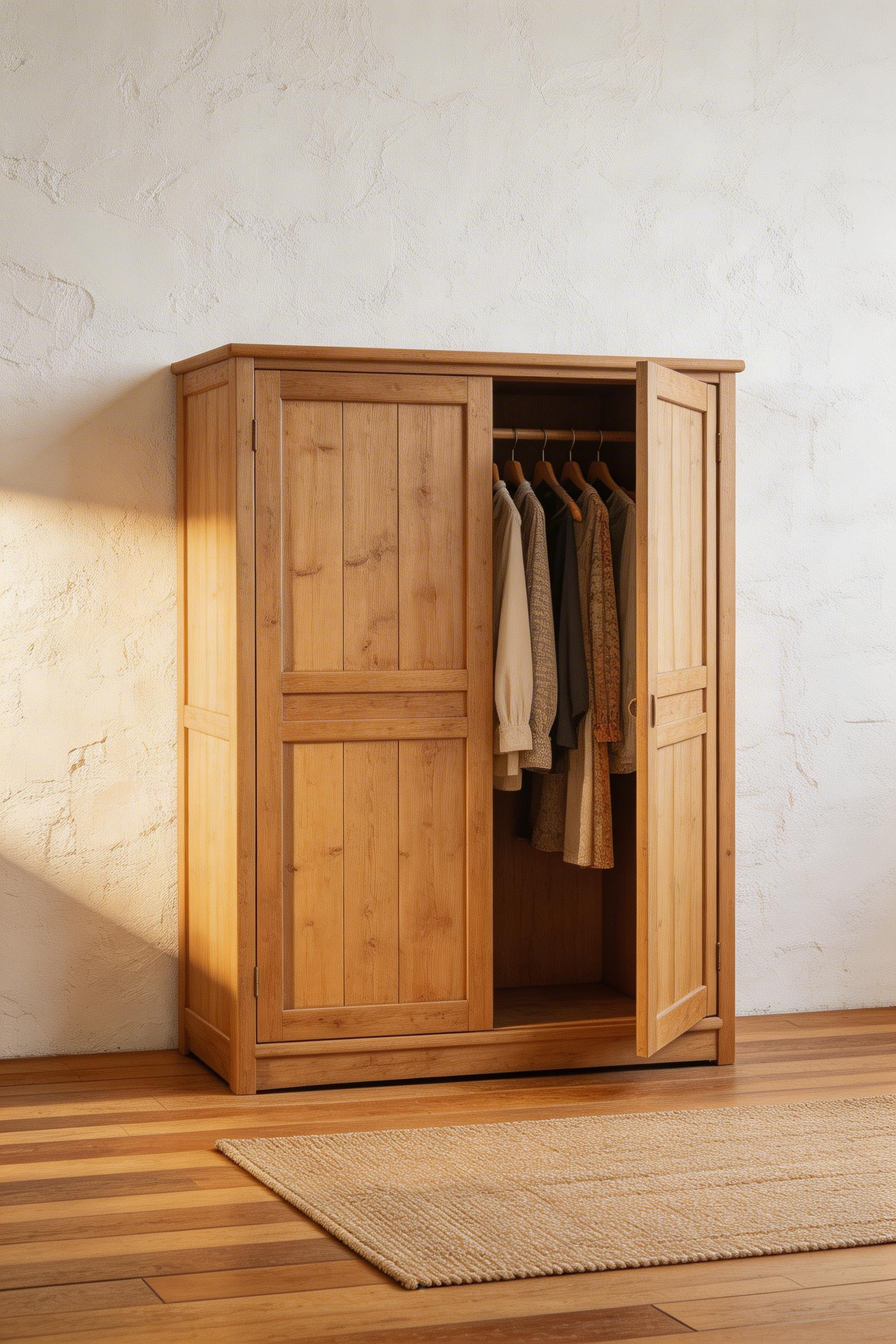
Solid Wood vs. Flat-Pack: Why It Matters
The functional difference matters. Solid wood armoires in pine, oak, or walnut weigh 150-300 lbs and last generations — joints are glued and dowelled, and the structure improves over time as wood settles. Flat-pack particleboard wardrobes look similar from the front. But they fail at the joints within five to ten years. The identifier: solid wood shows grain on the sides and top. Veneer over particleboard shows thin wood grain on the face but smooth, uniform sides.
A vintage pine armoire from estate sales runs £80-£250 in the UK and is genuinely solid construction. The La Redoute Camille mango wood wardrobe (£699) is new but built with traditional joinery and handles in aged brass — the right aesthetic without the hunt-and-find effort.
Safety and Proportion
Secure any tall armoire to the wall with anti-tip straps. They’re top-heavy and a genuine safety risk in homes with children. Check floor levelness before assembly; most older floors need felt pads under two of the four feet to level the piece. And like the vintage dresser, a wardrobe that’s slightly too large for the space is often the right call in rustic bedroom ideas for cold climates and cooler-country homes, where the sense of enclosure and warmth that a large piece creates is exactly what the bedroom needs.
15. Warm Edison Bulbs: The Final Layer of Rustic Bedroom Decor
Everything else in the rustic bedroom can be perfect — the reclaimed wood headboard, the layered textiles, the vintage dresser — and still feel wrong if the light temperature is incorrect. Cool overhead light (4000K and above) destroys the warm, enclosed feeling that this style of room depends on. Warm Edison bulbs and candlelight-style sources solve this at the source level.
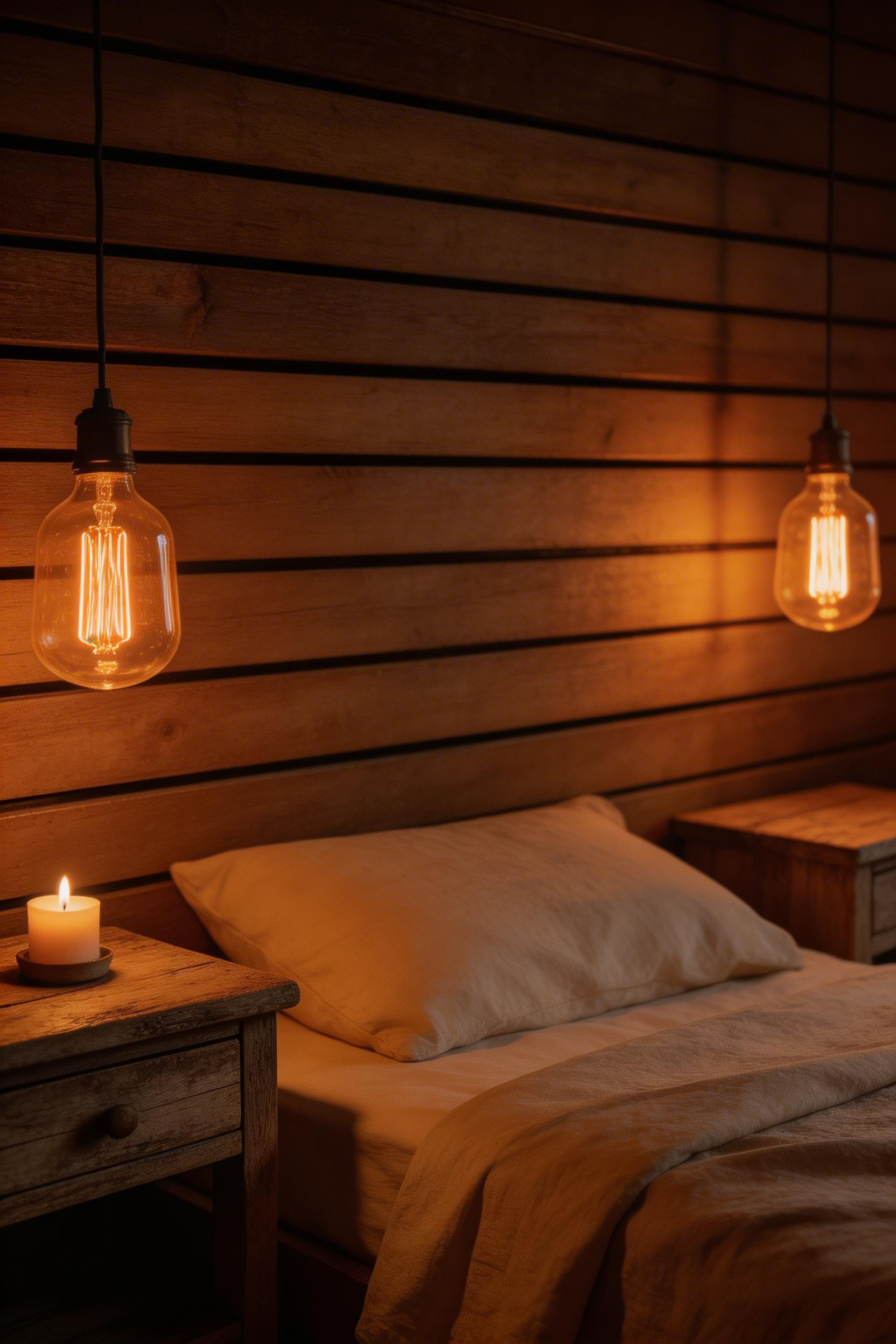
The Science of Light Temperature for Bedroom Atmosphere
Edison-style LED bulbs run at 2200K (deep amber, closest to candle flame), 2400K, and 2700K (warm white). Below 2700K is where the firelit quality that suits rustic bedroom decor begins. True candle flame is 1800-2000K; the sweet spot for atmospheric rustic bedroom lighting is 2200-2500K. Exposed-filament LED bulbs (Calex 4W ST64 at £5.99 each) give the visual warmth of original Edison tungsten at 90% less energy consumption and last 15,000 hours versus a tungsten bulb’s 1,000.
Research from the Lighting Research Center at Rensselaer Polytechnic Institute found that warm light below 2700K in the two hours before sleep increases melatonin onset by 34%. That’s compared with cooler overhead light. So the lighting choice that looks right is also the one that functions right. That alignment of aesthetics and biology is rare enough to be worth noting.
Smart Dimming
A Philips Hue White Ambience E27 kit ($79.99 for two bulbs) covers the full 2200K-6500K range. It dims smoothly via Bluetooth — no hub required. Paired with a Lutron Caseta dimmer, the result is stepless control from afternoon working light to evening amber glow without changing anything physically. A Luminara flameless pillar candle set ($45, battery-operated, realistic flicker and timer) layered with a single low-watt pendant creates the most convincing rustic bedroom atmosphere after dark — and removes the fire risk that real candles introduce near textiles.
A single table lamp with a 2200K amber bulb creates more atmosphere than three lamps at 3000K. Light level matters less than colour temperature once you’re below 400 lumens per source — that’s the insight most people miss when rustic bedroom lighting doesn’t feel right.
Building a Rustic Bedroom That Lasts
Rustic bedroom decor works when it’s built around genuine materials and honest choices, not around a theme or a trend cycle. The reclaimed wood headboard and the vintage dresser earn their place because they’re real. Made of actual wood by actual craft processes, they carry age and variation that manufactured goods can’t fake. The layered textiles, the natural fibre rug, the linen curtains — these are things that improve with use rather than declining. That quality is the most important criterion in any bedroom investment.
If you’re starting from scratch, the order of priority is: headboard first (it sets the room’s identity), then lighting (the atmosphere layer), then textiles (warmth and comfort), then rugs (the grounding layer). Accent pieces — the antler hook, the galvanized tray, the botanical print — come last. Each layer builds on the last. None of them needs to be expensive. The most convincing rustic bedrooms I’ve seen were built on $40 worth of aged pine and a very good eye, not a large budget.
The concrete recommendation: if you’re choosing one item from this list to start with, make it the light bulbs. Two Calex 2200K filament bulbs and a dimmer switch cost under $30 and will change how you experience the room immediately. Everything else can follow from there.