The idea that a small bedroom is a design problem worth solving is, frankly, a myth worth dismantling. In my work as a wellness design consultant, I’ve walked through genuinely cramped rooms that felt expansive and calm. I’ve also walked through large master suites that felt anxious and chaotic. The difference was never floor area. It was intention. Small bedroom design rewards careful choices in a way that a generous room simply doesn’t demand. Every decision matters. When those decisions are right, the result is a space that feels curated rather than constrained. The following ideas aren’t workarounds or visual tricks. They’re the approaches that consistently produce small bedrooms people genuinely enjoy. Spaces that work harder because they’ve been asked to.
1. Murphy Beds and Wall-Integrated Sleeping Solutions
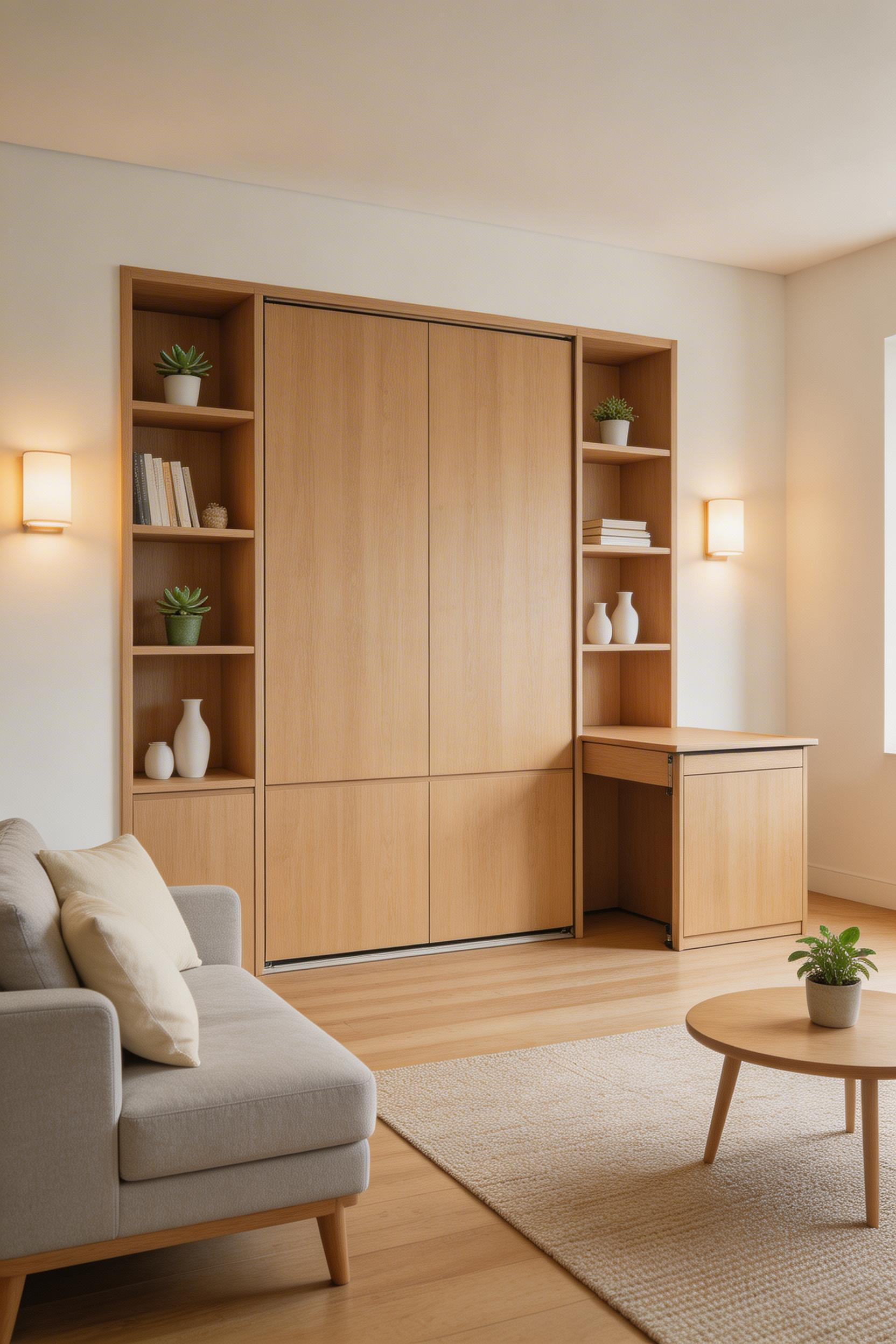
A standard queen-size Murphy bed folds flat against the wall and reclaims roughly 40 square feet of floor space. In a 100–120 sq ft room, that’s a meaningful amount of ground to recover. During the day, that footprint becomes open space, a working area, or a sofa zone, depending on the system you choose. Small bedroom design in cities with expensive square footage increasingly treats the Murphy bed not as a novelty but as the obvious first move.
Choosing the Right System
Modern Murphy beds have moved well beyond the basic fold-down frame. Brands like Resource Furniture and Wilding Wallbeds build systems that include shelving, sofas, and pull-down desks. These activate when the sleeping platform folds up. Resource Furniture’s Swing system (around $5,200 for a queen) converts from a full sofa to a sleeping surface in seconds. It’s built on an Italian-manufactured mechanism rated for 25,000 cycles. Wilding Wallbeds’ mid-range units with integrated shelving run $1,895–$2,800. They use solid wood cabinets with piston-assisted lift. For a tighter budget, the Night & Day Furniture Murphy Cube Cabinet Bed ($1,199) folds flat without a mechanism. It’s better for occasional guests than nightly use, but a genuine solution for a spare room that doubles as an office.
The main structural requirement worth checking before purchase: Murphy beds need to be secured to wall studs or solid masonry. Standard queen units fold to roughly 65W x 88H x 18D inches. Also, a mattress thicker than 12 inches won’t allow most wall bed cabinets to close. Verify the clearance spec with the manufacturer before ordering if you have a thick memory foam mattress.
2. Vertical Storage: Floor-to-Ceiling Shelving Systems
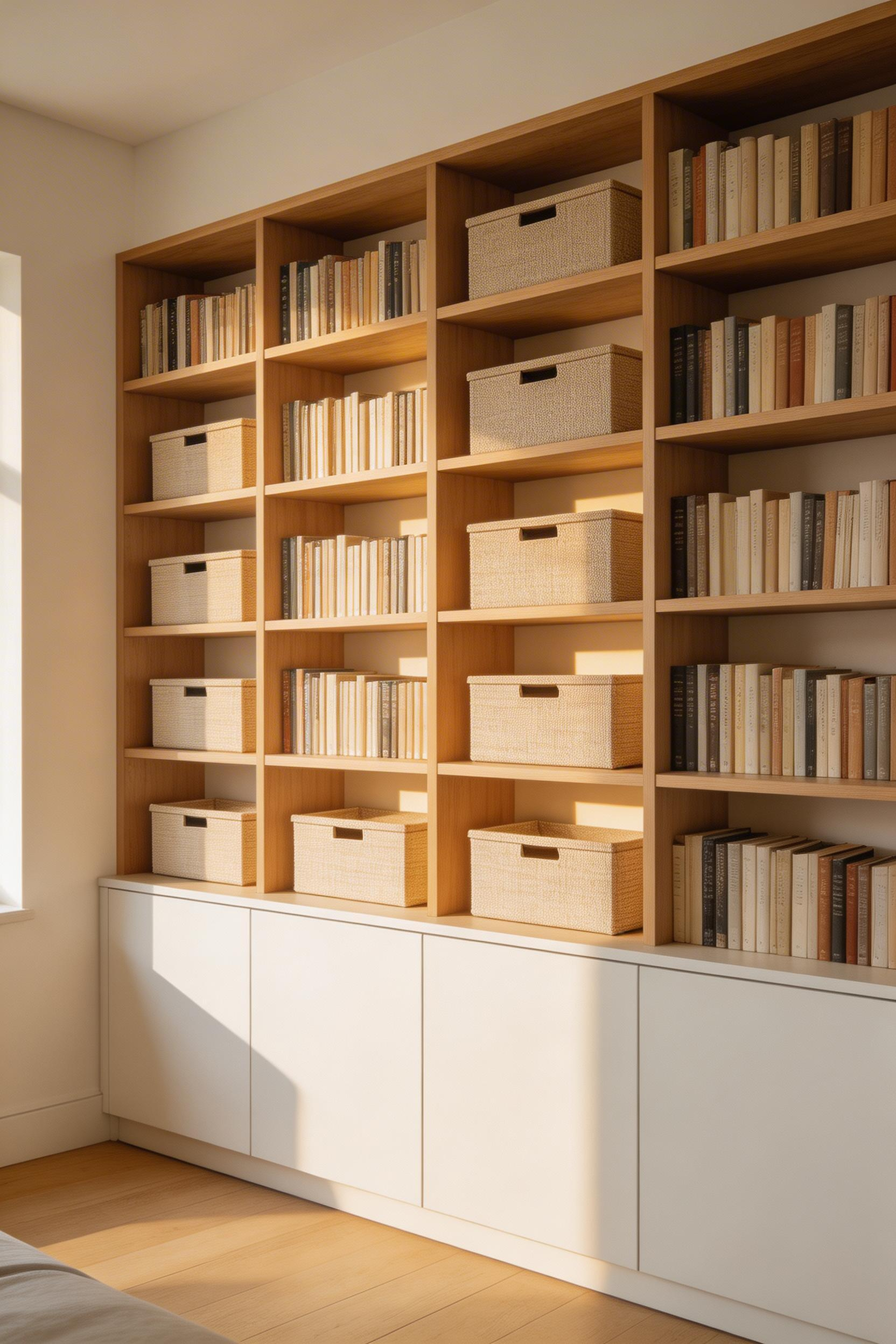
Most small bedroom design advice focuses on floor space. However, the average UK bedroom has 8–9 feet of ceiling height, and the top 2–3 feet of that is almost always dead space. Bringing shelving to the full ceiling height adds 25–30% more storage capacity per linear wall foot — without touching the floor plan at all.
Configurations That Work
The IKEA BILLY bookcase combined with OXBERG door additions costs $180–$350 per bay and reaches ceiling height with the extension packs. The result looks deliberately designed — particularly when the lower 60% has doors and the upper section stays open for display. For a more considered system, String Furniture’s Swedish-made modular shelving ($420–$650 per bay) mounts directly to the wall with no floor contact. It holds 132 lbs per shelf and reconfigures as needs change — which matters in a space where every system should adapt over time.
Weight limits are worth checking: IKEA BILLY’s standard back panel supports 66 lbs per shelf. String’s metal frame version handles 132 lbs. For heavy books or equipment, the difference matters. Freestanding units over 70 inches tall must be wall-anchored using the supplied anti-tip straps — non-negotiable in a room where you’re also sleeping.
The Top Shelf Rule
Keep the highest shelf consistent. Uniform boxes or baskets at ceiling height look deliberate rather than cluttered. Also, the even line at the top of the unit draws the eye upward, making the ceiling feel higher. It’s a free upgrade requiring only some matching storage boxes.
3. Light Colour Palettes That Expand the Room Visually
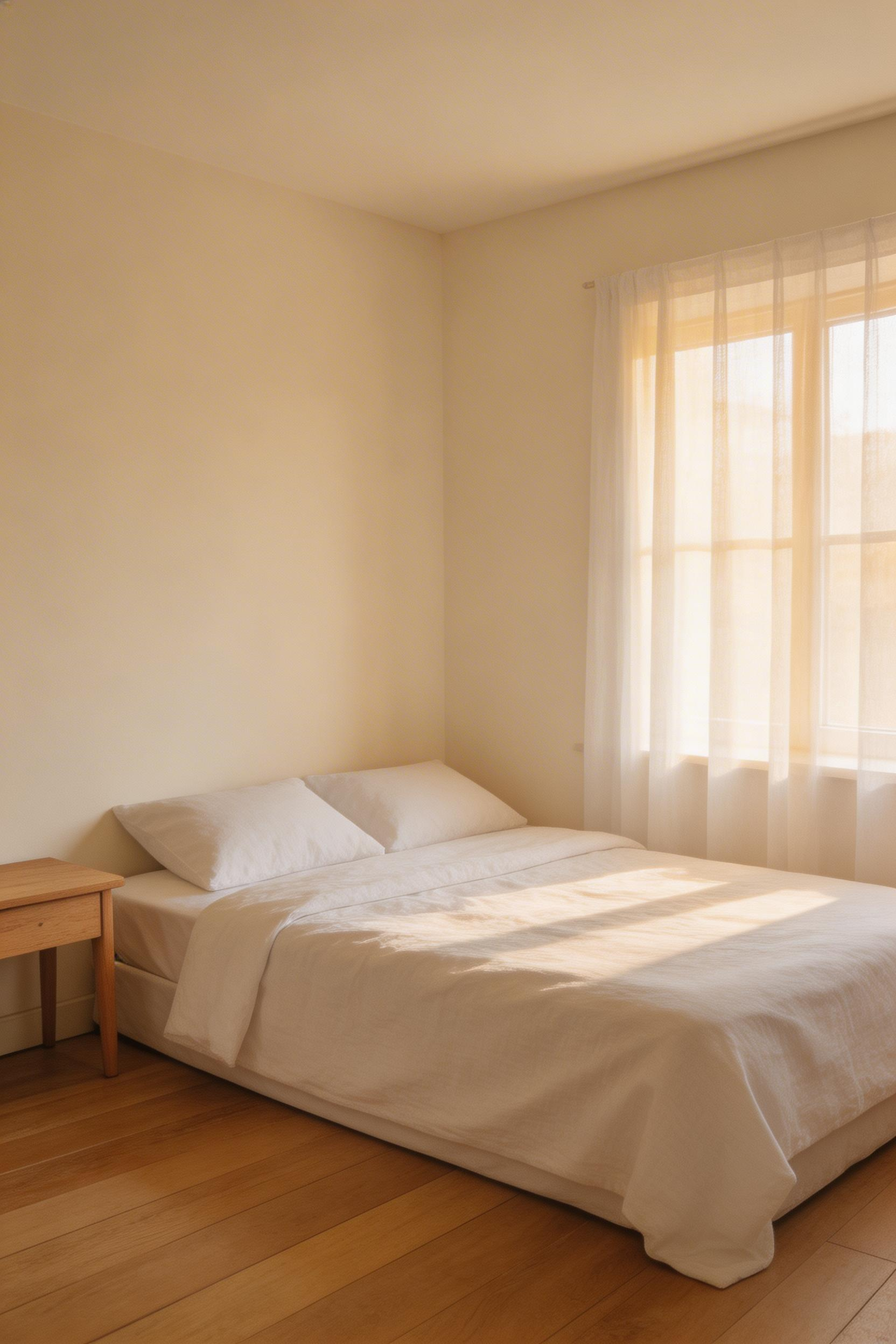
There’s genuine science behind why light paint colours make small rooms feel bigger. Research from the Scandinavian Colour Institute shows that warm whites with a Light Reflectance Value of 80–90+ reflect 80–90% of available light. Rooms painted in these tones are perceived as up to 20% larger than rooms in mid-tone colours. For small bedroom design, this is one of the most impactful changes available at the lowest possible cost.
What to Specify
LRV is the number to check, not brand names. Farrow & Ball All White (LRV 84) has a warm undertone that suits south- or east-facing rooms well. Benjamin Moore Chantilly Lace (LRV 92) is cooler and works in north-facing rooms that need maximum brightness. Dulux Warm Ivory (LRV 78) costs around £22 for 2.5 litres and pairs well with warm-toned wood floors.
Finish also makes a difference. Eggshell and satin finishes reflect more light than flat matte; use eggshell on walls and semi-gloss on woodwork for the most light return. One technique that consistently improves small bedroom design: paint the ceiling the same colour as the walls (or one shade lighter). This removes the visual ceiling line and makes the room feel taller without any structural work.
The Sample Rule
Don’t skip sample pots. A colour that reads as clean white on a chip card can look dingy yellow or clinical blue once it’s on four walls under your specific lighting. Paint 12-inch square samples on different walls and live with them for 48 hours before committing. A 2022 study in the Journal of Environmental Psychology found that light neutral wall colours (LRV 70–90) reduced perceived confinement scores by 23% in small room experiments. Worth taking seriously when choosing paint.
4. Multi-Function Furniture: Storage Beds and Fold-Down Desks
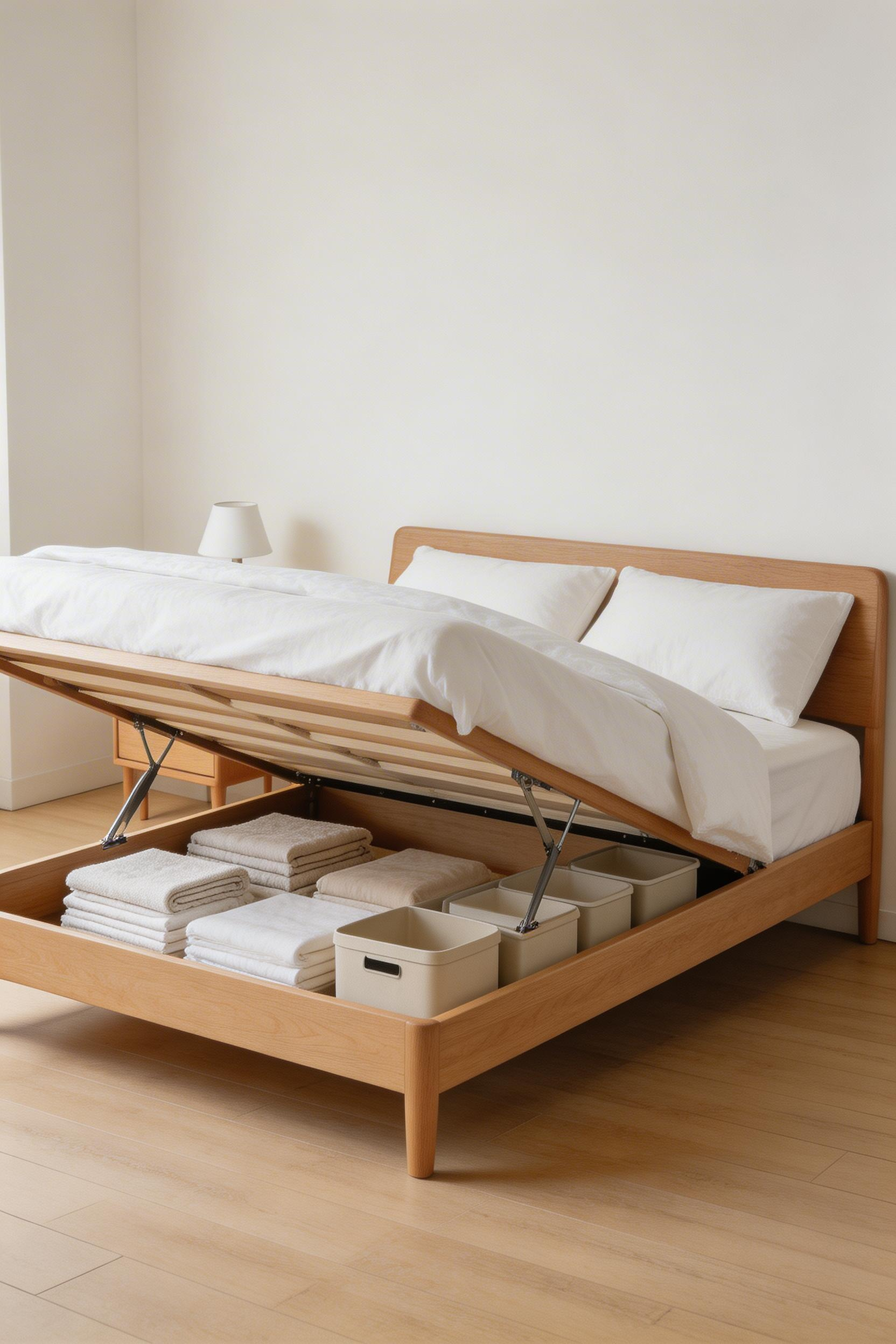
In small bedroom design, every piece of furniture should earn its place twice. A standard bed frame occupies 40 sq ft and does one job. A hydraulic-lift storage bed occupies the same 40 sq ft but also provides 25–35 cubic feet of under-mattress storage. That’s equivalent to a full chest of drawers. That exchange is significant, and it’s one of the clearest wins available in a compact room.
Two Types, Two Uses
Ottoman-lift beds raise the entire sleeping platform as one hinged lid — better for large, irregular items like winter duvets or sports equipment. Drawer-base beds (the IKEA MALM at $499 is a good example) have individual pull-out drawers that suit organised smaller items more naturally. The MALM is genuinely well-made: solid wood and veneer, four deep drawers, available in four finishes.
For bedrooms doubling as home offices, a wall-mounted fold-down desk (Prepac, $129) saves 8–12 sq ft when folded and mounts into two wall studs. It closes to just 4 inches deep against the wall. The surface when open is 36–48 inches wide by 20 inches deep — enough for a laptop and notebook. Also, storage beds represent 34% of all bed frame sales in urban UK markets (GfK 2023), compared to 18% nationally. That gap reflects the specific pressures small bedroom design creates in city living.
The Organisation Point
The biggest mistake with storage beds is treating the storage as overflow. A hydraulic bed without organisation becomes difficult to use and easy to avoid. Set it up with labelled bins from day one, and treat it like any other organised storage space — because that’s what it is.
5. Strategic Mirror Placement to Amplify Space and Light
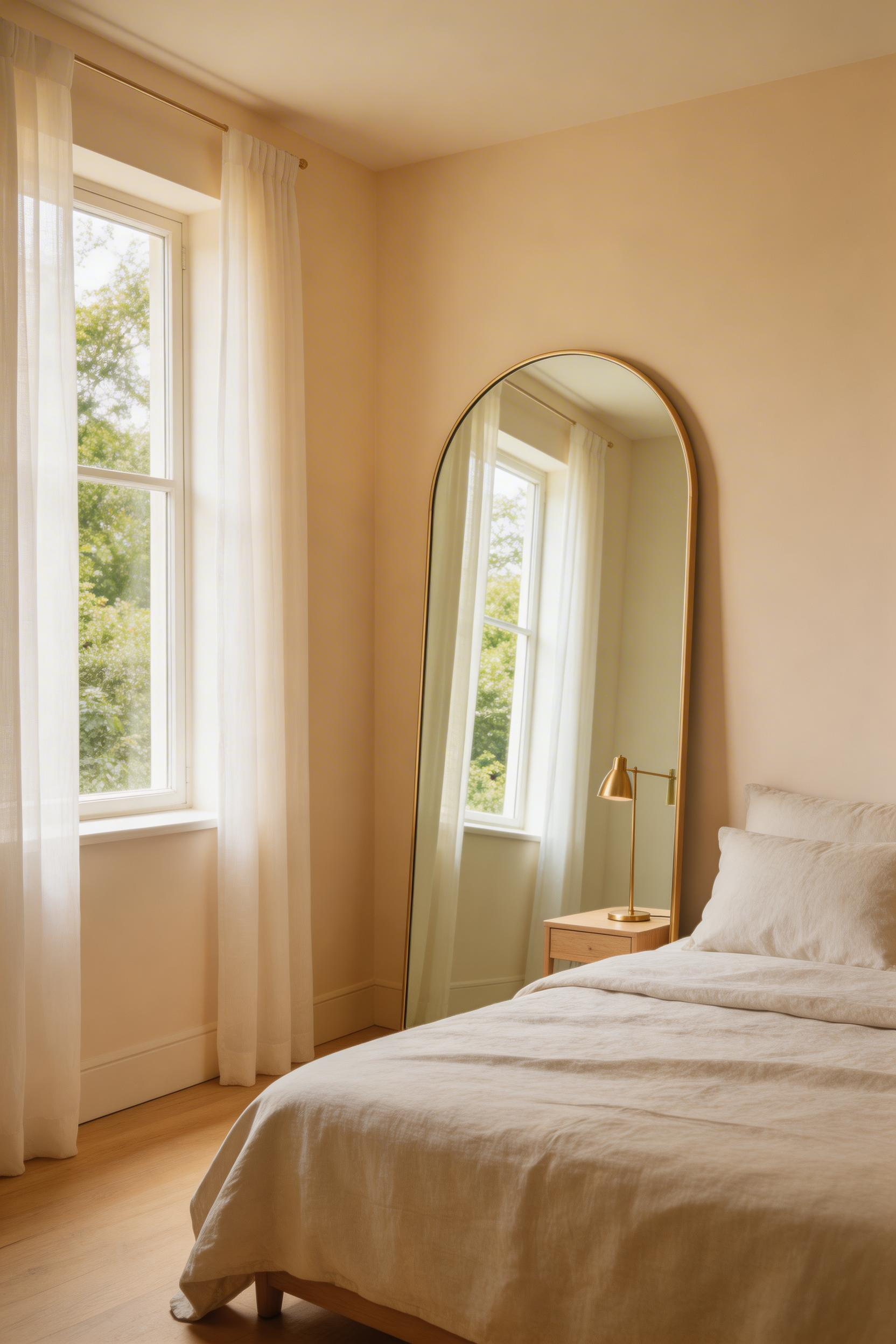
A full-length mirror positioned opposite a window effectively doubles the perceived depth of a small bedroom. It reflects the outdoor view back into the room, creating an illusion of depth. Research published in Lighting Research & Technology found that well-placed mirrors increase perceived room brightness by up to 40% by redistributing natural light. This makes mirrors particularly useful in north-facing rooms. So this is one of the more evidence-backed small bedroom design strategies available.
Placement That Works
The most versatile mirror approach in small bedroom design is a large leaning full-length mirror, 60–72 inches tall. Place it against the wall that receives the most reflected light from the window. Leaning looks intentional and allows repositioning as the layout changes. The IKEA HOVET (78×20 inches, $149) is virtually frameless and works in almost any style of room. H&M Home’s arched 170cm full-length mirror (£79) in thin brass or black is consistently popular — the arch adds visual softness without adding frame weight.
Mirrored wardrobe doors are the most space-efficient mirror solution. They serve two functions — storage and spatial illusion — without taking any additional floor or wall space. For maximising light, position a mirror at 45 degrees to the window rather than directly opposite. The reflection fans across a wider area of the room. For more detail on mirrors that make your bedroom look bigger, there’s a full guide covering angles, sizes, and placement strategies.
One Large Over Several Small
I’d always recommend one well-placed large mirror over a collection of smaller ones. Multiple small mirrors fragment the reflection and make the room feel busier rather than bigger. One clean, well-positioned large mirror does the spatial work without the visual noise.
6. Under-Bed Storage: Organising the Largest Untapped Space
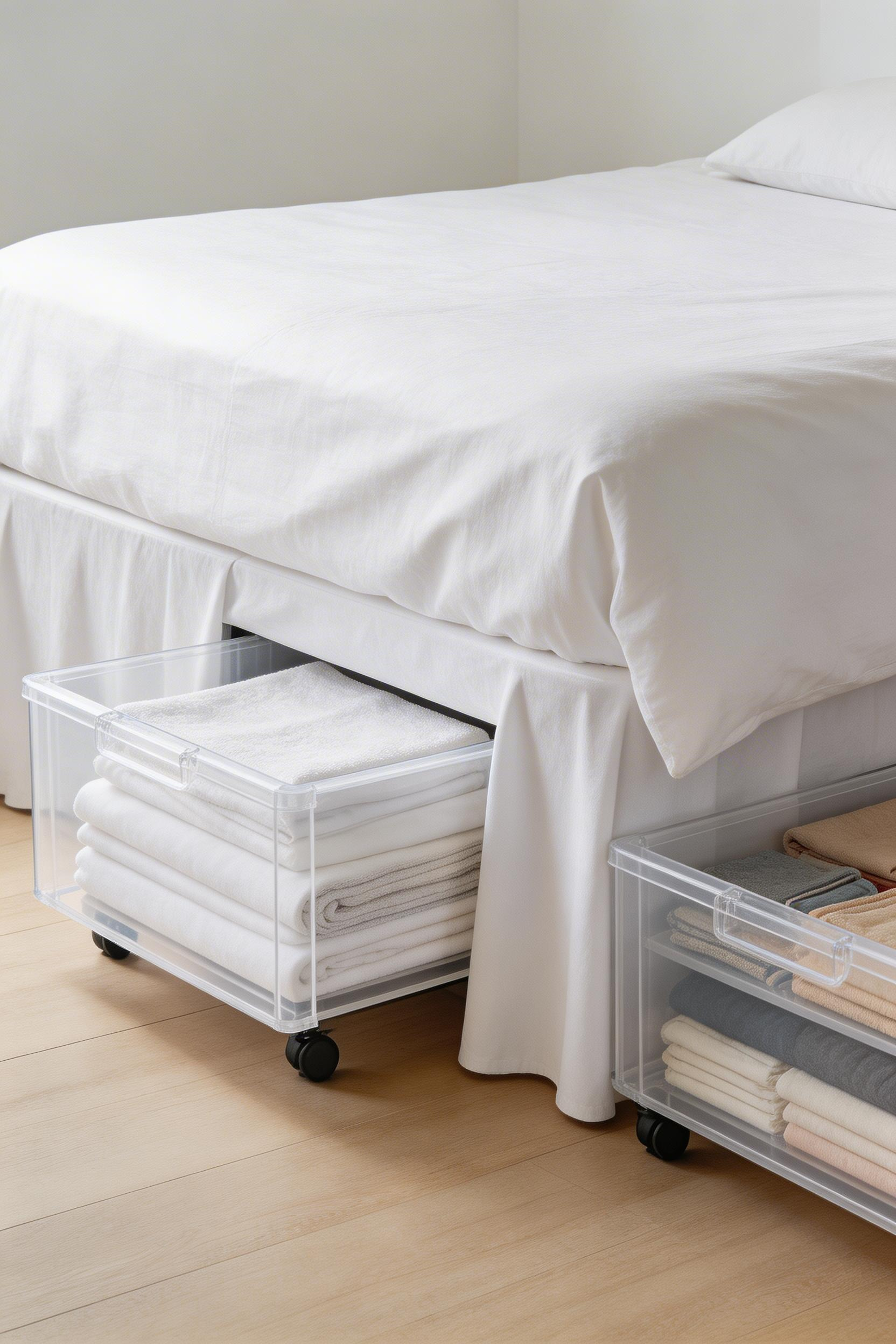
The gap between the floor and the bed frame is the largest untapped storage zone in most small bedrooms. A standard queen bed frame sits 14–18 inches above the floor. If used well, that gap holds up to 24 cubic feet of items. Yet 74% of small-space dwellers report under-bed storage as their primary overflow area (IKEA Life at Home 2022). It’s widely recognised but rarely organised properly.
What the Clearance Determines
Measure from floor to the bottom of the slats before buying anything. Six inches allows flat items and vacuum bags only. Eight to ten inches fits rolling bins. Twelve or more opens up proper storage drawers. The IKEA STUVA under-bed unit ($79) has two large drawers on wheels for frames with 7 or more inches of clearance. Vacuum compression bags (Spacesaver Premium, $34 for six) compress duvets and off-season clothing to 20–30% of original volume. They’re especially useful for bulky irregular items that won’t fit neatly in bins. The Container Store’s Weathertight Under-Bed boxes (four-pack, $59) have clear sides and snap lids.
The Labelling Rule
Label everything before it goes under the bed — including vacuum bags. Under-bed storage without labels becomes a place things disappear into. Finding your spare duvet at 11pm while opening every bag in turn is not the kind of small bedroom design win worth celebrating.
7. Loft Bed Configurations for Compact and Studio Bedrooms
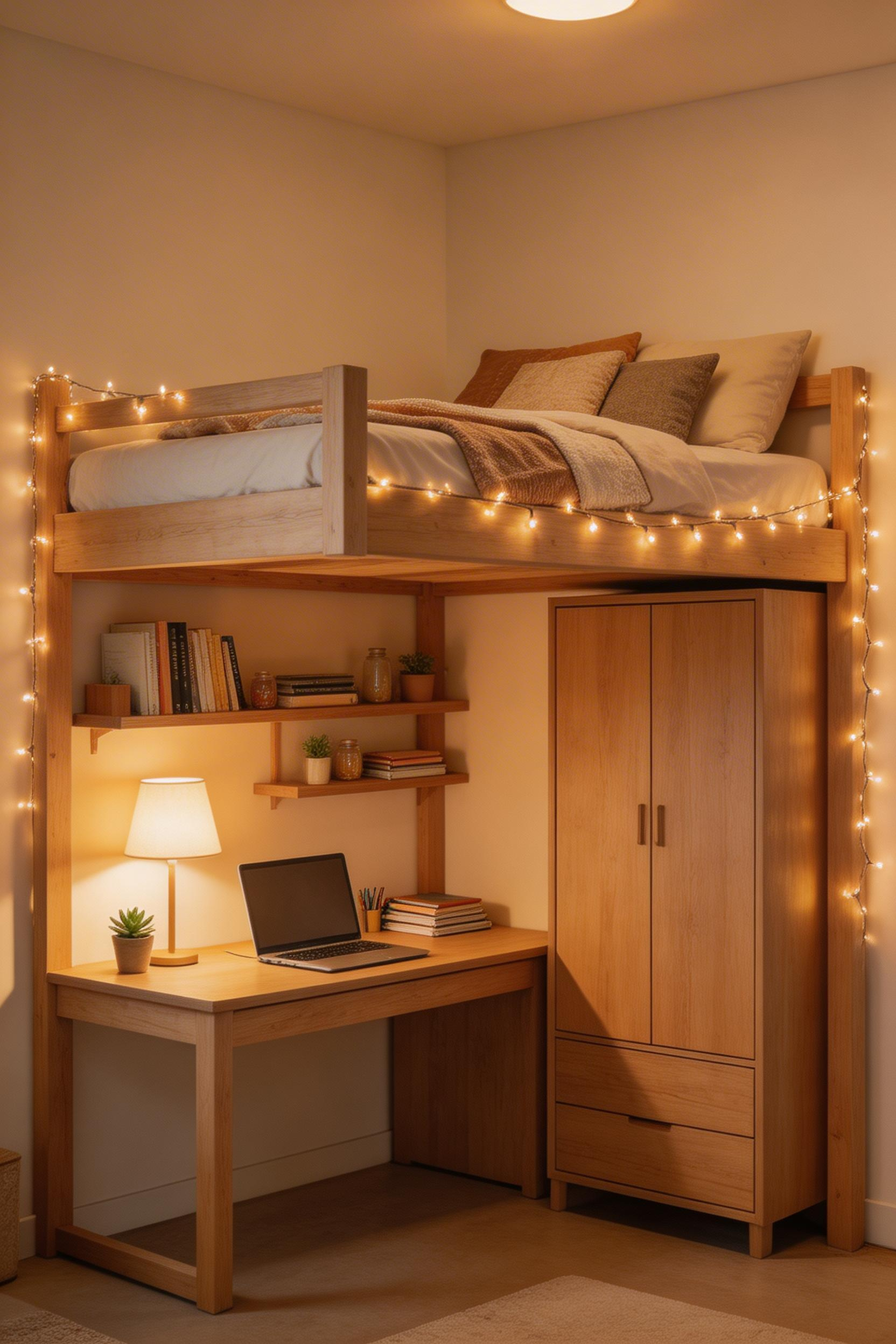
A full-height loft bed raises the sleeping platform to 60–66 inches above the floor, freeing the entire footprint below for a desk, wardrobe, or sofa. In a studio or small single bedroom, this is one of the most dramatic space-recovery strategies available. It essentially stacks two functional zones on top of each other.
Ceiling Clearance First
Ceiling height is the first thing to check. Add mattress thickness (8–12 inches), plus sitting clearance (26–30 inches), plus a 12-inch buffer. The resulting minimum ceiling height for comfortable full loft use is around 8 feet. Mid-height loft configurations (platform at 40–50 inches) work better in lower-ceilinged rooms and create desk-height space below rather than full standing clearance.
The STOMPA Uno S Plus High Sleeper (£699) is EN 747 certified, solid pine, and includes an integrated desk and two-door wardrobe below. It’s the most efficient single furniture investment for a small bedroom that also needs to function as a workspace. For adults, the Harriet Bee full-over-full loft bed (around $799 on Wayfair) has a full-size sleeping area and a desk with shelving below. It’s rated to 350 lbs. Safety standards matter: look for BS EN 747 (UK) or ASTM F1427 (US) compliance on any adult loft bed.
Design the Below Zone First
The space under a loft bed only works well if it’s designed before the loft goes in. Decide whether below is desk, wardrobe, or sofa before committing to the frame. An afterthought arrangement in an ill-fitting space is more frustrating than not having the loft at all.
8. Floating Nightstands and Wall-Mounted Bedside Solutions
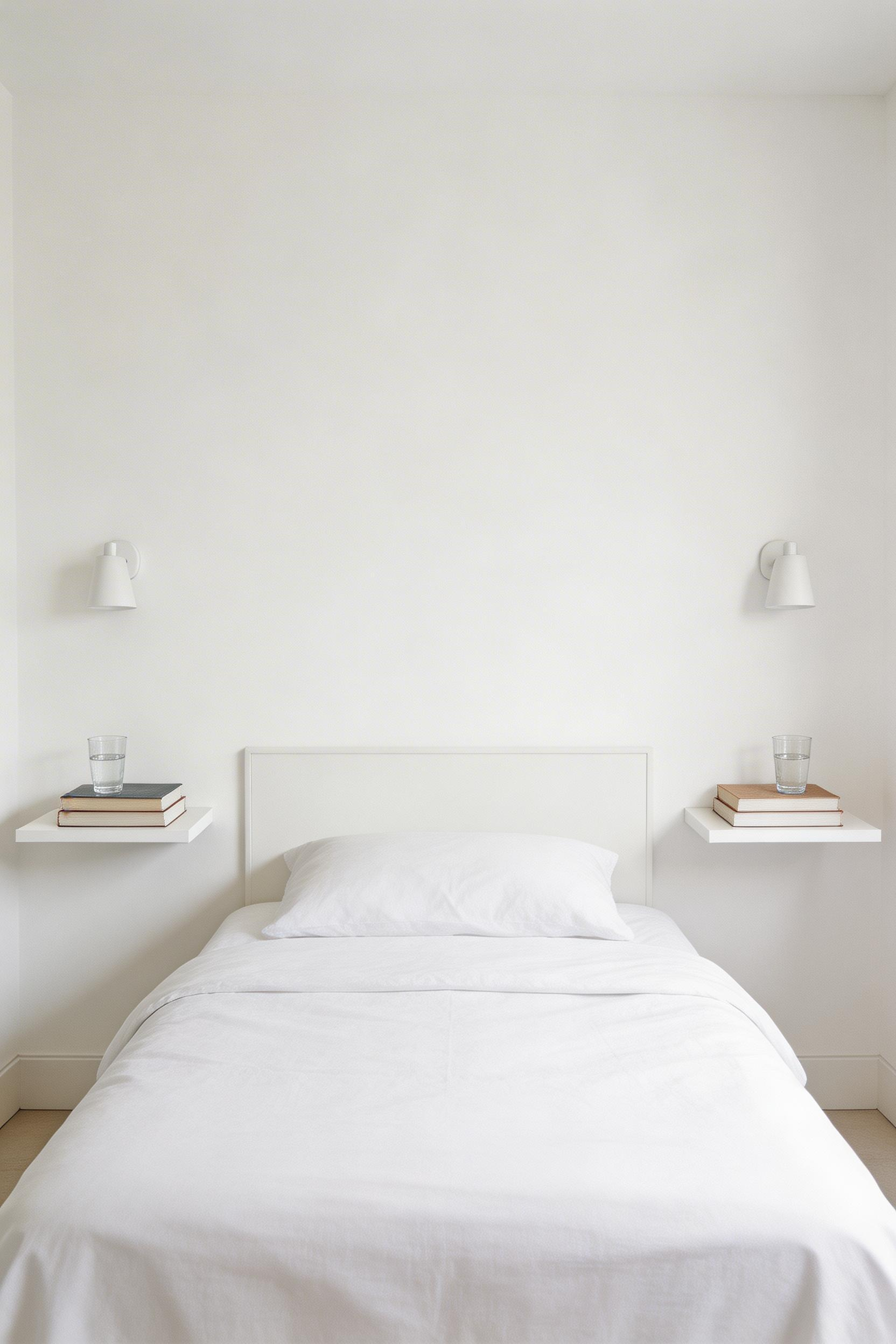
A freestanding nightstand takes up 2–4 sq ft of floor space on each side of the bed. In small bedroom design, that’s floor space giving very little back in return. Wall-mounted shelves or floating bedside tables eliminate the floor footprint entirely while providing everything a nightstand does. Wall-mounted bedside solutions are also among the top five most-shared small bedroom design ideas on Pinterest. The category had over 2.3 million saves as of 2024.
What to Mount
The IKEA LACK wall shelf (11×11 inches, $7.99) is the most widely used floating bedside solution. It’s inexpensive and adequate for a lamp, phone, and glass, though limited to 22 lbs load. Better alternatives are solid wood floating shelves with hidden internal brackets ($20–$60), which look considerably more considered. Umbra’s Trigg hexagonal wall shelf ($29) holds a phone, lamp, and glass without the grid rigidity of a rectangular shelf. For rental properties, clamp-on bedside shelves (BedBand, around $39) fix to the bed frame rail. They provide a surface without any wall drilling.
A Practical Upgrade Worth Making
Drill a 1-inch hole in any floating bedside shelf for a charging cable pass-through. The phone rests beside the shelf. The cable lies flat through the hole. One source of visual clutter — a cable snaking down the wall to the floor socket — disappears entirely. It takes ten minutes and a basic drill bit, and it’s the kind of detail that makes a small bedroom feel genuinely finished.
9. Window Treatment Strategies for Light and Spaciousness
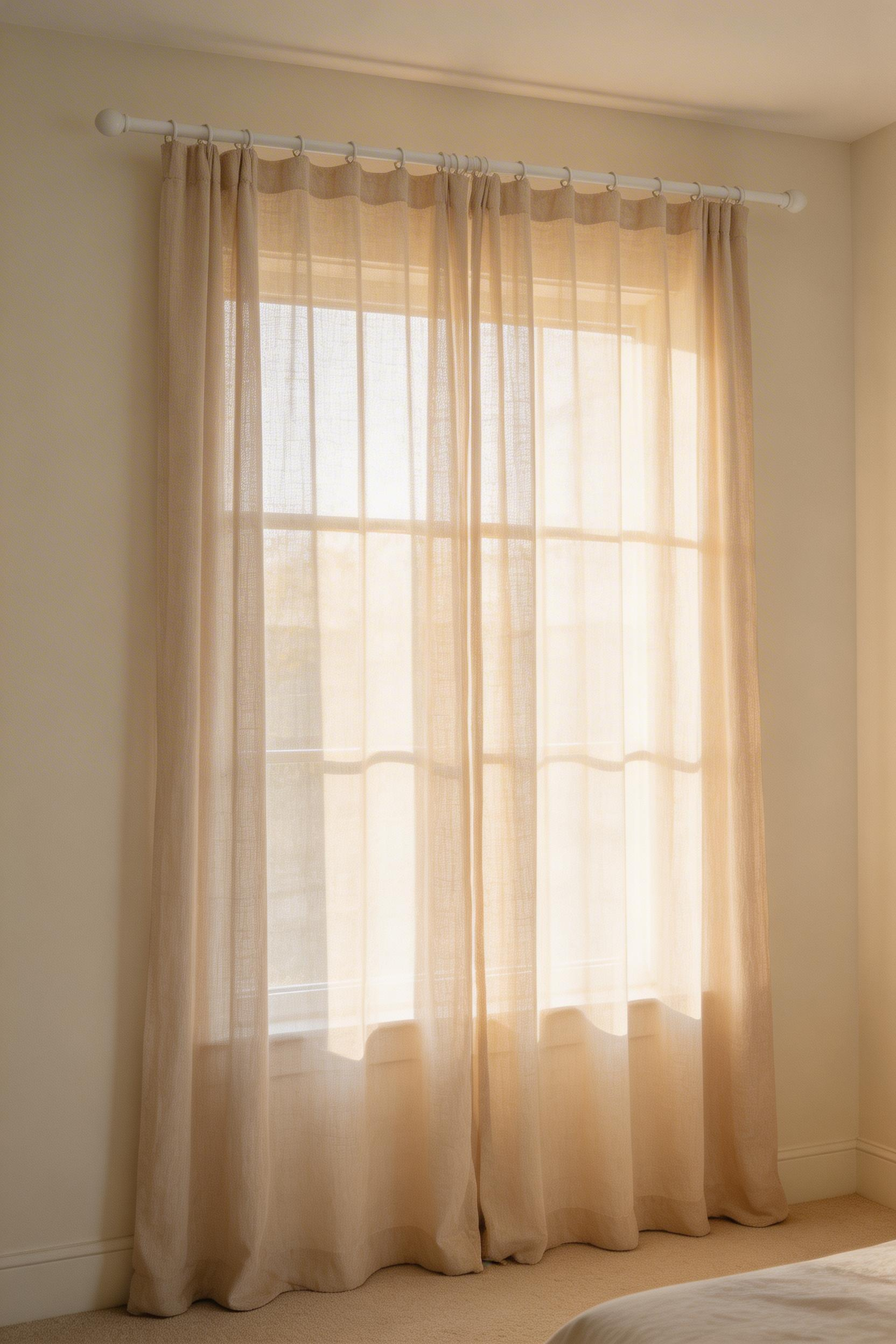
How curtains are hung matters as much as what they’re made of in small bedroom design. Hanging floor-length curtains from ceiling height makes the window appear taller and the ceiling higher. This holds true even when the actual window only occupies the middle portion of the wall. It’s a simple intervention that costs nothing extra and changes the proportion of the room significantly.
The Key Specifications
Extend the curtain rod 8–12 inches beyond the window frame on each side. This allows light to enter from the sides unobstructed and makes the window read as wider. Research by lighting designer Roger Grosse found that ceiling-height curtain rods increase perceived ceiling height by an average of 11% compared with frame-height mounting. That’s a meaningful gain in small bedroom design without any structural work.
For rooms with good natural light, sheer curtains (voile or linen voile) filter light without blocking it. The IKEA HANNALILL sheer curtains (two panels, $29.99) in white or natural are a clean, inexpensive option. They work particularly well layered with a separate blackout roller blind recessed inside the window reveal. For a fuller look, the John Lewis Made to Measure Blackout Roman Blind (£60–£150) combines blackout performance with a smart fabric appearance. Mounted at ceiling height, it’s a clean, considered alternative.
The Single-Panel Approach
In a small bedroom, less fabric bulk is almost always better. A single curtain panel pulled to one side creates an asymmetric, studio-style look. It suits the scale better than two heavy lined panels crowding the limited wall space flanking the window. It also reads as a deliberate, considered choice rather than a default. For small bedroom decor ideas that combine window treatments with other spatial strategies, that guide covers the interactions in detail.
10. Built-In Wardrobe Design for Full-Wall Clothes Storage
A full-wall built-in wardrobe uses every inch of an existing wall. In a small bedroom, that’s typically 8–12 linear feet with no wasted corner gaps or side return angles. It’s also the storage solution most likely to disappear into the room. A well-executed built-in makes the bedroom feel less like a space with a wardrobe problem and more like one that simply contains all your clothes.
IKEA PAX as a Semi-Custom Solution
The IKEA PAX system ($350–$900 per bay) is available in three widths (19.7, 23.6, and 29.5 inches) and up to 93 inches tall. Adding custom cabinet doors, plinths, and crown moulding to a PAX installation makes it look fully built-in for a total of $500–$1,200. A fully custom fitted wardrobe from Sharps (UK, £1,200–£3,500) or a local joiner delivers a more tailored result if budget allows.
Sliding doors save roughly 9 sq ft of swing clearance compared with hinged doors. That’s significant in a room under 120 sq ft. The IKEA HASVIK sliding door panels ($140–$200 per pair) are available in high-gloss white or mirror finish and sit on a top-mounted rail. Good internal configuration for most adults includes short-hang rail (jackets, shirts), long-hang rail (dresses), shelves, and drawers — not all-hanging or all-shelves.
The Disappearing Wardrobe
Match the wardrobe door colour exactly to the wall colour. Paint the interior the same colour as the doors. The wardrobe effectively disappears, leaving only the room and the bedroom furniture layout. Built-in wardrobes are the most searched bedroom storage solution in the UK (Google Trends 2024). Most people living with a small bedroom have already arrived at this conclusion independently.
11. Zone Creation: Separating Sleep and Relaxation in One Room
Zoning — creating distinct functional areas within a single room — reduces the psychological sense of compression that makes small bedrooms feel claustrophobic. When a small bedroom is one undifferentiated space, it tends to feel like it serves all purposes poorly. Defining zones changes that.
What Creates a Zone
The most effective zoning tool in a small bedroom is a rug. A 5×8 or 6×9 rug positioned under and around the bed defines the sleep zone without visual bulk or excessive cost. The rug should extend at least 18–24 inches beyond the bed on the sides and foot. In rooms under 120 sq ft, a 5×8 is the practical maximum under a queen bed. The IKEA STOCKHOLM 2017 rug ($199, low pile flat weave) defines the bed zone cleanly.
Lighting variation reinforces the zoning. A warm lamp at reading height (48–54 inches) on one side of the bed creates a distinct relaxation zone separate from the overhead ambient layer. A small armchair in the corner creates a conceptual second space. Even a compact slipper chair like the CB2 Cielo ($349, 27 inches wide) does this. That shift is what makes the room feel like more than just sleeping quarters.
The Wellness Argument
A 2021 study in Sleep Health found that occupants of single rooms with defined sleep zones reported 18% better sleep quality scores than those in undifferentiated rooms. So zoning a small bedroom is a wellness intervention as much as a design one. That frame helps explain why the rug-and-armchair investment is worth making.
12. Layered Bedroom Lighting for Atmosphere and Function
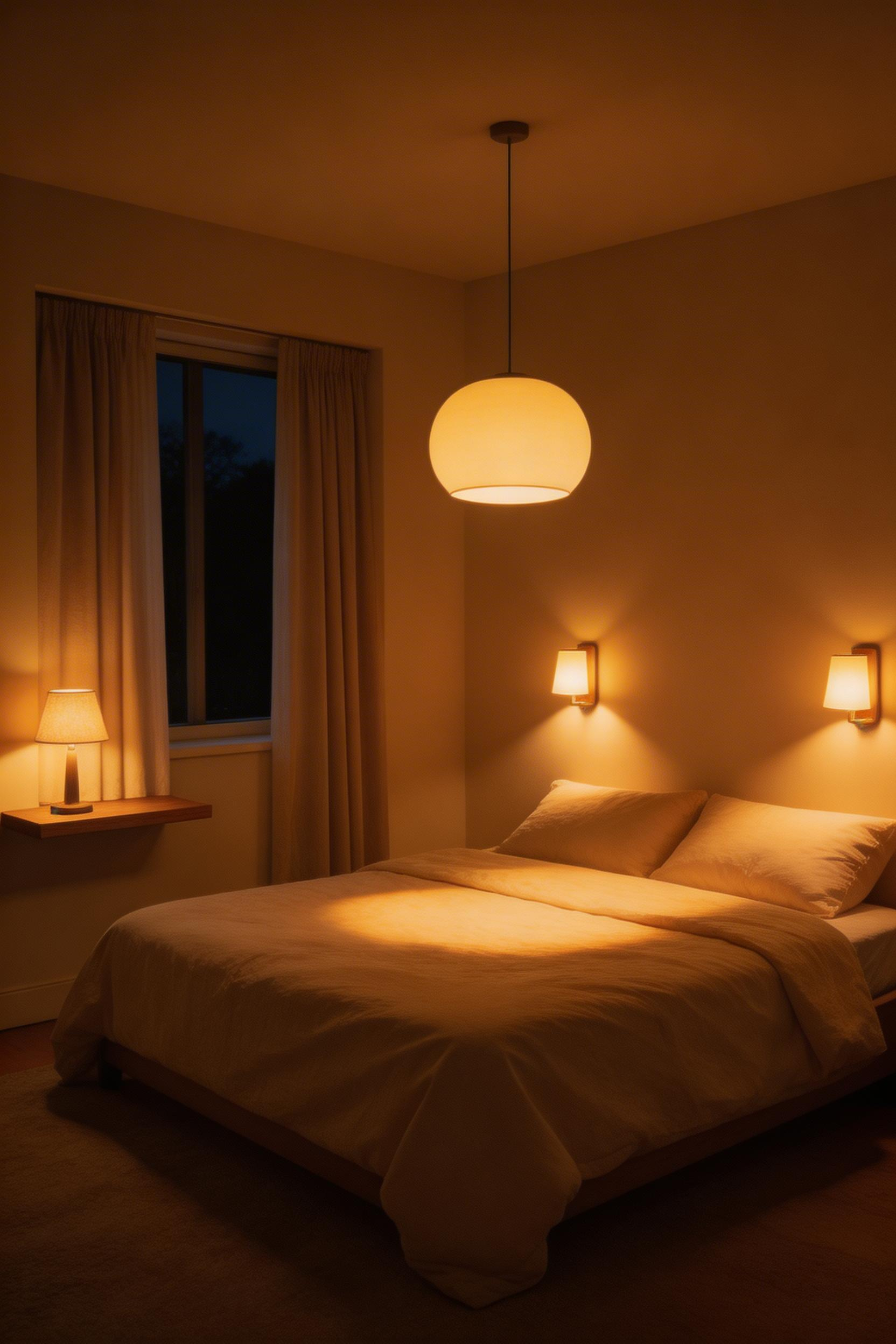
A single overhead light is the least effective lighting approach for a small bedroom. It casts flat, even illumination that reveals the room’s limitations and creates unflattering shadows. It also does nothing for the warmth or comfort a bedroom should provide. Layered lighting — ambient, task, and accent — solves this. It’s one of the clearest improvements available in any small bedroom design.
The Three-Layer System
Ambient light (general illumination): a ceiling pendant or flush mount at 2700K, ideally on a dimmer. Task light (focused): bedside lamps or plug-in wall sconces at 48–54 inches from the floor. Position them so the light falls on the book rather than directly in the eyes. Accent light: low-level sources — a small table lamp or an LED strip behind the headboard — create depth and atmosphere at the room’s edges.
Plug-in wall sconces — Arteriors Royale at $290 for a pair — are the most practical bedside task lighting upgrade in a small bedroom. They eliminate the floor-standing lamp and free surface space on the floating nightstand shelf. The Lighting Research Center reports that layered bedroom lighting with dimming control reduces average time-to-sleep onset by 24 minutes compared with fixed overhead-only lighting.
The Best Single Upgrade
Put every light source in the room on a dimmer. Lutron Caseta or basic rotary dimmer switches cost $25–$40 each. They have more impact on how restful and spacious a small bedroom feels than almost any other change available at that price. The IKEA RANARP pendant ($25) paired with a 2700K LED bulb and a dimmer is the full ambient layer for under $50.
13. Accent Walls That Add Depth Without Overwhelming a Small Room
The temptation in small bedroom design is to keep everything light and neutral to maximise space. But one well-chosen accent wall — properly executed — has the opposite effect to what most people fear. It creates visual focus, depth, and intention, making the room feel designed rather than cautious. The key is which wall, which colour, and how it’s applied.
The Headboard Wall
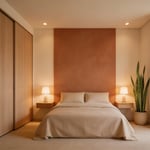
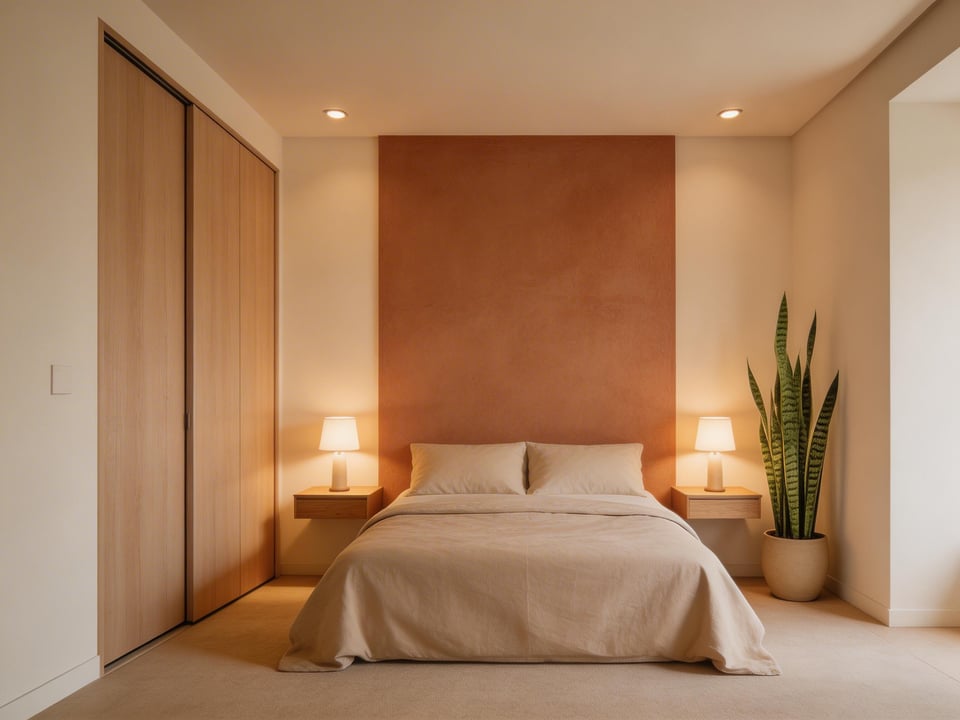
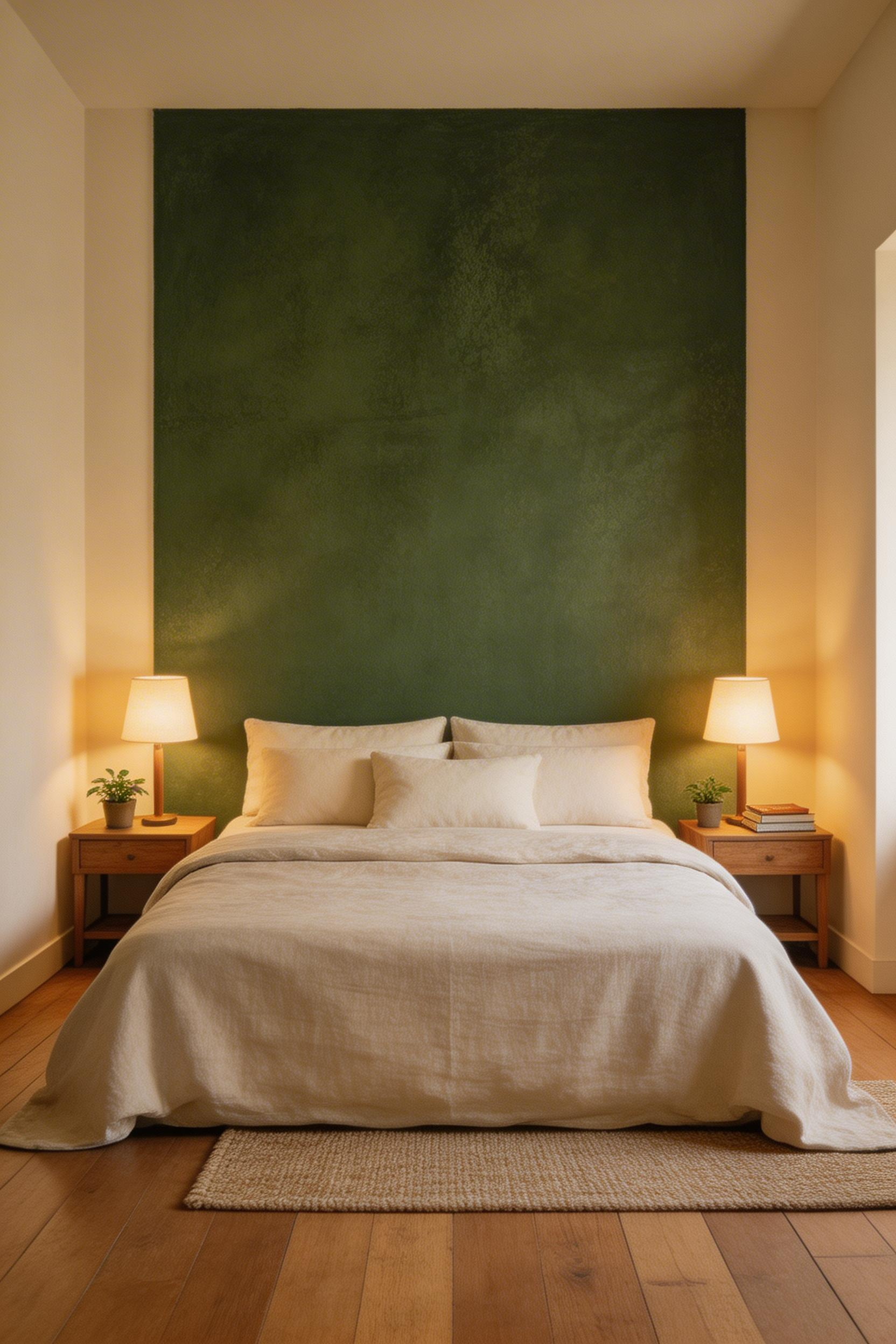
In a small bedroom, the headboard wall — the wall directly behind the bed — is the right accent wall. It frames the bed as the room’s centrepiece without making the room feel boxed in from all sides. Darker colours recede visually and create an illusion of depth. A charcoal, deep teal, or forest green headboard wall appears further away than it actually is, extending the perceived room depth.
Rust-Oleum Limewash Paint in Pompeii (£24/1L) gives an authentic aged texture that adds depth through surface variation rather than just colour. Walnut Grove Wood Slat Wall Panel Kits ($189 per kit, 32 sq ft coverage) install over existing walls and create dramatic vertical depth. Horizontal slat orientation makes walls feel wider; vertical makes ceilings feel higher. For renters, Graham & Brown Velvet Peel & Stick Wallpaper ($35/roll) in deep tones like forest green or midnight blue applies and removes without damage.
Also: [Maximise Style in Small Bedrooms](https://homedecorhero.com/maximize-style-in-small-bedrooms/)
That guide covers how accent walls interact with furniture scale and palette — a useful complement to the technical application guidance above.
14. Reading Nooks and Dressing Corners: Making Use of Awkward Spaces
Alcoves, recesses, corner angles, and the areas beside chimney breasts are typically dead space in a small bedroom. But with the right furniture, they become the room’s most characterful feature. These are the spaces that make visitors ask “did you always have this corner like this?” — as if it’s architecturally original.
What a Nook Needs
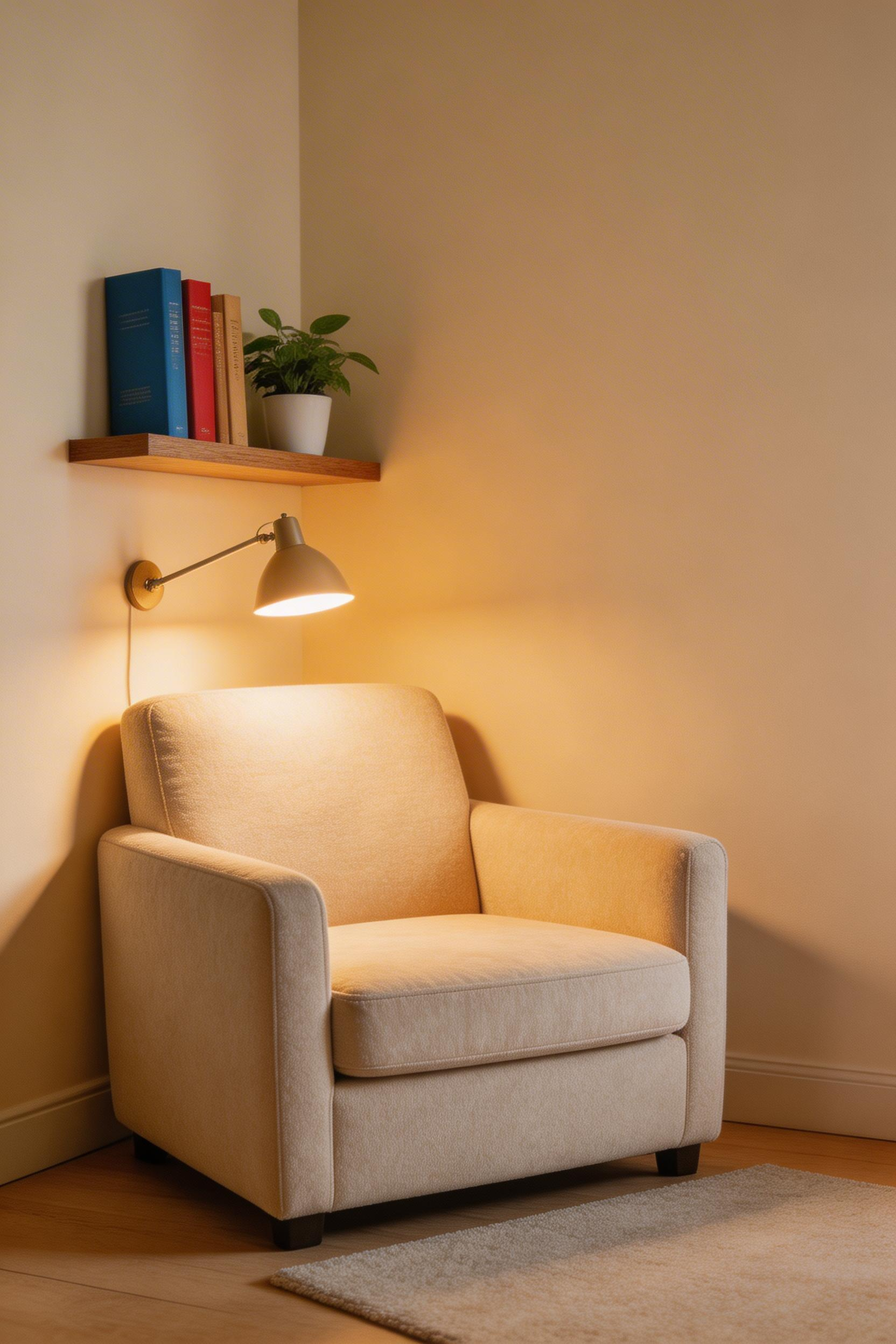
A corner reading nook requires as little as 30×30 inches: a small upholstered armchair, a wall-mounted lamp, and a floating shelf above. The IKEA POÄNG armchair ($149, 26 inches wide) fits a tight corner without being cramped. Fitted window seats over storage drawers turn an architectural feature into both a seat and a small bedroom storage solution. Built at 17–18 inches from the floor over a bay window or deep sill, they provide drawer storage below and seating above. The Vividstorm Window Seat Storage Bench ($229) fits 48 inches and works in most standard alcove and bay configurations.
For dressing areas, the IKEA KALLAX 2×2 shelving unit ($69, 30×30 inch footprint) used as a vanity base works well. Add a wall-mounted mirror above and a simple stool beside it. The result is a functional dressing corner in a very small floor footprint.
Commit to the Corner
The most effective thing you can do with an awkward corner is commit to it fully. Home staging data from Rightmove (UK, 2023) shows that bedrooms with defined secondary zones sell 9% faster than comparable bedrooms without them. A half-measure — a small table pushed into a corner, a chair that’s technically there but clearly an afterthought — wastes the space. A reading nook works only if it’s genuinely comfortable to use.
15. Plants and Biophilic Touches for a Calming Small Bedroom
Biophilic design — incorporating living natural elements into interior spaces — has genuine evidence behind it. A 2019 University of Melbourne study found that workers in plant-enriched spaces reported 47% higher wellbeing scores than those in spaces without plants. For bedroom design for small rooms specifically, that wellbeing argument is worth taking seriously. Small bedrooms already create pressure on the occupant’s sense of space and calm. Plants help counteract that.
Which Plants Work Best
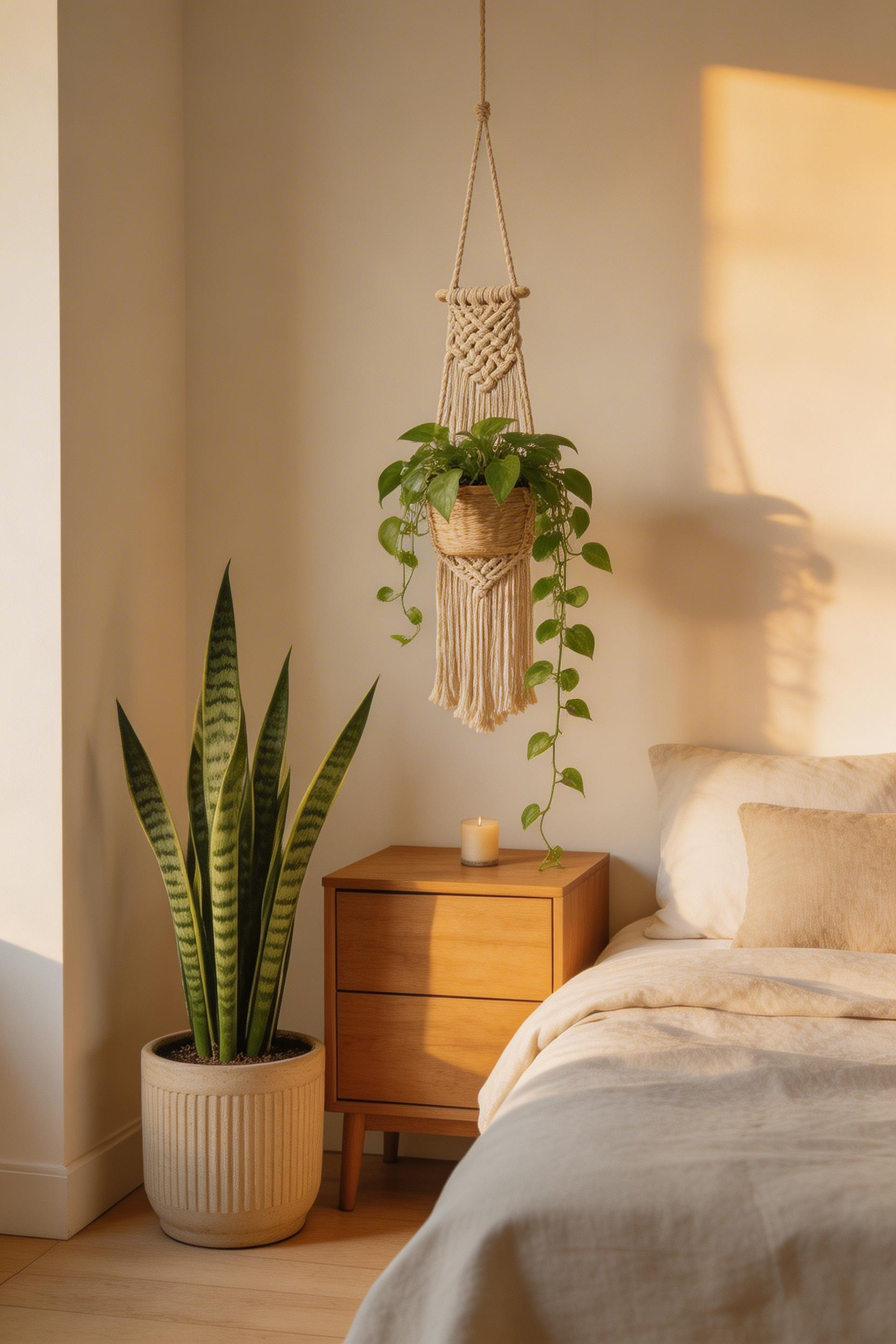
NASA’s Clean Air Study found that peace lilies, snake plants, and pothos can reduce indoor VOC levels by up to 87% in a closed room. Snake plants (Sansevieria) are the most practical bedroom plant. They tolerate low light and infrequent watering, and they convert CO₂ to oxygen overnight — most plants only do this during daylight. A single 80cm Sansevieria ‘Laurentii’ (Patch Plants, £39) in a ceramic pot in a bedroom corner reads as a design feature rather than a plant collection.
Hanging planters keep plant life off limited surfaces. A trailing pothos or string of hearts in a macramé ceiling planter above a dresser adds biophilic warmth without consuming shelf space. IKEA’s FEJKA artificial pothos (£15) is an honest option for genuinely low-light rooms or owners who know they won’t maintain a real plant. It’s far better to have one convincing artificial plant than three real ones in declining health.
The Two-Plant Rule
If you’re not a natural plant person, two well-maintained plants always look better than six struggling ones. Sustainable small bedroom design is about what you’ll maintain over time, not what looks best in the moment. Choose one plant that genuinely suits your light conditions and your watering habits, and build from there.
Making Every Square Foot Work
Small bedroom design succeeds when it’s built on a hierarchy of decisions. Start with the bed — it takes up the most space and sets the layout for everything else. Then address storage: vertical shelving, built-in wardrobes, and under-bed organisation remove the clutter that makes small rooms feel small. Then address light: paint colour, natural light through window treatments, and layered artificial lighting. Only then do the accent choices — the mirror, the plants, the reading nook — become additions to a room that already works.
The most common mistake in small bedroom design is trying to do everything at once. Instead, prioritise the two or three changes that address your room’s specific constraints first. If storage is the problem, address that before aesthetics. If the room feels dark and close, start with paint and curtains before buying furniture. The constraint itself tells you where to begin. Work with it rather than against it. A small bedroom tends to reward that focus with the kind of calm, considered space that a larger room rarely achieves without real effort.