Most people believe small bedroom layouts are a compromise. They accept less comfort, less storage, and less style in exchange for a lower rent or smaller mortgage. Home renovation shows repeat this idea. Well-meaning friends reinforce it. Here’s what the research actually says: compact rooms force smarter decisions. After working with clients in spaces under 120 square feet, I’ve seen confined dimensions produce more intentional and genuinely restful bedrooms than rooms twice the size. These 15 small bedroom layouts will show you exactly how.
A small bedroom isn’t a limitation. It’s a design brief.
1. The Bed-Against-the-Wall Layout
The most common of all small bedroom layouts is also the most logical. Slide the bed along the longest wall, and the remaining floor breathes. Yet this arrangement gets dismissed as boring or unambitious. That’s a mistake, because done well it’s one of the most efficient configurations available.
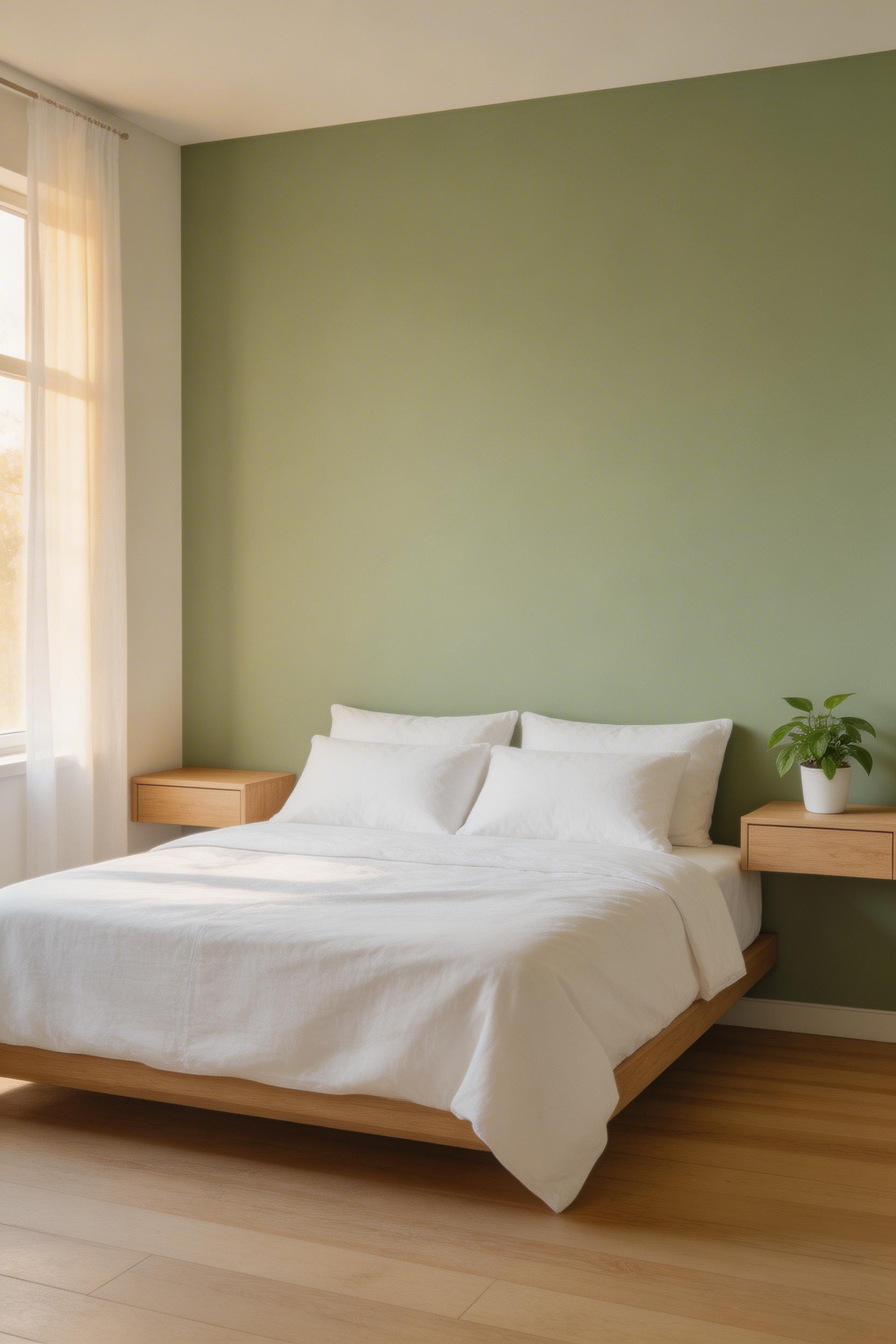
The key measurement that makes this work is clearance. A queen bed is 60 inches wide. In a 10-foot-wide room, that leaves 60 inches on the open side — well above the 24-inch minimum. That’s comfortable enough to walk past and make the bed without difficulty. If the room is narrower, dropping to a full (54 inches wide) frees a meaningful extra 6 inches. That gap matters.
Making It Feel Intentional, Not Institutional
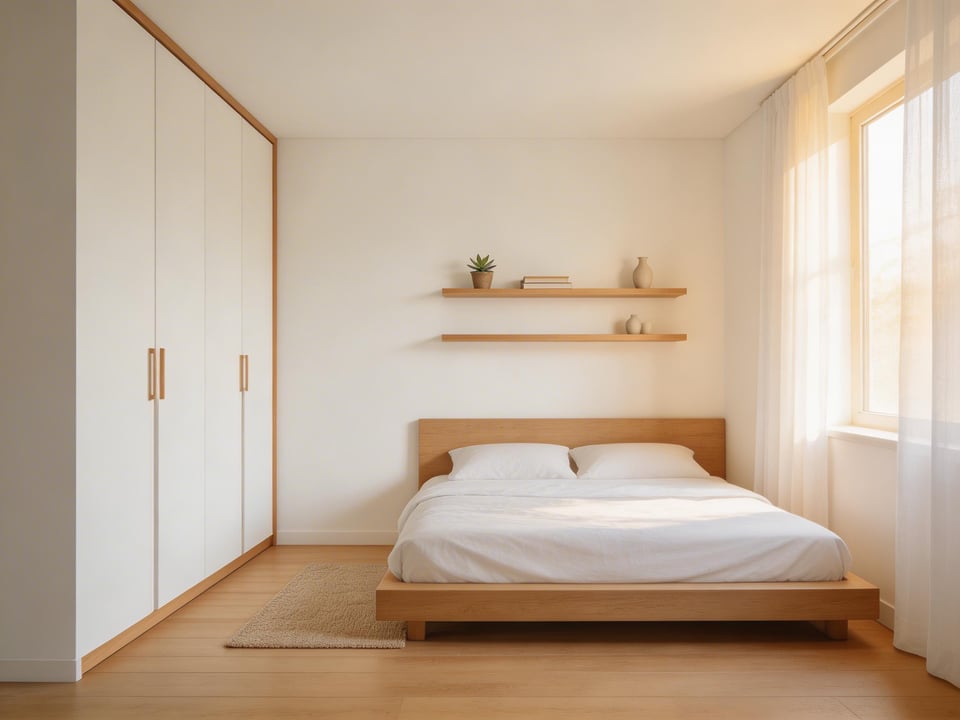
Because this layout places the bed flush against the wall, the risk is that it reads as a dormitory rather than a sanctuary. However, the fix is straightforward: replace floor-standing bedside tables with wall-mounted shelves. A floating shelf 6–8 inches deep and 43 inches wide (IKEA Lack Wall Shelf, $29) holds a lamp, a glass of water, and a book. It takes no floor space at all. Above the shelf, you still have a full wall to work with. A gallery arrangement, a single large print, or a textile panel all work well here.
A 2019 study in the Journal of Environmental Psychology found that sleeping with a solid wall on at least one side correlated with lower reported nighttime anxiety in small-space dwellers. So while the layout looks simple, it has a genuinely calming effect for many people. A full (54 inches wide) instead of a queen also frees 6 extra inches of circulation without noticeably reducing sleeping surface for most single sleepers. The Zinus Suzanne Metal and Wood Platform Bed ($189–$249) is a clean, low-profile frame that reads well in this arrangement.
2. The Corner Bed Configuration
The corner bed configuration takes the logic of the wall-facing layout one step further. Instead of one wall boundary, the bed has two. The sleeping surface sits in a corner, with walls on both the headboard side and one long side, leaving only two sides accessible.
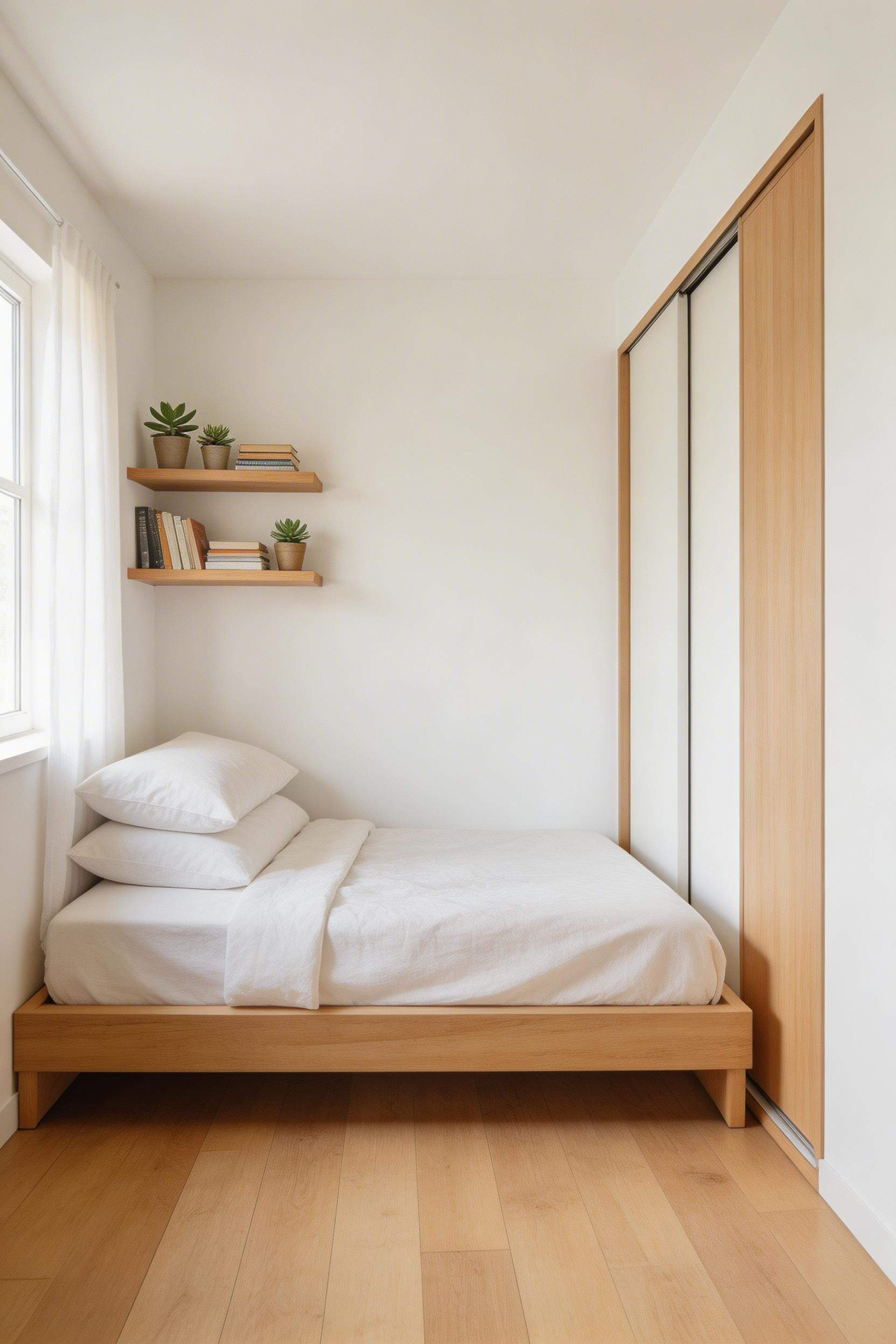
In a 10×10-foot room with a twin (38×75 inches) in one corner, the remaining wall space on the long side runs 82 inches clear. That’s enough for a 72-inch single-door wardrobe with a few inches of breathing room. The short wall opposite the bed head can take a full-width floating shelf or a narrow chest of drawers. Because the bed occupies the corner, the main circulation path stays open without weaving around furniture.
Corner Shelves: The Underused Detail
The small triangular dead space at the junction of the two walls above the bed is easy to miss. However, it’s one of the most useful spots in this layout. Corner wall shelves — the small triangular floating variety — fit exactly here. They’re available from $15–$40 at most hardware stores. They hold a phone charger, a reading light, and a small plant. Also, they make the corner feel finished rather than abandoned. The IKEA Hemnes Daybed Frame ($329) is specifically designed for corner use. It converts from twin to full, making it a practical choice if the room needs to serve double duty as a guest space.
3. The Loft Bed Layout for Adults
Loft beds aren’t just for children. Modern adult-rated loft frames exist precisely because small bedroom layouts often need to stack functions vertically. A loft bed raises the sleeping surface to near-ceiling height. The space beneath becomes a fully functional zone — office, wardrobe, or reading nook — that didn’t exist before.
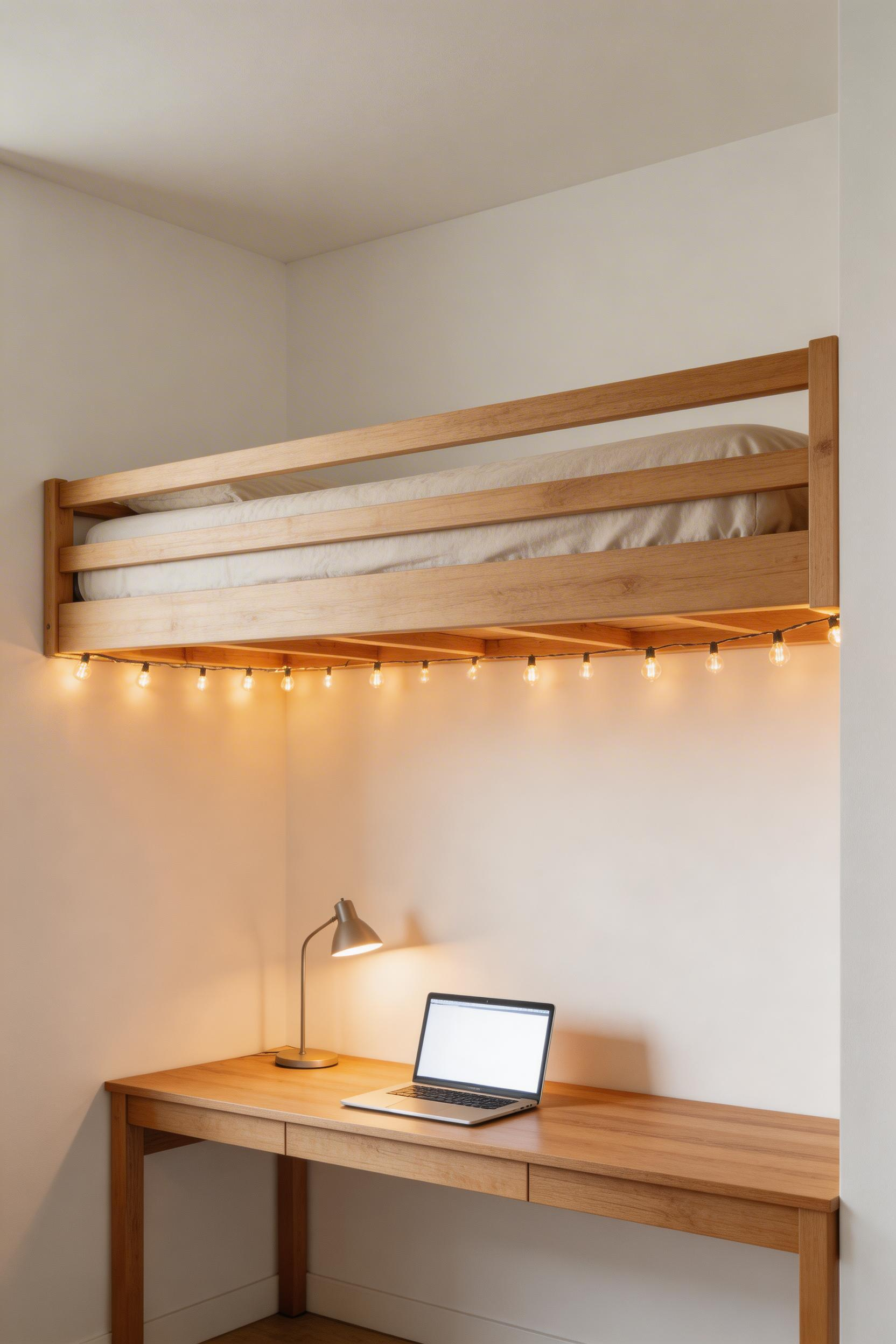
The ceiling height requirement is the critical factor. You need a minimum of 8.5 feet — ideally 9 feet — for an adult loft bed to work comfortably. Start with your ceiling height. Subtract mattress depth (10–12 inches), then frame depth (6–8 inches), then recommended headroom above the mattress (24 inches minimum). The result is your available clearance below. For a 9-foot ceiling, that works out to approximately 63 inches — enough for a full seated work zone.
Setting Up the Space Below
Because the underside of the loft frame sits right overhead, lighting is the first priority for the below zone. Battery-powered LED strips or a small plug-in pendant mounted to the underside of the frame keep the area usable. No floor lamp needed. The Dorel Living Miles Metal Loft Bed ($349–$449, full/queen) offers 64.5 inches of clearance below and supports 250 pounds. For a premium option with an integrated desk and wardrobe, the Stompa Uno S Plus ($799–$1,100) builds the entire below zone into the frame. A full under-loft workspace can reclaim 30–50 square feet in a room that otherwise had none. That effectively doubles the functional area of a 70–80 square foot bedroom.
4. The Murphy Bed + Sofa Hybrid
Of all the small bedroom layouts on this list, the Murphy bed with an integrated sofa system most dramatically changes how the room functions. When the bed is folded into the wall cabinet, the room becomes a sitting room. When it folds down at night, it becomes a bedroom. The floor plan doesn’t change — only the function does.
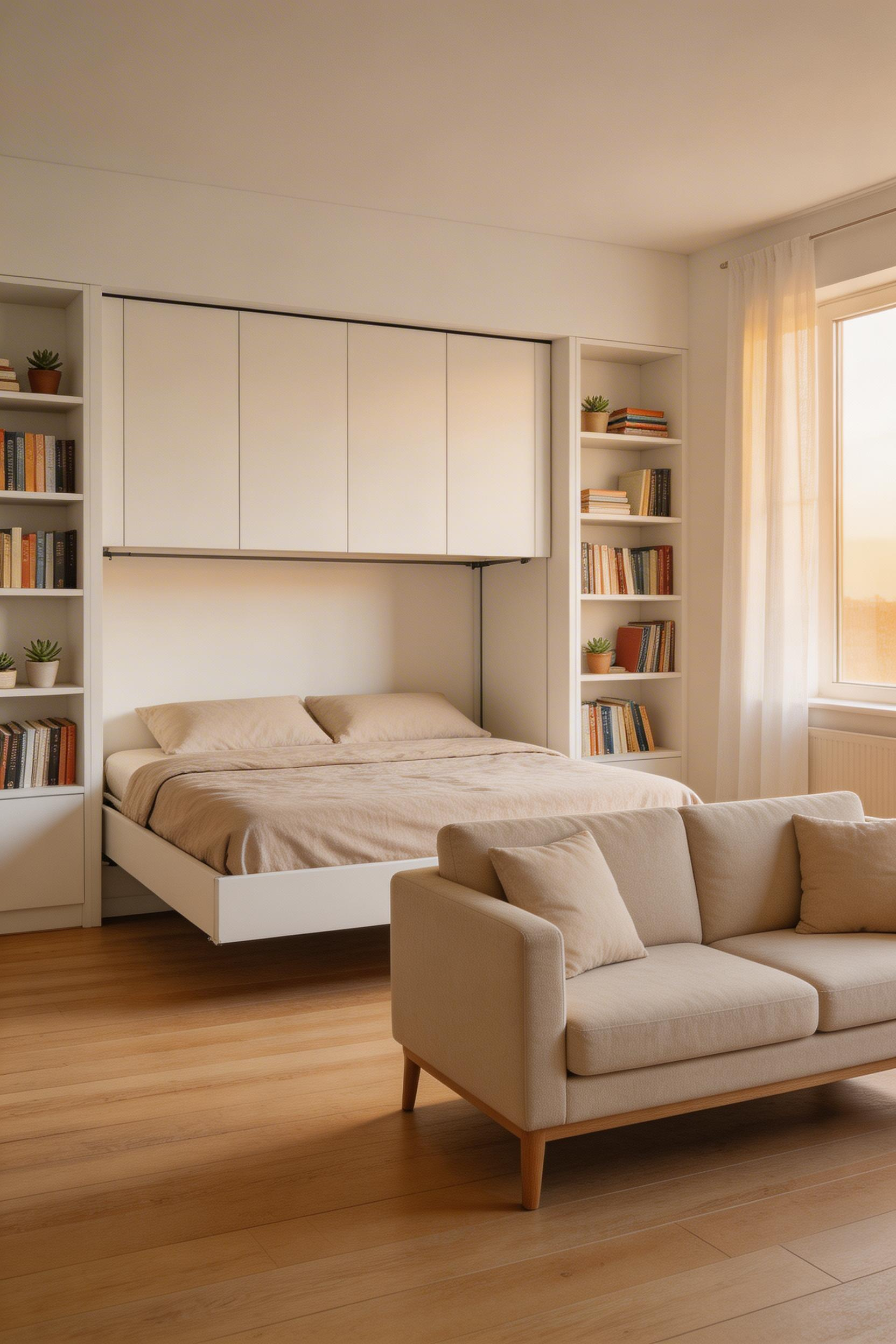
The key purchase decision is whether the sofa stays put when the bed folds down. Some budget systems require you to move the sofa first. In a genuinely small room, that means rearranging furniture twice a day — which defeats the purpose entirely. The best systems (Clei Altea, $3,800–$4,500; Resource Furniture Penelope, $4,200–$5,500) keep the sofa stationary. However, there’s also a more affordable path: the IKEA PAX wardrobe combined with a Murphy mechanism kit from Murphy Bed Center runs $700–$1,200 total.
What the Installation Requires
A Murphy bed cabinet anchors to wall studs — minimum 4 studs. The wall must be properly reinforced. Piston or counterbalance opening systems are strongly preferable to spring systems. They require no physical effort to operate and hold the bed precisely where you leave it. A queen bed lowered takes 60×80 inches of floor space and requires at least 6 feet of clear floor in front. Murphy bed searches rose 40–60% during periods of urban housing cost increases (Houzz trend data, 2021–2024). The quality and range of the category have improved substantially as a result.
5. The Diagonal Furniture Placement Strategy
Conventional wisdom says to keep furniture aligned with the walls. But in a square or near-square room — the most common proportion for a small bedroom — that alignment makes the room look and feel exactly like the box it is. Placing the bed at a 45-degree angle to the walls breaks that geometry. According to environmental psychology research, it also makes the room feel meaningfully larger.
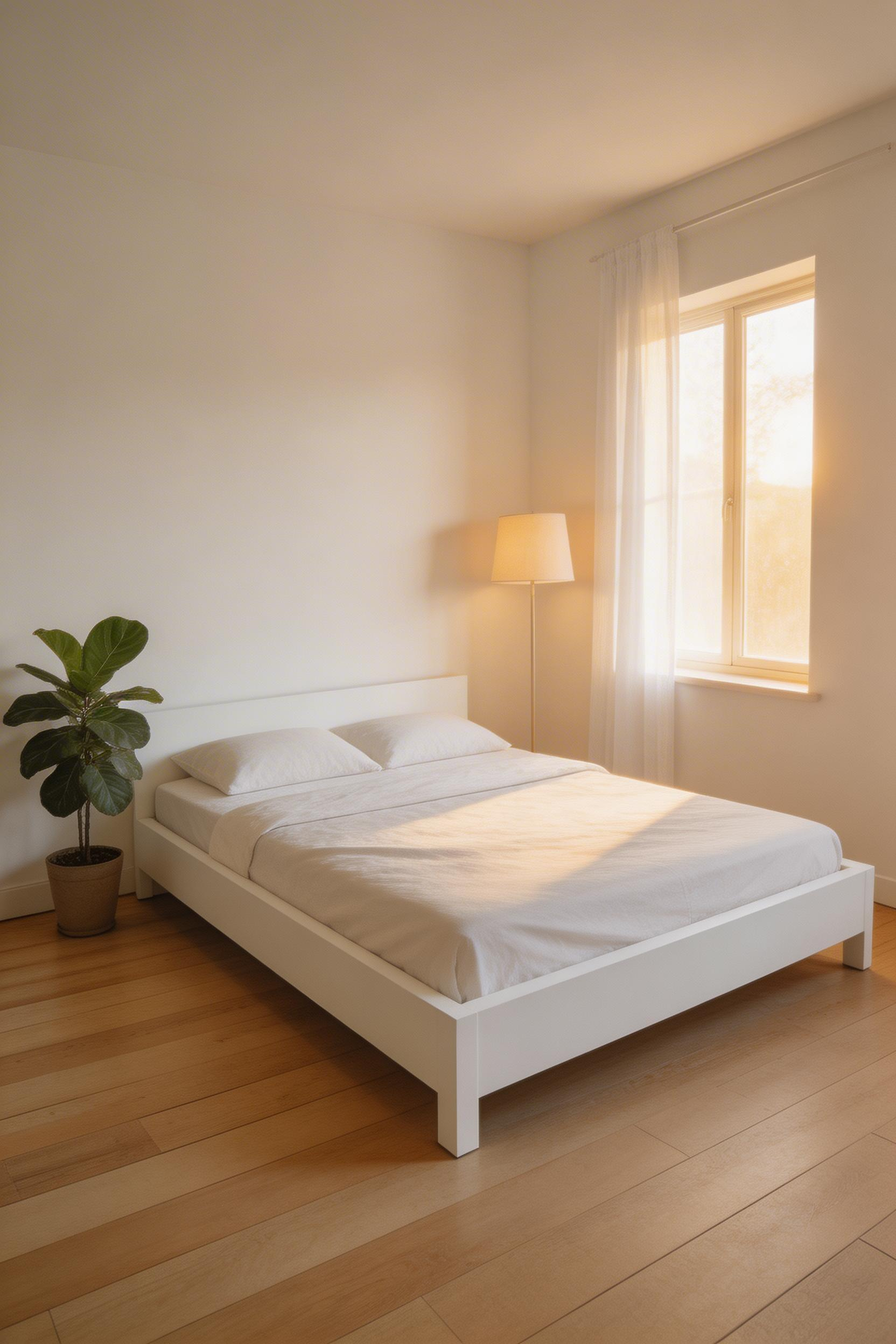
Diagonal lines running at 45 degrees to the room’s primary axes are processed by the brain as longer than equivalent horizontal or vertical lines. Controlled experiments have shown rooms feel 15–20% larger when key elements introduce diagonal orientation. That’s not nothing in a 100-square-foot room.
When This Layout Works — and When It Doesn’t
A queen bed at 45 degrees occupies a square footprint of roughly 99×99 inches. That needs a room at least 12 feet wide to avoid blocking the door. In a room under 10×10 feet, use a full instead — its diagonal footprint is approximately 90×90 inches. Also, this layout works only in rooms with few doors and windows. If walls are interrupted by multiple openings, the diagonal bed will conflict with at least one. Test it using furniture moving sliders before committing. The IKEA Malm Low Bed Frame ($229–$279) is an inexpensive way to trial this arrangement without a major commitment.
6. The Floating Furniture Layout
The most important single factor in how spacious a small room feels isn’t wall colour, window size, or ceiling height. It’s visible floor area. Research on perceived room size consistently ranks uncovered floor as the most significant spaciousness cue in rooms under 120 square feet. A floating furniture layout builds on this: put everything on walls and keep the floor completely free except for the bed frame.
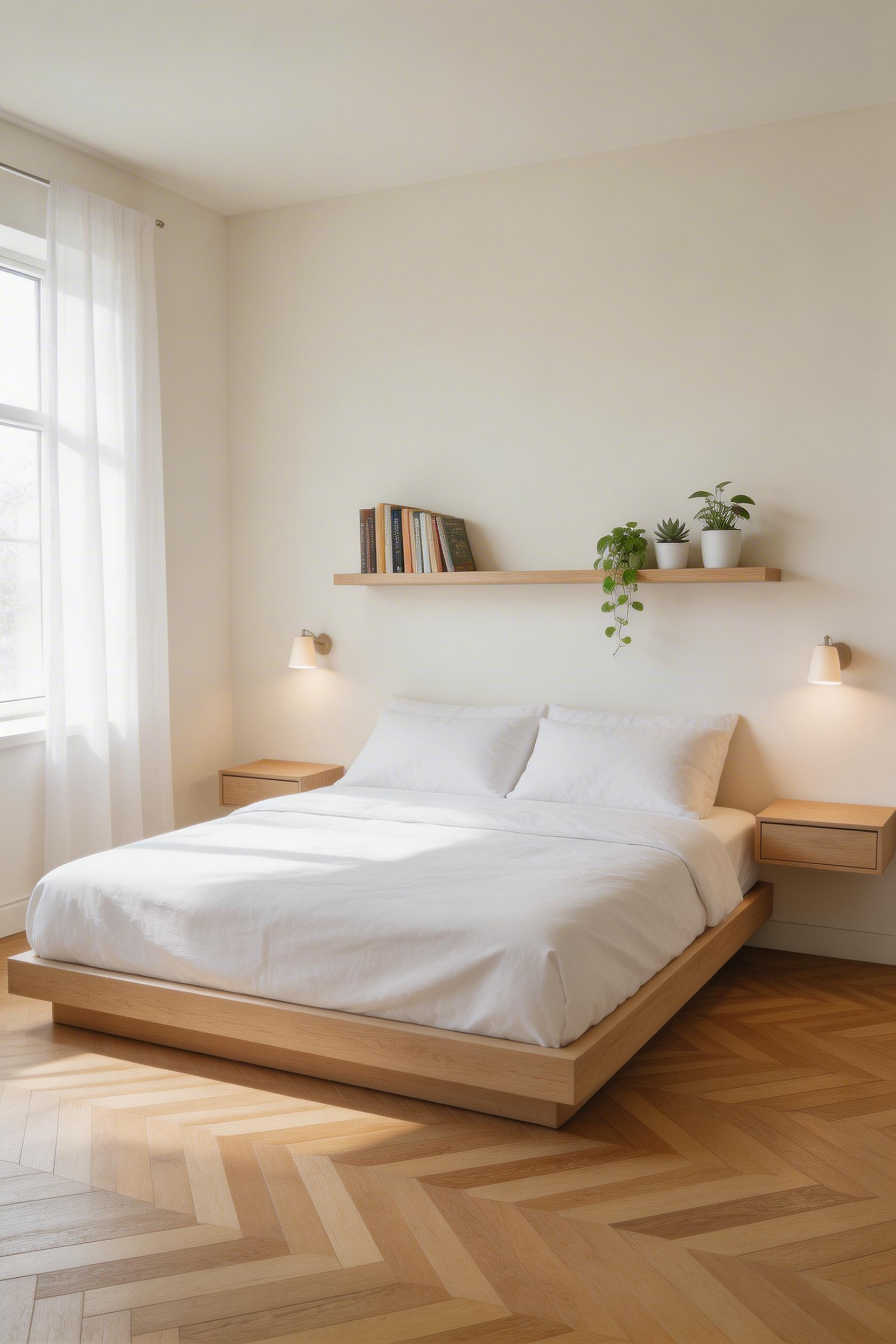
A standard 6-drawer dresser takes up approximately 6 square feet of floor space. Replacing it with a wall-mounted IKEA Eket cabinet system ($75–$250 depending on configuration) returns that floor to the room. It also creates a clear sightline to the skirting board. That exposed band of floor at the base of the wall is a disproportionately powerful spaciousness cue. The String Pocket Wall Shelf System ($180–$350 per panel) offers a more refined version of the same idea, with load ratings up to 66 pounds per bracket.
The Practical Side of Wall-Mounting Storage
Most wall-mount storage systems require anchoring into studs or using large toggle bolts rated for the load. A stud-anchored bracket holds 100+ pounds; a quality toggle bolt handles 25–50 pounds. If walls are in poor condition or you’re in a rental, free-standing narrow shelving under 12 inches deep from floor to ceiling mimics the floating effect. No drilling required. Install floating bedside shelves 18–24 inches above the mattress top — that’s natural reach height for a lamp, phone, and water glass. Among all the small bedroom layouts here, this one requires the most planning. It also consistently delivers the most dramatic visual result.
7. The Single-Wall Wardrobe Plan
Wardrobe storage is often the biggest challenge in a small bedroom. Dresser here, hanging rail there, shoe rack somewhere, boxes under the bed. The single-wall wardrobe plan resolves this by consolidating every storage function onto one wall. In doing so, it frees every other wall and all of the floor — one of the cleanest arrangements a small bedroom can have.
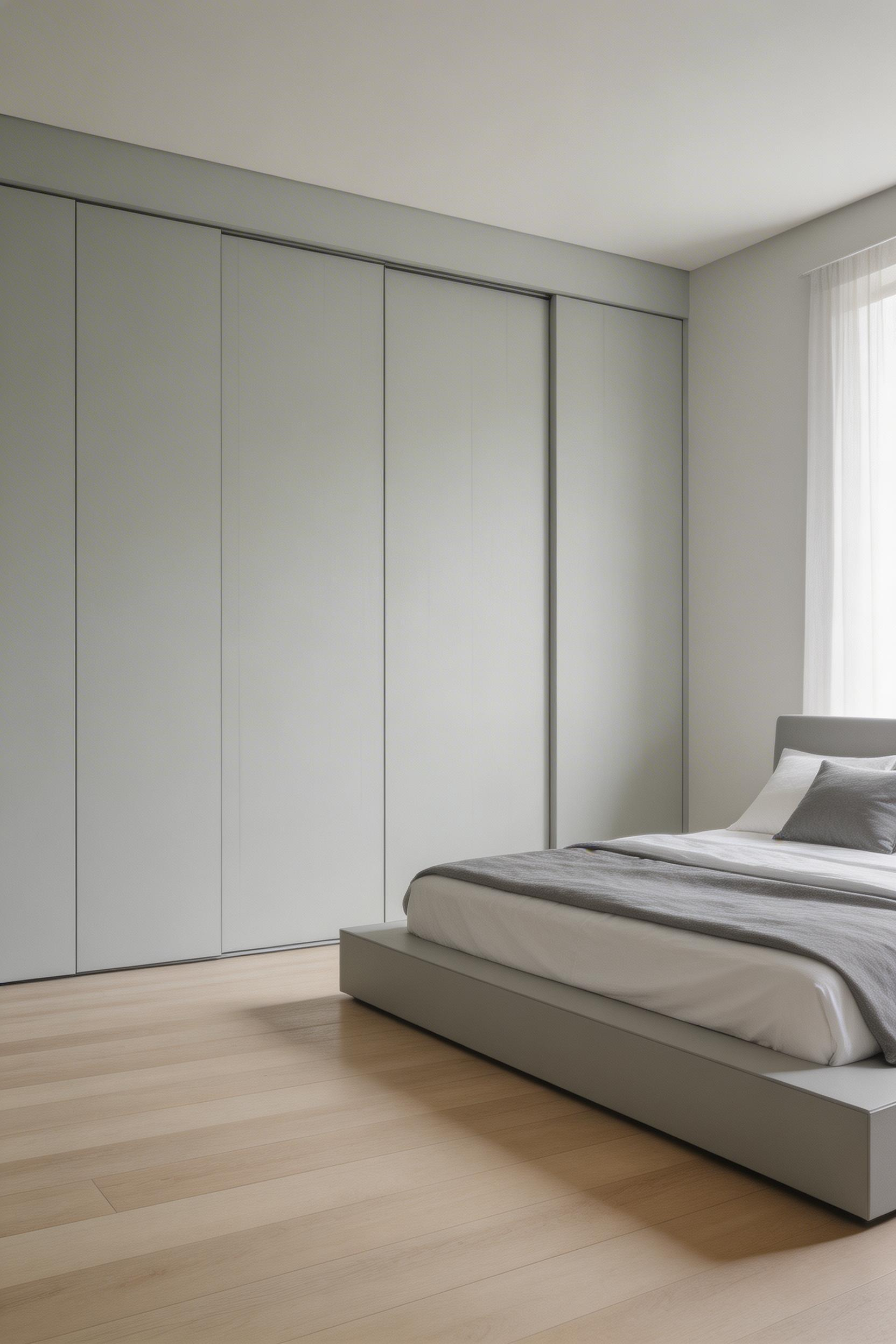
A standard reach-in wardrobe is 24 inches deep. In a 10-foot-wide room, a full-wall wardrobe leaves 96 inches of remaining width. That’s enough for a queen bed (60 inches) with 36 inches of clear circulation on one side. Sliding door wardrobes are strongly preferable over hinged ones in small rooms. No door swing means no furniture needs to be set back to allow clearance. An IKEA PAX system with Hasvik sliding doors runs $350–$700 depending on width. For more detail on clearance and placement principles, the bedroom furniture layout guide covers the key measurements worth knowing before ordering.
The Colour Trick That Makes It Disappear
Paint the wardrobe doors the same colour as the walls. The full wall then reads as a single continuous plane rather than a large piece of furniture. The room appears to have no wardrobe at all — just space. It’s a detail I use in almost every small bedroom project. This approach also reduces total furniture pieces from 4–5 (wardrobe, dresser, chest of drawers, shoe rack, bedside tables) down to just 2. That reduction in visual complexity is something people notice immediately.
8. The Nook or Alcove Bed Arrangement
Alcove beds — sleeping areas enclosed on three sides — are one of the oldest small bedroom layouts in history. The French ‘lit clos’ of Brittany, the Norse ‘seng’, and the Japanese sleeping nook all arrived at the same conclusion independently. Enclosing the sleeping zone on three sides creates warmth, privacy, and a genuine sense of sanctuary. Modern small bedrooms can use the same idea, whether there’s a natural architectural alcove available or not.
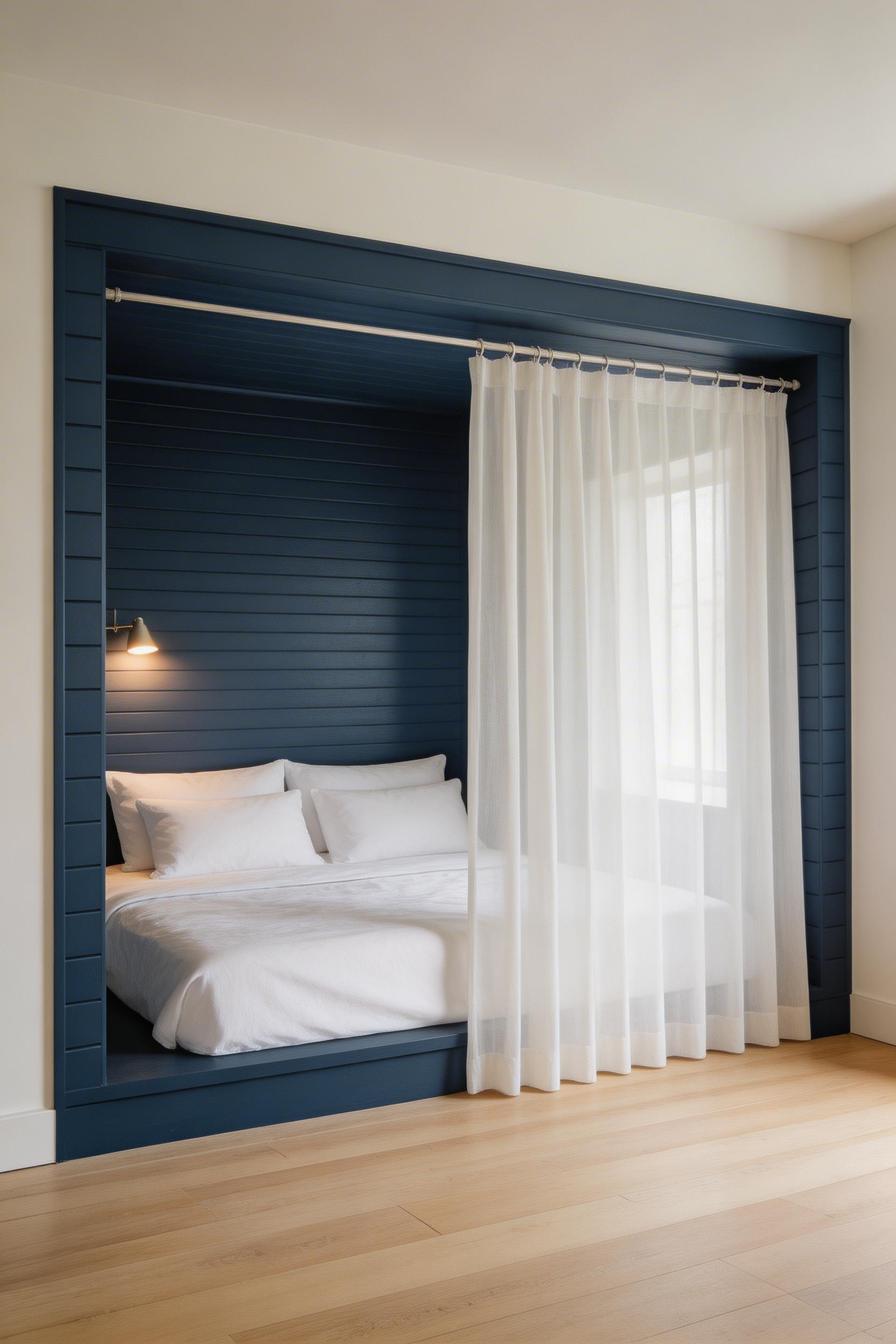
If the room has a natural recess — a chimney breast projection, a doorway nook, or an uneven wall — the alcove layout is almost free to create. For rooms without a natural recess, a simple three-sided frame built from 2×4 lumber and drywall costs under $300 in materials. It can be completed over a weekend. The internal dimensions need careful planning: a queen alcove needs a minimum internal width of 63 inches, minimum depth of 82 inches, and at least 36 inches of clearance above the mattress surface. For small bedroom design ideas that work well within framed sleeping zones, the principles in this bedroom design for small rooms overview apply directly.
The Curtain Finish
Install a curtain rod across the full opening of the alcove. A full-length linen curtain that draws closed at night turns the nook into a genuinely separate zone. Some sleep researchers suggest this kind of visual enclosure supports better sleep in open-plan or shared living. It reduces peripheral light and movement cues. The Pottery Barn Build-Your-Own Storage Bed ($2,400–$3,200) creates a close approximation of the alcove effect with integrated storage. A more affordable version uses the IKEA Hemnes bed flanked by two Malm 3-drawer chests. Total cost: $600–$900, and the visual result is convincingly built-in.
9. The Under-Bed Storage-First Layout
In most bedroom planning, the bed gets chosen for how it looks and storage is figured out afterwards. The under-bed storage-first layout inverts this. Start with the storage requirements, choose the bed frame that meets them, and let that frame define the rest of the room. It sounds like a minor shift. In practice, it changes every furniture decision that follows.
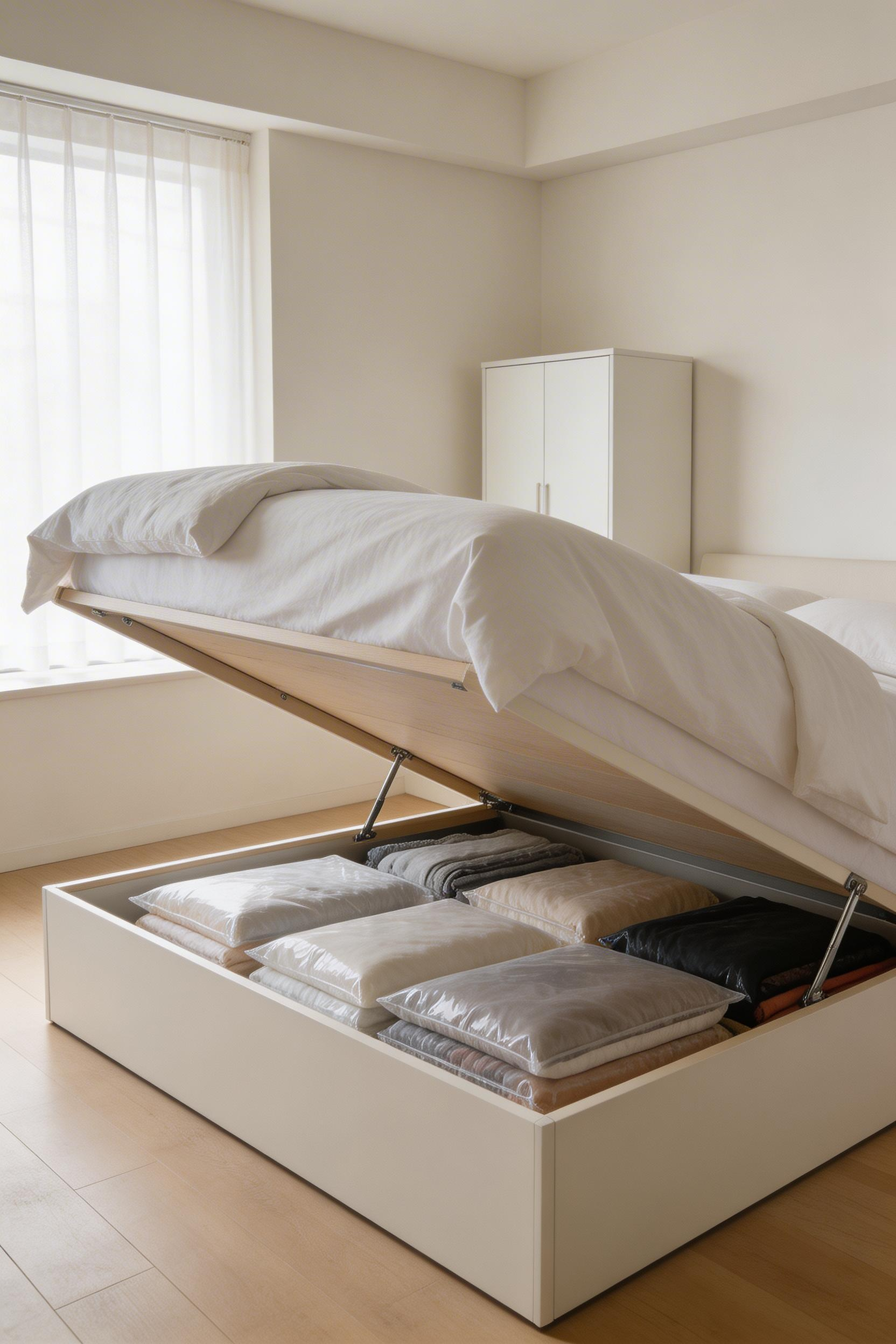
The space under a standard bed on legs 7 inches or higher represents 20–30 square feet of potential storage. That’s the equivalent of a full-size dresser. Frames with individual drawers (like the Zinus Compack Platform Bed with Storage, $249–$299) offer 6.5 inches of internal drawer depth. A gas-lift platform provides access to the entire under-bed volume. In a queen size, that’s approximately 45 cubic feet — far more versatile than fixed drawers. If budget allows, the gas-lift is the better choice. Fixed drawers are limited to items that fit their set dimensions; the open space adapts to anything.
What to Store There
Under-bed storage works best for items used weekly or less: seasonal clothing, extra bedding, shoes, and archived books. For rooms already working the small bedroom decor principle of eliminating excess, the under-bed zone becomes the final repository for everything that can’t be edited out. In a room with a storage bed, it’s often possible to remove the chest of drawers entirely. That’s a meaningful reclamation of floor space with no sacrifice in storage capacity.
10. The Minimalist Two-Piece Layout
Of all the small bedroom layouts I’ve worked with, this is the one I recommend first to anyone who comes to me frustrated by their room. Strip the furniture to just two pieces: a bed and one storage unit. That’s it. No dresser and wardrobe — choose one. No bedside tables (use wall-mounted shelves instead). No extra chair that becomes a clothes pile by Tuesday.
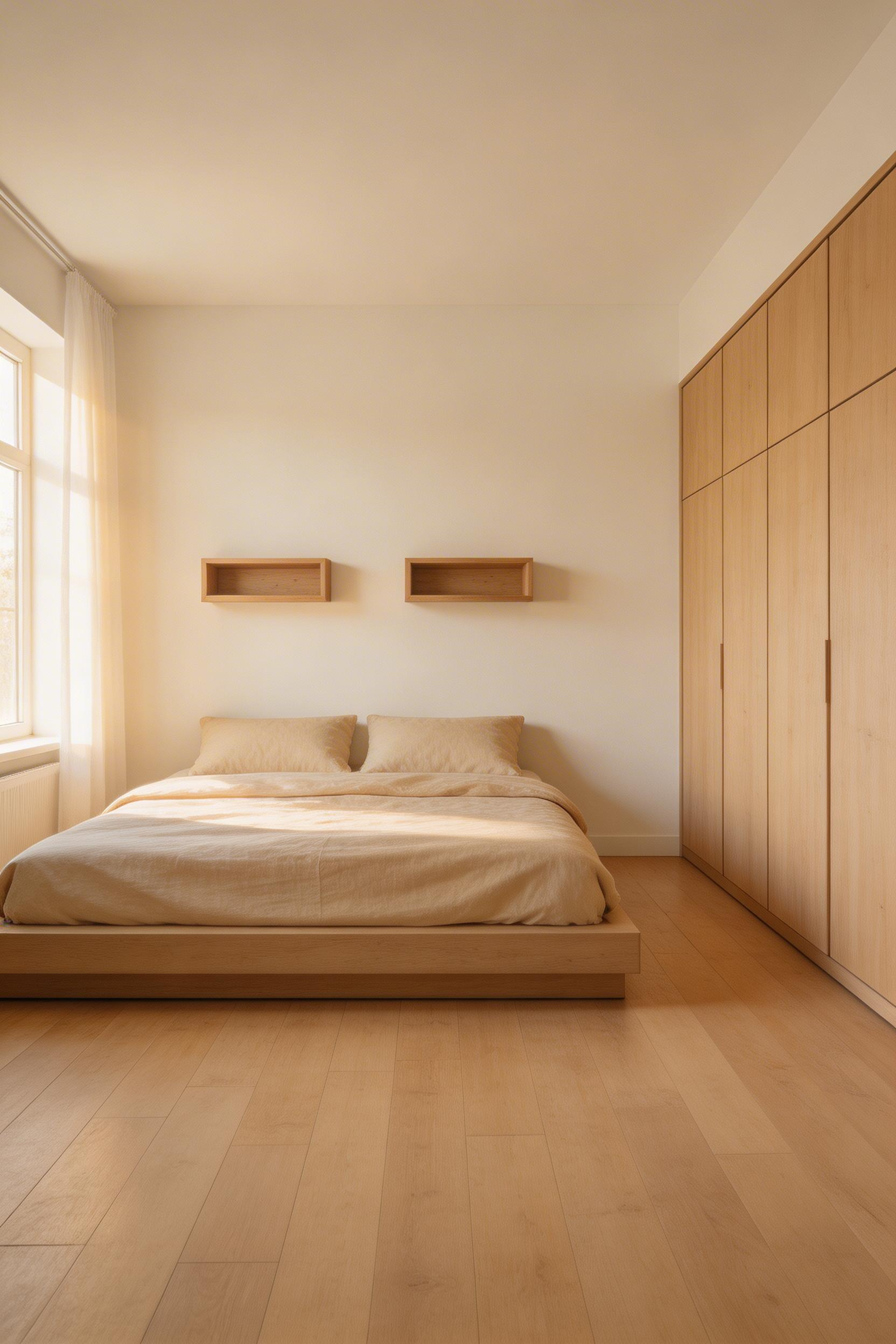
Research from the National Sleep Foundation links bedroom clutter directly to sleep quality. A 2019 study found that visual complexity in the sleeping environment correlated with higher cortisol levels at bedtime and reduced sleep efficiency. Removing furniture removes decision fatigue. It reduces dust accumulation. It also makes the cleaning routine simpler — and all of that contributes to a room that actually functions as a place of rest.
The Discipline This Layout Requires
This layout only works if you first address the possessions filling the furniture you remove. In my experience, most people find that 30–40% of what lives in their bedroom doesn’t need to be there at all. But the two-piece layout also reveals something useful. When only two pieces of furniture occupy a room, the quality and proportion of each one becomes much more visible. So this is the layout that makes the best case for buying one genuinely good piece rather than several mediocre ones. The IKEA Nordli Modular Chest of Drawers ($150–$350) is the budget option; the HAY New Order Storage System ($900–$1,800) is the long-term investment. For anyone exploring bedroom makeover ideas with a focus on wellbeing, this is the framework to start from.
11. The Desk-Behind-the-Headboard Setup
Working from a small bedroom is a reality for many people. Yet placing a desk in a bedroom is one of the most frequently cited causes of sleep disruption in small-space living. The visual cue of work equipment in the same room undermines the brain’s association between the space and rest. The desk-behind-the-headboard setup solves this with a neat piece of spatial geometry.
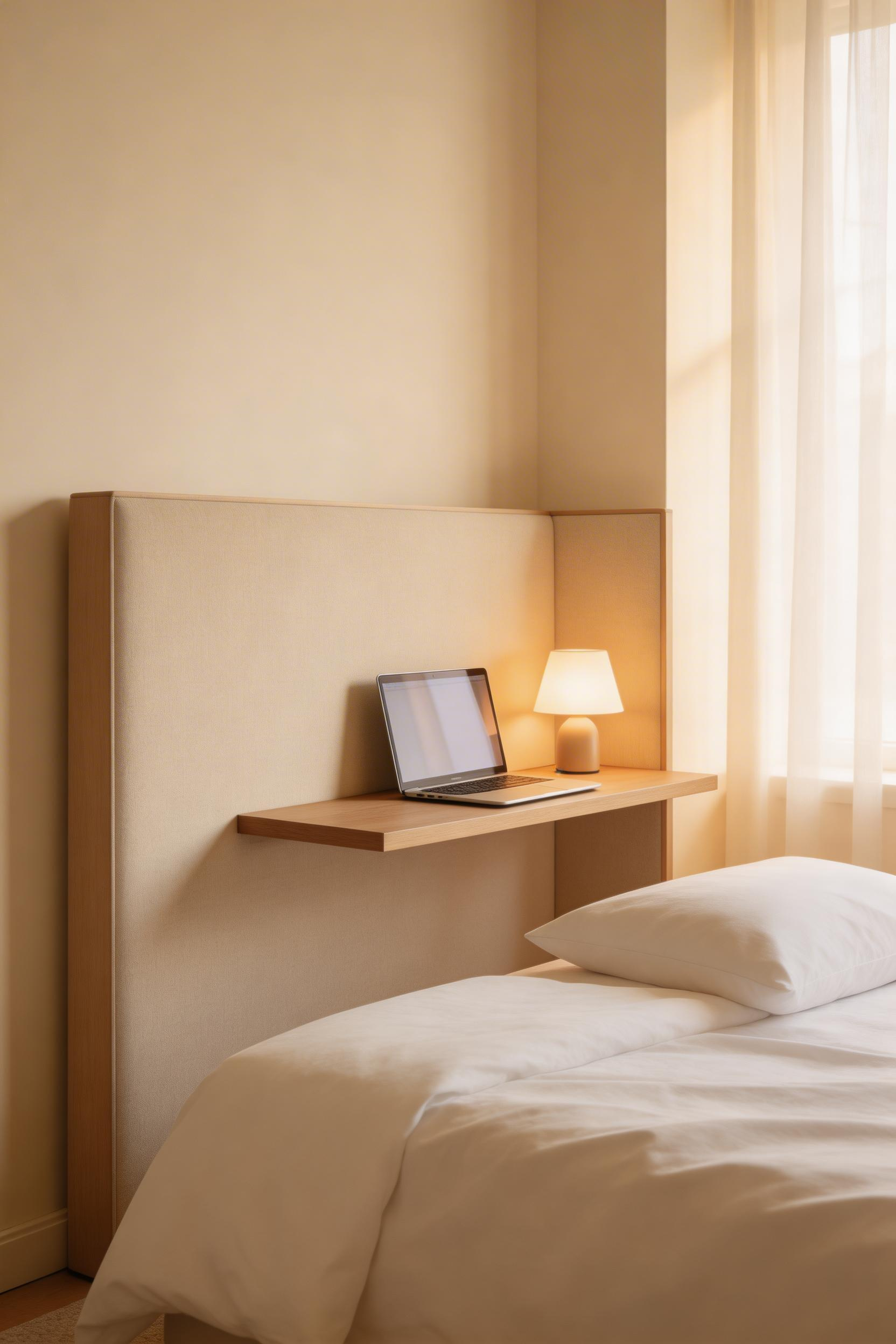
The setup requires a freestanding or floating headboard — not one attached to the bed frame — positioned 18–20 inches from the wall. This creates a work pocket behind it. The desk surface itself needs to be only 14–16 inches deep for a laptop-only setup. A Nathan James Telos Floating Wall Desk ($129–$149) folds flat when not in use. The folded position drops the surface behind the headboard, making the desk effectively invisible at night. The IKEA Micke Desk (47 inches wide, 19.5 inches deep, $179) is also shallow enough to fit behind most standard headboards.
Why the Divider Matters
Sleep researchers consistently advise separating the visual cues of work and sleep even in single-room living. The headboard as a physical divider achieves this without adding a room divider screen. However, the psychological separation only works if the desk surface is cleared at the end of the day. A fold-down desk behind the headboard makes this easy. Folded, it takes up no visual space at all. For apartment bedroom decor contexts where the room doubles as a home office, this is the most spatially efficient arrangement available.
12. The Mirrored Wardrobe Trick Layout
Interior design research confirms that strategically placed mirrors can increase the perceived size of a room by 15–25%. The most significant effect comes when mirrors reflect natural light rather than blank walls. A full-height mirrored wardrobe across one wall does both. It doubles the apparent depth of the room and bounces window light across every surface.
Position matters considerably here. Mirrored panels placed opposite or adjacent to the window create the light-amplification effect. Mirrors directly opposite the bed, however, are sometimes discouraged. Both feng shui principles and some sleep researchers flag reflective movement as a potential sleep disruptor. Positioning the mirrored wardrobe on the wall perpendicular to the bed avoids this concern while still achieving the full visual depth effect. The IKEA PAX system with Auli mirror sliding doors ($450–$750 for a full wall) is the most affordable route. The Sliding Door Company offers custom frameless panels ($800–$2,500) for rooms with non-standard dimensions.
The No-Install Alternative
If a full mirrored wardrobe isn’t possible — rental restrictions, awkward wall dimensions, or budget — a single large leaning mirror (60×20 inches or larger) against the wall adjacent to the window achieves about 60% of the same visual effect. Cost: $50–$150. No installation, no drilling, no permanent commitment. Among the small bedroom layouts on this list, the mirrored approach consistently surprises people most. The room feels immediately and obviously different.
13. The Zoned Small Bedroom Layout Using Rugs
A single well-sized rug under the bed is one of the most underrated tools in small bedroom layouts. The rug anchors the sleeping zone, making it feel deliberate and contained. By contrast, the surrounding floor reads as a distinct circulation space rather than leftover area. The result is a room that feels zoned even when it physically has only one function.
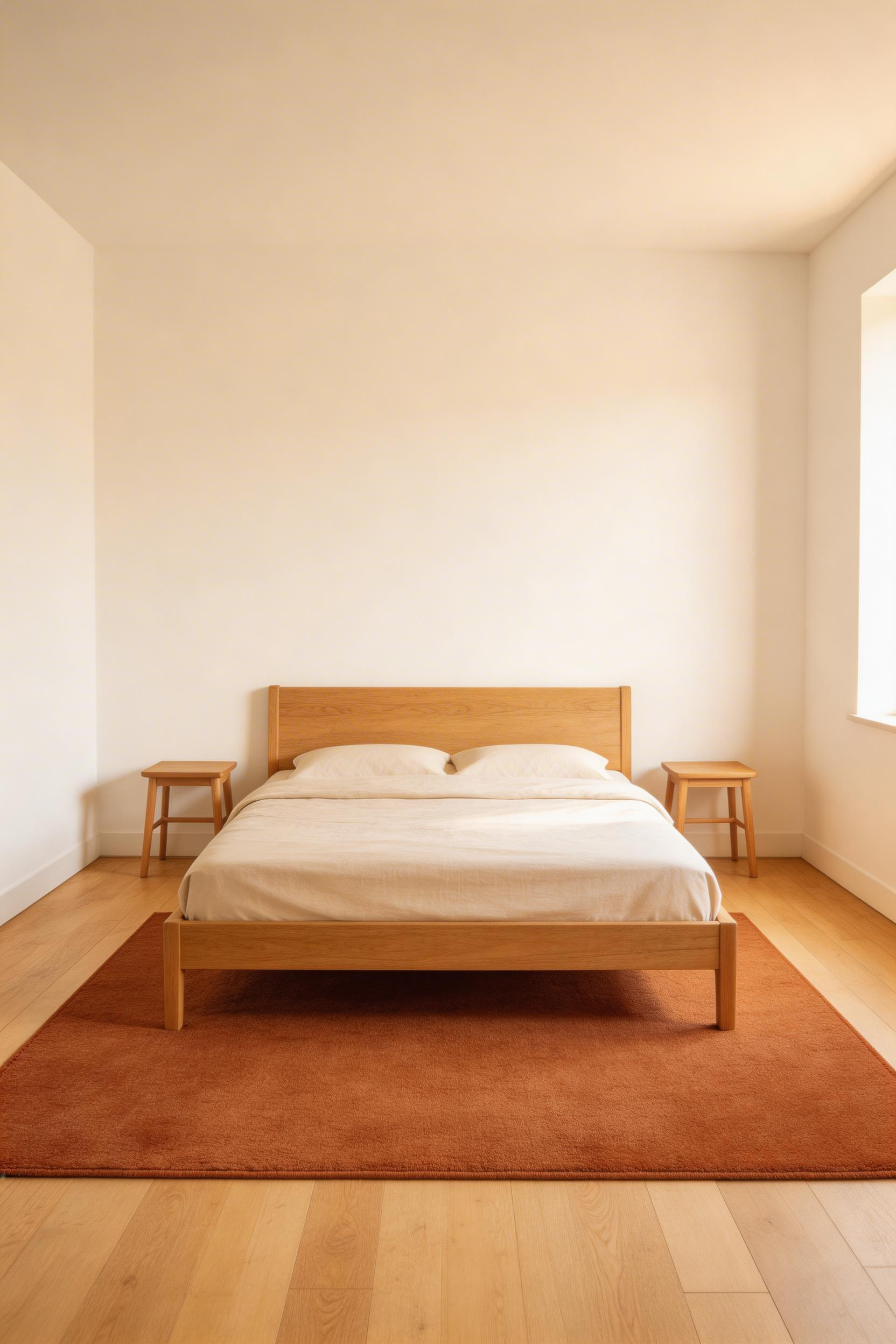
The most common mistake with bedroom rugs is choosing one too small. A rug should extend at least 18–24 inches on each accessible side of the bed and 12 inches at the foot. For a queen bed, the minimum effective rug size is 8×10 feet. For a full, 6×9 feet is the minimum. Anything smaller leaves the rug looking like a bath mat beneath a large piece of furniture. Houzz interior design surveys (2023) identified incorrect rug sizing as one of the top five most frequently corrected mistakes in small bedroom renovations. The overwhelming error is always too small, never too large.
Material Choice in a Small Room
Keep to low-pile rugs (under 0.5 inches) in small bedrooms. High-pile or shag rugs trap dust and skin cells more readily. They can also make the room feel visually heavier. The Ruggable Washable Rug ($269–$399 for 8×10) is a practical choice. Its machine-washable two-piece system makes maintenance straightforward in a space where dust accumulates quickly. The IKEA Stoense Low Pile Rug ($99 for 6.5×9.8 feet) is excellent value for renters. In a room under 100 square feet, going one size larger than instinct suggests actually makes the space feel bigger. More covered floor means less visual fragmentation at the perimeter.
14. The Vertical Storage Layout
Every small bedroom has an unused zone: the top 24–30 inches of every wall, above comfortable reach height (roughly 60 inches for most adults). A vertical storage layout claims this zone and works downward from ceiling height. Rather than stopping storage at head level and leaving a band of dead space above, it fills the room’s full vertical extent.
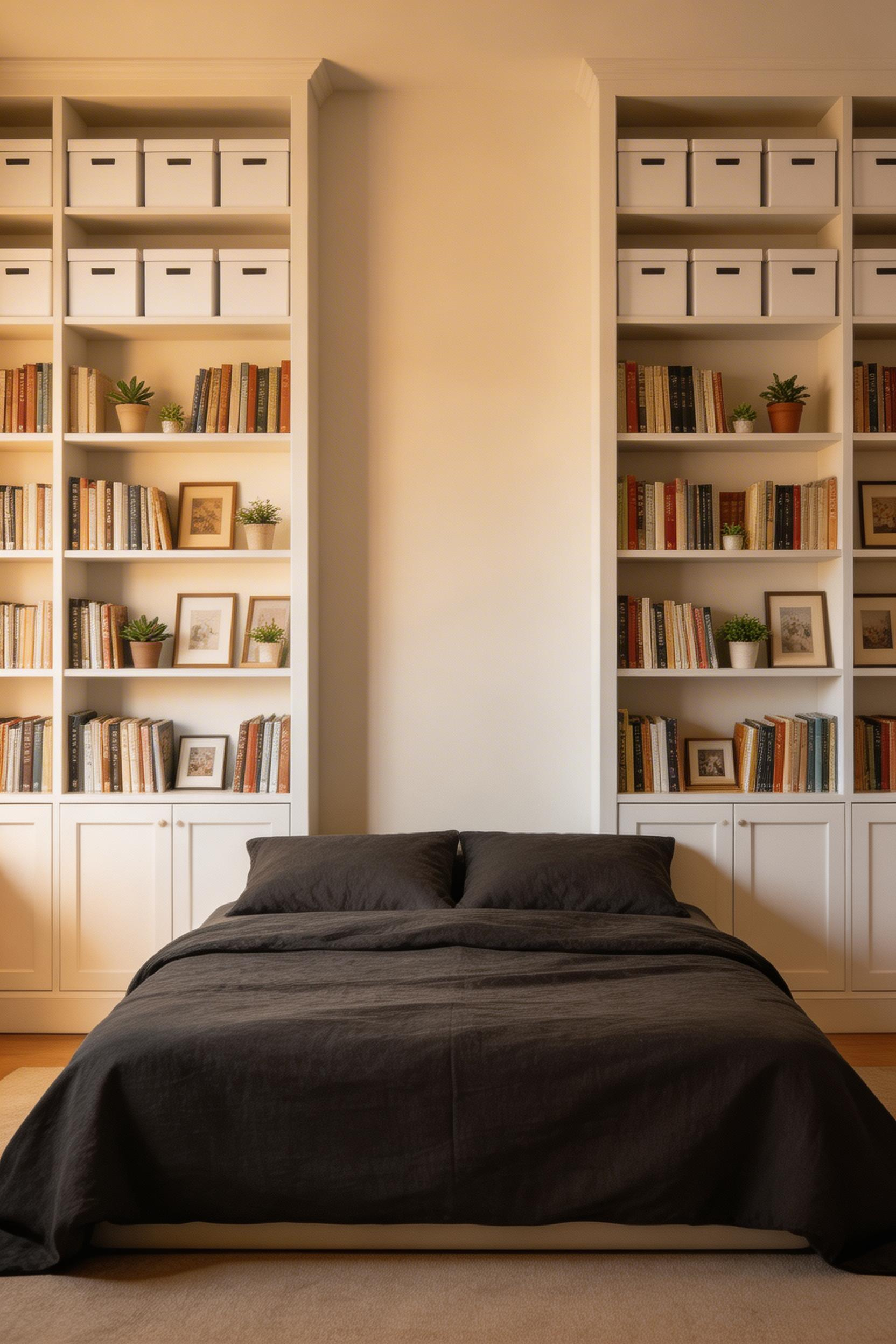
The visual effect is straightforward. Vertical lines draw the eye upward. The brain reads the space as taller. Also, the storage gain is substantial — a floor-to-ceiling bookcase holds 30–50% more than a standard-height equivalent at roughly the same cost. The IKEA Billy Bookcase with Oxberg Extension ($100–$150 per unit) reaches 93.5 inches — at or near standard 8-foot ceiling height. Two units side by side fill a 63-inch wall section for under $300. For a more adjustable system with heavier load ratings, the Container Store elfa Shelving ($300–$1,200) uses wall-mounted rails and supports 100 pounds per bracket.
Styling the Unreachable Zone
The top 24–30 inches of a vertical shelving wall should hold items used monthly or less: seasonal décor, rarely opened boxes, archived materials. Style this zone with matching boxes or baskets rather than random items. IKEA Samla storage boxes ($4–$8 each) in matching sizes make the top section look intentional rather than dumped. That’s the difference between storage that feels curated and storage that looks like overflow. This vertical principle is also one of the best-value changes in any small bedroom layouts project — it costs almost nothing to implement but changes the room’s proportions visibly. For more on how sleep environment affects rest, the principles in this bedroom interior design overview are directly relevant here.
15. The Flexible Furniture Layout Using Stools and Ottomans
The last of these small bedroom layouts addresses a specific problem. The more furniture is fixed in place, the less adaptable the room becomes. Replacing bedside tables — which typically anchor two fixed points in the layout — with movable stools or storage ottomans gives the room a flexibility that static furniture can’t match.
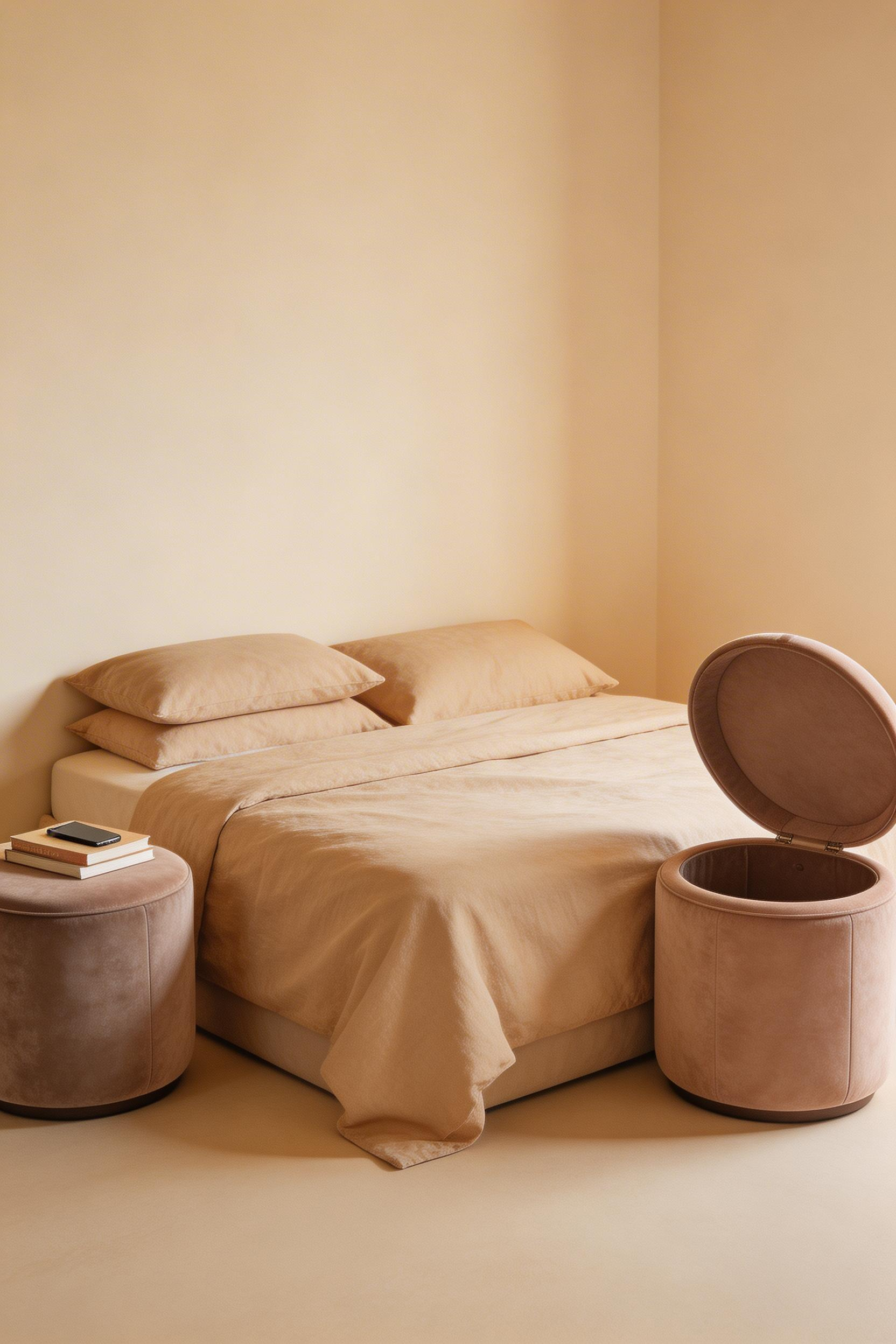
A round stool takes up roughly 60% of the floor space of a rectangular bedside table. It can slide to the foot of the bed, double as guest seating, or tuck under a desk when not needed. Storage ottomans add interior volume on top of that: the Threshold Velvet Ottoman Cube ($35–$45 at Target) holds approximately 1 cubic foot of storage while supporting 150 pounds as a seat. For ergonomics, look for pieces in the 22–26 inch height range for use beside a standard-height bed (mattress surface at 25 inches). A 2022 furniture industry study found that multi-functional pieces were the fastest-growing category in small-space furniture. Consumers reported 40% higher satisfaction with their bedroom layouts when at least two furniture pieces served dual functions.
Two Ottomans, One Immediate Upgrade
Two matching CB2 Blox Upholstered Storage Ottomans ($129–$149 each) used as bedside tables are genuinely one of the most flexible investments in small bedroom layouts for under $300 total. But the principle scales down even further. Two Threshold Ottoman Cubes from Target at $35–$45 each solve the same problem for under $100. For anyone working through small bedroom layouts on a budget, replacing fixed bedside tables with movable stools is typically the simplest single change to make — and one that immediately makes the room feel more adaptable.
Finding the Small Bedroom Layout That Actually Works for You
Small bedroom layouts aren’t a matter of choosing the most popular option. The right layout depends on a specific combination: how you use the room, what furniture you’re not willing to give up, and the practical dimensions you’re working within.
That said, a few principles apply across almost every compact bedroom. Start with the bed position — it occupies the most floor space and determines every other decision. Claim the vertical zone above 60 inches, because it’s almost always unused. Consolidate storage rather than distributing it across multiple pieces. And be honest about what the room actually needs versus what’s in there out of habit.
The minimalist two-piece layout is, in my view, the best starting framework for anyone genuinely stuck with their small bedroom. Not because minimalism is a style goal, but because stripping back to essentials reveals the actual spatial logic of the room. From that baseline, each of the 15 layouts above adds back only what’s necessary. That’s how a small bedroom stops being a compromise and starts being a room that genuinely works.