Most dining room lighting decisions get made backwards. People choose a fixture they love in a showroom, install it, and then wonder why the room still feels flat at dinner. The problem is almost never the fixture — it’s the assumption that any dining room lights over the table will do the job.
Dining room lights are the invisible conductors of every meal you share in that space. The colour temperature affects how food looks and how long people linger. The fixture height determines whether the table feels like a gathering place or a cavernous hall. The material of the shade changes the quality of light hitting the faces around it — warm and diffused, or harsh and direct. These are the distinctions that actually matter, and they’re what this guide is built on.
As a wellness design consultant who works at the intersection of environment and human wellbeing, I’ve spent years researching how light — specifically its warmth, direction, and quality — shapes the way we experience our homes. The right dining room lights don’t just illuminate a table. They change how people talk, eat, and feel. These 18 options span every style and ceiling height, with the specific details you need to choose well.
1. Classic Drum Shade Pendant — Versatile and Timeless
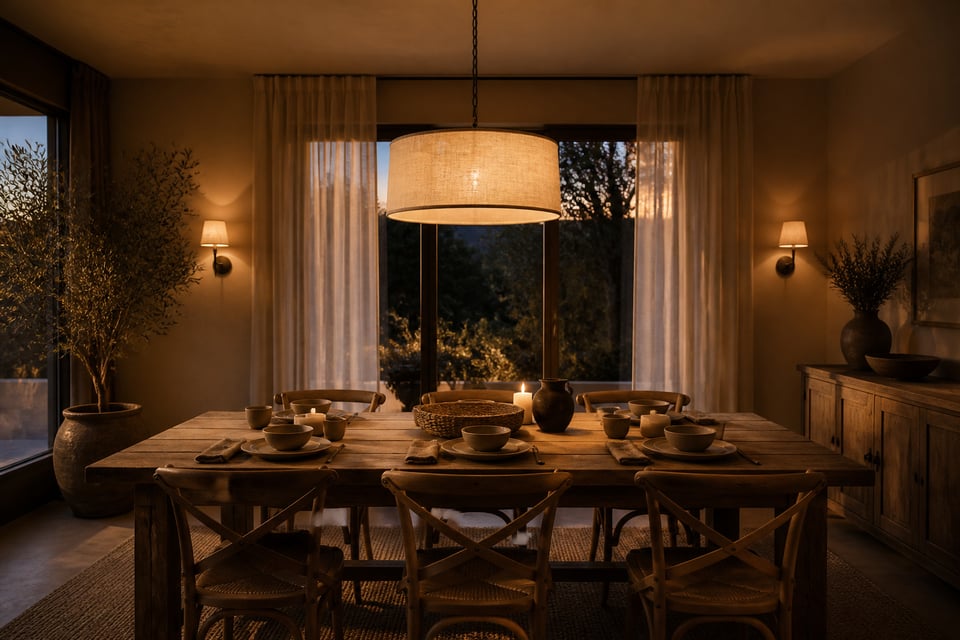
There’s a reason the drum shade pendant appears in more dining rooms than any other fixture style. Its cylindrical geometry commits to nothing — it doesn’t declare a period, announce a style, or require a specific aesthetic to make sense. A linen drum shade looks right above a Shaker-style table and equally appropriate above a contemporary one. As dining room lights go, that adaptability is genuinely rare.
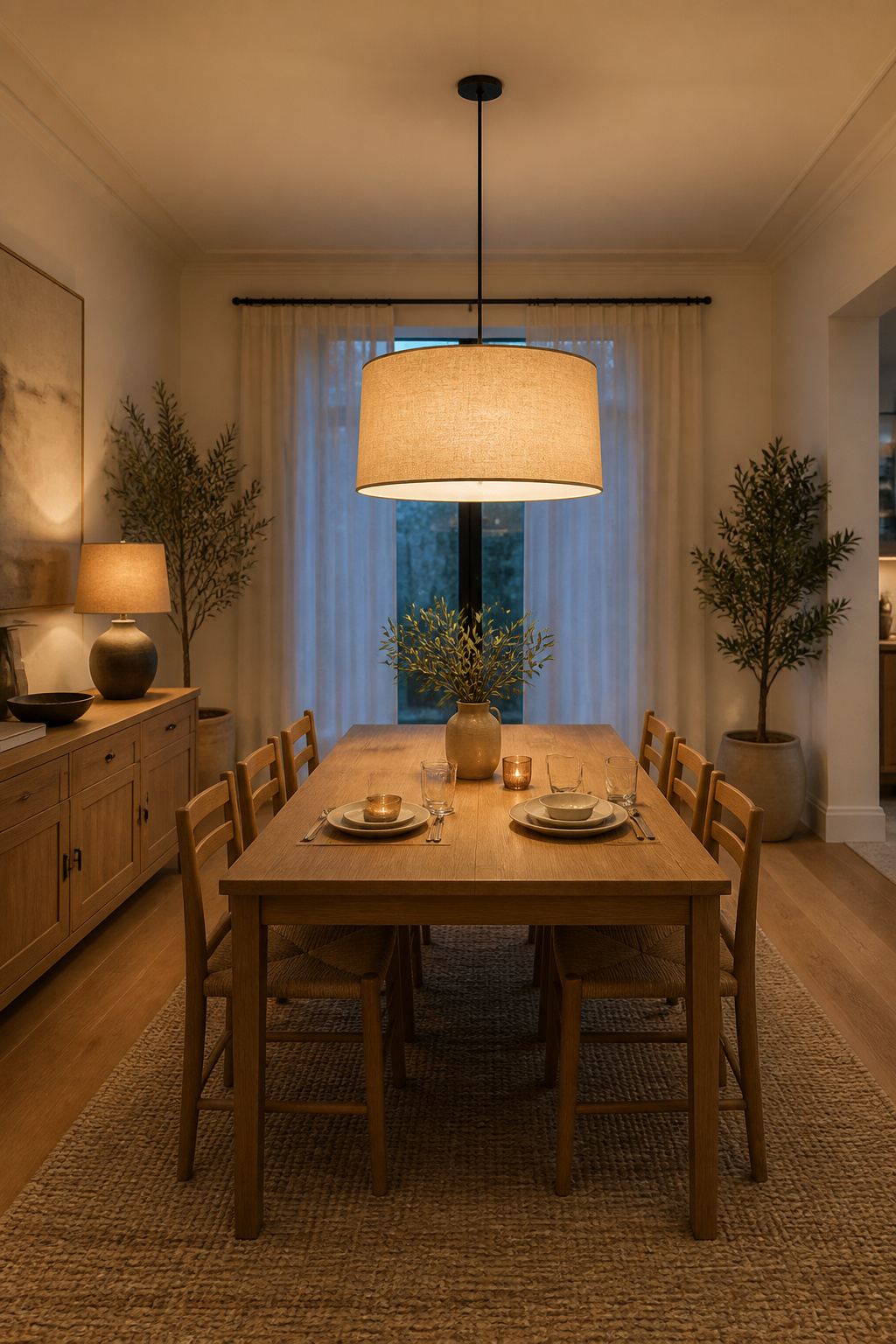
The sizing logic is straightforward and worth following precisely. The shade’s diameter should be between half and two-thirds the width of your dining table. For a 48-inch-wide table, that means a 24–32-inch drum. What most people miss is the distinction between fabric and metal: a solid fabric drum shade reads considerably heavier than its measured diameter suggests, because the eye has nothing to see through. The same fixture in perforated metal or linen with visible light transmission looks noticeably lighter at the same size. Plan your sizing with the material in mind.
Linen and cotton fabric shades transmit roughly 20–30% of light through their walls, which creates that warm amber glow around the shade perimeter rather than a sharp downward beam. From a wellness standpoint, this diffused quality is the right light for dinner — it softens the room rather than spotlighting individual faces. If the dining area sits adjacent to an active kitchen, choose a faux-linen or synthetic blend that can be wiped down; genuine fabric accumulates cooking vapours faster than most people realise.
2. Pendant Clusters for a Layered Dining Room Lighting Effect
A single pendant centred over a long rectangular table creates one bright zone in the middle and leaves both ends in shadow. You end up with a technically lit table and a psychologically dim dining experience. Multi-pendant clusters solve this by distributing light — and visual interest — along the table’s full length.
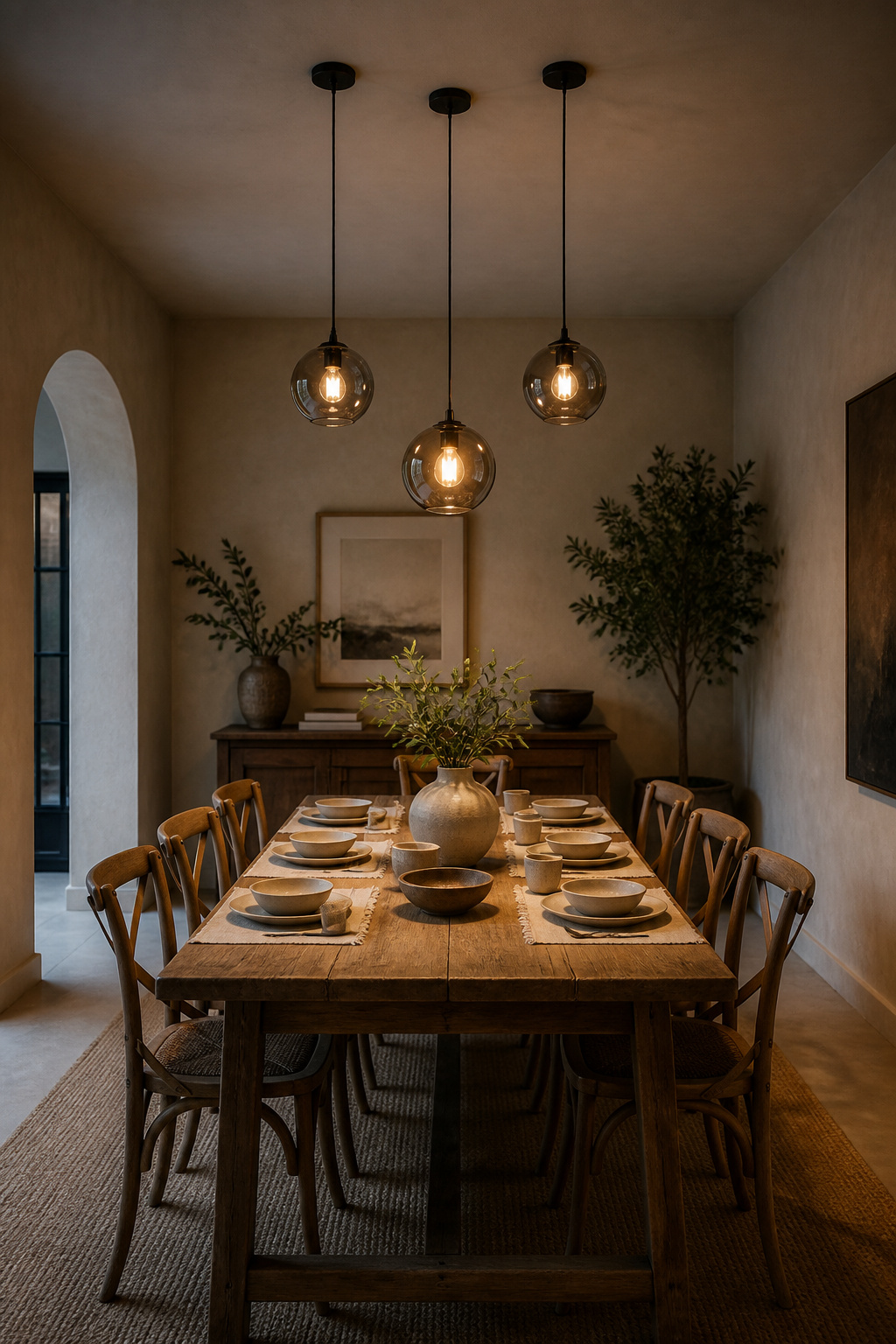
The proportions matter more than the style. Leave 24–30 inches of clearance between the outer edges of adjacent pendants. For three pendants in a row over a 7- or 8-foot table, position the two outer fixtures 4–6 inches higher than the central pendant to create a soft arc — this frames the table without blocking cross-table sightlines. Matching shades in different heights look designed; wildly different styles in different heights look accidental. For kitchen lighting over table situations where the space does double duty, clustering three small globes works better than one large pendant because the distributed light covers more functional area without sacrificing atmosphere.
Electrically, single-canopy systems (one ceiling box, multiple cord feeds) are the cleanest installation. Multi-canopy systems distribute weight better and allow for minor ceiling-box offset correction, which matters if your existing junction box isn’t precisely centred over the table. Check the ceiling box’s weight rating before committing to a heavy glass cluster — most standard residential boxes are rated to 25–35 lbs, and a substantial cluster can push that limit.
3. Statement Chandelier That Anchors the Entire Room
A chandelier changes the experiential weight of a dining room in a way no other single fixture can. It is the room’s focal point by design — everything else orbits it. The critical error people make with these dining room lights is undersizing them and hanging them too high, which produces the effect of a pendant floating lost in space above an unconvinced table.
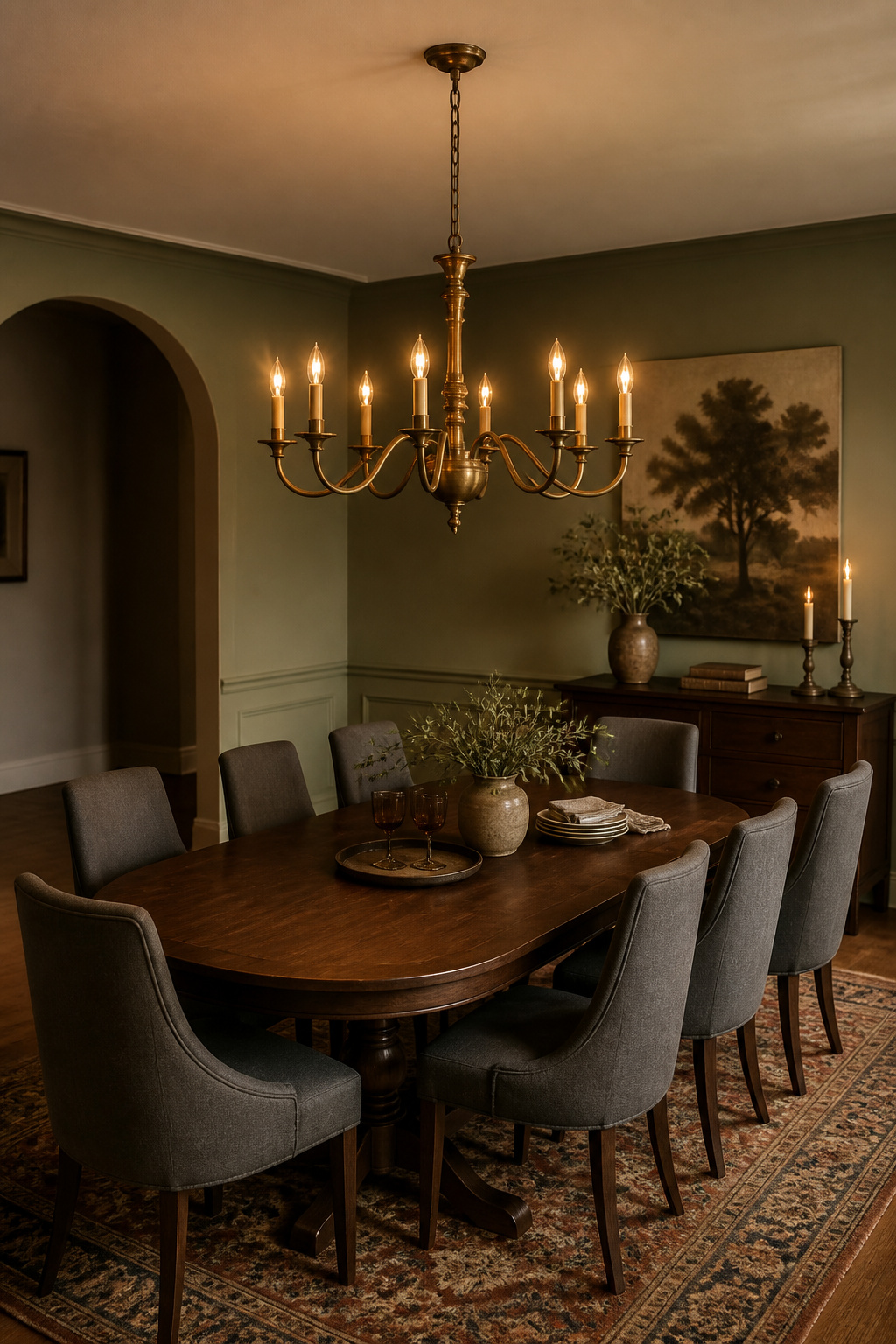
The sizing formulas are reliable. For the room itself: add the length and width in feet, and the sum in inches is your chandelier’s ideal diameter. A 10 x 12 dining room suits a 22-inch chandelier; a 14 x 16 room suits a 30-inch fixture. Over the table specifically, the chandelier should measure 1/2 to 2/3 the table width — a 60-inch table works with a 30–40-inch chandelier. Hang it at 30–34 inches from the table surface for standard 8-foot ceilings, adding 3 inches for every additional foot of ceiling height above 8 feet.
For material choices: brass reads as warm and organic, currently the dominant finish in wellness-oriented interiors, pairing naturally with wood tables, rattan chairs, and linen textiles. Matte black is graphic and contemporary — right for Scandinavian, industrial, or modern farmhouse dining rooms, paired with dark wood and concrete or stone surfaces. For modern dining room ideas beyond the expected, brass and black mixed-finish chandeliers occupy a genuinely versatile middle ground that works in almost any setting.
4. Edison Bulb Dining Room Lights for an Exposed Industrial Look
The exposed Edison filament is a design element in its own right, not just a light source. At 2200K — the amber-warm end of the warm white range — these dining room lights produce light that sits between incandescent and candlelight. Research in environmental psychology links this colour temperature with reduced cortisol response and heightened relaxation, which is why so many restaurants have defaulted to it for decades.
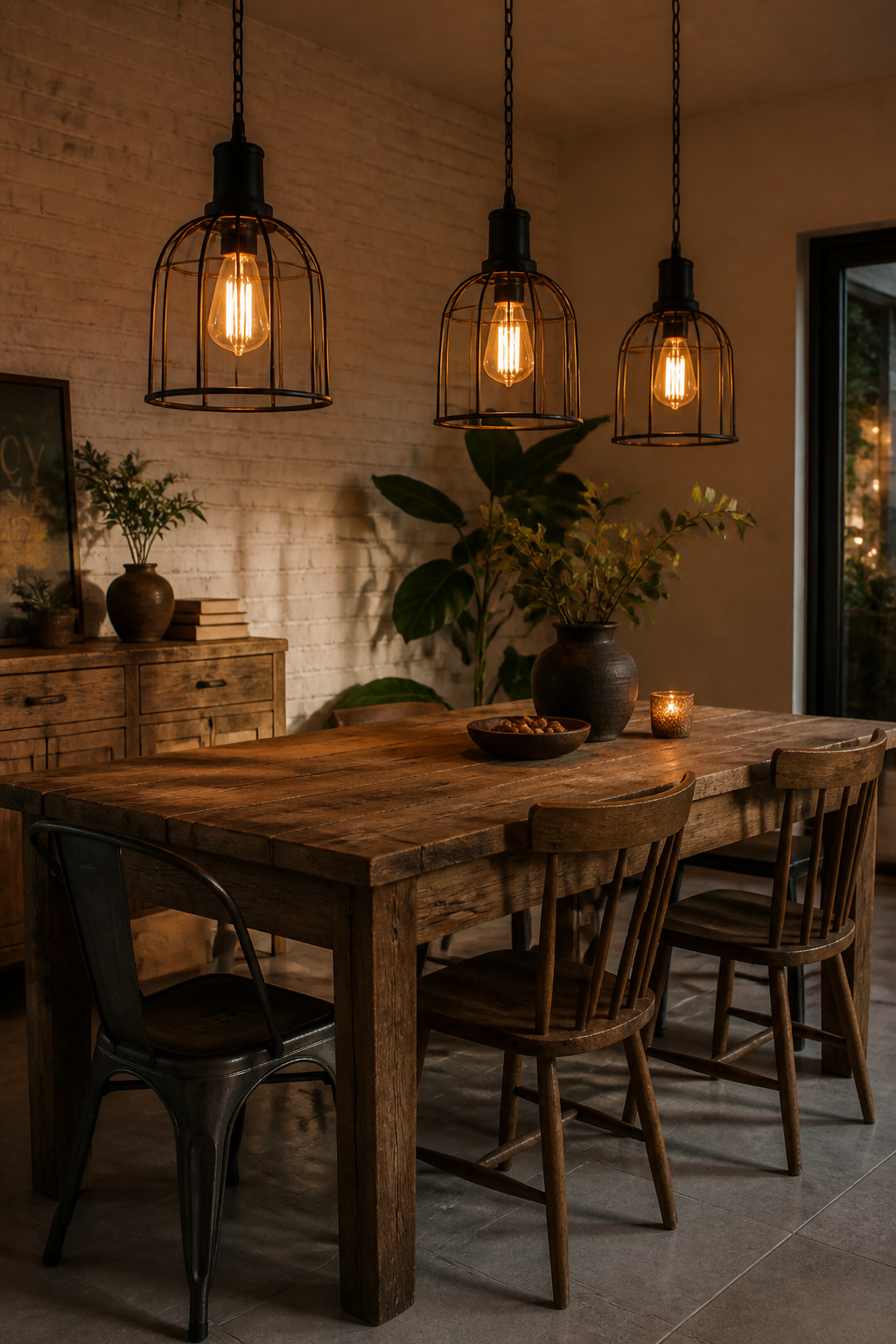
LED Edison alternatives now reach 2200–2400K with near-identical filament aesthetics and consume 3–6 watts against the original 40–60 watts. For fixtures with multiple exposed bulbs, this energy difference is significant. Globe-style (G-shape) filament bulbs are the most popular dining choice — their rounded profile is visible from multiple angles and the filament creates a warm centrepiece effect in cage or open pendants. Tube-style and squirrel cage filaments work better in pipe fixtures where the bulb’s linear form echoes the fixture’s geometry.
A dimmer switch is non-negotiable here. At full output, even 2200K filament through an open cage can create glare rather than atmosphere. At 60–70% dimmer output, the warm filament reads as intended. For industrial kitchen light fixtures the same rule applies — the bulb type and dimmer pairing determine whether the result is atmospheric or industrial in the clinical sense.
5. Rattan and Natural Fibre Fixtures for a Biophilic Table Setting
Biophilic design research consistently shows that even representations of natural materials — woven fibres, organic forms, wood textures — activate a stress-reduction response similar to actual nature exposure. Rattan dining room lights earn their place on wellness grounds before you even consider the aesthetic.
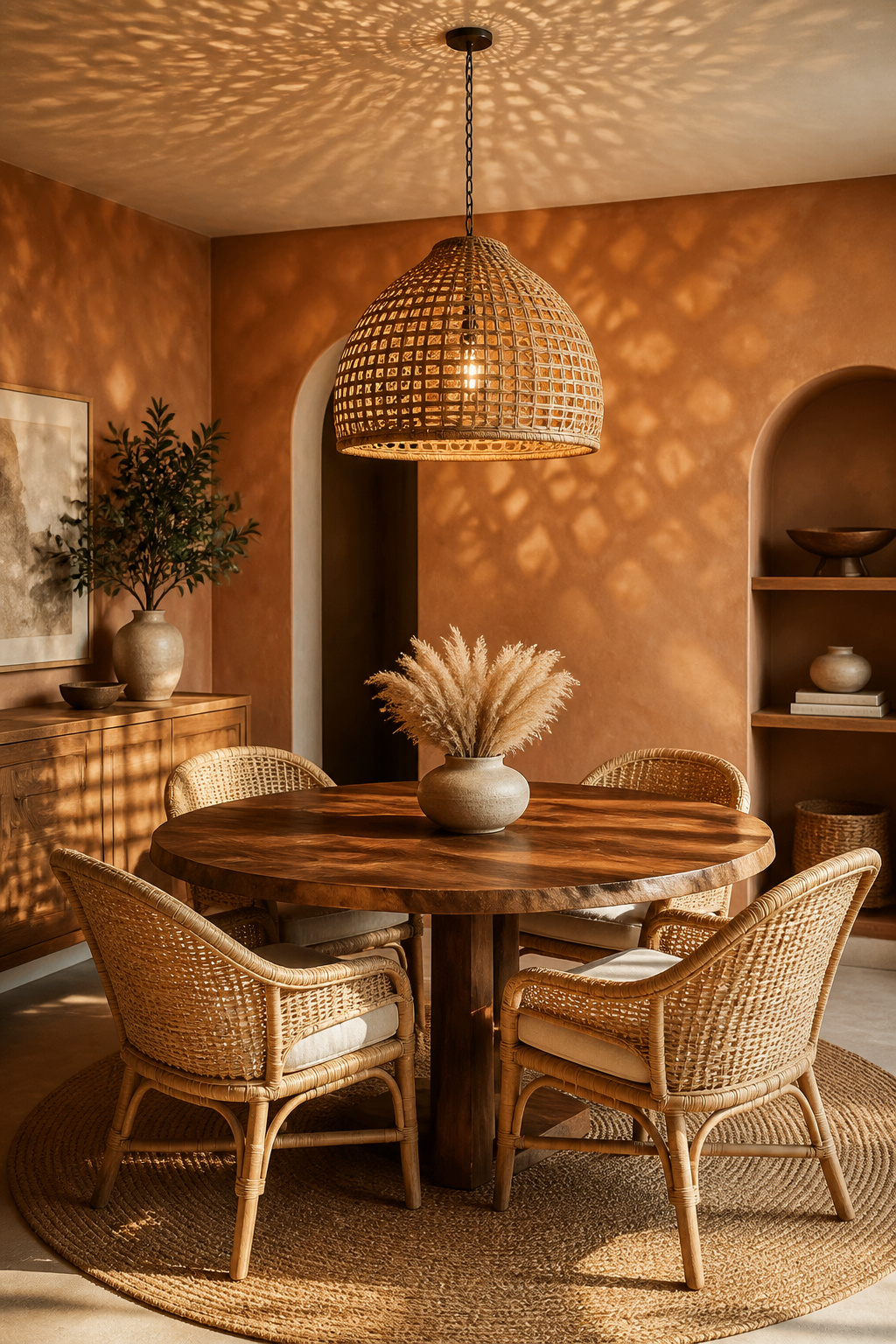
Rattan casts dappled, organic shadow patterns on the ceiling and walls — light filtering through a woven palm-fibre shade produces the visual equivalent of sunlight through tree leaves. No factory-formed metal or glass fixture can replicate this effect. Natural rattan produces warm amber-brown shadows with defined geometric weave patterns; seagrass has a tighter, finer weave and a more neutral tone, suited to Scandinavian or minimalist dining rooms; abaca (Manila hemp) has a rougher, rustier texture that suits boho and artisan-crafted dining spaces.
The main care reality is humidity. Natural rattan can handle moderate ambient humidity, but it should not be positioned directly above a cooktop or kitchen area where steam rises consistently. Sustained moisture causes fibres to weaken and eventually mould. For open-plan spaces where farmhouse kitchen ideas meet a dining area — and active cooking happens nearby — either choose treated lacquered rattan or swap to seagrass, which naturally resists moisture better. Rattan that is properly sited and dusted weekly lasts over 10 years; rattan positioned wrong lasts 18 months.
6. Linear Multi-Light Pendant for Long Dining Room Tables
A long rectangular table is one of the few dining room situations with a clearly correct fixture solution. Round dining room lights create a single bright zone in the middle of a long table and leave both ends dim — a functional problem that conversation-forward dining rooms shouldn’t have to apologise for.
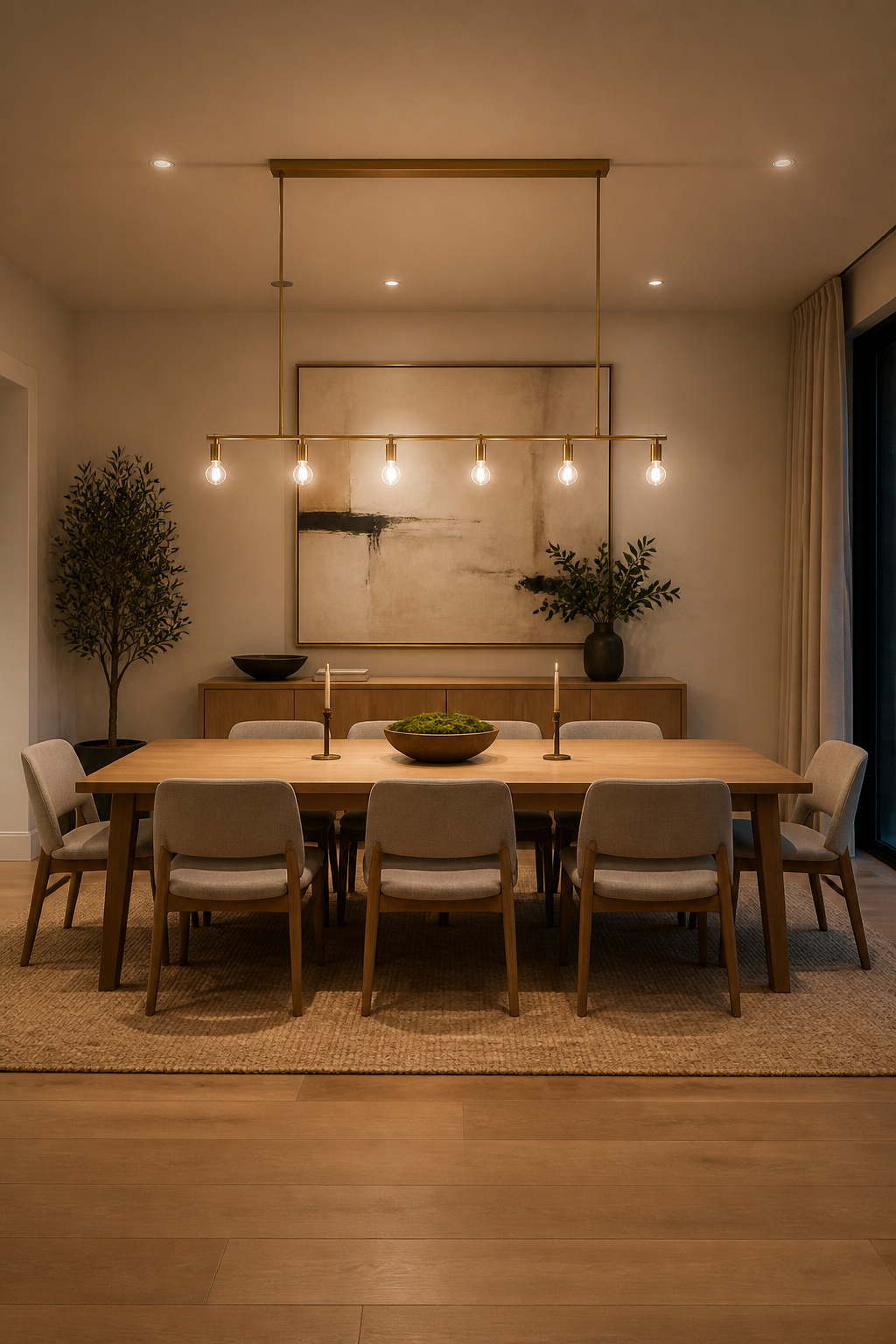
A linear pendant’s length should cover 2/3 to 3/4 of the table length. For a 72-inch (6-foot) table, that means a 48–54-inch linear fixture. The side clearance rule also applies: the fixture should be at least 12 inches narrower than the table width on each end to avoid visual overhang or any risk of catching moving chairs. Standard hanging height of 30–36 inches from table surface applies to linear pendants exactly as it does to round fixtures.
For very long tables (8 feet or more), two coordinated pendants positioned in series — with 24–30 inches of clearance between their outer edges — can outperform a single extra-long bar. The gap between them creates natural breathing room and a more dynamic ceiling line. Electrically, single-canopy systems require the ceiling box to be precisely centred over the table; multi-canopy systems tolerate offset more gracefully, which matters in older homes where the junction box may not be where you’d put it today.
7. Farmhouse Lantern as a Rustic Dining Room Light Fixture
The lantern’s design vocabulary borrows from barn carriage lights and period ironwork — peaked angular forms, seeded or hammered glass panels, decorative cross-bar hardware. These references to rural American and English craft traditions are what make a farmhouse lantern immediately legible as farmhouse rather than industrial (which swaps the glass panels for open cage wire) or transitional (which removes the period hardware).
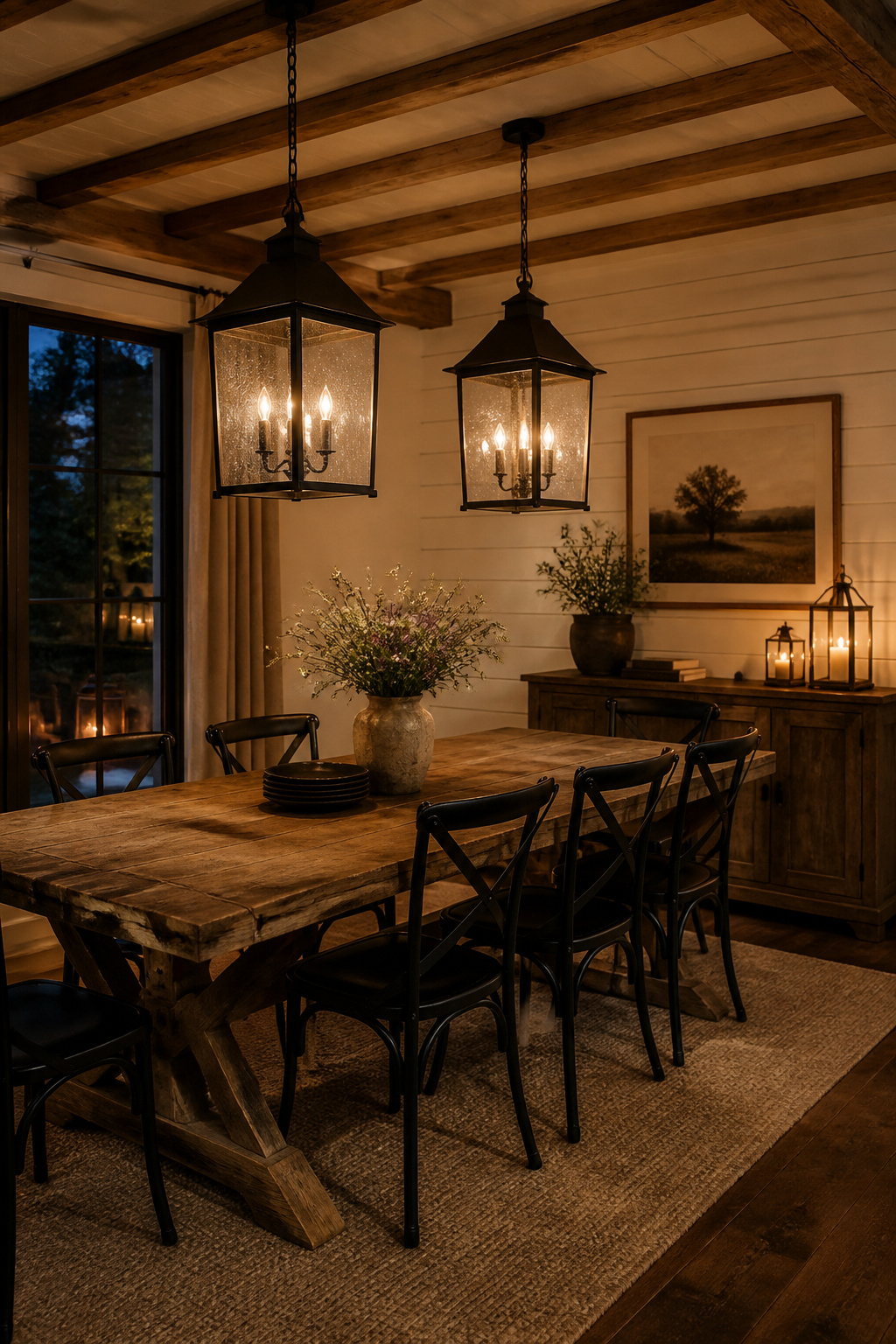
Finish choice is the most consequential decision with farmhouse lanterns. Matte black or black iron creates the sharpest, most contemporary farmhouse result — graphic against white shiplap, grey concrete, or painted cabinetry. Aged bronze and oil-rubbed bronze read warmer and more vintage, blending naturally with warm wood tones, exposed brick, and terracotta or ochre colour palettes. Matte white or cream lanterns shift the aesthetic toward French country or English cottage farmhouse — right for whitewashed wood tables and linen textiles, less cohesive with dark stained wood.
For rustic dining room decor that works year-round rather than just seasonally, the pairing logic is simple: black iron lanterns with raw or reclaimed pine; aged bronze lanterns with distressed oak or whitewashed wood; matte white lanterns with painted wood or antique white furniture. Open-back chair styles — Windsor, cross-back, ladder-back — sit comfortably under lantern pendants without competing for vertical attention the way tall upholstered chairs can.
8. Globe Pendant Lights That Define a Modern Dining Space
The sphere is uniquely calming among geometric forms because it has no edges, no directional emphasis, and no visual urgency. Globe dining room lights benefit from this psychological quality — they create a sense of completion and visual quiet that angular fixtures don’t achieve as effortlessly.
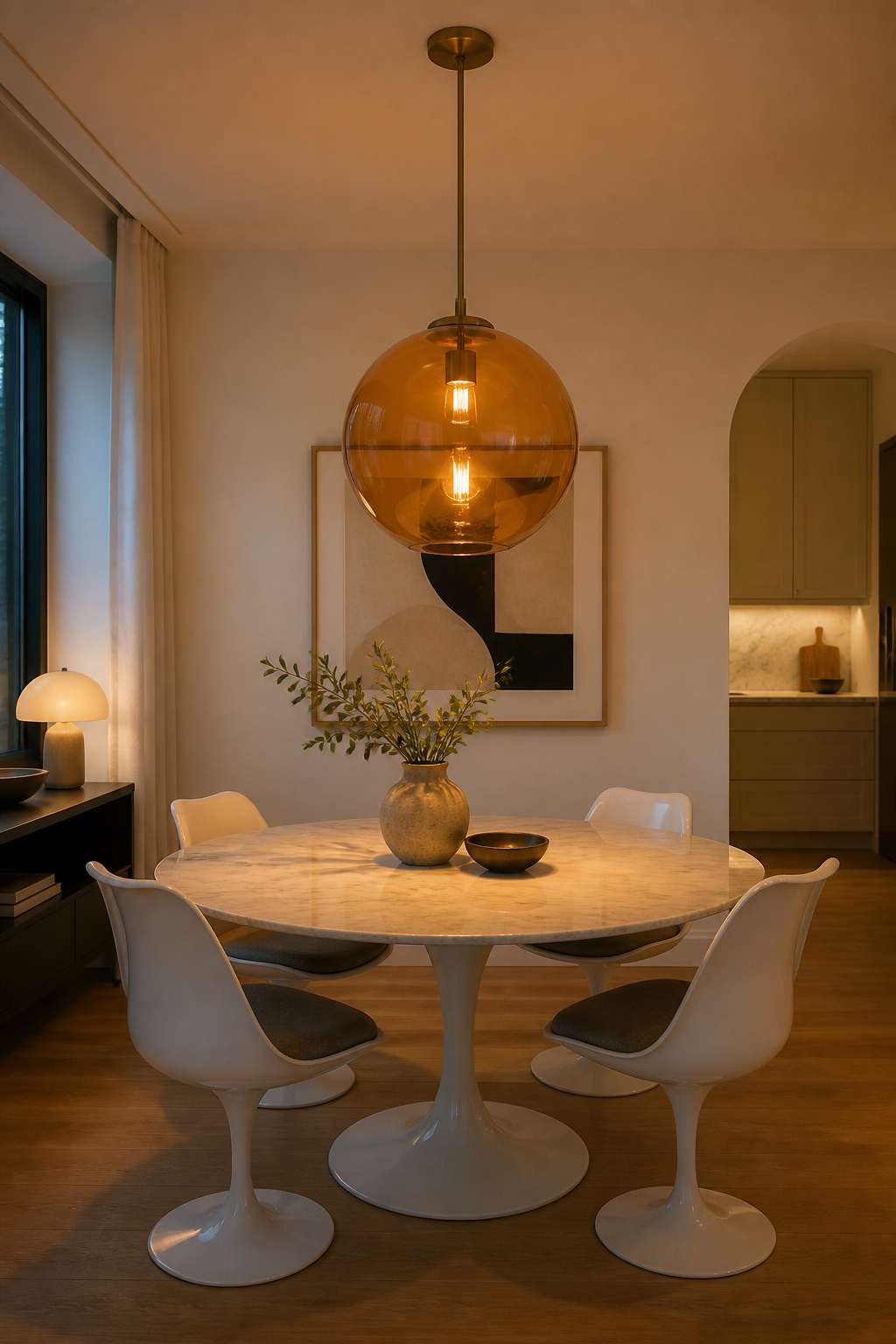
Glass colour makes a significant difference in light quality. Clear glass globes fully expose the bulb and produce the brightest, most direct output — functionally excellent but potentially glare-prone without a diffuser insert or low-watt bulb. Amber glass is the most flattering dining room choice: the warm golden diffusion enhances skin tones and makes food look more appealing, which is not a trivial consideration in a space dedicated to shared meals. Smoke grey glass cuts light transmission by 30–40%, creating a moodier, more atmospheric output better suited to evening dining than morning breakfast.
Sizing for globe pendants follows the same half-to-two-thirds table width rule as other styles, with one useful nuance: globe pendants can skew slightly larger relative to the table because the spherical form carries less visual weight than a solid drum shade at the same diameter. Always measure from the bottom of the globe to the table surface — a 20-inch globe’s bottom should sit 30–36 inches above the table, which puts its centre at approximately 40–46 inches up.
9. Crystal Chandelier for Glamorous Dining Room Lighting
Real crystal contains lead oxide — or barium oxide in modern eco-crystal formulations — that gives it a high refractive index. Light bends through it at sharper angles than ordinary glass, producing genuine rainbow prism effects on walls and ceilings rather than the surface shimmer of acrylic imitations. The difference is visible from across the room. Weight is the reliable field test: real crystal is noticeably heavy compared to its visual size; acrylic feels almost weightless for the same apparent dimensions.
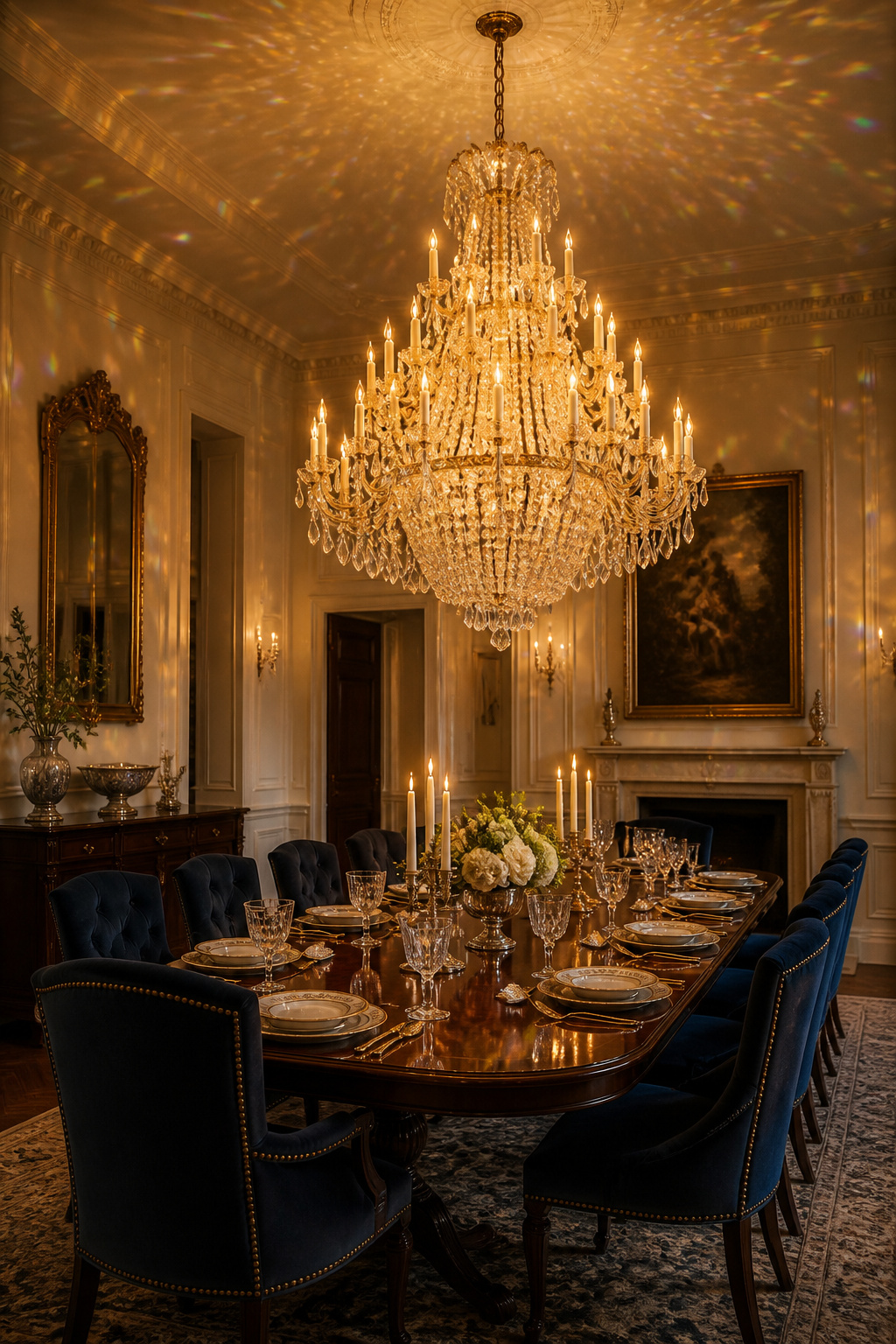
Under warm artificial light (2700–3000K), crystal refracts in amber-gold tones rather than full rainbow; under daylight or cooler artificial light, it produces blue-white sparkle. Morning sunlight through a dining room window activating a crystal chandelier into full rainbow-prism mode is one of the genuine wellness design bonuses of this fixture category — dynamic colour introduced into the space through physics, requiring no technology. For dining room decorating ideas that create occasion without a special-occasion budget, a modest 12-arm crystal chandelier at 2700K on a dimmer delivers far more evening atmosphere than its price suggests.
The cleaning reality is manageable. The professional method is a 1-part isopropyl alcohol to 4-parts distilled water solution sprayed onto white cotton gloves — wipe each crystal element individually, no fixture disassembly, no water dripping into sockets. Avoid any ammonia-based cleaners: ammonia strips the gold or silver coating from the metal hooks that hold crystal elements in place, eventually loosening the entire fixture’s structure.
10. Sputnik Mid-Century Fixture for Retro Dining Room Style
The sputnik chandelier is one of those rare designs that arrived fully formed and has resisted obsolescence for 85 years. Gino Sarfatti created the multi-arm radiating form in 1939 under the name ‘Fuoco d’Artificio’ — Italian for Fireworks — nearly two decades before the Soviet satellite that lent it the name everyone knows. The Soviet Sputnik was only 23 inches in diameter with four radio antennas; the design similarity was noticed after the fact, not intended. These dining room lights predate the space age and will outlast our current retrofuturist nostalgia for them.
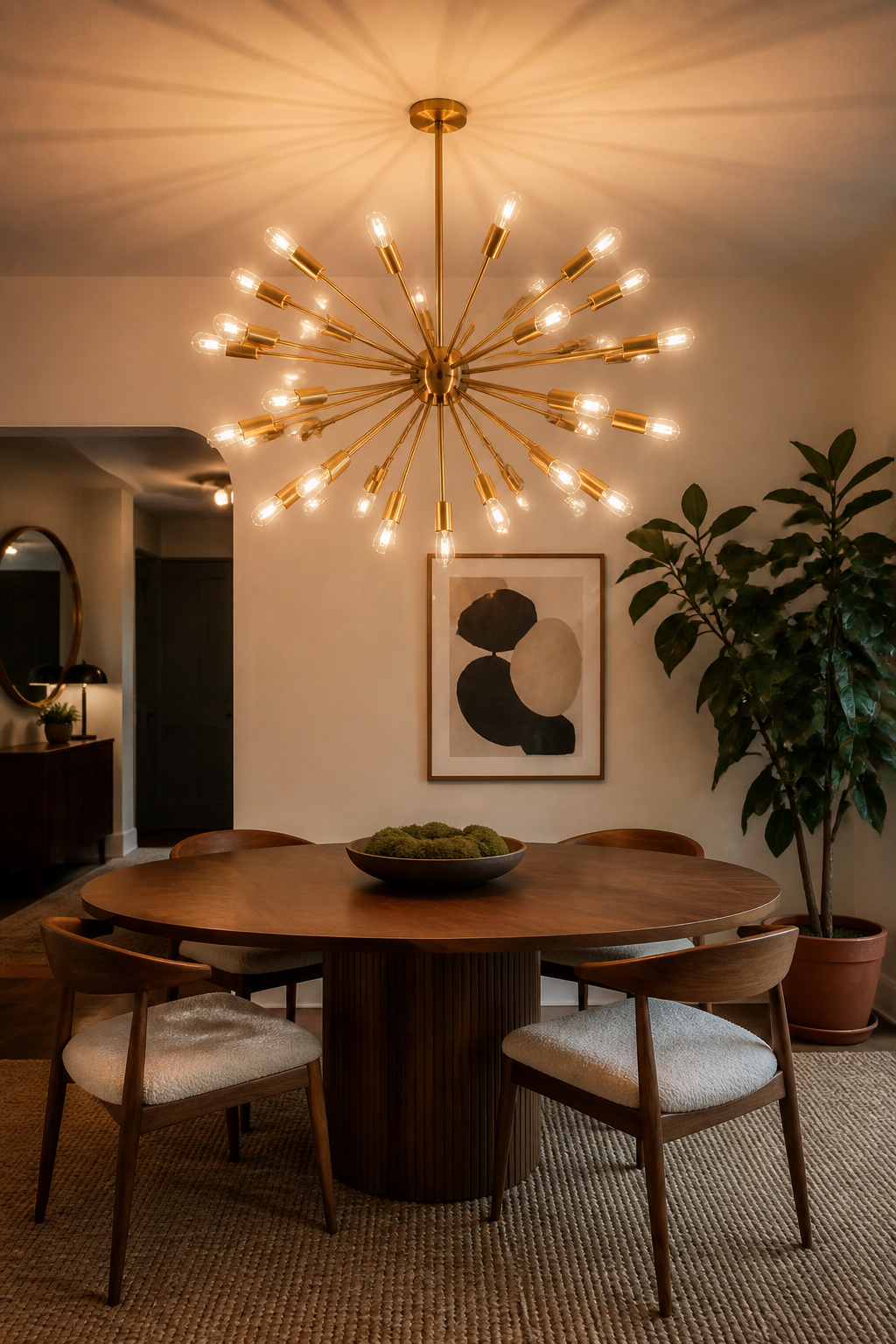
In dining rooms, sputnik fixtures work best in spaces with at least 9-foot ceilings — the radiating arms need vertical breathing room, and at 8 feet the fixture feels pressed toward the ceiling. Arm count affects both visual density and practical light output: a 24-arm sputnik with E12 candelabra bulbs at 3–4 watts each produces approximately 1,500–2,000 lumens, adequate for dining atmosphere on a dimmer. Brass finish warms up Scandinavian and rustic dining rooms; chrome reinforces industrial or contemporary edges; matte black bridges mid-century with modern farmhouse.
The unexpected quality of sputnik fixtures is their refusal to require matching furniture. A sputnik chandelier works above a simple farmhouse table, a live-edge wood slab, and a Japandi-style low-profile dining set — because the fixture reads as a single graphic punctuation mark rather than a period-specific ensemble piece. The one context where it struggles: ornate traditional dining furniture (Queen Anne, Victorian, Chippendale), where the 1950s optimism reads as styling confusion rather than confident eclecticism.
11. Adjustable-Height Pendant for Flexible Dining Room Use
Most pendant lights are fixed at a single height — you set them once and that’s it. For dining rooms that serve multiple functions (homework in the afternoon, dinner parties in the evening, weekend board games), that rigidity is a real limitation. Rise-and-fall dining room lights — fixtures with either a spiral recoil cord or a weighted pulley counterbalance — solve this with simple, tool-free height adjustment.
The two main mechanisms behave differently. Spiral recoil cords allow 12–24 inches of adjustment by pushing the fixture upward (cord compresses) or pulling it down (cord extends) — the most practical option for everyday height variation. Weighted pulley systems use a counterbalanced weight, operating like a miniature see-saw: infinite variation within the cord length, but the weight needs 12–18 inches of free space above the shade to function, which rules it out for 8-foot ceilings.
Standard cord-hung pendants (non-rise-and-fall) can also be adjusted ±6 inches without an electrician by repositioning the cord grip at the canopy — a useful detail for fine-tuning after installation. The standard dining height remains 30–36 inches from table surface to fixture bottom. At 30 inches you get intimacy; at 36 inches, openness. For a household where the dining table doubles as a workspace, the upper end of that range is more practical for daytime use.
12. Semi-Flush Mount Dining Room Lights for Low Ceilings
At 8-foot ceiling height, the math on pendant hanging gets tight. A standard pendant at 30 inches above a 30-inch table means the bottom of the fixture is at 60 inches from the floor — adequate clearance, but the pendant canopy and cord visually elongate in a room that already feels compressed. Semi-flush mount dining room lights with a 4–6 inch drop keep the fixture body at 7.5–8 feet from the floor while adding deliberate visual presence to the ceiling.
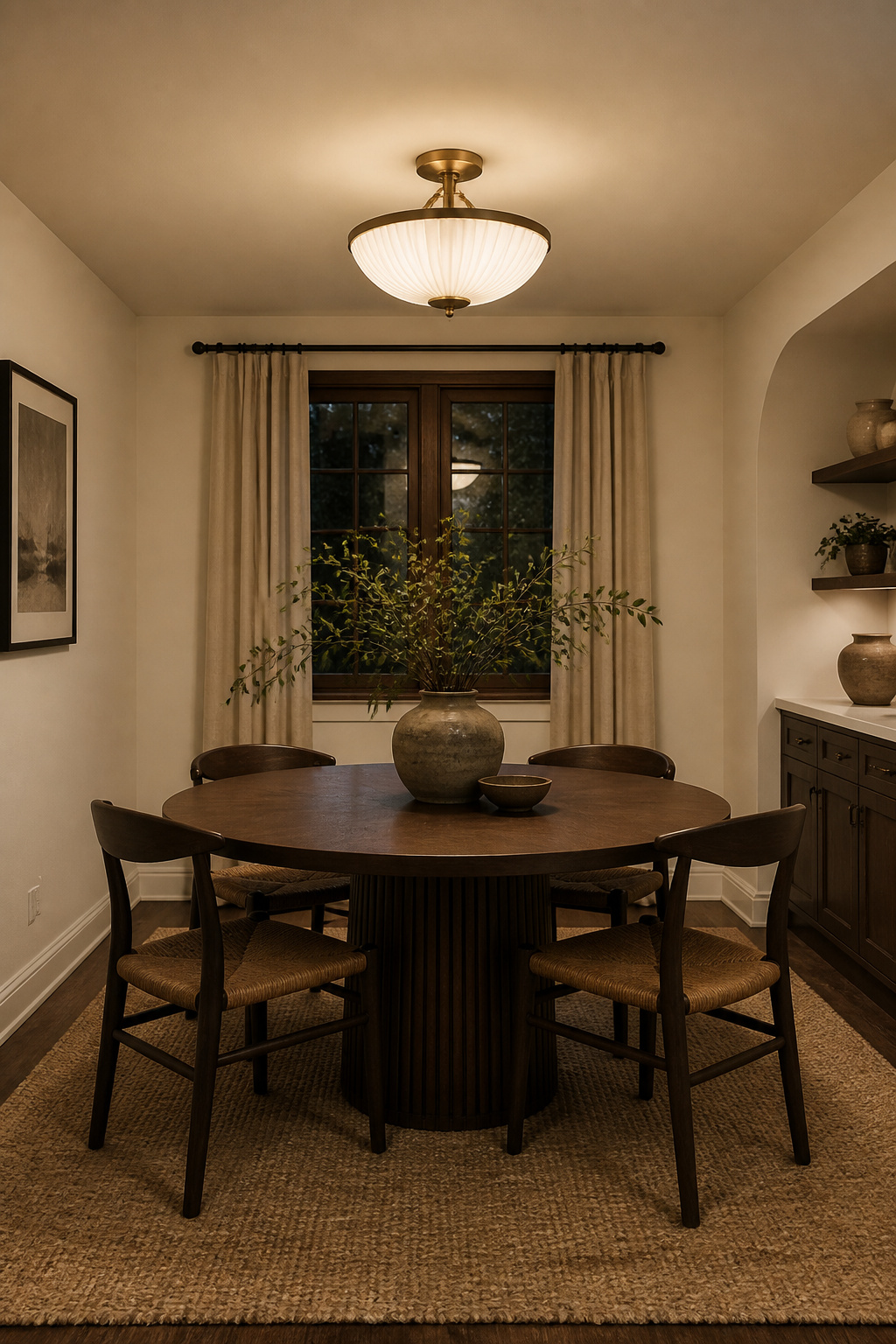
The threshold is clear: ceilings at or below 8 feet point toward semi-flush; 8.5 feet makes a low-profile pendant (12–15-inch drop maximum) borderline workable; 9 feet and above opens the full pendant and chandelier range. But the more important point is that semi-flush mounts are no longer a design compromise. Current collections from Rejuvenation, Visual Comfort, and similarly quality-focused brands include semi-flush options in sculptural fluted glass, cage-and-globe combinations, and geometric metal forms with decorative hardware that have nothing in common with the builder-grade diffuser domes of previous decades.
Characterful semi-flush design shows up in exposed Edison cluster configurations (3–5 candelabra sockets in a decorative canopy mount), hammered metal bowl shades in aged bronze or brass, drum-shade semi-flush mounts with linen or textured fabric shades, and fixtures with decorative canopy plates and visible hardware that signal intentional selection. The decorator’s rule: choose a diameter of at least 18–22 inches for a dining room — a smaller semi-flush in a 10 x 12 dining room is functionally adequate and visually insignificant.
13. Candlestick-Style Chandelier for Romantic Dining Atmosphere
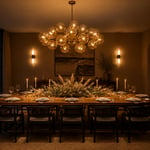
The candlestick chandelier’s design logic is built on multiplicity: instead of one bright source overhead, you have six or eight small ones arranged on arms that radiate outward like a flower unfurling. Each individual E12 candelabra LED bulb at 2200K produces approximately 200 lumens — restrained, individual, and warm. Together at 50–70% dimmer output, six of them create the dining atmosphere that expensive restaurant designers spend considerable money trying to replicate.
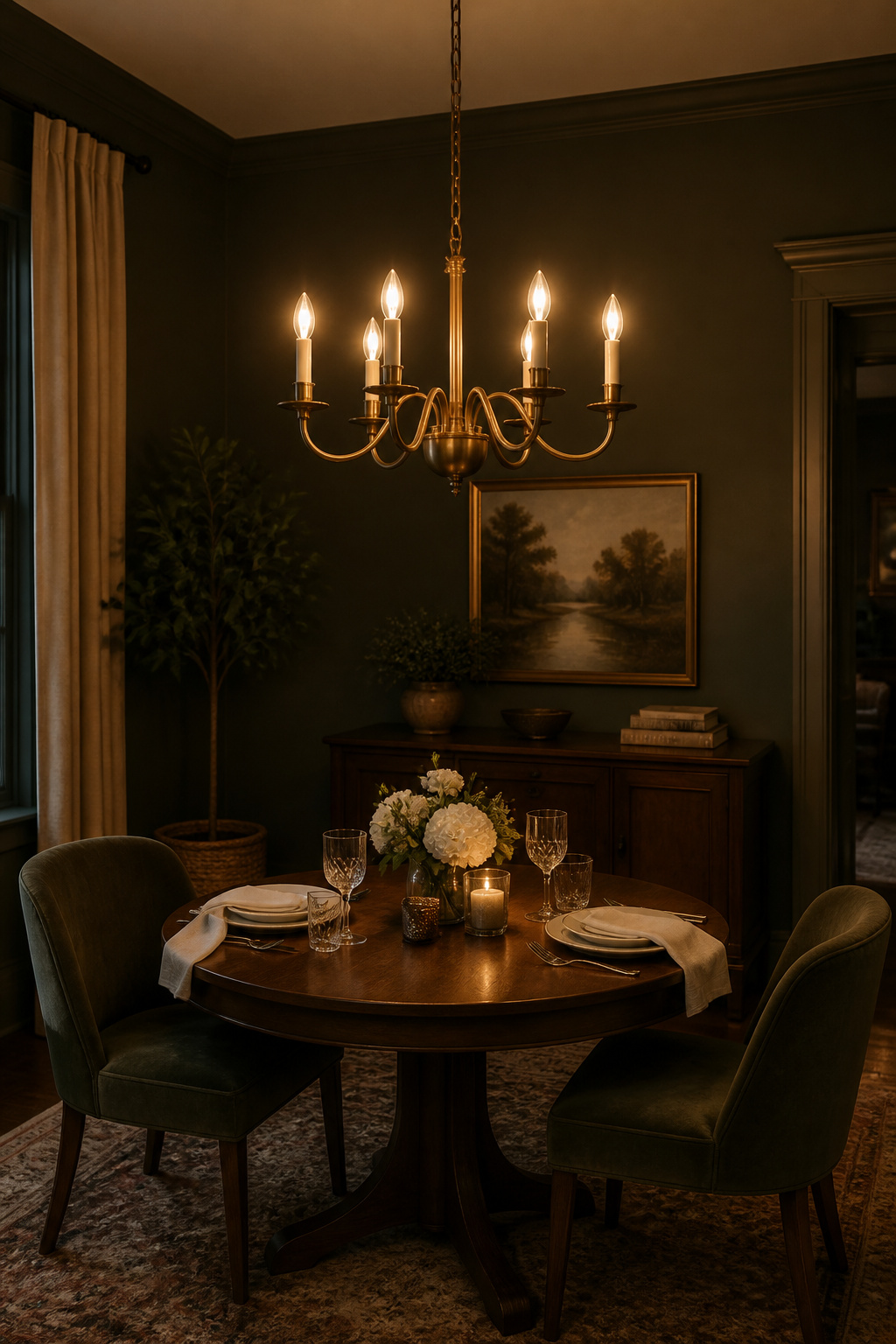
The 2200K colour temperature sweet spot is not arbitrary from a wellness perspective. Research in environmental psychology links warm dim lighting — under 2700K and under 50 lux — with longer time spent at the dining table, greater social conversation, and measurably lower reported stress. At 2200K, blue light emission is minimal, which supports the body’s melatonin preparation cycle during evening dinner hours. Connecting these bedroom lighting ideas principles to dining room lights matters most in households where dinner is the primary wind-down period of the day.
Dimmer compatibility is the one technical detail that will make or break this fixture category. Most LED E12 candelabra filament bulbs are TRIAC-dimmable and compatible with Lutron and Leviton leading-edge dimmers, but some low-watt LED arrays trigger minimum-load issues on certain dimmers, producing a low-level flicker at the bottom of the dimmer range. Test with your specific bulb-dimmer combination before completing the installation. Lutron’s Diva and Caseta lines have the broadest LED compatibility in US residential applications.
14. Oversized Sculptural Pendant as the Room’s Focal Point
The design case for a large pendant is the same as the case for minimalism: fewer elements, each more considered, creates a space that feels more intentional than one crowded with competing fixtures and accessories. An oversized sculptural pendant removes the need for wall art, decorative ceiling medallions, and a centrepiece that competes for the eye — the pendant becomes the room’s primary visual event and everything else becomes context.
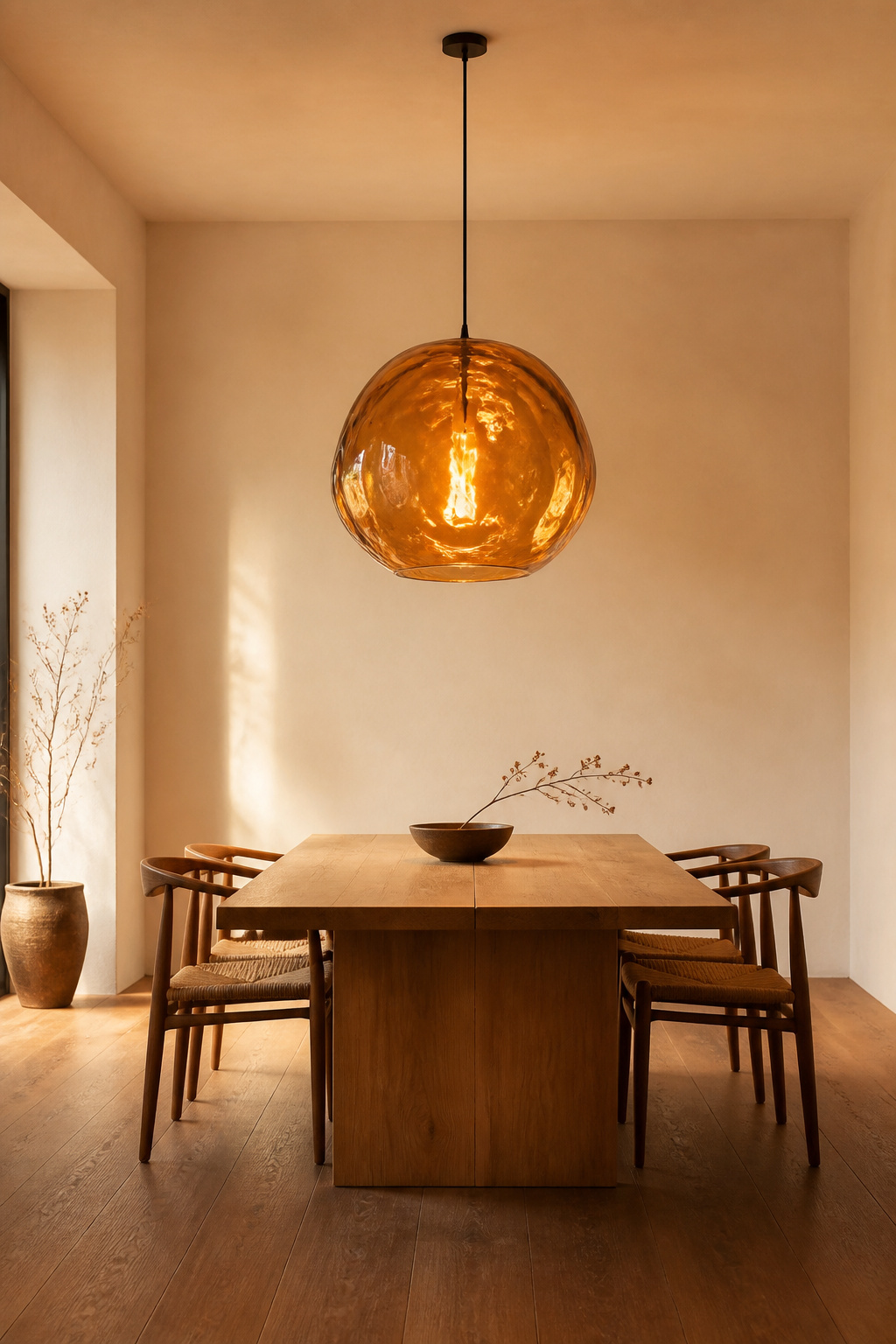
The material question is the most consequential choice at large scale. Hand-blown glass at 24–30 inches (organic globe or cloud forms) creates significant visual presence while remaining light-transmitting and therefore visually recessive compared to its actual size. Paper composite and resin pendants in cloud or irregular globe forms weigh 2–4 lbs at large scale and produce diffused, honeyed light — these dining room lights don’t press the ceiling down because you can see through them and around them. Woven rattan or abaca at 28–36 inches creates presence through shadow pattern complexity.
One structural rule: pair oversized pendants with low-profile dining furniture. A simple flat-frame table and chairs without high backs keep the fixture as the vertical anchor. High-back upholstered chairs under a large sculptural pendant create a visual competition the fixture usually loses. Also avoid oversized pendants in rooms with strong existing ceiling features — coffered ceilings, exposed beams, ornate moulding. Two competing ceiling features fight for attention; a more modest pendant that defers to the architecture almost always makes for a better room.
15. Layered Dining Room Lighting With Sconces and a Central Fixture
Relying solely on one overhead fixture — even a beautiful one — produces flat, single-source lighting that creates harsh shadows on faces and leaves wall surfaces and sideboard areas dim. Layered dining room lighting, combining a primary overhead fixture with wall-mounted sconces, is how professional designers create the depth and warmth that makes a dining room feel like a destination rather than a pass-through.
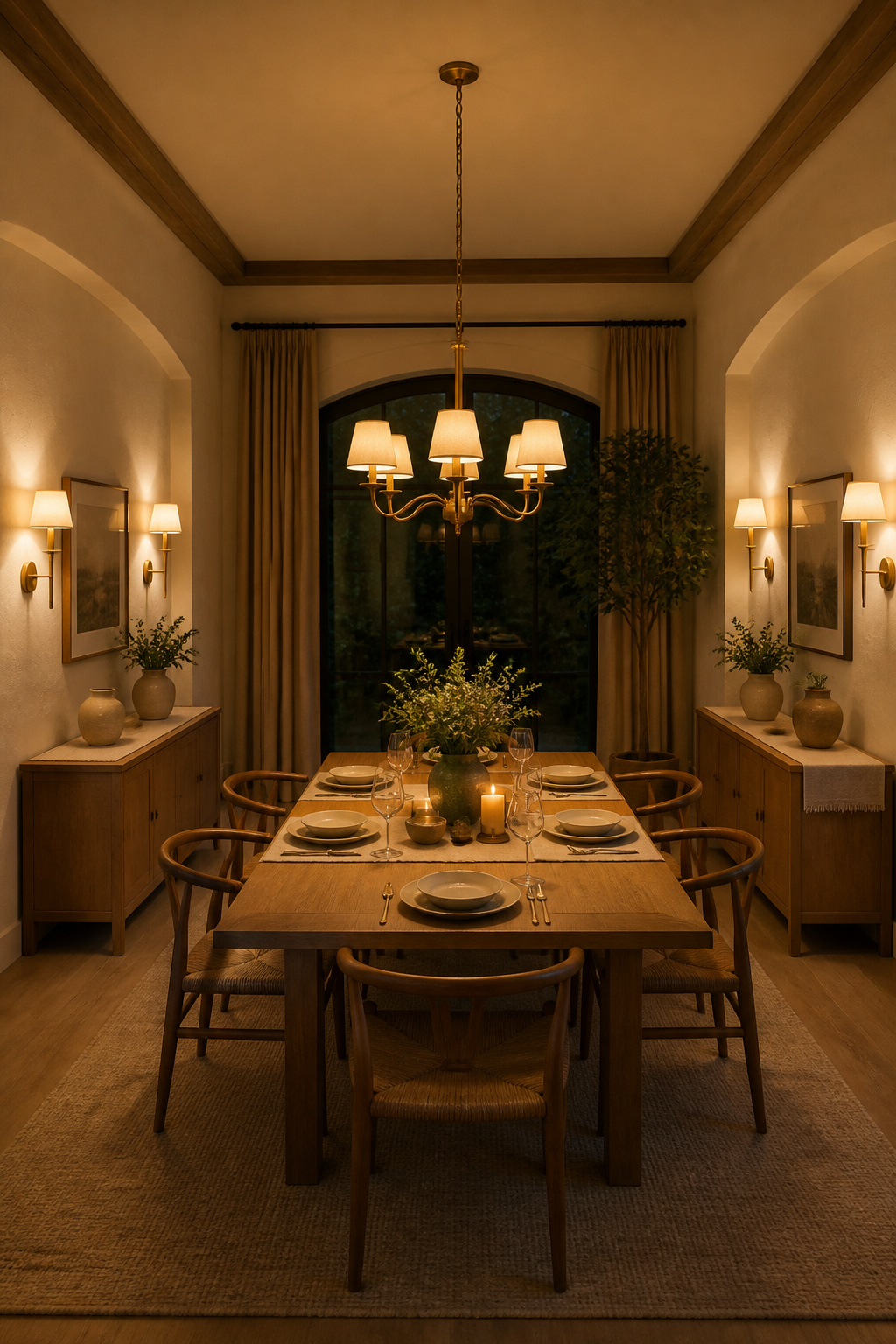
Sconces belong at 60–66 inches from the finished floor — roughly eye level for a standing adult, creating a horizontal band of warm light that visually separates the upper and lower zones of the room. Position them on the walls perpendicular to the table’s long axis (the side walls of a rectangular dining room) so the light crosses the table rather than backing one end. Sconce output should be lower than the primary overhead — 200–400 lumens per sconce is the supportive-not-competing range. As any wellness-focused dining room design guide will tell you, layered lighting is consistently the highest-impact single upgrade available — more transformative than new furniture or paint.
The real transformation comes from independent dimmer control. Separate dimmers for the overhead fixture and the sconces allow three distinct room scenes: full overhead with partial sconce for a lively dinner, dimmed overhead with sconces at 70% for an intimate dinner party, and sconces only for after-dinner conversation or candlelit atmosphere. Smart wall switches (Lutron Pico remotes, Philips Hue Dimmer switches) let you programme these scenes for single-tap recall — the kind of effortless atmosphere management that looks expensive but is primarily a planning decision, not a budget one.
16. Wabi-Sabi Inspired Fixture for a Calm and Mindful Table
Wabi-sabi is the Japanese philosophical acceptance of imperfection and transience as inherent qualities of beauty rather than flaws to be corrected. In dining room lights of this style, this translates to handmade ceramic pendant shades with softly irregular contours, matte clay-like surfaces, and gentle texture variations that no two pieces share exactly. Naaya Studio, Maso Lighting, and Residence Supply all produce ceramic pendants handformed from clay — when you order two, you receive two pieces that are related but not identical.
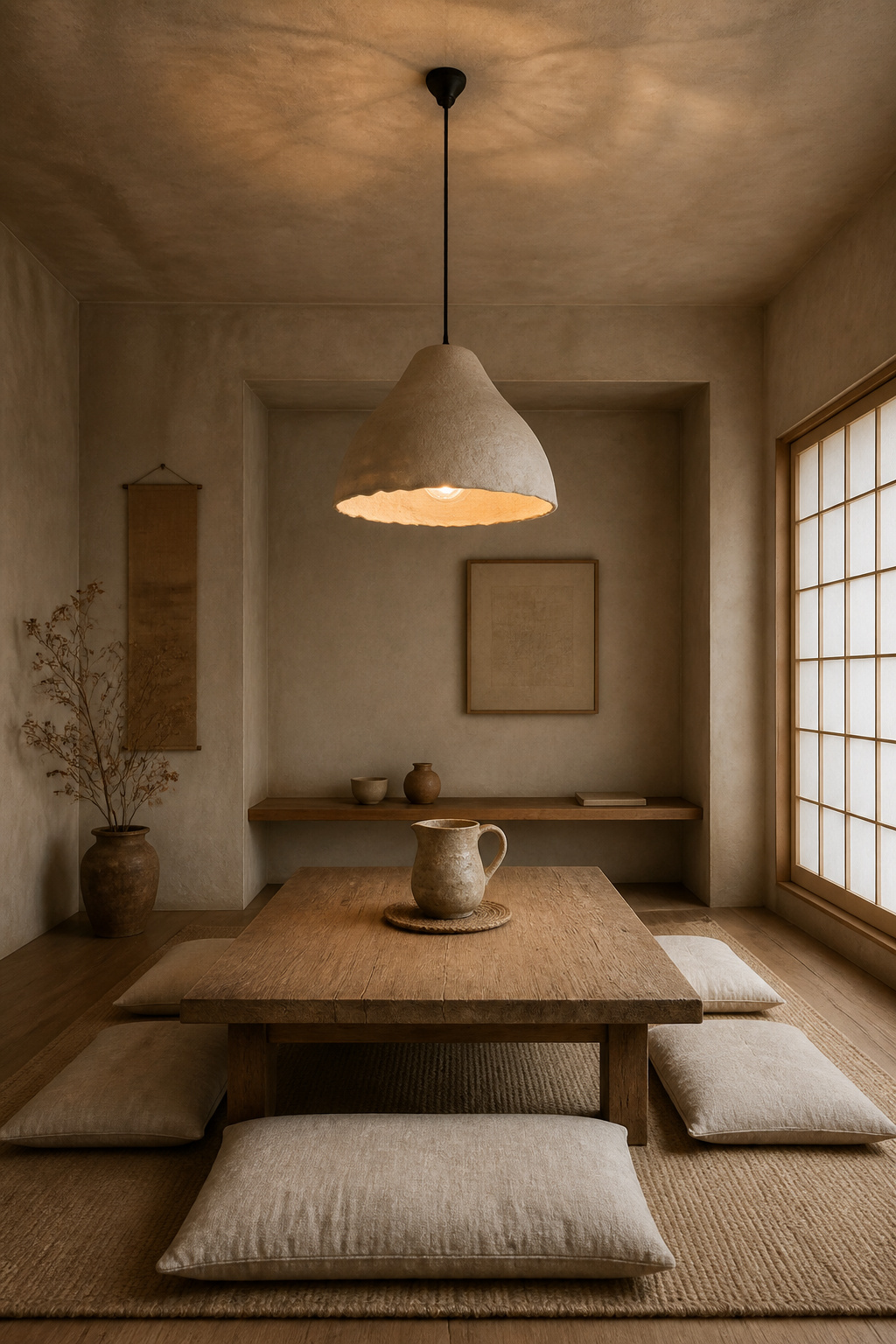
The diffused, honey-warm light that ceramic and composite resin wabi-sabi shades produce is distinctive. Unlike metal, glass, or fabric, high-density ceramic composite transmits light organically and evenly, eliminating the harsh shadow edges of direct downlighting. The result is an enveloping quality — the room is lit rather than illuminated — that environmental psychology research links with lower reported stress and greater psychological ease in the occupants. For a wellness approach to dining, this is a fixture that earns its cost at the level of daily wellbeing, not just aesthetics.
Use warm white bulbs at 2700–3000K in wabi-sabi fixtures — this is correct not just aesthetically but functionally. The organic translucency of ceramic and resin materials warms the light further as it passes through; a 2700K bulb in a ceramic shade registers closer to 2400K in the room. Using cool white or daylight bulbs in a wabi-sabi pendant defeats the purpose of the fixture entirely — the harsh blue-white light works against both the visual material and the wellness intention of the space.
17. Industrial Pipe and Cage Fixtures for a Raw Dining Room Edge
Industrial pendant design references the warehouse and factory aesthetic — exposed pipe hardware, wire cage guards, galvanised or raw iron finishes, and visible electrical components that make no attempt to conceal their construction. In a home dining room, this vocabulary creates confident contrast rather than confusion, but only if two things are true: the bulbs are warm (2200–2700K), and the table and surrounding materials provide organic contrast.
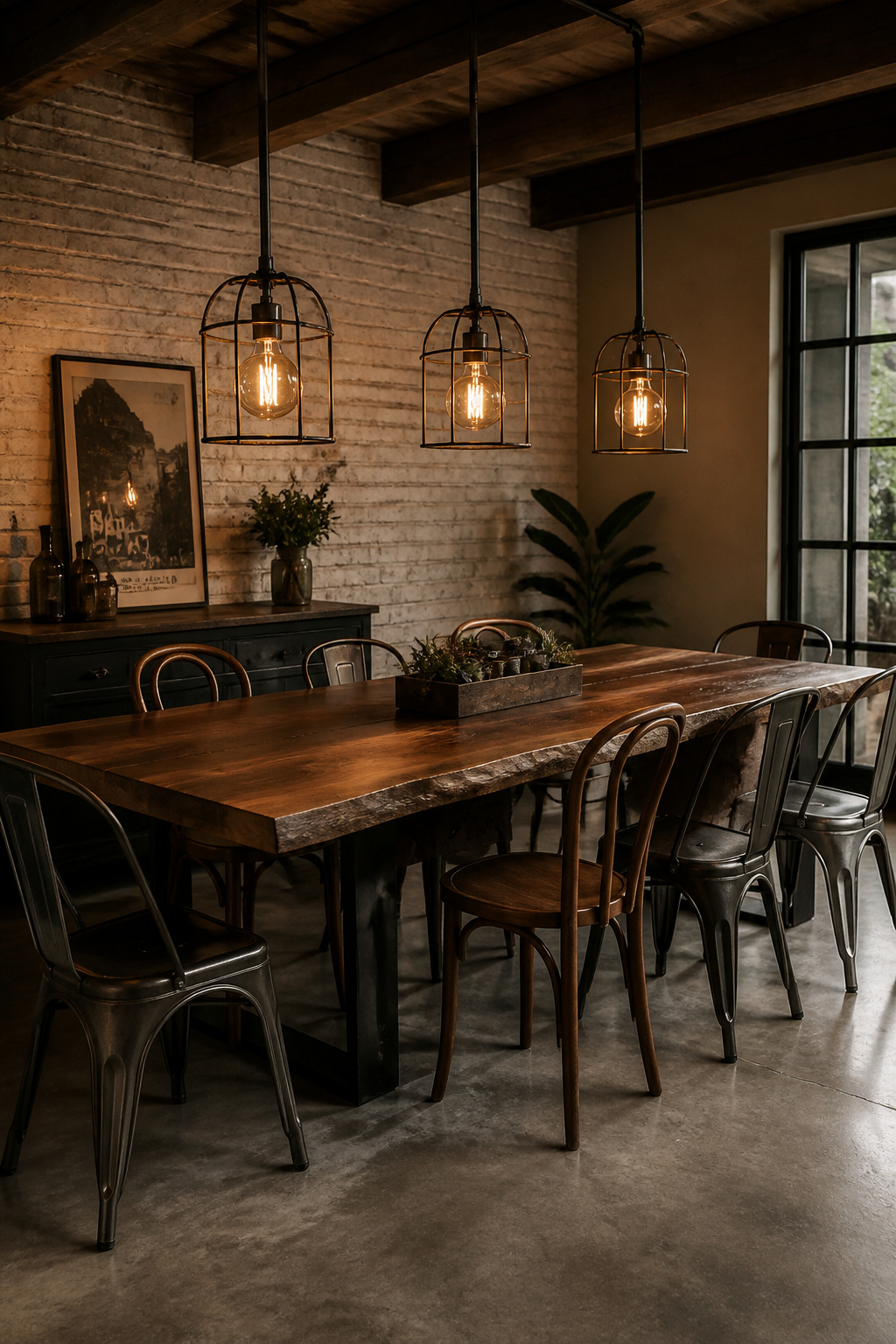
Without warm bulbs and organic material pairing, industrial cage dining room lights in dining rooms can read as cold and unintentional — as though someone’s workspace was hastily converted to a dining room. The bulb choice is the more important factor: a 4000K bulb in a cage pendant produces blue-white light that emphasises the metal’s rawness in the harshest possible way. A 2200K Edison filament through the same cage creates the warm chiaroscuro that makes industrial dining rooms feel considered rather than contractual.
For natural material pairing: live-edge walnut and reclaimed pine dining tables provide the warmth that raw metal needs. Honed marble or concrete tabletops offer a different kind of contrast — both materials and the fixture are industrial in origin, but the smoothness and weight of stone against the graphic openness of a cage pendant creates an interesting visual dialogue. Weight is the practical consideration that most industrial fixture buyers miss: pipe and multi-arm cage fixtures run heavier than glass or fabric alternatives. Standard residential ceiling boxes are rated 25–35 lbs; verify the fixture’s actual weight before installing on an unupgraded box.
18. Smart Dining Room Lights With Colour Temperature Control
The circadian argument for smart dining room lights is straightforward and well-supported by research. Exposure to cool, blue-rich light (4000K and above) in the evening suppresses melatonin production and delays sleep onset. The dining room is typically used during the evening — making it one of the highest-impact locations in the home for circadian-correct lighting decisions. A tunable-white smart bulb that shifts from 4000K at 6pm to 2700K at 7pm and 2200K by 8pm is not a luxury feature; it’s a functional health intervention applied to a fixture that’s already there.
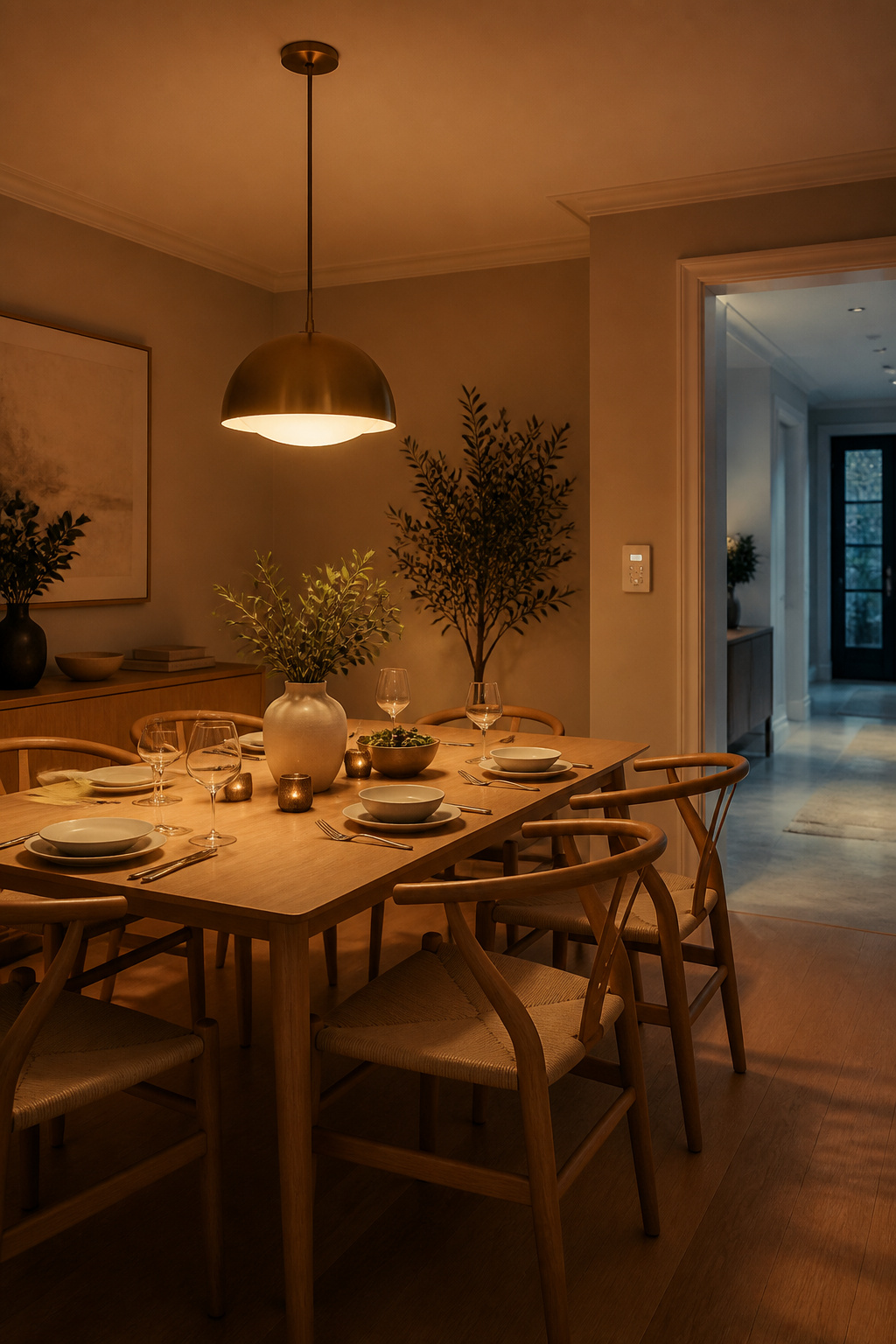
The control method matters more than most smart home guides acknowledge. App-based control requires pulling out a phone at the dinner table — it interrupts conversation and reads as inattentive to guests. Voice control (Alexa, Google Home) is more socially acceptable for mid-meal scene changes. The most elegant solution: pre-programmed scene buttons (Lutron Pico remotes, Philips Hue Dimmer switches) mounted on the dining room wall, single-tap recall that requires no phone and keeps the smart home layer invisible to guests.
Philips Hue White Ambiance in A19/E26 format covers colour temperature from 2200–6500K — the widest tunable white range of any major consumer platform. For chandeliers with decorative visible bulbs, LIFX makes a filament-style smart candelabra (E12 base) that maintains the visual look of a traditional Edison bulb with full app and voice control. One consistent rule: smart bulbs should not be installed in fixtures controlled by traditional dimmer switches. The conflict causes flickering and premature LED failure. Remove the dimmer and use the smart bulb’s own app-based dimming instead.
Choosing the Right Dining Room Lights for Your Home
Start with ceiling height because it’s the constraint that overrides every other preference. Eight feet or below: semi-flush mount or pendant with no more than a 12-inch drop. Nine feet: the full pendant range. Ten feet and above: chandeliers, statement sculptural pieces, and the kind of oversized globe you’d otherwise feel nervous about. These ceiling-height rules apply whether you’re choosing dining room lights for a new build or updating an existing space with limited ceiling box clearance.
From there, let the table guide the fixture shape. Round table: round chandelier or globe pendant. Long rectangular table: linear pendant or two coordinated pendants in series. Square table: symmetrical chandelier or a single large globe. Then match the fixture’s finish to the dominant metal already in the room — cabinet hardware, chair legs, faucet, or candleholders. The same finish family (warm metals together, cool metals together) creates visual coherence even when the individual pieces differ in shade.
Three questions before you buy any dining room lights: Is it dimmable? All dining room lights should accept dimmable bulbs and be installed on a dimmer switch — the inability to reduce light intensity is a significant functional limitation in a space used for varied occasions. What bulb base does it require? E26 standard is the most versatile; E12 candelabra narrows your replacement options but is correct for most chandeliers. And what is the ceiling junction box weight rating? Standard residential boxes support 25–50 lbs. Verify before buying any large chandelier or multi-pendant cluster — a reinforced fan-rated box is a $15 fix that prevents a much more significant problem.
The fixture you choose will outlast every other decorating decision you make in that room. Take the time to get the scale, the finish, and the colour temperature right.