Most small bathrooms feel like an afterthought. A cramped room with a single overhead light casting unflattering shadows, corners that collect damp, and surfaces that have no intention of ever feeling calm. But here is what keeps coming up in my work: the bathroom is the first room we inhabit each morning and the last room we leave at night. No other space has that kind of daily influence over how we feel. Getting it right matters more than its square footage would suggest.
The good news is that the best bathroom ideas for small bathrooms are not about spending more money on a bigger room. They are about understanding how light, material, and spatial arrangement interact — and making deliberate choices that work with a small floor plan rather than against it. These 15 ideas span structural changes, material choices, and finishing touches. Some are weekend projects; others require a contractor. All of them are worth knowing before you touch a single tile.
1. Wall-Mounted Floating Vanities That Free Up Floor Space
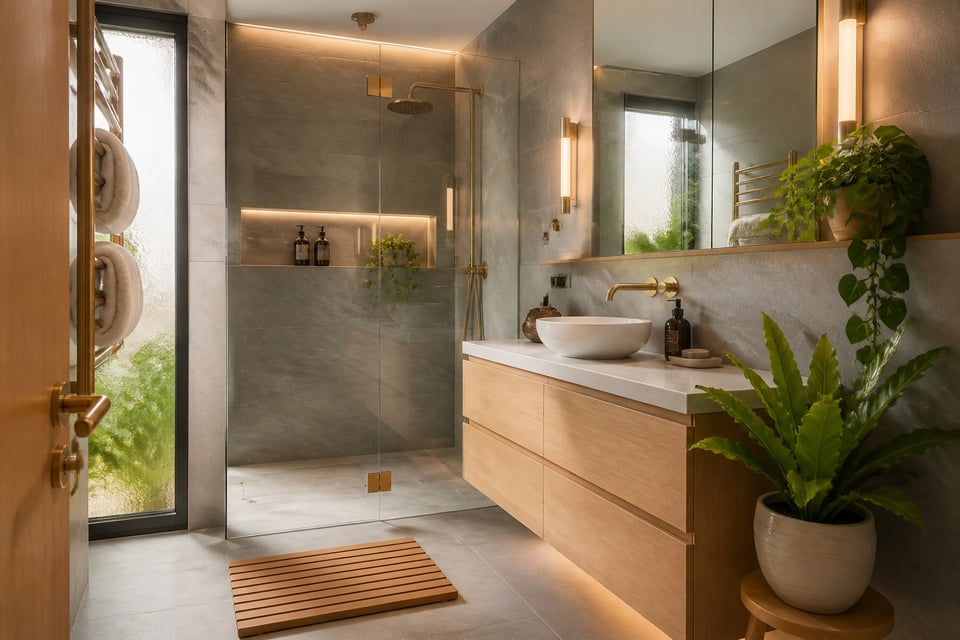
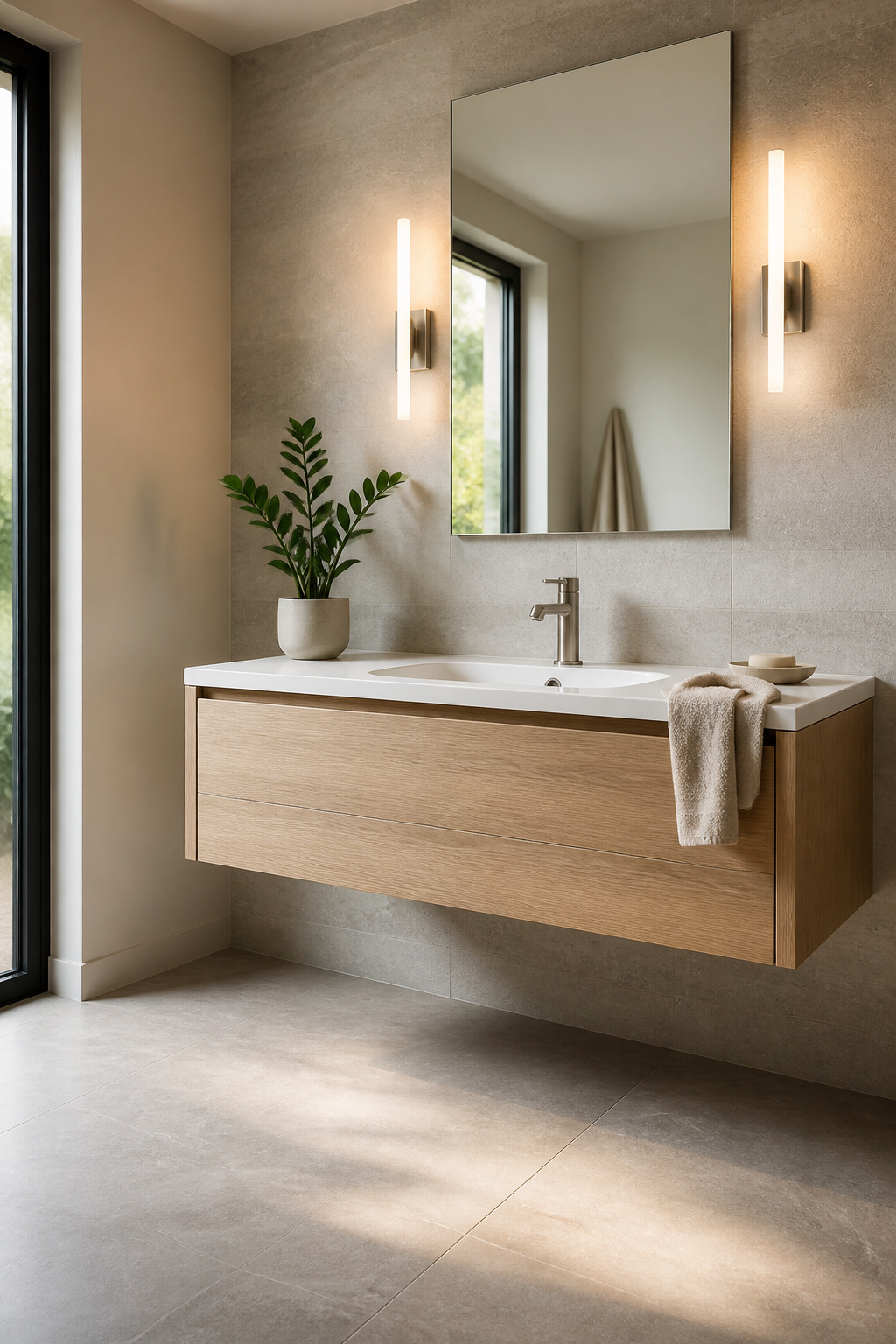
The single most effective of all bathroom ideas for small bathrooms is to take the vanity off the floor. The result is immediate — exposing even eight inches of floor beneath a floating unit makes the room read as larger, cleaner, and easier to move through. The brain processes continuous floor as spacious; the visual break created by a pedestal or floor-standing unit does the opposite.
Why It Works
Single-sink floating vanities run 24 to 36 inches wide, and in most small bathrooms a 24-inch unit is the practical minimum while 30 inches is the sweet spot if plumbing allows. The standard finish height is 34.5 inches from floor to basin rim, but wall-mounted units let you adjust that during installation. Shallow units at 14 to 16 inches deep exist specifically for space-constrained rooms and recover several inches of clear floor over a standard-depth cabinet.
Installation Notes
The plumbing must come from the wall rather than the floor, with the drain rough-in typically landing 16 to 20 inches above the finished floor. The bracket system anchors into studs or a solid timber backer board — this is the most common installation failure point, and the backer must go in before tiling, not after. Pair the floating vanity with a slim basket or low trolley beneath it and you have added storage without closing in the space. There are some genuinely clever vanity ideas for tiny bathrooms that show this approach at its best.
2. Frameless Glass Showers That Borrow Visual Space
Walk into any small bathroom with a framed shower enclosure and you feel the room divide. The metal channel creates a hard visual interruption — a horizontal stripe across every wall at waist height. Frameless glass removes that entirely. No dark channels, no shadow bands, and the room reads as one continuous space from any angle.
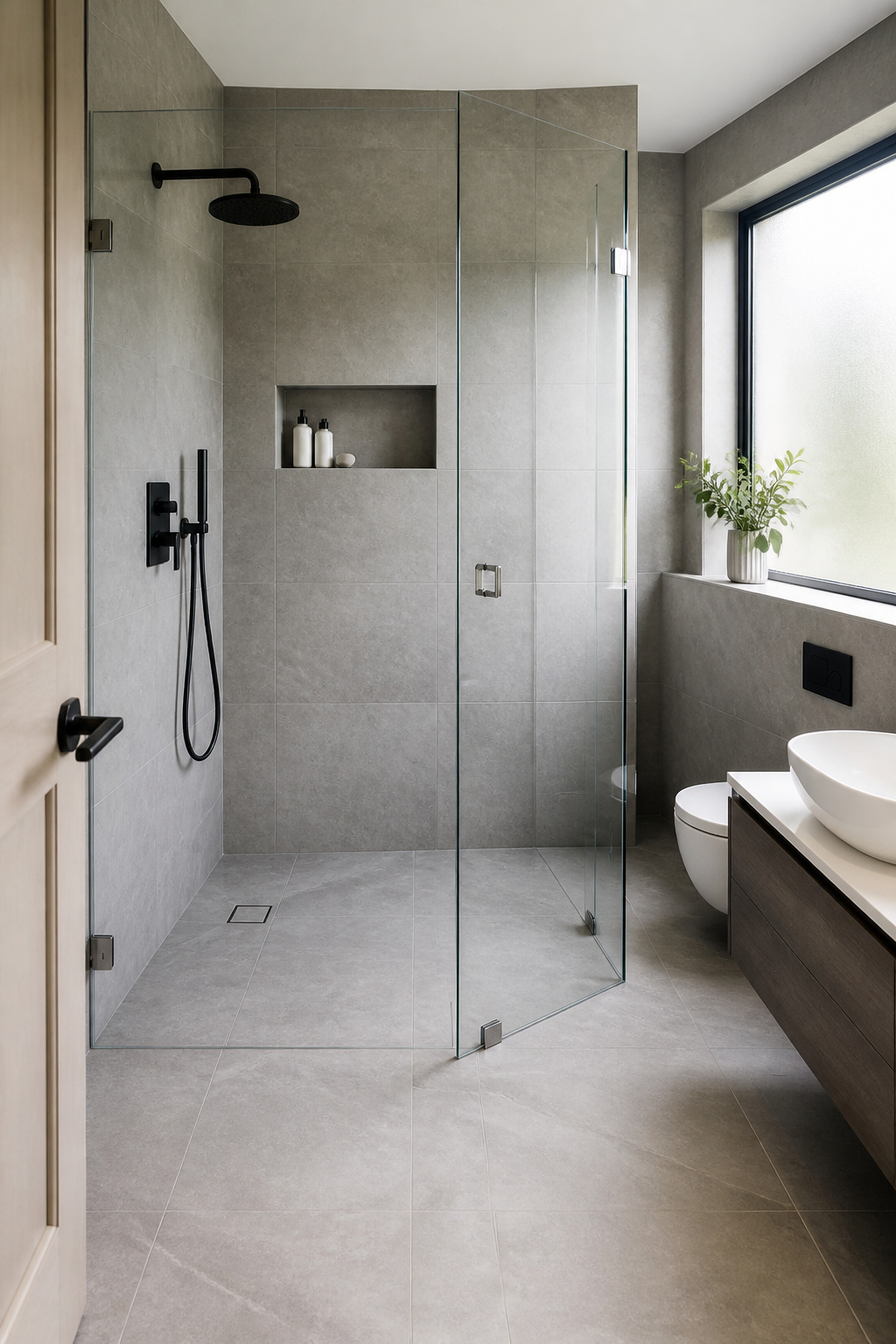
The glass — typically 3/8 inch thick as standard, with 1/2 inch as a premium upgrade — is supported entirely by clips rather than frames. For small bathrooms where a pre-cut standard panel size fits the space, off-the-shelf frameless panels reduce cost significantly compared to fully custom work. The installed cost range runs from $1,400 to $4,800. Continuing the same floor tile inside and outside the shower without a threshold makes the floor read as a single plane and the room feels considerably wider. Running a vertical tile layout inside the enclosure adds to this: the vertical lines draw the eye upward and the ceiling feels higher.
One decision worth resisting: the half-framed semi-frameless option. The visual benefit of frameless glass comes from eliminating the frame entirely. A partial frame gives roughly 30% of the spatial effect at 80% of the cost. If frameless is the goal, commit to it.
3. Recessed Shower Niches: Small Bathroom Ideas That Eliminate Clutter
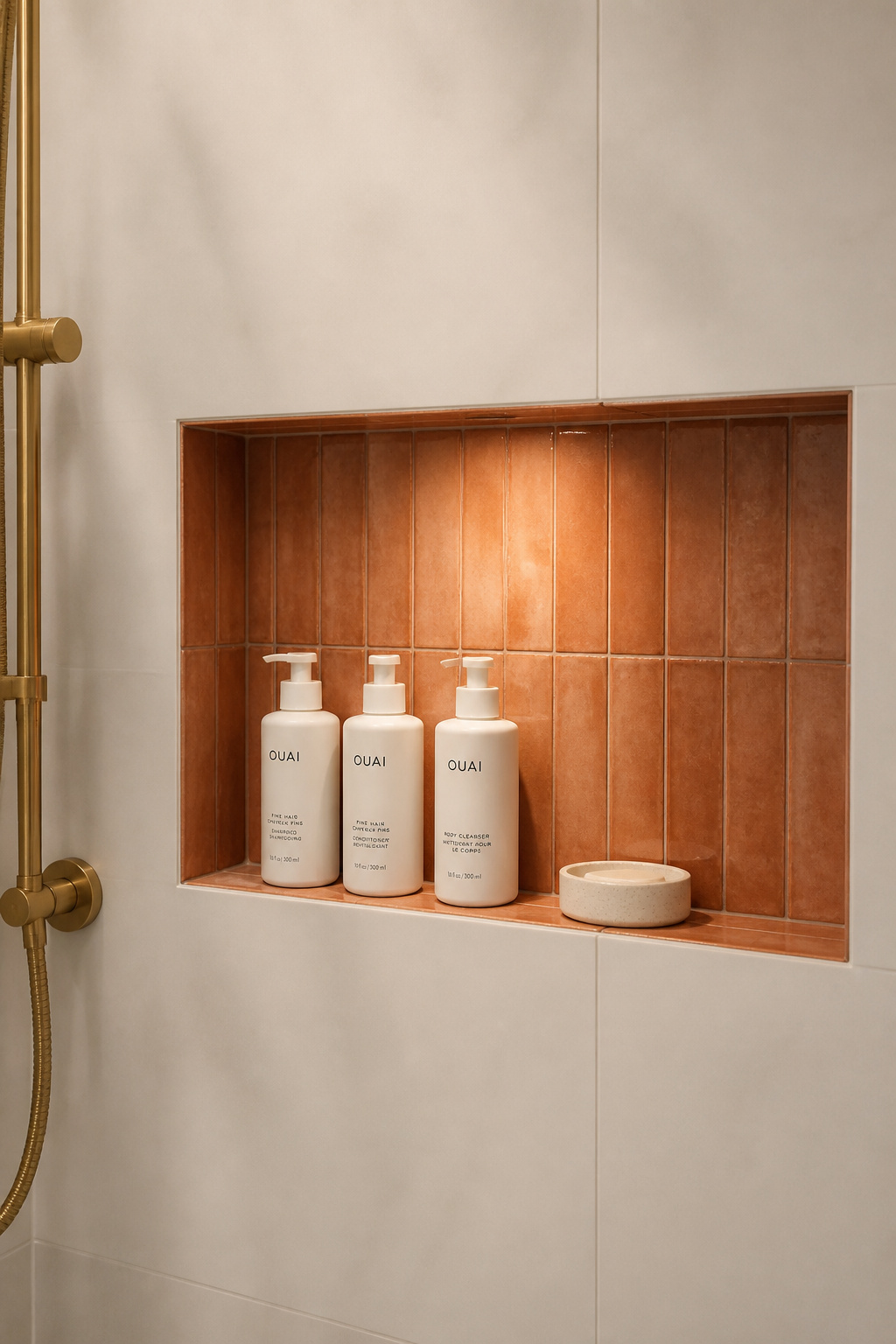
Corner caddies corrode. Over-the-shower-head caddies collect soap scum in unreachable joints. Both project into the shower space. A recessed niche does none of these things — it sits flush with the wall, is tiled to match or contrast, and has no moving parts to fail.
Why Recessed Beats Surface-Mounted
The standard niche depth is 3.5 inches — the exact width of a 2×4 stud bay — enough for most shampoo and conditioner bottles without projecting into the shower at all. Standard sizes are 12×12, 12×24, and 16×20 inches; designing the niche around the tile module size avoids awkward cuts. Optimal placement is approximately 60 inches from the shower floor — comfortable arm reach without bending. A good overview of shower storage solutions covers how recessed niches compare to surface-mounted alternatives in practice.
Waterproofing and Placement
Two to three coats of liquid membrane or sheet membrane cover all niche surfaces; the bottom is angled 1/8 inch toward the room to drain standing water. Inside corners get mould-resistant silicone caulk rather than grout — grout is not waterproof at corners and will crack under thermal movement. One firm rule: interior walls only. Never cut a niche into an exterior wall — the insulation void creates a cold spot and a condensation problem far more expensive to fix than the convenience gained.
4. Non-Toxic, Low-VOC Paints in Deep, Saturated Tones
Here is the change that surprises people most: paint the small bathroom dark. Deep charcoal, navy, forest green, warm terracotta — all of them make a room feel more considered and, counterintuitively, more spacious. As bathroom ideas for small bathrooms go, this is the least expensive option with the most dramatic spatial effect.
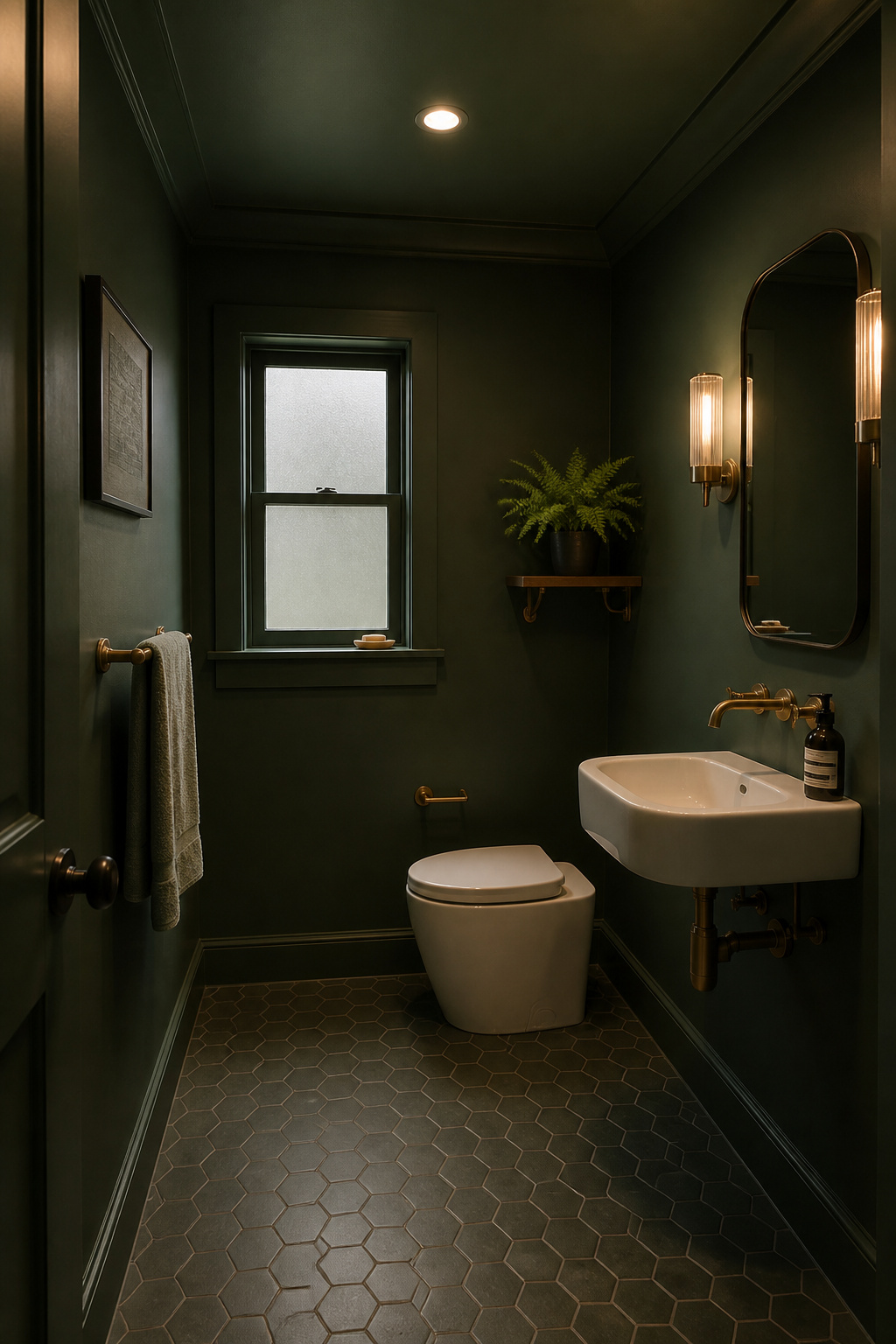
Dark, saturated colours blur corners and make boundaries hard to read. Rooms painted in deep tones can test 23% higher for spaciousness perception than white-walled equivalents in small space studies. The effect is strongest when walls, ceiling, and trim all receive the same colour — the room becomes a single, enveloping volume rather than a box. Benjamin Moore Aura Bath & Spa has mildew inhibitors built into the formula and performs reliably in humid rooms. Sherwin-Williams Harmony adds antimicrobial properties and is genuinely scrub-resistant. For the most chemically minimal option, Auro Anti-Mould Paint uses just five natural ingredients — plant oil, clay, lime, minerals, and silicate — and ECOS Paints offers zero-VOC formulas throughout their range.
The caveat on zero-VOC paints: brands like AFM Safecoat and ECOS remove all biocides, which makes them the cleanest choice for air quality but slightly less mould-resistant in bathrooms without extractor fans. In a well-ventilated bathroom, they perform well. Whatever paint you choose: never apply it over bare plaster without primer. Moisture gets behind the film within months and the peeling begins.
5. Pocket Doors and Barn Doors That Reclaim Swing Space
Draw an arc around a standard 30-inch bathroom door and you find the swing occupies approximately six square feet of clear floor area. In a 40-square-foot bathroom, that is 15% of the total space doing nothing except stopping the door opening into the vanity. A pocket door slides into a wall cavity and disappears. That six square feet comes back.
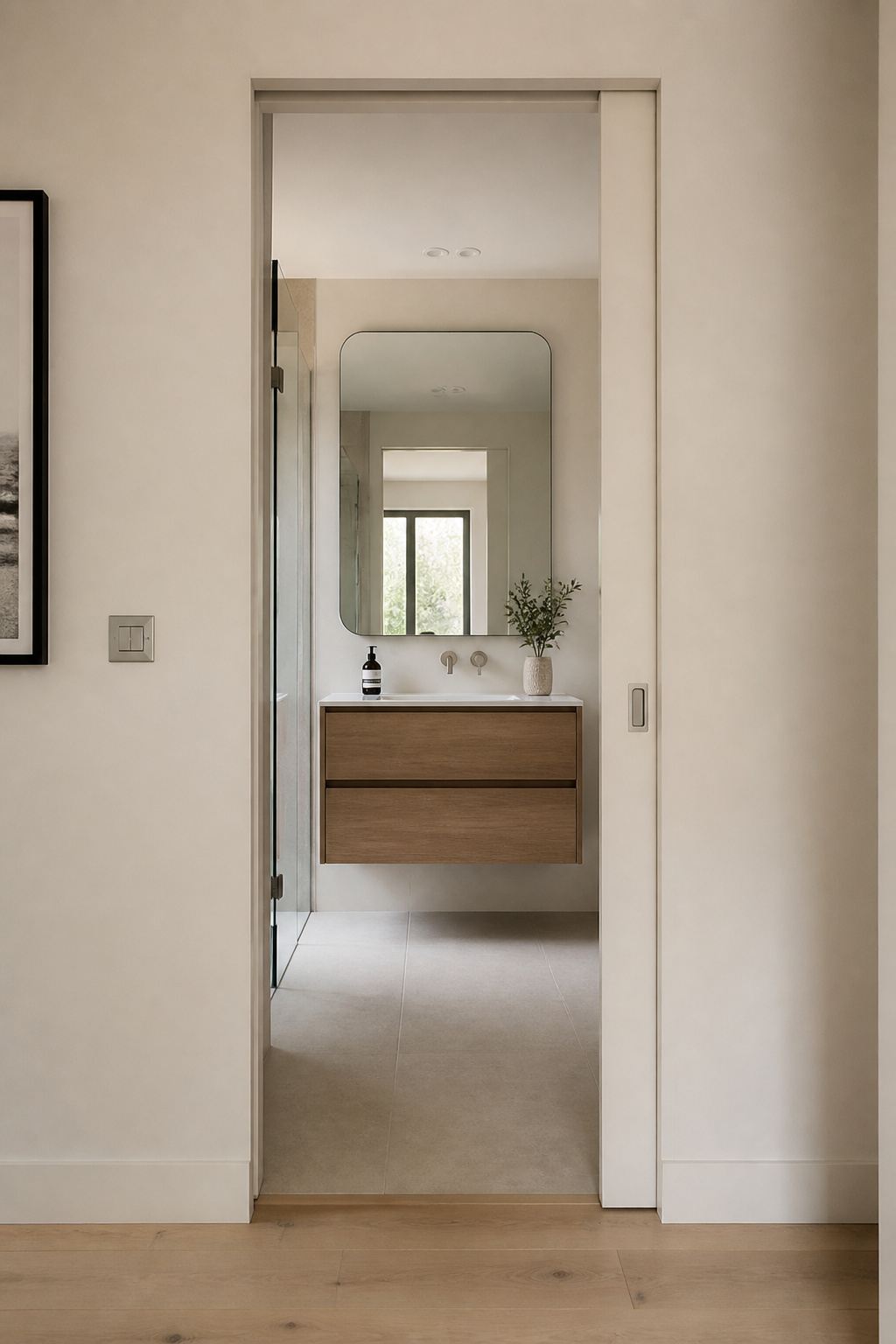
The rough opening for a pocket door is wider than most expect: the rough opening width equals twice the door width plus one inch. A 30-inch door needs a 61-inch rough opening; a 36-inch door needs approximately 74 inches. For bathroom applications, 32 to 36 inches is the recommended door width — 34 inches meets accessibility standards comfortably. These requirements mean a pocket door installation is not a minor project; it involves opening the wall and rerouting any plumbing or electrical runs inside it. Map the wall contents before committing.
Barn doors are the retrofit alternative for situations where opening a wall is not practical. The door slides on an exterior-mounted track above the doorway — no wall cavity needed. The trade-off is a small gap at the door sides, though purpose-made privacy latches address this for bathroom use. Bypass barn doors suit wider openings and divide the door weight between two smaller, easier-to-handle panels.
6. Floor-to-Ceiling Mirrors That Double Perceived Depth
Place a large mirror directly opposite a window in a small bathroom and the room transforms. The mirror captures incoming daylight and distributes it to the far wall, eliminating dark corners and creating the impression of a room that continues beyond its physical boundary. The brain reads the reflection as additional space — a reliable perceptual effect that costs far less than any structural intervention.
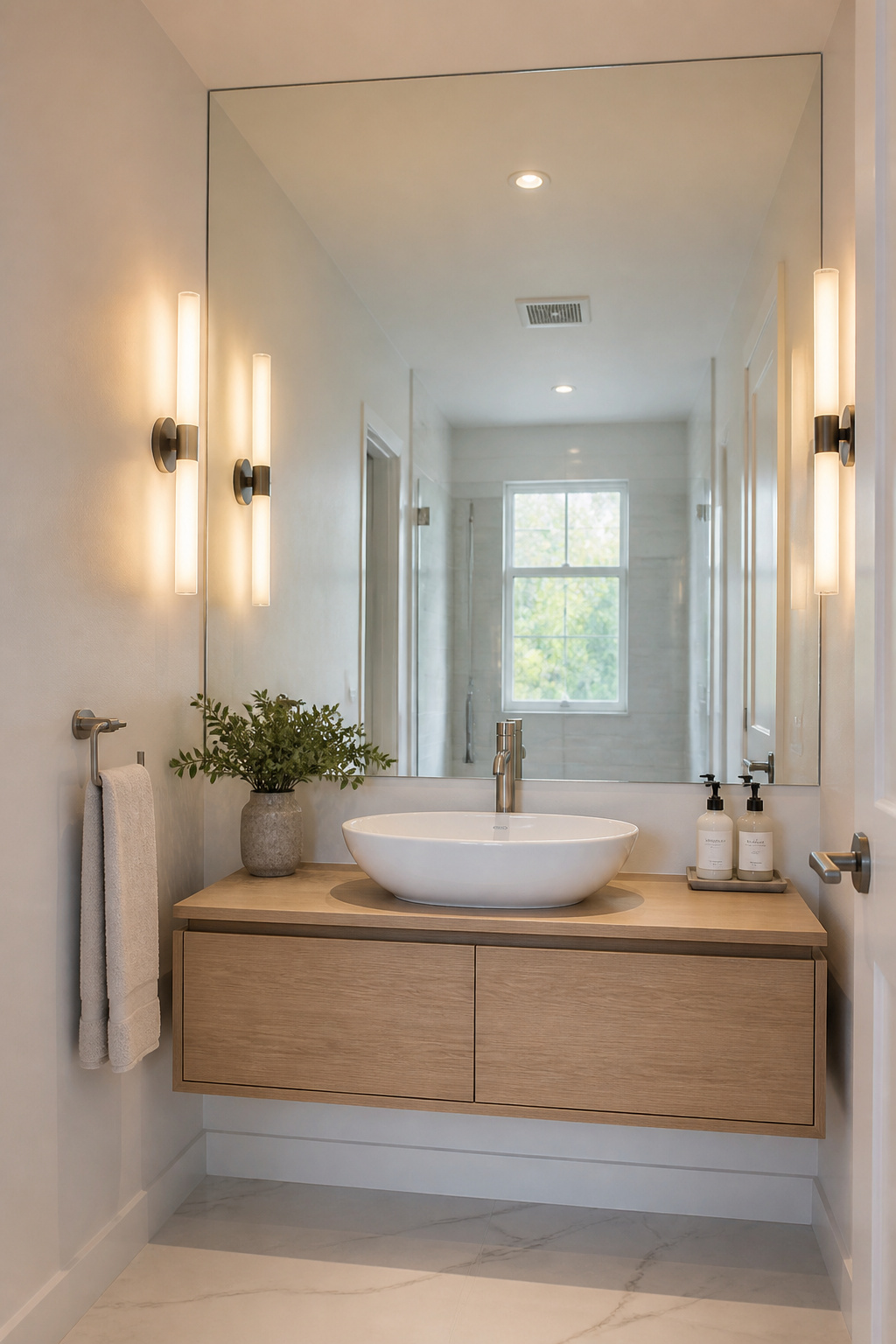
Wall-to-wall mirrors extend this further: the eye travels to the perimeter of the room, hits the mirror, and keeps going. For low-ceilinged bathrooms, a floor-to-ceiling vertical mirror is more effective than a standard vanity mirror because the vertical emphasis makes the ceiling feel higher. Frameless mirrors — where the glass perimeter is polished and sealed without a frame — give the strongest effect because there is no edge to signal where the room ends. The bathroom mirror ideas collection covers the full range from frameless slabs to backlit designs — worth reviewing if you are deciding between formats.
Safety and Fixing
Safety matters with large bathroom mirrors: toughened (tempered) glass or laminated glass is the correct specification. A 24×72-inch frameless mirror weighs 25 to 35 pounds, and fixings must be anchored into studs or rated hollow-wall anchors — adhesive-only mounting is not appropriate for anything this size. Avoid positioning the mirror so that users face direct sunlight. Perpendicular to a window is the practical compromise: the mirror gets indirect light and distributes it without creating glare.
7. Smart Lighting Layers as Small Bathroom Ideas That Feel Luxurious
A single ceiling fixture is the default small bathroom lighting plan, and it fails on every level. Overhead light casts direct shadows on the face — unflattering for grooming and harsh on the eyes first thing in the morning. It creates a bright ceiling and dark walls, which the brain reads as a low, compressed space. And it offers no flexibility: one brightness level, one colour temperature, one mood.
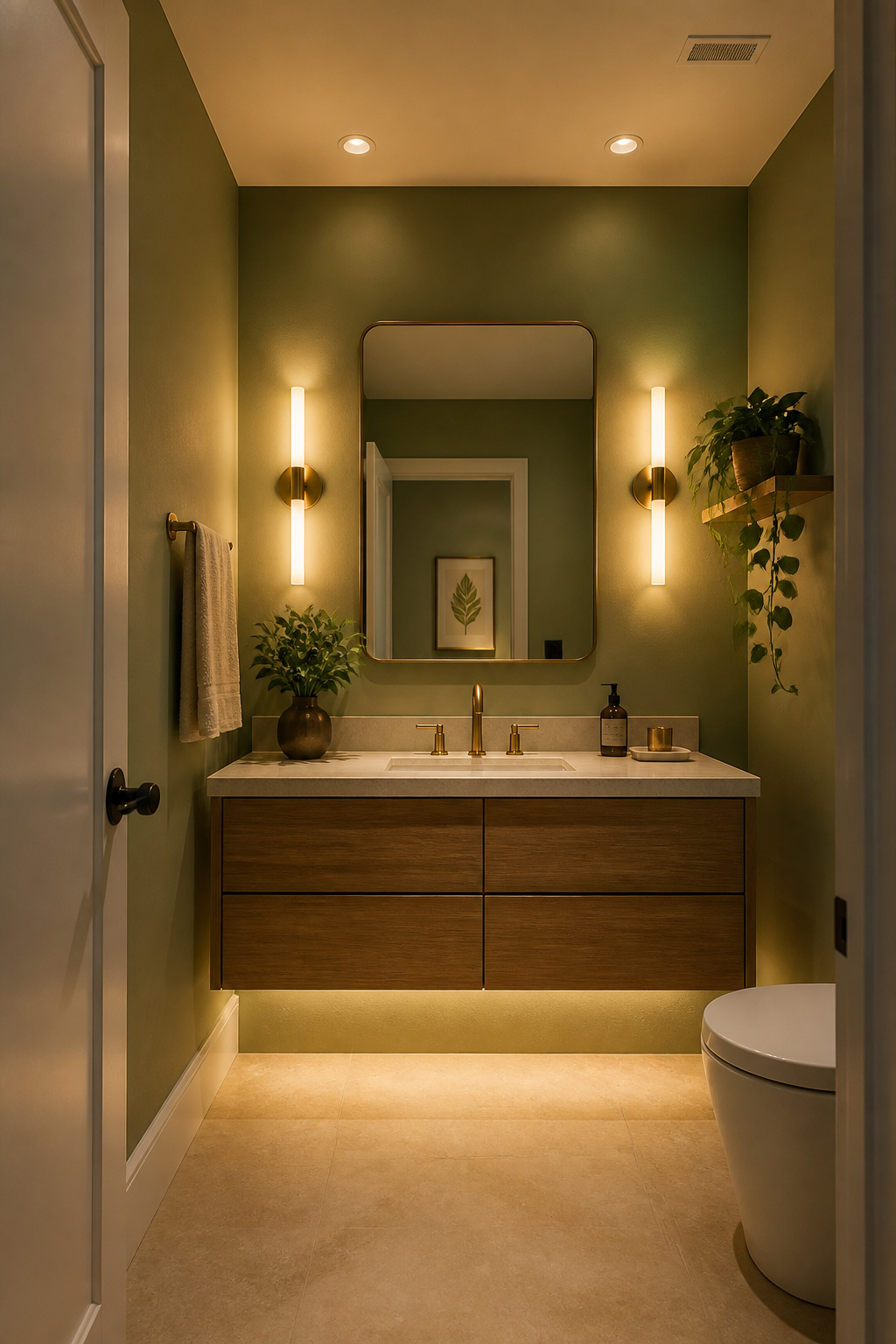
Three layers change everything. Ambient light — recessed downlights in the ceiling — provides overall illumination without taking up visual space. In wet zones: IP67 for Zone 0 (inside the shower or bath), IP44 minimum for Zone 1 and Zone 2. Task lighting at mirror height is the critical addition: vertical sconces or a horizontal LED bar flanking the mirror at face level eliminates facial shadows completely. Side-mounted task lighting is consistently more effective than over-mirror fixtures. The third layer — accent lighting — creates depth: a strip of LEDs beneath a floating vanity illuminates the floor plane and makes the room feel larger.
The Wellness Layer
Colour temperature is where the wellness dimension enters. Warm white (2700K to 3000K) around the bath and shower area signals the body to slow down — this matters at both ends of the day. Cooler light (4000K to 5000K) at the vanity mirror supports alert, accurate grooming. Smart tunable bulbs (Philips Hue, LIFX) let you program both temperatures on a schedule, shifting the bathroom’s atmosphere in alignment with your circadian rhythm. This is genuinely useful — not a gimmick — and has a measurable effect on how rested you feel by evening.
8. Oversized Format Tiles That Make the Room Read Larger
Count the grout lines on a bathroom floor tiled in 150x150mm tiles. Now count what the same area produces in 600x600mm tiles. Small tiles create approximately 49 grout lines per square metre; large tiles create four. In a small bathroom, that difference in visual busyness matters — grout lines are interruptions, and fewer interruptions mean the eye travels further before finding a reason to stop.
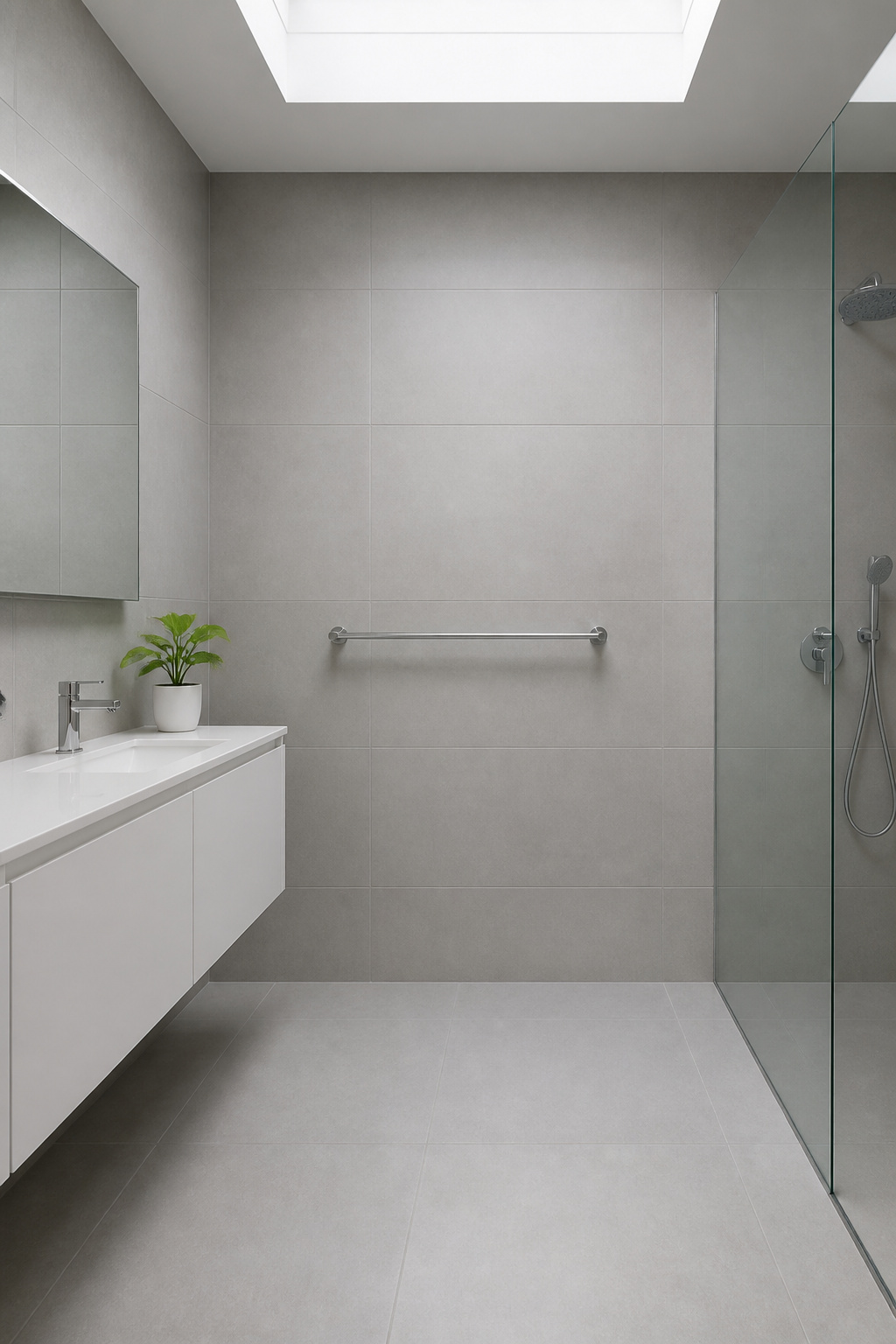
Large-format tiles work in small bathrooms specifically because the reduced grout line count allows surfaces to read as single, uninterrupted planes. The effect is strongest when the floor and wall tiles are the same material and colour — no horizontal colour break at the skirting line, just one cohesive volume. Rectified porcelain allows the tightest grout joints, typically 2mm, which is near-invisible at normal viewing distances.
Substrate Requirements
The floor must be flat within 1/8 inch (3mm) over six feet — imperfections that a small tile bridges over become lippage with large-format tiles. Tile levelling systems (Raimondi, Tuscan, Tylix) are standard practice during installation to maintain consistent joint width and prevent misalignment while the adhesive sets. For tile size: 600x600mm is the practical sweet spot for most small bathrooms. At 1200x600mm, the tile’s length may approach the room’s narrow dimension, requiring cuts that waste expensive material.
9. Vertical Storage Towers in Underused Corner Space
The wall above the toilet is the most consistently under-used surface in a small bathroom. It typically sits empty, doing nothing, while owners complain about having no storage. A floor-to-ceiling shelving column or closed tower unit here adds significant storage without reducing floor area by a single square foot. Height is the direction a small bathroom actually has room to grow.
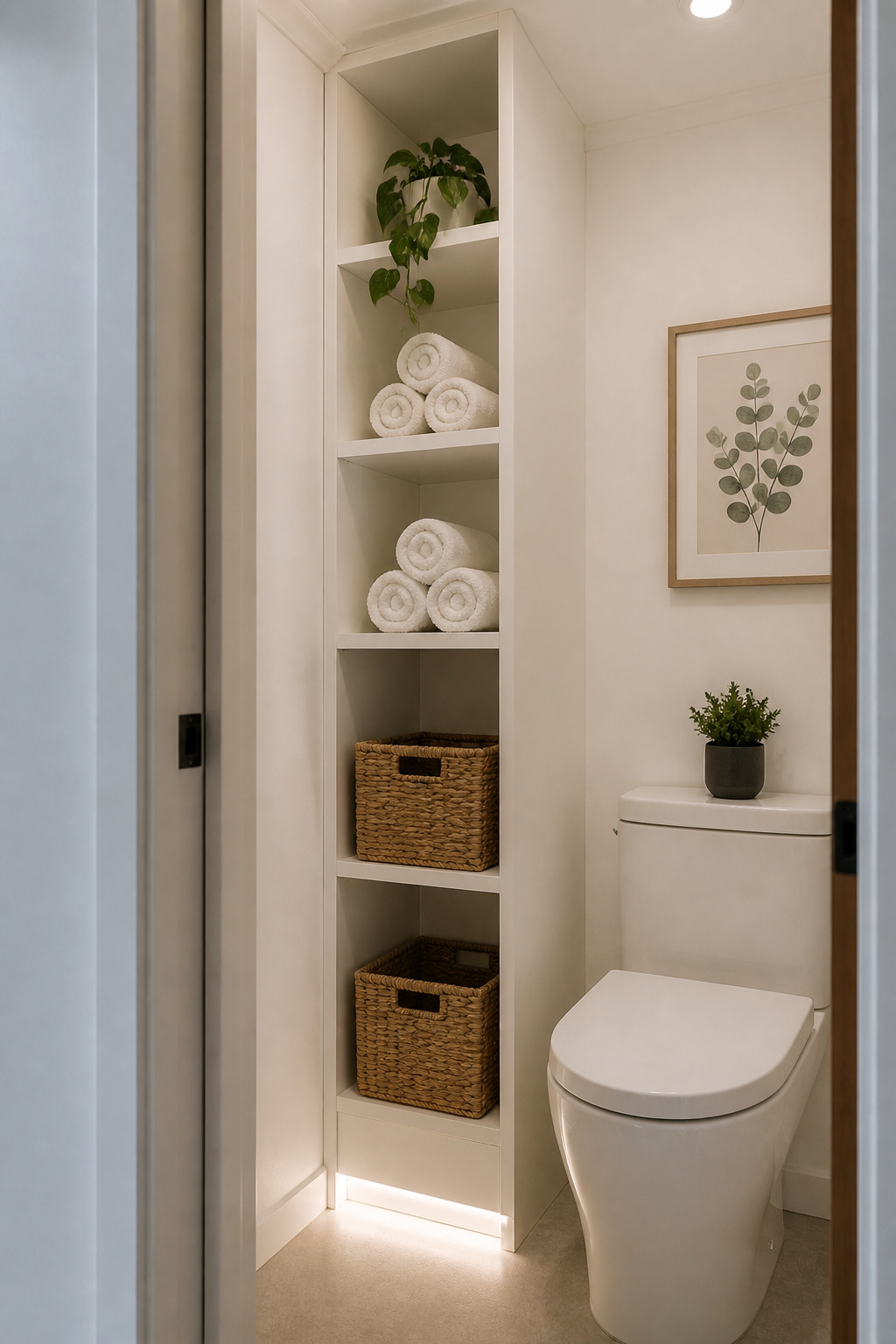
Corners are the second opportunity. Standard rectangular furniture does not fit them well, but corner-specific tower units — angled back panels, triangular footprints — use otherwise awkward space efficiently. Narrow alcoves beside the vanity or bath, often just 6 to 10 inches wide, can accommodate slim towers holding toiletries, medicines, or rolled towels.
Open vs Closed Storage
The choice between open and closed storage in a small bathroom comes down to whether you are willing to curate. Closed towers with doors hide everything — better for shared bathrooms or varied, unmatched products. Open shelving columns feel lighter and do not create the visual heaviness of solid cabinetry. A practical middle position: closed doors at floor level, open shelving above where towels and plants can be displayed. For more ideas across the spectrum, tricks to double bathroom storage covers built-in solutions to freestanding approaches.
Material matters here: moisture-resistant MDF (green-core MR-MDF) is the industry standard for painted bathroom cabinetry. Solid teak is the premium option — its natural oils resist moisture absorption without chemical treatment. PVC and aluminium are the most technically moisture-proof but work best in contemporary bathrooms where the aesthetic suits.
10. Biophilic Accents That Actively Reduce Stress
The research on this is consistent and worth knowing: viewing plants for just three to five minutes decreases cortisol levels by 15 to 20% compared to sterile environments. In a room used during the most transitional moments of the day — waking up, winding down — that effect is not trivial. As bathroom ideas for small bathrooms go, biophilic intervention is one of the highest-leverage changes because it addresses sensory and physiological experience rather than just spatial perception.
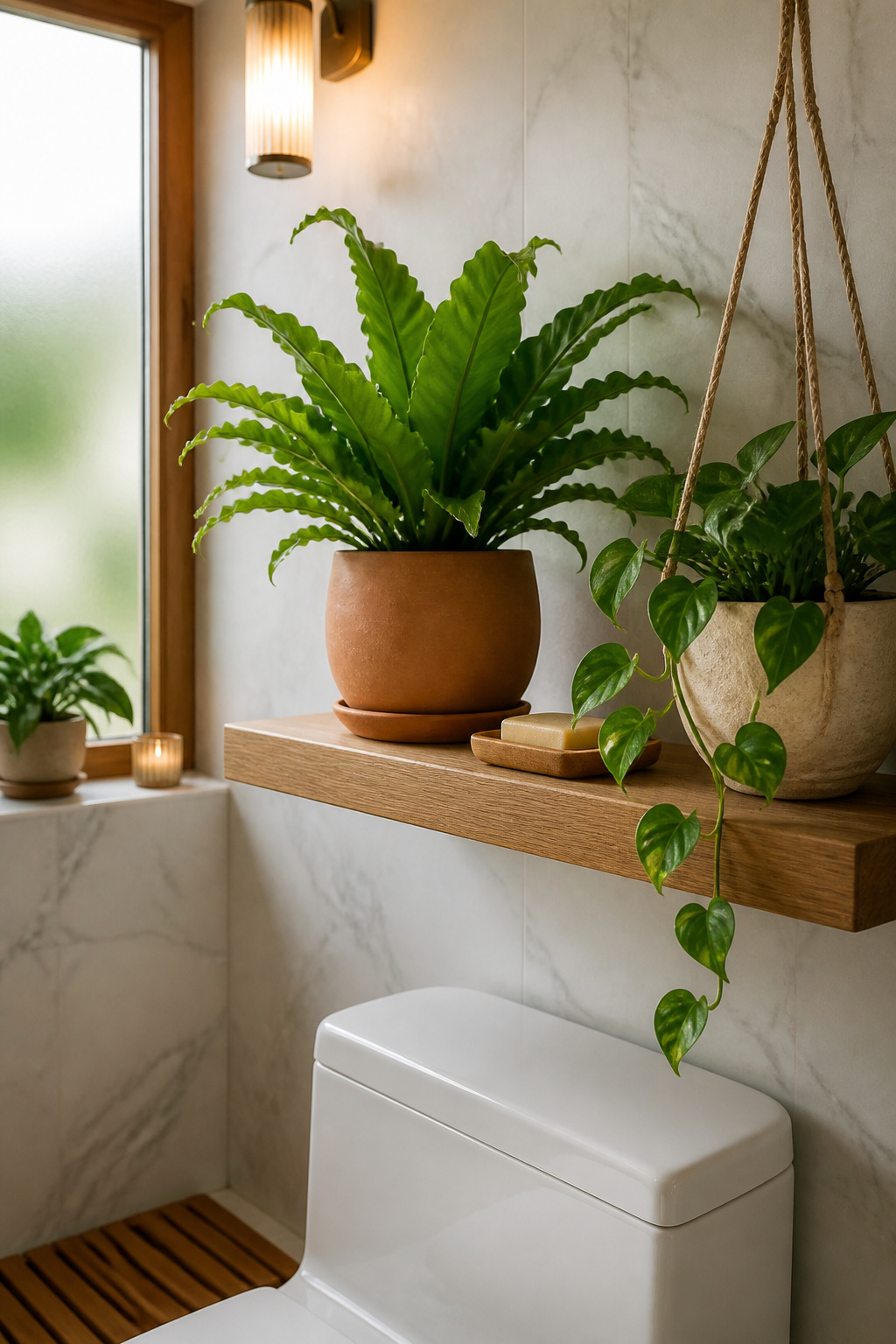
The bathroom’s humidity profile is an asset rather than an obstacle for the right species. Shower steam raises the room to 70 to 90% relative humidity during and after use — exactly the conditions tropical plants thrive in, often eliminating the need to water daily. ZZ plants tolerate very low light and survive long periods without water. Bird’s Nest Ferns thrive in low light and high humidity. Pothos trails from a shelf corner and is extraordinarily forgiving of neglect. Boston Ferns act as natural humidity regulators and help with any mustiness that can develop in a confined space.
Natural Materials
Natural materials extend the principle beyond plants. Teak bath mats and shower benches are moisture-resistant without chemical treatment — teak’s internal oils prevent mould growth naturally. Cork flooring is naturally antimicrobial, soft to stand on, and warm underfoot first thing in the morning. Honed travertine or textured slate on the floor brings tactile quality and visual calm — a matte finish is slip-resistant and does not show water marks the way polished stone does.
The one mistake worth avoiding: choosing plants based on appearance rather than light conditions. A peace lily or orchid in a windowless bathroom will decline within weeks. Match the plant to the actual light level of the room, not the light level you wish it had.
11. Small Bathroom Design With a Wet Room Layout
Strip a bathroom down to its essential functions and you get this: a shower, a toilet, a sink, and storage. A wet room takes the shower component and removes every piece of hardware from the equation — no tray, no enclosure, no threshold, no door. The floor slopes gently toward a drain, the entire room is waterproofed, and water runs away. In a small floor plan, the spatial result is dramatic.
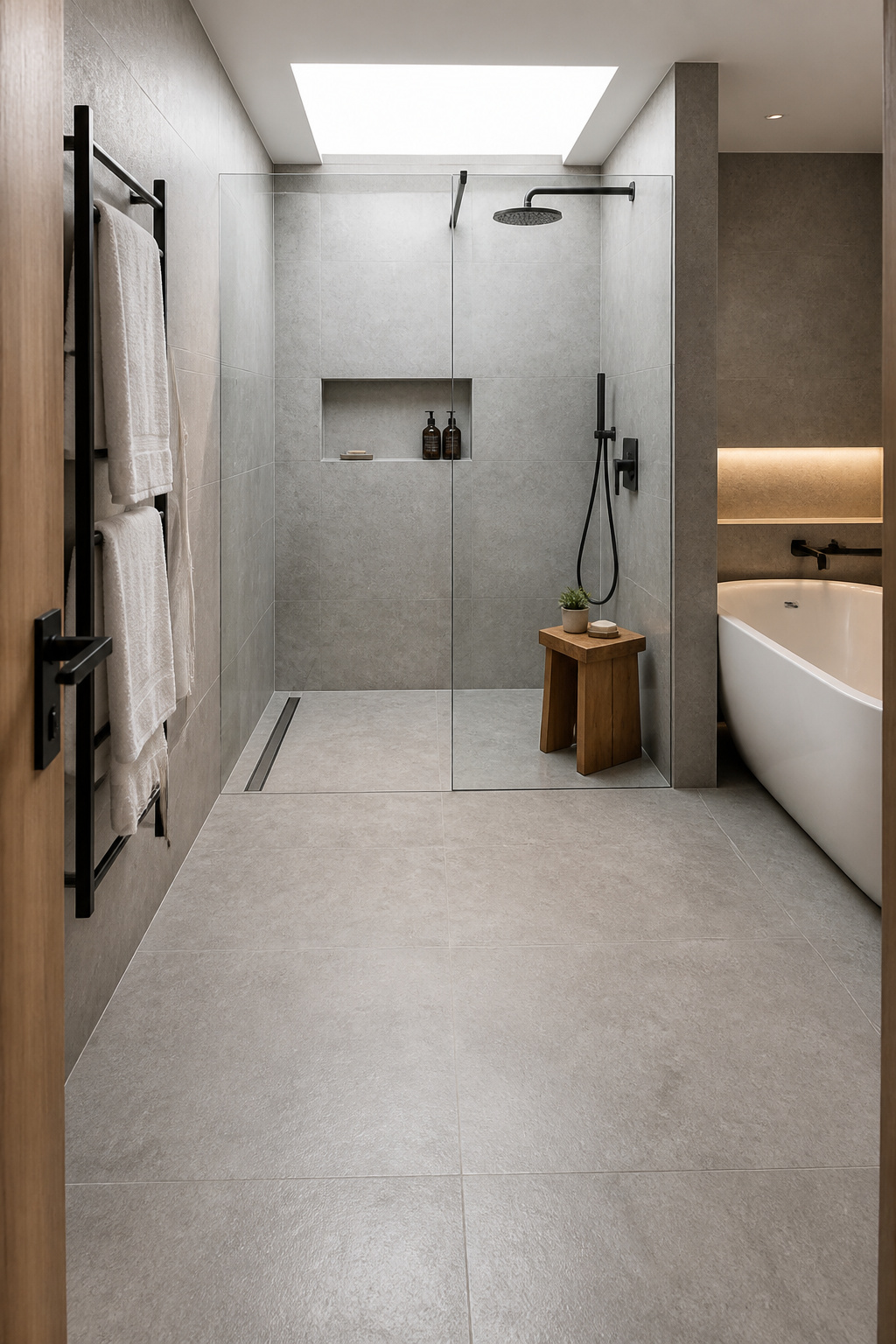
The walk-in design and the absence of a shower tray allows wet rooms to fit into smaller footprints than any alternative. Long, narrow bathrooms benefit particularly — an enclosure blocks the floor plan; a wet room removes the obstacle entirely. It also eliminates the most common maintenance problems: soap scum on enclosure glass, silicone seals that blacken with mould, and shower trays that discolour with scale.
Waterproofing is the critical investment. The entire floor and lower walls — typically one to two metres high — must be tanked before tiling. The floor drainage fall is typically 1:80 toward the drain. Linear channel drains along one wall are more effective than central point drains in rectangular rooms. Budget accordingly: wet rooms cost 40 to 60% more than a standard shower tray installation because of the tanking, drainage engineering, and typically higher tile content.
Material Specification
Fully vitrified porcelain with an R10 or R11 anti-slip rating (German DIN standard) is the correct floor specification. Avoid polished natural stone on the wet room floor — limestone and travertine are porous and will stain and degrade without annual sealing. If stone is important to the aesthetic, use it on the walls and choose porcelain for the floor.
12. Heated Floors That Remove Bath Mats and Reduce Allergens
Bath mats are one of the highest allergen-load surfaces in a small bathroom. They trap moisture, skin cells, and mould spores, and in a confined space with limited ventilation, that matters for anyone with asthma, dust mite sensitivity, or young children. A consistently warm floor dries within minutes of a shower; bath mats become unnecessary. Among bathroom ideas for small bathrooms, this is one of the most meaningful health-aligned improvements available.
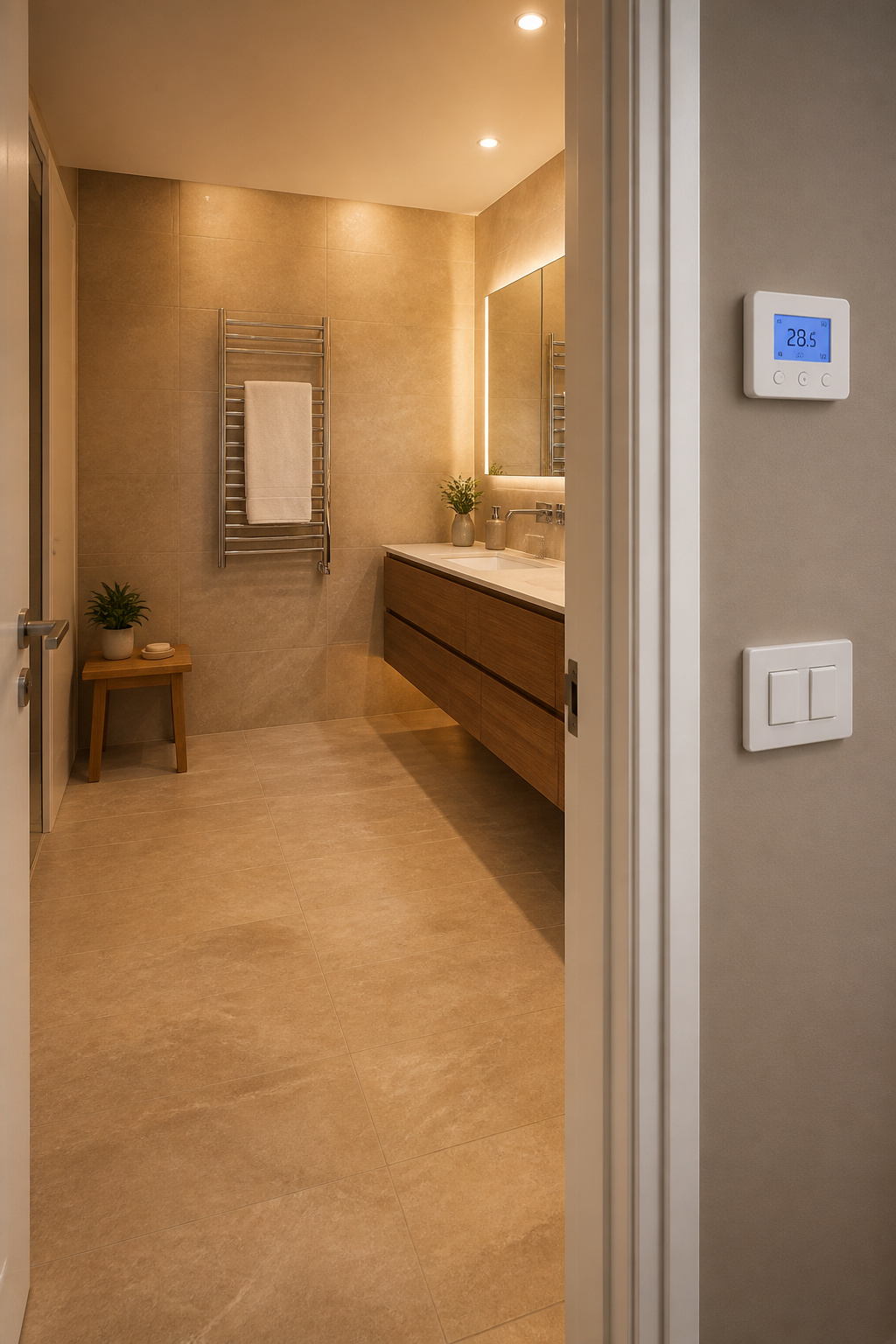
Electric mat underfloor heating is the practical choice for bathroom installations. Heating cables pre-spaced on fibreglass mesh roll out and embed directly into tile mortar — no boiler connection, no pump, no major plumbing. The system is invisible once tiled, adds no height to the floor assembly, and can be installed during a standard bathroom renovation without structural changes.
Cost and Controls
Cost: $5 to $10 per square foot installed, putting a 50 to 100 square foot bathroom at $265 to $700 for the heating element. Running costs are approximately $0.01 to $0.15 per hour — roughly $14 to $20 per month on a schedule. A programmable thermostat is essential: set it to warm the floor before the household wakes and switch off automatically during unoccupied hours. Running a bathroom heating mat without a thermostat is the most common operating error and makes the running costs seem unreasonable when the system itself is genuinely economical. Ceramic tile is the most efficient flooring material for radiant heat, per the US Department of Energy.
13. Monochromatic Palettes: Small Bathroom Ideas in a Single Tone
The most spatially effective colour approach for a small bathroom is not white, despite the conventional wisdom. It is a single tone carried consistently across every surface — walls, ceiling, floor, trim, and fixtures all in the same colour family. The result: the room’s boundaries become difficult to perceive. Corners blur. The ceiling recedes. The space reads as a single enveloping volume rather than a confined box.
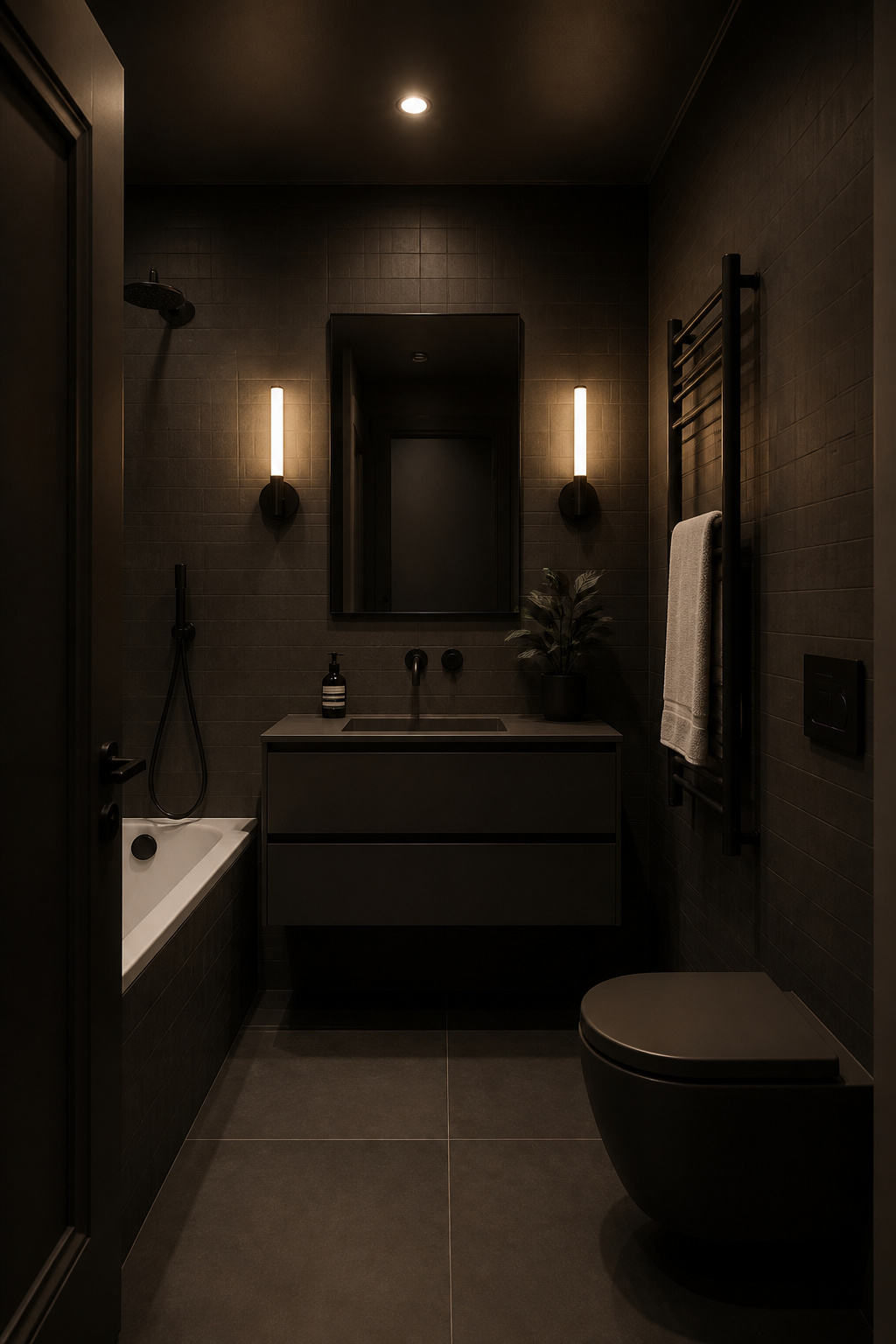
Dark tones work particularly well. Charcoal, deep navy, forest green, warm olive — all of them use depth rather than brightness to expand perceived space. The eye cannot find where one wall ends and another begins. For context on how this fits into current thinking, modern bathroom design trends covers the shift away from white tile as the default toward more considered, tonal approaches that designers are now applying consistently.
In a monochromatic room, texture replaces colour contrast as the primary design tool. Without varying surface finishes, a single-colour room becomes flat and clinical rather than spacious and calm. The difference between a successful monochromatic bathroom and a sterile one is the layering of texture: matte wall tiles paired with gloss grout; a brushed metal towel rail; a textured plaster finish on one wall; smooth porcelain fixtures — all in the same tone but with enough surface variety to create depth and interest. A subtle tile pattern in the same colour — herringbone, fluted, zellige — adds movement without breaking the palette.
Fixture finishes should align with the palette tone. Matte black in a charcoal or navy room; brushed gold in a warm ochre or terracotta scheme; brushed nickel in a cool grey. Accessories offer an opportunity for tonal layering: towels in a slightly lighter shade, a ceramic soap dish in a complementary mid-tone, a woven basket in a natural colour that sits comfortably within the palette.
14. Ideas for Your Small Bathroom: Open Shelving With Woven Baskets
Open shelving works in small bathrooms on one condition: it has to be curated. Each shelf should hold one category of contained items — rolled towels in one basket, products in another, a plant at the end. The moment items start accumulating loose and uncontained, the visual clutter negates every spatial benefit the open shelving was meant to provide. That said, when it works, the result is genuine warmth that closed cabinetry cannot match.
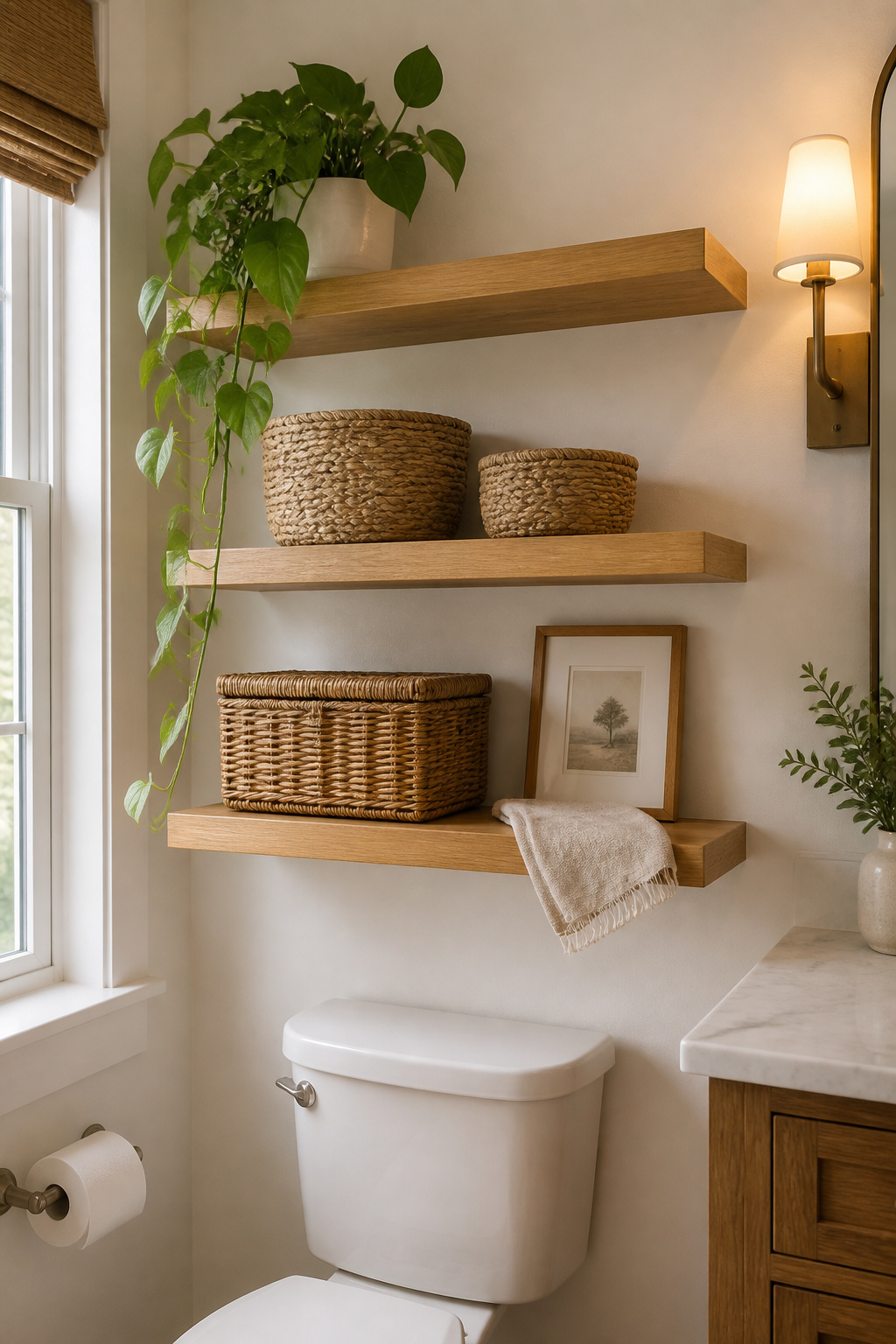
For shelves above the toilet or beside the vanity, 48 to 72 inches from the floor is the accessible and practical height range — clear of the mirror zone, reachable without stretching. The basket material matters for longevity. Seagrass is naturally moisture-resistant and holds its shape well in ambient bathroom humidity. Rattan resists warping in humid conditions and suits everything from coastal to contemporary. Water hyacinth adds a more handcrafted texture but is slightly more porous — better in well-ventilated bathrooms. Cotton rope baskets are excellent for rolled towels specifically, easy to wash, but not ideal for holding heavy products.
Fixing Shelves in Tiled Walls
Diamond-tipped tile drill bits are essential — standard bits crack porcelain. Drill slowly with occasional water cooling to prevent overheating and fracturing the tile. Shelf brackets anchored through tile into studs or solid masonry are the most secure. For lightweight shelves holding baskets and small items only, adhesive rail systems remove the drilling challenge entirely. For a broader look at how storage solutions work together, brilliant storage solutions for small bathrooms is worth exploring alongside this approach.
15. Towel Radiators and Heated Rails as the Final Functional Layer
A heated towel rail does two things a standard panel radiator cannot: it heats the room and it dries towels. In a small bathroom, that dual function is the point — one wall-mounted unit replaces what would otherwise require a separate radiator and a separate towel rail, recovering wall space in a room that typically has very little to spare. Among bathroom ideas for small bathrooms, it is one of the tidiest functional upgrades available.
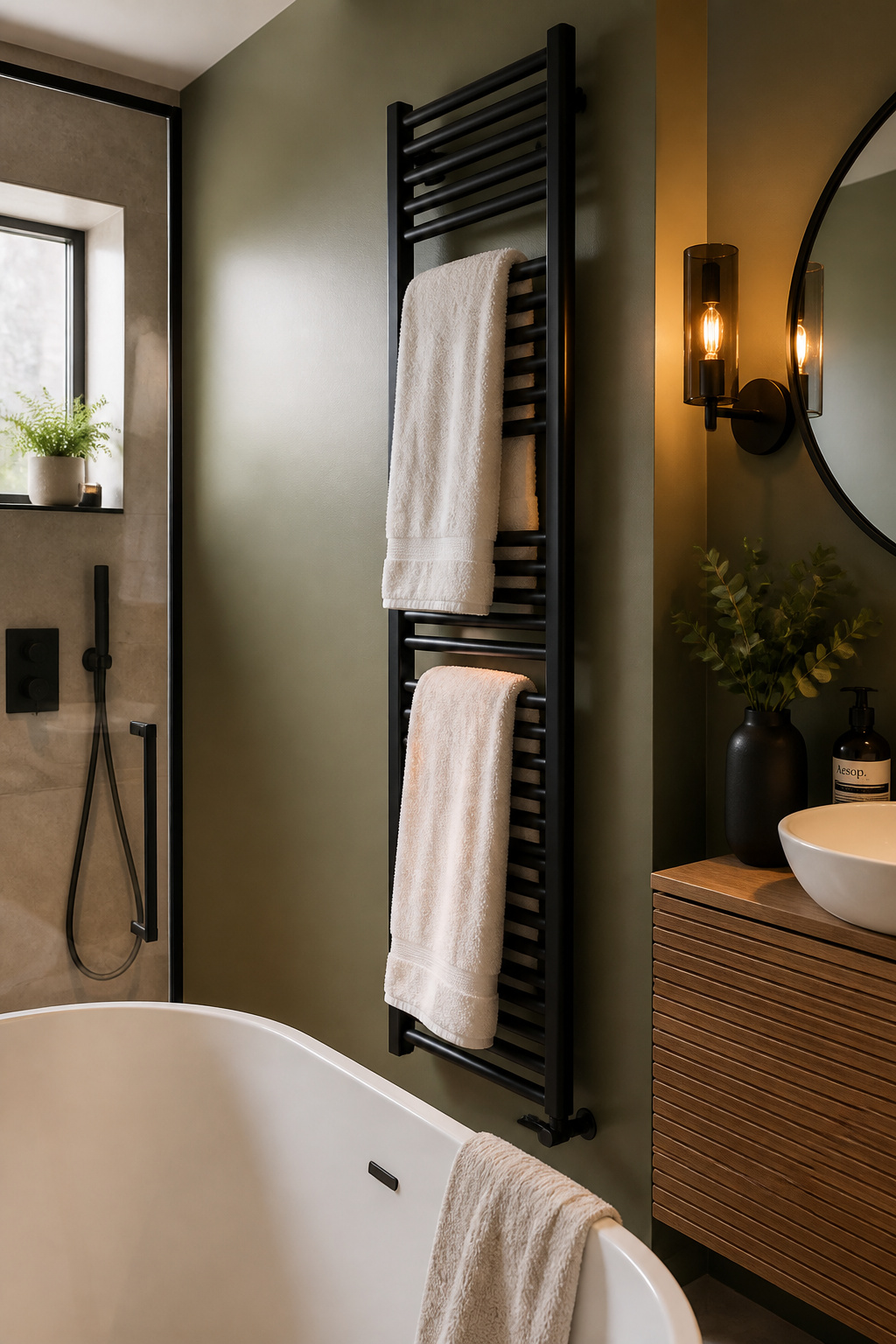
The BTU calculation for a small bathroom is straightforward. Multiply the room volume (length x width x ceiling height in cubic feet) by four for a well-insulated space, or by five for a poorly insulated room. Add 20% buffer to the result. For a small en-suite approximately 2m x 1.5m, the target falls around 1,500 to 2,000 BTU. A 600-watt electric towel radiator produces approximately 2,046 BTU — typically right-sized for this application.
Electric vs Plumbed
Electric models wire directly into the mains, heat quickly, and can be switched on independently of the central heating system — practical for summer months when running the full boiler to warm towels is wasteful. Plumbed models connect to the central heating circuit and deliver stronger, more sustained heat but run on the boiler’s schedule. Dual-fuel radiators offer both: central heating in winter, electric in summer. Installation costs are manageable: electric hardwired units run £100 to £200 for a qualified electrician; plumbed installation costs £150 to £300 for a plumber.
Choose the finish — chrome, matte black, brushed brass — before sourcing taps and mirror frames. Mismatched finishes in a small bathroom are visually distracting in a way that a larger room absorbs more easily. And place the radiator on the wall opposite the vanity or beside the bath — positions that keep it clear of the door swing and away from splashing zones.
Choosing the Right Small Bathroom Ideas for Your Space
The 15 bathroom ideas for small bathrooms in this article span a wide range of investment, disruption, and timescale — and knowing which ones belong in which sequence matters as much as knowing which to choose.
Structural changes go first, before a single tile is laid. Pocket doors, floating vanity backing boards, wet room drainage engineering, underfloor heating mats, and recessed shower niches all need to be in place before the finishes go on. Trying to retrofit any of these into a finished bathroom means undoing expensive work. If you are planning a renovation, sequence these decisions before committing to a tiler.
Cosmetic changes can happen at any time. A larger mirror, a fresh coat of low-VOC paint in a deep saturated tone, open shelves with woven baskets, plants, and a quality towel rail — these can transform how a bathroom feels without touching the plumbing or the tiles. If you are not ready for a full renovation, start here. The visual and sensory improvement is genuine and immediate.
If the budget allows just one structural investment, the choice with the broadest impact depends on the specific constraint. Floor space lost to a swinging door? Change the door type. Vanity dominating the room? Go wall-mounted. Lighting flat and unflattering? Add a task layer at mirror height. These three changes address the most common problems, and together they are among the bathroom ideas for small bathrooms that transform the experience of a room without changing its square footage at all.