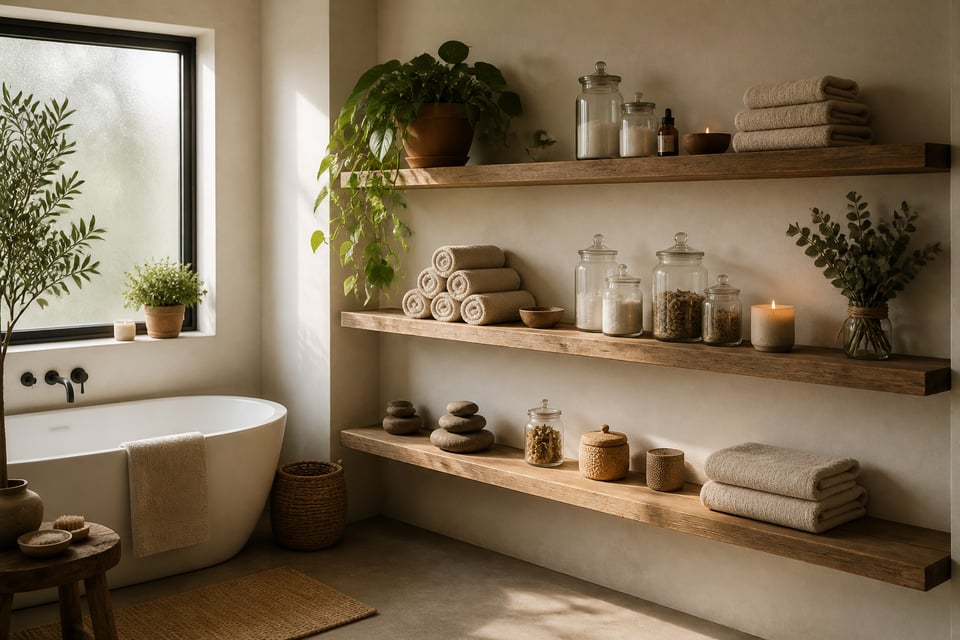
There is a particular frustration that comes from a bathroom shelf that refuses to look calm no matter how many times you rearrange it. You add a candle. You move the jars. You clear some space. Yet the shelf still reads as cluttered rather than curated, functional rather than intentional. The problem, in most cases, is not what you have on the shelf — it is how, and more importantly why, the shelf was styled in the first place.
As a wellness design consultant, I approach bathroom shelf decor not as an aesthetic exercise but as a wellbeing one. Research confirms what most of us already feel intuitively: visual clutter in the bathroom, a space we move through twice every day, creates a measurable cortisol response — a small but real stress at both the start and end of every single day. A UCLA study linked high-density household objects directly to elevated cortisol levels throughout the day. Getting your bathroom shelf decor right is one of the highest-impact-per-square-foot changes available to you in your entire home.
These fifteen ideas range from natural material choices to compositional principles, all filtered through a wellness lens. Some will require shopping. Many will simply require editing. All of them treat the bathroom shelf as something worth taking seriously — because a bathroom that genuinely makes you feel calm is one of the most underrated upgrades you can give yourself.
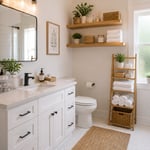
1. Reclaimed Wood Floating Shelves With Woven Baskets and Live Greenery
There is something the body recognises before the mind does when it encounters natural materials. A reclaimed wood shelf — with its grain variations, slight imperfections, and warm undertones — activates what researchers call a biophilic stress response: a measurable reduction in cortisol and heart rate simply through visual contact with natural texture. This is not interior design mysticism. It is documented environmental psychology, and it makes reclaimed wood one of the most credentialed starting points for wellness-focused bathroom design.
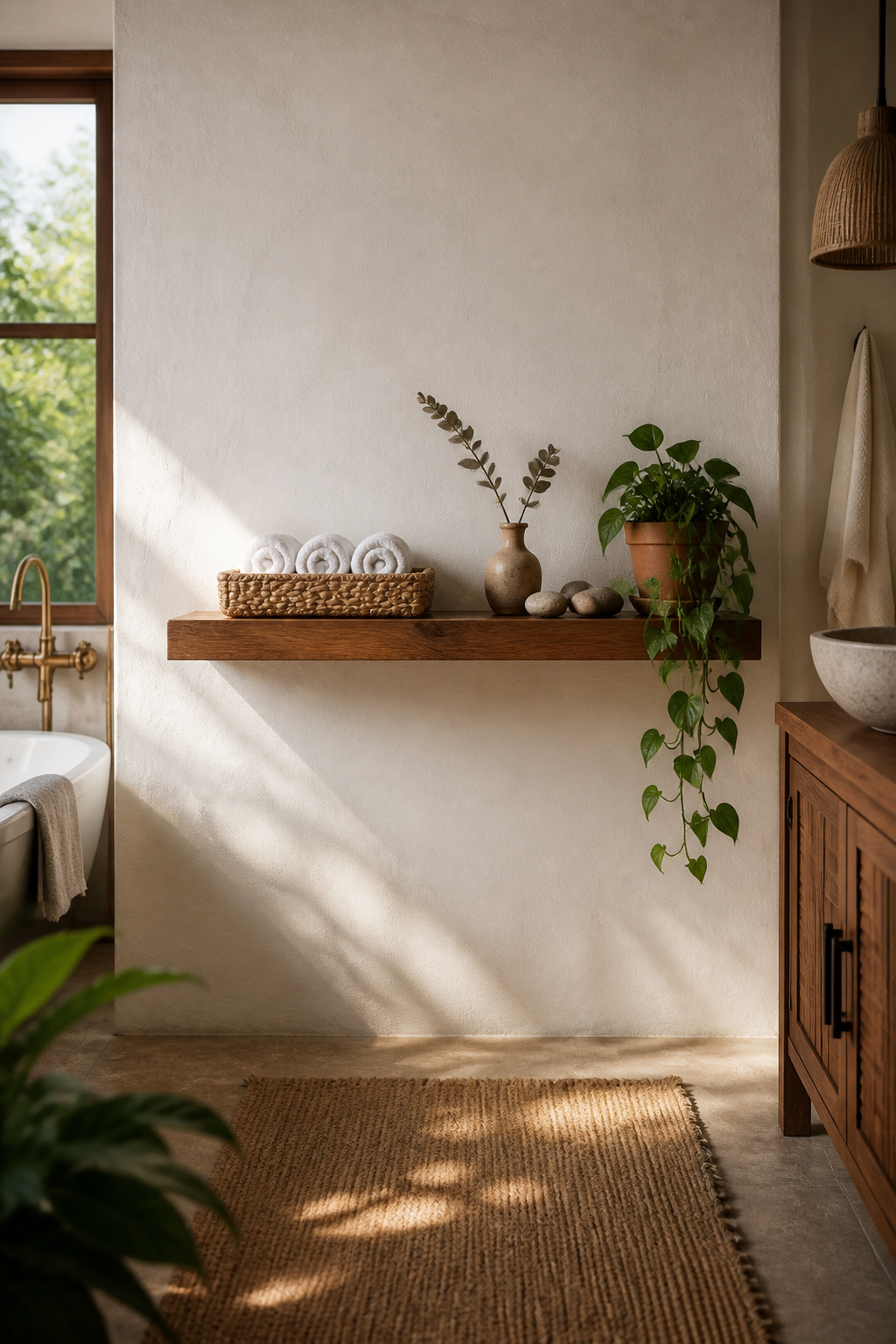
For bathroom use, the right wood matters. Teak is the gold standard: its internal oils resist moisture without heavy chemical treatment. White oak scores above 1,360 on the Janka hardness scale and handles bathroom humidity without significant swelling or movement. Properly finished reclaimed barn wood can also work beautifully — look for VOC-free finishes (water-based polyurethane, hard wax oil, or plant-based tung oil) rather than solvent-based lacquers, which off-gas in enclosed spaces and undermine everything you are trying to create. Brands like Earthy Timber and What WE Make offer live-edge shelf options with plant-based, non-toxic finishes.
The styling principle for this kind of bathroom shelf decor is restraint. Keep woven baskets in one material family — sea grass, water hyacinth, or rattan — rather than mixing types. A single trailing pothos at the shelf edge and one upright plant mid-shelf creates movement and life without competing with the wood’s natural warmth. As a general guide, decorative objects (including baskets and plants) should occupy no more than 30% of the total shelf surface. The remaining 70% of visible wood is not wasted space — it is the point.
2. Apothecary-Style Glass Jars for Everyday Bathroom Essentials
Most bathroom shelves start out as a fragmented mix of mismatched plastic: different sizes, different labels, different shades of white and blue. The fix for bathroom shelf decor that genuinely reads as calm is simpler — and more wellness-aligned — than it might appear. Glass apothecary jars are non-porous, BPA-free, lead-free, and chemically inert. They will not leach anything into stored products, they do not off-gas in warm humid conditions the way some plastics do, and they create an immediate sense of order that significantly reduces the visual noise of a shared bathroom shelf.
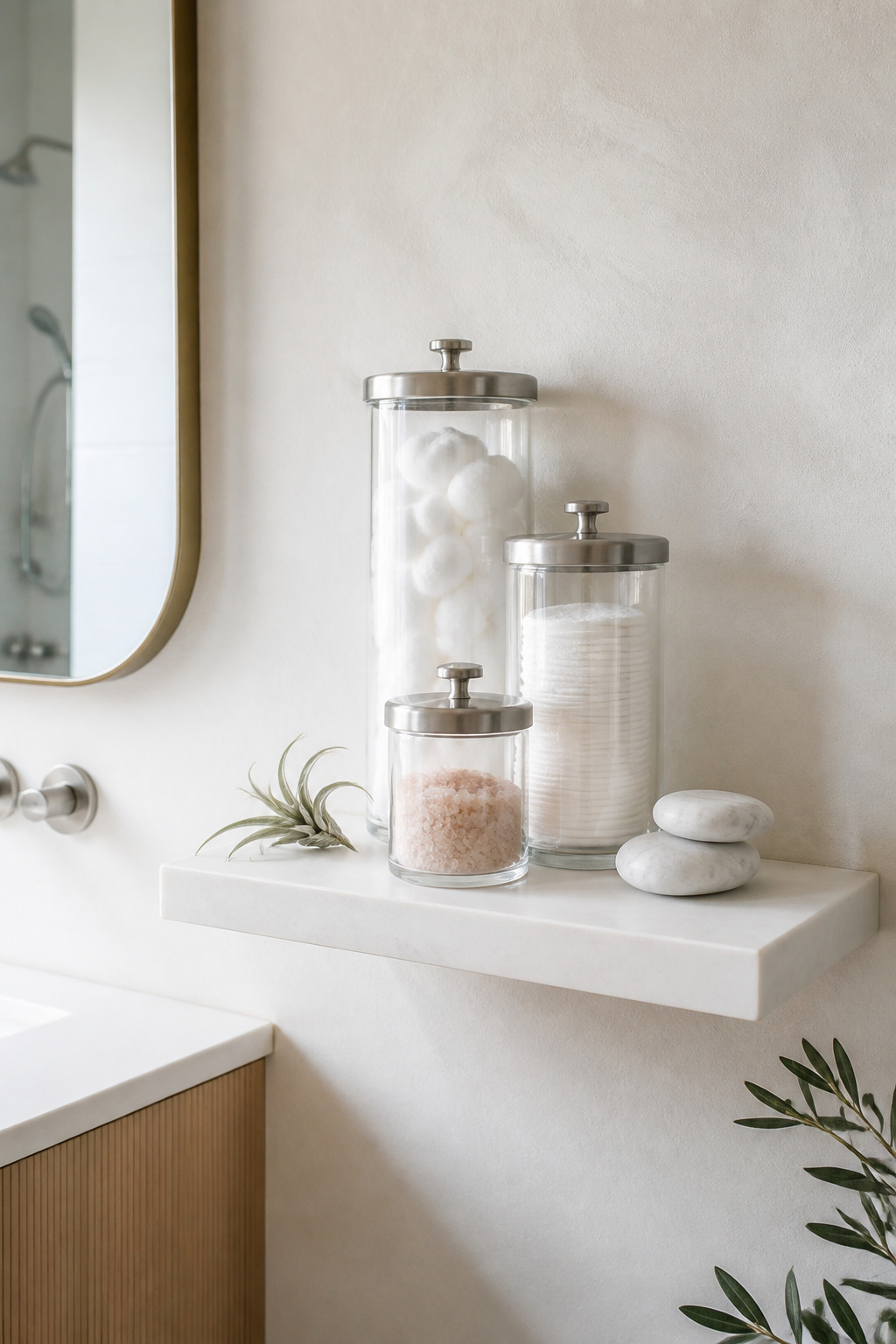
Standard apothecary jar sets come in three sizes: approximately 24oz (7 inches tall) for cotton balls or bath salts, 12oz (around 5.5 inches) for cotton rounds and Q-tips, and 5oz (4.3 inches) for smaller items like hair pins. Swing-top Kilner-style jars work particularly well for bath salts and dried herbs because the seal keeps contents fresh in a humid environment. For visual consistency, choose all jars from one design family — all cylindrical with matching metal lids, for example — rather than mixing jar shapes.
The arrangement principle is simple: tallest jar at the back, medium in the middle, smallest at the front. Leave 2-3cm of breathing room above the contents in each transparent jar — an overfilled jar loses the clean apothecary look and makes it harder to access what’s inside. One frosted or coloured glass jar among clear ones adds gentle variety without breaking the calm.
3. Bathroom Shelf Decor Using River Stones and Air Plants for Zen Balance
In Feng Shui, the bathroom is a water-element space — and the primary challenge is preventing that water energy from becoming draining or destabilising. Grounding elements (stones, low-growing plants, earth-toned objects) directly counterbalance this. River stones represent earth energy; living plants introduce wood energy, which Feng Shui associates with growth and vitality. Together, they create a small but genuinely stabilising composition that works whether or not you subscribe to Feng Shui as a philosophy.
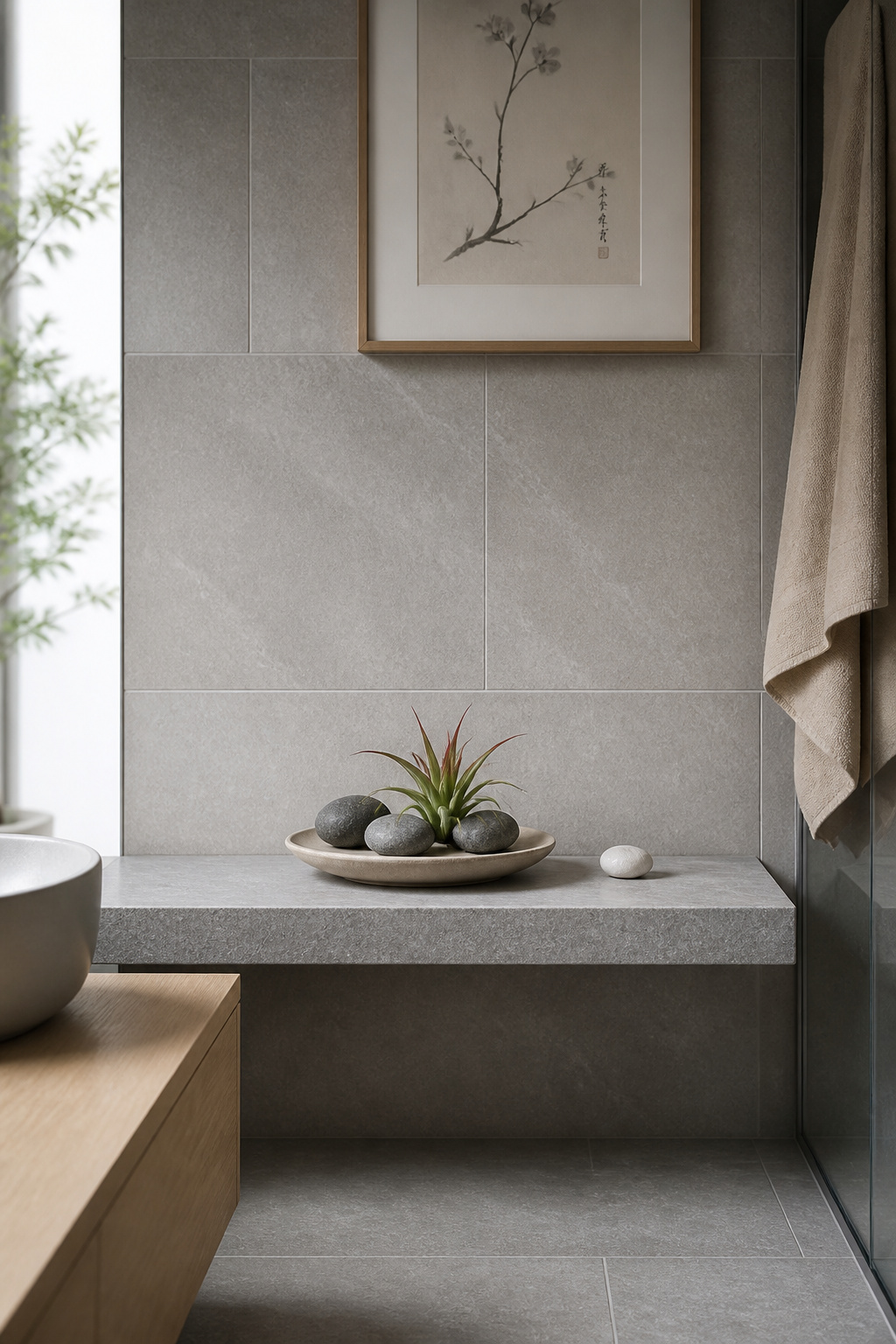
Air plants are ideal for this kind of vignette because they require no soil and minimal care — and they genuinely thrive in bathroom humidity. The species that perform best in high-humidity conditions are the Mesic Tillandsia family: Tillandsia ionantha (compact, turning red and purple at bloom), Tillandsia brachycaulos (bright green, medium-sized), and Tillandsia cyanea (the Pink Quill Plant, striking at bloom). For mindful small bathroom design ideas, these small-scale plants are particularly effective because they occupy almost no physical space while creating significant visual interest. In a bathroom, you can reduce supplemental misting to once weekly — the ambient steam from showers does the rest.
For the stone arrangement, use an odd number (three or five) in varying sizes — large, medium, small — grouped loosely rather than in a straight line. Position the air plant as the tallest element, slightly off-centre, and cluster the stones asymmetrically at its base. Grey basalt stones against a green Tillandsia keep the palette quiet and grounded; white quartz with a pink-tipped ionantha adds a gentle, warm contrast without becoming ornate.
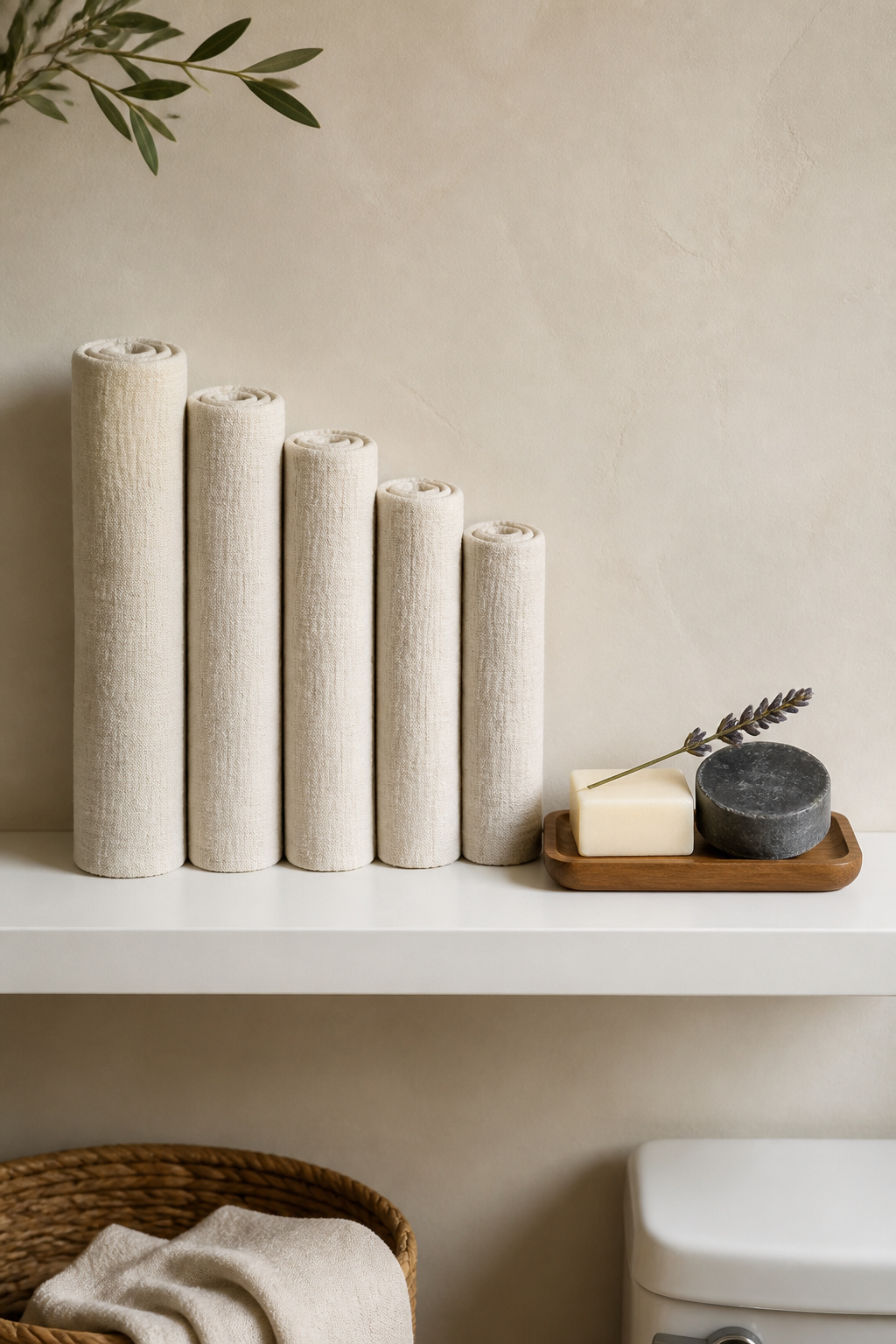
4. Rolled Linen Towers and Handmade Soap Bars as Functional Sculpture
The idea that functional items can be beautiful — and that beauty and function are not competing priorities — sits at the heart of wellness design. Rolled linen towers and handmade soap bars are the clearest expression of this principle available on a bathroom shelf. This approach to bathroom shelf decor treats what you need every day and what you want to look at as the same thing.
The Certification That Matters Most
Conventional bath towels often contain formaldehyde resins (used for wrinkle resistance), synthetic dyes with azo compounds, and chlorine bleach treatments. Many also carry PFAS finishes — potential allergens or endocrine disruptors that make prolonged skin contact worth considering. GOTS-certified (Global Organic Textile Standard) linen or organic cotton guarantees no toxic pesticides in cultivation and no harmful dyes in processing. OEKO-TEX Standard 100 certification tests the finished product for over 100 harmful substances. Both certifications are now widely available and not significantly more expensive at mid-market price points.
For the soap, castile bars (made entirely from plant oils, traditionally olive) have a smooth, matte surface in warm off-white that photographs and displays beautifully — and they are genuinely non-toxic, with no synthetic surfactants. Goat milk soaps sit in a soft creamy-to-pale-peach palette. Charcoal soaps are the visual outlier: deep grey with a slightly textured surface, they work well as a single dark accent among lighter shelf objects. Rolling technique matters: fold in thirds lengthways, roll tightly from one end, stand upright. Three to five towels creates height variation. Keep displayed towels in rotation — a towel that sits on display in a steamy bathroom for too long will develop mildew before it is used.
5. Candle Vignettes in Built-In Niche Shelves for Spa-Like Warmth
Before selecting candles for your bathroom shelf decor, the air quality conversation is worth having first. Most people choose candles for scent, which is reasonable — but the wax type matters more than most realise. Paraffin candles release benzene, toluene, and formaldehyde when burned. In an enclosed bathroom with limited ventilation, burning paraffin is a meaningful indoor air quality issue. It is worth switching.
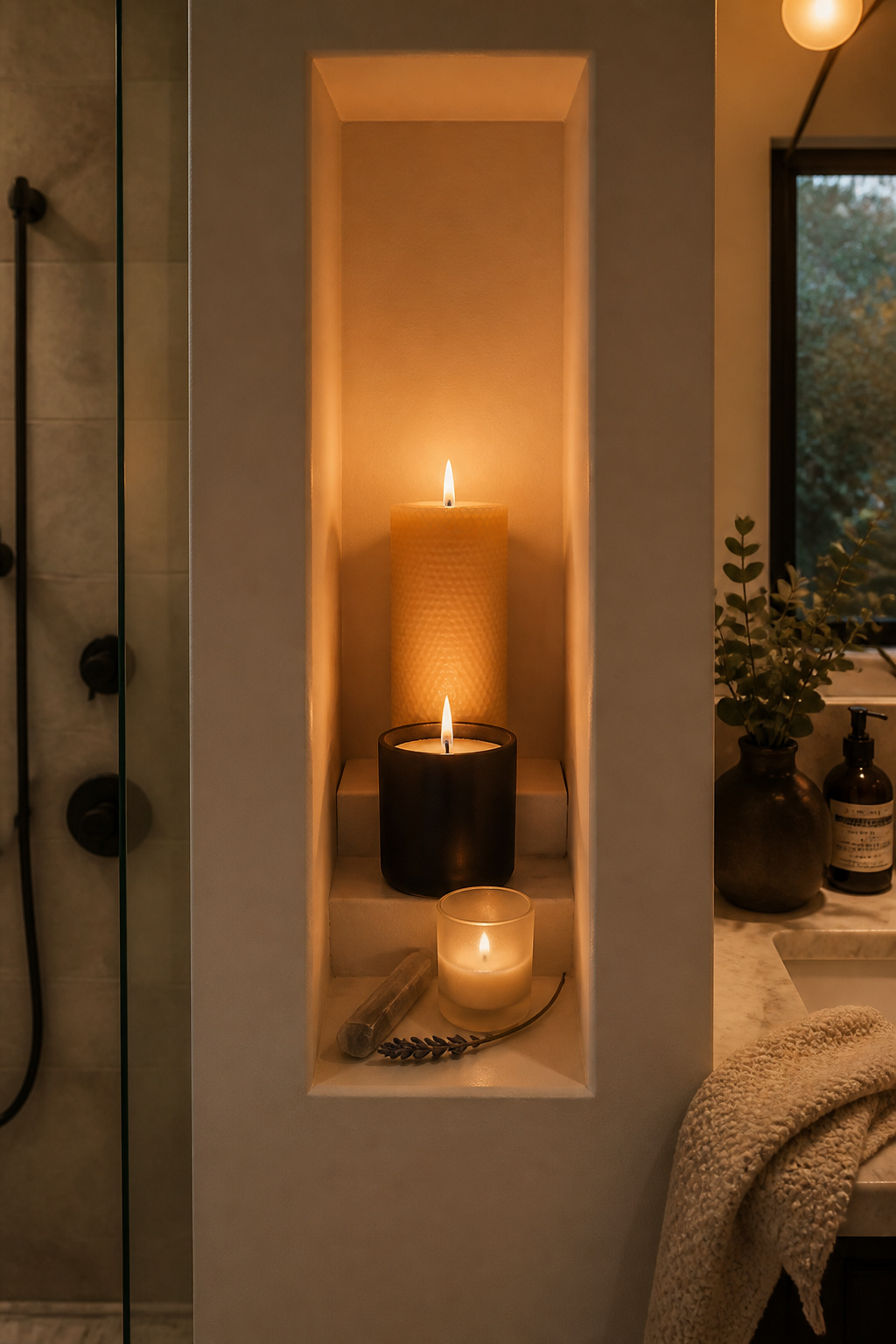
100% soy candles with phthalate-free fragrance produce less than 5 micrograms per gram of VOCs — significantly below paraffin levels — and burn without the black soot that paraffin deposits on bathroom tiles and ceilings. Beeswax burns with virtually no soot and negligible VOC emissions; it does not purify the air (that claim is marketing, not science), but its combustion is ultra-clean. Either is a solid choice. What matters is the 100%: many candles labelled ‘soy’ or ‘beeswax’ contain paraffin blends, which largely negates the benefit.
For scent, the evidence-based choices are lavender (meta-analyses confirm statistically significant anxiety and heart rate reduction), eucalyptus (eucalyptol acts as a mild bronchodilator and decongestant — particularly good for morning use), and bergamot (clinical studies show reduced cortisol with bergamot essential oil).
Building the Niche Arrangement
For a niche shelf arrangement, work with height variation: a tall pillar candle at the back, a medium jar candle in the middle, a small votive at the front. Add one non-candle element — a smooth river stone, a small selenite crystal — to give the eye a place to rest between flames. Place candles at slightly different shelf depths rather than all flush with the edge, and crack a window or run the extractor fan if burning candles for more than twenty minutes in an enclosed space. Even soy candles add particulate matter to the air; brief ventilation is good practice regardless of wax type.
6. Bamboo Bathroom Shelf Styling With Earthenware and Botanical Bundles
Bamboo has earned its reputation as the most sustainability-credentialed material in bathroom shelving. It reaches harvestable size in 3-5 years compared to 20-80 years for most hardwoods, is harvested without killing the plant, and grows back from the same root system. For shelf use in a humid bathroom, look for carbonised bamboo or shelves with a clear sealed finish — the tight grain structure resists mould and swelling naturally, but a sealed surface provides the extra protection needed for long-term bathroom use. IKEA’s RÅGRUND range uses FSC-certified bamboo and remains one of the most widely accessible options. For smaller or more refined pieces, bamboowood.art and ToiletTree Products offer sealed bathroom-specific bamboo shelves.
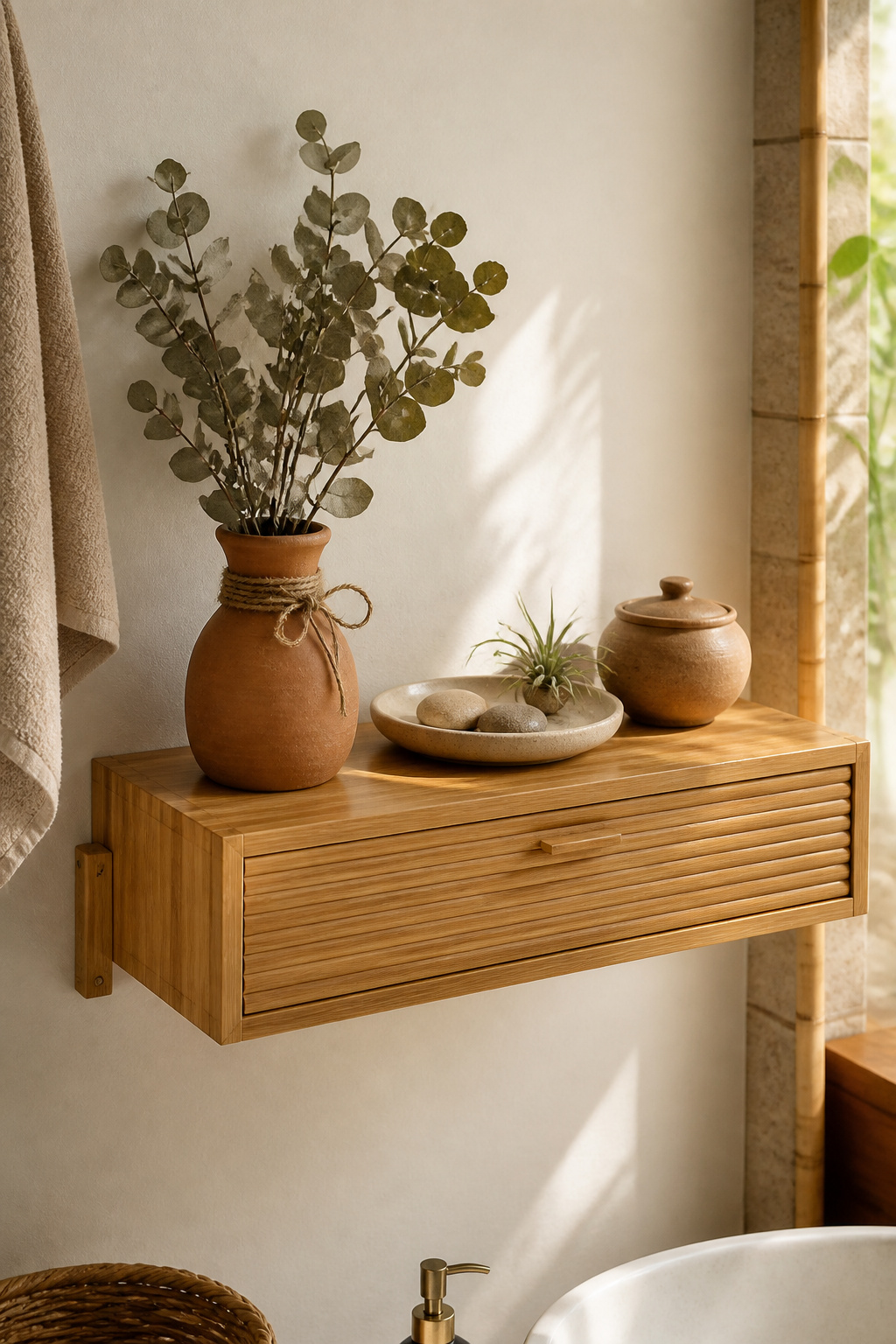
Earthenware — the most porous and naturally textured of the ceramic types, fired at around 1,000°C — is bamboo’s ideal shelf companion. Its matte surface in terracotta, cream, or sand tones sits in the same material family as bamboo without competing with it. Use unglazed or partially-glazed earthenware as functional display: a small crock for cotton buds, a lidded pot for bath salts, a flat dish corralling lip balm and a hair clip. These are objects that earn their shelf space by working as well as they look.
The Dried Botanical Layer
The dried botanical layer completes the composition. Eucalyptus bundles retain their visual appeal for 4-6 months on a dry shelf and release light fragrance for 6-8 weeks. Lavender holds fragrance for 2-3 months and can be gently refreshed by squeezing the dried flower heads. Rosemary is the most structurally durable of the common dried herbs — its needle structure holds for up to 6 months — though its fragrance fades after the first 4-6 weeks. Bind bundles with natural jute twine, which sits in the same warm tonal family as dried botanicals and bamboo without requiring any colour coordination effort.
7. Corner Ladder Shelves That Blend Towel Storage and Greenery Display
The bathroom corner is typically wasted space. A standard corner ladder shelf — footprint of 14-20 inches at the base, height of 54-72 inches — converts that dead zone into a vertical display without requiring any drilling. For renters or anyone reluctant to commit wall space before testing a styling approach, this reversibility is significant. Unlike wall-mounted shelves, a ladder shelf can be repositioned, removed, or replaced in under ten minutes.
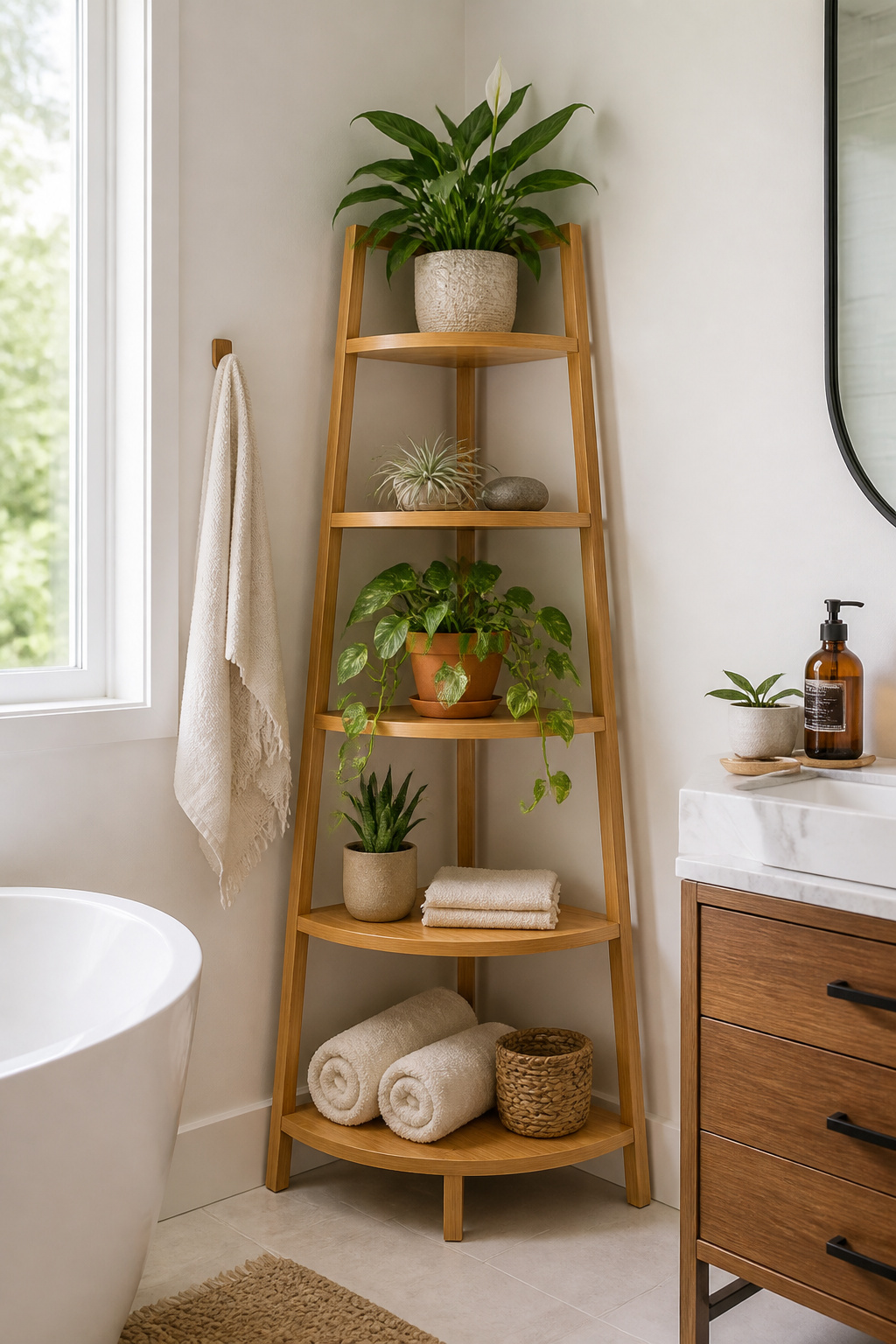
The tiered structure creates natural zones that make styling intuitive: the bottom tier carries weight and daily-use items (rolled bath towels, a woven basket), middle tiers hold hand towels and decorative objects, and the top tier belongs to the statement plant. For simple bathroom decor ideas that achieve storage and aesthetics simultaneously, a corner ladder styled this way is one of the most practical starting points available.
For plant selection in bathroom corners, where light is often minimal and humidity is high, golden pothos is the clear first choice. It tolerates low light and artificial lighting, thrives at 40-60% humidity, and its trailing vines cascade naturally over shelf edges — one plant can visually populate an entire ladder shelf over time. Peace lily handles low light well and benefits from bathroom humidity; it is one of the few flowering plants that can genuinely perform in a bathroom corner. Boston fern requires more ambient moisture but is worth considering if your bathroom tends to be steamy; place it on the top tier where rising steam provides the most consistent humidity.
For the overall layering, the ‘one functional, one decorative, one natural’ rule per tier works reliably — a rolled towel, a ceramic pot, and a trailing cutting, repeated across tiers with variation. The pattern creates rhythm without requiring any matching, and that is what good bathroom shelf decor should always achieve.
8. Geometric Ceramic Trays as Visual Anchors for Small Shelf Arrangements
A single tray performs a psychologically useful function that many people underestimate. Without a tray, five objects on a shelf register to the brain as five separate items — each competing for attention, each contributing to what researchers call attentional load. Add a tray, and the brain registers one display: its perceptual work drops from five separate processing events to one contained composition. This is the principle behind the ‘perceptual containment’ effect — the tray creates a boundary the eye reads as the object’s edge, significantly reducing visual noise regardless of what’s on the tray.
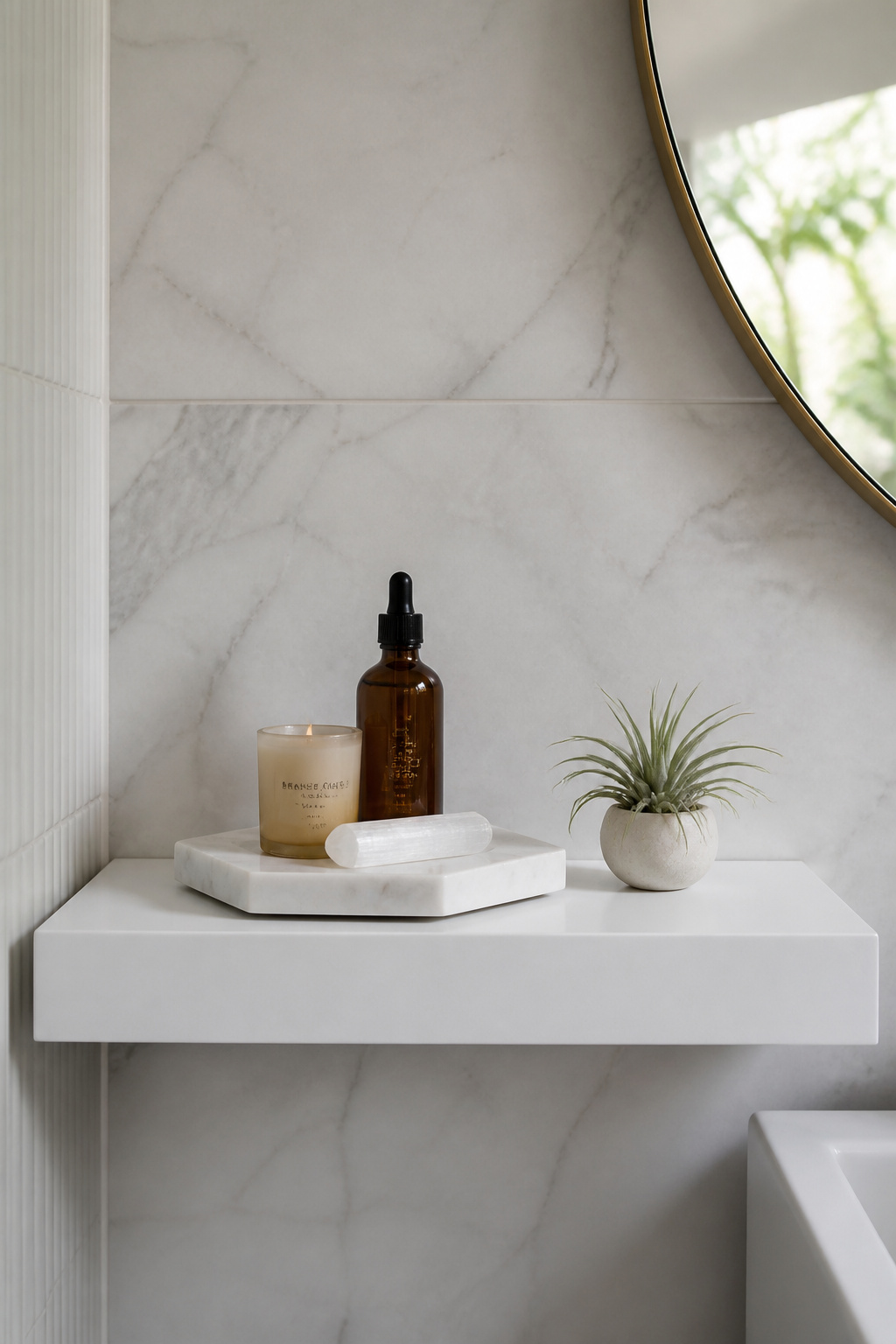
For a wellness bathroom, the best tray materials are marble or natural stone (the most versatile — they sit comfortably in minimalist, spa, and farmhouse contexts), unglazed ceramic in earthy tones (warmest option, pairs well with natural wood shelves), and sealed acacia wood (adds warmth but requires an annual application of food-safe mineral oil to maintain moisture resistance). Avoid high-gloss options, which tend to dominate the composition rather than anchoring it.
The arrangement principle for tray-based bathroom shelf decor: start with the tray as the base note and build outward using the rule of three — one tall, one medium, one small, with variation across texture, material, and visual weight. A tall beeswax candle, a medium apothecary jar, a small smooth stone. Place one item next to rather than on the tray to give the composition breathing room and signal that the objects were placed intentionally rather than consolidated. Leave at least 40% of the tray surface empty. The objects on the tray should look chosen, not gathered.
9. Bathroom Shelf Decor Principles: Negative Space and the Rule of Three
Two design principles determine whether your bathroom shelf decor succeeds — and neither requires buying anything.
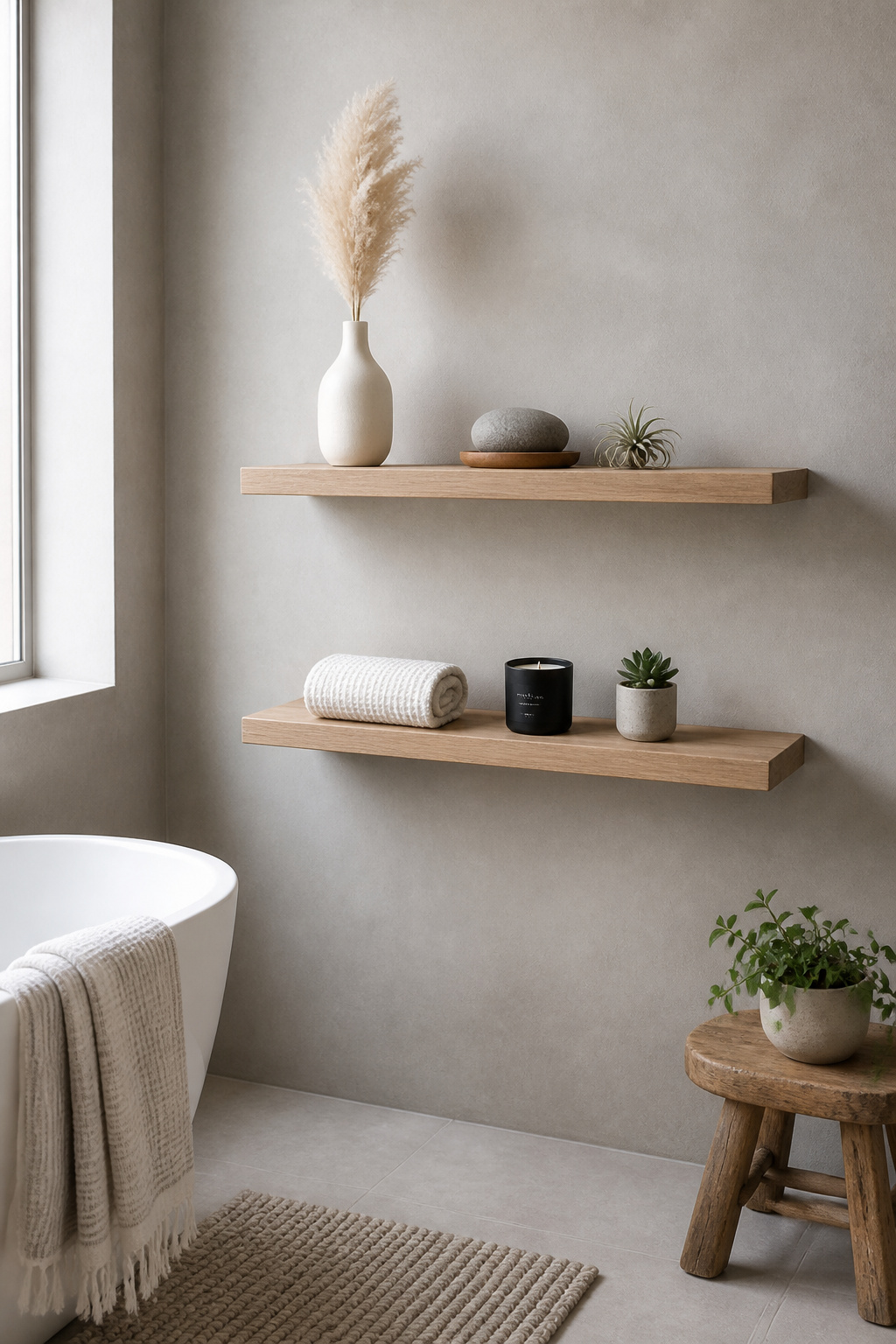
The first is negative space. The UCLA study that linked high household object density to elevated cortisol was measuring something real: visual clutter activates the amygdala as a low-grade threat. According to research cited by NAPO (the National Association of Productivity and Organizing Professionals), clutter triggers measurable neurological stress responses within 200 milliseconds, activating cortisol pathways before the conscious mind has processed what it is seeing. Negative space is not empty space — it is the breathing room that allows the brain to process a shelf composition without becoming taxed. Aim to leave at least 30% of any shelf surface empty before you consider the arrangement complete. The minimalist bathroom design principles that make spa bathrooms feel so restorative are largely an application of this: less stimulation, lower cortisol, genuine rest.
The second is the rule of three. Even-numbered groupings create symmetrical pairs the eye reads as static and resolved — pleasant but forgettable. Odd-numbered groupings create a central focal point with gentle dynamic tension that is more visually engaging. Group objects in threes on a small shelf: one tall, one medium, one small, with variation across texture, visual weight, and material. On a larger shelf, repeat this across two or three separate vignettes with space between them. The 3-5-7 rule extends this principle: three objects per small-shelf vignette, five for a medium shelf with more horizontal space, seven for a very generous shelf.
The most useful reset for an overcrowded shelf: remove everything, then add items back one at a time until the shelf reaches 70% capacity. Anything that does not fit that edit belongs somewhere else.
10. Dried Herb Bundles and Jute Accents on Rustic Wooden Shelves
There is a specific quality of calm that comes from bathroom shelf decor layered in natural materials — the kind of shelf that smells faintly of eucalyptus when you enter the room and feels, in some fundamental way, like it belongs to the earth rather than the hardware store. Dried herb bundles, jute accents, and rustic wood achieve this effect, and they do so with research behind them.
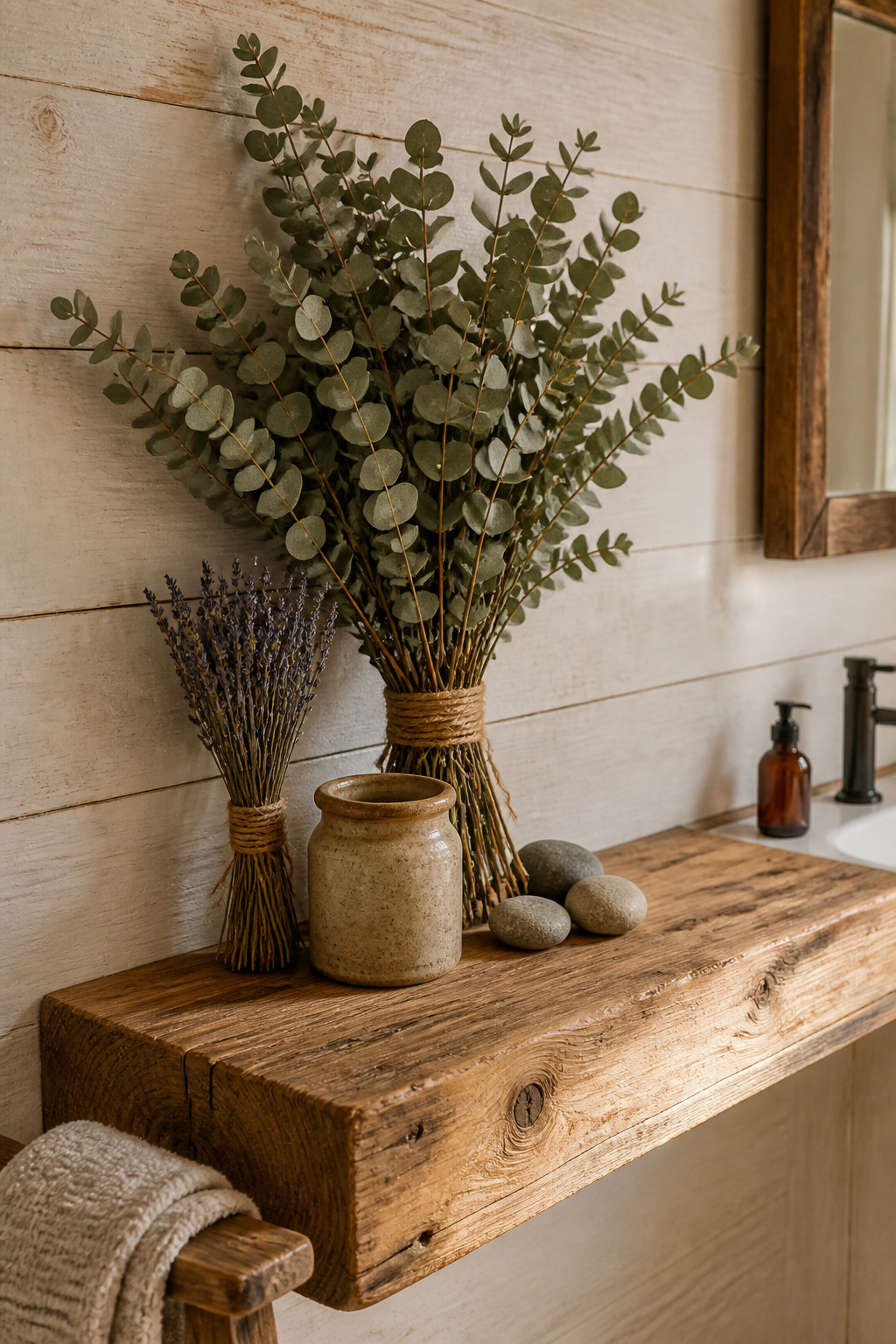
Eucalyptus contains eucalyptol (1,8-cineole): a compound with proven bronchodilator and antimicrobial properties that is released passively into the air when bathroom steam activates the dried leaves — no diffuser required. Lavender’s anxiety-reducing properties have been confirmed in multiple clinical trials; the primary active compound, linalool, acts on GABA receptors in a way that meaningfully reduces perceived stress. Rosemary, higher in camphor and also containing 1,8-cineole, has been associated in small studies with improved alertness and memory — better suited to a morning bathroom than an evening wind-down space.
For pairing with rustic wooden shelves, jute is the ideal complementary material. Its natural beige-to-caramel tone sits in the same tonal family as dried herbs and warm wood without requiring any deliberate colour coordination. Bind your botanical bundles with natural jute twine, and the composition reads as cohesive from the first arrangement. The durability numbers are worth knowing: eucalyptus holds visual appeal for 4-6 months on a dry shelf (fragrance fades after 6-8 weeks); lavender fragrance lasts 2-3 months; rosemary holds its structure longest. For rustic bathroom designs with natural materials, dried herbs outperform faux botanicals in every category — they biodegrade, they smell real, and they change gradually in a way that keeps the shelf feeling alive.
Keep the palette tight: wood, jute, dried botanicals, and one additional material (unglazed ceramic or river stone) as a single accent. Four materials is a complete composition. Five tends toward busyness.
11. Skincare as Shelf Decor: Arranging Glass Bottles and Dropper Serums
Making your skincare routine visible on a shelf is a choice that is both aesthetic and behavioural. Environmental design research consistently shows that visible, curated daily rituals increase follow-through. There is a real difference between rummaging through a bathroom drawer for a product you can barely see and reaching for a glass dropper bottle from a shelf you designed to look forward to using. One starts the morning by frustrating you; the other starts it with intention. The display is not vanity. It is architecture for your habits.
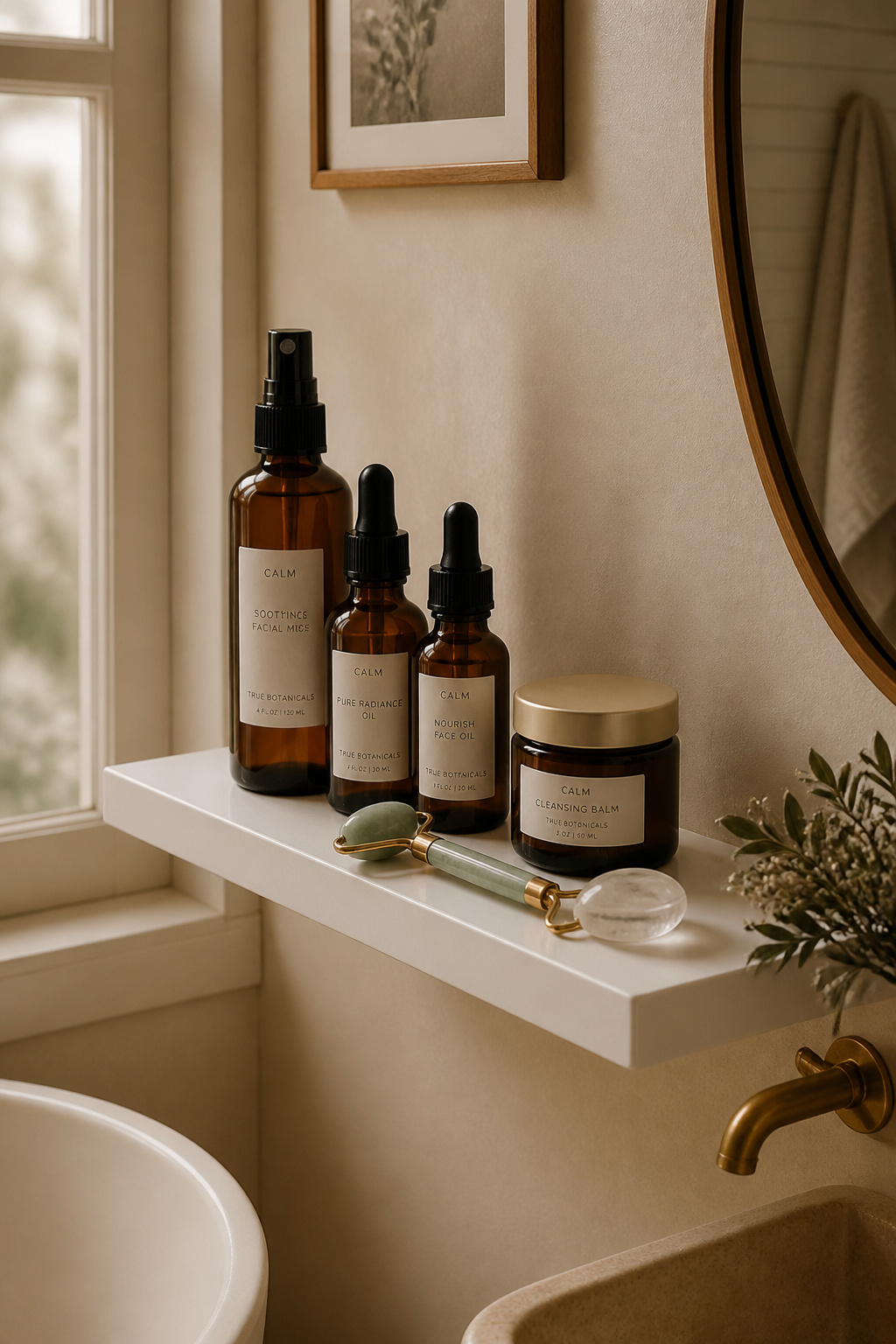
The practical rule here is important and often overlooked: decant into amber (dark brown) glass bottles, not clear glass, for any light-sensitive product. Vitamin C serums, retinoids, and products containing AHA or BHA acids can degrade within weeks in clear containers exposed to ambient bathroom light. Products that are safe to display in clear glass include thick moisturisers, oil-based cleansers, and physical (mineral) sunscreens. For a wellness-oriented bathroom display, a row of matching amber dropper bottles with black rubber tops creates an apothecary-meets-laboratory aesthetic that is both functional and genuinely calming to look at.
Height variation is the styling key. Arrange by descending height: tall spritz bottle at the back, medium dropper serums in the middle, a short roller or small pot at the front. The resulting visual skyline draws the eye through the display from back to front. Add one non-bottle element — a jade roller, a gua sha stone, a small amethyst — to break the uniformity of glass and reintroduce an organic note. Limit the display to your daily essentials: 5-7 items is a ritual; more than that is a collection, and collections create the visual pressure that this bathroom shelf decor approach is specifically designed to remove.
12. Farmhouse Bathroom Shelf Decor With Stoneware Crocks and Ironwork Accents
Farmhouse bathroom shelf decor and wellness design share more foundational values than their aesthetic differences might suggest. Both prioritise natural and durable materials over synthetic ones. Both favour handmade objects over mass-produced equivalents. Both treat function as the starting point for beauty rather than its opposite. The farmhouse aesthetic’s appeal — in a wellness context — is not nostalgia for rural life. It is an instinctive response to objects that were made to last.
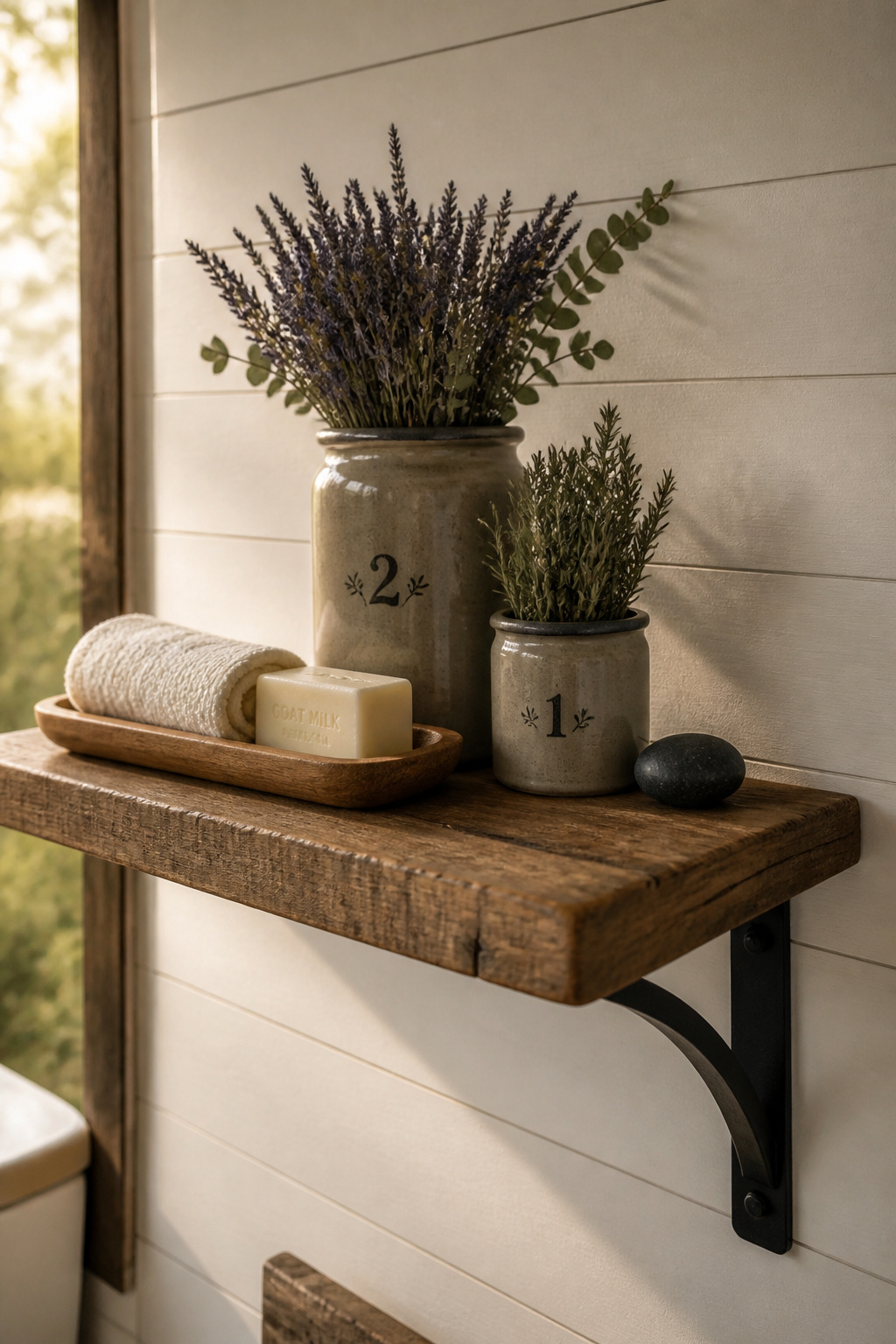
Salt-glazed stoneware crocks were originally produced for food storage and preservation; authentic American examples date from around 1720 onward, with many 19th-century pieces still found at estate sales and antique markets. They are identifiable by their characteristic salt glaze (a slightly rough, pebbled surface texture in warm tan, cream, or grey), their significant weight, and their thick walls — the physical signature of an object that was never designed to be disposable. On a bathroom shelf, a wide-mouth crock holds bundled dried herbs, extra rolled towels, or tall dried grasses; a smaller crock corrals cotton buds or bath salts. They earn their space. For easy farmhouse bathroom decor without the antique hunt, Etsy sellers and pottery studios like Debra Hall Lifestyle offer well-made reproduction pieces at lower cost that capture the aesthetic honestly.
The ironwork element — shelf brackets, small hooks, or hardware in a matte black or oil-rubbed bronze finish — partners with warm reclaimed wood in the way that brackets have always anchored shelves: visually and literally. Keep the metal family consistent across your bathroom. Mixing matte black iron with chrome fittings creates a competition between finishes that works against the coherence you’re building. A useful pairing rule: warm-toned wood (honey, walnut, amber) with matte black iron; cooler-toned or grey-washed wood with oil-rubbed bronze.
13. Floating Glass Shelves With Crystal Accents and Folded White Linen
In a small bathroom, a floating glass shelf does something that solid shelves cannot: it holds objects without visually interrupting the wall. Because tempered glass transmits light rather than blocking it, the eye reads the shelf as part of the wall surface behind it, and the objects appear to float. The practical result is a perception of more depth and space — a significant advantage in a bathroom where every square inch registers. Tempered glass is five times stronger than standard glass and is the only appropriate type for wall-mounted bathroom shelves; standard glass shelves are not rated for bathroom weight loads. Most tempered glass bathroom shelves in the 20-24 inch range carry 44-80 lbs depending on bracket placement and glass thickness (6mm vs 10mm).
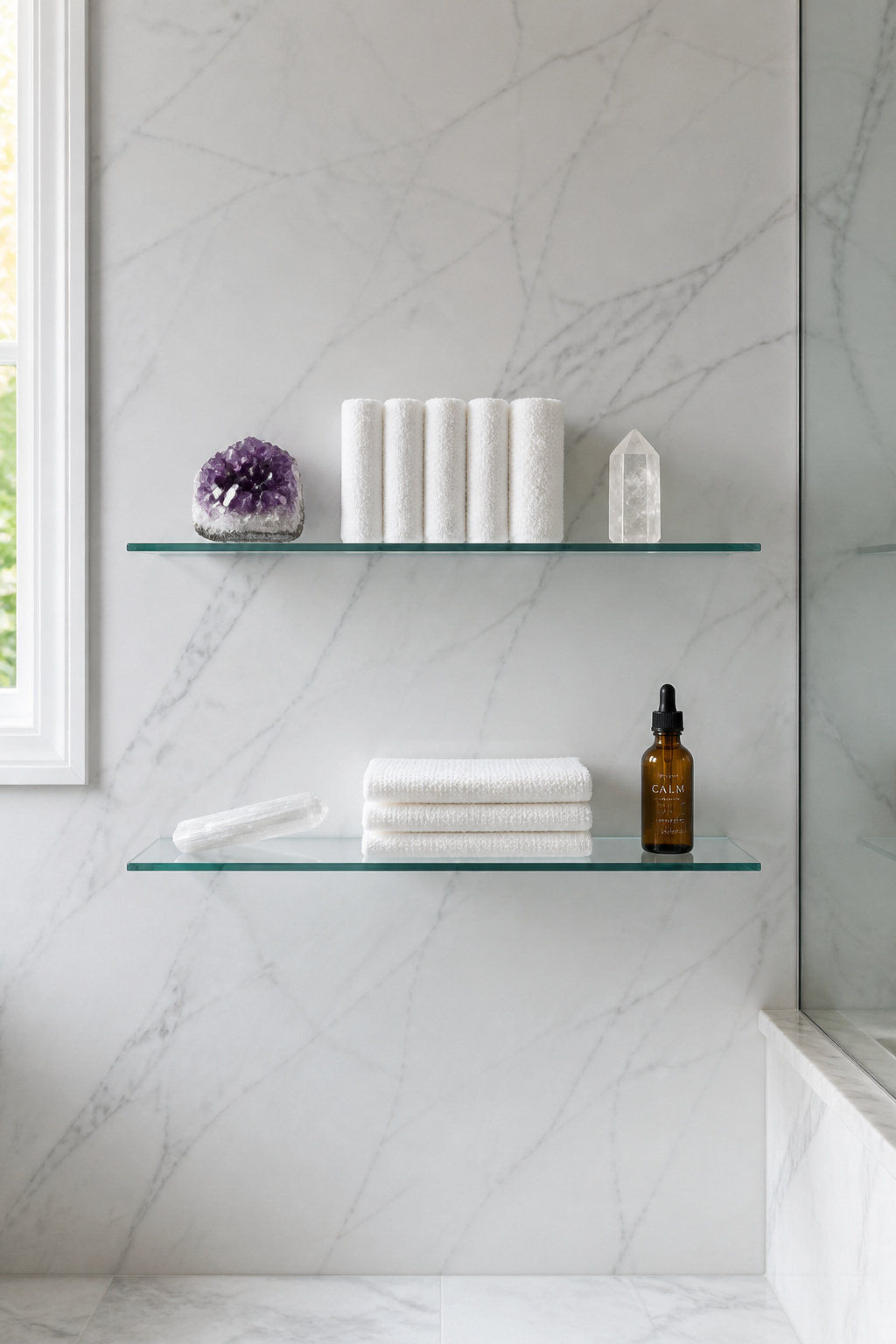
The crystal accents in this styling approach are genuinely optional from a design standpoint — the glass shelf and white linen hold the composition beautifully on their own. That said, selenite (a naturally white gypsum crystal with a soft luminous surface), amethyst clusters (purple, pairs naturally with white linen and clear glass), and clear quartz points (neutral, light-refracting) all contribute a wellness-intentional note that many people find worth having. A small selenite wand at $15-$25 or a modest amethyst cluster at $20-$40 is a low-commitment introduction to this styling approach.
For the white linen, consistency of fold and colour is the only rule. Hotel-style washcloth rolling: fold in thirds lengthways, roll tightly from one end, stand upright in a row. The uniform height creates visual intention that reads as designed rather than stored. White or natural (unbleached) GOTS-certified cotton or linen is the material choice that supports both the aesthetic and the wellness goal: visually quiet, skin-safe, and beautiful precisely because of its simplicity.
14. Medicine Cabinet Shelves Transformed Into a Curated Wellness Display
The medicine cabinet is the most overlooked bathroom shelf surface — and the highest-frequency one. Most people interact with it twice daily without ever giving it the same styling attention they would give a visible open shelf. Yet a cluttered, disorganised cabinet creates a micro-stressor at both the start and end of every day: the rummaging, the expired products, the products that don’t belong there but have nowhere else to go.
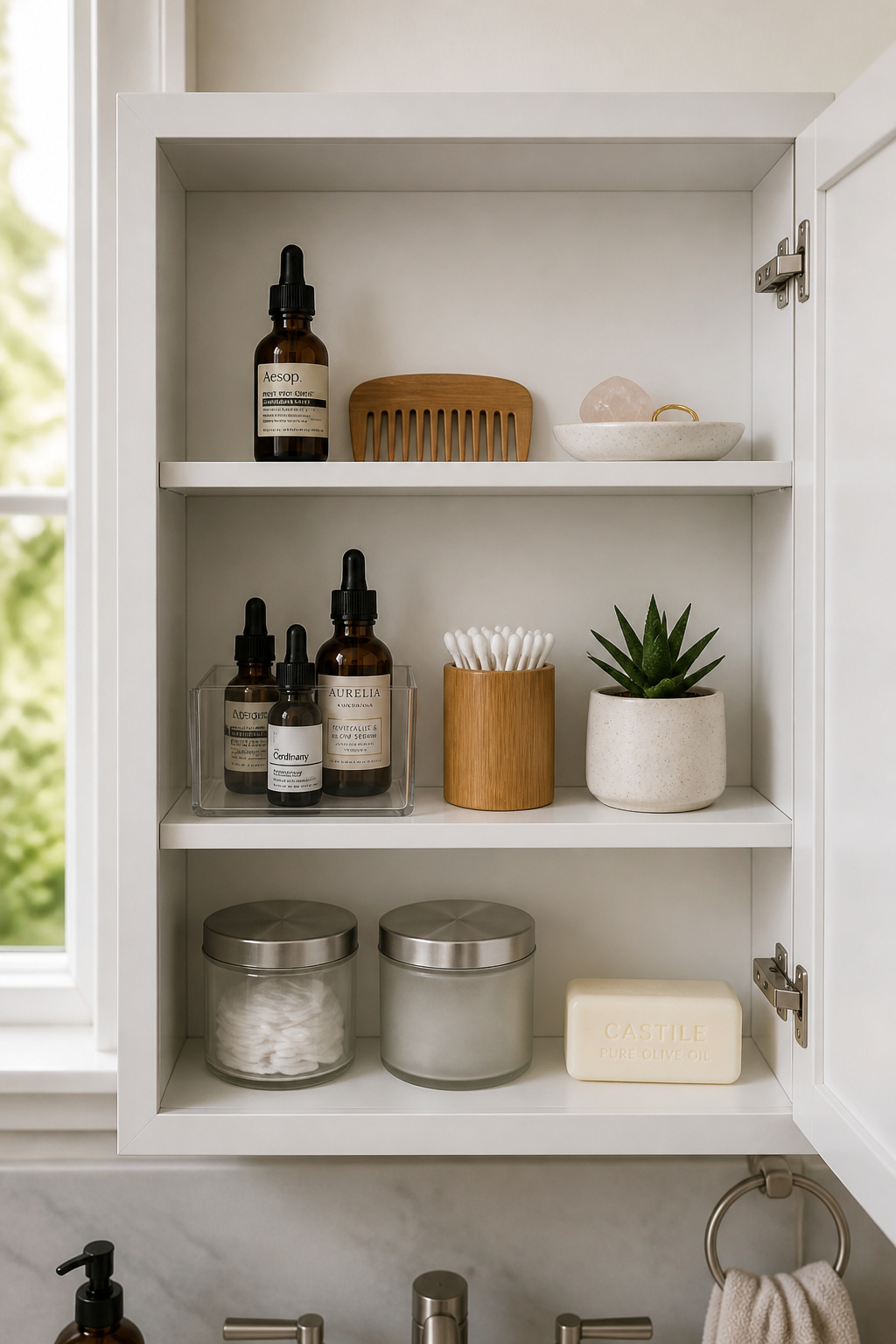
There is also a practical misalignment worth correcting: despite being called a medicine cabinet, the bathroom is actually one of the worst places to store medication. Heat and humidity degrade many medicines’ shelf life and effectiveness. Moving medications to a cool, dry kitchen cabinet or bedroom drawer is both a safety improvement and a freeing-up of prime bathroom shelf real estate for beauty and wellness products that actually belong there.
The editing framework: categorise everything by use frequency. Daily essentials (face wash, moisturiser, daily supplements if kept in bathroom) at eye level. Weekly-use items on upper or lower shelves. Items used less than monthly belong in a linen cupboard, not the cabinet. A useful test for each item: ‘Do I reach for this at least three times a week?’ Anything that doesn’t pass the test leaves the cabinet.
What remains can be organised into something worth looking at. Glass dropper bottles for decanted serums, a small ceramic dish for rings removed before washing, a wooden comb, a bamboo cotton bud holder — these objects are functional and inherently beautiful, requiring no separate styling effort. Small glass or ceramic bins group items within the cabinet while keeping them visible. One small succulent or fresh flower, if there is space on a cabinet shelf, adds a living note to a space that is otherwise entirely about products.
15. Monstera Leaves and Trailing Pothos as Statement Shelf Anchors
Plants are the most powerful addition available to a wellness-focused bathroom shelf. Not because they photograph well — though they do — but because the research behind their effect is among the most consistent in environmental psychology. Biophilic design studies show that even minimal access to living nature, a plant on a shelf or a view of a tree, produces measurable reductions in cortisol, blood pressure, and perceived stress. A bathroom plant accessed twice daily generates a recurring, cumulative micro-dose of this effect. No candle, crystal, or ceramic delivers the same return.
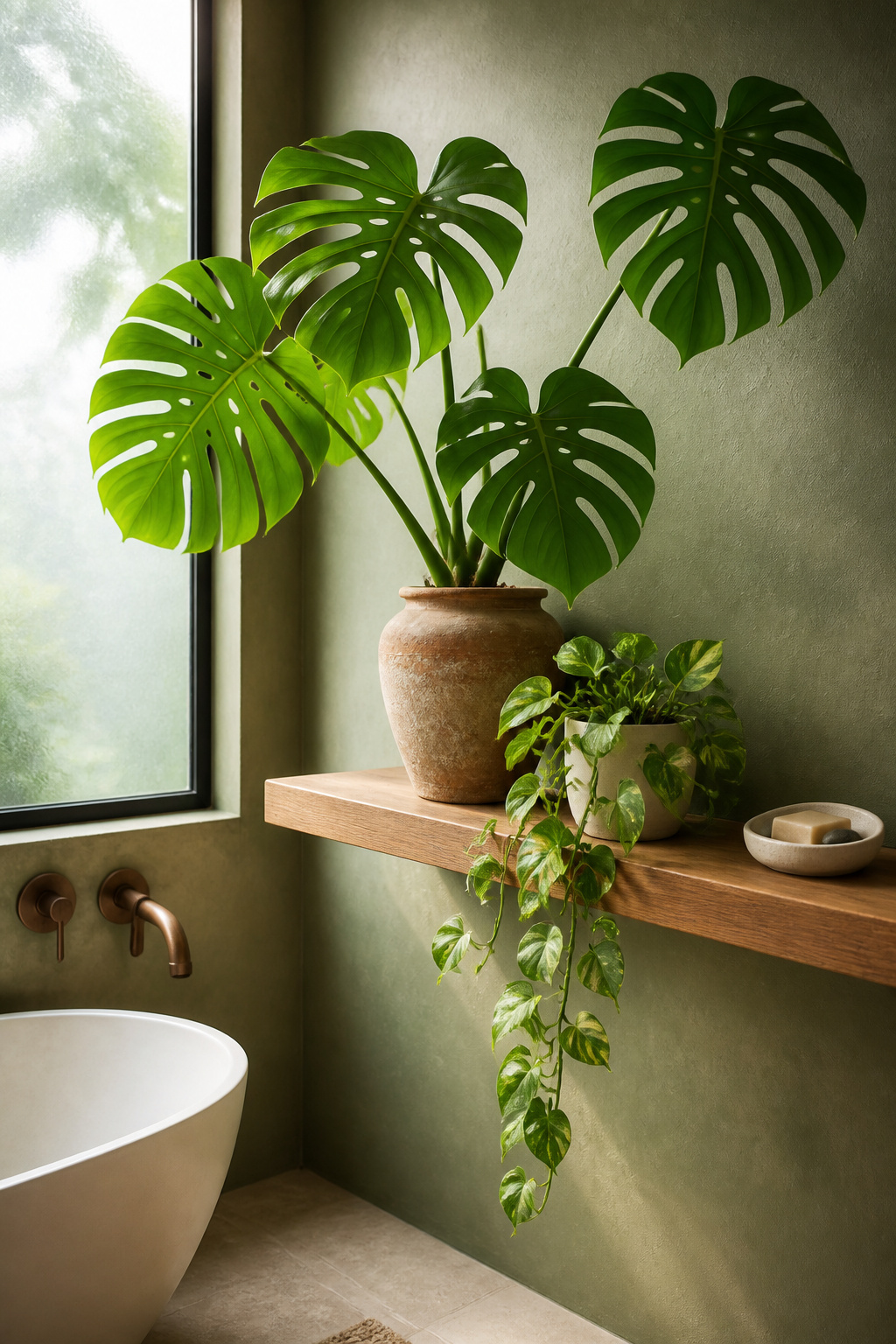
Trailing plants have a quality that static shelf objects cannot replicate: movement. A golden pothos develops slowly over weeks, extending vines over the shelf edge, adding new heart-shaped leaves. The shelf changes. It grows. For bathroom inspiration for a mindful space, this sense of living progress is a genuine differentiator between a decorated bathroom and a well-designed one.
Choosing the Right Species
For species selection: golden pothos (Epipremnum aureum) is the most reliably successful bathroom shelf plant. It tolerates low light and artificial lighting, thrives at 40-60% humidity, and actively purifies formaldehyde, toluene, and xylene from the air — a claim backed by NASA’s clean air study. Monstera deliciosa is the statement choice: its characteristic split leaves (fenestrations, which appear on mature plants exposed to adequate light) create a visual presence no other plant matches. It does best in medium to bright indirect light, making it ideal for bathrooms with a window. For dark bathrooms, pothos is the more practical choice — it survives where monstera will merely exist.
Terracotta or unglazed ceramic allows the soil to breathe, reducing the risk of overwatering — a common mistake in bathrooms where ambient humidity makes soil look drier than it is. Choose a pot roughly 20-30% of the shelf width. As the pothos grows, train one or two vines deliberately along the shelf edge rather than letting multiple shoots fall in all directions. Controlled trailing looks styled; unchecked trailing looks abandoned.
How to Choose Bathroom Shelf Decor That Reflects Your Wellness Aesthetic
The most useful starting point for any of the bathroom shelf decor ideas in this article is not a shopping list. It is a cleared shelf.
Before adding anything new, remove everything from your bathroom shelf. Return only the items that are either genuinely functional — used at least three times per week — or genuinely beautiful, in a way that makes you feel better for seeing them. Items that are neither belong somewhere else. Live with the edited shelf for a week before adding anything. The resistance to immediately restocking is not a design trick — it is the discipline that separates intentional shelf styling from decorating by accumulation, and it is the single most transformative thing you can do without spending any money.
From there, the aesthetic direction tends to become clear. Four broad material languages work well for wellness-focused bathrooms: natural minimalist (white, stone, glass, generous negative space); farmhouse warmth (reclaimed wood, stoneware, iron hardware, dried botanicals); botanical abundance (plants, earthy ceramics, jute, woven materials); and spa clean (glass jars, white linen, crystal accents, candles). Most bathrooms land somewhere between two of these. What matters is consistency of material language across the shelf, not adherence to a single category.
The practical starting point is simpler than any of this. Choose your highest-frequency shelf — the one you see every morning and every evening. Style it with three objects: one natural material, one functional item that doubles as display, one living element. Leave at least 30% of the shelf surface open. That is complete bathroom shelf decor. Everything else in this article is a variation on that principle.