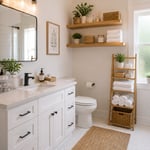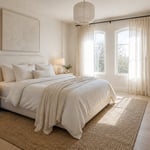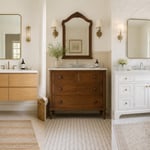
There’s a specific kind of calm that happens when you step into a bathroom connected to water. Not a blue-paint-and-anchor-print version of the beach, but something quieter — the cool of natural stone underfoot, the warmth of weathered wood, light filtering through linen in the particular unhurried way it does near the coast. That feeling isn’t an accident. It’s the result of deliberate design choices that work because they align with how our nervous systems respond to natural environments.
I’ve spent years studying the intersection of biophilic design and interior wellness, and beach bathroom ideas sit right at the heart of that work. Water-adjacent colour palettes, natural materials, organic textures — the research consistently shows these elements measurably reduce cortisol and create spaces where genuine rest is possible. These aren’t just aesthetically pleasing choices. They’re physiologically sound ones.
The fifteen beach bathroom ideas here cover the full spectrum, from a full renovation centrepiece down to a single accessory change you could make this weekend. Together they map a complete coastal bathroom — one that feels genuinely restful rather than theme-park themed.
1. Shiplap Accent Wall: The Cornerstone of Beach Bathroom Style
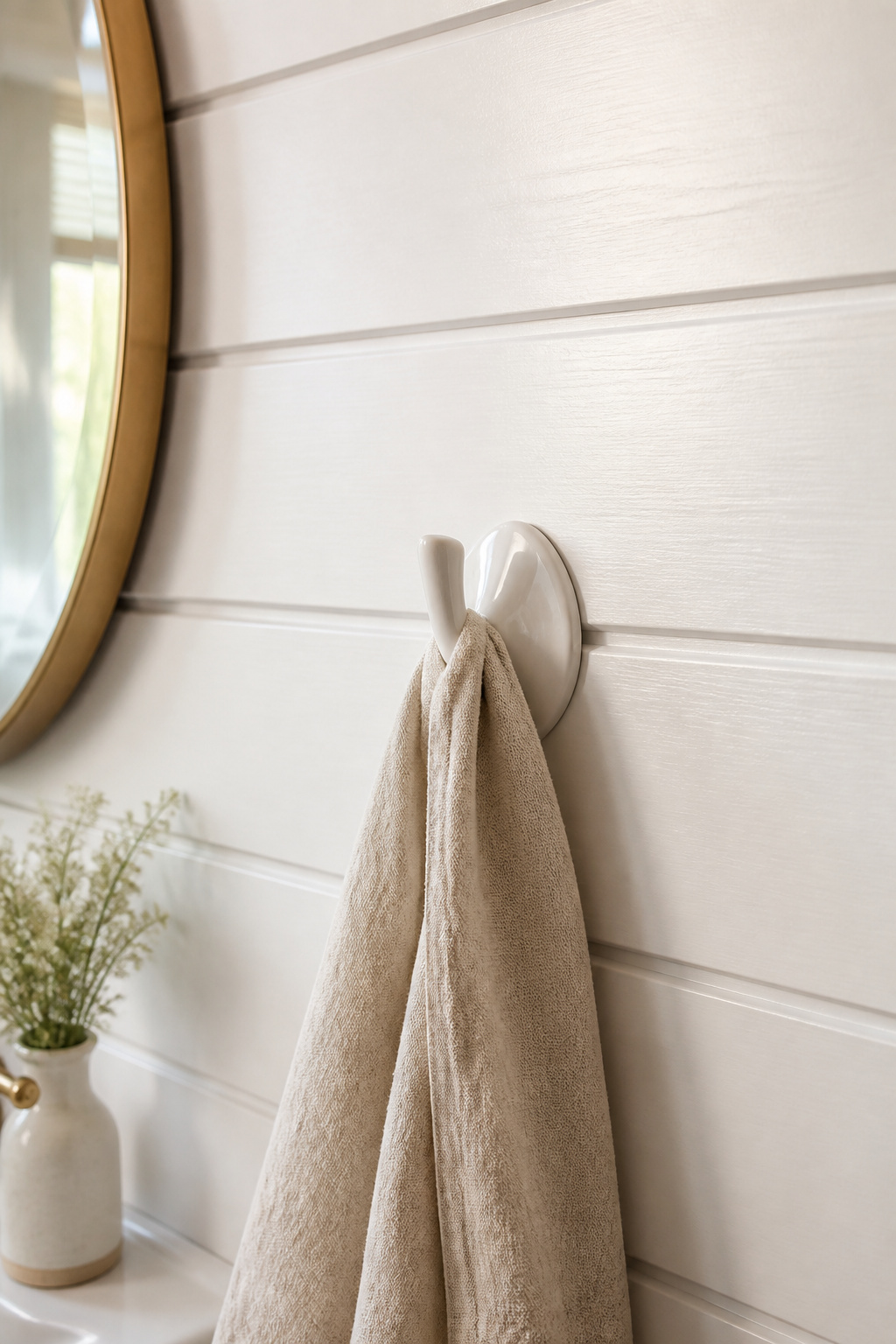
Shiplap is the most recognisable signal of coastal bathroom design, and it earns that status. The horizontal boards with their overlapping reveal create shadow lines that anchor a wall without the visual busyness of tile or wallpaper. In a beach bathroom, shiplap connects to the planks of a boathouse or a New England cottage — it references coastal architecture without announcing it.
Getting the Material Right
The practical question is material, and it matters more than colour. PVC shiplap (Azek, WOLF) is fully impervious to moisture and mildew — the right choice for any wall within three feet of a shower or tub, at $200-$400 for a 50-60 square foot accent wall. Real pine or poplar shiplap works on genuinely dry walls when primed and finished in semi-gloss; MDF shiplap doesn’t belong in any bathroom at any location, as steam penetrates it regardless of distance from the water source.
For colour, weathered white (a slightly warm off-white — Benjamin Moore White Dove or Sherwin-Williams Alabaster) reads coastal without harshness. Driftwood grey (Benjamin Moore Coventry Gray HC-169) gives the detail a more grown-up quality that pairs well with unlacquered brass and natural stone. Semi-gloss white also bounces light around small bathrooms, amplifying whatever natural light is available.
Caulk every seam at installation and inspect annually. A gap lets moisture reach the wall cavity behind the boards — the one maintenance step that undermines every other decision if you skip it.
2. Pebble Stone Shower Floor for a Tactile Coastal Feel
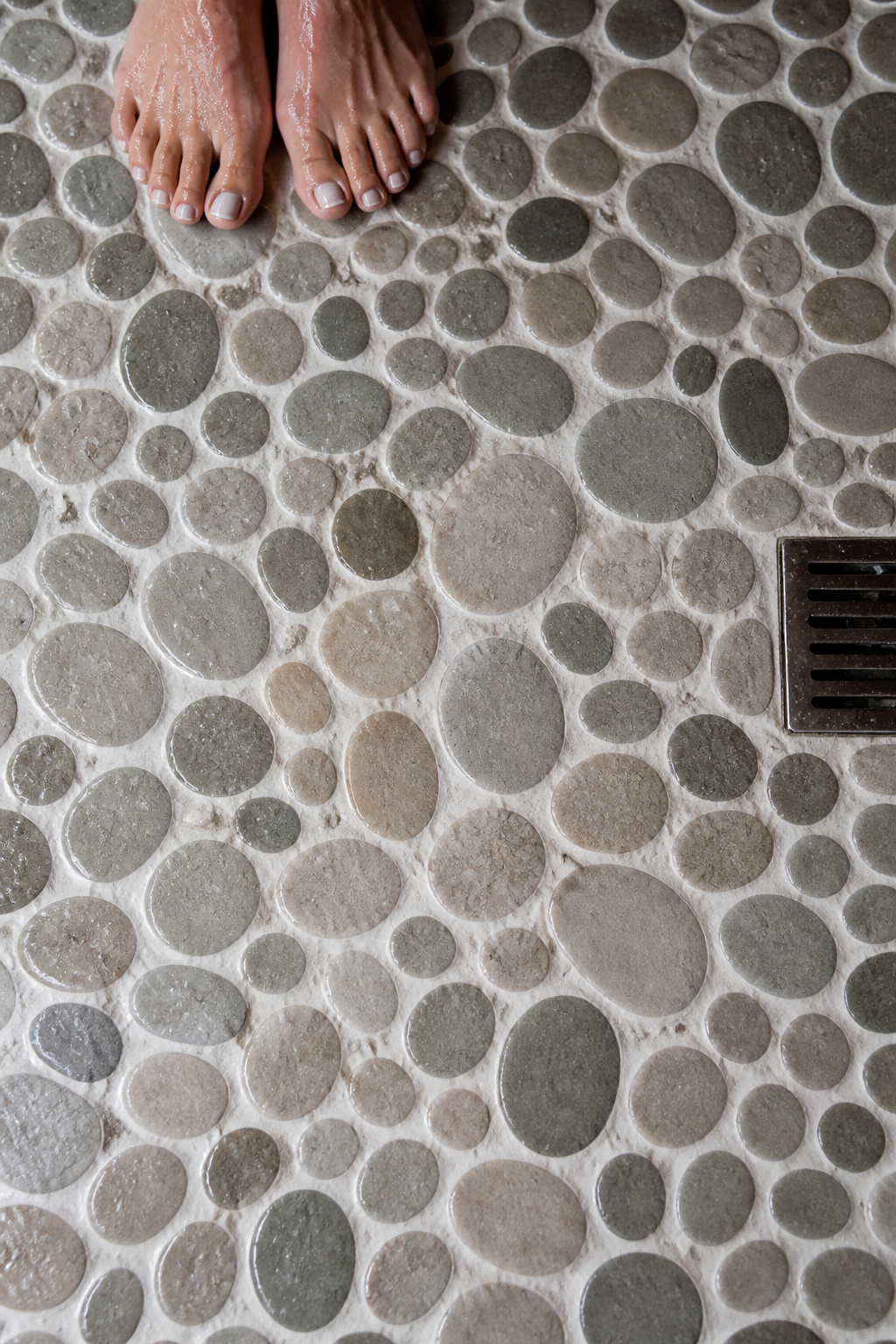
A pebble stone shower floor is one of the simplest applications of biophilic design in a home, and the physical experience is unlike any other bathroom surface. Bare feet on natural river pebble activate pressure points across the sole — a mild reflexology effect that makes a morning shower feel closer to a spa treatment. Research on natural terrain surfaces finds this proprioceptive stimulation reduces physiological stress markers, which is exactly what good bathroom design should deliver.
Stone Types and Maintenance
Natural river pebble tile comes mesh-backed in sheets ($8-$20 per square foot). For a beach bathroom, grey-tan natural pebble reads most authentically coastal. Tumbled marble gives a more refined spa-resort look; flat slate chips offer more texture than marble at a less rounded profile. If you’re weighing options beyond the shower floor, natural bathroom flooring options covers the full performance picture across materials.
Grout choice is the detail most often overlooked. Epoxy grout is the right material here — harder than cement grout, non-porous, no annual sealing required. With cement grout, the high grout-to-tile ratio of a pebble floor creates enormous surface area for soap scum and mildew; switch to epoxy and that problem nearly disappears. Natural stone pebble tiles still need sealing annually in a high-traffic shower. A post-shower squeegee is the most effective single maintenance habit for keeping a pebble floor looking good at year five.
3. Driftwood Mirror Frame as the Beach Bathroom Focal Point
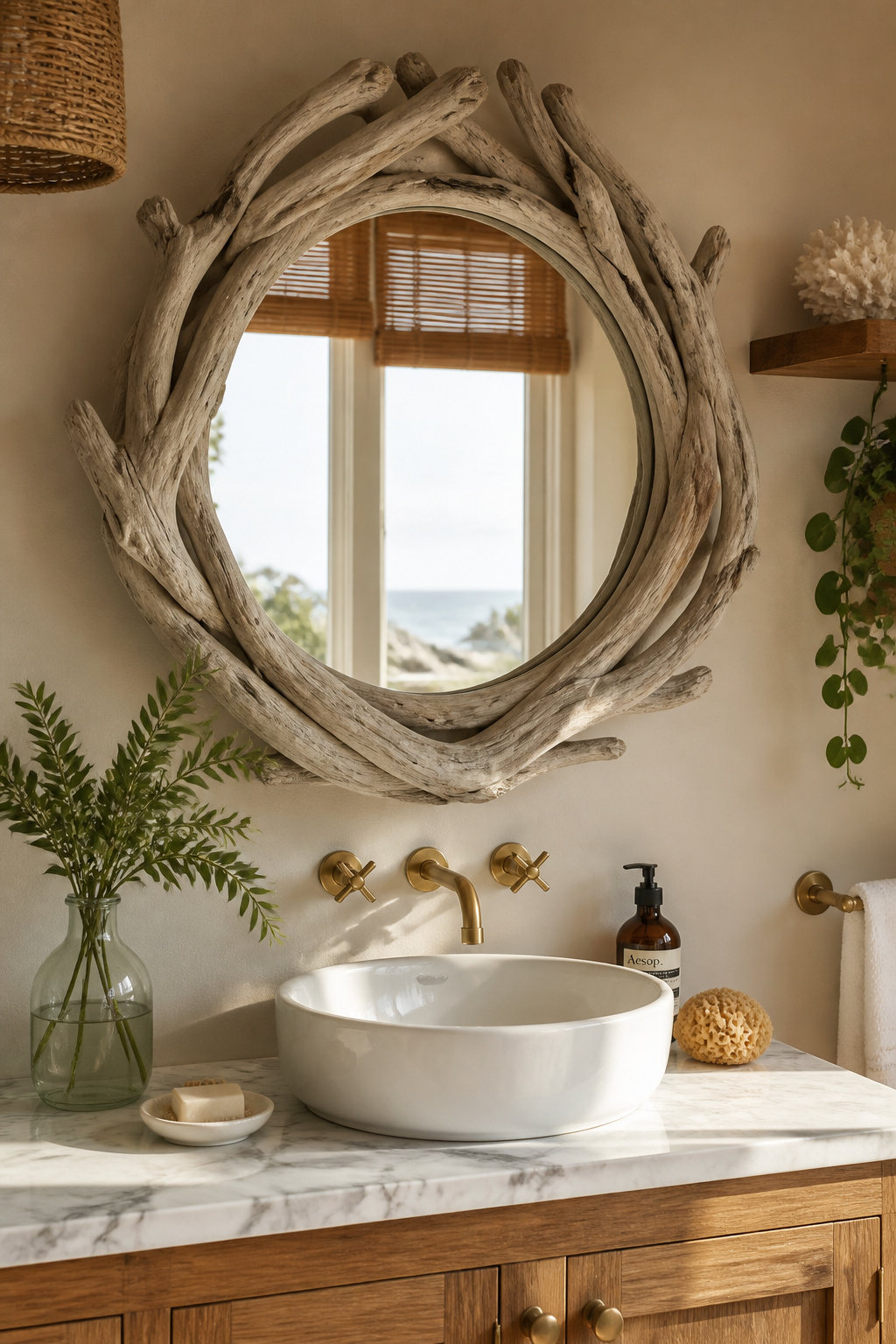
A bathroom full of right angles — sink, tiles, cabinetry — has a geometry that’s practical but not restful. A driftwood mirror frame is the organic counterpoint. Its irregular silhouette immediately softens the room’s geometry and introduces natural variation that the eye needs to feel at ease. This is the focal point that makes a beach bathroom feel curated rather than assembled.
Sourcing, Sizing, and Humidity
Real driftwood mirrors from artisan makers — Etsy is the most reliable source, and local coastal craft markets produce some of the most interesting work — typically run $80-$250 for a 24-30 inch mirror. Mass-market faux-driftwood from Pottery Barn and Wayfair runs $40-$80 and works for a budget renovation, but examine the texture: quality faux-driftwood has genuine surface irregularity; cheaper versions have repeating moulded texture that reads manufactured from across the room.
Sizing is specific: the mirror should span 70-90% of the vanity width. For a 36-inch single vanity, that means a 24-28 inch frame. Mount so the bottom sits 5-8 inches above the backsplash — clear of splash water, centred visually on the vanity.
The maintenance commitment: a real driftwood mirror in a bathroom needs a functioning exhaust fan. Without ventilation removing moisture post-shower, even treated driftwood develops mould on the back surface within eighteen months. Run the exhaust fan for fifteen to twenty minutes after showering and the frame will last a decade.
4. Navy and White Stripe: The Timeless Coastal Bathroom Colour Play
The Breton stripe — navy on white — is the most historically grounded combination in beach bathroom design. It originated in French maritime culture in the 1850s and has been connected to the sea ever since, which is why it works in a beach bathroom without additional visual explanation. The reference is immediate and culturally encoded.
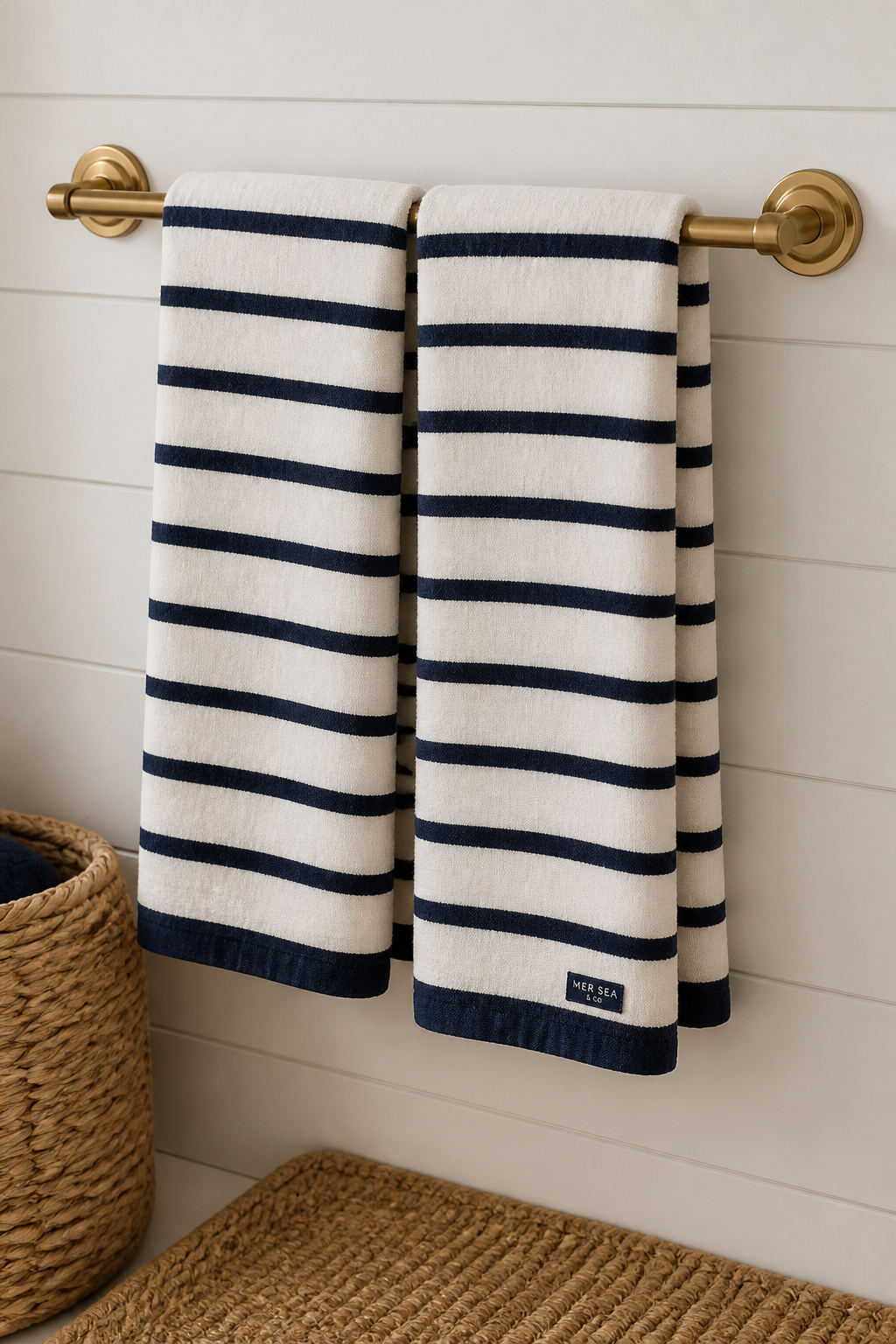
In small bathrooms, white should dominate — walls, ceiling, floor — with navy as the accent. Deploying the stripe in one layer is the key decision: the combination works beautifully in a single application and becomes visually busy across multiple ones. Breton-stripe linen towels (Zara Home, Serena & Lily, H&M Home) are the lowest-commitment entry point — swap them out if the look grows tired. Stripe wallpaper (Rifle Paper Co., Schumacher) in a powder room or contained small bathroom is the architectural version. Navy-and-white penny tile on the floor is the most permanent expression.
Expand the palette with warm brass fixtures — towel rings, tap hardware — which shift the register from preppy nautical to warm coastal. A woven seagrass bath mat at the tub grounds the combination with natural texture that the graphic stripe alone lacks.
5. Weathered Wood Floating Shelves for Organic Beach Bathroom Texture
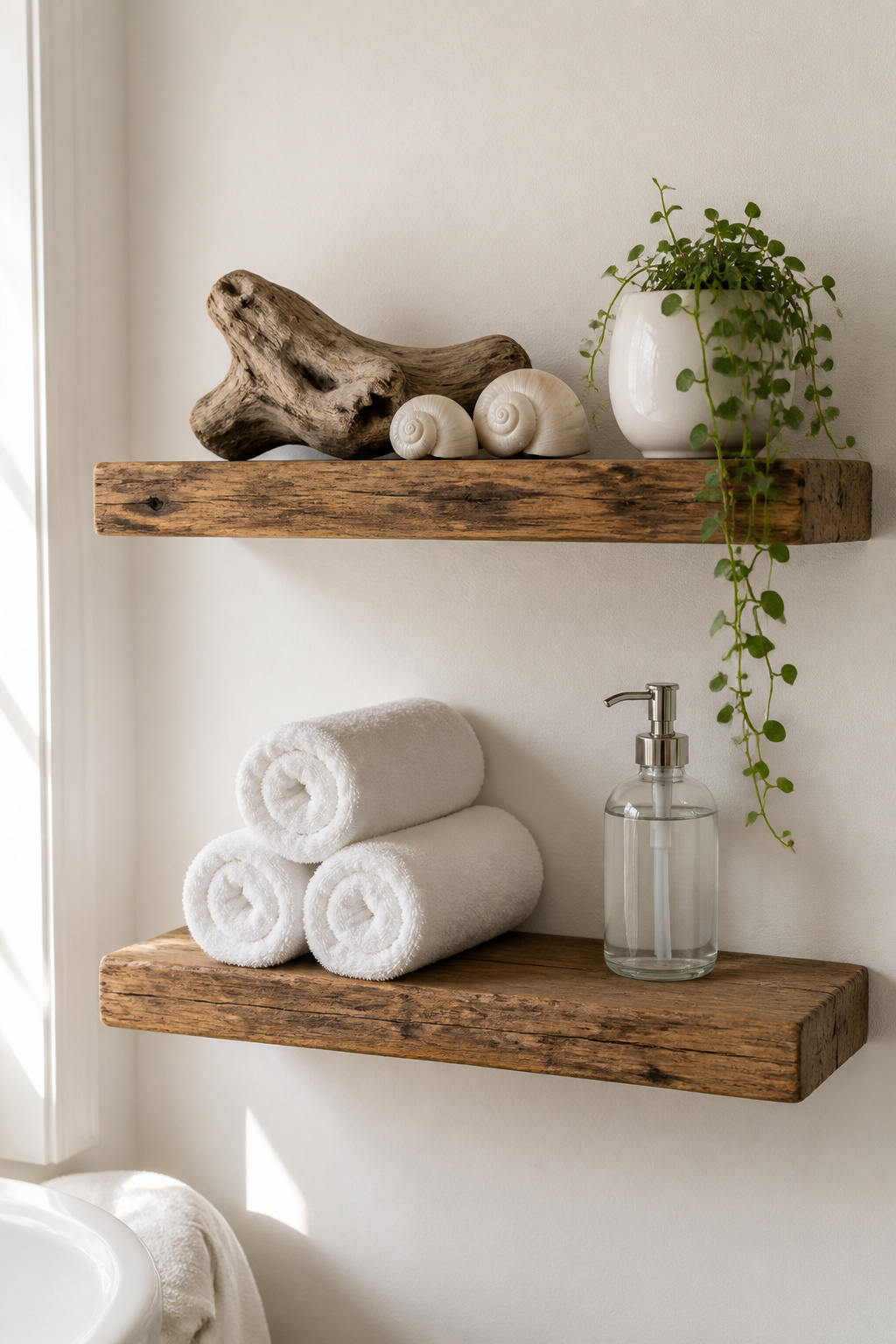
In a beach bathroom, open floating shelves in weathered or treated wood do more design work than closed cabinetry. Closed cabinetry creates visual weight and blocks sight lines — the opposite of the open, breezy quality a coastal space should have. Open shelves maintain the room’s lightness, display natural objects, and introduce warm organic texture against tile and chrome.
Wood Species and Shelf Styling
Teak is the gold standard for bathroom shelves. Its natural silica and oils resist moisture at the cellular level — life expectancy in an untreated bathroom environment is genuinely 75 years, which is why it was used on ship decks for centuries. White oak performs nearly as well at a lower cost, but the open grain requires sealing with polyurethane or marine-grade varnish before installation. Reclaimed pine has the most beautiful weathered character but is the least humidity-tolerant; it needs thorough sealing and annual inspection.
Styling follows a simple rule: one-third functional (folded towels, a soap dispenser), one-third natural objects (driftwood, two or three shells, a small plant), one-third empty space. That final third — the breathing room — is where most people go wrong. The space is doing as much work as the objects; it’s what separates a curated shelf from a cluttered one.
6. Sea Glass Mosaic Tile as a Coastal Bathroom Feature Wall
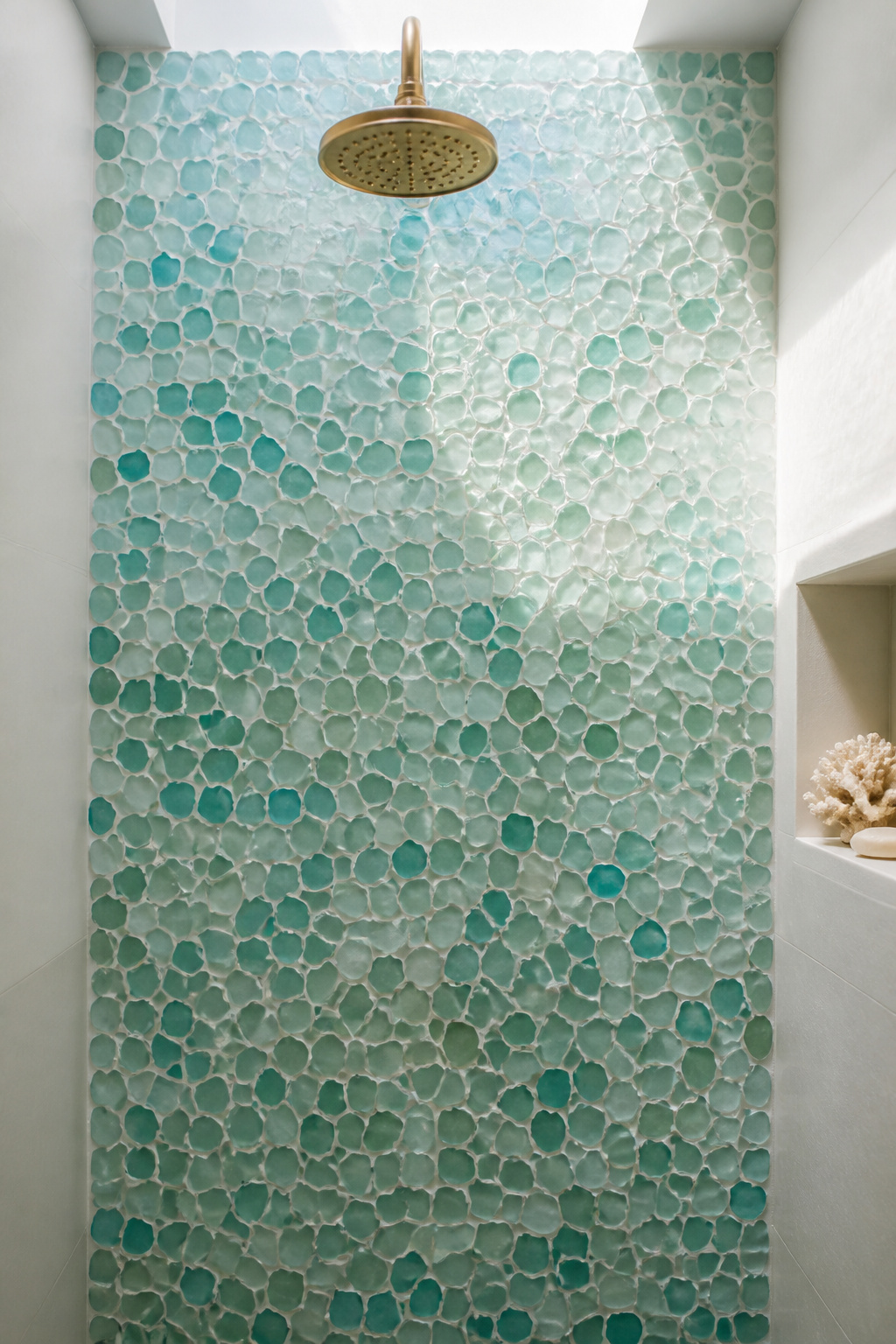
Sea glass mosaic tile is among the most visually distinctive beach bathroom ideas — and the difference between genuine recycled glass tile and ceramic imitations is visible from across the room. Genuine glass tile from makers like Oceanside Glasstile or Fireclay Tile has natural colour variation and translucency that means the wall appears to shift as light moves through the day. Ceramic imitations have uniform colour and a flat, dead finish.
Choosing the Right Application
Glass tile has a practical advantage for a wellness space: it’s impervious to water and doesn’t need sealing, unlike stone. Fireclay’s glass tile is frost-resistant and maintenance-free — one less chemical cleaning product in a bathroom you’re trying to keep non-toxic. When deciding between tile types, choosing the right shower tile covers the maintenance difference in practical depth.
Where Sea Glass Tile Works Best
A full bathroom in sea glass mosaic is expensive ($15-$35 per sq ft for genuine glass) and visually overwhelming — the shimmer that makes it beautiful in a contained area becomes busy across four walls. The best applications: a single shower feature wall, a shower niche that becomes a jewel-box inset at eye level, or the wall behind a freestanding tub. One surface, everything else simple. Use white or warm grey grout; dark grout absorbs the light and negates the shimmer effect that makes genuine glass tile worth its cost.
7. Freestanding Clawfoot Tub With Nautical Fixtures for a Beach Bathroom
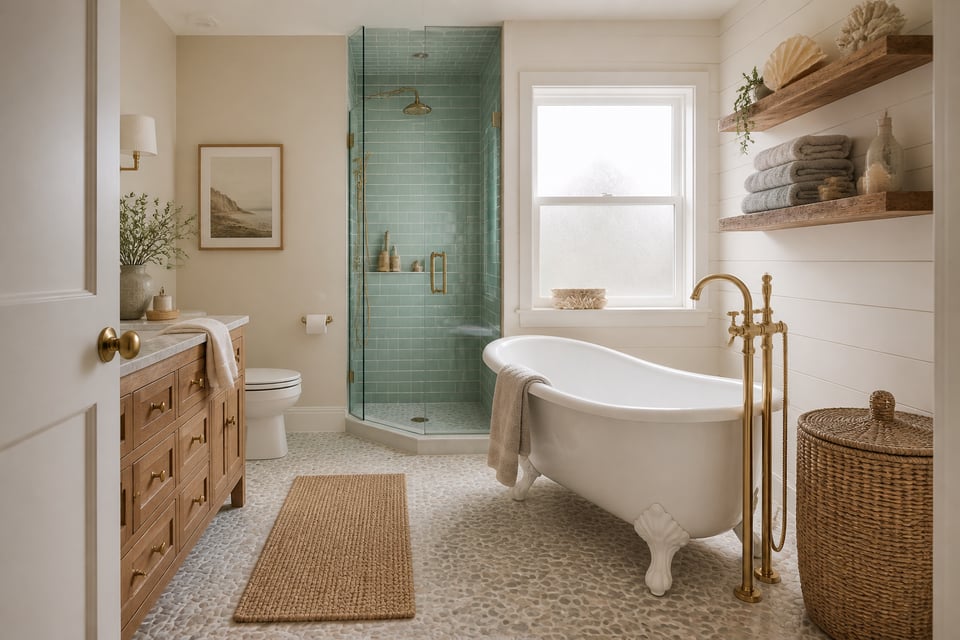
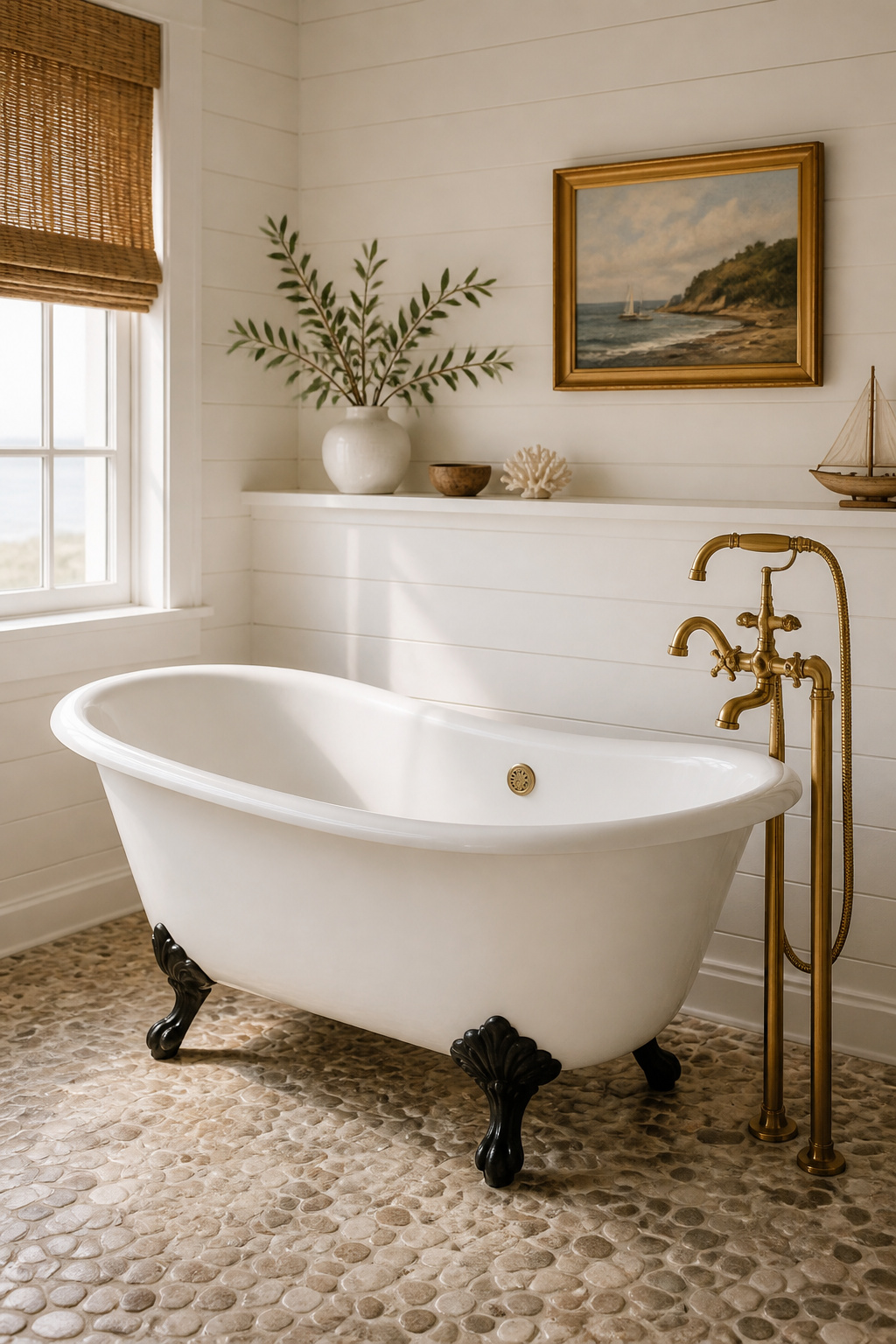
A clawfoot tub is the most aspirational piece in a beach bathroom. It’s an object, not just a fixture — freestanding from all four sides, it occupies the room the way a piece of sculpture does. In a beach bathroom with pebble tile, shiplap walls, and seafoam tile in the shower, a white roll-top clawfoot tub becomes the centrepiece that makes the whole design legible.
Structure First: The Weight Question
The standard 60-inch cast iron clawfoot tub weighs 350-450 pounds empty; filled with water and a person, the floor load reaches 650-900 pounds — and all of that weight concentrates on four small feet rather than distributing across a broad base. On an older home with wooden joists, this almost always requires structural assessment before purchase. Sistering the floor joists beneath costs $500-$2,000 depending on access and scope; budget for it explicitly, because it’s what most renovation estimates quietly omit.
For fixtures, unlacquered brass is the most authentic finish for beach bathroom ideas in the coastal vernacular. It develops a patina over time — darkening, softening — that echoes driftwood and worn nautical hardware. Brushed nickel gives similar warmth without the maintenance commitment. Chrome reads more clinical and suits only very graphic, minimalist coastal interpretations. Minimum floor space recommendation: 7×10 feet, enough to walk comfortably around all four sides.
8. Rattan and Jute Storage for a Natural, Layered Beach Bathroom
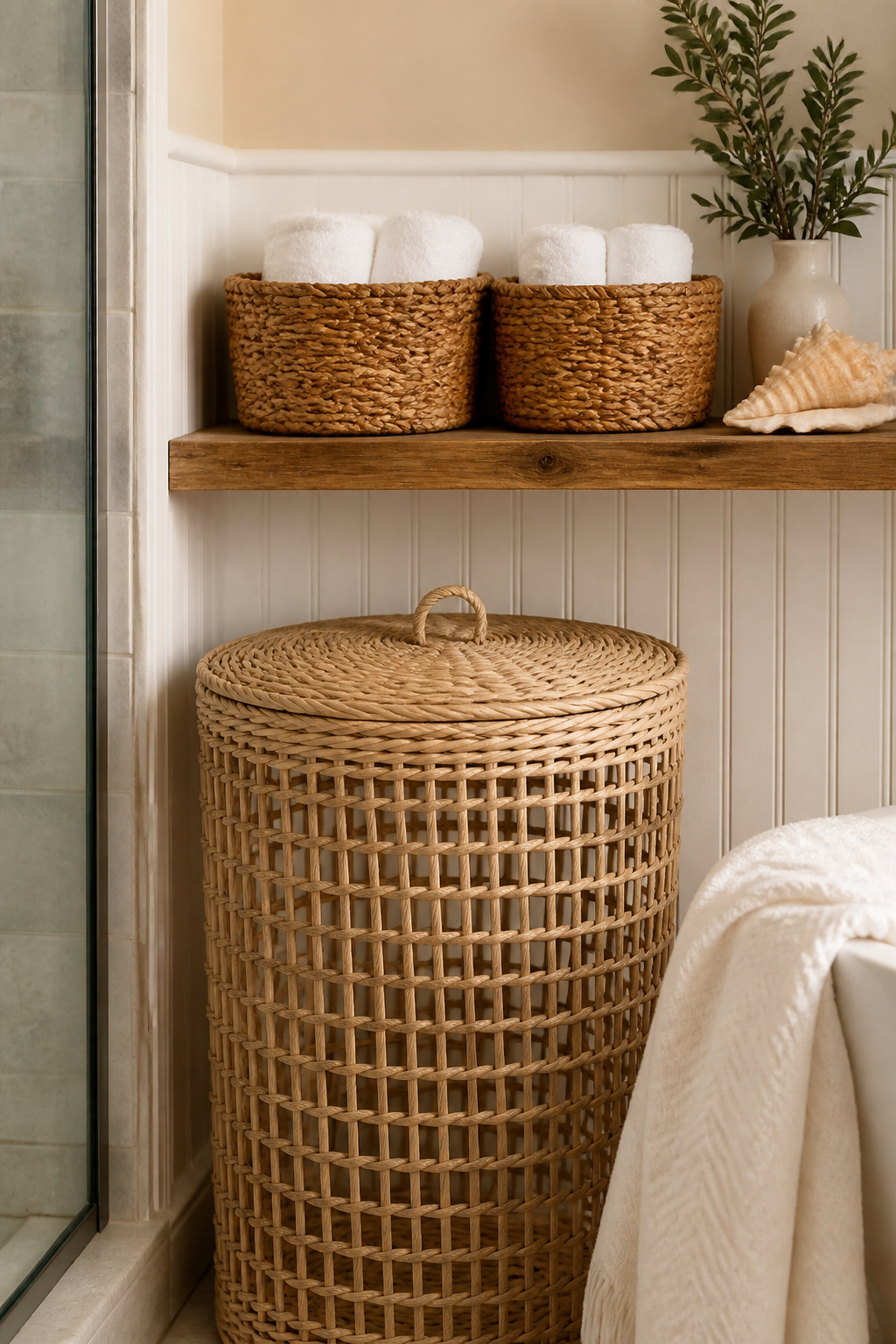
Natural fibre storage is where a beach bathroom shifts from looking coastal to feeling coastal. Rattan hampers, seagrass open bins, jute baskets — they add organic warmth that no chrome or plastic alternative can deliver. In a room dominated by tile, chrome, and glass, that warmth performs a genuine psychological function.
Placement and Fibre Comparison
Rattan performs better than jute or seagrass in humid environments — its waxy outer surface offers moisture resistance the others lack. The positioning rule: natural fibre storage belongs near the bathroom door, away from steam concentration around the shower and tub. A bathroom with a properly sized exhaust fan running for fifteen minutes after each shower maintains 30-50% relative humidity — the range where natural fibres stay stable. Also, small bathroom storage solutions covers how to balance storage capacity with the airy quality coastal bathrooms need.
One large rattan hamper with a lid (the lid reduces moisture exposure to its contents; an open weave still allows ventilation) plus two small seagrass open bins is the complete storage system for most bathrooms. Match tone across pieces rather than material — a sand-coloured rattan hamper and a honey seagrass bin read as a considered selection; deep chocolate rattan next to pale seagrass reads as random accumulation.
9. Coastal Bathroom Wall Art That Earns Its Place
Wall art is where beach bathroom ideas most often fail. The gap between a coastal bathroom that feels designed and one that feels themed is almost always the art — specifically, whether it was chosen or whether it was purchased from a boardwalk souvenir display. Novelty signs, bright printed anchors, and resin starfish sets read as theme; vintage nautical charts, fine-art ocean photography, and botanical illustrations read as rooms that take themselves seriously.
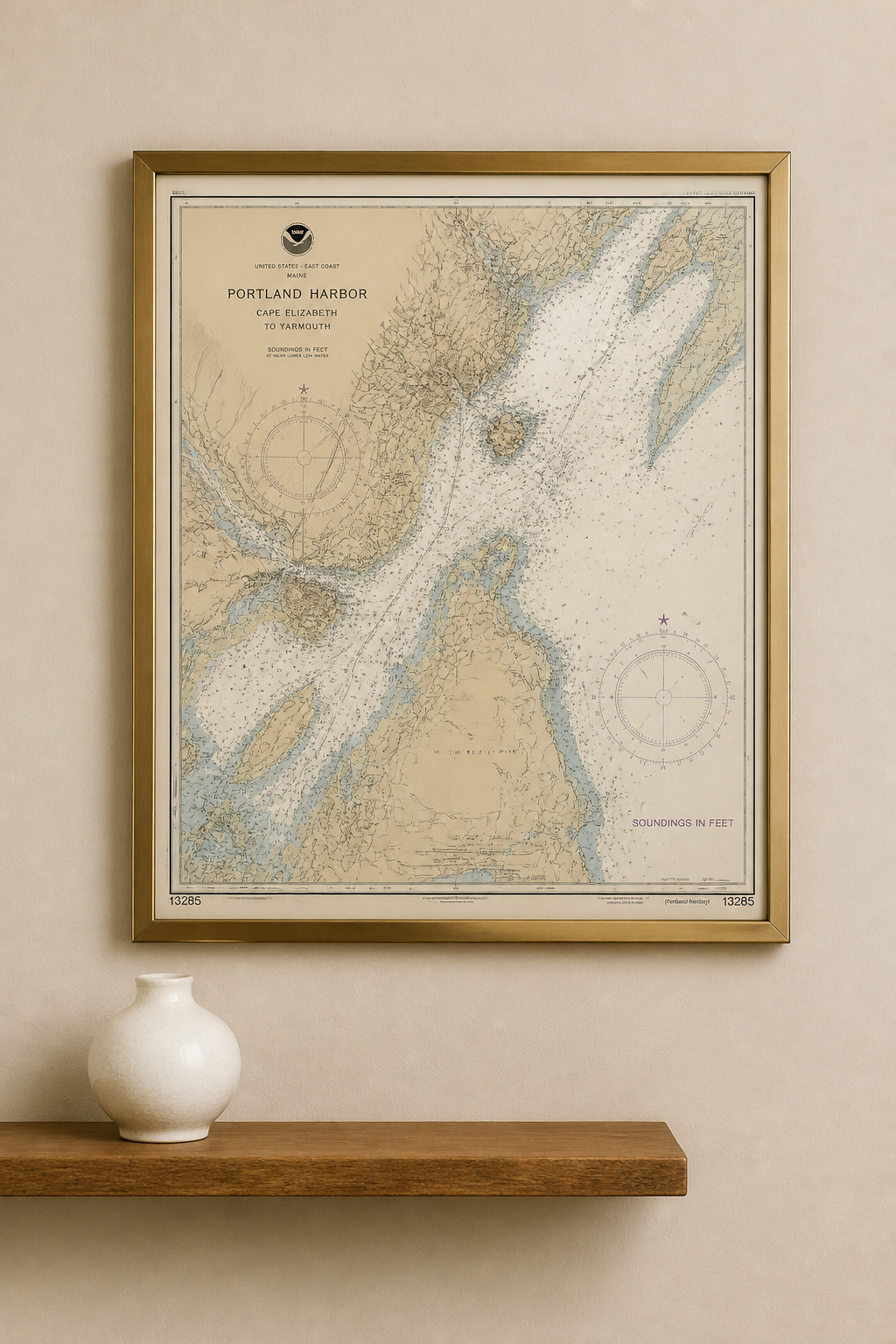
The test is consistent: would this piece look at home in an art gallery, or only in a themed retail display? Vintage nautical charts — NOAA’s archive of historical charts is available as free high-resolution downloads, and antique originals run $30-$150 depending on the region depicted — pass this test and carry quiet authority. Abstract ocean photography (long-exposure wave photographs, aerial drone shots of reef and shallow water) also works: these read as colour-field art as much as coastal references. For a naturalist cabinet quality, coastal botanical prints in a minimal Audubon-adjacent style pair brilliantly with driftwood frames and open shelving. Detailed guidance on arrangement and framing is in this piece on bathroom wall art ideas.
Framing for Humid Environments
In a small bathroom, limit art to one to three pieces — the restraint is the curatorship. Metal frames (aluminium, brass) are the most stable for bathroom humidity; sealed hardwood frames also perform well. Use acrylic glazing rather than glass: lighter, shatter-resistant, and it doesn’t develop condensation on a cold surface in steam.
10. Sand-and-Stone Neutral Palette as a Coastal Bathroom Foundation
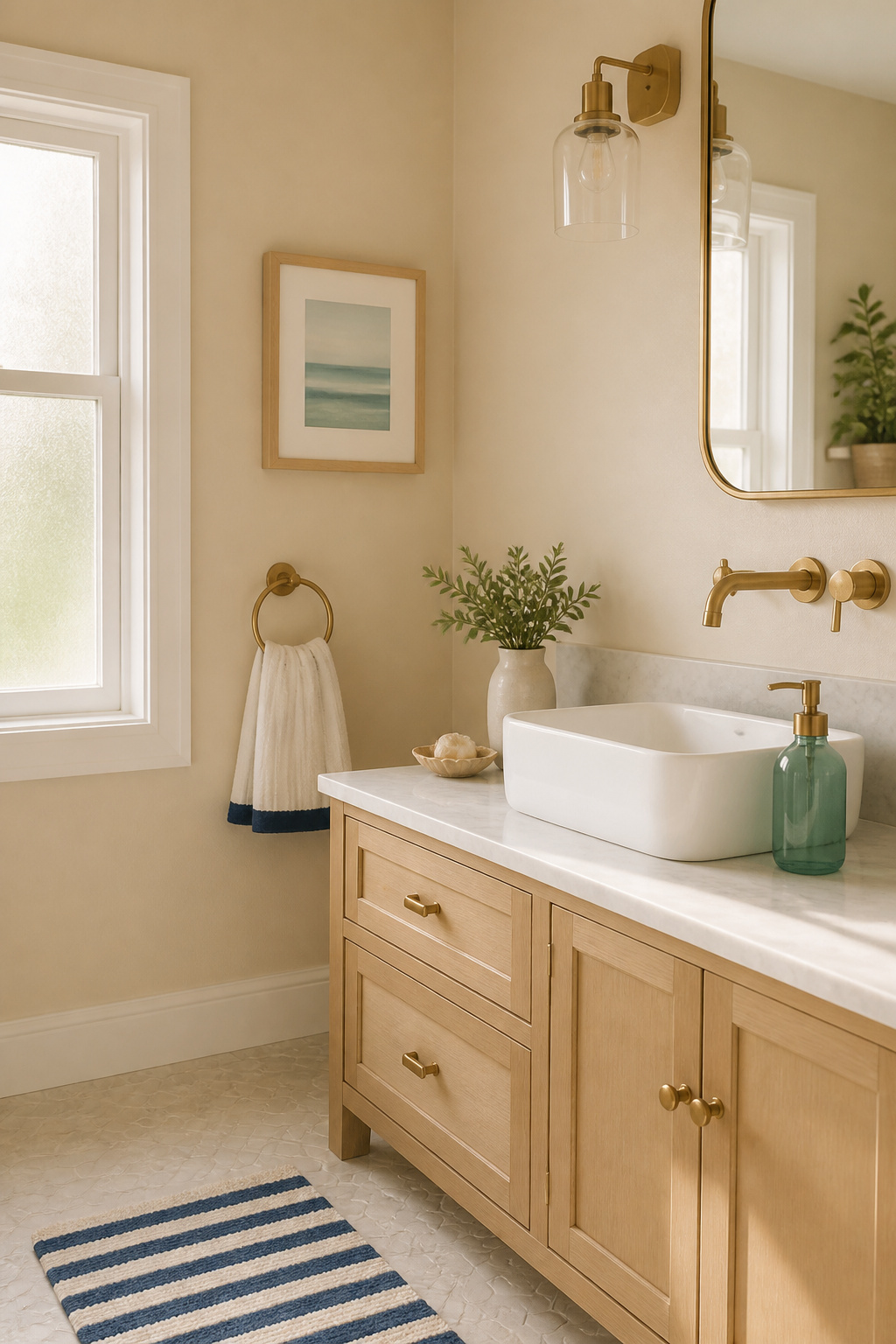
The most common mistake in beach bathroom design is reaching for blue and white before establishing a warm neutral foundation. Blue and white against a stark cool-white wall creates a bathroom that reads crisp and graphic — beautiful, but one-dimensional. The same combination against a sandy warm neutral creates depth, because the warm undertone makes cool blues appear more vivid by contrast. The neutral isn’t the background to the design; it’s the mechanism that makes the design work.
Paint Colours and Palette Ratios
Benjamin Moore Skipping Stone (2164-50) is a soft warm sand tone that avoids the yellow-orange trap of generic beige. Sherwin-Williams Sand Dune SW 7505 delivers similar warmth with a stronger grey backbone; Farrow & Ball Elephant’s Breath No. 229 is the most refined option for bathrooms where the coastal palette will be restrained. For a lighter, airier feel, Benjamin Moore White Sand OC-10 is a warm white with sandy undertone — it keeps a small bathroom feeling large while still establishing the palette.
The 60-30-10 coastal rule: sixty percent warm neutral (walls, large surfaces), thirty percent blue-green (tile accent wall, towels, bath mat), ten percent natural accents (driftwood, shells, brass hardware). Benjamin Moore Beach Glass 1564 — a soft blue-green-grey that reads like sea mist — is the transitional colour that bridges sandy neutral walls and crisp coastal accents without committing entirely to either blue or green.
11. Bamboo and Teak Accessories for a Spa-Like Beach Bathroom Feel
Teak and bamboo bath accessories are where the materials science and the aesthetics of biophilic design align most clearly. Both are plant-derived, minimally processed, and bring genuine warmth that ceramic or plastic alternatives cannot. In beach bathroom ideas, the spa-like quality most people are reaching for comes largely from these two materials doing their work at counter level.
Teak vs. Bamboo in Humid Spaces
Teak contains natural silica and oils distributed through its grain — not just on the surface, but deep in the wood structure. It handles wet-dry cycles without cracking, warping, or developing surface mould, which is why it was the standard material for ship decks for centuries. Bamboo, technically a grass rather than a wood, is fast-growing and genuinely sustainable, but it’s less naturally water-resistant than teak — without careful drying between uses, bamboo accessories in a high-humidity bathroom can warp or mildew at the base. The practical guidance: teak for anything in or near the splash zone; bamboo for the toothbrush holder and accessories that stay dry.
AquaTeak makes the most consistently recommended bath tray at $60-$120. Apply teak oil every four to six months to maintain the warm honey colour; without it, teak silvers naturally to driftwood grey, which is a different beauty rather than a maintenance failure.
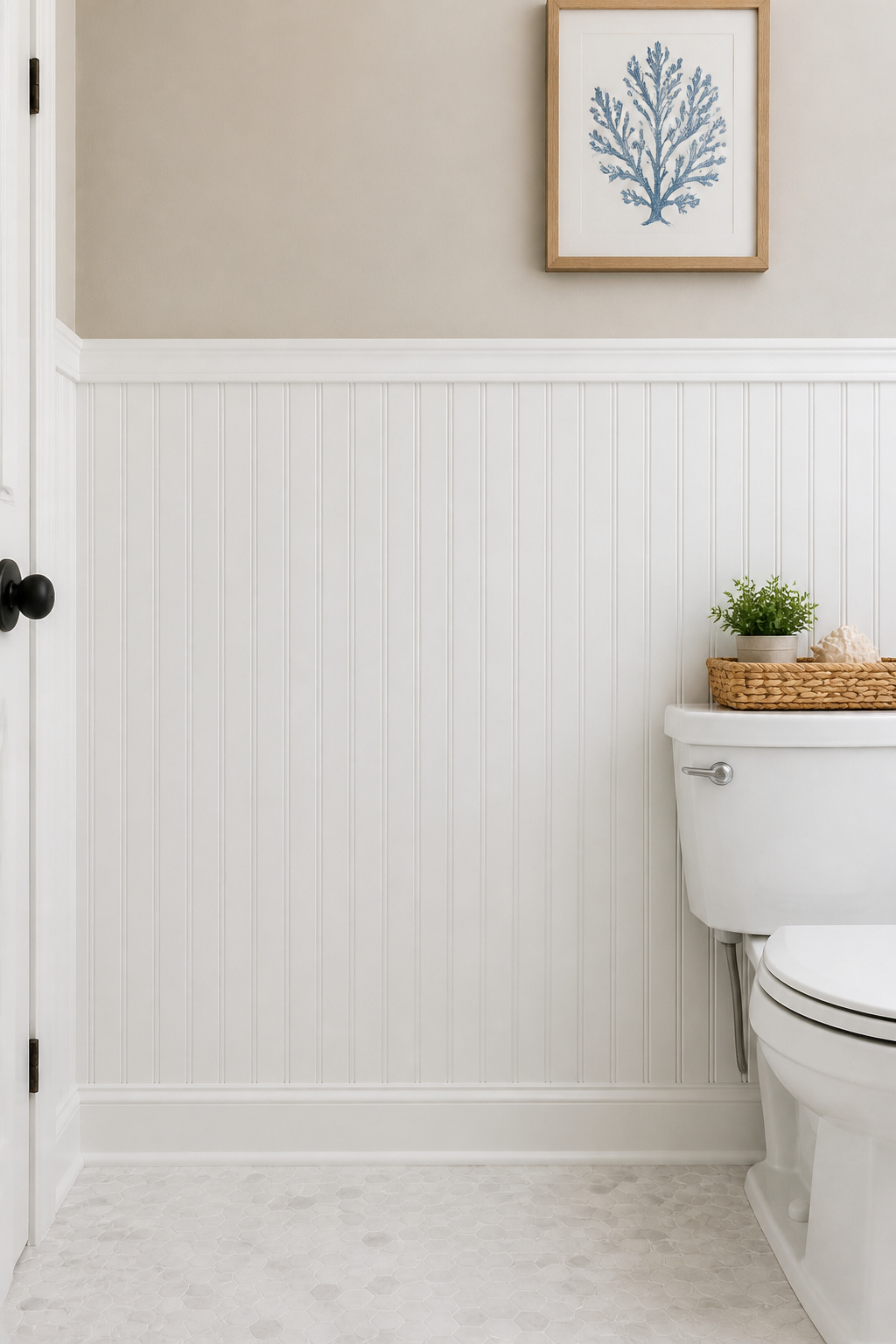
12. Beadboard Wainscoting: The Architectural Detail Coastal Bathrooms Need
Beadboard wainscoting is the most historically grounded of all beach bathroom ideas. Its roots are in 19th-century cottage architecture — New England coastal homes, Cape Cod shingle-style interiors, Nantucket summer houses — and that cultural association runs deep enough that beadboard reads coastal instinctively, without any supporting elements. Per dollar of investment, it does more communicative work than almost any other architectural addition in a coastal bathroom.
Material and Height Selection
The vertical channel detail creates a secondary rhythm on the lower wall that makes rooms feel taller — the eye follows the ribbed lines upward, and the cap rail creates a natural horizon line dividing the wall into two proportioned zones.
PVC beadboard (Azek, WOLF, Versatex) is the correct choice for any bathroom — fully waterproof, no warping, no mildew, and now accurate enough in profile that the visual difference from real wood is minimal at a distance. Moisture-resistant MDF performs reasonably well in well-ventilated bathrooms away from direct splash but isn’t fully waterproof. Standard MDF swells in bathroom humidity regardless of paint finish; confirming the grade before purchase is the one technical check that prevents an expensive installation from deteriorating within two years.
Pre-packaged kits come in finish heights of 36, 42, 52, and 66 inches. The 52-inch height — half-wall with painted plaster above — is the contemporary proportion that works in most standard-height bathrooms.
13. Open-Plan Shower With Coastal Tile for a Beach Bathroom Centrepiece
The walk-in shower is where beach bathroom ideas make their most significant structural statement. A shower curtain creates a visual wall that interrupts the flow between the sink, tub, and shower. Frameless glass removes that interruption entirely — the tile design becomes an architectural element visible from every point in the room, and the spatial quality changes fundamentally. For refreshing bathroom shower designs that cover the full layout decision, the spatial planning thinking is useful before committing to a wet room or a three-sided enclosure.
Tile and Glass Choices
For tile, 3×6 inch subway tile in seafoam green or sage is the most authentic cottage-coastal choice. Fireclay Tile’s handmade subway range has natural variation between tiles that makes a shower wall look artisanal rather than factory-produced. Glass seafoam subway tile reflects light into the enclosure, making even a 36-inch-wide shower feel considerably airier. Large-format stone-look porcelain in pale sand or warm grey achieves a more resort-spa feeling with fewer grout lines to clean.
Frameless glass thickness: 3/8-inch is standard for panels up to 36 inches wide; 1/2-inch is required for wider panels, which flex in the hinge at the thinner gauge and eventually crack. Tempered glass is mandatory by building code in most jurisdictions. Brass hinges and a brass door pull complete the hardware language — the same finish connecting the shower to the clawfoot tub, the shelf brackets, and the vanity tap creates a unified vocabulary that makes a room feel resolved.
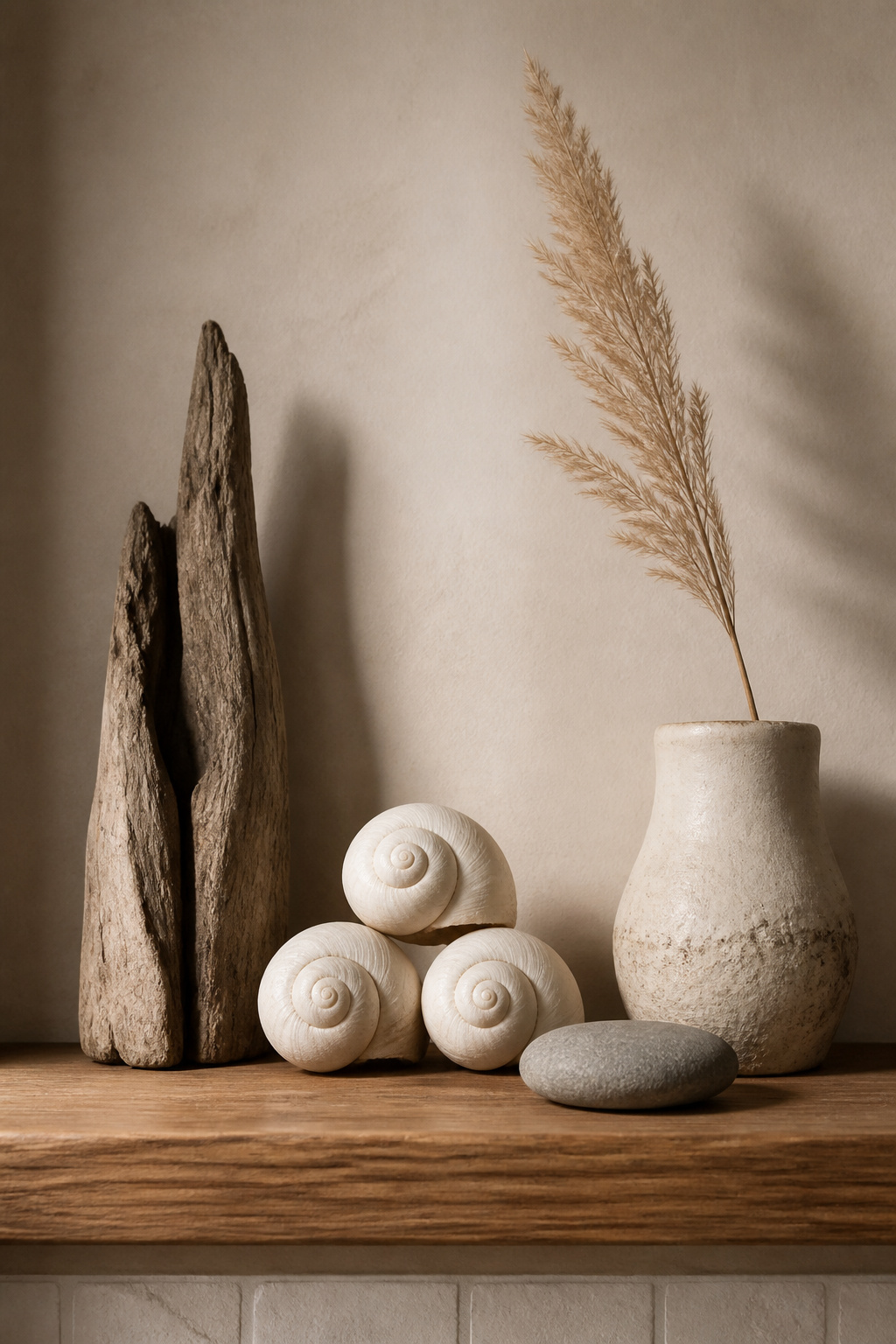
14. Shell and Driftwood Accents That Feel Collected, Not Decorated
The best beach bathrooms look assembled over time — shells from specific beaches, a piece of driftwood found on a particular walk, a stone that came home in a pocket. They don’t look purchased. The moment accessories read as a matching set from a coastal retail display, the authenticity of the entire room deflates.
The Restraint Principle in Practice
The rule of three for coastal vignettes: a tall vertical element (driftwood branch or a tall vessel), a mid-sized grouping (three or four shells arranged closely), and a low piece (a flat stone or a single large shell). This creates visual hierarchy — the eye moves through the arrangement from tall to mid to low — and that movement is the difference between display and clutter.
The kitsch test is consistent: if it could appear on a boardwalk souvenir stand, it’s themed rather than designed. Painted shells, resin starfish, novelty driftwood signs all fail. A matched set of white angel wing shells, a hand-thrown celadon ceramic vessel with pampas grass, and a large smooth grey beach stone arranged on a teak shelf all pass. Monochromatic groupings read more sophisticated than mixed-colour collections — all-white shells together, or all-grey stones together, rather than a mixed assortment.
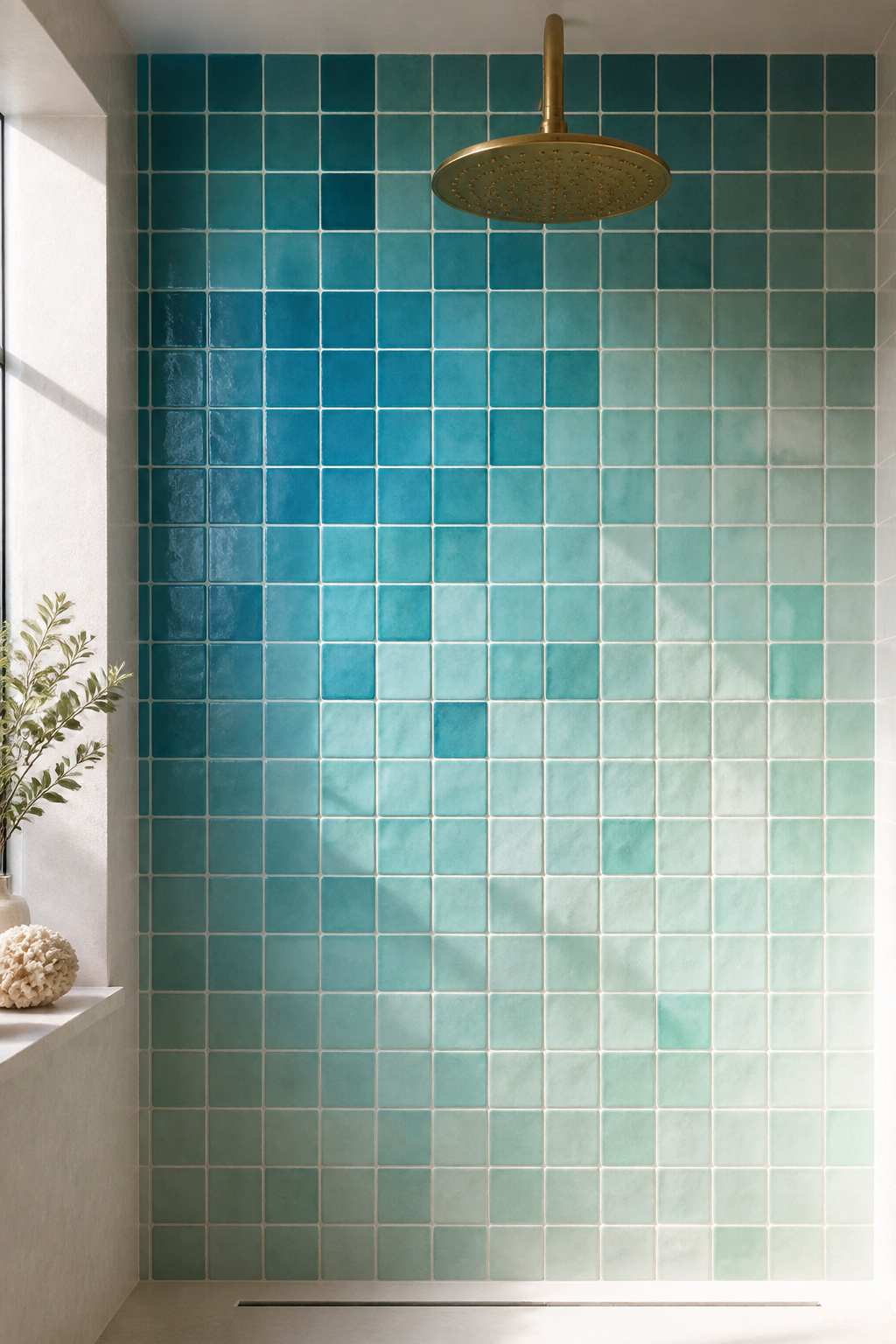
15. Coastal Blue-Green Tile Gradient for a Beach Bathroom Colour Story
A blue-to-green tile gradient — moving from deeper aqua at one anchor point to lighter seafoam at the other — is the most technically ambitious of these beach bathroom ideas, and the one with the most immersive payoff. Natural coastal water shifts from deep navy offshore to bright turquoise in the shallows to clear seafoam at the wave break. This gradient is encoded in visual memory for anyone who has spent time near the sea, and a tile wall that mirrors it activates that memory immediately.
Tile Selection for a Natural Gradient
Fireclay Tile’s handmade range has natural batch-to-batch variation that makes blending two adjacent colours — their ‘Sea Glass’ and ‘Seafoam’, for instance — produce an organic gradient rather than a hard line between two distinct tones. Heath Ceramics in Oakland offers eight to ten blue-green tile tones sharing the same clay body, which makes tone transitions smooth. Merola Tile’s ‘Arcade Sea Glass’ mosaic comes pre-mixed in graduated blue-green tones on a single mesh sheet — a simpler approach to the gradient effect without ordering and blending multiple colours manually.
The key matching principle: the two gradient colours must share an undertone — both slightly warm, or both slightly cool. Mixing a warm aqua with a cool seafoam creates a colour clash rather than a gradient. For grout: white creates clear visual separation and makes the colour progression readable; matching mid-tone grey blends grout lines and makes the wall read as a wash of colour. Dark grout is a mistake with any glass or translucent tile — it absorbs light and the shimmer that makes the gradient worth its cost disappears.
Bringing Your Beach Bathroom Together Without Starting From Scratch
The most practical question about beach bathroom ideas is also the most common: do I need to gut the room and start again? For most bathrooms, the answer is no — but the sequence of changes matters considerably.
Zero-renovation changes can be made in a weekend for $100-$300: swap to Breton-stripe towels, introduce teak accessories, replace the vanity mirror with a driftwood frame, add a rattan hamper. These four moves shift a generic bathroom toward a coastal register without touching a single tile or pipe. At the next level — painting walls in a sandy neutral or seafoam tone, installing floating wood shelves, adding PVC beadboard wainscoting from a pre-packaged kit — you’re looking at one to two days and no trades required, at a cost of $500-$1,500 depending on room size. Only at the renovation tier (new shower tile, clawfoot tub, frameless glass enclosure, pebble stone floor) do you need contractors and permits, with budgets starting at $3,000-$15,000.
The sequencing principle holds whether you’re doing everything at once or in stages: architecture first (beadboard, tile, structural changes), colour second (paint and grout decisions made against finished surfaces are always more accurate than decisions made from swatches), accessories last. The beach bathroom ideas that look most collected and least purchased are usually the ones added slowly, over several months, as each piece earns its place. That’s not a design compromise. That’s how the rooms that look genuinely coastal actually come together.