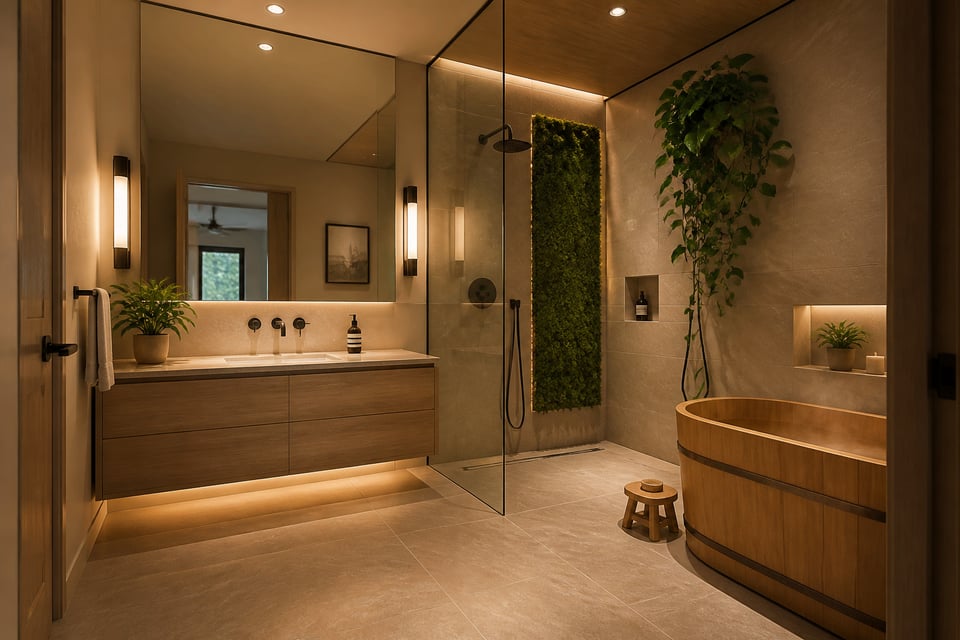
Small bathrooms hold a paradox that most design advice gets backwards: the more intentionally you design them, the larger they feel. A small bathroom interior isn’t a problem to be solved with mirrors and pale paint — it’s an invitation to design with honesty that larger rooms rarely demand. You have to choose what matters, remove what doesn’t, and pay close attention to how materials, light, and proportion support the daily rituals that happen here. Every morning and every evening, you return to this space alone with your thoughts. That matters more than square footage.
Over years of working with clients through the lens of wellness architecture, I’ve watched small bathrooms transform not by becoming bigger, but by becoming more considered. The fifteen ideas in this guide do both things at once: they expand the perceived space through intelligent design choices, and they improve the physiological and emotional experience of using the room. From natural stone to circadian lighting, from non-toxic finishes to wabi-sabi plaster — these aren’t trends. They’re lasting decisions that compound daily.
1. Floating Vanity to Open Up Your Small Bathroom Interior
A wall-mounted vanity does something no paint colour or mirror can fully replicate: it removes the visual anchor at floor level and lets the floor plane breathe. In a small bathroom interior, the effect is immediate. Your eye reads the full expanse of tile beneath the vanity, the room loses its hemmed-in quality, and the bathroom feels designed with intention rather than simply furnished.
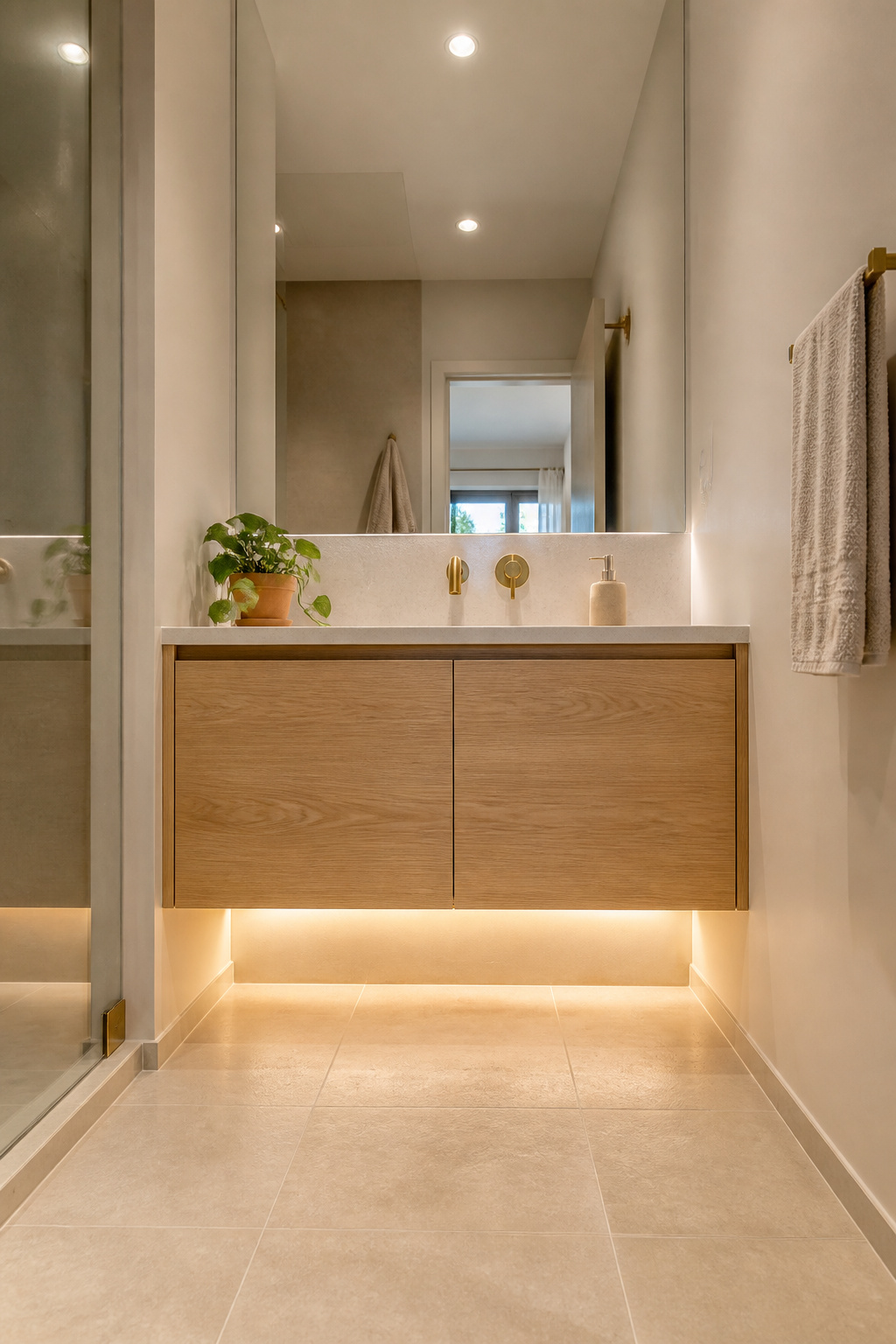
The measurements matter more than most people realise. A 24-inch floating vanity in a 45-square-foot bathroom doesn’t need an enormous mirror to feel spacious — the exposed floor underneath is already doing most of the work. For really tight layouts, an 18-inch depth vanity rather than the standard 21 inches gives you three extra centimetres of clearance that makes a morning routine noticeably more comfortable. Wall-hung designs in the 18-36 inch width range work well for small bathrooms; mount them between 32 and 36 inches from floor to top of unit. Building code requires at least 21 inches of clear floor space in front — always confirm minimum clearance before selecting a width.
Material matters from a wellness standpoint, too. Standard MDF cabinetry uses urea-formaldehyde binders that off-gas continuously — in a poorly ventilated bathroom, that exposure accumulates daily. Solid wood or CARB Phase 2-compliant plywood construction off-gases significantly less. White oak and teak are the workhorses here — both resist moisture naturally, and teak’s internal oils mean less chemical treatment to worry about. If you’re drawn to a painted finish, look for CARB Phase 2 or E1-certified cabinets made with formaldehyde-free adhesives.
For the full range of options at different price points, this collection of vanity ideas designed for tight floor plans covers proportions, styles, and storage configurations in detail.
2. Vertical Tile Patterns That Make Ceilings Feel Taller
There’s a simple reason vertical tile layouts appear in nearly every high-end small bathroom renovation: the brain reads directional lines as spatial cues, and vertical lines draw the eye upward continuously. Grout lines in a vertical arrangement function like ladder rungs — their upward repetition creates optical momentum that registers as height even when the ceiling hasn’t moved an inch.
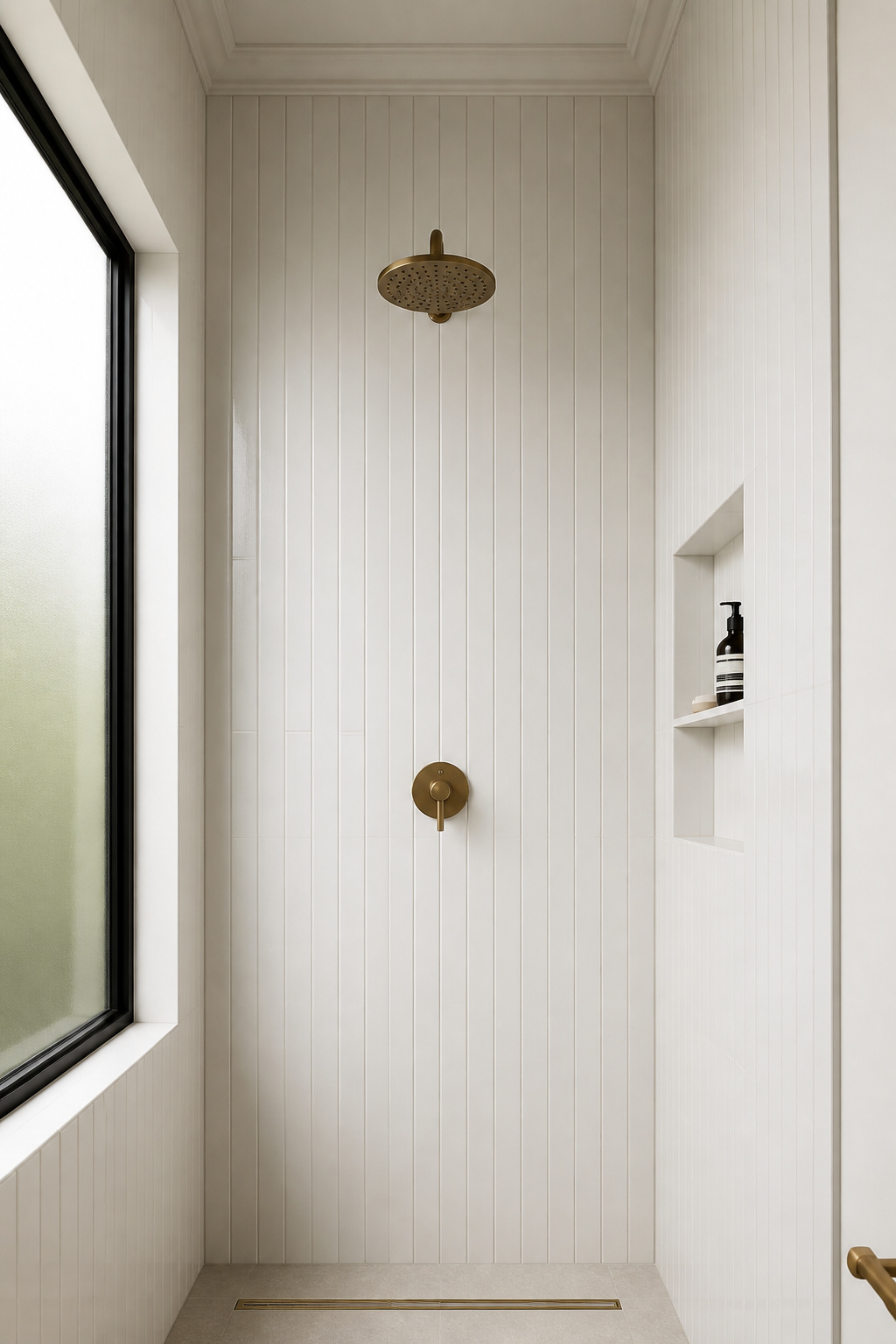
The format shapes how pronounced the effect is. A standard 75×300mm subway tile set vertically has a strong 4:1 height-to-width ratio that creates clear upward momentum. Plank tiles — 100×600mm or similar — produce a more contemporary version of the same effect with a quieter, more linear aesthetic. For something with more character, long hexagonal or elongated zellige-style tiles set in a stacked vertical arrangement layer texture on top of the height illusion, which suits a wellness bathroom where the material invites touch.
Grout colour is where many people unknowingly undermine the effect. A grout colour closely matching the tile body lets the lines almost disappear — the wall reads as a single monolithic surface. A contrasting grout makes the vertical emphasis explicit and more graphic, which looks beautiful in bathrooms with good natural light but can feel heavy in darker spaces. For a calming, wellness-focused room, a satin or low-sheen gloss tile prevents glare while preserving the light-extending quality. One caution worth noting: vertical tiles on a very narrow wall can accentuate its narrowness. Balance the emphasis with a wide vanity or a generously sized mirror to give the eye somewhere to rest horizontally.
3. A Seamless Walk-In Shower to Expand the Visual Field
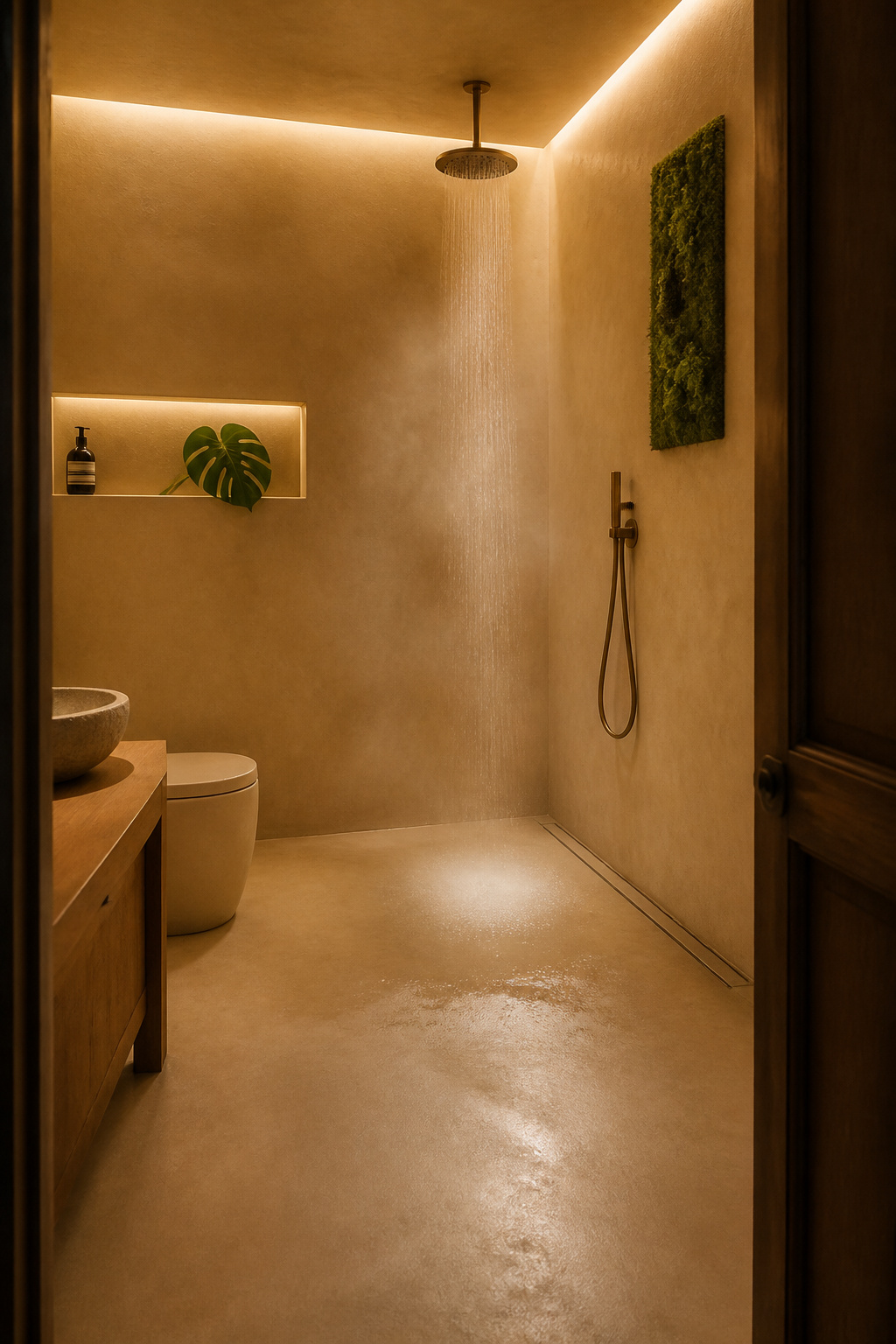
Removing the shower door is consistently the single most impactful spatial change in a compact bathroom — not because it adds square footage, but because it removes the visual boundary that mentally segments the room into smaller zones. Without a door, the floor reads as continuous, the eye travels the full length of the space, and even a 1m² shower footprint feels generous when it opens to the room.
Dimensions and Waterproofing
The minimum workable footprint for a walk-in shower is 36×36 inches (91×91cm), but 42×60 inches gives comfortable adult movement and enough room to raise your arms without touching both walls. For a fully open wet room, a sloped area of at least 72×72 inches contains water effectively without additional barriers. Before settling on an opening format, plan the splash zone: at least 72 inches (183cm) of adjacent floor space needs to stay dry, and in a tight bathroom this directly determines the whole layout.
Waterproofing is the investment that determines whether a wet room thrives or fails. Full tanking requires a waterproof membrane on all walls and floor surfaces to a minimum of 1800mm height on shower walls. A linear drain running along one wall edge requires a single long gradient rather than four converging ones — technically simpler and visually cleaner. Add rigid foam insulation behind shower walls and niche cavities to prevent condensation bridging, a detail frequently skipped and consistently regretted after a few years.
For a deeper look at shower formats suited to small footprints, these shower design ideas scaled for small bathrooms explore walk-in designs, wet rooms, and frameless screens at every budget level.
4. Natural Stone That Brings Grounding Texture to a Compact Bathroom Interior
The research on natural materials and human stress response has grown considerably. Proximity to stone, wood, and water activates the parasympathetic nervous system in measurable ways — reducing heart rate and cortisol in a way that porcelain replicas simply cannot replicate. The reason isn’t primarily visual. It’s the combination of visual variation, tactile texture, and the body’s subliminal recognition of contact with something that came from the earth. In a compact bathroom interior, natural stone earns its higher cost many times over in daily lived experience.
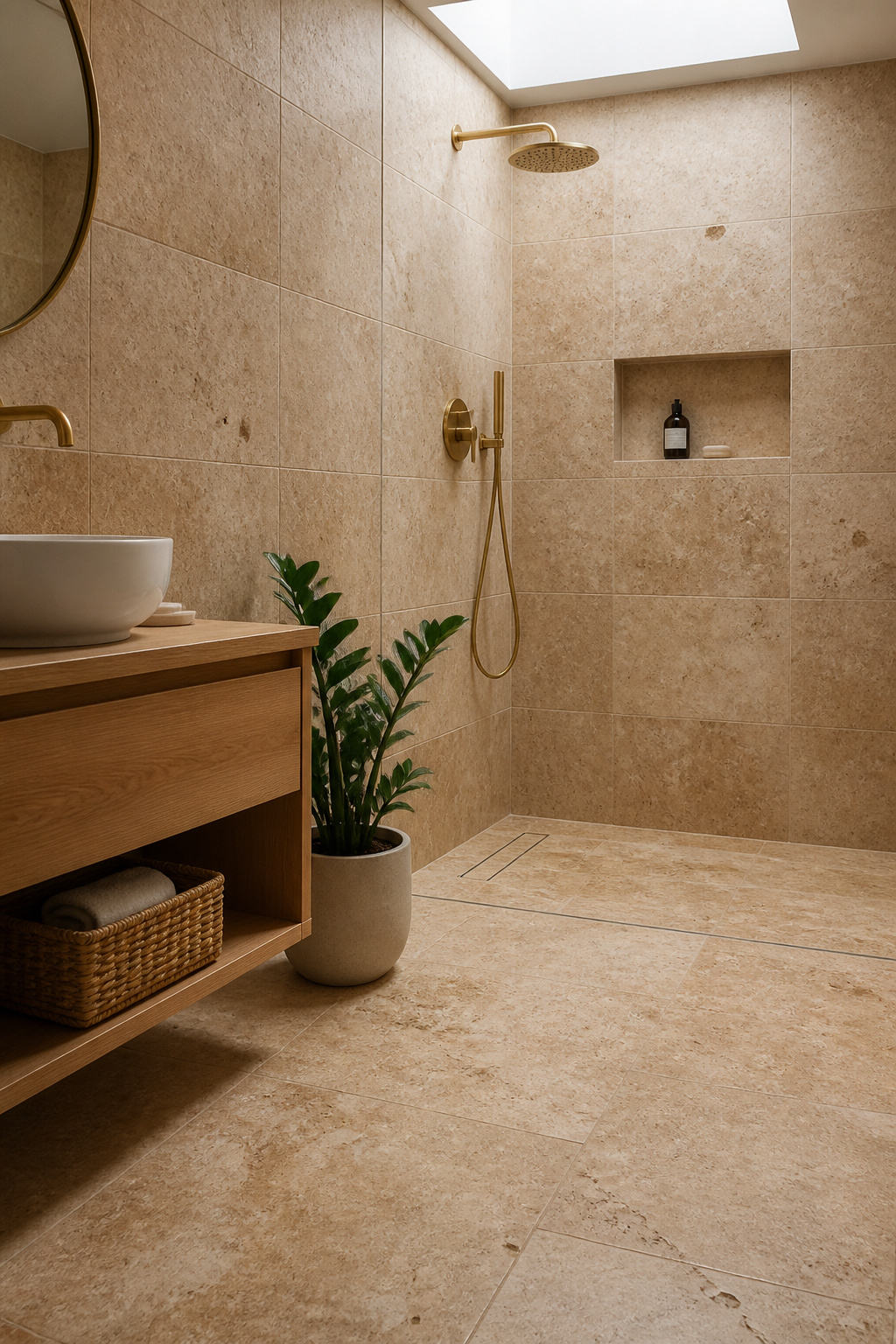
Travertine is the best starting point for most bathrooms. Its warm honey-tan tones resonate with the brain’s evolved response to natural environments, and it’s more forgiving to work with than marble. For floors — where slip resistance is non-negotiable — choose a tumbled or honed finish rather than polished. Honed travertine removes the high sheen without eliminating surface texture, keeping it safe underfoot while retaining its characteristic warmth. A brushed limestone achieves a similar balance and hides water spots particularly well.
Stone needs sealing, and it needs re-sealing. The first application of a penetrating sealer goes on before grouting; annual reapplication maintains moisture protection and prevents staining from the products that accumulate on bathroom surfaces. For a wellness-focused space, choose a solvent-free, water-based penetrating sealer — these protect without off-gassing into the enclosed room. Tadelakt and lime-based grouts are natural companions to stone tiles: they share the same alkaline chemistry, are mould-resistant by nature, and contain no synthetic biocides.
5. Warm Ambient Layered Lighting Instead of a Single Overhead Fixture
A single overhead downlight is the most common and most damaging choice in a small bathroom. It casts shadows downward from every ridge — brow, nose, jaw — making morning mirror use difficult and giving the room a clinical quality that no amount of good materials can overcome. There’s also the circadian dimension: lighting above 4000K in the evening actively suppresses melatonin production. Harvard researchers found that people exposed to warm light in the 2700-3000K range fell asleep 19 minutes faster than those under cool overhead light — a meaningful difference that begins and ends in a bathroom ritual.
Building the Three Layers
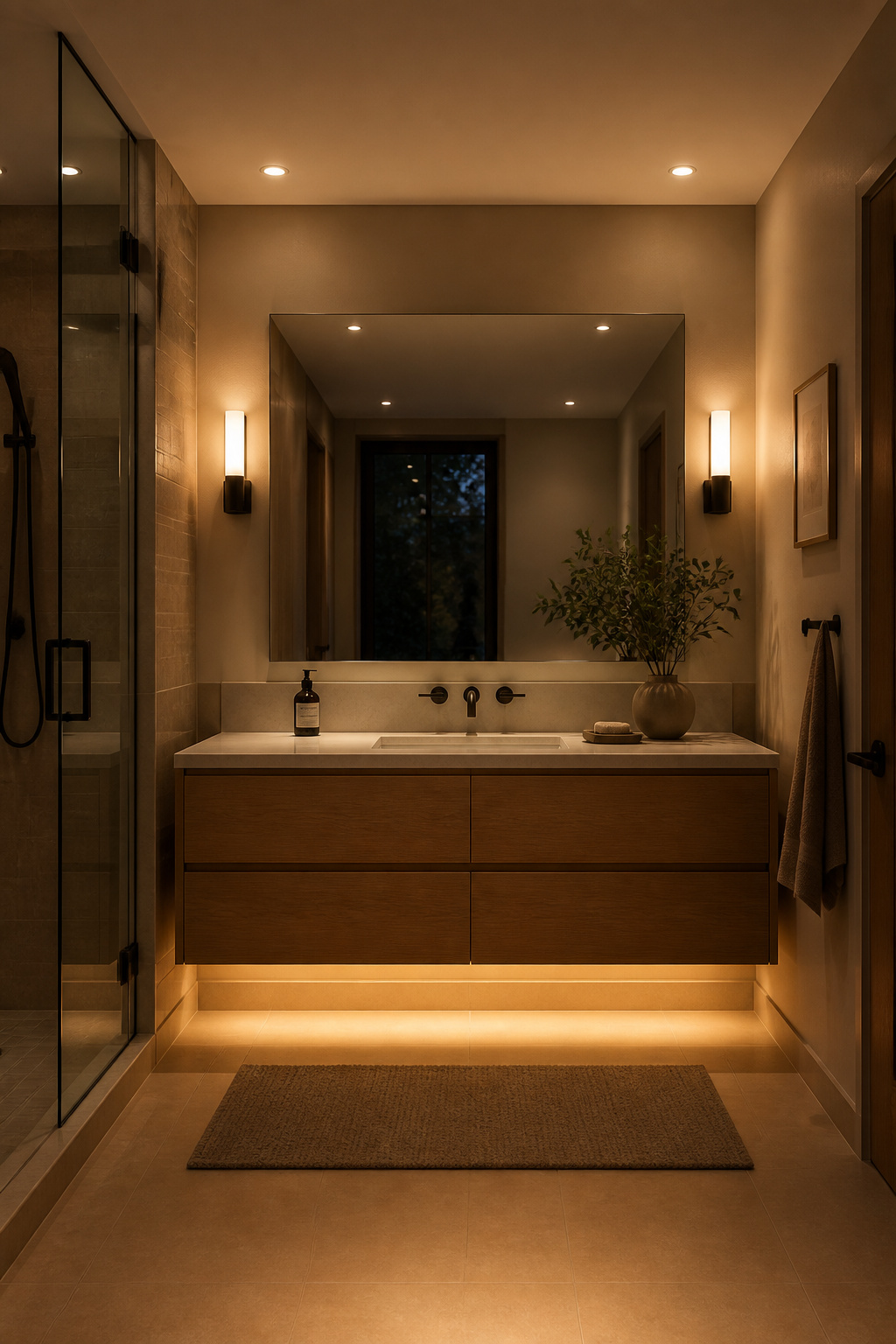
A three-layer approach rewires the experience completely. The ambient layer uses recessed downlights at the ceiling perimeter — not directly over the mirror — with dimmer control. The task layer comes from wall-mounted fixtures flanking the mirror at eye height (approximately 1500-1600mm from floor), providing shadow-free illumination for shaving, skincare, or makeup. The accent layer — under-vanity LED strip lighting or warm light inside a shower niche — creates warmth at floor level after dark and reinforces the floating vanity’s spatial effect in the evening.
Colour temperature determines the room’s psychological register. For a wellness bathroom, 2700-3000K is the range for all permanent fixtures: warm white that feels like late-afternoon light, supporting relaxed alertness in the morning and calm wind-down at night. Smart bulbs or separate dimmer circuits allow a shift between a slightly cooler morning setting and a warmer evening one. IP ratings matter: Zone 1 (directly above bath or shower, up to 2.25m) requires IPX4 minimum; fixtures inside the shower enclosure need IPX7.
The full decision tree — fixture types, beam angles, IP ratings, and switch configurations — is covered in this small bathroom lighting guide covering every zone and fixture type.
6. Recessed Shelving Built Into the Wall for Hidden Storage
Surface-mounted shower caddies and corner shelves add visual weight to walls that a small bathroom can’t afford to lose. A recessed niche removes items from the visible plane entirely — products sit inside the wall rather than projecting into the room, and the result is a shower that looks intentional rather than merely organised. This distinction — between a bathroom that functions as a retreat and one that feels like a utility room — often comes down to exactly this choice.
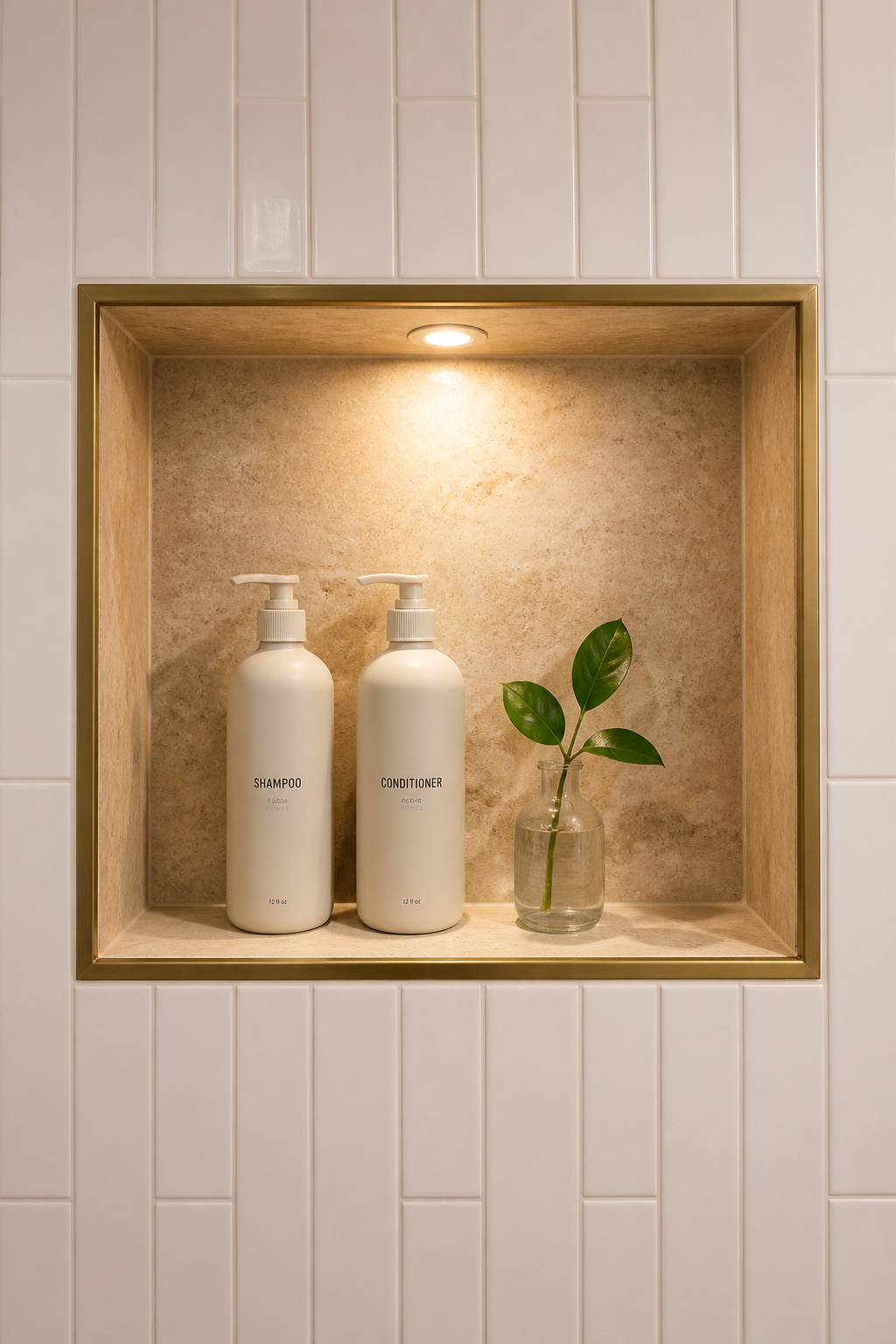
The structural reality is straightforward: standard timber studs are 3.5 inches (89mm) deep, and that’s the usable niche depth without additional framing. Studs are typically 16 inches on centre, giving a single-bay clear opening of approximately 14.5 inches wide — enough for a row of product bottles upright. A wider niche across two bays needs a horizontal header above the cut studs for structural integrity. Prefab foam niche inserts sized to this 16-inch bay include a built-in membrane, simplifying waterproofing on a first renovation.
The niche floor must slope — a 1/8-inch forward grade ensures water drains out rather than pooling. This detail is missed with surprising frequency during tile installation, and standing water in the niche eventually produces mould at the grout joints. For the aesthetic: a niche tiled in the same material as the surrounding wall creates a seamless, recessive effect; a contrasting stone or timber-look insert makes it a deliberate design moment. The contrasting approach particularly rewards placement at eye level where it receives close attention. One technical note: a niche on an exterior wall requires rigid foam insulation behind the cavity, as exterior walls are more susceptible to moisture bridging in winter.
7. A Deep Soaking Tub as the Anchor of a Small Bathroom Space
A compact freestanding tub does something no tile pattern or fixture combination can achieve: it announces that this bathroom has a primary purpose beyond the functional. A soaking tub is a commitment to the ritual of bathing — to the evening soak that lowers cortisol, raises core body temperature before sleep, and creates a physical transition between the working day and rest. In a small space, it commands the layout entirely, and that intentionality changes the room’s register.
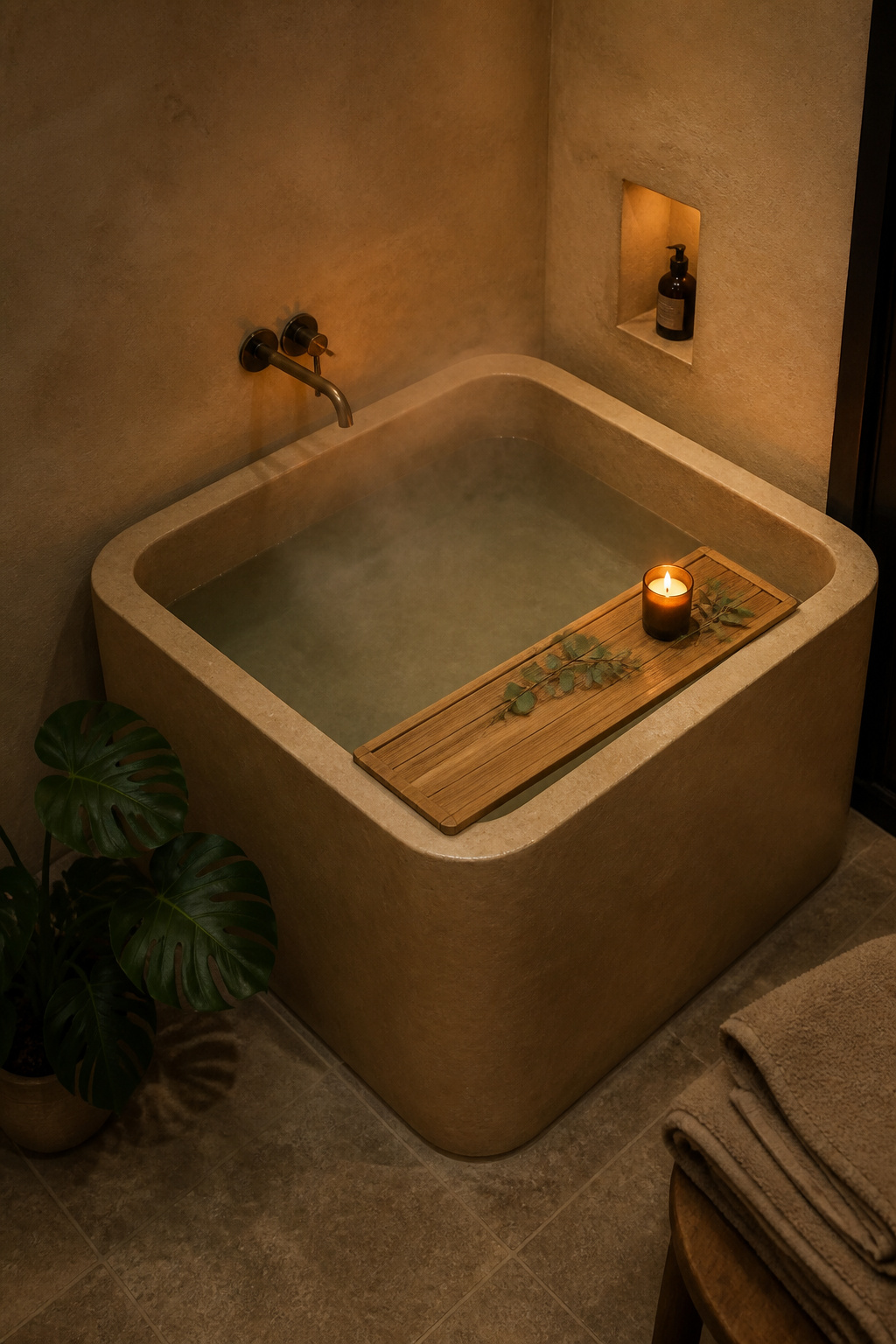
The Japanese ofuro format solves the “I don’t have room for a bath” problem that many small bathroom owners accept too quickly. Where a standard Western tub requires 60+ inches of linear space, a compact ofuro fits in 38-55 inches and compensates for its shorter length with depth: 22-27 inches of water rather than the 14-16 inches of a conventional tub. The Aquatica True Ofuro Mini fits a 43-inch square footprint — workable in a bathroom as small as 5×7 feet when planned around the tub from the design stage. The upright posture it requires is also more physically supportive for deep relaxation than reclining in shallow water, and the deeper soak retains heat significantly longer.
For materials: cast iron has the best thermal retention (2-4 hours for a full soak) and zero off-gassing, but at 300-400 lbs it requires a structural floor assessment. Stone resin balances thermal retention with a natural mineral feel at a more manageable weight. Acrylic is lightest and most affordable but retains heat for only 30-45 minutes — ventilate the bathroom well during the first few weeks after installation.
8. Large-Format Floor Tiles to Minimise Visual Breaks
Every grout line in a bathroom floor is a visual interruption — a small boundary the eye registers as a transition point, breaking the floor into a grid of perceived small zones. Conventional 100×100mm mosaic tiles in a 45-square-foot bathroom can produce twelve or more interruptions per square metre. A 600×600mm tile reduces that to a few long joints; the floor reads as a continuous surface, the room feels less segmented, and the perceptual gain is immediate.
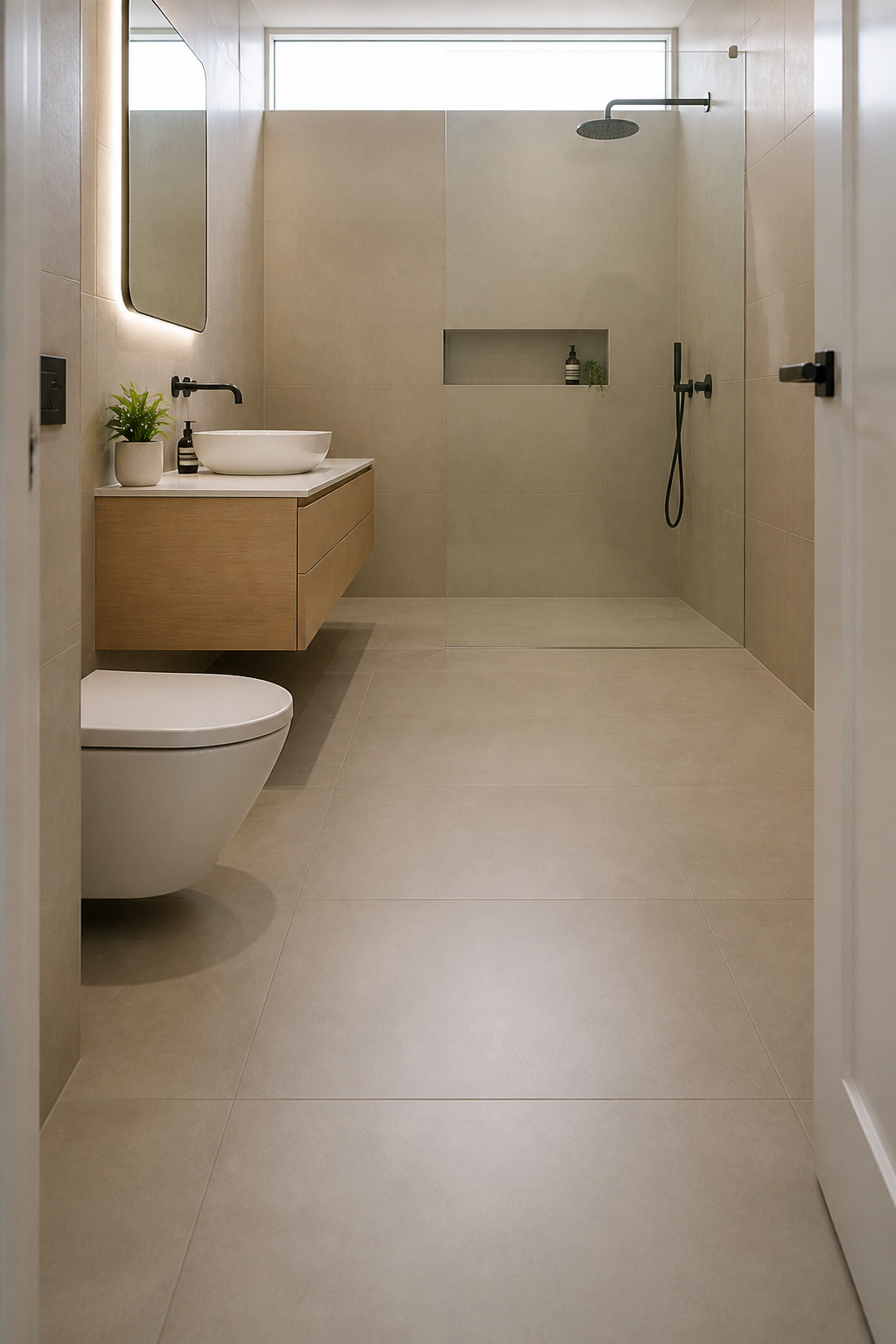
The minimum format where the effect becomes convincingly perceptible is 600×600mm. Smaller tiles still produce too many joints to create the seamless quality that makes a small floor read as a large plane. For maximum impact, 600×1200mm planks oriented lengthwise in a narrow bathroom guide the eye toward the longer dimension, visually stretching the space. Running the same large-format tile on walls as well as floors, in matching material and colour, creates a fully monolithic surface — the most spatially expansive treatment available in a compact small bathroom design.
Rectified tiles are the essential companion to large formats. Standard tiles retain natural edge variation from the kiln and need 3-5mm grout joints; rectified tiles are precision-cut after firing to edges accurate within 0.5mm, allowing joints as small as 1.3mm — virtually invisible from standing height. The substrate preparation also matters more at large formats: any unevenness in the sub-floor causes large tiles to rock and eventually crack. A self-levelling compound or tile backer board system is not an optional step here.
9. Biophilic Accents: Preserved Moss Panels and Living Plants
Roger Ulrich’s 1984 study — one of the most cited papers in architectural psychology — found that patients with a view of nature recovered from surgery 8.5% faster than those facing a blank wall. The foundational insight is that nature exposure has measurable physiological effects, not just psychological ones. More recent work published in 2025 in Frontiers in Physiology confirmed that biophilic interventions in confined spaces — plants, natural materials, natural light — reduce cortisol, heart rate, and electrodermal activity in reproducible, clinically meaningful ways.
Plants and Materials That Work
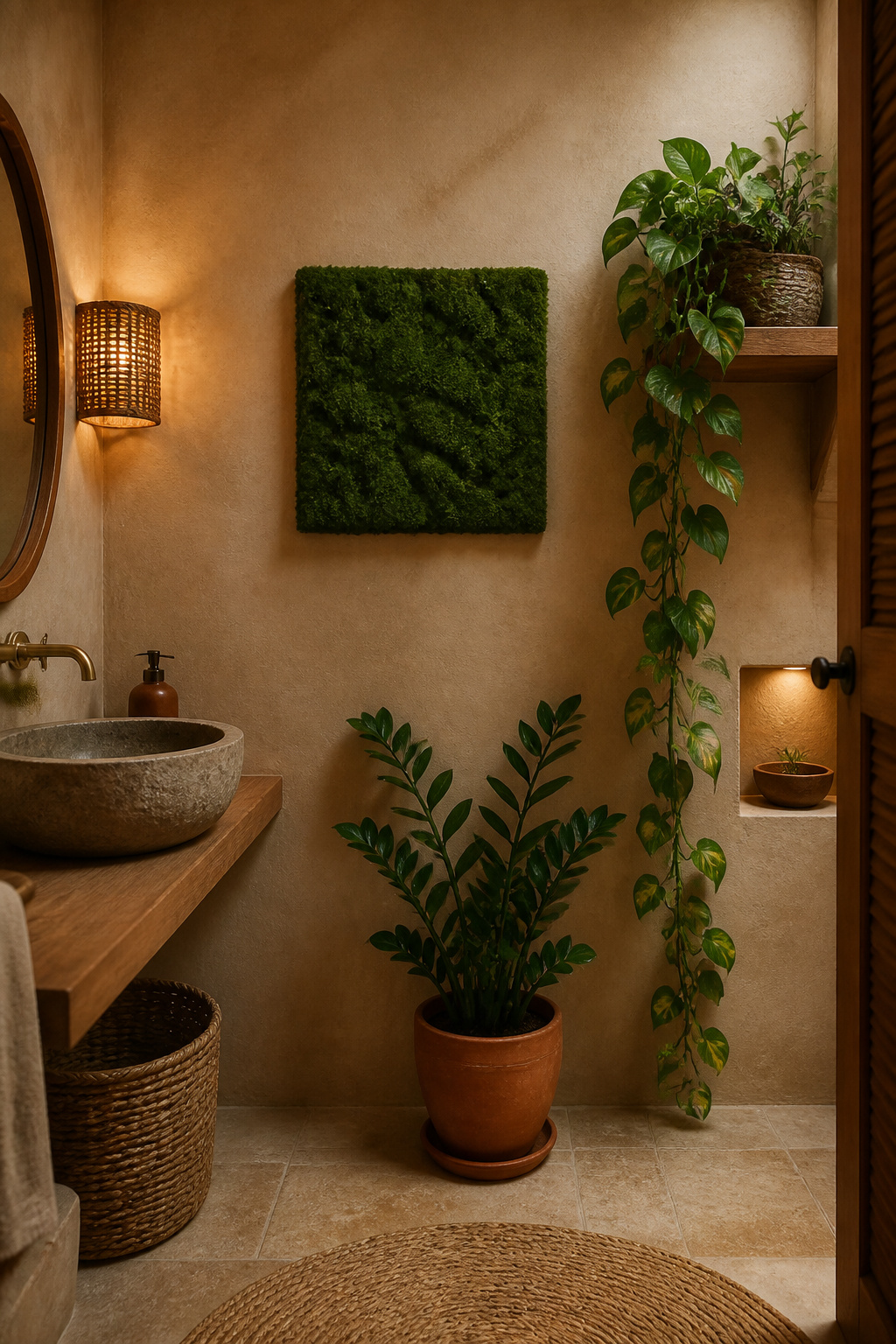
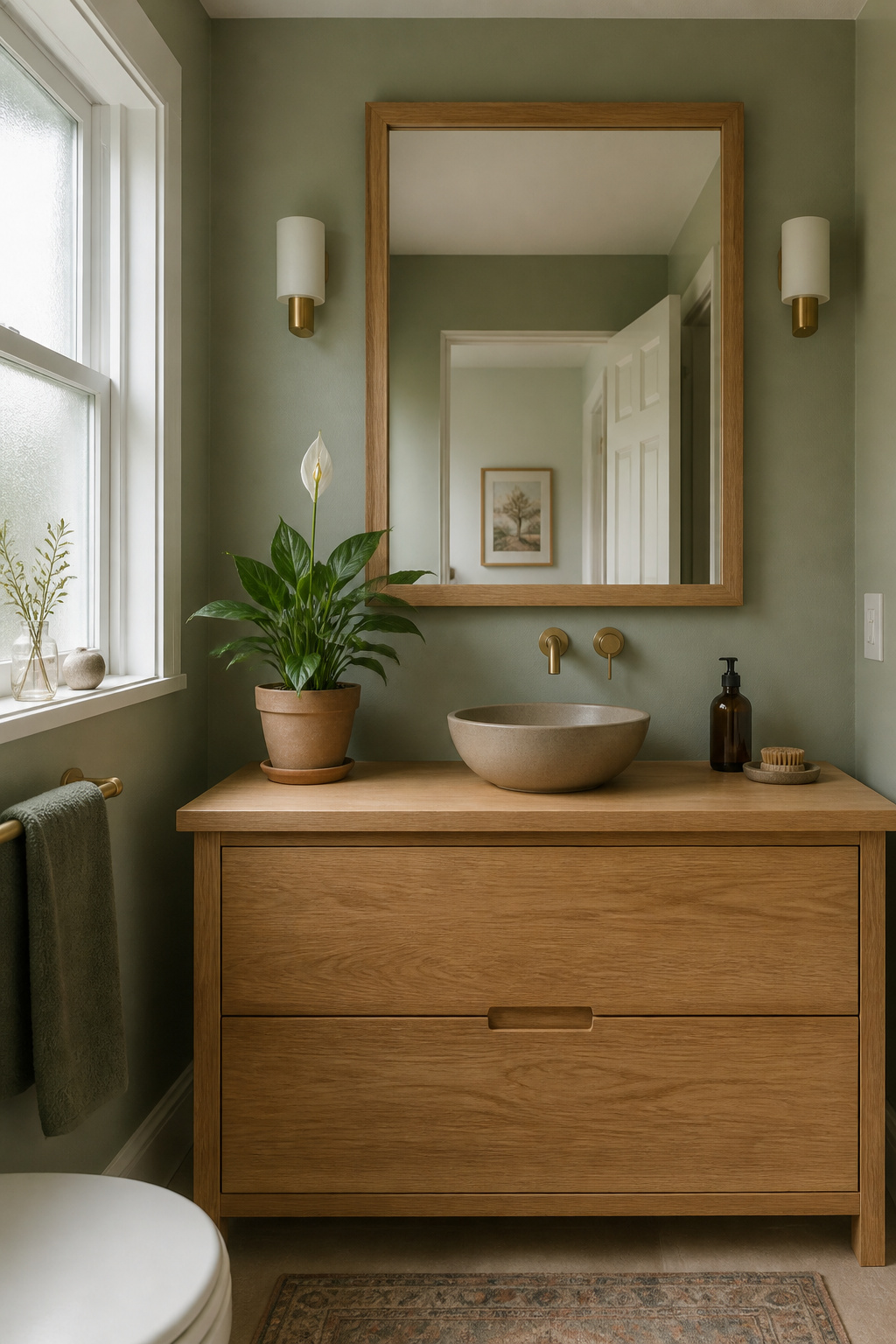
A bathroom is used twice daily at the moments when you’re most physiologically open to environmental influence — making it one of the best rooms in the house for biophilic investment. In a low-light, high-humidity small bathroom, pothos (Epipremnum aureum) is the most resilient plant: it tolerates near-darkness, thrives in moisture, and trails beautifully from a high shelf. Peace lily manages similar conditions and adds white blooms. ZZ plants and Boston ferns both handle humidity well; the ZZ plant’s glossy dark leaves contrast beautifully against plaster or stone.
For bathrooms with no natural light, or for those who prefer zero-maintenance greenery, preserved moss panels are worth serious consideration. Real moss stabilised with glycerine and natural dyes requires no watering, no light, no soil — but retains the visual and tactile quality of living moss. Source from suppliers using food-grade glycerine rather than solvent-based preservatives, which can off-gas in enclosed spaces. A 30×30cm panel on an accent wall shifts the room’s register toward the natural without competing for floor space.
For a wider range of mindful small bathroom inspiration ideas for calm spaces, including other biophilic and wellness-aligned decisions, there’s a lot of practical guidance in that collection.
10. A Frameless Mirror That Doubles Your Small Bathroom Design’s Perceived Depth
If there’s one change that consistently produces the most visible transformation in a small bathroom design, it’s replacing a small framed mirror with a full-width, ceiling-height frameless one. The mirror creates a reflected visual plane that the brain reads as a second room. Size this correctly — spanning the full vanity wall, running from countertop to ceiling — and the bathroom feels approximately twice as deep. Frameless edges remove the interruption of a frame, allowing the reflective surface to sit flush with the wall plane as though it were simply more space behind the glass.
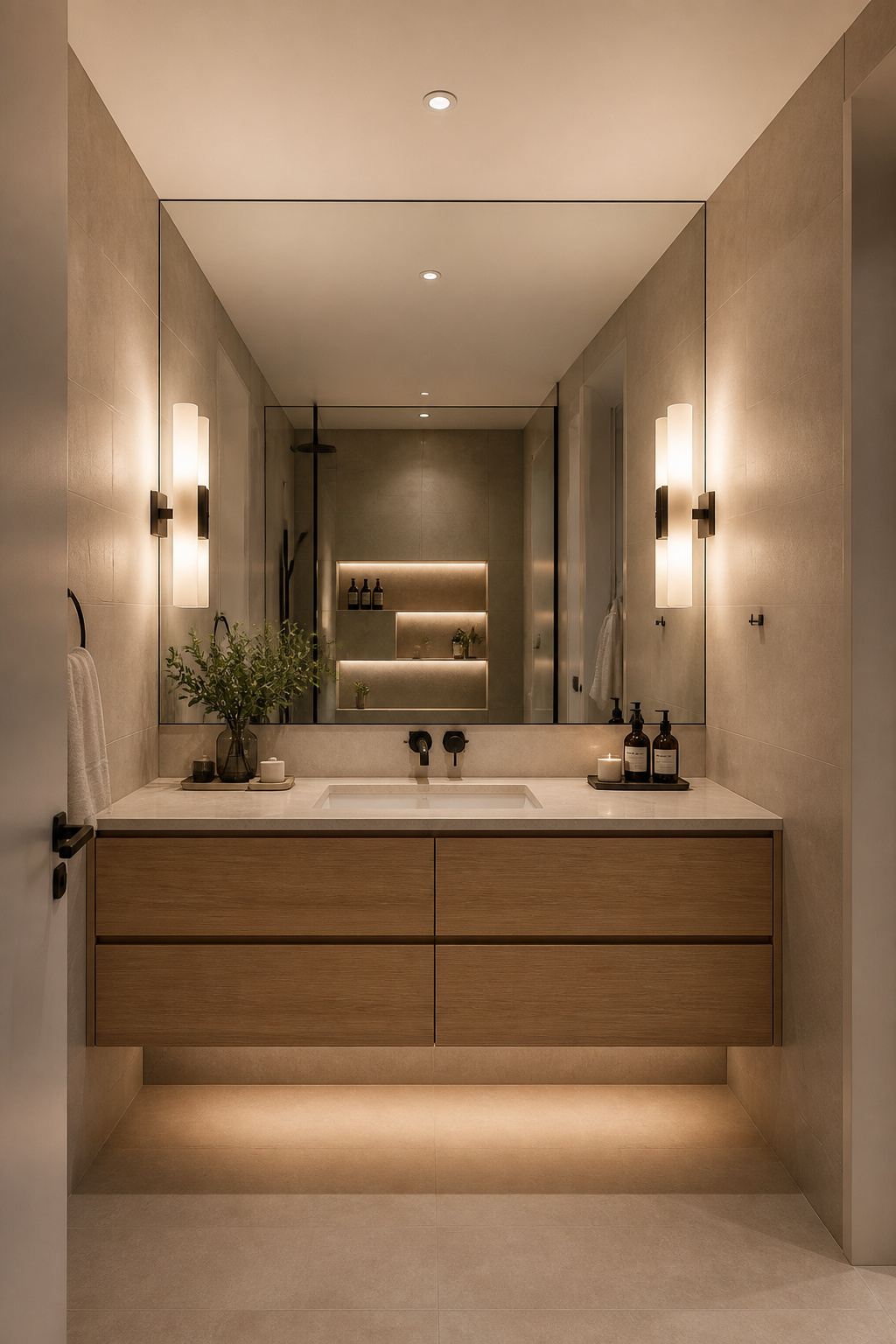
Width should match the vanity at a minimum. A mirror narrower than the vanity creates awkward proportions and leaves unmirrored wall space that actively reinforces a sense of smallness. Extending from countertop to ceiling removes the visual weight of blank wall above and maximises the height of the reflected space. In very tight bathrooms — 1.5m wide or less — running the mirror wall-to-wall is transformative: the perceived width doubles, and the floor plane reads as seamless in both directions.
Anti-fog options are worth planning at the installation stage rather than retrofitting. Demister pads are ultra-thin self-adhesive heating foils that fix to the back of any mirror, applying just enough warmth to prevent condensation on the glass surface. Wired pads connected to the bathroom lighting circuit are the most reliable option; plug-in versions are less consistent in high-humidity environments. UK Building Regulations require 15 litres per second continuous extraction or 60 l/s intermittent — the minimum for compliance, and also a useful reminder that a mirror that stays clear is a sign of a well-ventilated bathroom.
11. Wabi-Sabi Plaster Walls That Celebrate the Small Scale
The philosophy of wabi-sabi — finding beauty in imperfection, transience, and incompleteness — might seem abstract as a design directive. Applied to a small bathroom, though, it reframes everything. The plaster wall that shows the subtle variation of a hand-applied finish is not imperfect; it’s alive. The narrow room that cannot accommodate a double vanity is not deficient; it’s intimate. Wabi-sabi asks you to stop compensating for the small scale and instead design into it — to treat tight proportions as the condition that makes material quality and precision genuinely matter.
Choosing the Right Plaster for Wet Areas
Tadelakt is the most compelling material expression of this philosophy. An ancient Moroccan lime plaster polished with smooth river stones and sealed with olive soap, it’s naturally waterproof — no grout, no tile joints — and deeply beautiful in the way handmade things carry beauty. Applied by a skilled plasterer, it covers shower walls and wet-area floors as a single seamless surface, eliminating the visual grid of grout lines entirely. Venetian plaster produces a similarly luminous layered finish but is not waterproof; it should not be used in direct water contact. Microcement — a thin-set cement polymer applied in 2-3mm layers — is more accessible and can go over existing tiles without demolition, making it the practical choice when full wet room construction isn’t possible.
Colour palette in a wabi-sabi small bathroom runs warm: aged bone whites, sandy putties, pale sage, warm grey-greens. These tones absorb natural light softly rather than reflecting it harshly, and they interact with moisture and steam in ways that synthetic paints rarely match. Deeper tones — warm terracotta, aged olive, mushroom — work beautifully with generous natural light, creating the enclosed quality that a small room can deliver more convincingly than a large one.
12. A Ceiling-Height Shower Niche as Storage Without Visual Weight
Where the standard shower niche serves a single stud bay at shoulder height, a tall niche running from mid-wall to near the ceiling does something more interesting: it draws the eye upward in the same way a floor-to-ceiling mirror does, reinforcing perceived ceiling height while providing the storage equivalent of a freestanding shelving unit. A niche 300mm wide and 1600mm tall holds towels, skincare, and bathroom accessories at a scale that eliminates the need for any separate storage furniture — without projecting into the room at all.
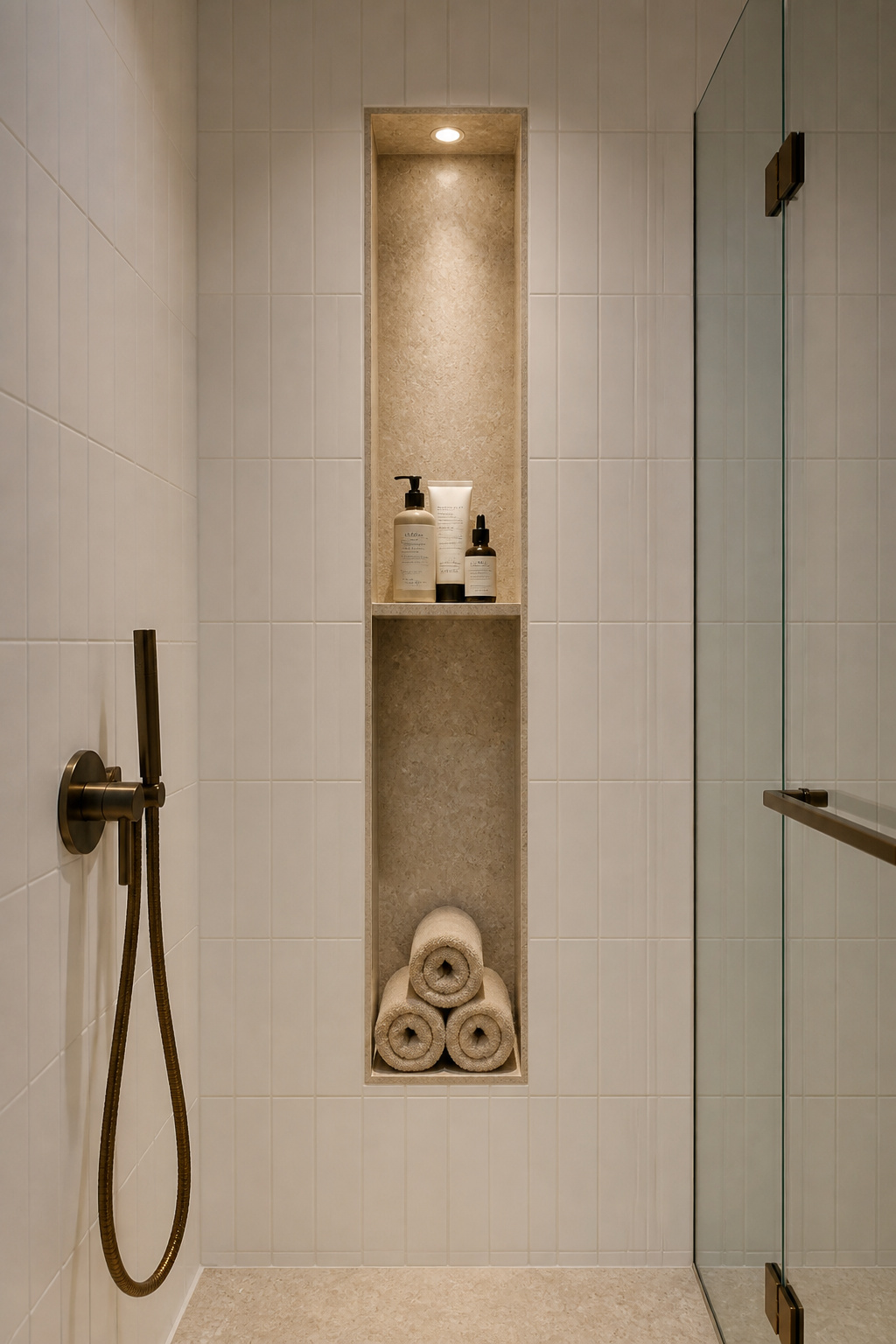
Building this into a full remodel means modifying the framing: horizontal blocking inserted between studs at the top and bottom of the opening, with cut studs supported by a header above. During construction it’s straightforward; retrofitting after tiling is significantly more involved. For rental properties or smaller interventions, surface-mounted recessed-look products exist in tile and stone finishes — they project 2-3 inches from the wall but create a convincing recessive visual. Key consideration: niches in non-plumbing walls are uncomplicated; planning around pipes in a wet wall requires careful marking and usually a pipe detector.
The deeper principle here is worth stating directly: bathroom surfaces accumulate clutter almost faster than any other surface in the home, and visual clutter elevates cortisol in measurable ways. The wellness bathroom operates on a clear discipline — countertops hold only what is used daily; everything else lives behind a door or inside a niche; products not used in two weeks live elsewhere. A tall niche makes this discipline sustainable, because it provides the storage capacity to honour it without being ruthless. Keep the niche depth at 100-120mm wherever framing allows — the standard 75mm between studs doesn’t hold a full-size shampoo bottle upright.
13. An Earthy Tonal Palette to Make Small Bathroom Spaces Feel Whole
The visual fragmentation of a small bathroom — walls in one tone, floor in another, vanity in a third, fixtures in a fourth — creates the same spatial effect as too many grout lines on the floor: the eye is continually interrupted, each boundary reinforces the sense of separate small zones, and the room feels cramped regardless of its actual dimensions. Tonal dressing removes these interruptions. When walls, floor, vanity, and accessories share a colour family, small bathroom spaces read as a single cohesive volume, and that perception changes everything.
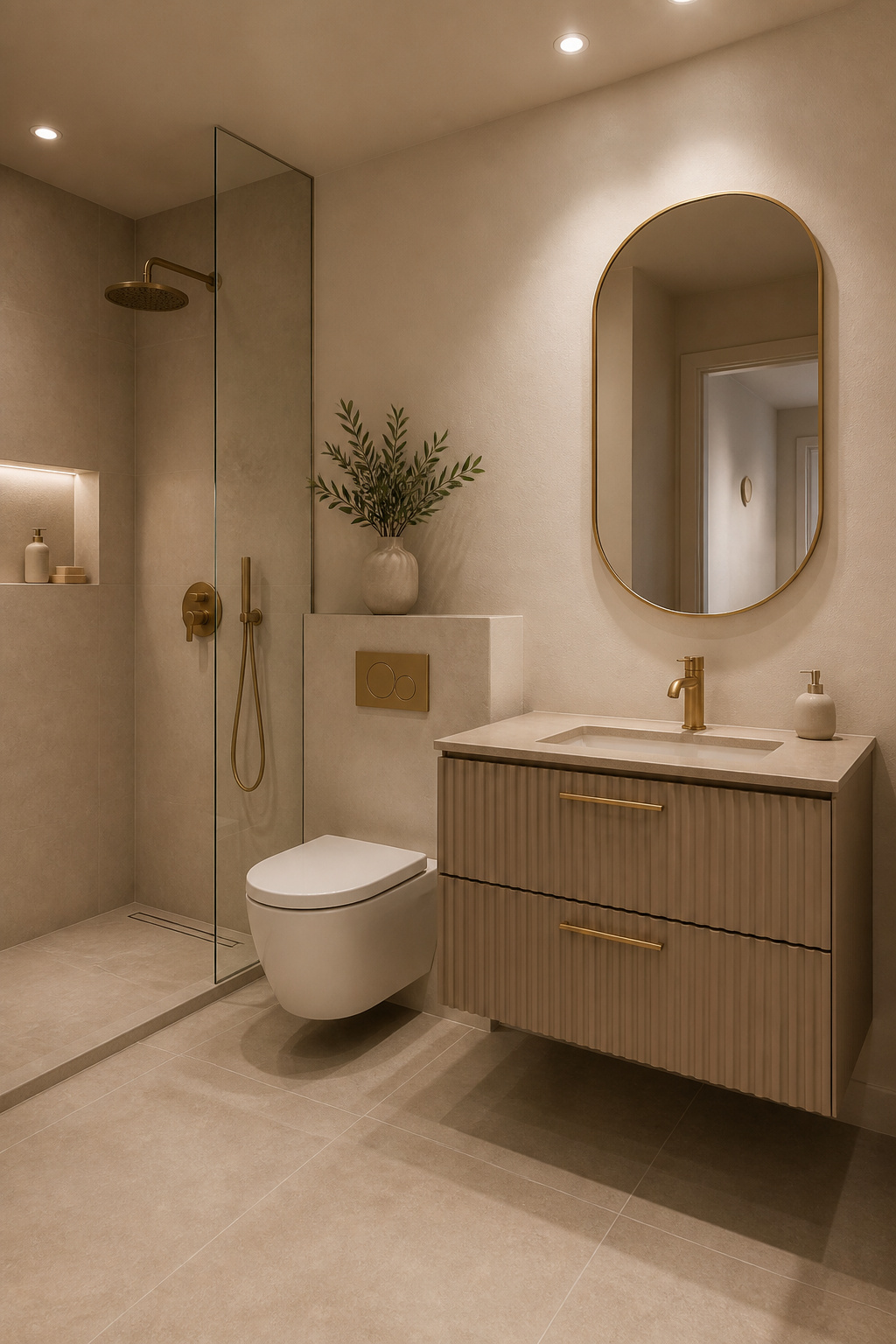
An earthy palette adds the wellness benefit of colour psychology on top of the spatial gain. Earth tones — warm ochres, sandy greiges, muted sage greens — lower cortisol and create the conditions for groundedness and calm. Environmental psychology research consistently shows that exposure to earth-tone spaces produces lower physiological stress responses than cool or highly saturated environments. The brain’s evolved response to natural horizon tones signals safety. In practice, a warm greige on walls with a slightly deeper mushroom tone on the vanity and stone-toned floor tiles in the same family creates a cohesive palette without monotony.
For specific paint choices: Farrow & Ball’s ‘Dead Salmon’ and ‘Joa’s White’, Little Greene’s ‘Slaked Lime Dark’, and Earthborn Claypaint’s ‘Linen’ are all widely used in wellness bathrooms, each available in bathroom-rated low or zero-VOC formulations. The most common error is choosing paint under showroom lighting and finding it reads very differently in the bathroom. Test sample boards in the actual room under your actual artificial light — earthy tones are particularly sensitive to colour temperature shifts and can read yellow-beige under 2700K when they appeared to be a true warm mushroom in the shop. For more on the principles that support this approach to calm, there’s a lot of practical guidance on tonal dressing in this collection on minimalist bathroom design.
14. Non-Toxic Finishes for a Healthy Small Bathroom Interior
A bathroom is a small, often poorly ventilated room that gets hot and humid twice a day. These are ideal conditions for off-gassing — the gradual emission of volatile organic compounds from finishes, adhesives, and sealers. Standard MDF cabinetry uses urea-formaldehyde binders that release continuously and concentrate in enclosed spaces. Conventional bathroom paints contain biocides to resist mould, along with preservatives that become more active as temperature and humidity rise. This is the chemical reality of a conventional small bathroom interior that most design guides overlook entirely.
Non-Toxic Alternatives That Are Now Cost-Competitive
The alternatives are widely available. For paint: zero-VOC bathroom formulations cure free of formaldehyde, preservatives, and hazardous air pollutants. In the UK, Earthborn Claypaint and Auro Natural Paints offer bathroom-rated zero-VOC options; in the US, ECOS Paints provides a certified zero-VOC bathroom range. For cabinetry: CARB Phase 2-compliant or E0/E1-certified solid wood or plywood-core construction is the benchmark to specify. The search phrase “formaldehyde-free cabinet construction” will find the right manufacturers. For tile sealers: mineral-based penetrating sealers that are silicone-free and solvent-free protect natural stone without the off-gassing associated with solvent-based topcoats.
Ventilation is structural, not optional. UK Building Regulations Part F requires 15 litres per second continuous extraction or 60 l/s intermittent — the legal minimum. A mechanical ventilation and heat recovery (MVHR) unit is worth taking seriously: it provides continuous fresh air at room temperature, removes moisture and VOCs without heat loss, and is the most effective single air quality intervention available for a sealed small bathroom. For those who find this approach helpful, these modern bathroom ideas built around wellness design principles address non-toxic finishes alongside layout, lighting, and material choices in a cohesive framework.
15. Narrow-Profile Fixtures That Reclaim Every Centimetre of Floor Space
Sanitaryware has changed significantly in the past decade, driven largely by the growth of small-space living. A floor-mounted close-coupled toilet typically projects 680-720mm from the wall; a wall-hung WC with a concealed cistern projects only 350-480mm. That 200-350mm saving is transformative in a bathroom where total room depth may be as little as 1800mm — it’s the difference between a layout that functions comfortably and one that feels like a narrow corridor.
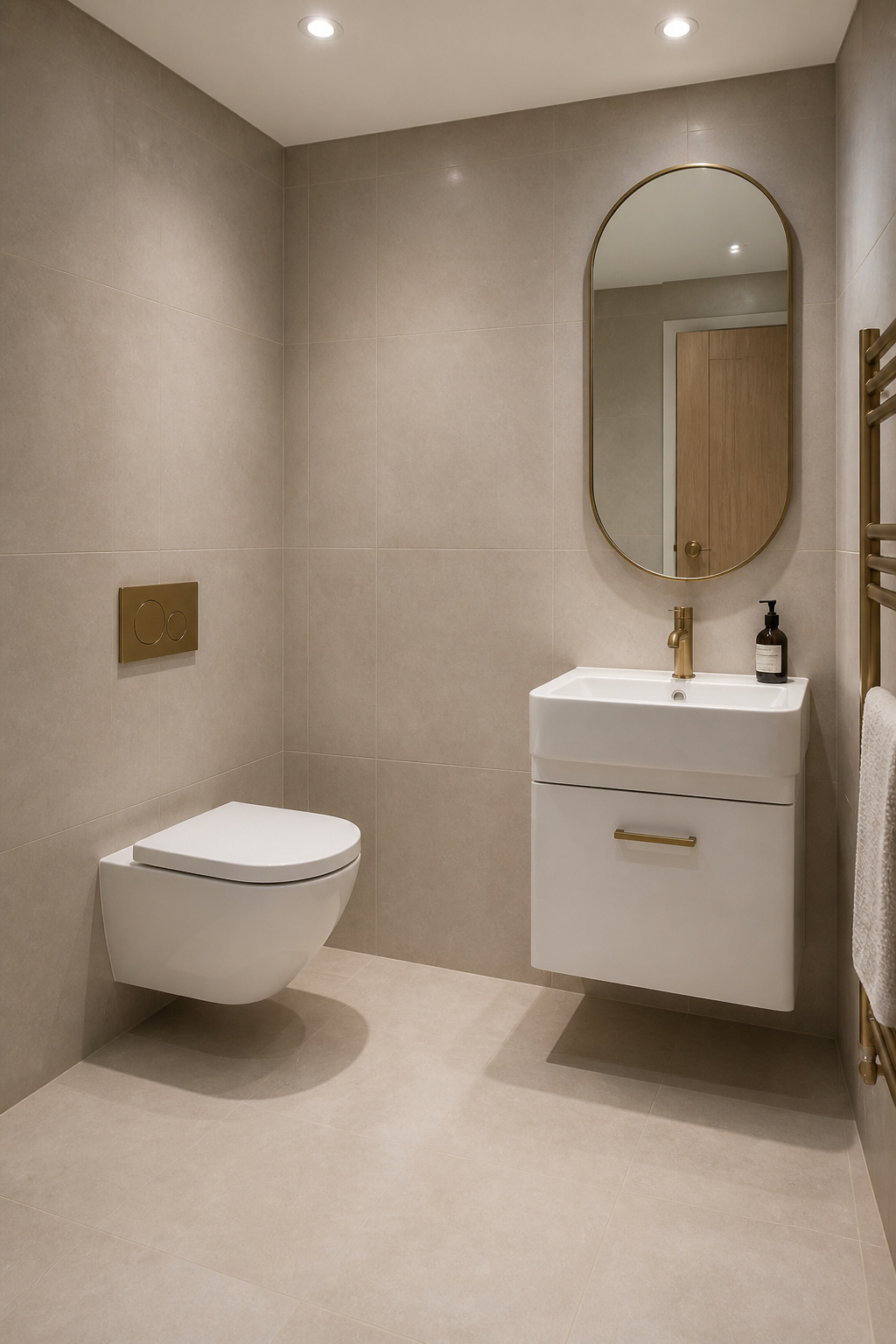
Wall-hung toilets also make the floor continuous beneath them, contributing to the visual openness that a floating vanity creates at the other end of the room. Height is fully adjustable during installation — typically 380-500mm from floor to top of pan — making them significantly better for accessibility and aging-in-place. Installation requires a concealed cistern carrier frame from Geberit, Ideal Standard, or Valsir, housed inside a partition wall of at least 200mm depth. This framing works best planned at the design stage rather than retrofitted, as it affects where services run and how the wall is finished.
Slim shower trays at 25-35mm depth allow step-in access without a threshold, maintaining the visual continuity at floor level that a doorless shower requires. Back-to-wall or semi-recessed basins reduce counter depth to 350mm versus the standard 550mm — another 200mm reclaimed in a tight layout. Wall-mounted basin taps plumbed directly into the wall free the countertop entirely. Recessed accessories — paper holder, soap dispenser, robe hooks — require only 60-80mm of wall depth and add nothing to the room’s visual footprint. The principle across all these choices is identical: every fixture dimension that can be reduced, should be. One installation note worth emphasising: a wall-hung WC carrier frame carries the full weight of the user and must be correctly anchored. Hire a qualified plumber for this part of the project.
Choosing the Right Small Bathroom Interior Style for Your Home
The most useful question before any change: what is this bathroom’s actual limiting factor? Not all small bathroom interiors are small in the same way.
A narrow, deep bathroom gains most from depth-saving fixtures — wall-hung WC, back-to-wall basin, doorless shower. Every reclaimed millimetre of wall projection changes daily usability. A low-ceilinged bathroom benefits most from vertical tile and floor-to-ceiling frameless mirroring — two relatively low-cost changes that work immediately and visibly. A dark bathroom with no natural light needs layered warm lighting and biophilic elements before anything else; without these, spatial tricks feel hollow regardless of the tile choice.
For renters or tighter budgets: replace existing bulbs with warm-white 2700K dimmable equivalents, add a wall-to-wall frameless mirror above the vanity, introduce two resilient plants, and keep only what you use daily on any surface. These four changes cost under £150 combined and alter the room’s atmosphere more than most surface-level renovations.
For a full renovation, the sequence matters: structure first — tanking, carrier frames, niche framing — then fixtures and sanitaryware, then tiling, then plaster or paint, then lighting, then vanity, then accessories. In a small bathroom interior, every decision affects every other one. Plan the whole before committing to any part of it.
The goal isn’t to disguise the scale. It’s to inhabit it completely — with intention, and with materials that support you every morning and every evening for years to come.