There is a moment — usually around the third or fourth candle you’ve lit trying to fix an underlit dining room — when you realize the problem isn’t the candles. It’s the fixture. Contemporary dining room lighting has quietly become one of the highest-impact design choices in a home, because it shapes not just how a room looks but how the people in it feel. Light temperature affects stress levels. Food appears more or less appetizing depending on color rendering quality. The right dimming range can shift the same table from a homework surface at 4pm to a dinner party setting at 7pm.
The difference isn’t expensive. It’s intentional. Over the past decade working with clients on wellness-focused spaces, I’ve come to think of dining room lighting as the silent host — it sets tone, supports connection, and makes everything on the table look better. These 18 ideas span the full spectrum from sculptural statement pieces to layered budget-conscious systems, with the science of light quality woven through each one.
1. Linear Suspension Pendants Above a Long Dining Table
A linear pendant over a rectangular dining table is one of those pairings that makes sense the moment you see it. The fixture mirrors the table’s proportions — long, horizontal, purposeful — and in open-plan spaces it defines the dining zone without requiring a wall or a ceiling partition to mark the boundary. It is also the most practical contemporary dining room lighting choice for anyone working with a table longer than 60 inches, since a round chandelier at the correct diameter for a long table becomes too large for the room.
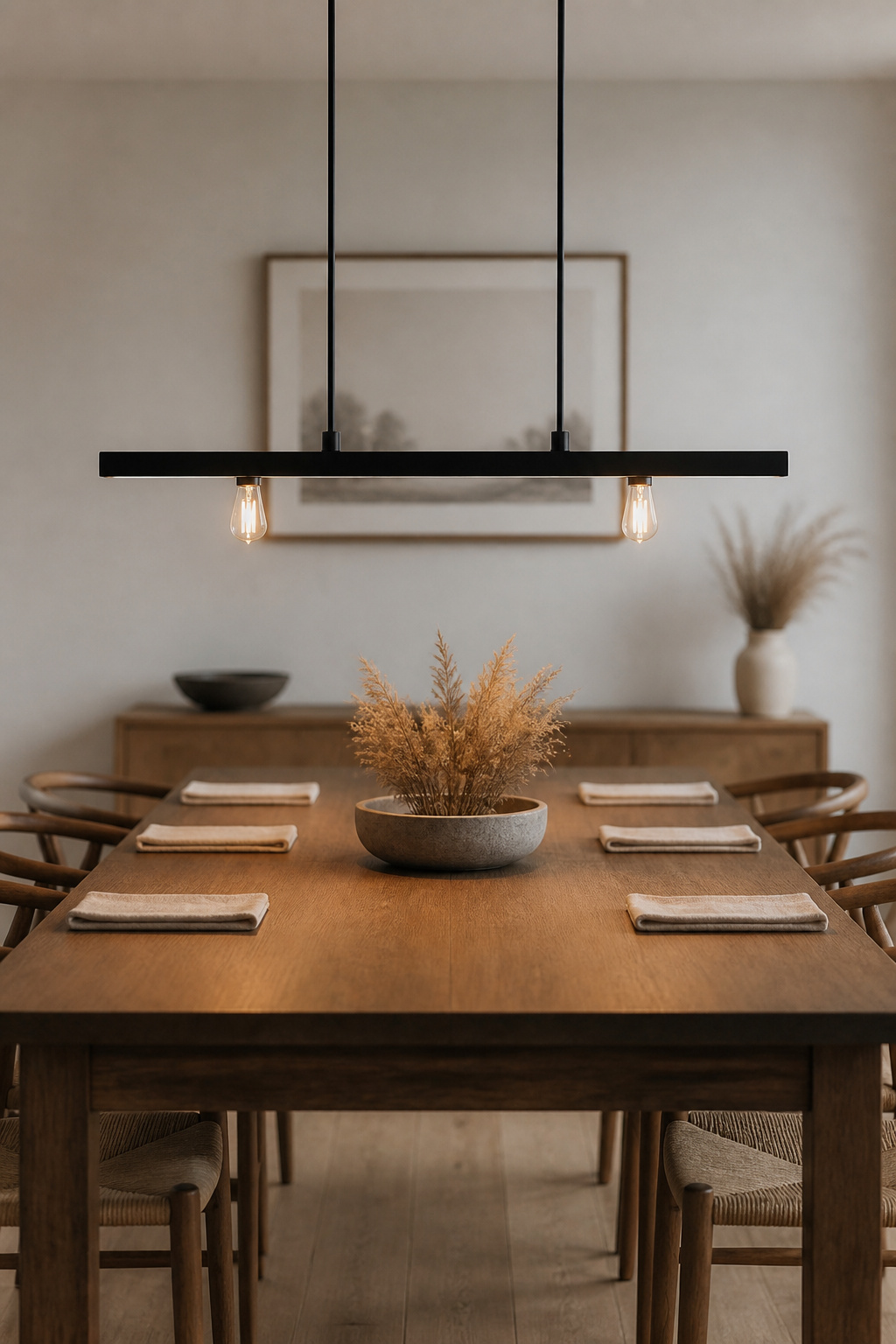
Sizing is more forgiving than most people expect. Length should fall between one-third and one-half the total table length: for a 72-inch table, choose a linear fixture between 24 and 36 inches long. Go shorter and the fixture looks undersized; go longer and it crowds the visual field above the table. Width matters too — the fixture should sit at least 12 inches inside the table edge on each side, so guests can stand without colliding with the hardware.
Hanging height is 30-36 inches from the tabletop to the bottom of the fixture for standard 8-foot ceilings, with 3 additional inches for every ceiling foot above that. Matte black and brushed brass are the leading finishes for 2026; both read clean against white or wood ceilings without visual competition. For anyone exploring modern dining room ideas for open-plan spaces alongside this fixture choice, a linear pendant often ties an open-plan layout together more effectively than a chandelier.
2. Contemporary Dining Room Lighting With Exposed Filament Bulbs
The exposed filament bulb has been in the contemporary design conversation long enough that you might expect it to feel dated by now. It doesn’t — because it works. The bare filament suspended in glass is both the fixture and the feature, and at 2200K-2400K the warmth it delivers sits close to candlelight without the flicker. That color temperature is the biological sweet spot for evening relaxation: intimate enough to slow the pace of a meal, bright enough to see clearly across the table.
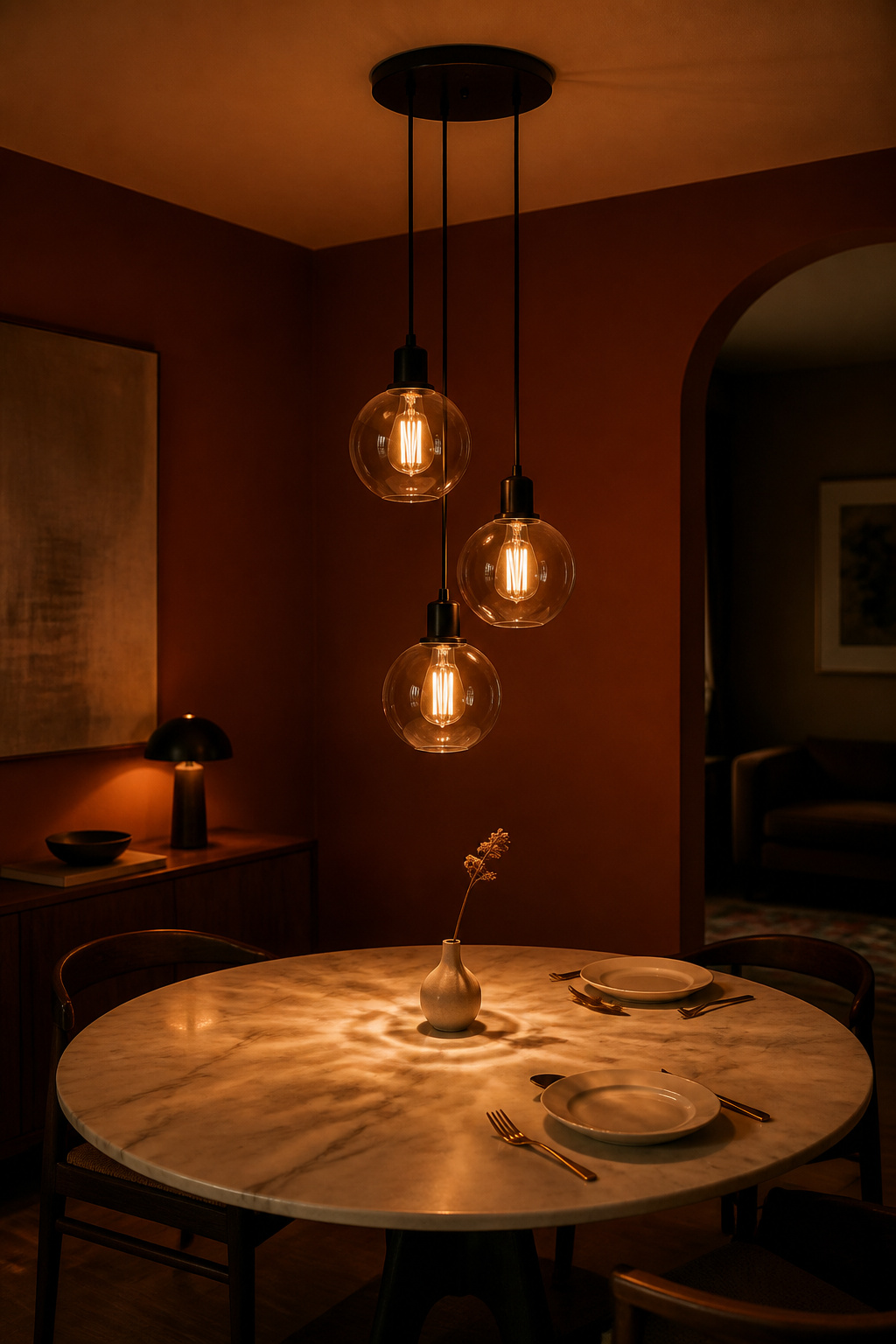
The material shift that saved the exposed bulb from trend fatigue was LED technology. A quality LED filament bulb at 2200K uses 4-6 watts to replace a 40-watt incandescent — a 90% reduction in energy use that matters considerably when running three, five, or seven bulbs in a cluster pendant. The critical variable is CRI: look for CRI 95 or above from brands like Waveform Lighting, Yuji, or Satco. Budget LED filaments at CRI 80 have a greenish tinge at low dim levels that makes food look flat and skin tones sallow — exactly the opposite of what a dining room light should do.
For multi-drop configurations, staggered heights create more interest than uniform ones: three drops at 20, 26, and 32 inches above the table reads as artisan and relaxed. Five uniform drops reads more formal. In rooms with ceilings under 9 feet, limit clusters to three drops — more than that at low ceiling height creates visual crowding. The same warm-bulb principles apply to kitchen lighting fixtures with exposed bulb styles elsewhere in the home, where CRI and color temperature matter just as much.
3. Sculptural Chandeliers as Functional Dining Room Statement Pieces
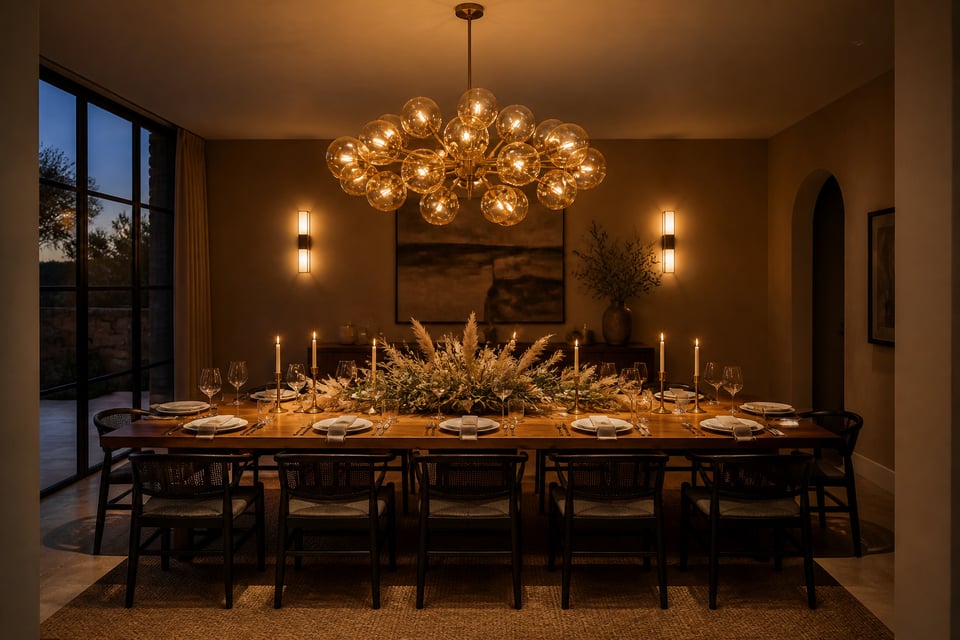
What separates a contemporary chandelier from a traditional one isn’t always obvious at first glance — but the difference is fundamental. Traditional chandeliers use symmetrical candle-style arms, crystal drops, and tiered structures that reference ballrooms and formal European dining. Contemporary chandeliers are about material and form: a single blown glass globe, a geometric wire frame, an asymmetric arrangement of poured concrete discs. The fixture functions as art as much as illumination, and its visual impact at zero light is as deliberate as its effect when lit.
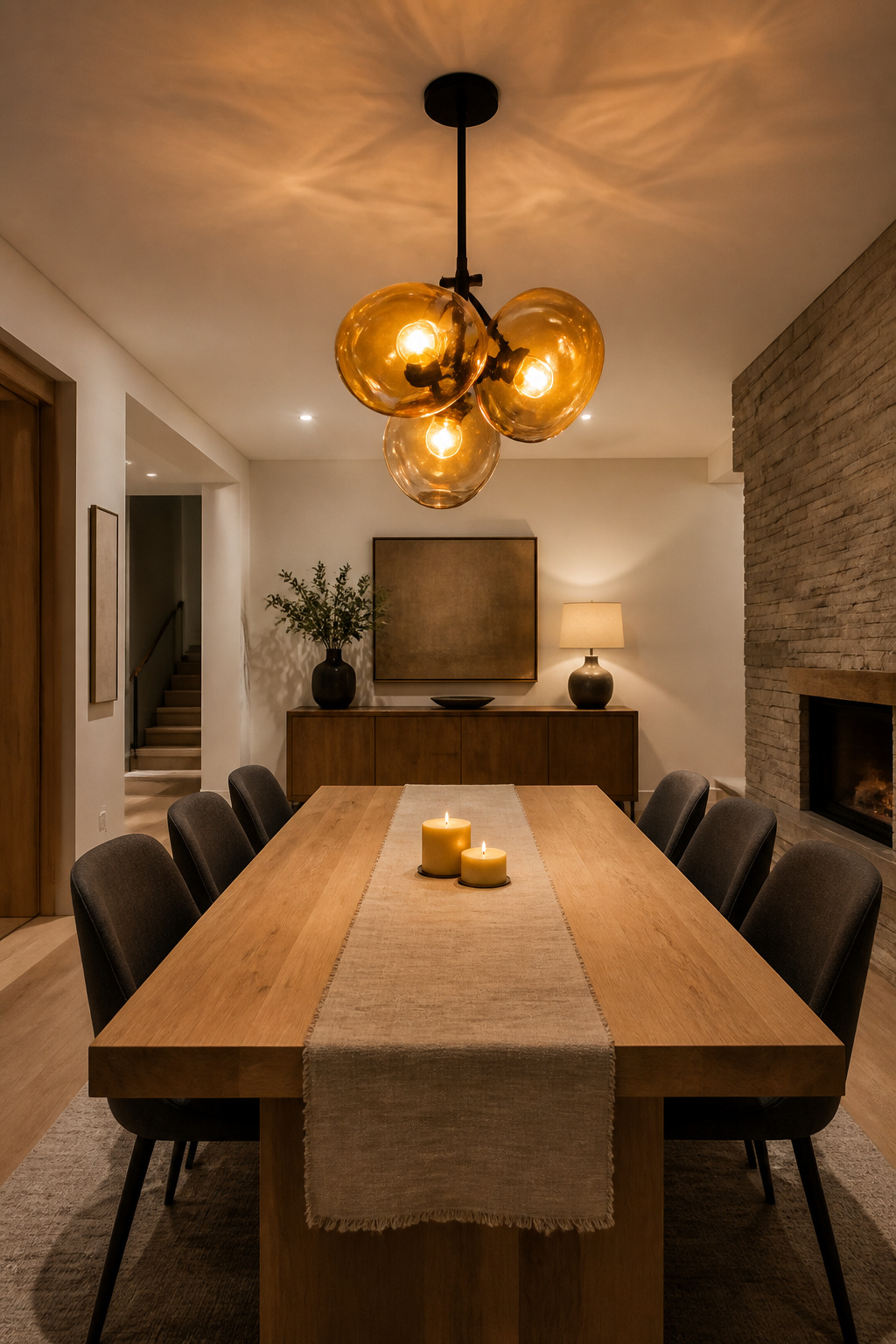
Sizing is where many people go wrong with this contemporary dining room lighting approach. The room-based formula — add room width and length in feet to get the minimum fixture diameter in inches — is a starting point: a 12 by 14-foot room calls for a 26-inch chandelier. But verify against the table: diameter should fall between one-half and two-thirds the table width. A 48-inch wide dining table works with a 24-32 inch chandelier. When the two formulas conflict, favor the table size rule.
Materials tell the story of the current chandelier market: hand-blown glass globes range from $400 (mass-produced) to $4,000+ for studio-blown pieces. Raw steel and blackened iron pair with exposed brick and concrete surfaces. Woven rattan cord chandeliers run $150-$600 and offer visual lightness and genuine sustainability. The dining room decorating ideas that complement statement fixtures depend on which material direction you choose, since each reads differently against wood, stone, or painted walls.
4. Dimmable LED Systems for Mood-Adaptive Dining Light
The most underappreciated quality of a dining room is its need to serve multiple moods across a single day. A homework table at 4pm needs clarity and brightness. A family dinner at 6:30pm benefits from warmth and about 70% brightness. A dinner party at 8pm needs 40-50% — low enough to feel deliberately intimate, bright enough that guests don’t feel like they’re eating in a restaurant that’s also saving electricity.
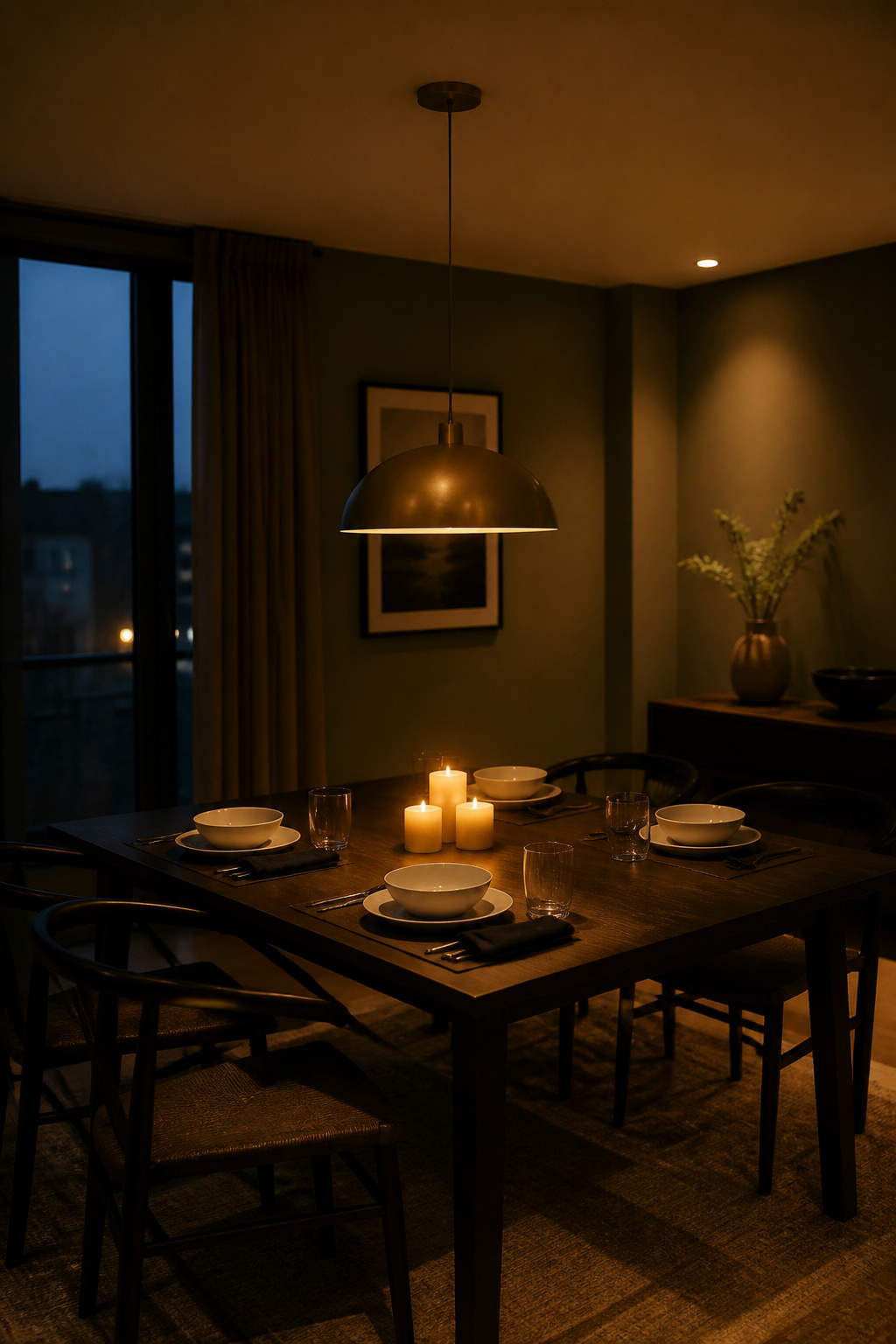
A dimmable LED pendant handles all three scenarios without any fixture change. The variable most people miss is the dimmer itself. Standard leading-edge (forward-phase) dimmers — the cheap ones at the hardware store — chop the front of the AC wave in a way that can damage LED driver electronics over time, causing the flickering and buzzing that makes people regret switching from incandescent. Trailing-edge (reverse-phase or ELV) dimmers are the correct choice for LEDs: they trim the back of the wave instead, operate silently, and prevent voltage spikes. Lutron Caseta wireless dimmers are the most-specified residential choice — no neutral wire required, compatible with most LED fixtures, and controllable by app or voice.
One circuit running a pendant often isn’t enough. A second circuit for recessed perimeter lights — controllable independently — gives the room its full range. At family dinner: pendant at 75%, recessed at 30%. At a dinner party: pendant at 45%, recessed off. The electrician cost for a second circuit runs $200-$400 as a one-time investment, and it changes what the room can do permanently. CRI 90 minimum on any bulb: below that threshold, food looks less appetizing at a level that registers subconsciously even when guests can’t name why.
5. Mixed-Metal Dining Room Light Fixtures for a Curated Look
The rule that all metal finishes in a room must match was a product of a specific moment in interior design — early 2000s showroom aesthetics that prioritized control over character. That moment is over. In 2026, the dominant design preference is for a layered, collected quality that reads as lived-in rather than assembled. Mixed metals in contemporary dining room lighting are central to that shift.
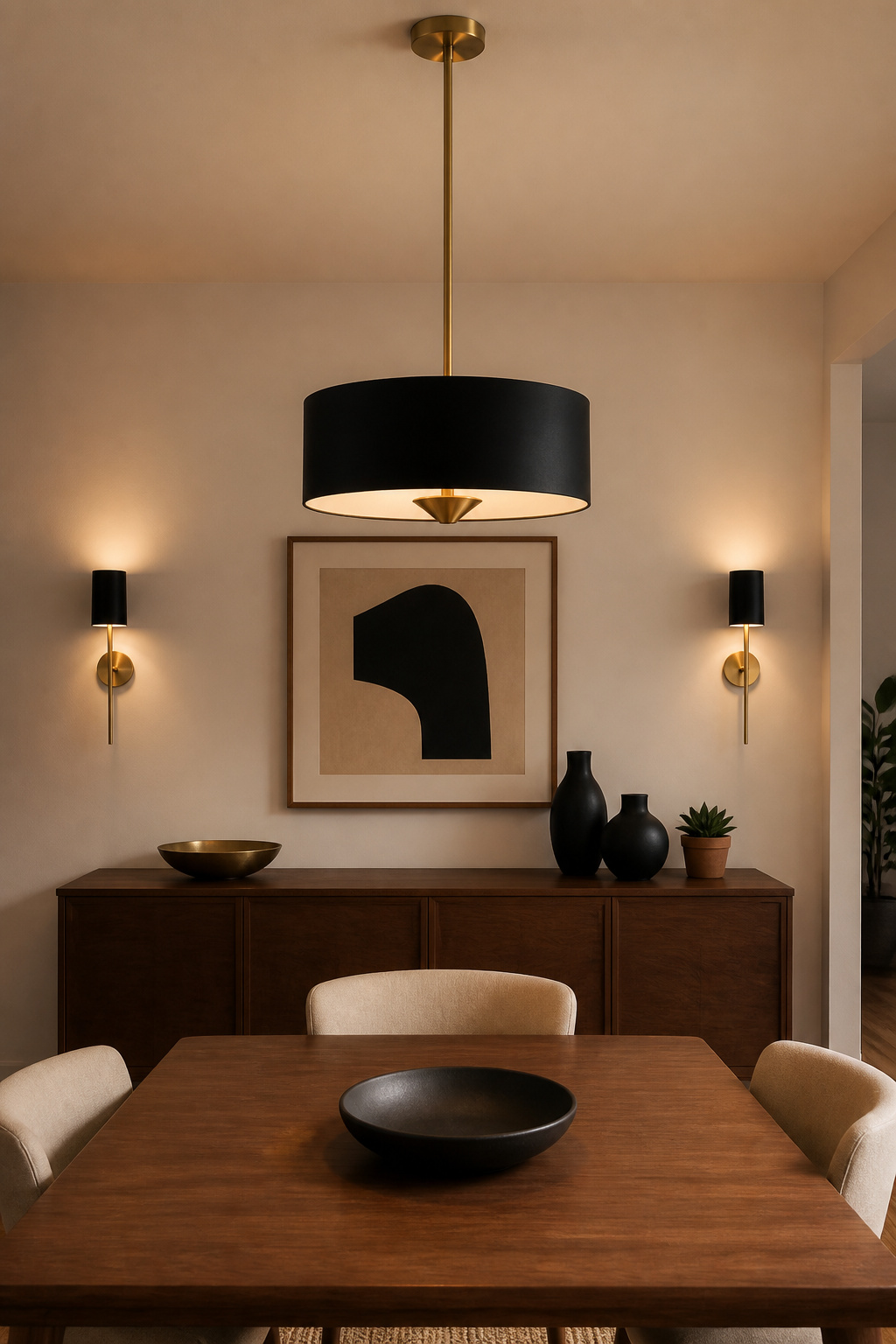
The specific combination driving most dining rooms right now is warm brass plus matte black — a pairing that works because the contrast is tonal rather than clashing. Warm brass sits in the amber register; matte black absorbs rather than reflects, which neutralizes the contrast before it tips into conflict. Aged bronze and polished nickel are the subtler alternative: both sit in the mid-warmth range and carry a quality of having been somewhere, creating depth without drama.
The practical key is a dominant finish — one that appears in the largest fixture and repeats in at least two other elements. If the pendant is brass, that finish should reappear in cabinet hardware, the lamp base on the sideboard, or chair leg caps. Two-tone fixtures from brands like Visual Comfort and Cedar & Moss do the mixing internally, removing the coordination burden entirely. To modernize your dining room with thoughtful material choices this way, you don’t have to source every element separately — one well-chosen two-tone pendant does most of the work.
6. Statement Globe Pendants Over a Round Dining Table
Round pendant, round table: it is a pairing that works because the visual logic is self-evident. A circular fixture mirrors the circular table beneath it, and the eye finds the repeated geometry satisfying in the same way it finds aligned patterns satisfying. Globe pendants are also one of the most versatile expressions of contemporary dining room lighting — they work in almost every aesthetic from Japandi minimal to relaxed coastal.
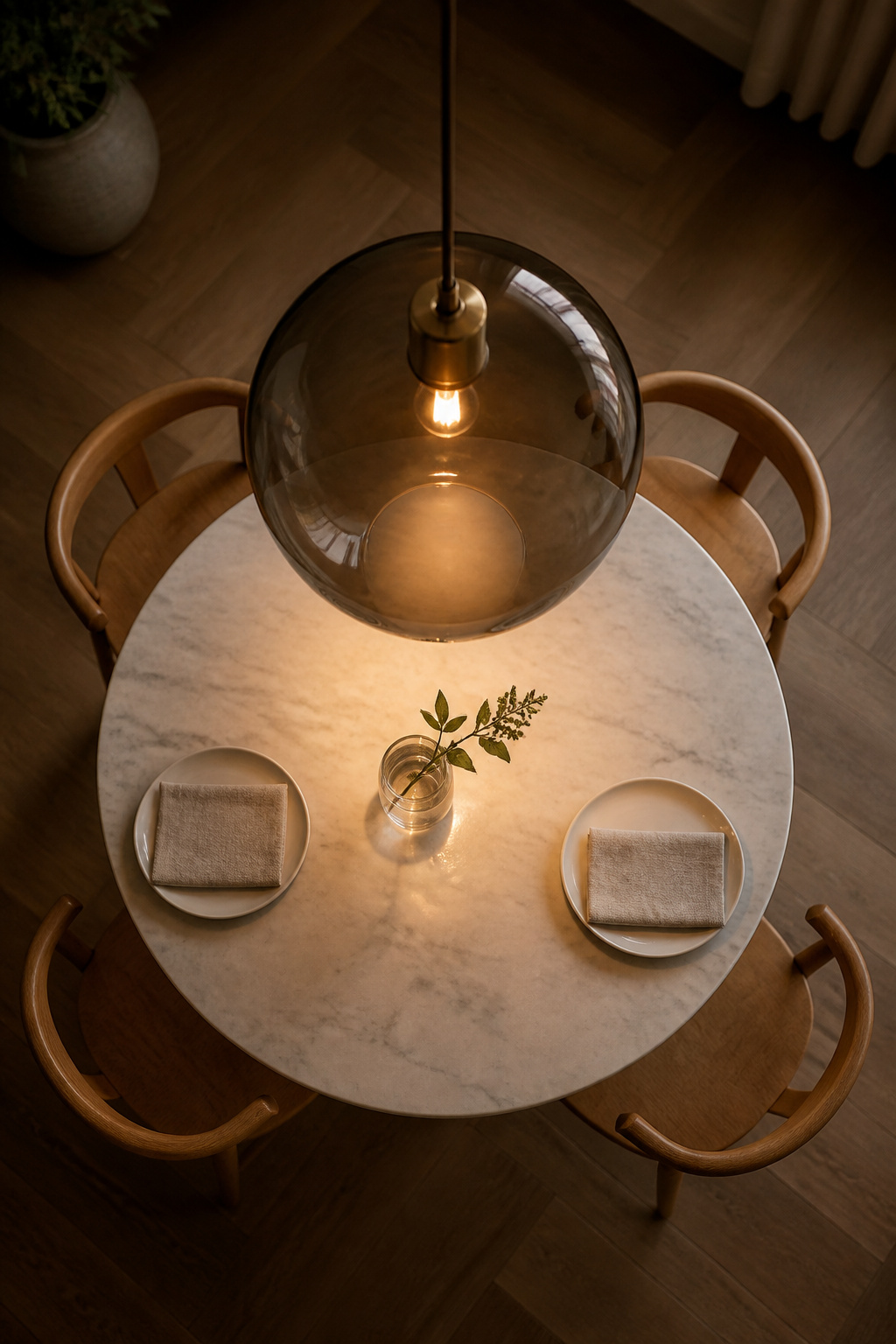
Globe pendants offer a useful range of glass types that each produce a distinct atmosphere. Clear glass maximizes light output and shows the bulb — works best with a decorative LED filament that looks good unlit as well as lit. Smoked glass reduces light output by 20-30% while adding visual depth and a slight amber filter; it is the most atmospheric of the options, but may require a higher-wattage bulb to maintain adequate table illumination. Ribbed or fluted glass scatters light in directional rays that create shadow patterns on the ceiling — a dynamic quality that flat glass cannot produce.
For sizing, a single globe over a 36-inch round table should measure 16-20 inches in diameter. At that scale the fixture has genuine presence without blocking sightlines across the table. A cluster of three 6-8 inch globes at varied heights achieves similar visual mass with more movement — better suited to larger tables or open-plan spaces where the cluster needs to read from a distance. Schoolhouse Electric, West Elm, and CB2 cover this market at $80-$400 for single fixtures; the quality difference between them is most visible in the glass uniformity and the weight of the hardware.
7. Contemporary Dining Room Lighting With Cove and Recessed Layers
A single pendant over a dining table is the starting point, not the endpoint. It provides ambient light at table level but does little for the room’s walls, ceiling, or corners — the room feels like a lit island surrounded by relative darkness. Cove and recessed lighting fill that void without announcing themselves. This is contemporary dining room lighting thinking at its most sophisticated: the system serves the space without any single element dominating.
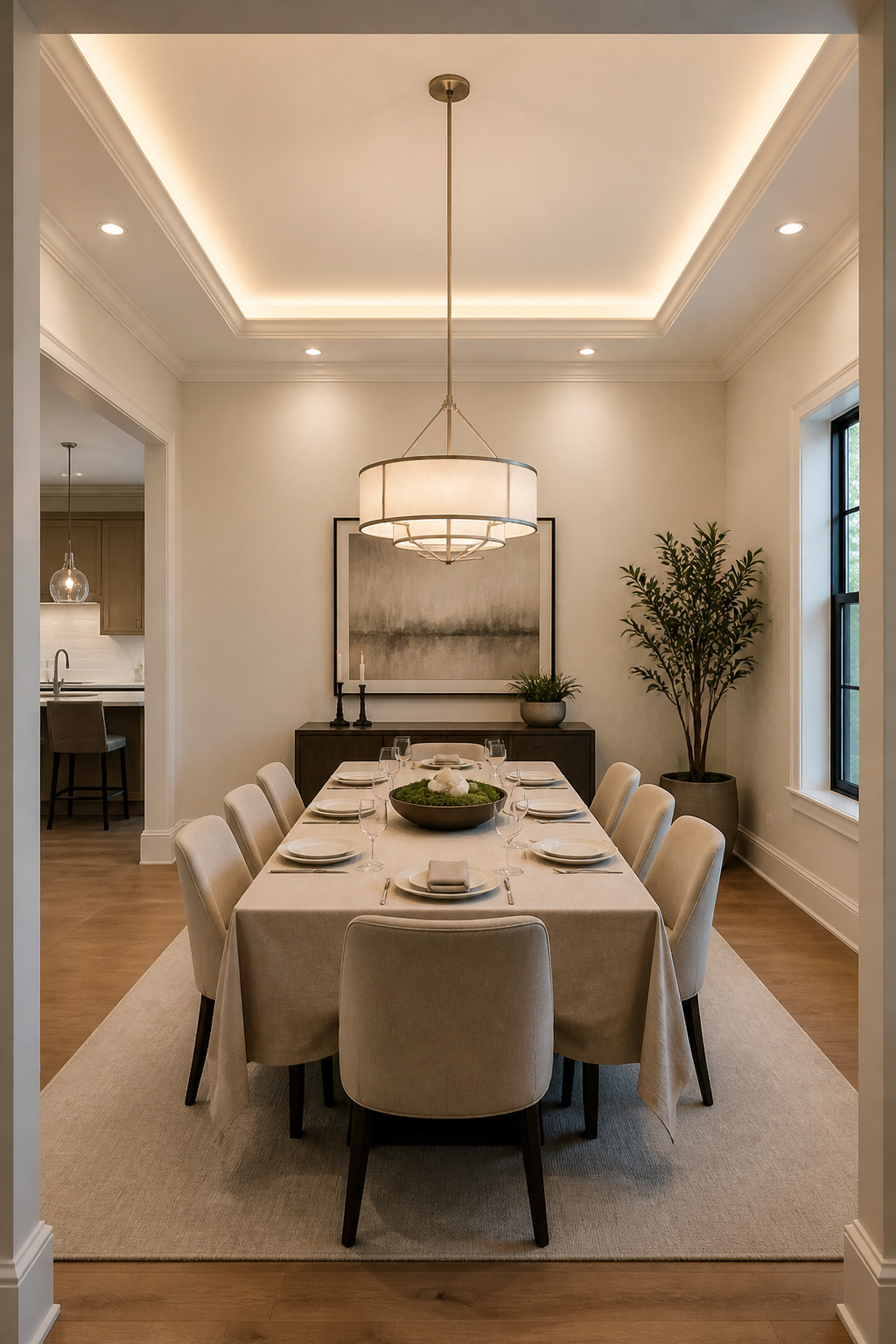
Recessed lighting in a dining room has a common mistake: positioning the cans directly above the table. Downward-aimed light from directly overhead creates unflattering shadows on faces — the equivalent of holding a flashlight under your chin, but from above. Instead, position recessed fixtures in a perimeter ring 18-24 inches from the walls, aimed inward at low brightness (20-40%). At that level they fill the room’s volume without competing with the pendant. 4-inch fixtures in satin nickel or matte white integrate more cleanly with contemporary ceilings than 6-inch cans, which can look dated.
Cove lighting — LED strip concealed in a ceiling recess or behind crown molding — creates an indirect upward wash that makes the ceiling appear higher and eliminates hard shadow edges at wall junctions. A 2700K-3000K strip temperature is appropriate; going cooler undercuts the warmth of the overhead pendant. Installation typically runs $500-$1,500 in materials and labor for a standard dining room. With a dimmable pendant on one circuit, dimmable recessed lights on a second, and cove lighting on a third, the room can shift from functionally bright to cinematically warm in under 30 seconds — without a single candle.
8. Minimalist Black Frame Pendants for a Clean Aesthetic
Matte black has become the default finish in contemporary dining room lighting for a reason that takes a moment to understand: it is the finish that does the least. Not in a deficient way — in the way that a good photograph’s background does the least so the subject can do the most. Matte black absorbs light rather than reflecting it, preventing the fixture from competing with its own output. It sits in a room like dark soil in a garden: grounding, neutral, visually present without asserting a color agenda.
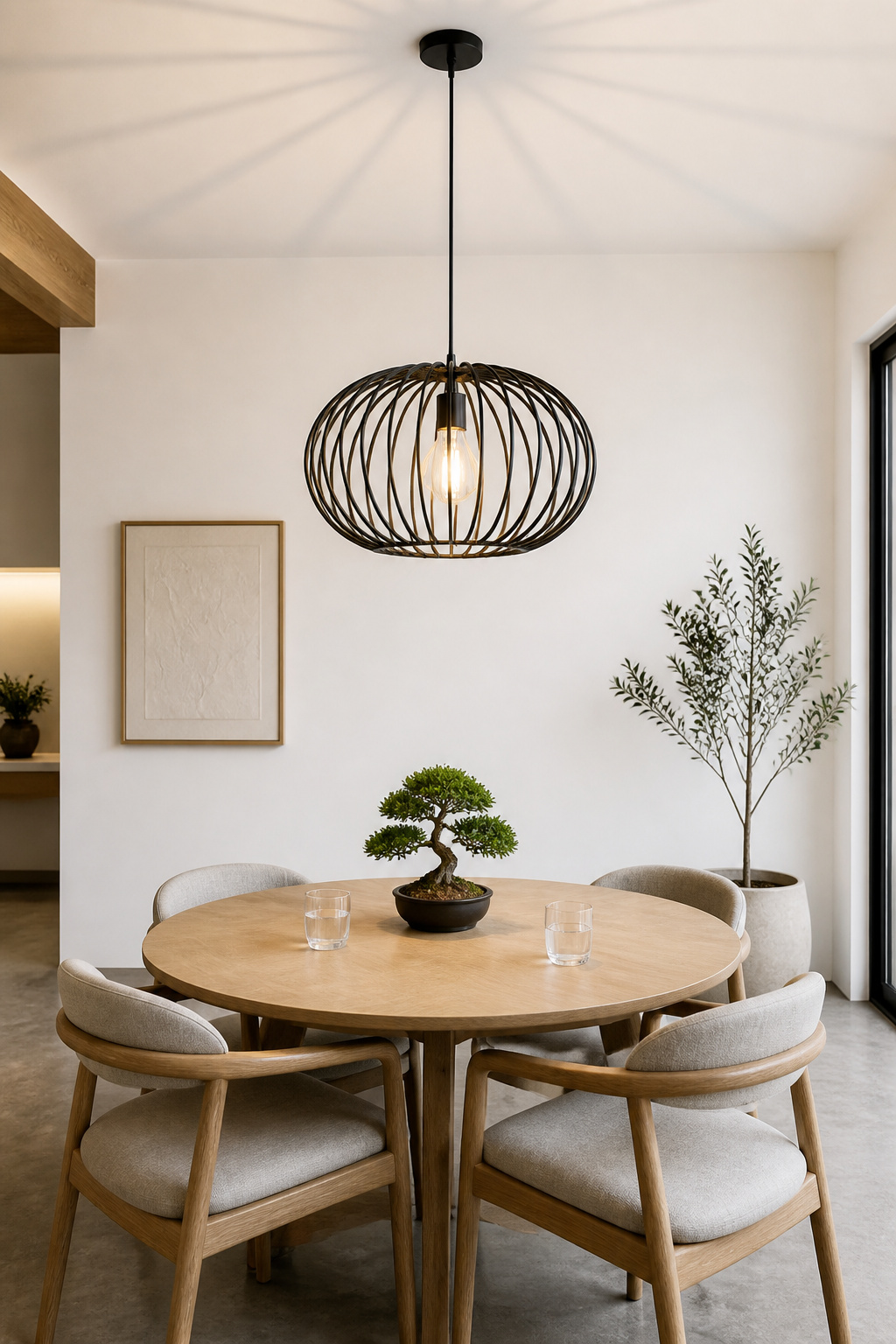
This makes matte black pendants unusually versatile. Against warm ochre or terracotta walls, a black pendant and a warm Edison bulb create a moody, amber-lit atmosphere. Against cool sage or grey, the same pendant and a 2700K LED read as precise and considered. The finish coordinates with virtually every other material in a contemporary interior — matte black chair frames, window hardware, cabinet pulls — without requiring a separate specification decision for each.
The choice between an open wire frame and an enclosed shade changes how the light behaves. An open cage or ring pendant scatters light in all directions — appropriate when the pendant must serve as the room’s primary ambient source. An enclosed black dome directs all light downward in a focused pool — best when layered with other sources, creating intentional contrast between the lit table and the dimmer room around it. For Scandinavian and Japandi-influenced interiors, the open geometric frame is the more natural choice; for mid-century and industrial-contemporary spaces, the enclosed shade reads truer.
9. Rattan and Natural Fibre as Contemporary Dining Lighting
The appeal of rattan as a contemporary dining lighting material is not merely aesthetic — though the aesthetic is considerable. It is the specific quality of light that a woven natural shade produces. Rattan’s open weave structure allows light to pass through while simultaneously casting an intricate shadow lattice onto the ceiling and adjacent walls. At dining table height, with a warm 2700K bulb inside, this mimics the quality of candlelit outdoor dining with a consistency that candles cannot provide. The shadow patterns shift subtly with any air movement in the room, adding a low-level animation that enlivens an otherwise static overhead fixture.
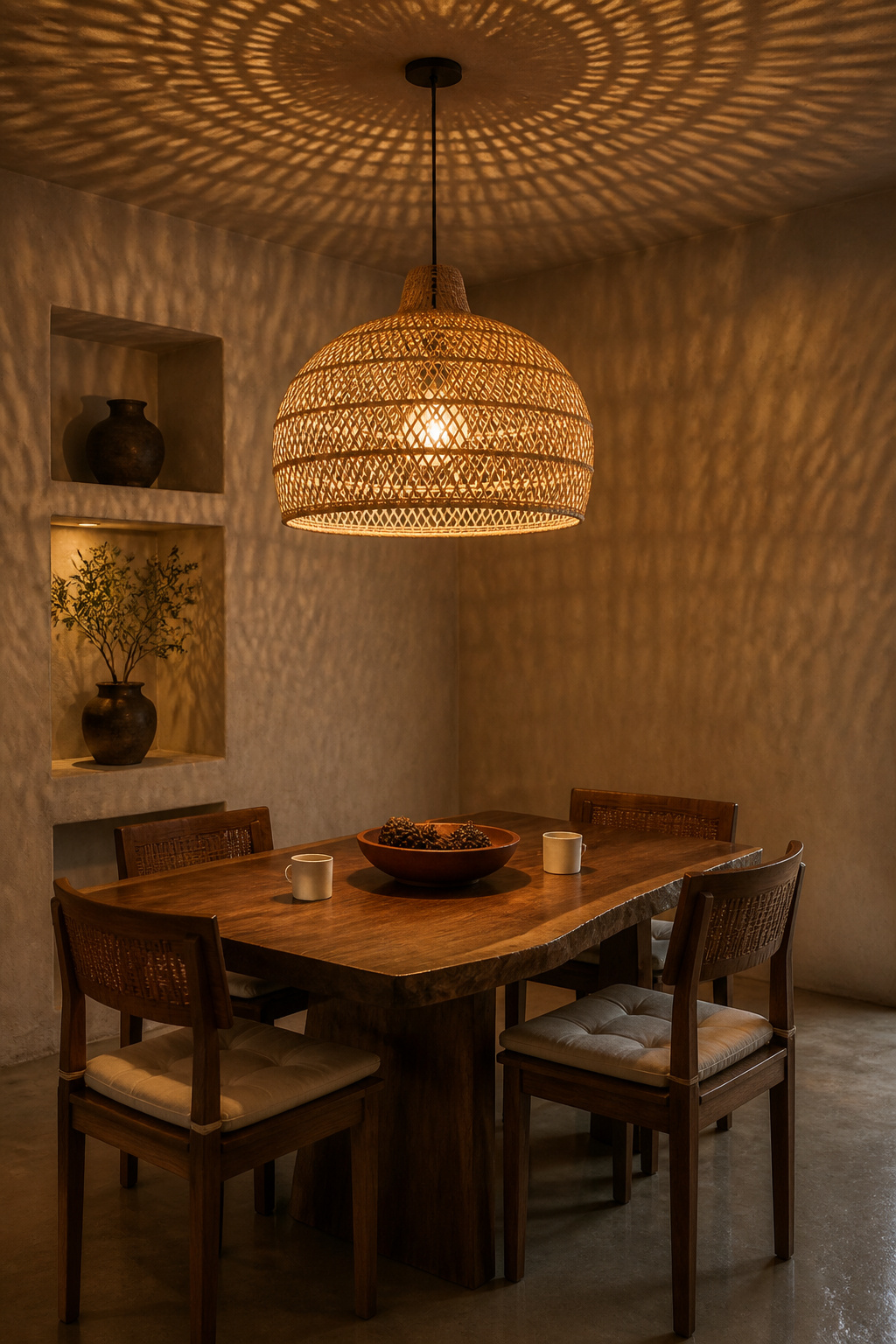
There is a wellness dimension worth naming here. Biophilic design — the principle that human beings benefit from contact with natural forms, textures, and patterns — has solid research support. Natural materials in a space reduce stress hormones and support the psychological restoration that makes home feel genuinely restorative. A woven pendant over a dining table is a modest expression of this principle, and a real one. Wellness-focused dining room design principles consider the full sensory environment, which means lighting material is as relevant as color or furniture choice.
Practically: rattan is sourced from a fast-growing palm, making it one of the more genuinely renewable fixture materials available. It pairs naturally with concrete, live-edge wood, linen, and raw stone. For a contemporary dining table with a clean marble top and metal base, a single large rattan shade (20-24 inches in diameter) provides textural counterpoint without undermining the room’s sophistication. Size to one-half to two-thirds the table width, as with any pendant.
10. Adjustable Track Lighting for a Flexible Dining Space
Track lighting in a dining room sounds like a commercial decision — the kind of thing you install in a gallery or a restaurant kitchen, not a home. That is the reputation of the 1990s T-bar commercial track system. Modern monorail systems from WAC Lighting, Tech Lighting, and Kichler bear no visible resemblance to that. Their tracks run as 1-inch diameter rails, barely visible against a white ceiling, and their pendant and spot heads look like residential fixtures, not contractor-grade hardware.
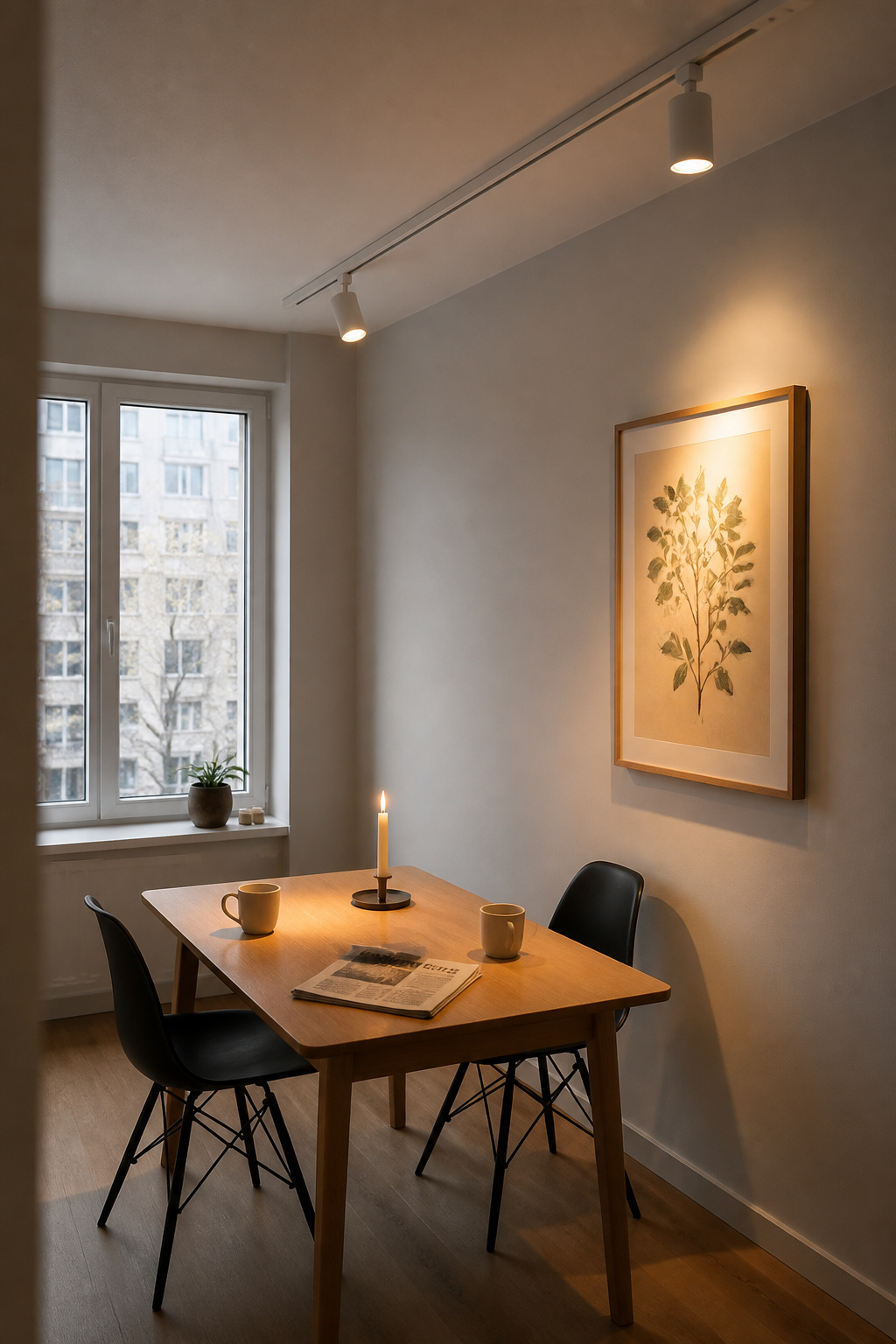
The right context for track in a dining room is a space that serves multiple purposes. If the dining table doubles as a workspace, track gives you the flexibility to direct heads toward the table for task light and toward wall art for accent light — a fixed chandelier position cannot do that. Open-plan apartments where the dining area has no clear ceiling center point benefit similarly: a monorail system follows the space rather than requiring a fixture to hang in the wrong spot.
Flexible monorail can be shaped to follow curved ceiling lines — a feature rigid track cannot offer. For table illumination, aim two heads at 45-degree angles toward the center of the table from either end. Angled light makes food and table settings appear three-dimensional in the way that a photographer’s side lighting does — the difference between a flat scan and a proper portrait. Additional heads can point to wall art or a sideboard, creating a complete lighting environment from a single electrical connection.
11. Warm Linen Drum Shades for a Soft Dining Room Atmosphere
Linen drum shades occupy a specific position in the contemporary dining room: they provide the softest, most face-flattering overhead light of any shade material. Fabric diffuses light rather than directing it — the output is a broad, even halo rather than a focused beam — and linen’s natural weave texture adds organic warmth that cotton and synthetic shades do not have. The result at table level is diffused, shadow-softened, warm, and even.
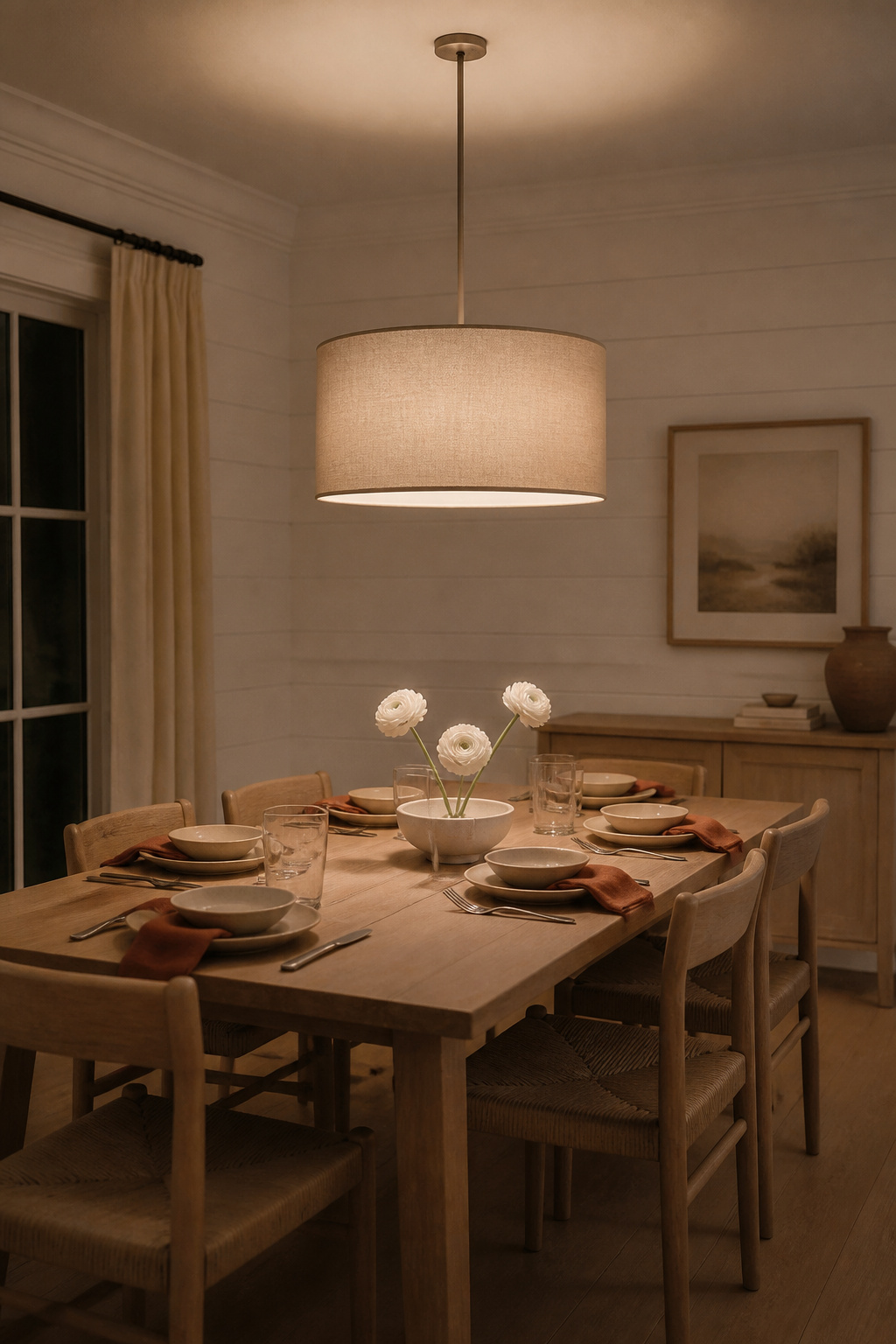
The sizing principle is the same as all dining room pendants: diameter should be one-half to two-thirds the table width. Medium drum shades in the 16-20 inch range are the most useful — large enough to have visual presence, compact enough to avoid dominating. For a 72-inch rectangular table, a 24-inch drum shade provides the right visual weight; for a 42-inch round table, 18-20 inches is the correct range. Stacking two smaller shades at different heights — 14 and 16 inches — at offset drops creates a multi-tier effect that reads as custom without requiring a custom fixture.
Among fabric options: linen transmits 30-40% of light at standard shade thickness and carries visible texture at close range. Cotton shades transmit slightly more light but lack linen’s texture — they read flatter and suit more formal settings. Silk transmits up to 60% of light and has a luminous quality that suits formal dining rooms. The material question to settle first is how much light quantity the room needs from this fixture alone, accounting for any secondary sources. If the drum shade is the sole source, cotton or silk keeps the room adequately bright; if layered with recessed lights, linen’s slightly lower transmission is perfectly fine.
12. Oversized Single-Drop Pendants for Maximum Dining Drama
There is a confidence to the single oversized pendant that a cluster of smaller fixtures cannot replicate. A cluster can read as indecision — as if the designer couldn’t commit to one choice. A single large pendant over a dining table says something specific: that the room has a point of view and it commits to it. This is one of the bolder contemporary dining room lighting moves available, and like most bold choices, it requires the right conditions.
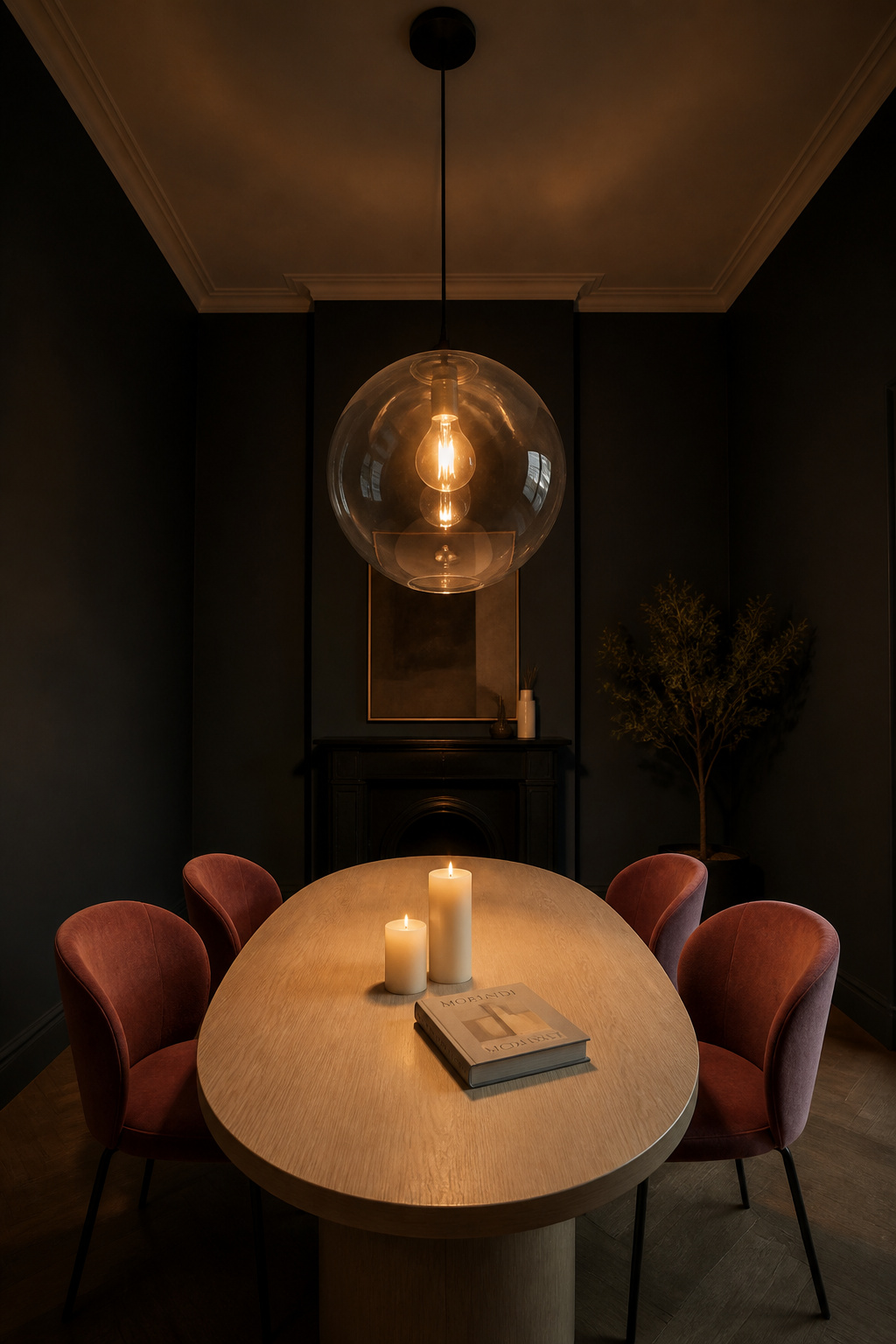
The conditions that allow this to work are primarily about ceiling height. Under 8.5 feet, anything above 18 inches in diameter starts to feel visually oppressive — the scale doesn’t have room to breathe. At 9-foot ceilings, pendants up to 24 inches become viable; hang them at 36-40 inches above the table. At 10 feet or higher, 28-36 inch diameter pendants work as intended — the spatial volume around the fixture allows the scale to read as dramatic rather than crowded.
Material choices determine whether an oversized pendant reads as heavy or light. A 28-inch blown glass globe has substantial diameter but negligible visual mass — glass is defined only by its outline and its transmission of light. Open wire frame pendants in geometric forms are similar: their spatial volume is large, their material presence minimal. Solid opaque materials — ceramic, concrete, powder-coated metal — in oversized formats feel genuinely weighty and suit high-ceiling spaces where that grounding quality reads as intended.
13. Contemporary Dining Room Lighting That Combines Sconces and Pendants
A pendant lights the table. Sconces light the room. The difference between a dining room with both and one with only an overhead pendant is the difference between a room that feels fully inhabited and one that feels like a lit island in the dark. This is the most common lighting deficit in residential dining rooms, and one of the simplest to address.
Wall sconces in a dining room should sit 60-66 inches from the floor to the center of the fixture — this places the light at approximately seated eye level, where it provides warm fill light without being directly in anyone’s sightline. For a dining room with a sideboard against one wall, mount sconces directly above it at 60-66 inches; they frame the furniture and provide task light for serving while doing double duty as ambient fill. For two sconces on a 12-foot wall, space them 5-6 feet apart to create balanced symmetry without crowding.
The question of matching versus contrasting sconces and pendant comes down to which quality the room needs. A matched set creates a polished, coordinated look that suits formal contemporary dining rooms. Contrasting choices — a brass pendant with matte black sconces, for example — extend the mixed-metal palette throughout the room and create the layered, collected quality that characterizes the best contemporary interiors. When contrasting, maintain one shared element (a finish, a scale, a material) so the room reads as considered rather than assembled from whatever was available. With sconces on a separate circuit from the pendant, the room gets a second dimming range: pendant only for intimate dinners, both sources for active entertaining.
14. Smoked and Tinted Glass Pendant Clusters for Sophistication
Smoked glass does something that clear glass cannot: it makes the air around the fixture feel weighted and deliberate. This is partly about light transmission — smoked glass reduces output by 20-30%, which filters the room toward intimacy. It is partly about the subtle amber-grey tint the glass imparts on the transmitted light, warming a 2700K bulb toward something closer to 2400K. And it is partly visual depth — looking at a smoked glass pendant, the eye has something to look at beyond just the bulb.
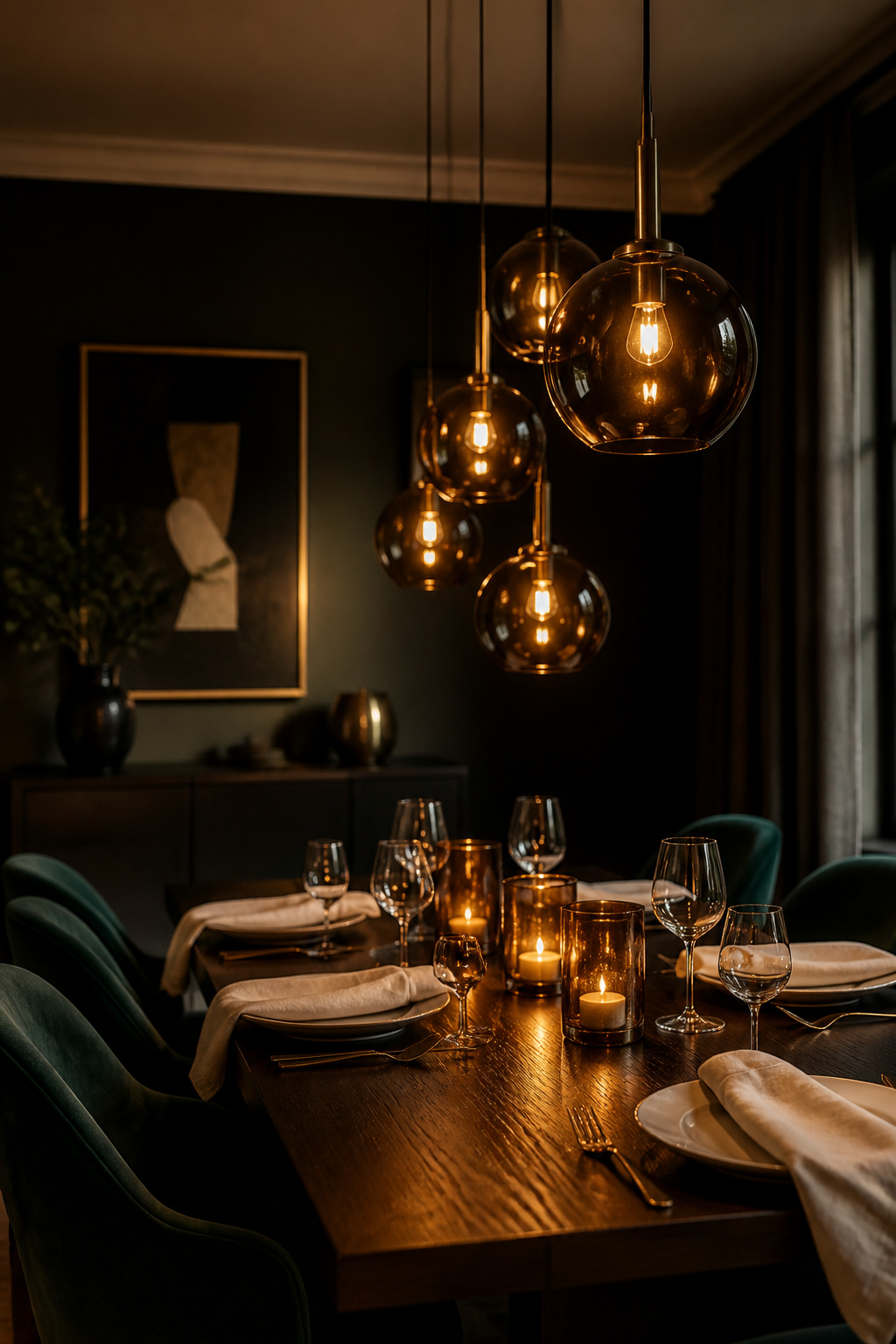
Cluster arrangements in smoked glass read differently depending on their configuration. Symmetrical clusters — three or five pendants at equal heights in a tight grouping — have a chandelier-like formality; they work in spaces that are modernizing a traditional dining room rather than starting from scratch. Asymmetric clusters at varied heights (18, 24, and 32 inches from the ceiling) create organic movement appropriate for contemporary and transitional spaces. The asymmetric version is harder to get right but more rewarding when it lands — it looks collected rather than purchased.
In terms of metal pairing: smoked glass with brass reads warmer and more layered, as the amber glass and warm metal reinforce each other. Smoked glass with matte black reads sharper and more architectural — the cool glass and absorbing metal create a distinctly cooler atmosphere that suits spaces with strong natural light. For dining tables with light marble or white oak tops, smoked glass provides tonal contrast that makes both the fixture and the table more visible. Against dark walnut, use amber-tinted glass rather than standard smoked — the contrast registers more clearly.
15. Warm Edison Bulbs in Modern Dining Room Light Fixtures
The Edison bulb has outlasted its trend status because it occupies a position no other bulb technology currently fills: 2200K warmth at a scale and form that is genuinely beautiful to look at directly. Its visual simplicity — a glowing filament in clear glass — aligns with contemporary design’s preference for objects that honestly reveal their function. There is no attempt to hide the light source, no decorative shade to modify the output. The bulb is the point.
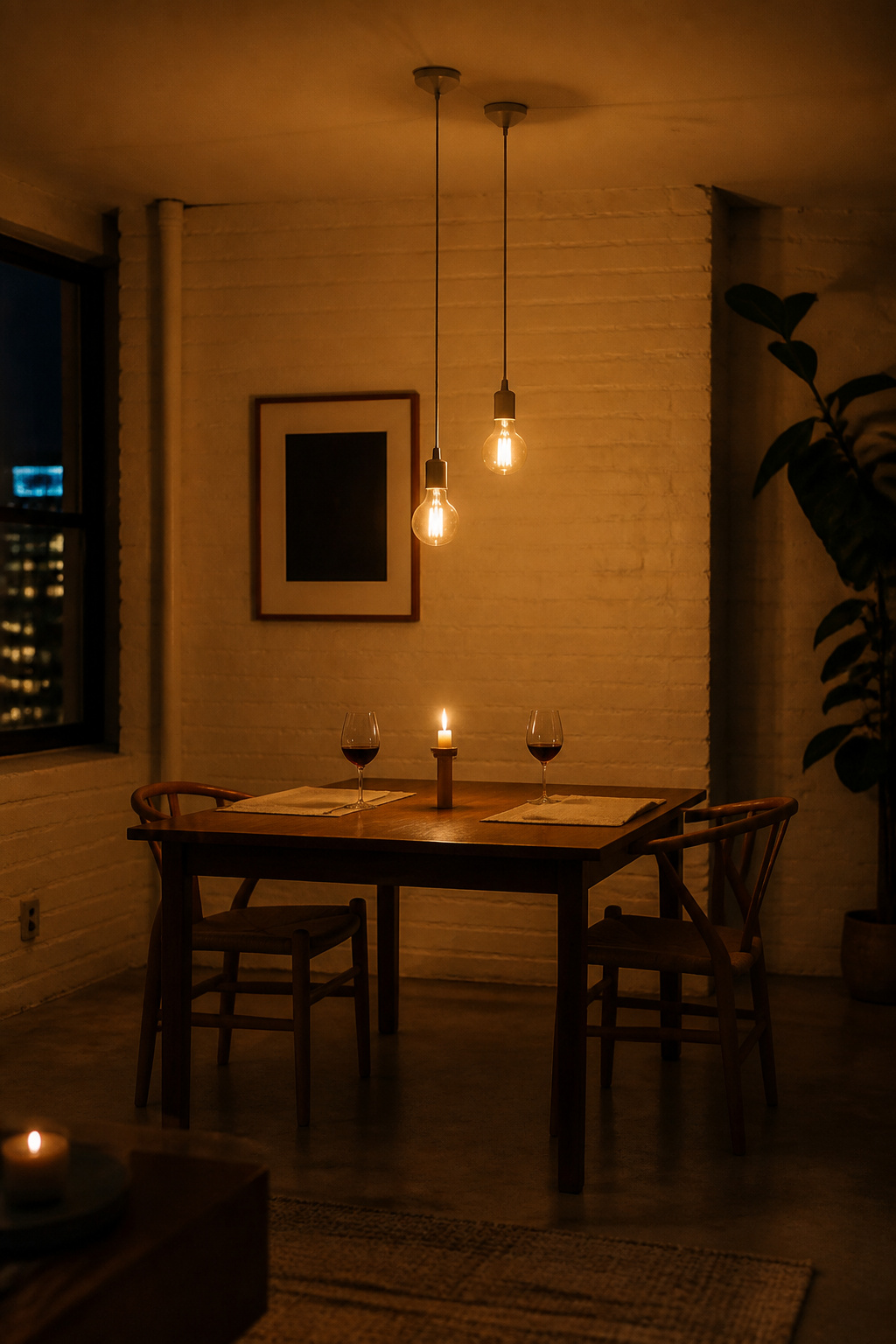
Why Edison Bulbs Work in Modern Settings
The energy question was the only real argument against Edison-style bulbs in a dining room setting. LED filament technology resolved it: quality LED filament bulbs from Feit Electric, Satco, and GE Reveal use 4-6 watts to replace a 40-watt incandescent — a 90% reduction in energy use. At CRI 95, available from Waveform Lighting and Yuji, the color accuracy matches incandescent and makes every item on the table look as good as it does in daylight. Food that looked flat under a CRI 80 bulb regains its natural color; the faces around the table look warm rather than washed out. For similar ideas in adjacent spaces, kitchen lighting over the table with similar warm-bulb ideas covers the same principle in a higher-function environment.
Getting the Installation Right
Exposed-bulb fixtures designed around the Edison form range from Schoolhouse Electric’s ring pendants ($120-$250) to simple pendant cord kits from Creative Cables ($30-$60) that support a single socket and bulb on a textile-wrapped cord. In rooms with 9+ foot ceilings, three cords at varied heights — 28, 36, and 44 inches from the table — create a dramatic artisan installation for under $100 in materials. The only specification that matters: use trailing-edge dimmers and buy CRI 95 filament LEDs. Everything else is personal preference.
16. Smart Lighting Integration in the Contemporary Dining Room
Smart lighting is often sold as a convenience technology — app control, voice commands, the ability to turn lights off without leaving the couch. These are features, but they are not the reason to invest in a smart contemporary dining room lighting system. The reason is light quality over time.
Philips Hue White Ambiance bulbs support a tunable white range of 2200K-6500K. That means the same dining room fixture that delivers cool, energizing 5000K light for a Saturday morning brunch can automatically shift to 2700K for family dinner and 2200K for a late evening glass of wine — all on a daily schedule that follows the body’s circadian rhythm. The biological benefit is real: cool morning light suppresses melatonin and supports alertness; warm evening light supports melatonin production and natural sleep onset.
Building Useful Scene Presets
Scene presets are where the system earns its setup effort. A ‘family dinner’ scene — 2700K at 70%, pendant and any fill lights — activates with a single tap or voice command. An ‘entertaining’ scene drops to 50% and 2700K. A ‘cleanup’ scene goes to 90% bright white. Lutron Caseta handles the physical dimming for hardwired fixtures without requiring a neutral wire; a Hue Bridge (~$50) enables schedule-based automation for Hue bulbs. LIFX is the simpler setup: Wi-Fi direct, no hub, tunable white, though slightly less reliable on congested home networks than hub-based Hue.
The One Setup Step That Matters
Any smart lighting system that requires app access for every adjustment is not more convenient than a standard dimmer. The critical step is building the scene presets at installation rather than leaving it to later. Set ‘entertaining’, ‘family dinner’, and ‘cleanup’ on day one. After that, the system runs itself.
17. Brass and Matte Black Contrasts in Dining Lighting Design
Unlacquered brass returned to interiors around 2018 in a form quite different from the polished brass of the 1980s. Where polished brass is bright, uniform, and reflective, unlacquered brass develops a patina over time and carries a warmth that is organic rather than manufactured. Matte black arrived alongside it as a counterbalancing force — not shiny, not reflective, not competing. Together they form the most recognized contemporary dining room lighting palette of the current decade.
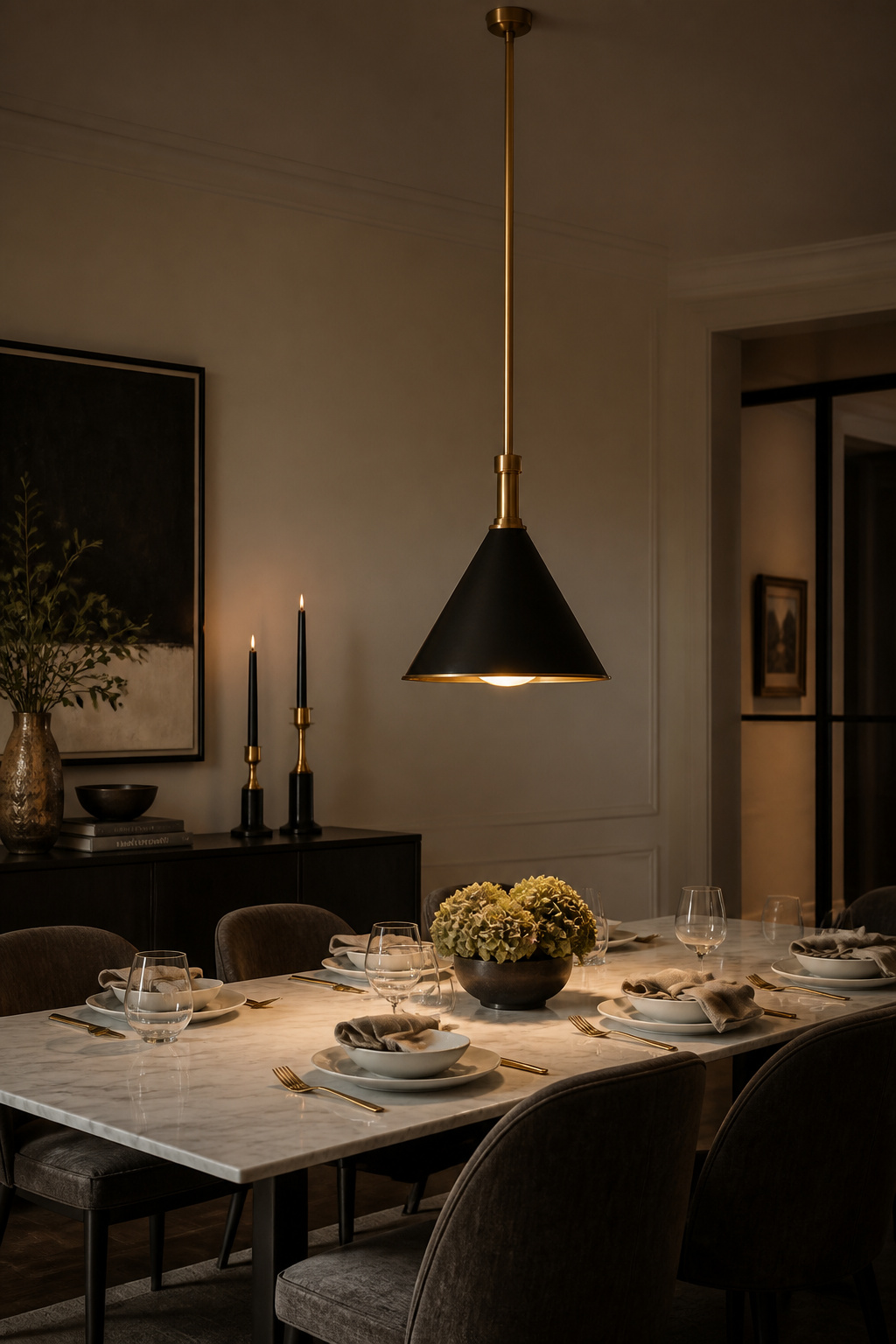
The reason the pairing works is tonal contrast without color conflict. Warm brass sits in the amber register; matte black reads as neutral because it absorbs rather than reflects. They contrast without clashing, and the matte quality of the black finish prevents the contrast from becoming aggressive. Two-tone fixtures — a pendant with a brass body and a matte black shade — do the mixing internally, which simplifies the coordination challenge. Brands like Visual Comfort, Arteriors, and Cedar & Moss offer well-executed two-tone dining room pendants at $150-$600.
The pairing extends naturally beyond the fixture. Dining chairs with black frames and brass leg caps or nail-head trim carry the palette to furniture level. On the table itself, unlacquered brass candlesticks with matte black bases maintain the palette through the full room. The one caution: avoid over-saturation. If the pendant is brass and black, keep the table’s primary material palette to one of the two. The instinct to double up on both finishes simultaneously is the most common way the palette tips from sophisticated into effortful.
18. Layered Ambient and Task Dining Room Lighting for Everyday Living
A single pendant fixture is the minimum viable dining room lighting — it covers the table and provides enough ambient light to function. But minimum viable is exactly what it sounds like. A dining room lit by one overhead fixture has no flexibility, no depth, and no ability to shift mood. Good contemporary dining room lighting thinks in layers, not fixtures.
Why One Fixture Falls Short
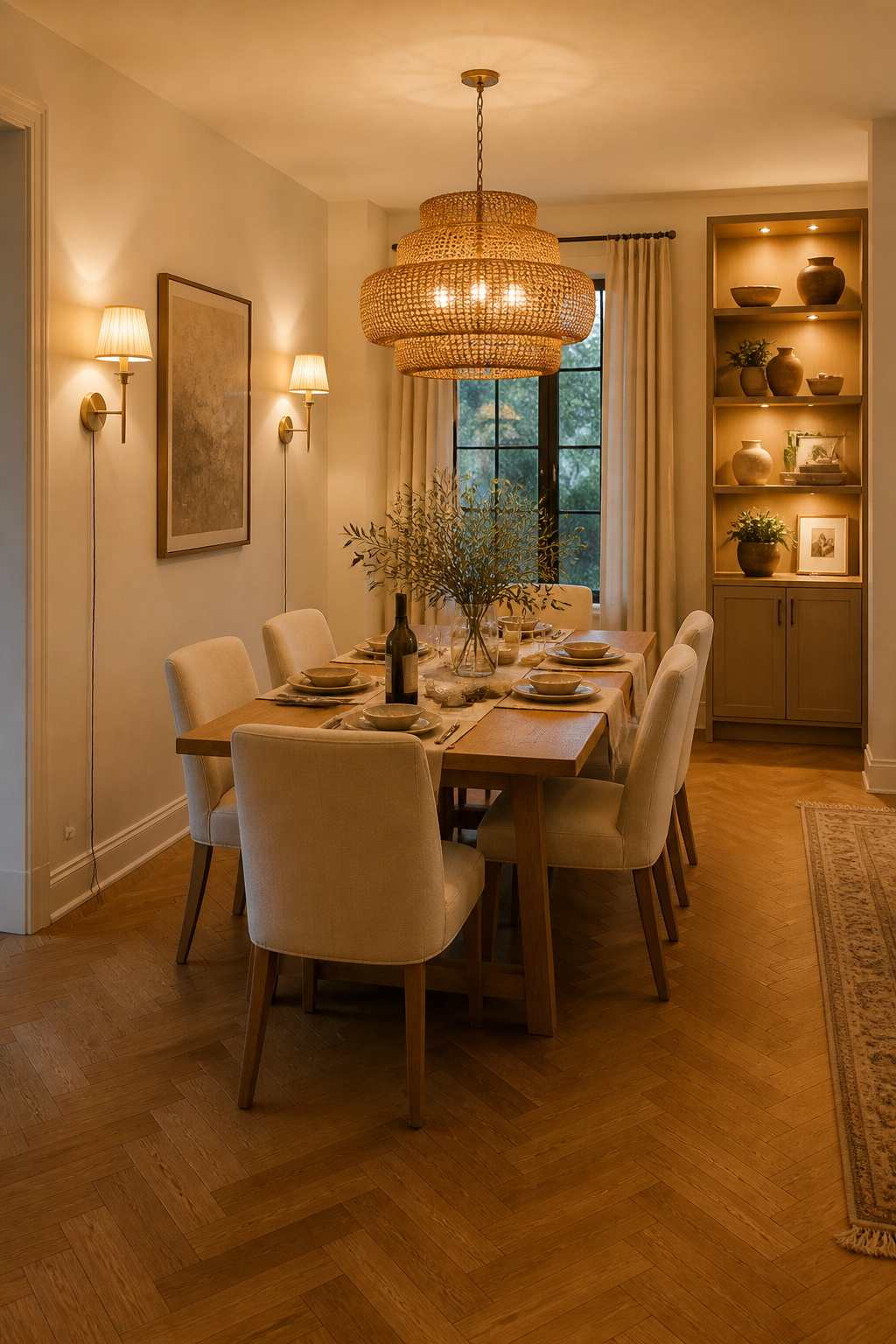
A single ceiling pendant at dining height lights the table but leaves walls in darkness — the room feels unfinished and seems smaller than it is. Without a secondary source, the full dimming range of the pendant is constrained: at 20% it is too dark for comfortable eating; at 80% it is too bright for relaxed conversation. Secondary sources fill the room’s volume and make a dimmed pendant feel intentionally intimate rather than merely insufficient.
The Practical Three-Layer Structure
Layer one is the primary ambient source: the pendant or chandelier at 30-36 inches above the table, dimmable, 2700K, CRI 90+. Layer two is fill: recessed or surface lights at the room perimeter, set to 20-40% brightness as fill — not as primary sources. Layer three is accent: a sconce above the sideboard, a table lamp in a nearby corner, or candles on the table at eye and surface level.
Making It Work Without an Electrician
For anyone not ready to run new electrical circuits, the third layer is achievable with no electrician at all. Plug-in wall sconces from IKEA, West Elm, or Rejuvenation run $50-$200 and mount at 60-66 inches with the cord running behind a picture frame or through a cord cover. A dimmable floor lamp in a dining room corner costs $80-$250 and adds genuine ambient fill from a completely different direction than the overhead fixture. Battery-operated LED puck lights inside a sideboard or on open shelving add a fourth layer of warm light at under $30 for a set of three — a surprisingly effective contribution that requires no installation of any kind.
How to Choose the Right Contemporary Dining Room Lighting for Your Home
Start with ceiling height, because it determines what is possible before any style conversation begins. Ceilings under 8.5 feet rule out oversized single pendants and limit cluster drops to three. Ceilings at 9-10 feet open the full range of contemporary dining room lighting fixtures. Above 10 feet, a statement chandelier with genuine visual mass — whether blown glass, sculptural steel, or a large woven form — makes the most of the vertical space.
Then size to the table. The formula — pendant diameter equal to one-half to two-thirds the table width — is the single most reliable rule in contemporary dining room lighting and worth applying before any other dimension is considered. When the room formula (width plus length in feet equals diameter in inches) conflicts with the table formula, the table wins. You sit at the table; you don’t sit in the middle of the room.
The quality decision that most people leave to last is actually the one that matters most: light quality — specifically, color temperature and CRI — before style. A 2700K bulb at CRI 90+ makes food look appetizing, skin look healthy, and the room feel warm whether the fixture is a $4,000 studio chandelier or a $40 socket pendant on a textile cord. A 4000K bulb at CRI 75 does none of those things regardless of how beautiful the fixture looks in a catalogue. Get the light quality right first. Then choose the fixture that best expresses the room’s character within that spec. Contemporary dining room lighting at its best is invisible as a system and unforgettable as an experience — the difference between a meal eaten under functional overhead light and one that everyone around the table wants to linger over.