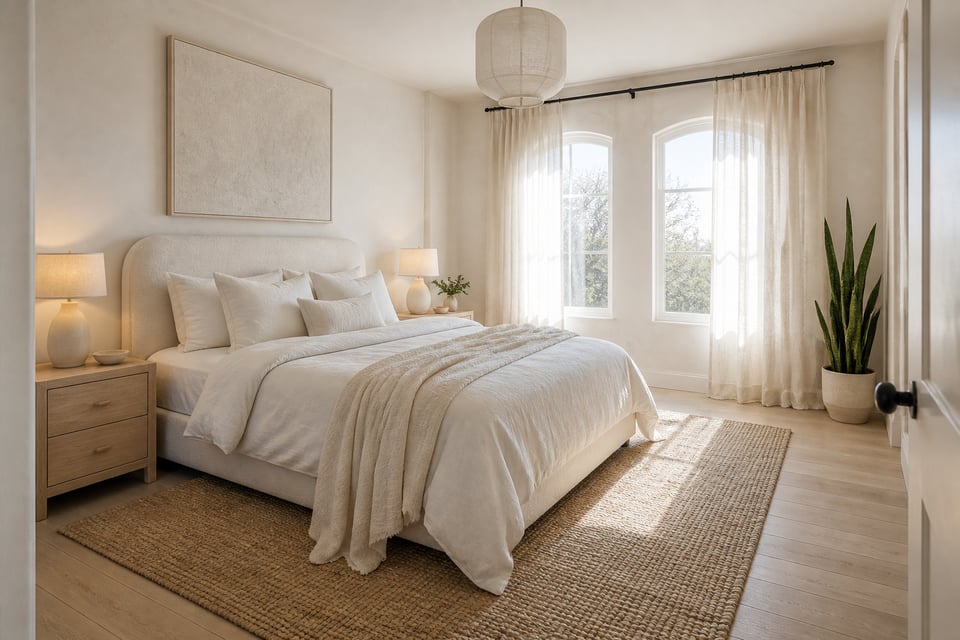
The first thing I noticed after repainting my own bedroom in Benjamin Moore White Dove was how differently I breathed in it. Not the colour, though I already knew warm whites worked. It was the way the room had stopped competing for my attention. The white bedroom aesthetic isn’t really about absence. It’s about removing the visual noise that keeps the nervous system slightly, constantly alert.
Research on stress and environment consistently finds that lighter, calmer palettes lower cortisol more effectively than complex, saturated interiors. Nowhere matters more than the room where you spend a third of your life. After eight years designing wellness spaces, I’ve learned that a white bedroom done right isn’t sparse. It’s layered in texture, intentional in material, and tuned to support sleep. Done wrong, it feels like a hospital waiting room. The difference is in the specifics: which white, which linen, which light temperature, which wood.
These 15 ideas cover every element of a well-designed bedroom aesthetic white approach — from the bedding on the mattress to the bulbs in the lamp. None requires gutting a room. Most can be implemented in order, one step at a time.
1. Organic Linen Bedding as the Foundation of a White Bedroom Aesthetic
There’s a version of this that focuses purely on how linen looks — the relaxed drape, the slightly crumpled ease. But I’d rather start with what linen isn’t. It isn’t polyester. And in a bedroom, that matters more than most people realise.
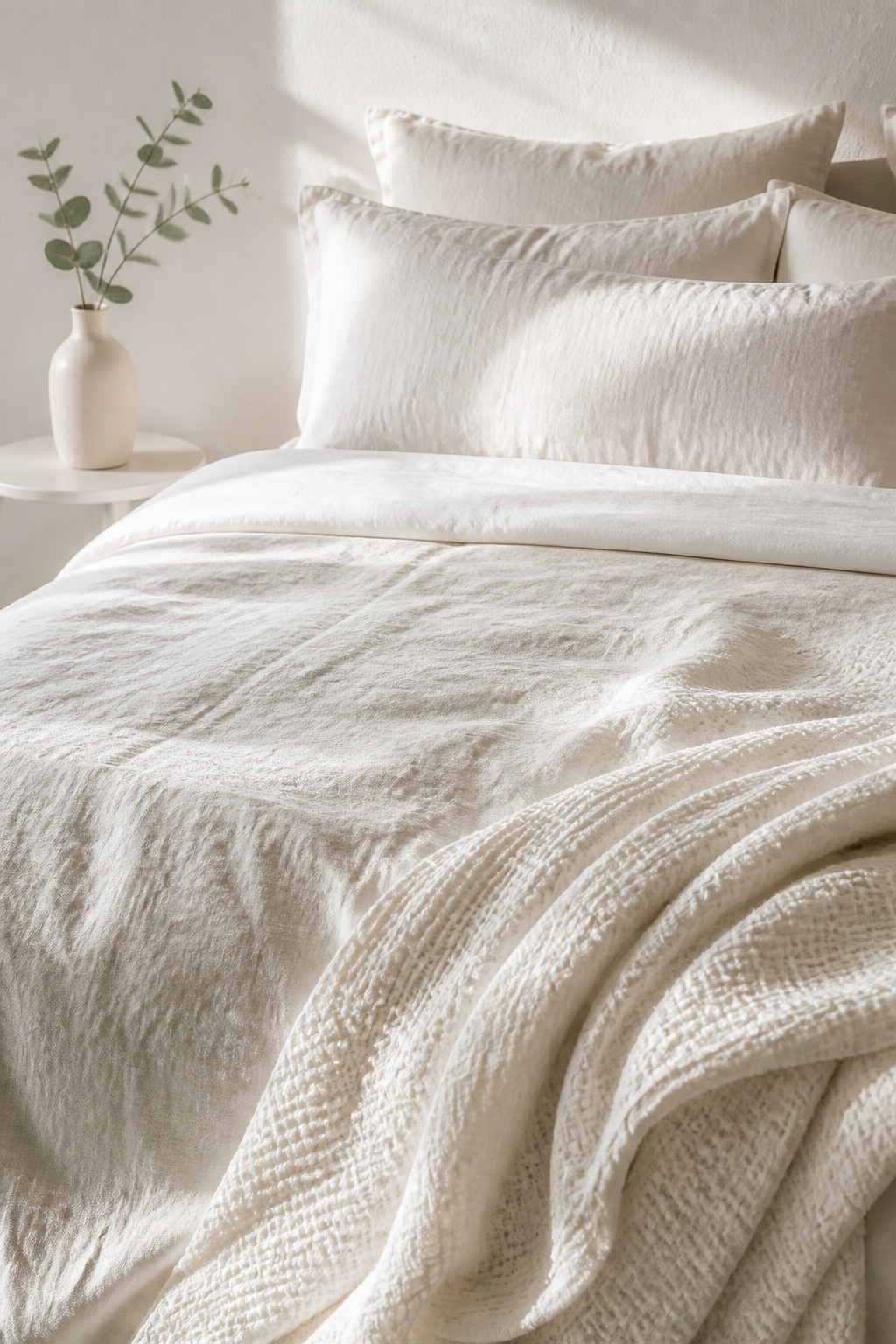
Conventional polyester and polyester-blend bedding off-gases volatile organic compounds including formaldehyde. The International Agency for Research on Cancer classifies formaldehyde as a human carcinogen. The off-gassing continues for the lifetime of the product. So a polyester duvet cover is emitting compounds at your face for eight hours every night, for years. Switching to certified organic linen eliminates this entirely.
Linen’s hollow flax fibres absorb up to 20% of their weight in moisture without feeling damp. That’s why linen sleepers consistently run cooler than cotton sleepers — and considerably cooler than polyester. In summer it genuinely breathes. In winter its hollow fibres trap warmth efficiently.
Certification and Brand Notes
For certification, look for GOTS plus OEKO-TEX Standard 100 together. GOTS (Global Organic Textile Standard) verifies that the fibre source and supply chain are organic. OEKO-TEX verifies the finished product contains no harmful residues. Brands carrying both include Cultiver, Parachute’s linen range, and Naturepedic’s GOTS linen duvet covers. Coyuchi is another consistently certified option.
The layering principle for white linen bedding is texture variation, not tonal variation. A stonewashed linen duvet (matte, nubbed), a crisp cotton flat sheet folded back 30cm, and a waffle-weave throw introduce three distinct surface textures. That’s what creates depth within a white palette. On washing: cool water, plant-based detergent, and line-drying in indirect sunlight preserves the white far longer than a hot machine cycle. For creative approaches to extending bedding life, some genuinely useful DIY bedding ideas for the bedroom can help while you build a linen collection.
2. Choosing the Right White Paint: Warm Undertones Versus Cool for Calm Sleep
The most common mistake in white bedroom projects is choosing the wrong white. Not the wrong colour — the wrong undertone. And the consequences show up every time the light changes.
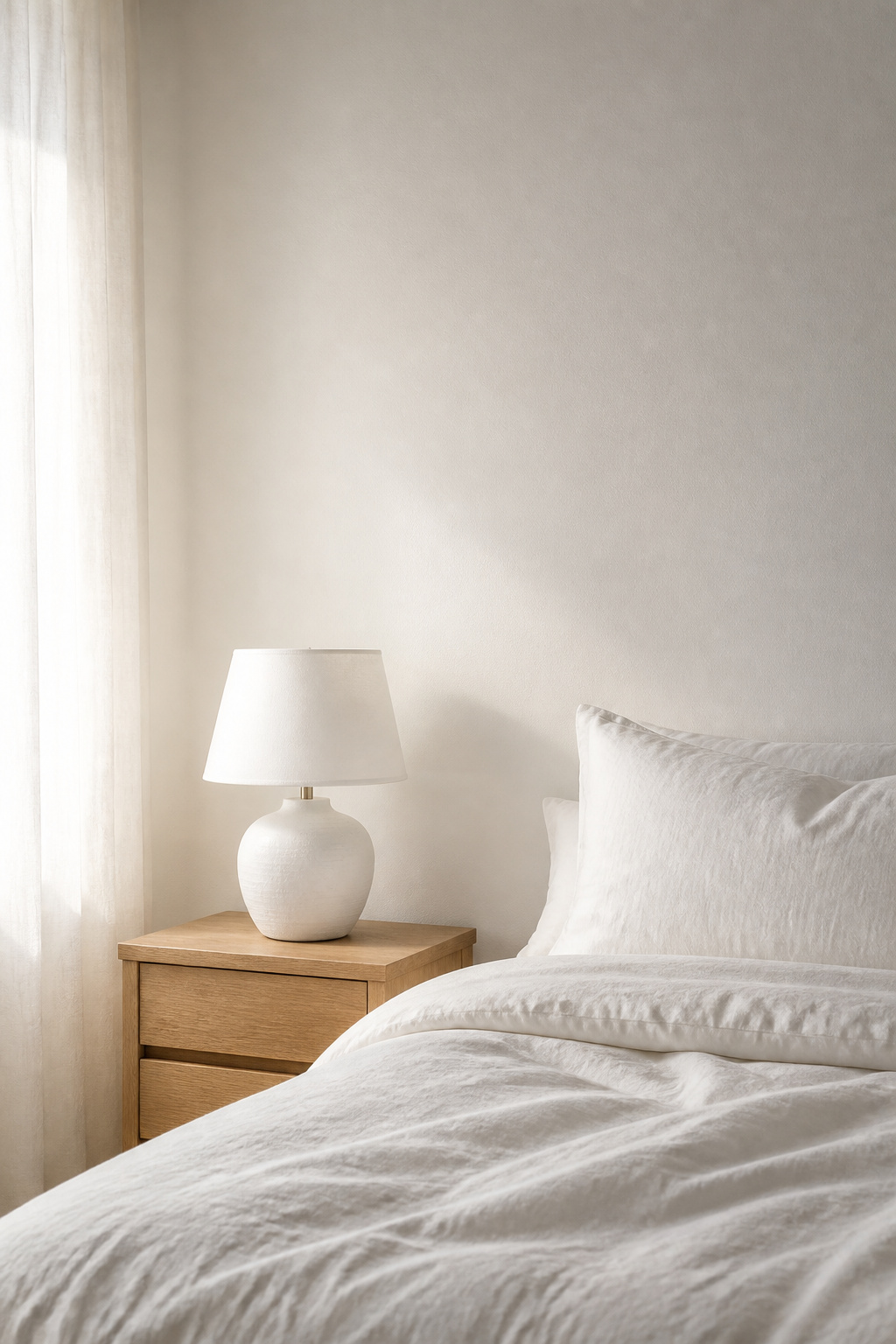
Cool whites with blue or green undertones look clean on a paint chip in a bright shop. On a north-facing bedroom wall in winter afternoon light, they read blue-grey and slightly clinical. Warm whites with yellow or pink undertones register as safe and settled to the limbic system. That’s exactly what a bedroom environment should communicate.
LRV — light reflectance value — is the other critical variable. It’s measured on a scale from 0 (absorbs all light) to 100 (reflects all light). For bedrooms under 120 square feet, an LRV above 55 prevents the room from feeling compressed. Larger rooms can go lower. Benjamin Moore White Dove sits at LRV 85.4: warm, clean, and the most specified white in wellness bedroom design right now. Sherwin-Williams Alabaster (LRV 82) is slightly creamier and reads particularly well under 2700K artificial light in the evenings.
The Right White for Your Light
For a crisper, more graphic white — the kind that suits modern-minimal bedrooms — Benjamin Moore Chantilly Lace at LRV 92.2 is the right choice, provided the room gets significant natural light. Without it, Chantilly Lace reads blue. Farrow & Ball Wimborne White is the warm, layered option for a relaxed organic aesthetic. All White is the brand’s cool version and best reserved for south-facing rooms.
Sheen matters, too. Flat or matte finishes absorb light rather than reflecting it. They soften a white room’s brightness and hide surface imperfections. Eggshell (2-10% sheen) is more washable and still close enough to matte that it won’t create the mirror-effect reflections that make a white bedroom feel agitated rather than calm.
Whatever you choose: test a 30x30cm patch on the actual wall. Observe it in morning light, afternoon light, and under your artificial evening lamps. The chip never tells the full story. Good bedroom interior design tips for deep sleep consistently start here, with the paint decision, and for good reason.
3. White Bedroom Aesthetic Built With Woven Seagrass and Natural Fibre Accents
A white bedroom without natural texture is an aesthetic risk. Without something rough and organic against all that white, the room drifts toward sterile — toward hotel corridor rather than sanctuary.
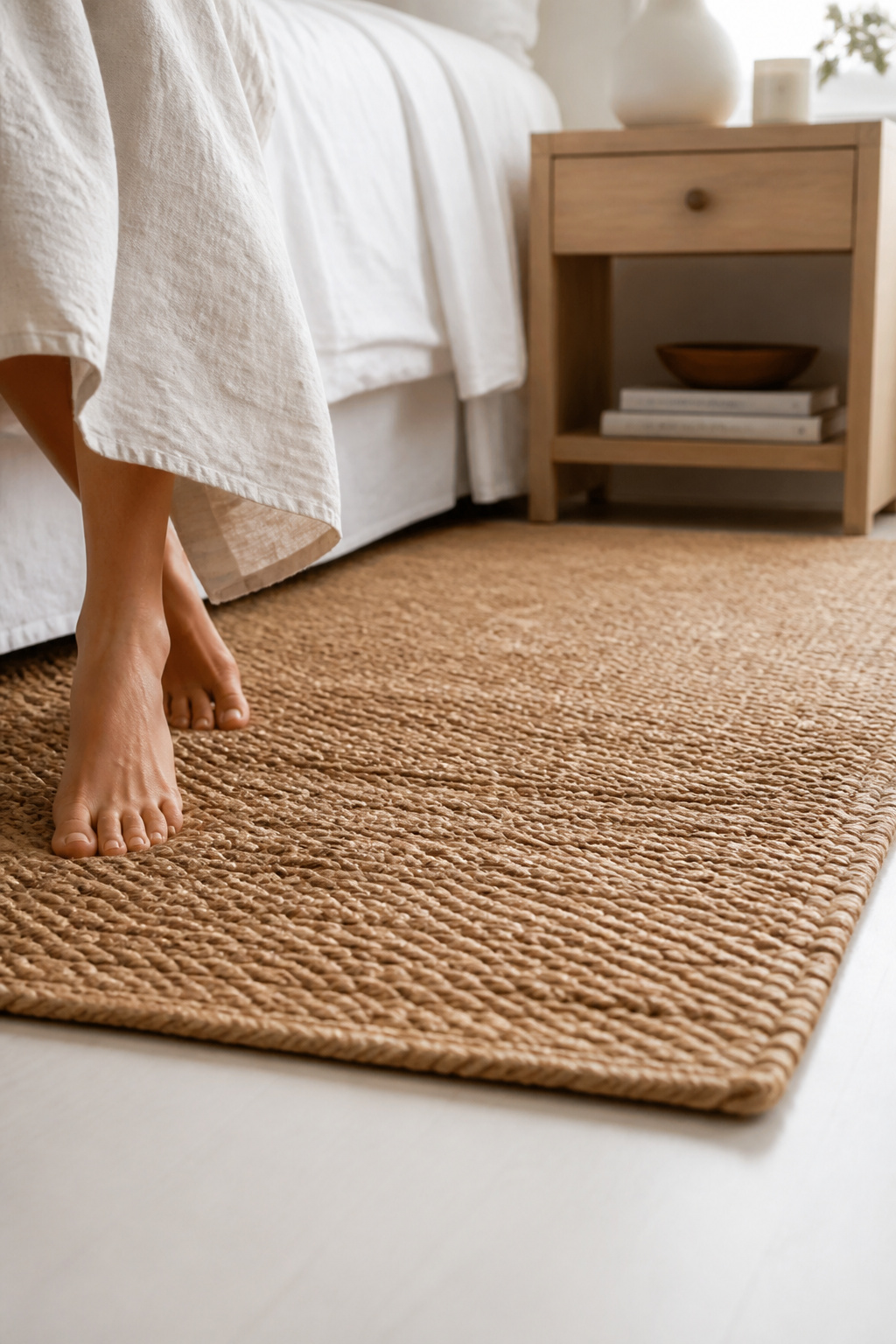
Natural fibre rugs solve this immediately and bring a genuine air quality benefit. Unlike synthetic rugs made from polypropylene, nylon, or polyester — which release VOCs — natural fibre rugs are free from toxic treatments. Their breathable construction improves indoor air quality rather than undermining it. The fibres trap dust particles within their weave, keeping them out of the breathing zone. That’s particularly valuable in a bedroom.
Seagrass is the most durable of the natural fibre options. It’s naturally stain-resistant and moisture-resistant in a way that jute is not. Jute can stain and degrade in damp conditions. So seagrass is better for high-traffic bedroom positions: the foot of the bed, a dressing area, or a reading corner. For the main bedroom rug where bare feet land every morning, jute is softer underfoot and still a non-toxic fibre.
Placement and Scale
The sizing that makes a white bedroom feel grounded: a 240x170cm rug centred under the bed with 45-60cm extending on each side. Smaller than this and the rug floats. IKEA Lohals (jute, flat-woven, affordable) is a solid starting point. Serena & Lily produces the most refined natural fibre rugs for a more considered white bedroom aesthetic.
Beyond the floor rug, seagrass baskets beside the bed and woven pendant lamp shades both introduce natural texture without adding colour. The rule I return to: no more than three different natural materials at once. Linen bedding plus seagrass rug plus a light oak side table is the right limit. Beyond that, the room starts reading as a materials experiment rather than a designed space.
4. Layered White-on-White Pillows in Organic Cotton, Linen, and Bouclé
Pillow layering in a white bedroom is about material variety, not colour. The goal is three visually distinct surfaces that read as unified because they share a palette: crisp, matte-woven, and textured.
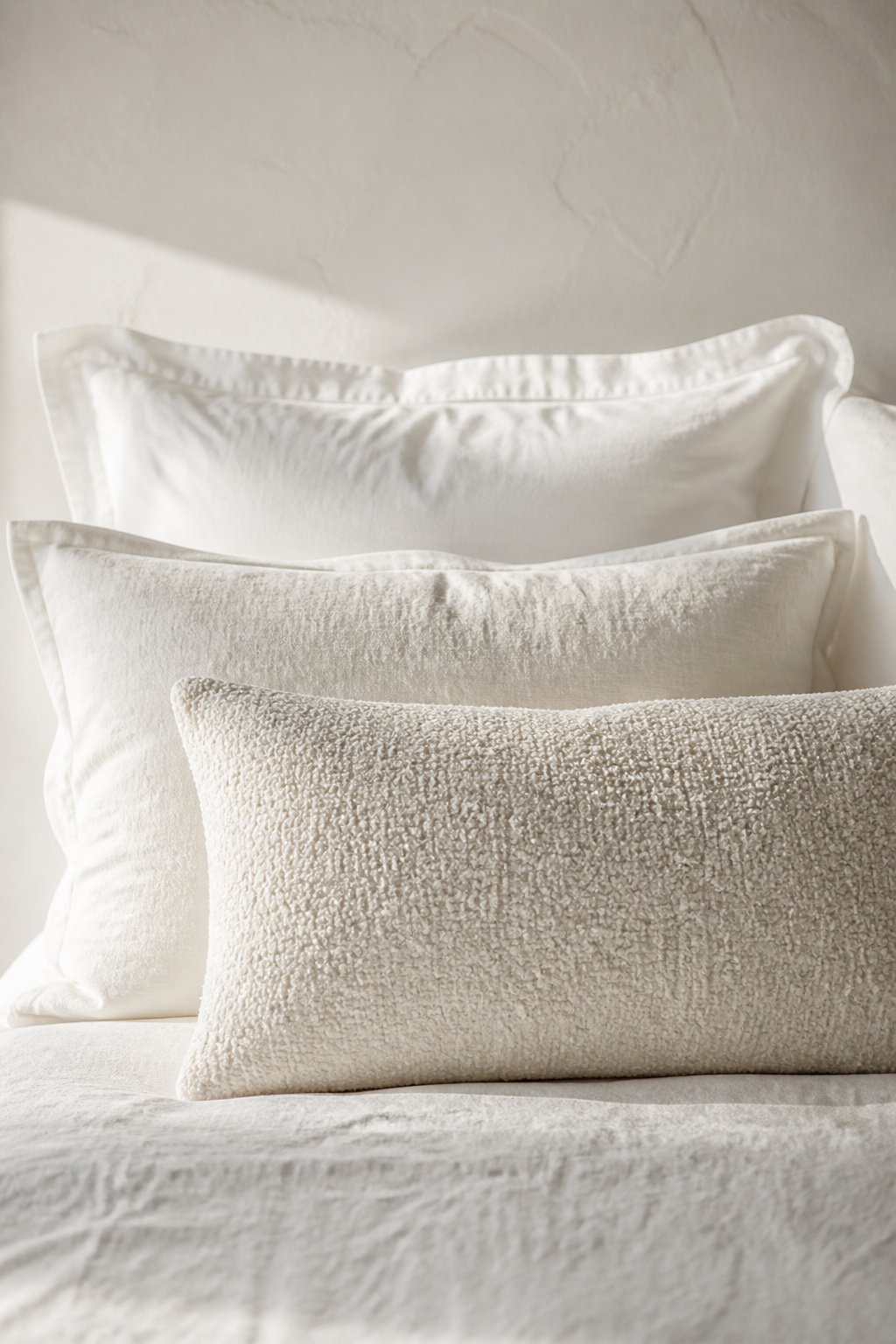
The arrangement that works consistently: 65x65cm Euro shams in organic cotton percale at the back, two standard sleeping pillows (50x75cm) in stonewashed linen in the middle, and a 30x50cm bouclé lumbar cushion at the front. This three-tier structure is what most well-designed hotel rooms use — and for good reason. It works at any bed width from a queen to a super king.
Slightly off-white variation between layers reads as deliberate, not accidental. One pure white Euro sham, one warm ivory linen sleeping pillow, one natural-tone lumbar — the slight warmth of natural linen against cooler cotton prevents the arrangement from looking bleached and institutional.
On fills: poly-fill is the obvious avoidance. Polyester fibres off-gas and shed. GOTS-certified wool fills are my first recommendation for allergy-sensitive clients: naturally hypoallergenic, dust-mite resistant, and genuinely temperature-regulating. Buckwheat hull fills are the choice of many committed wellness sleepers. They off-gas nothing, are naturally hypoallergenic, and adjust to the shape of the head in a way that foam only approximates. The adjustment period is real — buckwheat is firm and moves audibly. Give it two weeks before making any judgements.
5. White-Painted Solid Wood Furniture That Shows Off Its Natural Grain
The material decision for bedroom furniture isn’t purely aesthetic. It’s chemical.
MDF emits approximately 0.11 parts per million of formaldehyde — at the upper limit permitted by EPA and California’s CARB 2 regulations. Particle board bonded with urea-formaldehyde resins can release formaldehyde for three to fifteen years. The highest concentrations occur in the first six to twelve months of a new piece. A 2024 EPA study found that UF-bonded particleboard in new furniture can push indoor formaldehyde levels to two to three times the EPA’s recommended limit within the first year.
For a bed frame — an object centimetres from your face for eight hours — the proximity argument makes solid wood a health decision first and an aesthetic one second. Solid wood formaldehyde emissions are negligible. They come only from naturally occurring wood chemistry, not synthetic binders.
Choosing the Right Finish and Species
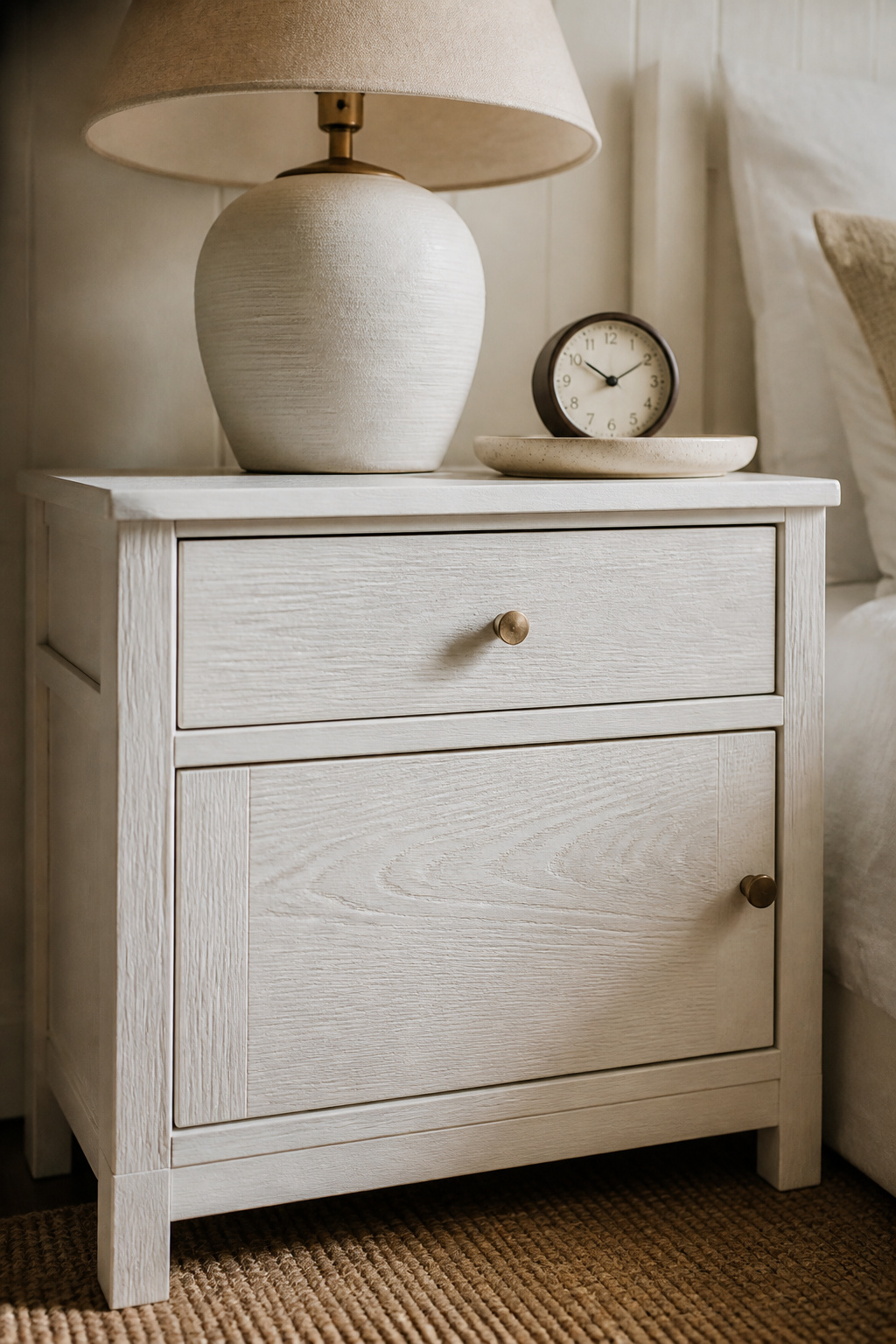
White-painted solid wood is a genuinely beautiful material in a bedroom. The grain reads through the paint. White oak is the standout species: its open grain structure absorbs paint into the channels while the surface wood stays bright. The result is a two-tone depth effect. Ash has similarly pronounced grain lines. Birch takes white paint evenly and smoothly — the right choice for a cleaner, less textured result.
For paint: chalk paint (Annie Sloan is the benchmark) adheres to bare wood without primer and contains low VOC levels. It produces a matte, grain-revealing finish that suits a white bedroom aesthetic well. For maximum durability, low-VOC eggshell latex — Benjamin Moore Natura or Sherwin-Williams Harmony — produces the smoothest result over well-prepped wood. Two thin coats reveal grain better than one thick coat.
The best place to start: the bedside table. It’s the highest-impact element in the room and the most affordable solid wood piece to source. For broader ideas on shaping a bedroom through furniture choices, the range of bedroom furniture decor ideas for a dream space is worth exploring before making any significant purchases.
6. Bouclé Headboard Against a Limewash Wall: The Soft White Bedroom Aesthetic
Of all the combinations defining the soft white bedroom aesthetic in 2026, this is the one with the most design logic behind it. Two matte, light-absorbing surfaces placed against each other create depth without contrast. Warmth without colour.
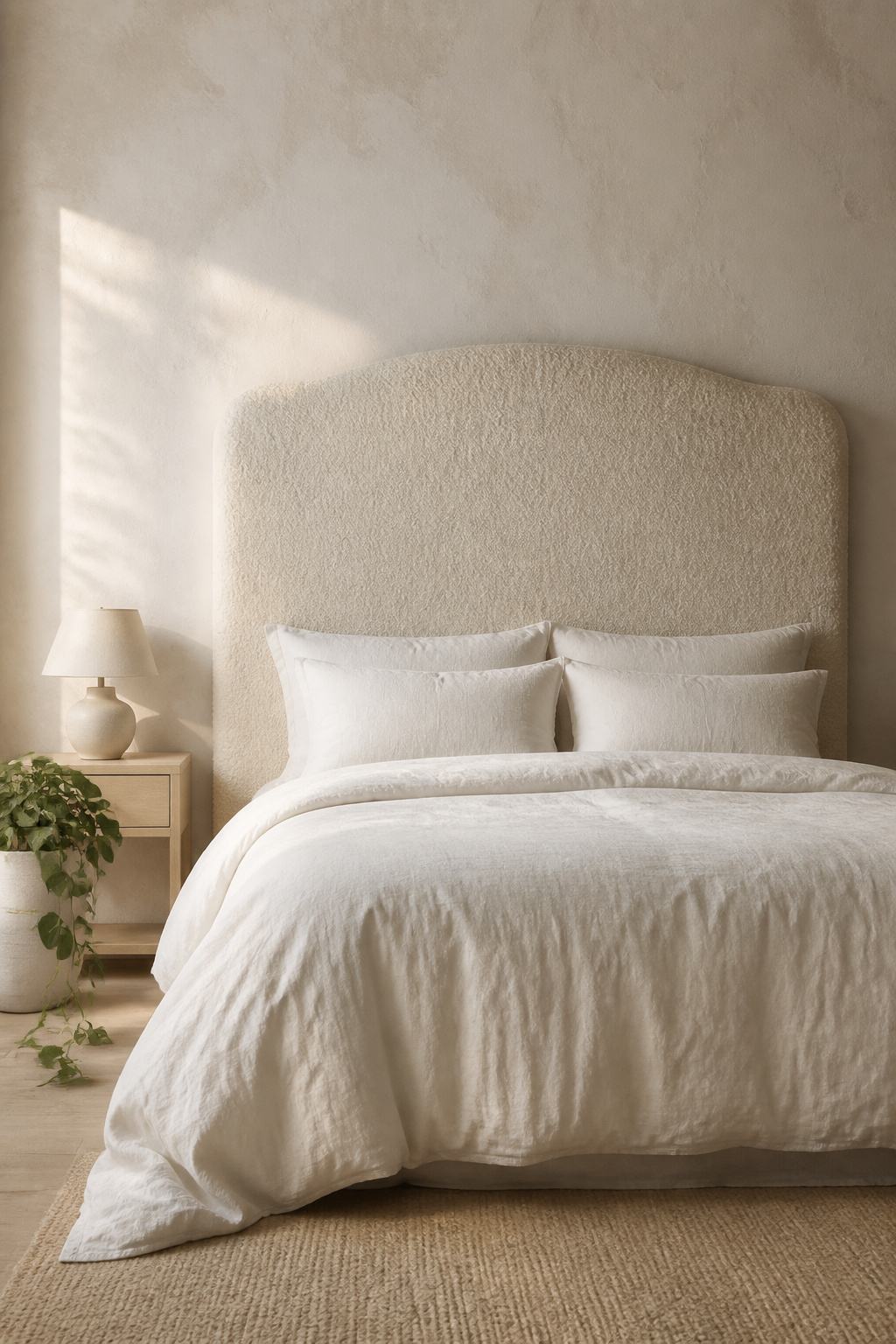
Bouclé — a looped-yarn fabric with a characteristic nubbed surface — became the signature bedroom textile of warm minimalism for a specific reason. It manages a difficult balance: it adds tactile interest and visual weight without pattern or hue. In its natural wool form, it’s genuinely hypoallergenic, naturally fire-resistant, and moderately humidity-regulating. SoftFrame Designs and Article both produce well-regarded options. West Elm sits in the accessible mid-market. Custom upholstery with a fabric-store bouclé, done by a local upholsterer, is the highest-quality route.
For sizing: headboard width should sit within 5cm either side of the mattress. For a king (193cm mattress), 180-200cm is correct. At 130-150cm height, you get the impression of luxury without a custom piece.
The limewash wall behind it is what elevates the combination. Romabio Velatura Mineralwash is the correct product for interior drywall. Their exterior Classico Limewash is designed for masonry — a different substrate entirely. The Velatura process uses a crosshatch first coat applied undiluted, then a second coat diluted 50-80% with water and applied with both brush and cloth. The varying absorption creates the tonal movement. Portola Paints Lime Wash in Beeswax is the widely used alternative. It reads warmer as it dries and shifts noticeably as the light changes through the day. Leave 5-8cm of limewash wall visible on each side of the headboard. Against a textured surface, that border isn’t empty — it’s part of the design.
7. Sheer Linen Curtains That Diffuse Light Without Breaking a White Bedroom’s Calm
Blackout curtains are the standard bedroom recommendation. For some people, they’re right. But for anyone sleeping on a conventional schedule, blocking all morning light has a biological cost worth considering.
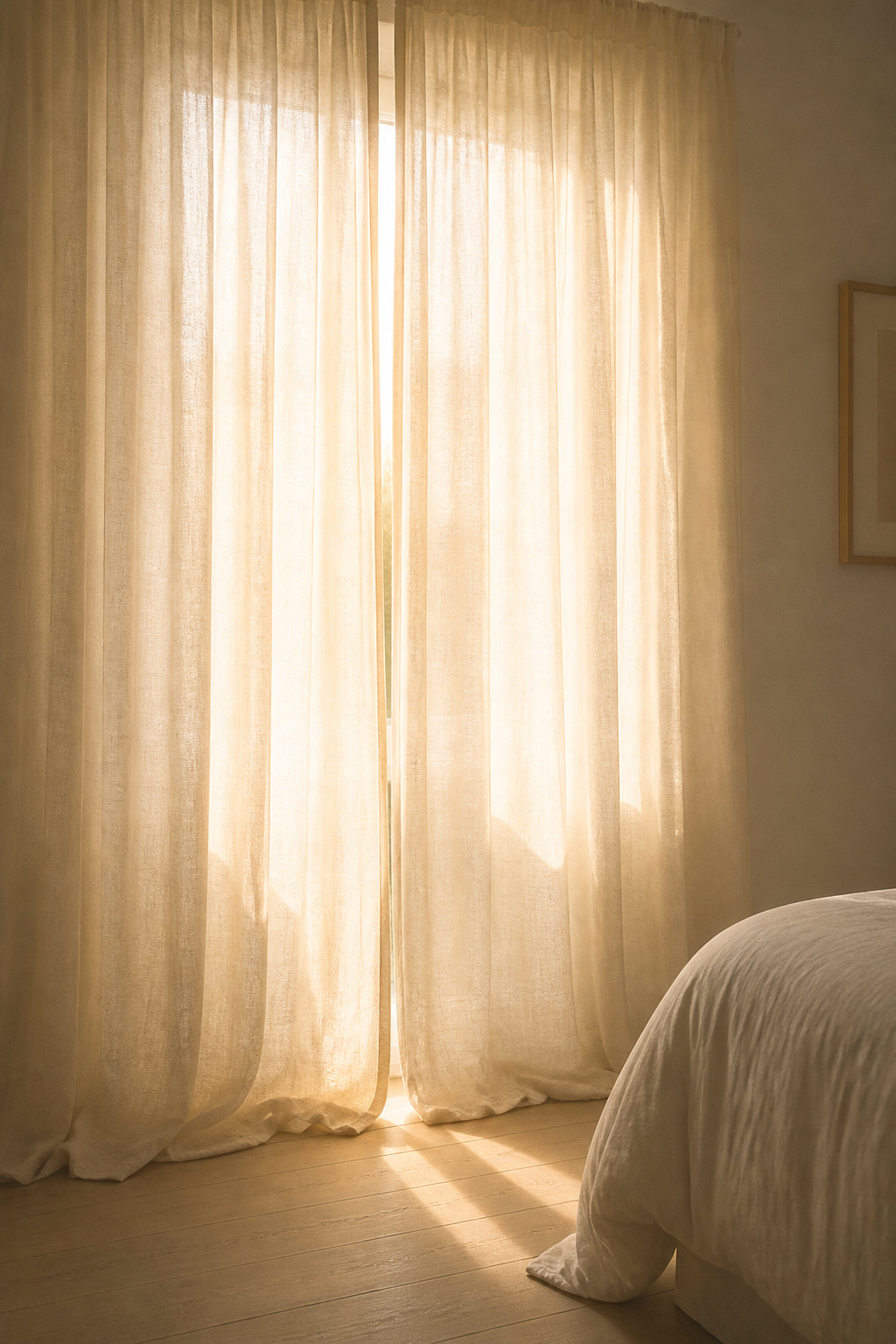
Morning light is the primary external cue for circadian rhythm alignment. It signals the brain to reduce melatonin production and begin producing cortisol and serotonin. These are the hormones that create genuine wakefulness — not the blunted, groggy feeling of sleeping through an alarm. Sheer linen curtains filter this morning signal rather than blocking it. They preserve the biological benefit while removing the harshness of direct sunlight across white walls.
The practical recommendation for a white bedroom: sheer linen panels during the day, a secondary roller blind behind them at night. This two-layer system handles the morning light cue and the evening darkness requirement without compromising either. The linen diffuses; the roller blocks.
Getting Curtain Drop and Fabric Right
Ceiling-to-floor curtains are the only approach that works in a white bedroom. Anything shorter looks cropped and slightly makeshift. Hang the rod at ceiling height — within 5cm — and allow panels to reach the floor with a 1-3cm puddle for a relaxed quality. Standard windows are typically 210-230cm from floor to window top. A ceiling rod at 240-250cm requires panels of at least 245-255cm. Always measure your actual ceiling height before ordering.
IKEA Ritva (white linen, 145x300cm) is the most widely recommended affordable option. Pottery Barn’s Belgian Flax Linen sheers are a step up in hand feel. For maximum organic quality, undyed natural linen from a fabric supplier made up by a curtain maker is often no more expensive than branded retail panels.
Unlined linen diffuses light with an organic, slightly crinkled texture that catches light beautifully. Voile (fine woven polyester) is smoother and more transparent but brings the VOC concern of synthetic fabrics. Linen wins on both aesthetic and material grounds.
8. Understated Wall Art That Sits Quietly in a White Bedroom
Bedroom art has one job that living room art doesn’t. It should not activate.
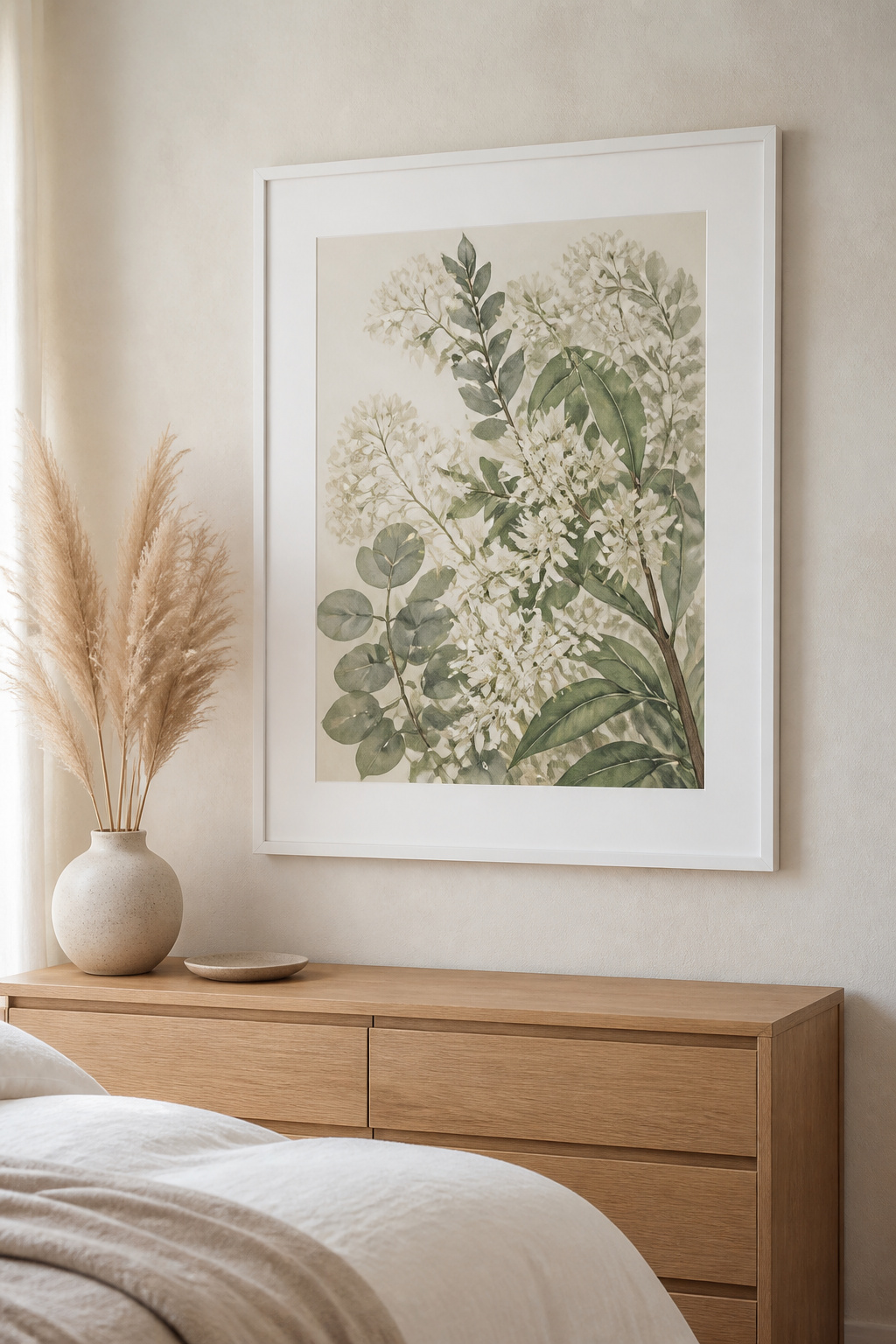
Research in environmental psychology consistently finds that visual stimulation in sleep environments interferes with the nervous system’s wind-down. Bright reds, electric blues, high-contrast photography, and imagery depicting movement or conflict are all counterproductive in a rest environment. What works instead: minimalist compositions, soft botanical prints, abstract mark-making in muted tones, and landscape photography without dramatic contrasts.
From a feng shui perspective — one of my specific areas of study — bedroom art should depict stillness. Calm water, open landscape, a single plant form. Nothing that represents busy activity or conflict. Environmental psychology research supports this: studies consistently find that nature scenes and minimalist abstract compositions lower blood pressure and reduce cortisol.
Framing, Scale, and Placement
For framing in a white bedroom: white frames make art float, which is the right effect with abstract or minimal work. Natural wood frames — light ash or untreated oak — introduce the warm wood accent that item 13 describes, and at minimal cost compared to a piece of furniture. A wider mat (7-10cm) makes a small or medium print feel considered rather than rushed.
Scale matters more than most people expect. A single large piece (80x100cm minimum for a king bed feature wall) is visually more powerful than a gallery wall of smaller pieces in a white room. Hang the centre of the artwork at 145-150cm from the floor — eye level when standing. For a gallery wall, Margot’s rule: all frames the same colour, consistent mat widths, and a maximum of five pieces in a tight arrangement. More than five creates the visual activity that undermines a restful environment. For a much broader range of approaches to how a bedroom wall can tell a story, bedroom wall decoration ideas explores the full range.
9. Low-EMF Minimalism: White Bedroom Decor With Intentional Purpose
Intentionality is the word I return to in wellness bedroom design. It’s more useful than minimalism, because minimalism is about aesthetics — about how things look. White bedroom decor built on intentionality asks a different question of each object: does this earn its place here?
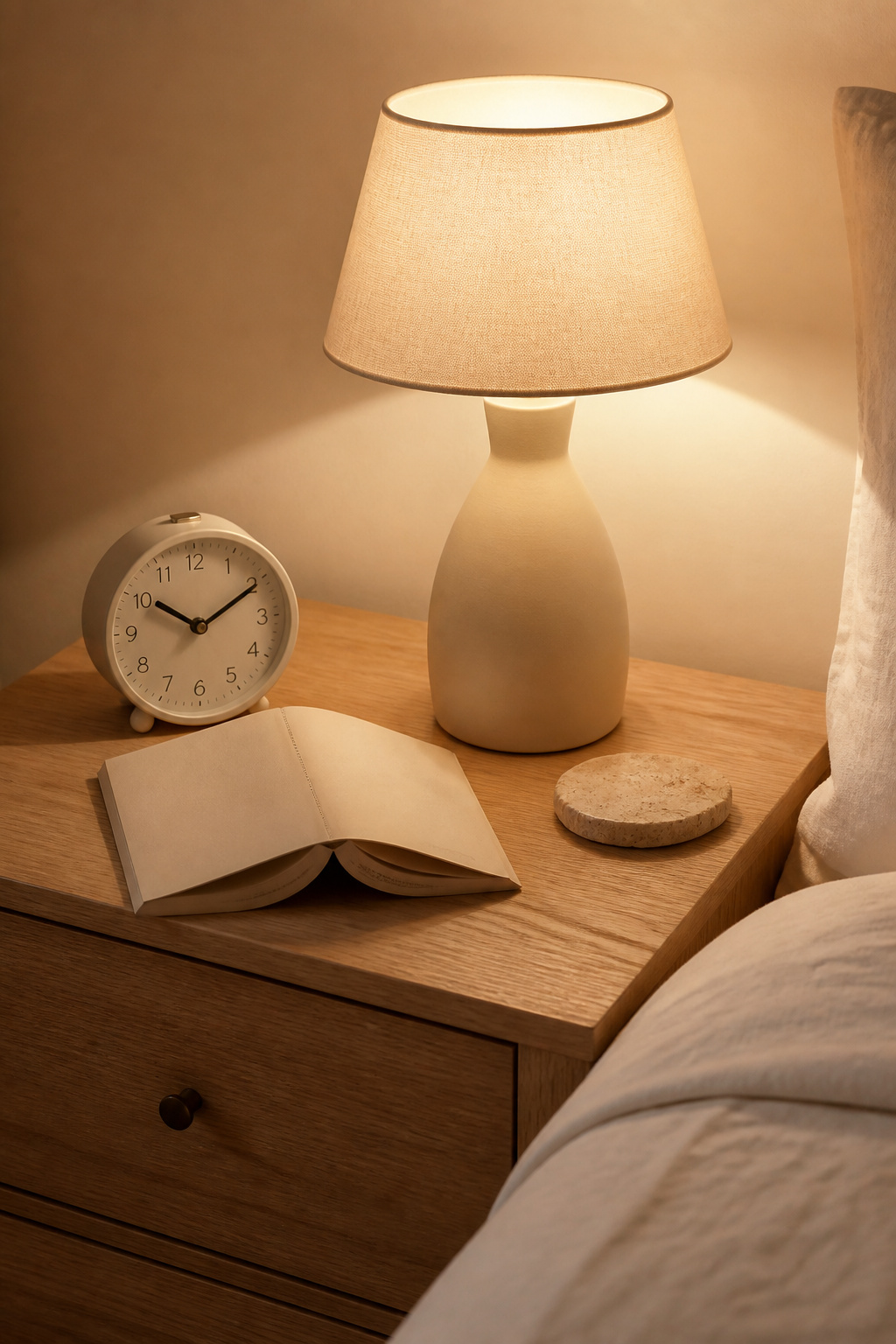
The EMF-conscious dimension of this question has gained traction in wellness interior design. Common bedroom EMF sources include mains-powered digital clocks at close range, phones kept on the bedside, wireless-enabled smart bulbs, and Wi-Fi routers directly adjacent to the bedroom. Research on radiofrequency electromagnetic fields and sleep quality shows correlations between device exposure at night and disrupted sleep architecture. Results across studies are mixed, and the field is still developing. However, the simpler evidence-based principle holds: electronic devices in bedrooms disrupt sleep.
The white bedroom aesthetic makes device creep immediately visible. Anything that doesn’t belong — a black phone, a grey laptop, a charging brick — shows up against white surfaces. The room itself becomes an accountability tool.
The practical swaps are genuinely simple. Replace a mains-powered digital clock with a battery-powered analog. Battery clocks produce minimal EMF; analogs produce essentially none. Move phone charging to a different room or to the opposite wall. Choose a bedside lamp with a conventional physical switch rather than a wireless smart bulb. Schedule the Wi-Fi router to switch off between 10pm and 6am — most routers have a built-in scheduling function, and this costs nothing.
The white bedroom with intention isn’t sparse. It’s deliberately, purposefully occupied.
10. Limewash Walls in White: Depth and Texture Without Adding Colour
Flat white paint is a starting point, not a destination. What prevents an all-white bedroom from feeling featureless is the same thing that prevents a blank page from feeling like a document: texture, variation, and a sense that the surface has been made rather than applied.

Limewash is the answer. Unlike flat paint, which sits on the surface and produces a uniform, static finish, limewash penetrates the wall and is absorbed unevenly at the microscopic level. The result is tonal movement — slightly darker in shadow, almost luminous in direct light — that shifts visibly as the light changes through the day. No other product replicates this.
Romabio Velatura Mineralwash is the correct product for interior drywall. The application technique matters: the first coat is crosshatched using undiluted product, covering the full surface with random brush strokes. The second coat is diluted 50-80% with water and applied with both brush and cloth. The cloth removes material unevenly. That’s what creates the characteristic movement.
For colour: Portola Paints Beeswax reads warm and honey-tinged, shifting perceptibly with light throughout the day. Romabio Bianco Antico is cooler and crisper, close to pure white in daylight. Portola Chalk sits between the two — the most versatile choice for bedrooms with uncertain orientation or mixed natural light.
One important point: limewash on all four walls (or at minimum three) creates the enveloping quality that makes the effect work. A single limewash accent wall against flat-painted others reads as unfinished. The texture needs to wrap the room to produce the intended warmth and depth.
11. Plants, Stone, and Wood: Biophilic Touches for a White Bedroom Aesthetic
Research in biophilic design is consistent: exposure to natural elements — living plants, unfinished wood, raw stone — lowers cortisol and reduces physiological stress markers. In a white bedroom, these natural elements don’t compete with the palette. Against white, they read more clearly than in any other environment.
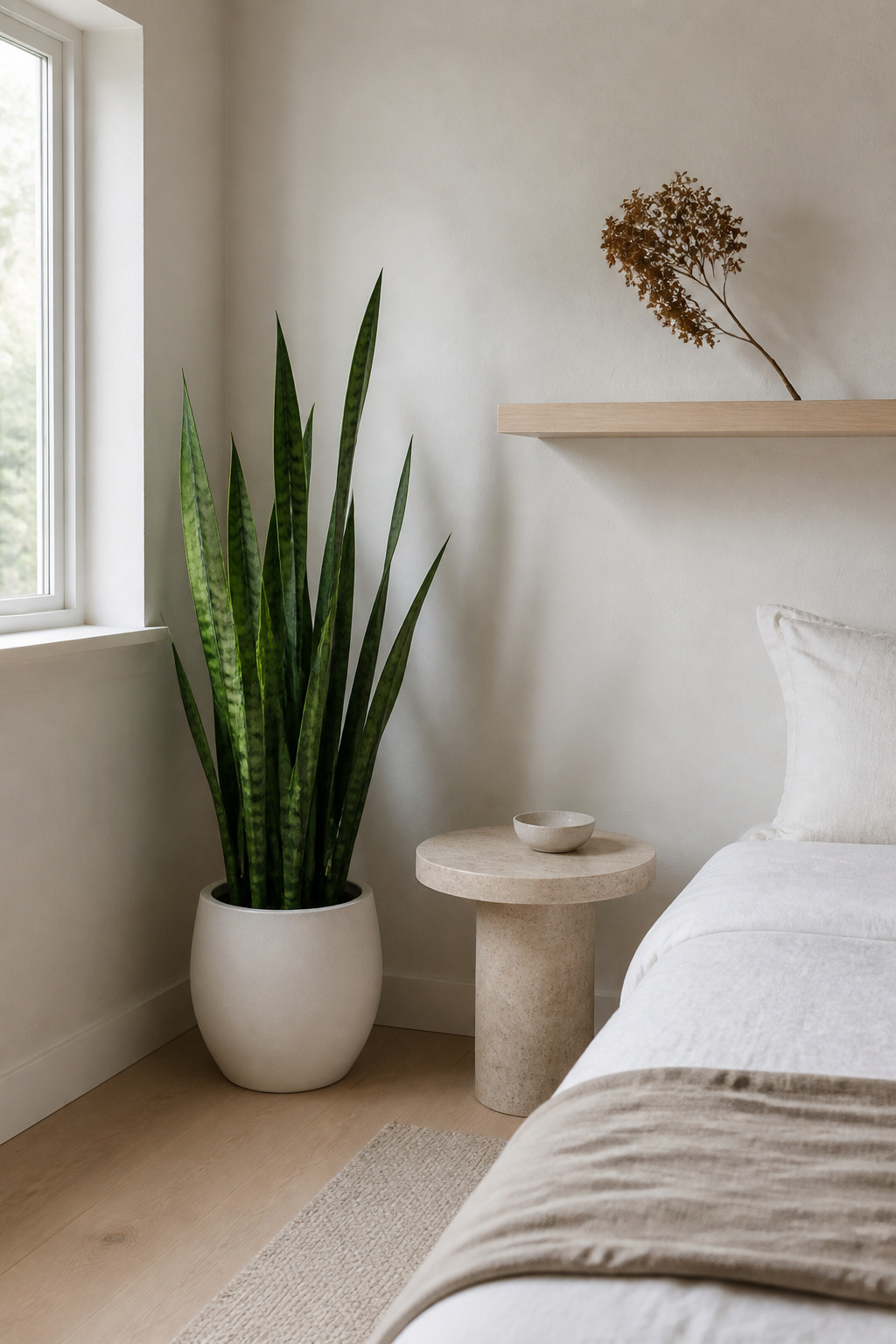
On plants: the NASA Clean Air Study’s 1989 findings are often cited in wellness design, with some important context. The study was conducted in sealed chambers. In a ventilated home, the air-purifying effect is real but less dramatic. What holds for the bedroom is this: snake plant is the most practically useful choice. It releases oxygen at night rather than switching to CO2 absorption in darkness, as most plants do. It requires minimal light and is genuinely difficult to kill. Peace lily absorbs the broadest range of VOCs in the NASA data but needs more light and is toxic to pets — a consideration for some households.
For stone: a honed marble or travertine bedside table surface is the most impactful natural stone element. Honed (matte) marble — Calacatta or Bianco Carrara — reads warmer than polished and doesn’t show fingerprints as readily. A single rough-surface travertine piece as a decorative object is the lowest-cost natural stone introduction in a white bedroom aesthetic.
The Three-Material Rule
The material balance principle: if the room already has linen bedding (one natural material) and a jute rug (two), adding one wood furniture piece (three) is the right limit. Stone and plants fit within this framework rather than adding new categories. More than three primary natural materials in a white bedroom reads as overcrowded. One sculptural snake plant in a white ceramic pot is better than four small assorted ones — scale and intention matter as much as species.
12. Built-in White Storage That Keeps Allergens Low and Visual Clutter Gone
Open shelving in a bedroom looks beautiful in photographs and accumulates dust in practice. Mayo Clinic guidance specifically recommends storing clothing in drawers and closets rather than on open shelves for allergen-sensitive households. In a bedroom — where everyone is effectively an allergen-sensitive household — this principle applies broadly.
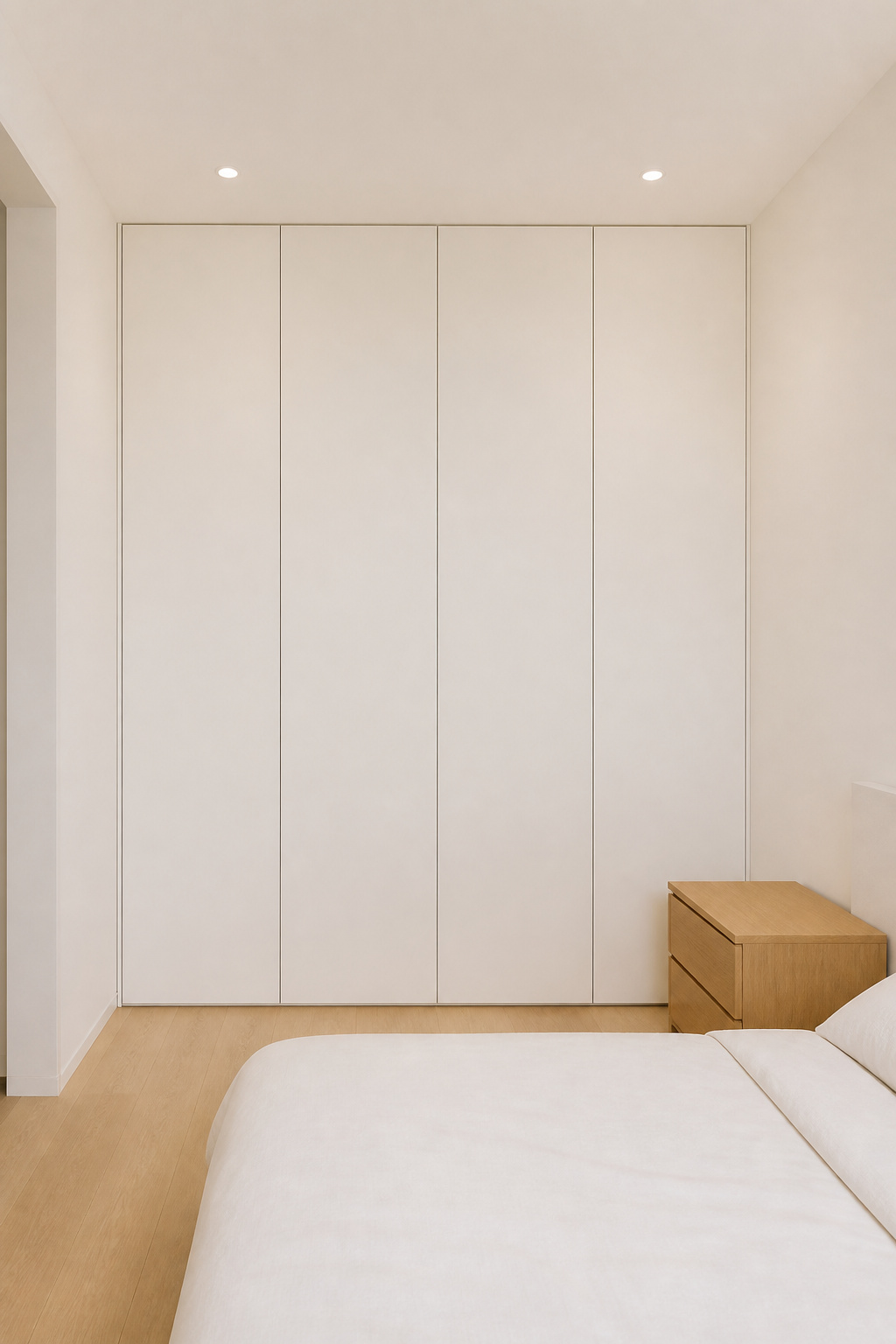
Dust mites thrive in undisturbed fabric-and-dust environments. Closed drawers and wardrobe interiors, kept at 40-50% humidity, are significantly lower-mite habitats than open shelving with folded textiles. The visual and health arguments arrive at the same conclusion: close the storage.
White built-in wardrobes are the aesthetic ideal. They disappear into white walls and create the seamless, uncluttered quality that defines a considered white bedroom. For renters or those without the budget for true built-ins, IKEA PAX in white is the most widely used alternative. The key to making PAX read as built-in: run the units floor-to-ceiling using a spacer panel cut to fill any gap at the top, then paint the doors to match the wall colour. A PAX wardrobe in Sherwin-Williams Alabaster on Alabaster walls is, at normal viewing distance, effectively invisible.
Touch-latch or push-to-open doors — no visible hardware — are the most seamless choice. IKEA doesn’t offer this natively on PAX, but aftermarket push-to-open mechanisms install easily. For bedside storage: hard-sided containers with smooth surfaces (ceramic, lacquered wood, or glass) rather than fabric bins. Fabric containers trap allergen particles and are harder to wipe clean. For creative and practical storage approaches across all bedroom types, genius bedroom storage solutions to declutter covers a broad range of options at various budgets.
13. Natural Wood Accents That Ground a White Bedroom Without Breaking the Palette
A white bedroom with no natural materials feels like the before photograph in a renovation feature. Aesthetically correct, but not yet human. One or two pieces of well-chosen natural wood are the objects that make a white bedroom feel inhabited rather than staged.
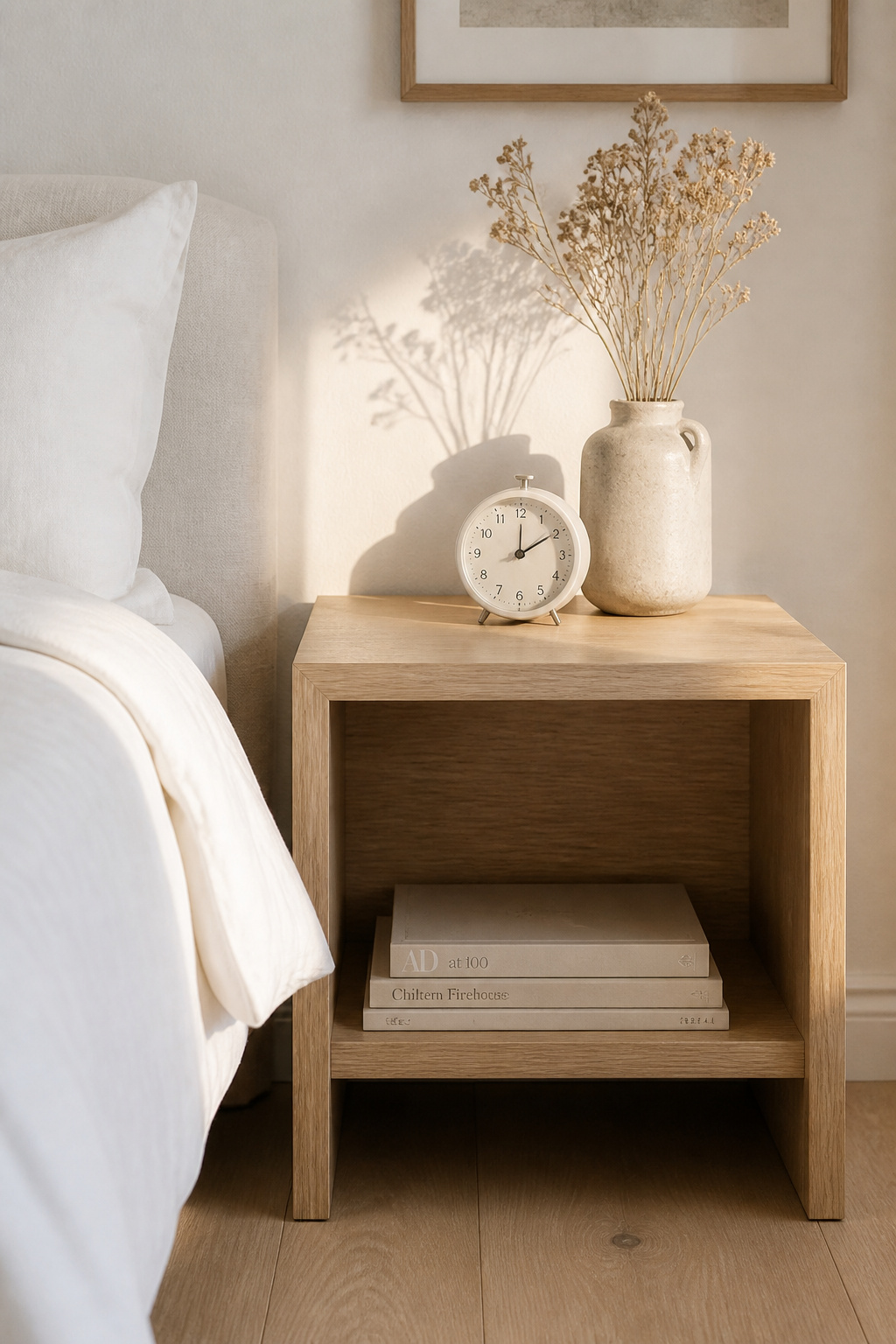
Research in biophilic design supports this at a physiological level. Studies consistently show that exposure to wood as a visible surface material lowers cortisol and reduces stress markers. The white bedroom is, in part, an architecture for the nervous system. Natural wood is one of its most effective components.
The most impactful single wood element is the bedside table. It’s always in frame, always within reach, and provides the warmth anchor that the rest of the white room can float around. Light ash and blonde oak are the two wood tones that work most consistently with white: pale and golden-cream, they read as warm without dominating. Dark walnut or mahogany creates too stark a contrast in an all-white room, pulling focus rather than providing quiet warmth.
Muji’s light ash furniture range, IKEA HEMNES in natural stain, and West Elm’s light wood bedside collections are the three most accessible starting points at different price levels. For a more considered aesthetic, a simple solid ash or white oak piece from a local joiner — an open-shelf bedside, a small bench at the foot of the bed — is often no more expensive than a mid-market retail option, and is typically solid wood throughout.
How Much Wood Is Too Much
The 80/20 principle: white (walls, bedding, furniture) should account for roughly 80% of the visual surface area. Natural materials — wood, linen texture, stone, seagrass — should make up the remaining 20%. When wood proportion rises above 30-35%, the room begins to read as ‘natural materials room’ rather than white bedroom aesthetic. The single bedside table that provides warmth and anchor is usually enough.
14. Layered Warm Lighting for a White Bedroom Look That Supports Deep Sleep
White walls amplify every light source in a room. A 2700K bulb in a bedroom with dark walls is warm. The same bulb in a white bedroom is warm and bright — the reflective surfaces multiply the light quality in ways that make colour temperature more consequential here than in any other room.
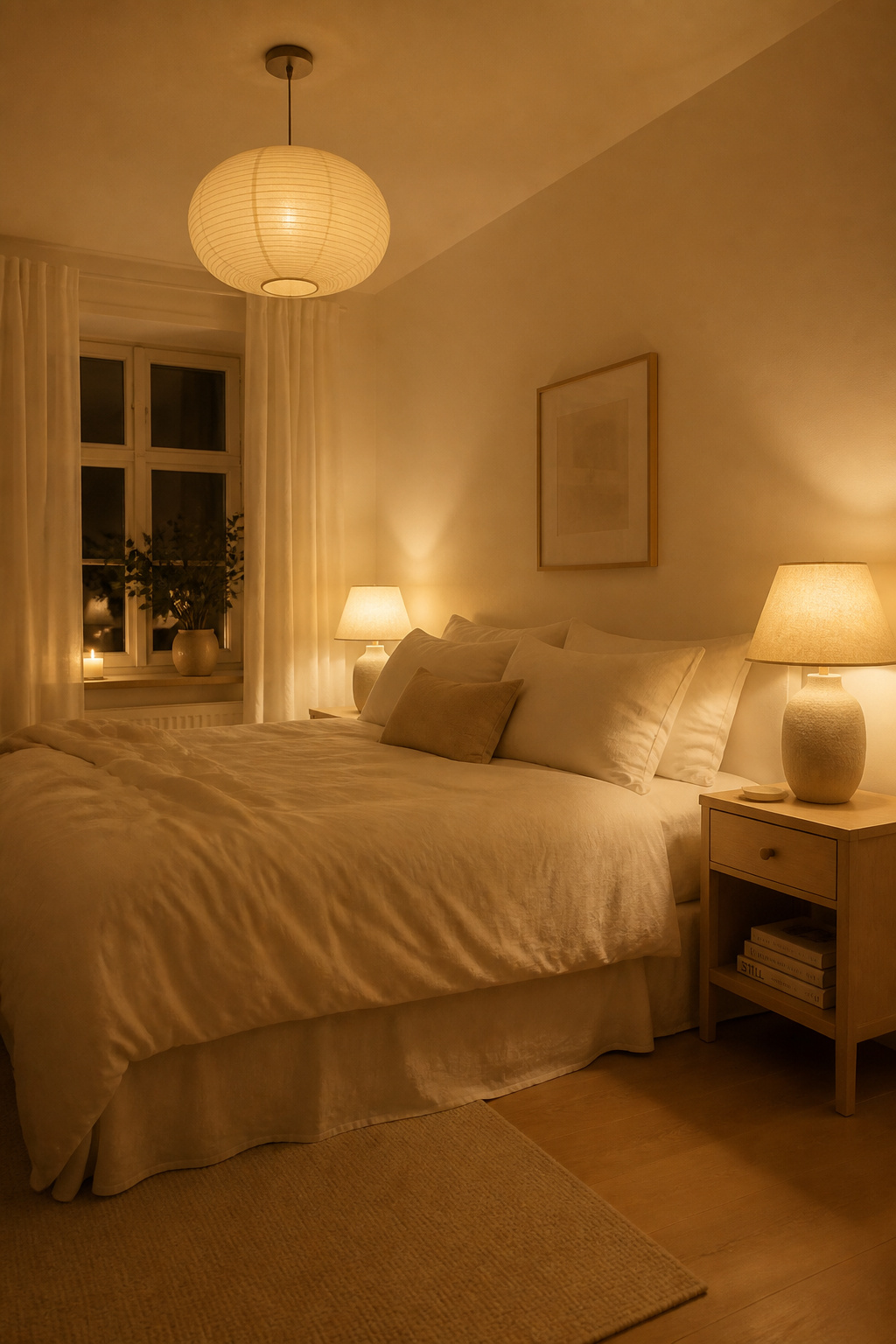
The number is 2700K. That’s the maximum colour temperature for any light source used in a bedroom in the two to three hours before sleep. At 2700K, the light is warm and yellow-tinged with minimal blue spectral output. It’s blue-spectrum light that suppresses melatonin production. At 3000K — which many people prefer aesthetically, as it doesn’t ‘yellow’ whites as visibly — there’s enough blue to meaningfully affect melatonin. Harvard sleep research is unambiguous: cool-white or daylight-spectrum light before bed delays sleep onset and reduces sleep quality.
Building the Three-Layer System
The layered approach that works: ambient (one central pendant or two wall sconces on a dimmer, 2700K), task (two bedside lamps at eye level when sitting up, 2700K), and accent (a corner floor lamp or shelf light, 2700K). All three layers should be individually dimmable. The difference between 80% and 20% brightness on the same 2700K bulbs is the difference between alert and genuinely ready for sleep.
For dimmer switches: Lutron Caséta is the most reliable and LED-compatible option. Standard dimmers cause LED flickering; Lutron’s forward-phase dimming solves this across most bulb brands.
Bedside lamp aesthetics: a simple ceramic or natural wood table lamp with a linen shade diffuses 2700K light to an even warmer quality. Linen shades filter some blue and add a slight amber tone that suits a white bedroom perfectly. For a much broader range of bedroom lighting approaches, dreamy bedroom lighting ideas for your next refresh covers both the aesthetic and practical dimensions thoroughly.
15. Pale Timber, Marble-Effect Tile, or Limewashed Concrete: The White Bedroom Floor
The floor is the hardest element in a white bedroom to change. It’s also the decision most people make least carefully. It carries the room’s visual weight and its practical performance. Both matter.
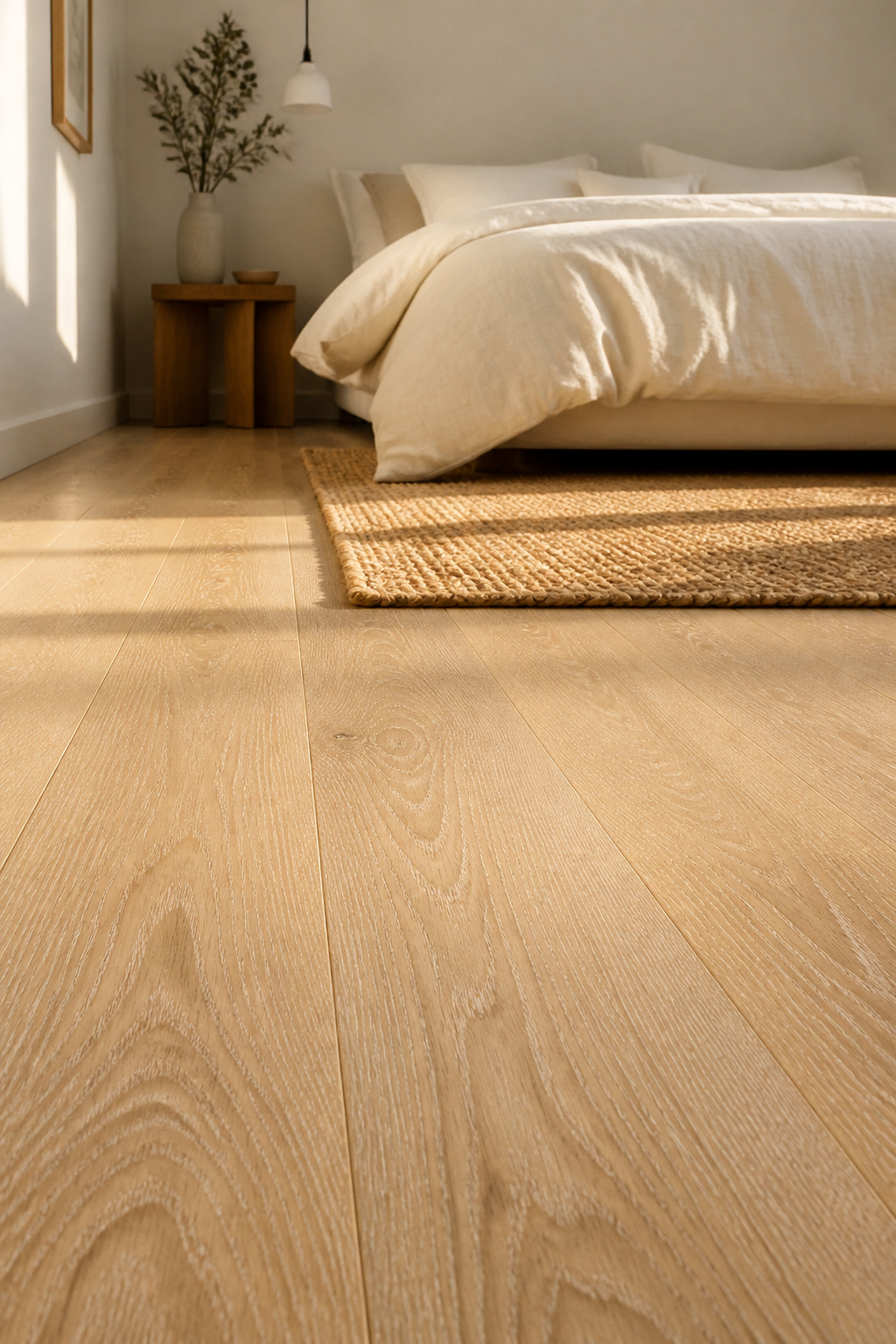
The allergen case for hard flooring in a bedroom is clear. Dust mite concentrations in carpeted floors are six to fourteen times higher than on smooth surfaces. Carpet releases more fine particles into the breathing zone when disturbed — when you walk across it, sit on the edge of the bed, or vacuum. For a bedroom designed around wellness principles, carpet works against the brief.
Pale engineered timber is the most practical and visually versatile hard floor option. Engineered timber (a real wood veneer over a plywood core) is more dimensionally stable than solid hardwood in rooms with seasonal humidity fluctuations. The plywood core resists the expansion that causes solid hardwood to gap or cup. It’s also compatible with underfloor heating. Havwoods Pale Oak, Quick-Step Impressive Ultra Soft Oak, and Bjelin’s white-oiled ash in herringbone are all well-regarded options.
Tile and Concrete — When They Work
Marble-effect porcelain tile works in a white bedroom under specific conditions: significant natural light, a substantial textile layer on the bed, and a large natural fibre rug on the floor. Without these elements, tile pushes the room toward spa rather than bedroom — striking but not restful. White-stained concrete suits a very particular industrial-meets-wellness aesthetic. It works with limewash walls, raw materials, and considerable textile layering. Without those, it reads cold.
In both cases: the floor should be slightly warmer or more textured than the walls. A bright white gloss tile or bleached-white laminate matching the wall colour removes the grounding element that makes a room feel settled. The floor needs to anchor the room — visually and in terms of practical logic.
Designing Your White Bedroom Aesthetic: Where to Begin
A full white bedroom project is an accumulation of decisions, not a single purchase. The order matters.
Start with paint and bedding. These two elements account for roughly 60-70% of the room’s visual impression. Both can be changed in a weekend. Meanwhile, test three warm whites on the actual wall — observe them through morning light and under your artificial evening lamps — and live with the samples for a week before committing. Swap the duvet cover to organic linen in white or ivory. These two changes alone show you what the room can become.
Lighting is the underrated second step. Switching existing bulbs to 2700K and adding a dimmer to the bedside circuit costs under £100 for most bedrooms. That change transforms the evening quality of any white bedroom regardless of what furniture remains.
Furniture comes last, because it’s the most expensive intervention. A wardrobe that looked fine against the old wall colour may suddenly be the wrong material or scale once the paint and bedding direction are clear.
For those who can’t paint — renters, or those living with a landlord’s colour scheme — white textured peel-and-stick wallpaper (Tempaper and RoomMates both make credible limewash-effect options), white linen bedding, a large natural fibre rug, and 2700K bedside lamps will shift the character of even a strongly coloured room. The palette sets the emotional register. The light locks it in. A white bedroom isn’t a blank room — it’s a room where everything that isn’t essential has been removed to make space for what matters.