The bathroom is where every day begins and ends. What greets you there matters more than most people realize. A chaotic counter, a shower shelf held together by optimism, a drawer that requires excavation to find dental floss — these aren’t minor inconveniences. They’re tiny stressors that compound, and they start before you’ve had a single sip of coffee.
Small bathroom organization isn’t about making your space look like a magazine shoot. It’s about designing an environment that supports your daily rituals instead of fighting against them. I’ve spent years helping clients understand that their spaces shape their moods. Nowhere is that more true than in the bathroom. When the environment is calm and functional, morning routines take half the time. When it isn’t, you begin every morning with a low-level cortisol spike you can’t quite name.
These 15 ideas range from the kind you can put in place in five minutes with no tools to the kind that require a weekend and a tile saw. Start wherever your bathroom hurts most.
1. Over-the-Door Organizers: Unlock the Small Bathroom Storage You’re Ignoring
The back of your bathroom door is offering you storage you haven’t taken. In most bathrooms, this surface is roughly six square feet of vertical space. It collects nothing but the back of the door itself. An over-the-door pocket organizer changes that without a single hole in the wall.
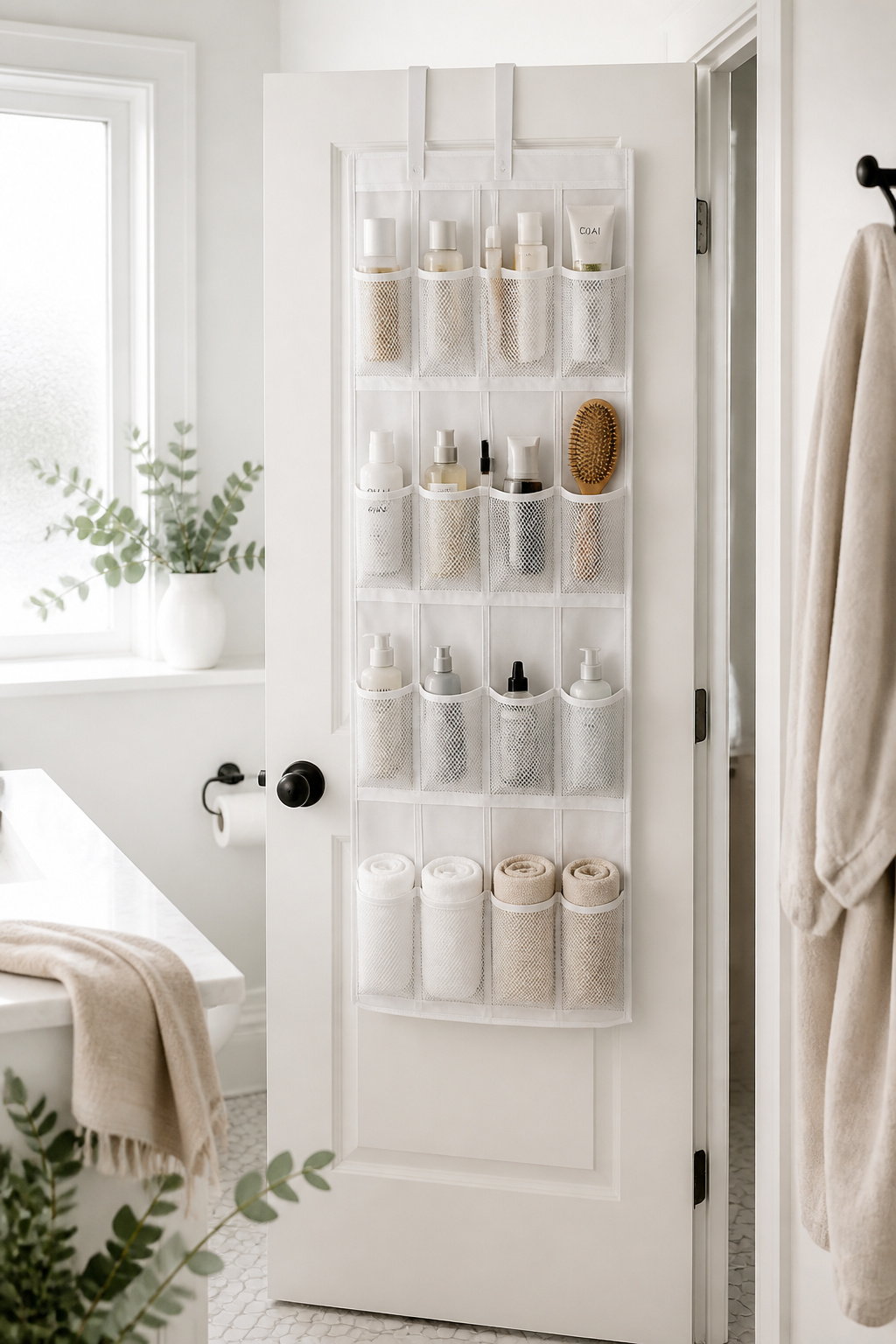
The best options for bathroom use are mesh or fabric pocket styles with rust-resistant hardware. Smart Design’s 42-pocket VentilAir mesh organizer holds up to 44 pounds across all pockets and breathes well to prevent moisture buildup. It hangs in under five minutes with three steel hooks. For heavier items — blow dryers, full-size bottles — the JARLINK 5-shelf style uses 15.7-inch deep pockets with fiberglass rods to keep them open and stiff.
For renters pursuing small bathroom organization on a zero-alteration budget, this is often the highest-return first move. Check door thickness before buying. Most hooks fit up to 1.98 inches of thickness. Distribute weight evenly across pockets rather than loading the bottom ones. These are the small bathroom storage solutions that actually work: systems you don’t have to think about once they’re in place.
2. Floating Shelves Above the Toilet: Going Vertical Changes Everything
Look up. The column of space between the toilet tank lid and the ceiling is five to six feet of completely unused vertical real estate. Two or three floating shelves in this zone add storage equivalent to a full under-sink cabinet. And they do it without claiming a single inch of floor space.
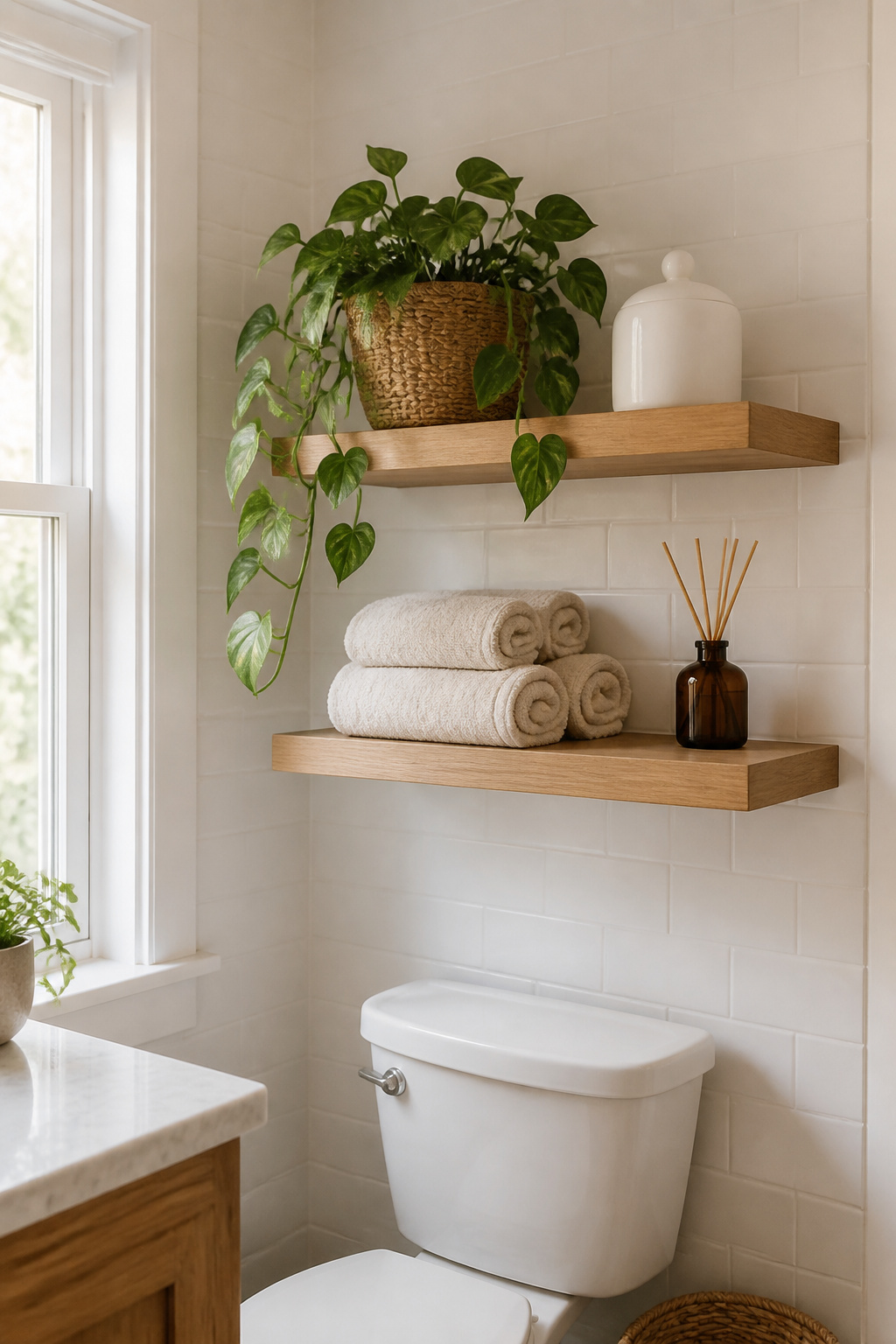
Vertical thinking is the foundation of small bathroom organization in rooms where the floor plan can’t grow. The installation numbers matter. The bottom shelf needs to sit at least 16 to 20 inches above the tank lid. That clears enough space to lift the lid off cleanly. Space additional shelves 12 inches apart. Keep shelf depth to 8 inches — deep enough for rolled towels and toiletry bottles, not so deep it becomes a head-height obstacle.
Material choice is where most people make a costly mistake. MDF and particle board absorb moisture and delaminate within a year or two. The materials that hold up are solid hardwood with a polyurethane topcoat, sealed bamboo, or powder-coated steel. Use stainless steel screws and brackets only. Chrome-plated steel chips and rusts at bathroom humidity levels. Store by access frequency: backup supplies on top, decorative functional items in the middle, daily-reach items on the bottom shelf. Set it up once and it runs itself.
3. Magnetic Strips for Grooming Tools: Small Storage With Outsized Impact
For under ten dollars, you can eliminate one of the most persistent frustrations in any bathroom. Bobby pins on the counter. Tweezers somewhere in the back of a drawer. Nail clippers that have achieved independent mobility. A magnetic strip collects all of them in one place and keeps them there.
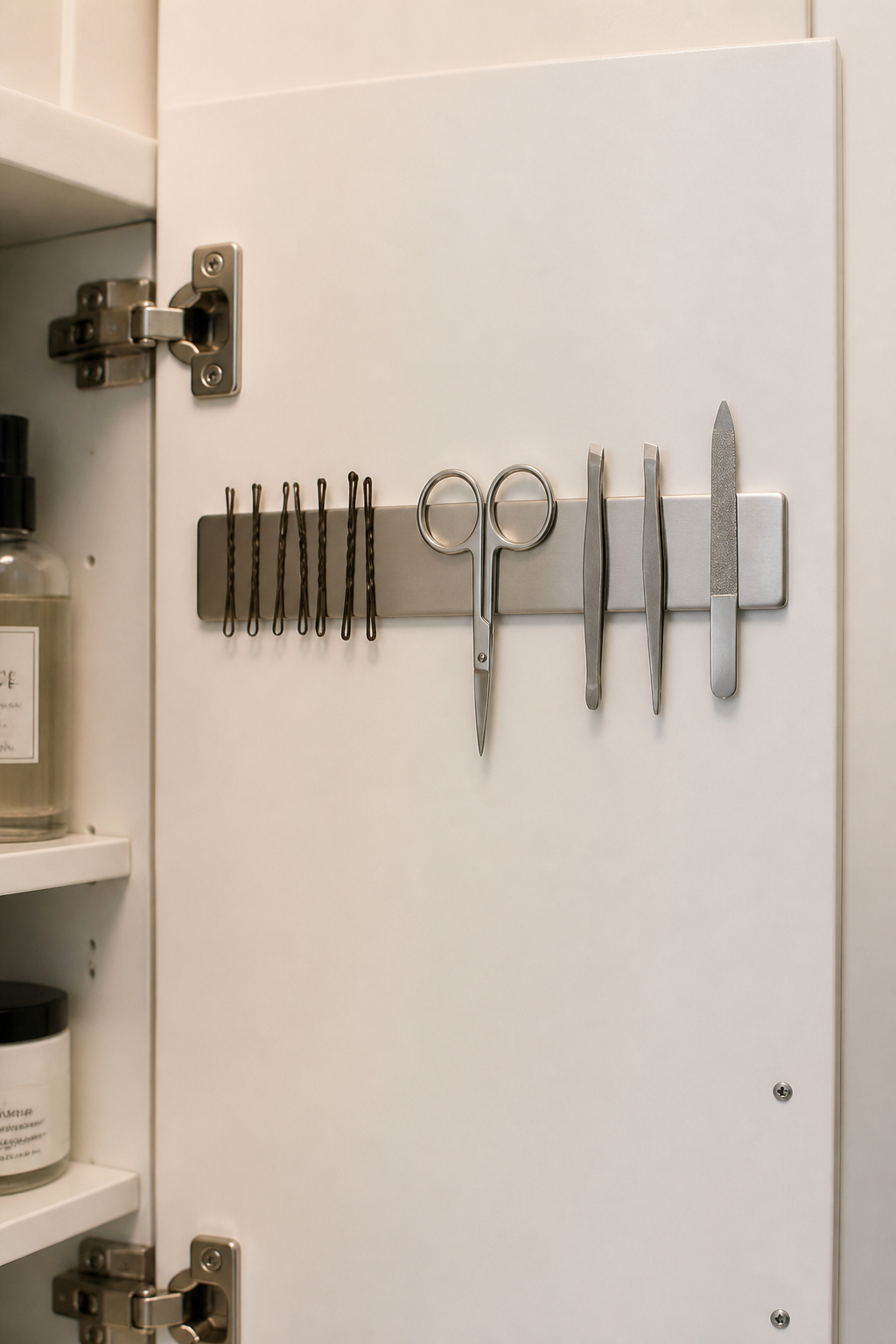
A strip labeled “strong” or “neodymium” holds significantly more than a standard fridge-magnet weight. Clean the mounting surface with isopropyl alcohol first. Bathroom humidity and dust cut adhesive bonds faster than in any other room. Press firmly along the full length. Allow it to cure for an hour. Then test with your heaviest item before committing the whole collection.
What sticks: bobby pins, tweezers, nail scissors, small nail clippers, safety pins, metal hair clips. What doesn’t: anything with a plastic or bamboo handle. The strip works on ferromagnetic metal only.
Installation and Placement
Best placement is inside a medicine cabinet or vanity cabinet door. Tools stay hidden when the cabinet is closed, protected from direct steam, and within arm’s reach during the morning routine. Self-adhesive versions are entirely damage-free for renters. A two-screw version is sturdier for owned spaces. Multiple strips side by side scale up to organize a full grooming kit. The HairpinPal countertop magnetic dome ($12 to $15) is a standalone alternative if wall space is genuinely limited.
4. Corner Shower Caddies That Actually Stay Put
The shower caddy is one of the most re-purchased items in any bathroom. Most people cycle through two or three before landing on one that doesn’t rust, fall, or create more problems than it solves. The issue is almost always the mounting mechanism. Not the caddy itself.
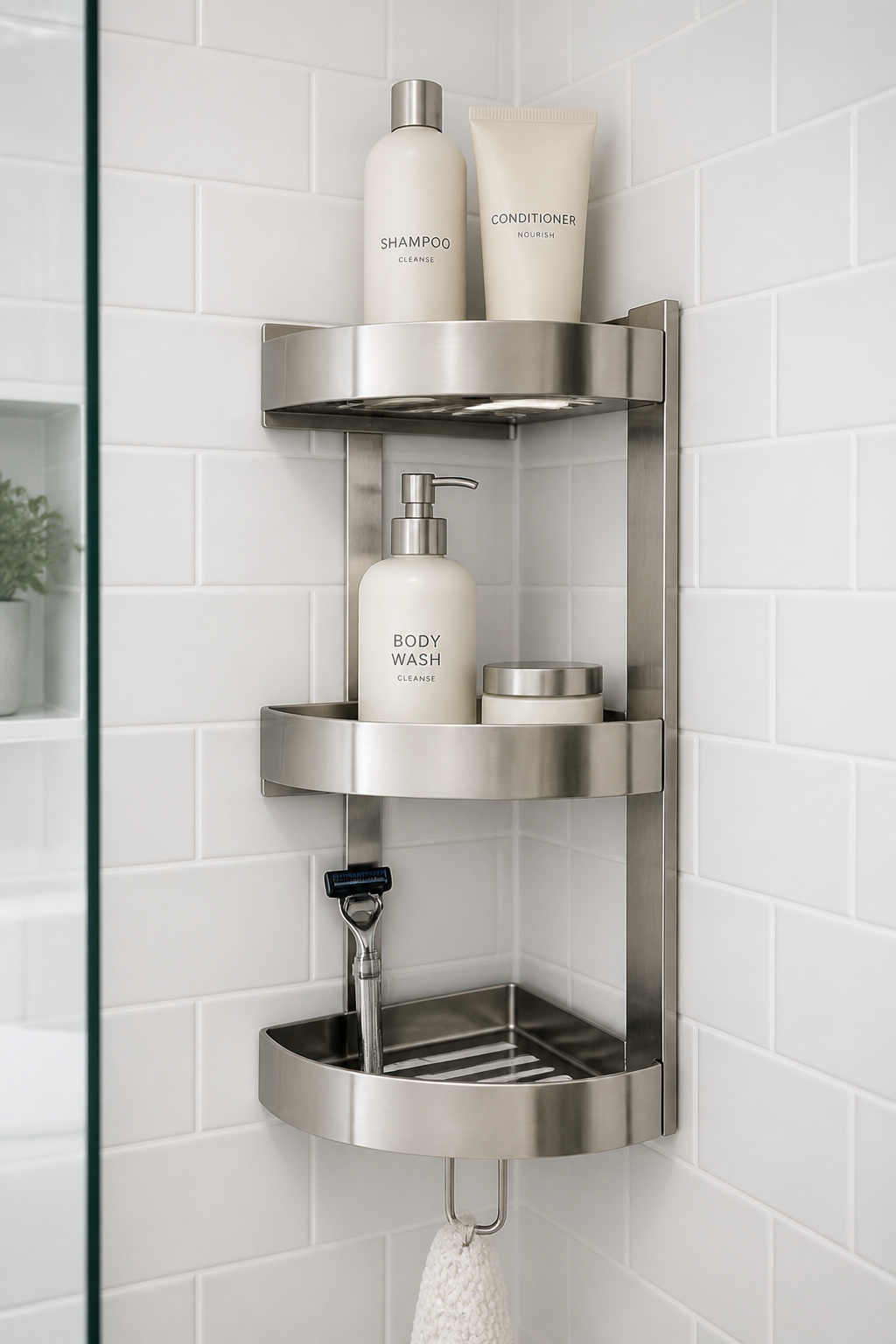
Suction cups fail on textured, matte, or natural stone tile. Any surface with micro-gaps prevents the cup from forming an airtight seal. Chrome-plated steel rusts once the plating chips. That typically happens within 12 to 18 months of daily shower exposure. Adhesive-mount caddies from brands like Moen mount flat against the wall and hold more than suction cups. They require a 24-hour cure before loading and need smooth tile to bond to. Drilled stainless steel (304 grade) is the most permanent option. A drilled bracket rivals a recessed niche for durability while staying removable.
For a shared bathroom, two separate caddies work better than one large shared unit. Individual tension pole caddies give each person a defined zone. That eliminates the daily rearrangement entirely. Tension poles need a ceiling between 8 and 9 feet to span properly. The full range of shower storage solutions covers combinations that suit different shower configurations.
5. Drawer Dividers That End the Undersink Scramble
The undersink cabinet is the most accessed storage zone in a bathroom. It’s also the most likely to become a catch-all. The plumbing already eats into the usable interior space. Without a system, items pile behind each other until everything at the back is effectively lost. The result is buying duplicates of things you already own.
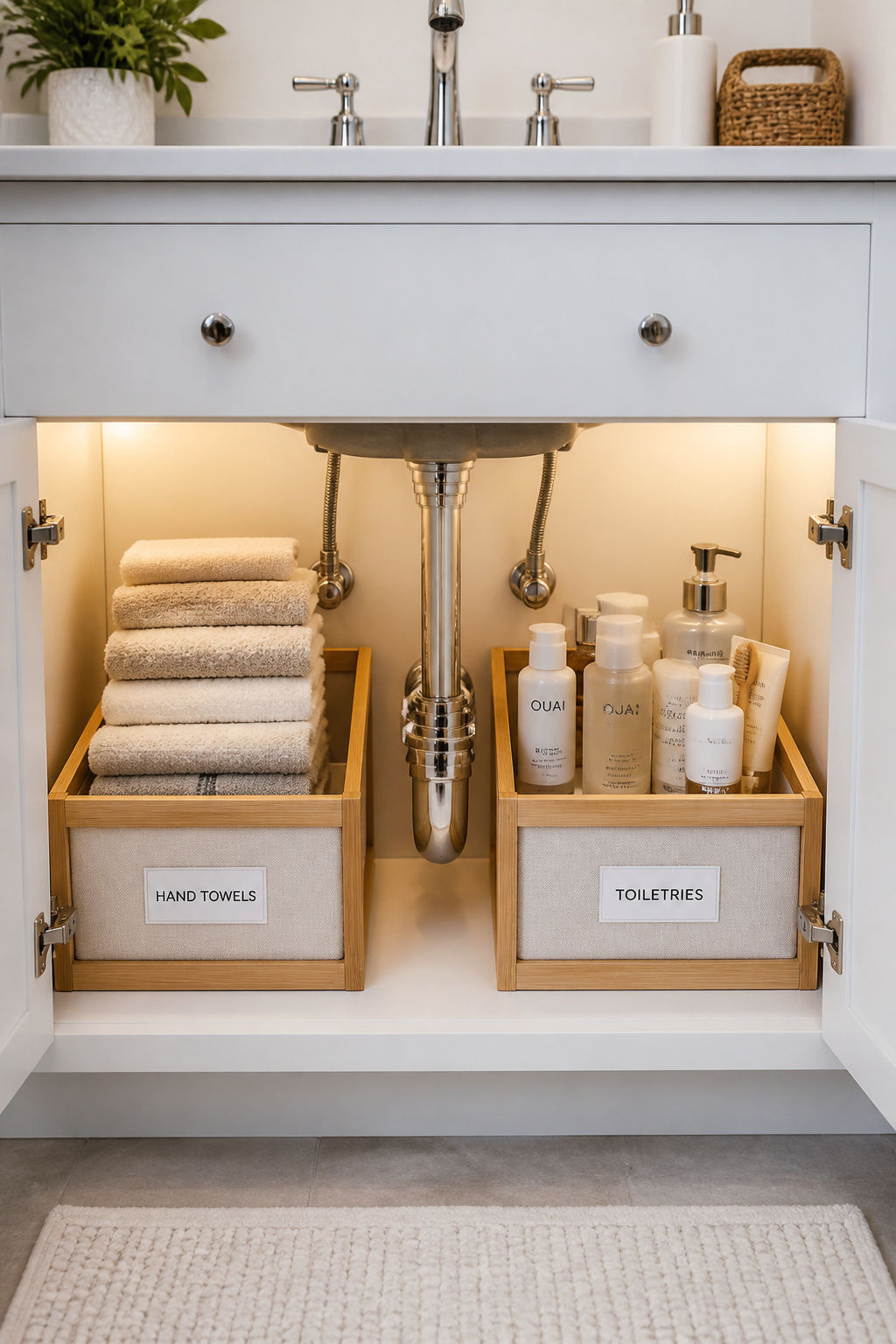
Most undersink cabinets are 24 to 36 inches wide and 19 to 22 inches deep. The plumbing column eats 4 to 6 inches of central depth. The small bathroom organization principle that works here: place one bin on each side of the pipe. Work around the obstacle rather than pretending it isn’t there.
For the drawers, adjustable expandable dividers are more useful than fixed inserts. The Masirs Expandable Drawer Organizer stretches from 9 to 16 inches wide. It sits just 1.5 inches tall — fitting in the shallow 3 to 4 inch vanity drawers where standard kitchen organizers won’t close. Bamboo versions expand similarly and wipe clean easily. Arrange by access frequency: daily items at the front, weekly behind them, monthly at the back. The bathroom is for using things, not warehousing them.
6. Wicker Baskets and Bins: Small Bathroom Organization With Warmth
Hard surfaces dominate most bathrooms. Tile, chrome, glass, ceramic — the materials that work in wet environments are also the ones that create a slightly clinical feeling. Wicker and natural-material baskets interrupt that pattern. No amount of neutral paint achieves the same effect.
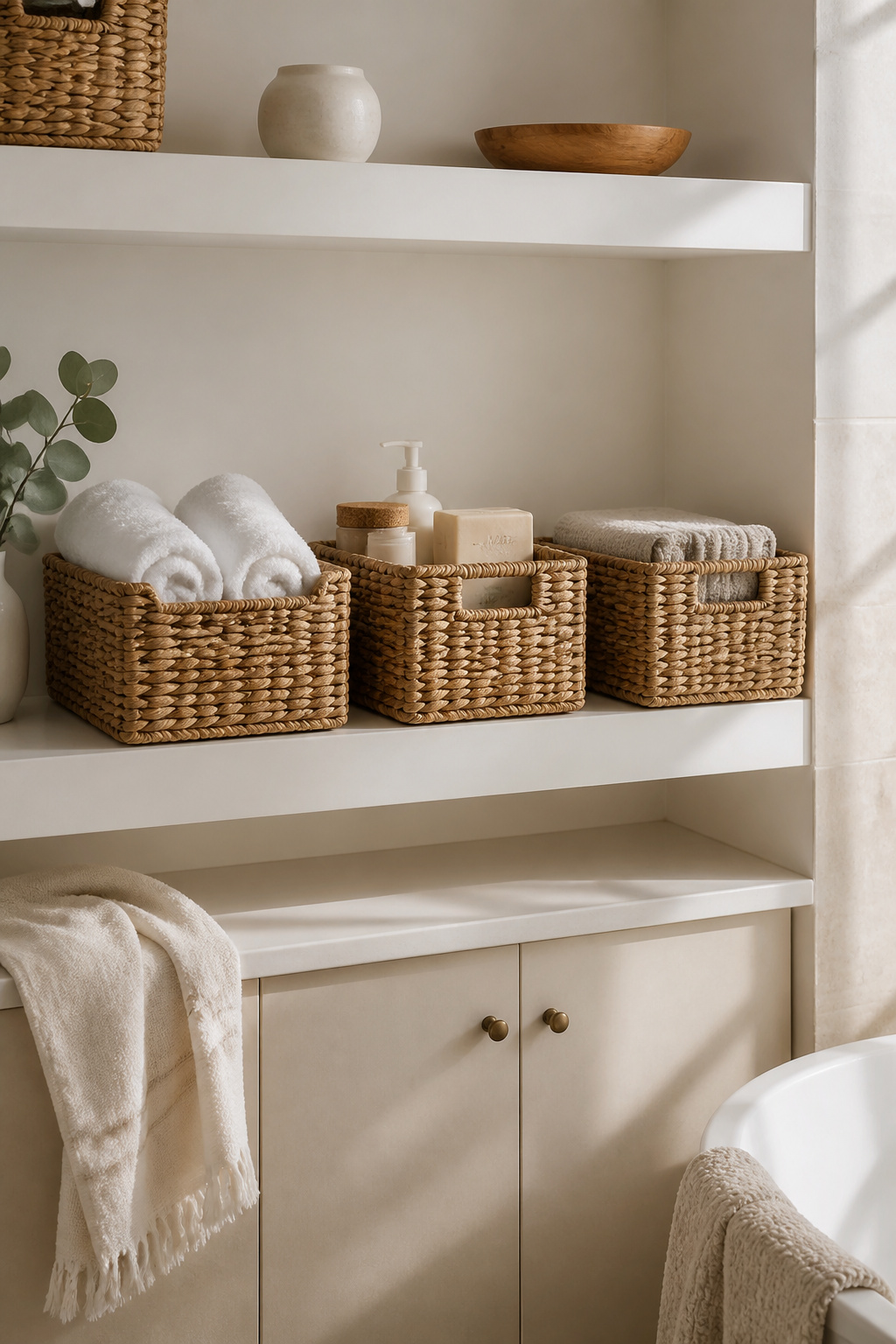
In biophilic design — the practice of incorporating natural elements into built environments — organic textures like woven seagrass signal connection to the living world. For a small bathroom particularly, where the eye has nowhere else to rest, this matters. A set of matching baskets on open shelves unifies a collection of products into something that reads as intentional rather than accumulated.
Choosing the Right Material and Size
Seagrass outperforms willow wicker in humid environments. Its natural cellular structure tolerates moisture better than most natural materials. Use cotton canvas liners if storing anything damp — wet washcloths or bottles with damp exteriors will wick moisture into any natural weave without one. Standard undersink cabinets are 19 to 22 inches deep. A basket should be 16 to 18 inches deep to pull in and out without lifting it entirely out. For 8-inch over-toilet shelves, look for shallow rectangular baskets in the 8 by 6 by 5 inch range. Measure before buying. Buy matching — three identical baskets read as a system; three different ones read as clutter in a new form.
7. Wall-Mounted Toothbrush and Cup Holders to Reclaim the Countertop
The cluster of items around the bathroom sink is where counter clutter concentrates most densely. Toothbrushes in a cup, face wash, hand soap, a stray hair clip — it’s a lot to look at first thing in the morning. A 2011 Princeton neuroscience study found that visual clutter measurably increases cognitive load. Starting every morning facing a crowded counter makes your brain work harder before the day has started.
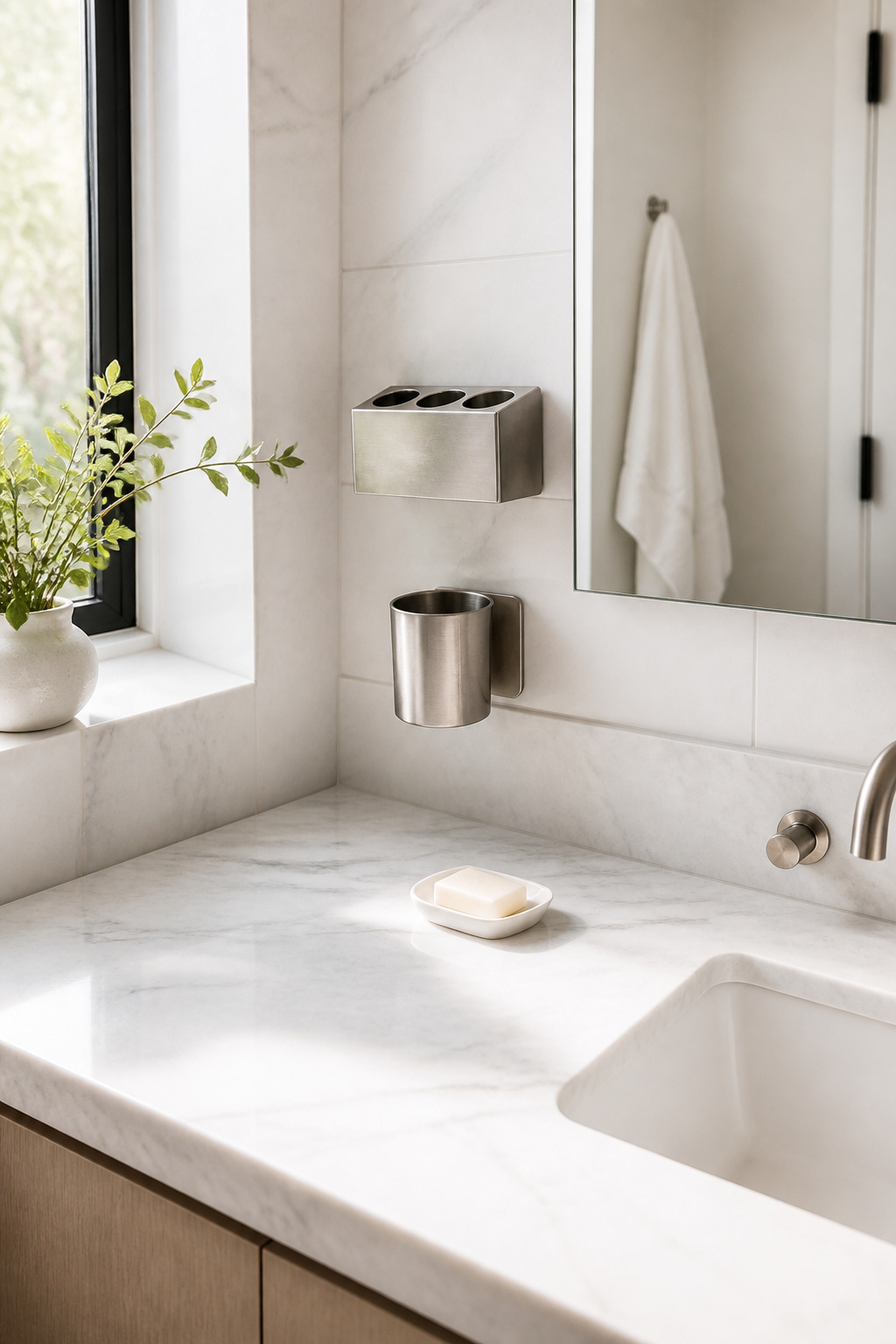
Moving the toothbrush holders and cups to the wall takes ten minutes and costs under $30. The counter immediately reads as cleaner and more designed. For mounting on tile without drilling, Command Bath water-resistant strips hold 3 to 5 pounds per mount. 3M VHB tape handles heavier ceramic or stainless holders up to 10 pounds. The key step most people skip: clean the tile with isopropyl alcohol first. Let it dry completely. Then press for 30 seconds and wait an hour before hanging anything.
For material, brushed stainless steel hides water spots and suits modern bathrooms. Matte brass reads warmer and fits transitional spaces. White ceramic suits farmhouse aesthetics but is heavier — it needs drilled mounting. If you want a broader view of small bathroom organization approaches that start from the counter zone, that’s a useful reference before choosing a mounting system.
8. Medicine Cabinets With Mirrors: A Dual-Function Small Space Essential
A medicine cabinet with a mirrored door replaces two separate requirements with one wall-hung unit. You’re not just saving money on a separate mirror. You’re getting the mirror in exactly the right location while hiding a full shelf system behind a clean flat surface.
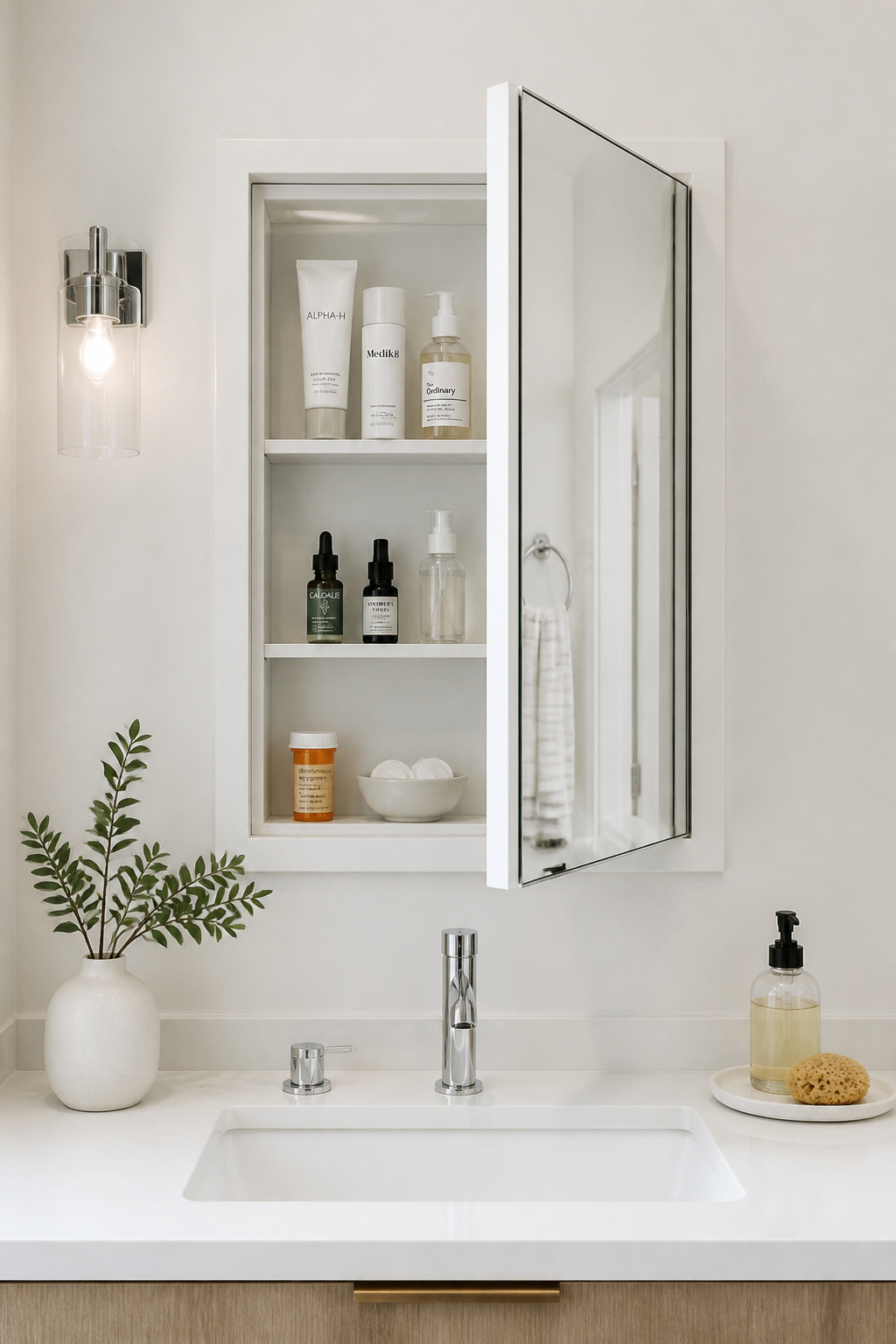
The case for a recessed version is strong in tight bathrooms. A recessed cabinet sits inside the wall cavity rather than projecting from it. Interior depth is 3 to 4 inches, fitting within a standard 2-by-4 stud bay. The mirrored door also reflects light back into the space, making a narrow bathroom feel more open. Standard widths are 18, 24, and 30 inches. The 24-inch option suits most single-sink vanities.
Surface-Mount vs. Recessed: The Trade-Off
Recessed installation requires locating studs, cutting drywall between them, and verifying the cavity is clear of plumbing and electrical. It’s a capable DIY weekend project. Surface-mount installs in under an hour with no cutting, but it projects 4 to 8 inches from the wall. You feel that projection in a tight space. Surface-mount gives more interior depth (5 to 8 inches vs. 3 to 4 inches recessed), so storage capacity is actually higher. Brands worth knowing: Kohler and Robern at the higher end, IKEA Godmorgon for a budget option. Interior organisation works best by access frequency: daily products at eye level, weekly items on the second shelf, first aid and backup supplies at the bottom.
9. Tension Rods Under the Sink: A Two-Minute Organisation Upgrade
This tip consistently surprises people who haven’t encountered it. It costs five dollars. A tension rod installed horizontally inside the undersink cabinet, two to three inches below the cabinet ceiling, creates a hanging rail for spray bottles.
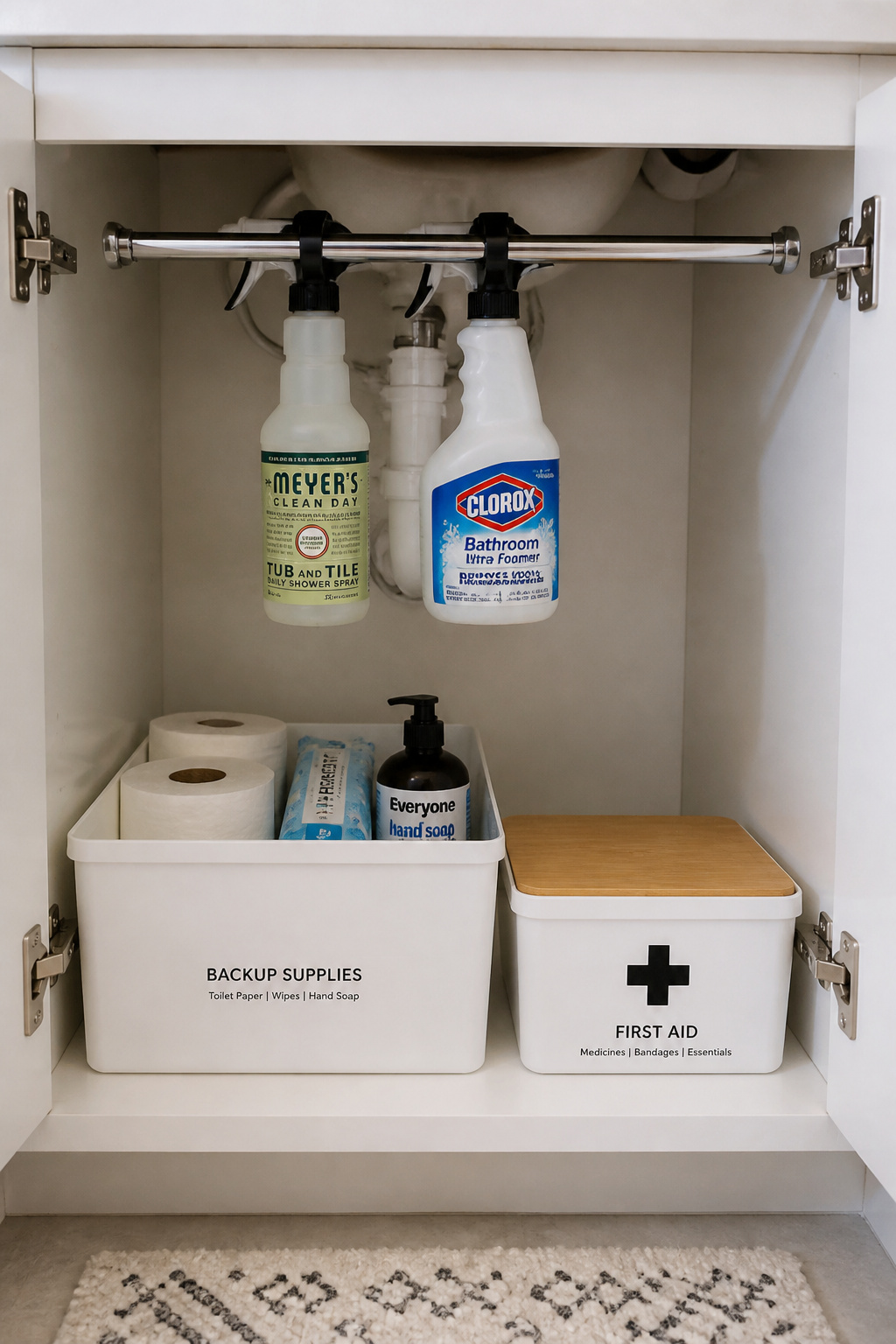
Spray bottles are designed to be held by their trigger. That trigger doubles as a hook. Rest it over the rod and the bottle hangs, leaving the cabinet floor clear below it. Four bottles on a single rod free up roughly a square and a half of cabinet floor space. It sounds almost too simple to count as a proper small bathroom organization upgrade. But few investments this inexpensive pay off this consistently.
Choose a rubber-tipped tension rod sized to your cabinet width. Standard undersink cabinets run 24 to 36 inches wide. Most adjustable rods span 28 to 48 inches. Rubber tips grip the cabinet walls without scratching. Avoid thin curtain rods — they bow under the weight of full cleaning bottles. Look for a rod rated to at least 10 pounds. Add S-hooks for small cleaning brushes or mesh bags. Below the rod, the cleared floor holds two or three labeled bins. The full system costs $15 to $20 and is done in under 15 minutes. That’s a hard ROI to beat.
10. Ladder Shelves: Freestanding Small Bathroom Storage With Style
A ladder shelf needs no anchor bolt. It delivers the storage of two to three floating shelves without drilling. Renters, those in apartments with strict rules, and anyone not ready to commit to wall anchors will find it especially useful.
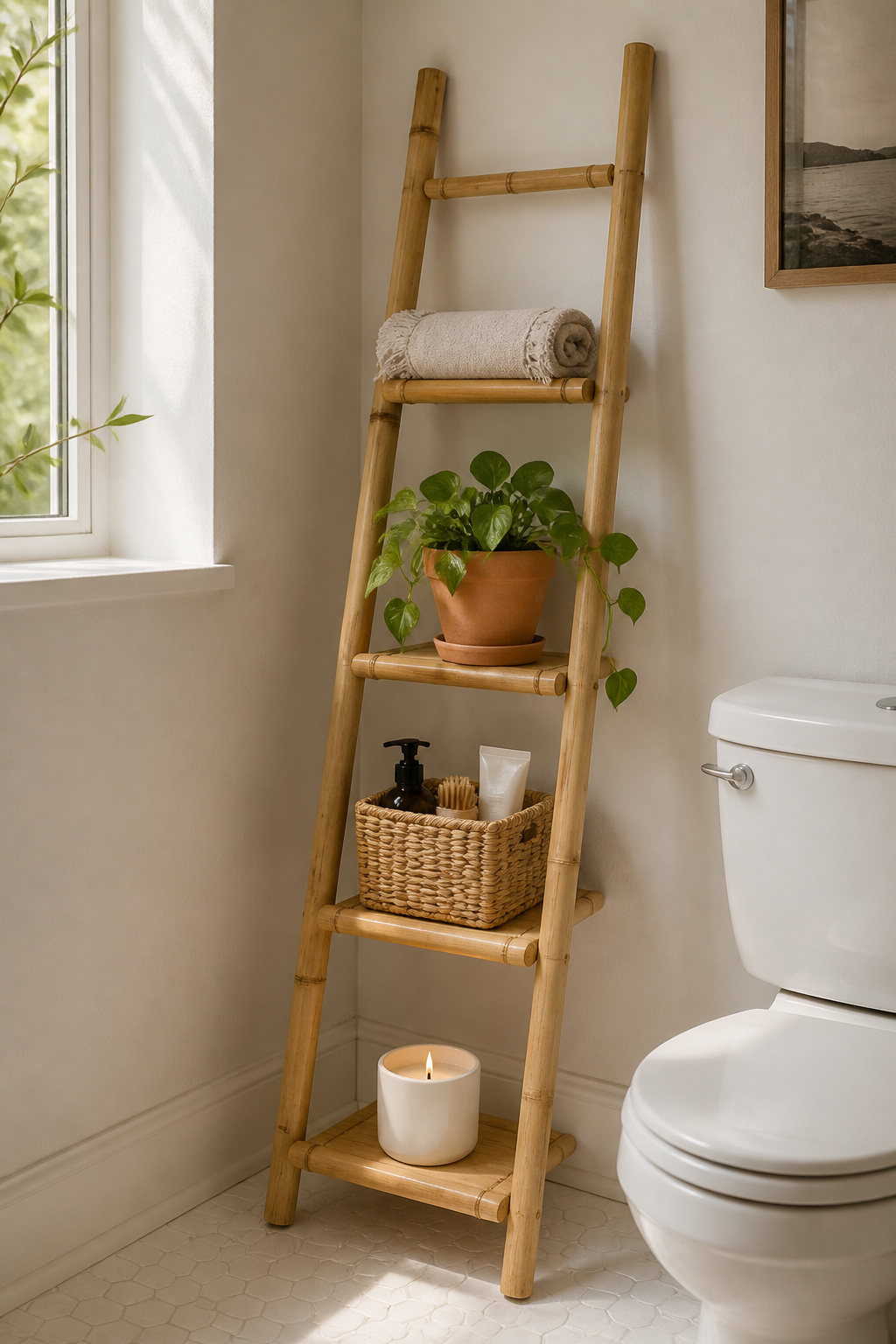
Most bathroom-suited ladder shelves stand 60 to 65 inches tall. The base footprint is typically 18 to 24 inches wide. The angled lean braces against the wall at two or three contact points, making it stable on flat tile without any wall attachment.
Materials Worth Knowing
Bamboo is the first choice for bathroom use. Its slatted shelf design allows water to drain through rather than pool. Its cellular structure resists moisture absorption better than most hardwoods. Teak has natural oils that repel moisture without any chemical treatment. It’s premium, warmer-looking, and significantly heavier than bamboo. Powder-coated steel is fully moisture-proof but harder-looking — better suited to industrial or contemporary aesthetics. Avoid pine or unfinished wood in a bathroom; it absorbs humidity and eventually warps.
This is where small bathroom organization works with the room’s constraints rather than against them. Choose materials shaped for humidity and formats that don’t need the walls to cooperate. The styling principle that holds: alternate display and storage rung by rung. One rung with rolled towels, the next with a plant, the next with a woven basket. Keep rubber feet on the base on tile floors. For more ideas that develop this layered, organic aesthetic, there are some genuinely calming small bathroom inspiration ideas worth exploring.
11. Adhesive Wall Hooks: The No-Damage Solution for Towels and Robes
Three or four adhesive wall hooks, placed with any attention to where towels actually land after a shower, eliminate enormous daily friction. Towels on the floor or draped over the shower rod are a symptom of hooks being in the wrong place. Not a character flaw.
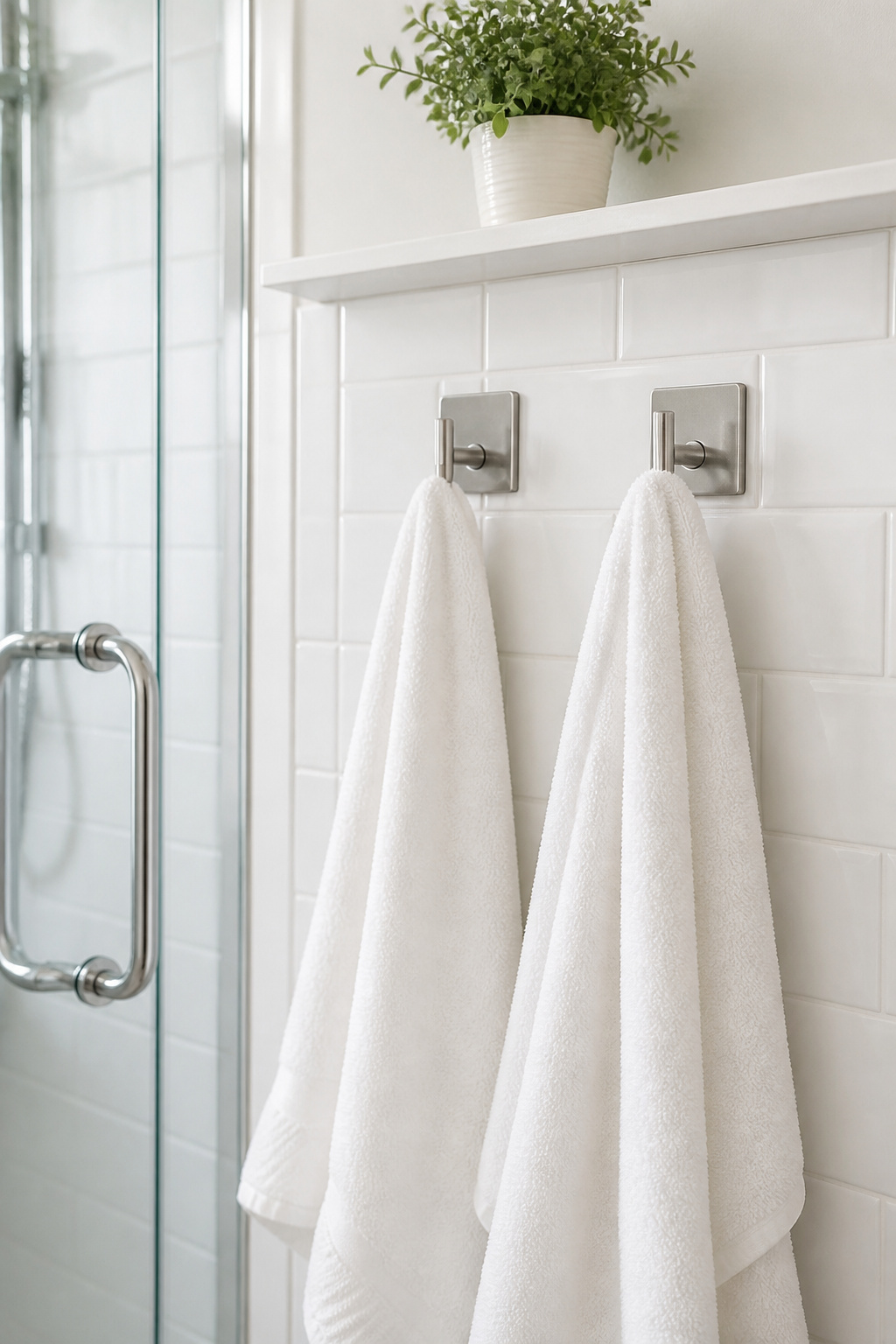
Modern Command Bath adhesive hooks hold more than their size suggests. The large towel hook is rated at 7.5 pounds. That’s sufficient for a daily-use full bath towel. The water-resistant bath-specific strips are designed for bathroom temperature swings and steam. These are not the same as standard household Command strips. The bath version uses different chemistry for humidity resistance.
Surface compatibility is specific. These bond reliably to smooth ceramic tile, glass, mirrors, painted drywall, metal, and fiberglass. They fail on textured tile, rough plaster, brick, and wallpaper. The preparation step is non-negotiable: wipe with 70% isopropyl alcohol, let it dry fully, press firmly for 30 seconds, wait an hour before hanging anything. Small bathroom organization has to account for actual human behavior, not theoretical tidiness. Stand in the shower exit path and note where your hand goes naturally for a towel. That’s where the hook belongs. Group hooks in pairs or threes at 60 to 65 inches from the floor — standard towel bar height — so they read as intentional design.
12. Clear Acrylic Bins to Tame the Countertop Clutter
Transparent storage works for one reason: you can see what’s there without touching anything. In a bathroom where counter space and morning time are both limited, locating items at a glance makes a daily difference that compounds.
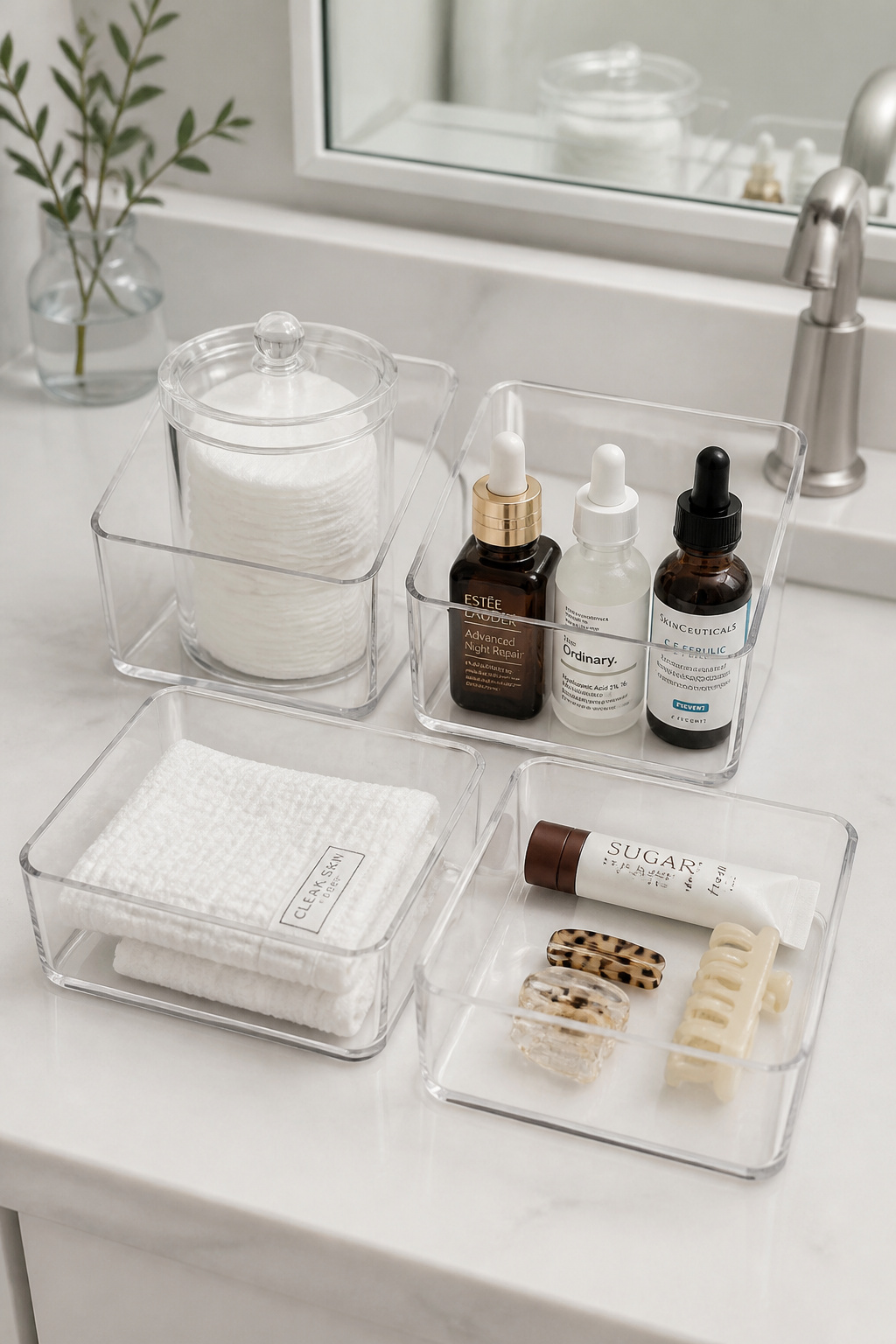
The iDesign Clarity line is the standard-setter here. The 8 by 4 by 2 inch bins suit cotton swab dispensers and small product groupings on a standard vanity. The Clarity Customizable 4-Piece (6.5 by 6.5 by 4.5 inches with removable dividers) suits a fuller lineup on a slightly larger counter. For tall bottles — toners, larger serums — the Linus bin at 10 by 4 by 6 inches holds them upright without tipping.
This clear approach to small bathroom organization reduces a specific kind of anxiety. It’s the “I know I have that somewhere” feeling that surfaces when products live in opaque containers. When everything is visible, you notice when stock runs low before it runs out. You buy fewer duplicates. The daily routine is marginally but genuinely less frustrating. Clean acrylic with mild dish soap and a soft cloth — never abrasive scrubbers or acetone-based sprays, which cloud the surface permanently. Measure the counter before buying. A set of four bins can easily exceed the available surface space in a compact vanity.
13. Recessed Shower Niches: Built-In Bathroom Organization That Elevates the Whole Room
A recessed shower niche is in a different category from the other ideas here. It’s a construction project, not an afternoon purchase. But if you’re tiling a shower or mid-remodel, adding a niche is one of the smartest long-term decisions available. It removes the caddy problem permanently.
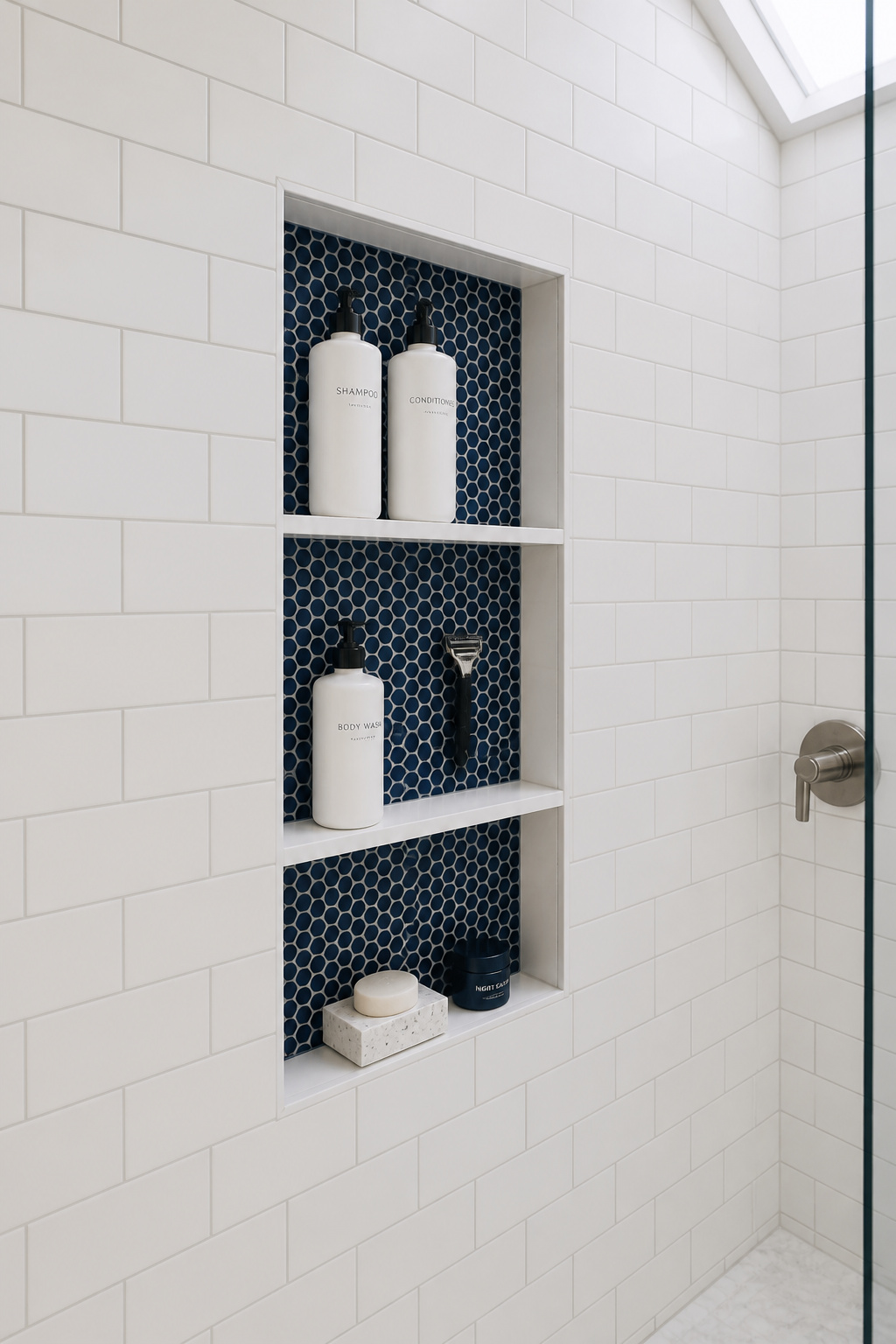
The basics: a niche is an opening cut into the wall between two studs, lined with waterproofing membrane, and tiled flush with the shower surround. Standard 16-inch on-center framing yields a clear stud bay of 14.5 inches. Tile on both sides brings the interior to roughly 12 inches wide. A 12 by 24 inch niche holds a full two-person shower lineup with room to spare.
Waterproofing Is Where It Lives or Dies
Apply two to three coats of liquid membrane (RedGard or Schluter Kerdi) on all interior surfaces. Seal corners with mesh tape. Then slope the niche floor at 1/8 inch per foot toward the shower. That slope is non-negotiable. A flat niche floor pools water and grows mildew regardless of how well the walls are sealed. Pre-made foam niche inserts (Schluter Kerdi-Board-SN, $50 to $150) arrive pre-sloped and pre-waterproofed, substantially reducing the failure risk. Professional installation for a single niche adds $200 to $600 to a broader shower tile project. The best time to add a niche is always during the tile phase. Worth pairing with broader thinking about shower design ideas for small bathrooms if a larger project is already in motion.
14. A Slim Rolling Cart for the Gap Between the Toilet and Wall
In most small bathrooms, the 5 to 8 inch gap between the toilet tank and the nearest wall holds nothing. It’s too narrow to walk through, too narrow for furniture, and too specific a dimension for most storage products. A purpose-built slim rolling cart fills it with a full column of tiered, accessible storage.
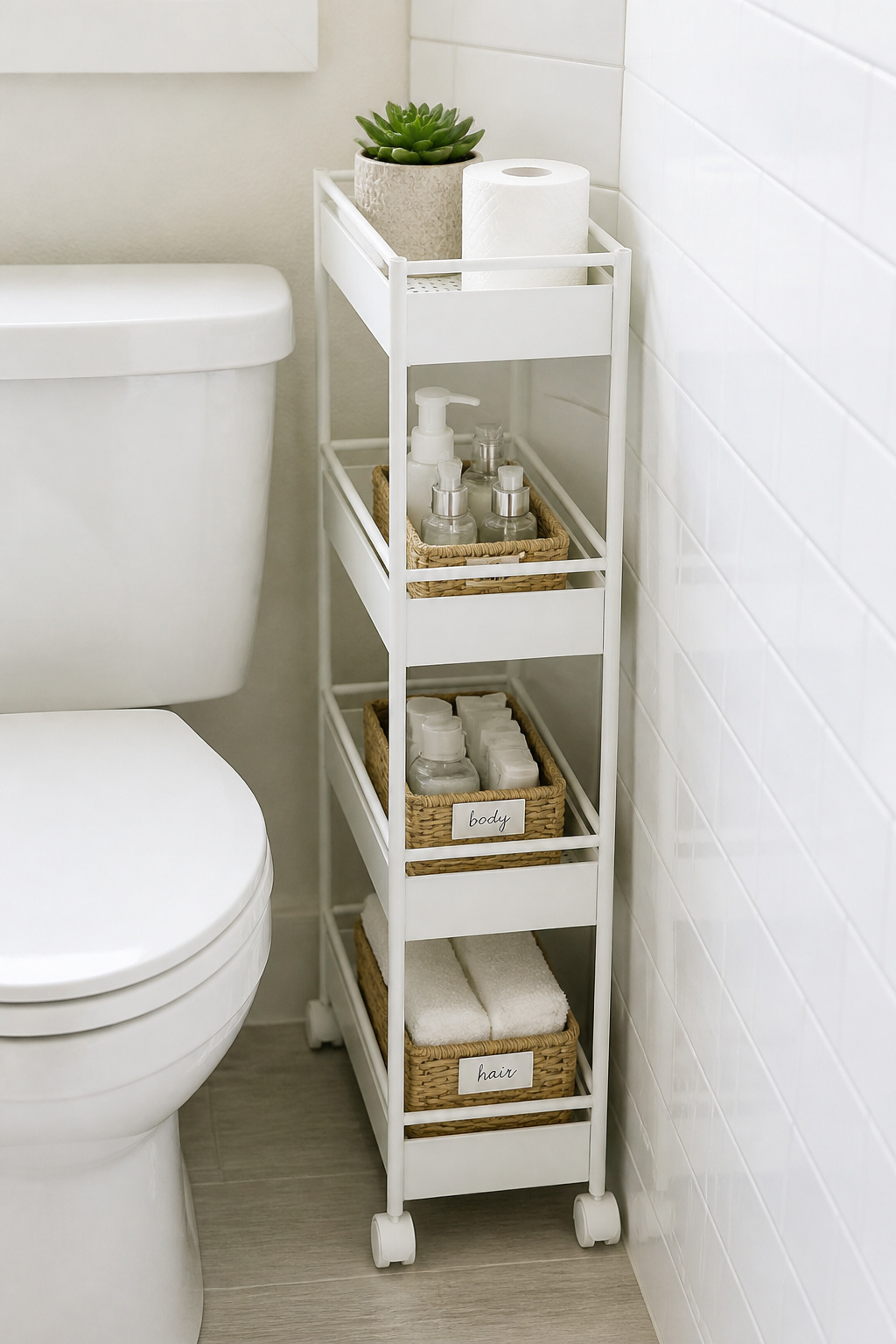
Tapping into the room’s own geometry is one of the most satisfying forms of small bathroom organization. This gap is one of the most reliable to find. The SPACEKEEPER 4-tier cart at 4.9 inches wide fits gaps as tight as 5.5 inches. The Pipishell 4-tier at 7.1 inches suits the more common 8-inch gap. Both stand approximately 36 inches tall. Check the wheel frame width separately from the cart body. Manufacturer dimensions don’t always include the wheel housing, which can add half an inch per side.
How to Organise the Tiers
Arrange by access frequency from the top down. Top tier (eye level, easiest reach): daily items — hand cream, a small plant, extra toilet paper. Middle tiers: weekly items. Bottom tier: cleaning products or bulk backup supplies. Rolling the cart out to clean behind it takes five seconds. That makes maintenance far easier than a fixed cabinet in the same location. Mid-range powder-coated steel carts ($40 to $80, e.g., SONGMICS, Homfa) are significantly more stable than budget plastic. They come with locking wheel brakes and don’t yellow with UV exposure.
15. Flat-Lay Drawer Organizers: Small Bathroom Organization for Your Skincare Routine
The bathroom vanity drawer is where skincare routines either take hold or fall apart. Behavioral research on habit formation identifies environmental design as one of the most powerful variables in whether a daily routine sticks. An organized, frictionless drawer makes the routine effortless. A jumbled drawer creates small obstacles that, on tired mornings, become reasons to skip steps.
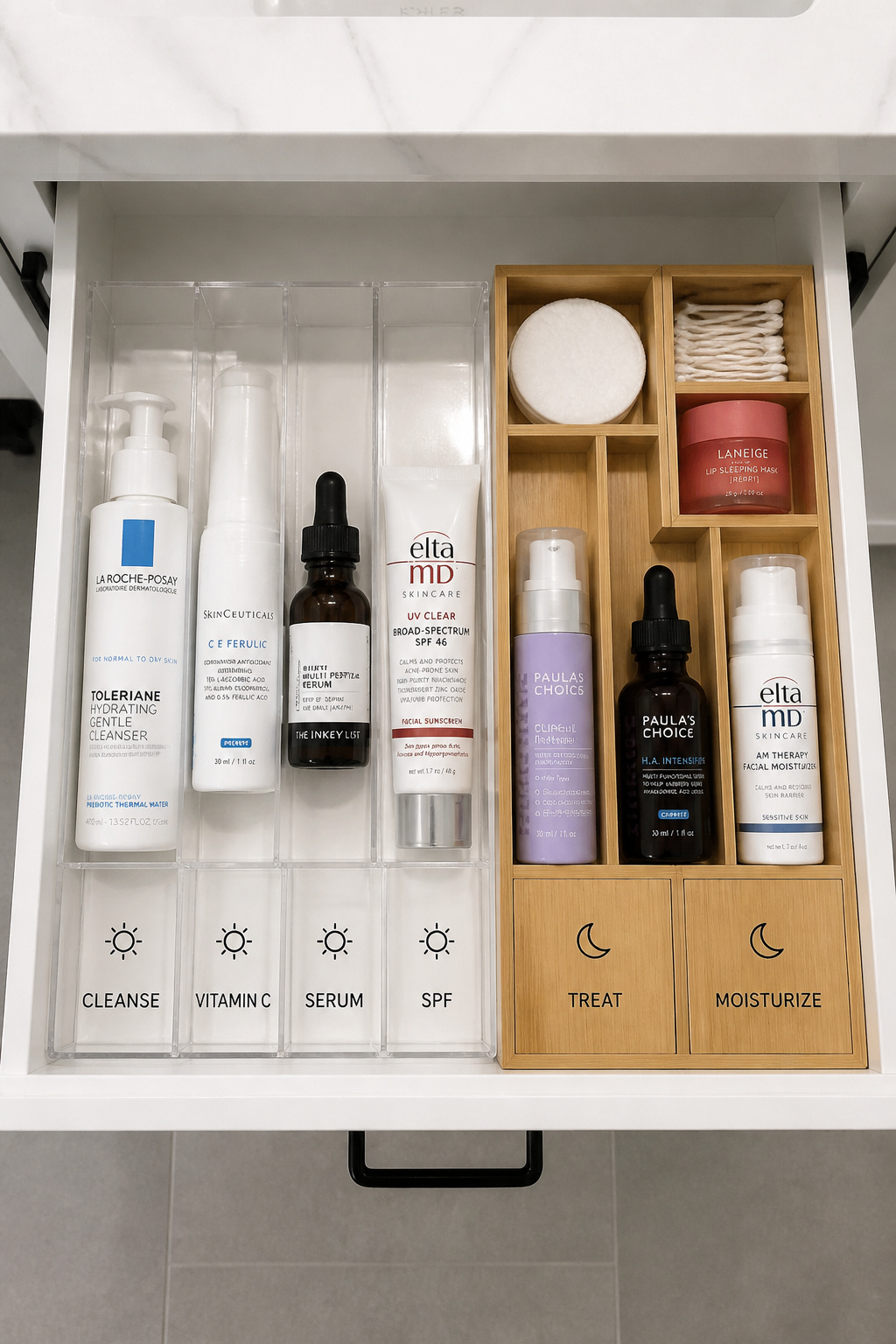
Standard bathroom vanity drawers are 3 to 4 inches deep on the interior. Standard kitchen drawer organizers are 5 to 6 inches tall. They won’t close in a shallow vanity drawer. The Masirs Expandable Drawer Organizer stretches from 9 to 16 inches wide. It sits just 1.5 inches tall — fitting universally in vanity drawers. The Sorbus 6-Piece Drawer Organizer Set at 2.1 inches tall provides a modular system that rearranges as the skincare lineup changes.
The best system for a daily routine is routine phase grouping rather than product category grouping. AM products on the left: cleanser, vitamin C, moisturiser, SPF. PM products on the right: oil cleanser, retinol, night cream. Work left to right in the morning, right to left at night. Within each section, arrange in application order. The drawer becomes a sequence rather than a collection. The morning routine follows naturally — no decisions required. This small bathroom organization approach pairs well with vanity ideas for an organized bathroom if the vanity structure itself also needs rethinking.
Your Small Bathroom Organization Plan Starts With One Decision
Before buying anything, identify your bathroom’s primary constraint. Is it floor space? Wall space? Counter space? Cabinet depth? The answer changes which of these solutions to prioritize. Buying the wrong type of organizer — however well-reviewed it is in general — solves the wrong problem.
If floor space is the limit, prioritize wall-mounted and over-door systems. These leave the floor entirely clear: floating shelves, wall hooks, over-door organizers, medicine cabinets. If wall space is the constraint — rental restrictions, all-tile walls, no studs where needed — focus on freestanding and tension-based systems: ladder shelves, rolling carts, tension rods. If counter space is where the pain is sharpest, the fastest return comes from moving counter items to the wall.
Once the right small bathroom organization system is matched to your constraint, the last step is a full empty-out. Take everything out of the bathroom. Sort it into daily, weekly, monthly, and never-use piles. The never-use pile is almost always larger than expected — often 30 to 40 percent of what was stored there. Donating or discarding that pile before buying storage means you’re not paying to organize things you don’t need.
The small bathroom organization strategies that last are the ones matched to the actual space, the actual habits, and the actual lives being lived in them. Start with one constraint, solve it well, and the clarity that follows usually makes the next step obvious.