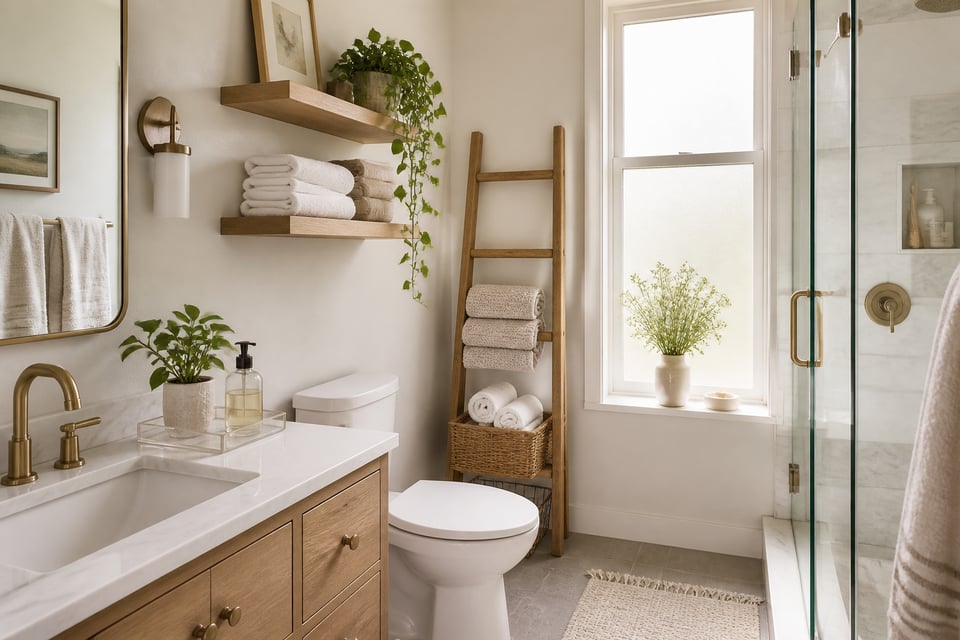
There is a moment, usually somewhere around 7 am, when a cluttered bathroom stops being an inconvenience and becomes a genuine source of stress. The cortisol spike from hunting for a razor under a pile of bottles, or knocking three things off the counter reaching for the face wash — that’s not a trivial nuisance. Research in environmental psychology links visual clutter on horizontal surfaces directly to elevated morning cortisol, and the bathroom counter is often the very first surface you interact with. When small bathroom storage is handled well, the space supports your routine rather than fighting it. The difference between those two experiences is not a renovation budget. It’s a set of deliberate choices about how the vertical, corner, behind-door, and under-sink space in your bathroom is actually being used. These 15 ideas range from a $3 tension rod to a weekend-project recessed shower niche — and together they cover every storage zone a small bathroom has.
1. Floating Shelves Above the Toilet: The Classic Space-Saver
The area above the toilet is the most consistently wasted vertical space in a small bathroom. From floor to toilet tank top is roughly 28 to 30 inches. Above that, all the way to the ceiling, is yours — and in most bathrooms, it sits empty.
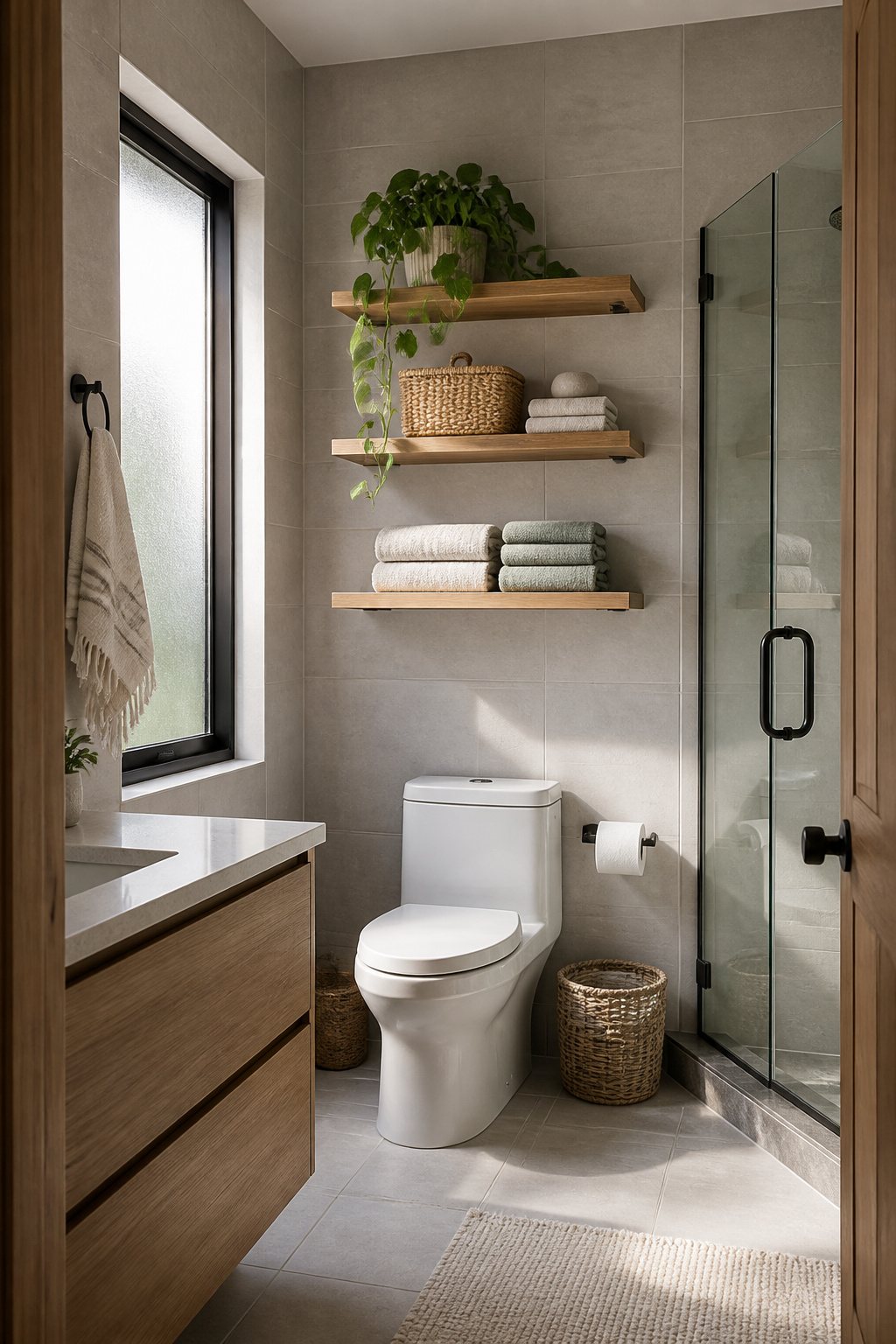
As small bathroom storage solutions go, floating shelves installed at least 24 inches above the tank (roughly 52 to 58 inches from the floor) clear your head comfortably and still keep items within reach. A set of three shelves in this column can hold the equivalent of a small linen closet — rolled towels, spare soaps, small plants, candles — without removing a single square foot from your floor plan. From a wellness standpoint, the effect is doubly useful: vertical storage draws the eye upward, creating a perceived sense of height in a room that typically feels compressed.
The Vertical Small Bathroom Storage Zone Above Your Toilet
For materials, 8-inch depth is the practical sweet spot — deep enough to hold a toiletry bottle upright, not so deep that items disappear at the back. White oak is the most requested species for bathroom floating shelves among wellness-conscious designers: it accepts low-VOC water-based finishes readily and handles humidity cycles better than softer domestic woods. Bamboo is a strong non-toxic alternative (Moso bamboo reaches a Janka hardness of around 1,380, harder than most domestic hardwoods), but it does require a clear sealer applied annually to stay moisture-resistant.
For installation, always anchor into studs rather than drywall alone. Stud-anchored shelves with 2.5-inch screws hold 20 to 30 pounds per shelf comfortably. Drywall anchors in a humid bathroom soften over time and lose holding strength. If you’re creating a cohesive look across your whole bathroom, you’ll find bathroom shelf decor ideas for a calm space can guide the styling once the shelves are up.
2. Recessed Shower Niches Built Into the Wall — No Counter Clutter
A shower caddy is the default small bathroom storage choice for the shower, but it drains slowly, rusts eventually, and creates a ring of micro-pools around every shelf lip where mold colonizes between cleans. A recessed niche does none of these things. Water drains immediately if the niche is set with even a slight forward slope, there’s no metal to corrode, and the space becomes a permanent architectural feature rather than a piece of equipment that needs replacing every two years.
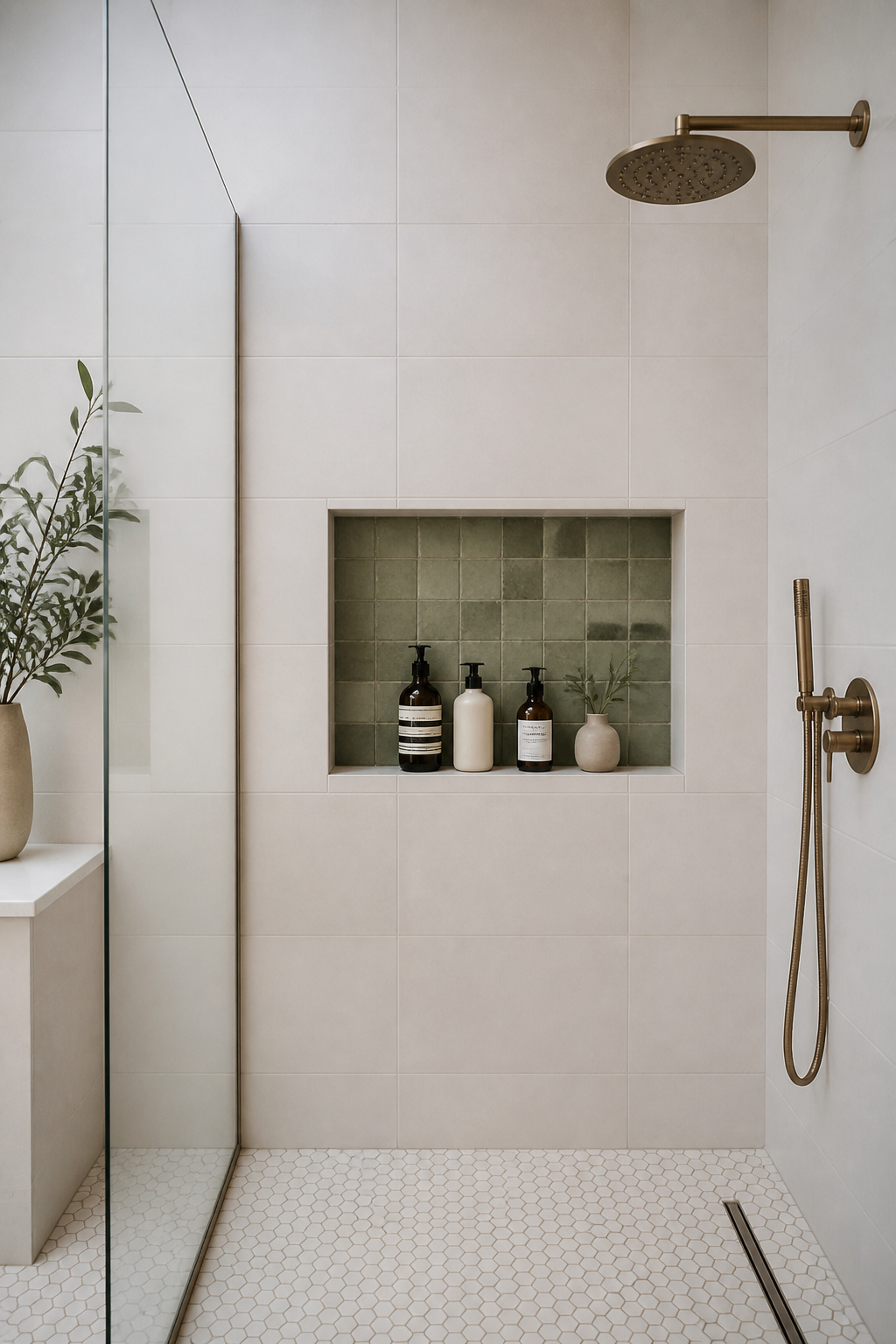
Standard wall framing is 16 inches on center, which gives a clear span of about 14.5 inches between studs — the exact width of the most common niche size. The standard niche dimensions are 12 by 12 inches or 12 by 24 inches, with a depth of 3.5 to 5 inches matching the stud cavity. A 12 by 24 inch niche fits tall shampoo bottles comfortably (most standard bottles run 9 to 10 inches tall), while the smaller 12 by 12 is ideal for a soap dish and a few small containers.
Sizing and Waterproofing Your Recessed Shower Storage
The step that cannot be skipped is waterproofing. Before any tile goes in, every interior surface of the niche — all six walls — needs two to three coats of liquid waterproofing membrane: RedGard, Schluter Kerdi, and HydroGuard are the commonly used products. Skipping this step leads to mold growth behind the tile within two to three years, and eventually wood rot and structural damage. It’s the error that accounts for virtually every failed shower niche repair.
If you want to make the niche look intentional rather than functional, tile the interior in a contrasting material — a small zellige tile or a different grout color. A niche tiled the same as the surrounding wall tends to read as an afterthought. Professional installation of a single niche with standard tile typically runs $200 to $500; complex tilework or niches requiring a structural header can reach $1,200.
3. Over-Door Pocket Organizers: Bathroom Storage Ideas That Cost Almost Nothing
The back of a bathroom door is almost always empty. A standard interior door is 80 inches tall and 24 to 32 inches wide — 13 to 17 square feet of vertical surface that most people never use. An over-door organizer hooks over the door frame with no drilling, no anchors, and no wall damage. It’s the most accessible small bathroom storage solution for renters and for bathrooms where every wall surface is tile.
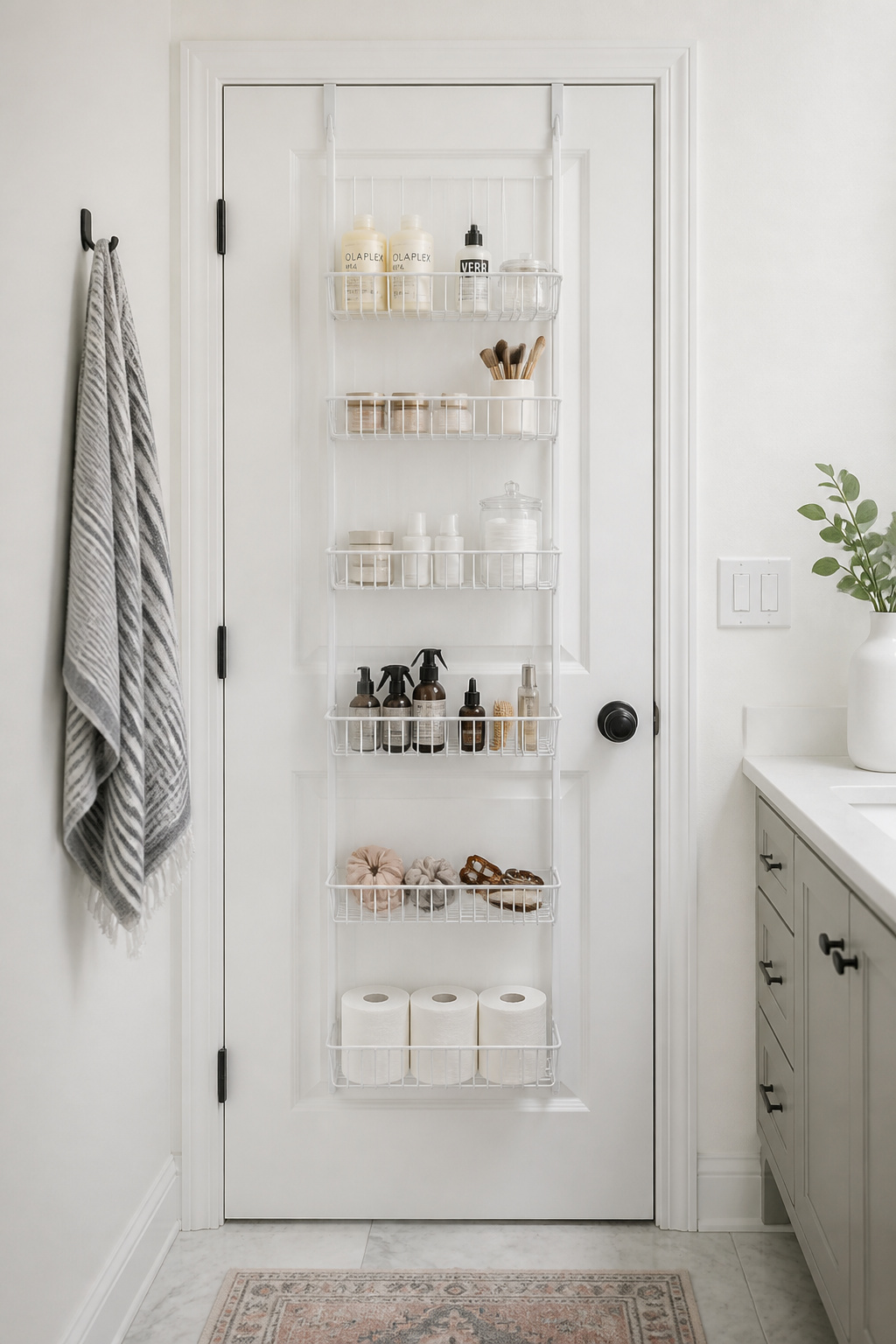
The material question matters in a humid bathroom. Clear PVC pocket organizers offer visibility, but cheap PVC can off-gas in warm conditions. PEVA (polyethylene vinyl acetate) is the non-toxic alternative — look for that material label specifically. Coated fabric organizers (PVC-coated polyester or 600-denier polyester with PE backing) are the most practical for bathroom use: moisture-resistant, breathable, machine-washable, and strong enough to hold their shape under load. Powder-coated steel wire basket versions are the most durable and fully mold-proof, though they’re heavier and cost $40 to $80 versus $15 to $30 for fabric.
Each fabric pocket typically holds 1 to 3 pounds. Keep lightweight items here: cotton rounds, razors, travel-size toiletries, hair accessories, children’s bath toys, backup cleaning cloths. Avoid heavy glass bottles and ceramic dispensers in fabric pockets — the weight strains the hook system. One practical note before buying: measure the gap between the bottom of your door and the floor. Some organizers hang 80 inches and will drag if your door clearance is tight.
The organizational principle that makes these work is category, not container. Top pockets for daily-use face items, mid pockets for backup supplies, lower pockets for once-a-week items. That vertical hierarchy means you’re never reaching past what you need to get to what you want.
4. Mirrored Medicine Cabinets That Hide Clutter in Plain Sight
A surface-mount medicine cabinet adds 4 to 8 inches of projection into an already compressed bathroom. As a small bathroom storage upgrade, a recessed version adds zero projection into the room. It replaces the flat mirror, sits inside the wall cavity, and contributes 3.5 to 4.5 inches of hidden storage depth — enough for a full row of toiletry bottles plus a back row of flat items like razors, first-aid supplies, and contact lens cases — all invisible when the door is closed.
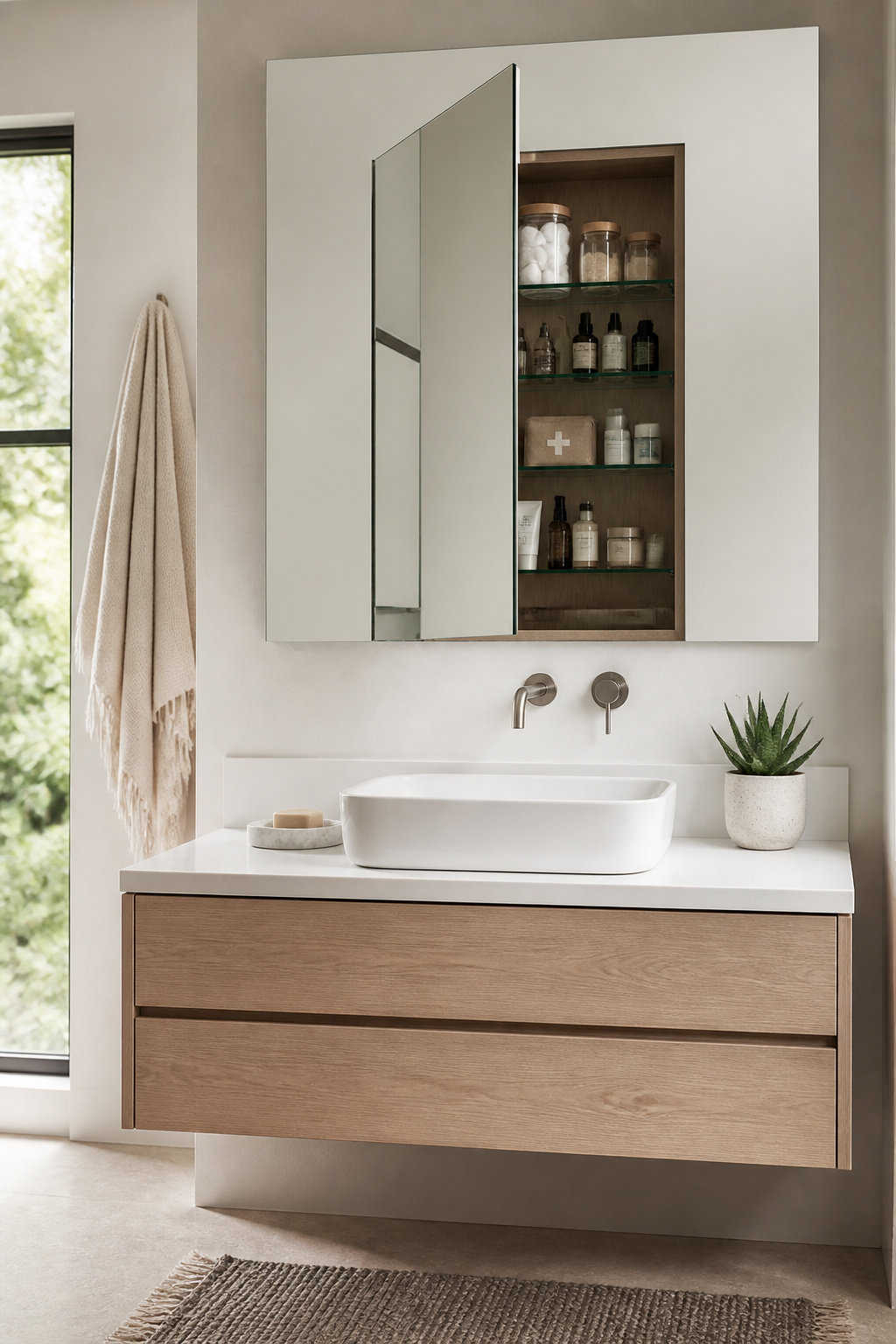
Standard framing spaces studs 16 inches on center, leaving a 14.5-inch clear span inside. Most small bathroom medicine cabinets (14 to 16 inches wide) fit this span without cutting structural members, making the installation more accessible than many assume. Heights run 18 to 35 inches; 30 inches is the most common dimension and suits most adults. Installing a recessed cabinet into an existing mirror rough-in is often as simple as removing the old mirror, cutting back the drywall to the studs, and fitting the cabinet into the opening.
For the mirror glass, look for ANSI Z97.1 certified safety glass — tempered or laminated — which shatters into small blunt pieces rather than dangerous shards if it breaks. The cabinet interior should have painted or powder-coated steel shelves rather than bare metal (which rusts in humidity) or MDF shelving (which off-gasses formaldehyde in warm damp conditions). Frameless styles read as more modern and visually generous in small spaces; framed suits period or traditional bathrooms. If you’re planning the full bathroom around the cabinet upgrade, pairing it with thoughtful thoughtful bathroom vanity lighting transforms both form and function.
5. Under-Sink Cabinet Organizers That Tame the Chaos Below the Basin
The under-sink zone is the most commonly wasted area in small bathroom storage. Standard under-sink cabinets run 24 to 36 inches wide, 20 to 24 inches deep, and 14 to 16 inches tall. Then the P-trap pipe and drain plumbing occupy the center 6 to 8 inches, and suddenly the back third of the cabinet becomes effectively inaccessible without kneeling and reaching. Items migrate to the back, get forgotten, expire, and get repurchased. It’s an organizational failure baked into the furniture.
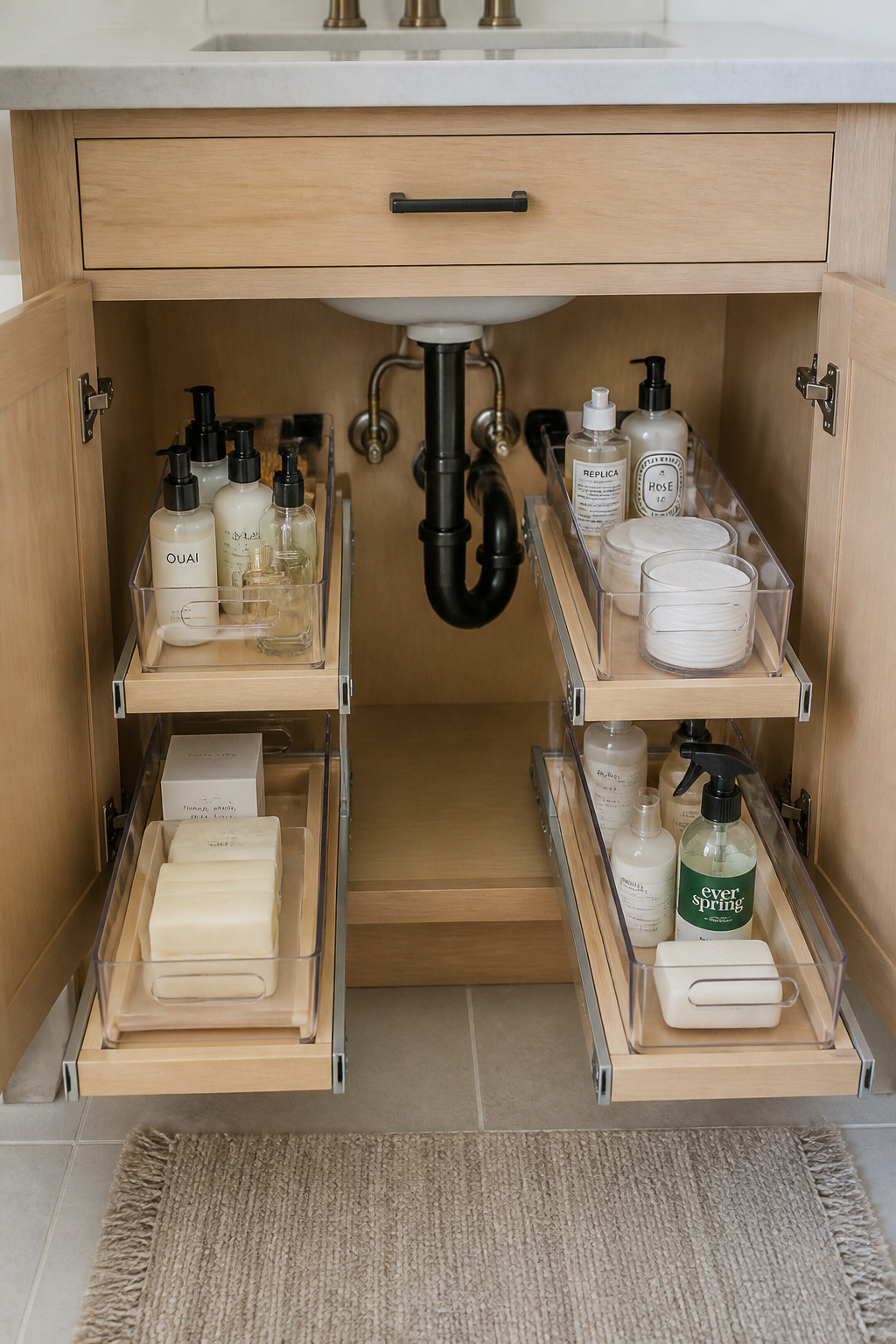
The fix requires no tools, no renovation, and about an hour. Rev-A-Shelf’s 486 Series is the most specific solution for sink base cabinets: a U-shaped organizer designed around the drain pipe, sized for 24-inch to 30-inch vanity bases, with BLUMOTION soft-close Blum slides, natural maple construction, and a non-skid vinyl lining. Pull it out, see everything, push it back — the full cabinet depth becomes accessible with one smooth motion. For a budget approach that still works, mDesign’s Lumiere stackable clear bins ($25 to $45 for a two-pack) are clear plastic pull-out drawers that stack to use vertical space. The clarity matters: you can see what’s inside without pulling every container out.
The non-toxic detail worth noting: line any shelf surface under the sink with food-safe HDPE or polypropylene liner, not PVC — the chronic warmth and humidity under the sink accelerates off-gassing from PVC liners. Also keep paper products (tissues, cotton pads, toilet rolls) in sealed containers under here, not loose — the persistent humidity will swell cardboard packaging and create ideal conditions for mold within weeks.
These principles pair well with vanity ideas for tiny bathrooms that actually work if your whole vanity zone needs rethinking, not just the cabinet interior.
6. Ladder Racks for Small Bathroom Storage and Towel Display
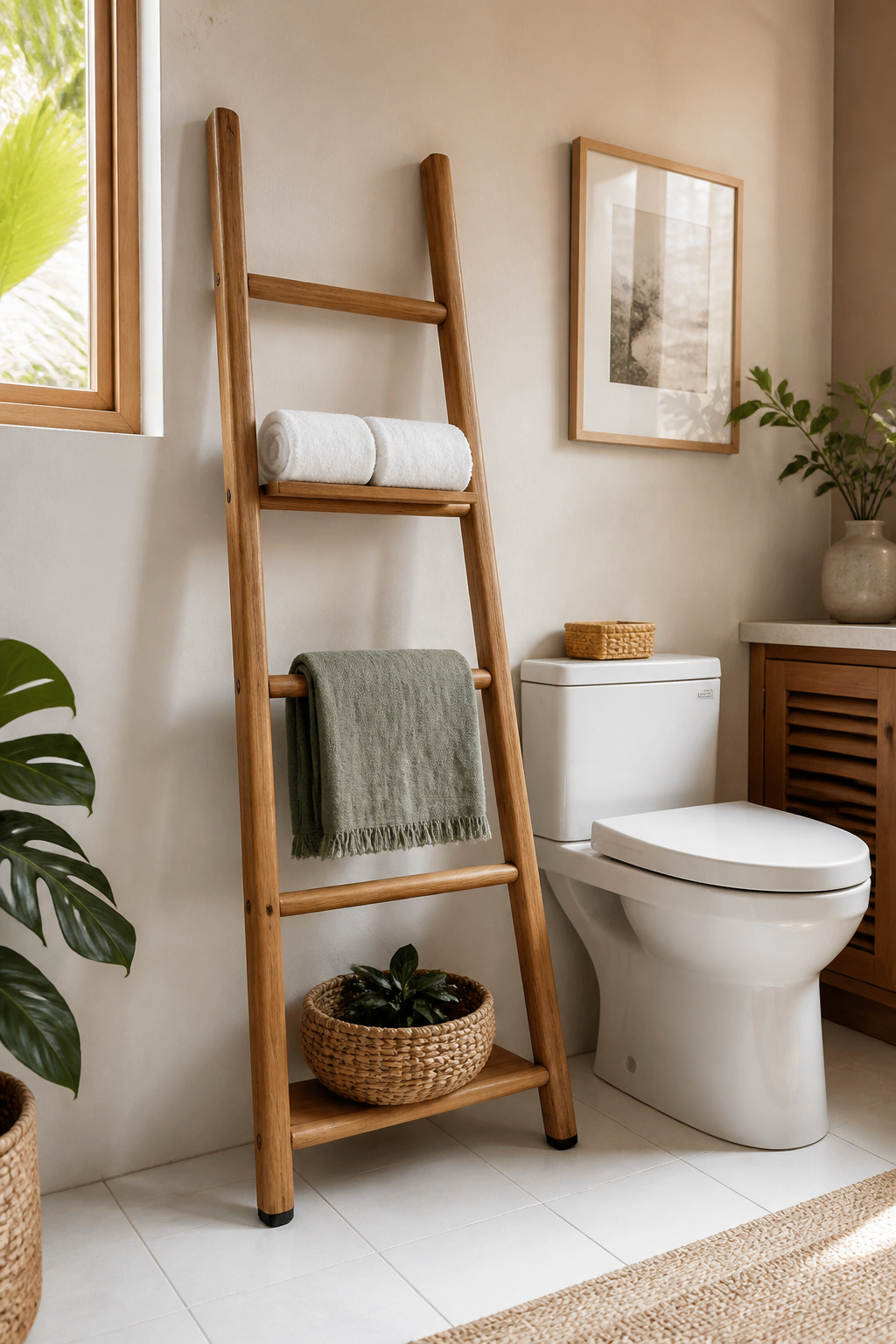
Freestanding ladder racks are the quickest small bathroom storage upgrade with zero commitment. No drilling, no wall anchors, no installer required — lean it against the wall, load it up, and the bathroom is transformed. A standard rack stands 62 to 72 inches tall on a footprint roughly 18 to 24 inches at the base. It fits beside a toilet or vanity without blocking the circulation path, and it moves when you need to clean behind it.
Choosing Materials for Your Small Bathroom Storage Ladder Rack
Material choice is the decision that determines how long it lasts. Teak is the superior option for humid environments: naturally occurring tectoquinone oils make it inherently water-resistant with no surface treatment needed. AquaTeak’s Sula 34-inch model, with three tiers and non-slip rubber feet, is a frequently cited benchmark for quality in teak shower and bathroom accessories. Bamboo is lighter, costs significantly less, and is one of the most renewable materials available (Moso bamboo matures in three to five years versus 25 to 50 years for teak) — but it lacks teak’s natural oils and needs an annual coat of clear water-based varnish or food-safe mineral oil to stay moisture-resistant in a steamy bathroom. Powder-coated steel is the fully mold-proof option: no organic material for mold to colonize, with a matte black powder coat hiding water spots better than chrome.
The most functional ladder configuration moves from the floor up: a medium wicker basket on the lowest rung for extra toilet paper or spare hand towels; daily towels on the middle rungs with 2 inches of clearance from the wall (towels pressed flat against the wall take twice as long to dry and leave moisture marks); a small basket or a plant on the top. Stainless S-hooks ($5 to $8 for a pack of ten) extend every rung’s capability — hang a small pouch, loofah, or hand mirror at any point without taking up shelf space.
7. Corner Shelving Units That Make Awkward Angles Work for You
A 90-degree corner offers about 12 to 16 inches of linear run on each adjacent wall. That’s room for a 10-to-12-inch triangular shelf that sits completely outside the traffic path and doesn’t interfere with doors, drawers, or circulation. It’s the most overlooked small bathroom storage zone — otherwise unclaimed floor area — no competing with the zones that already have plans.
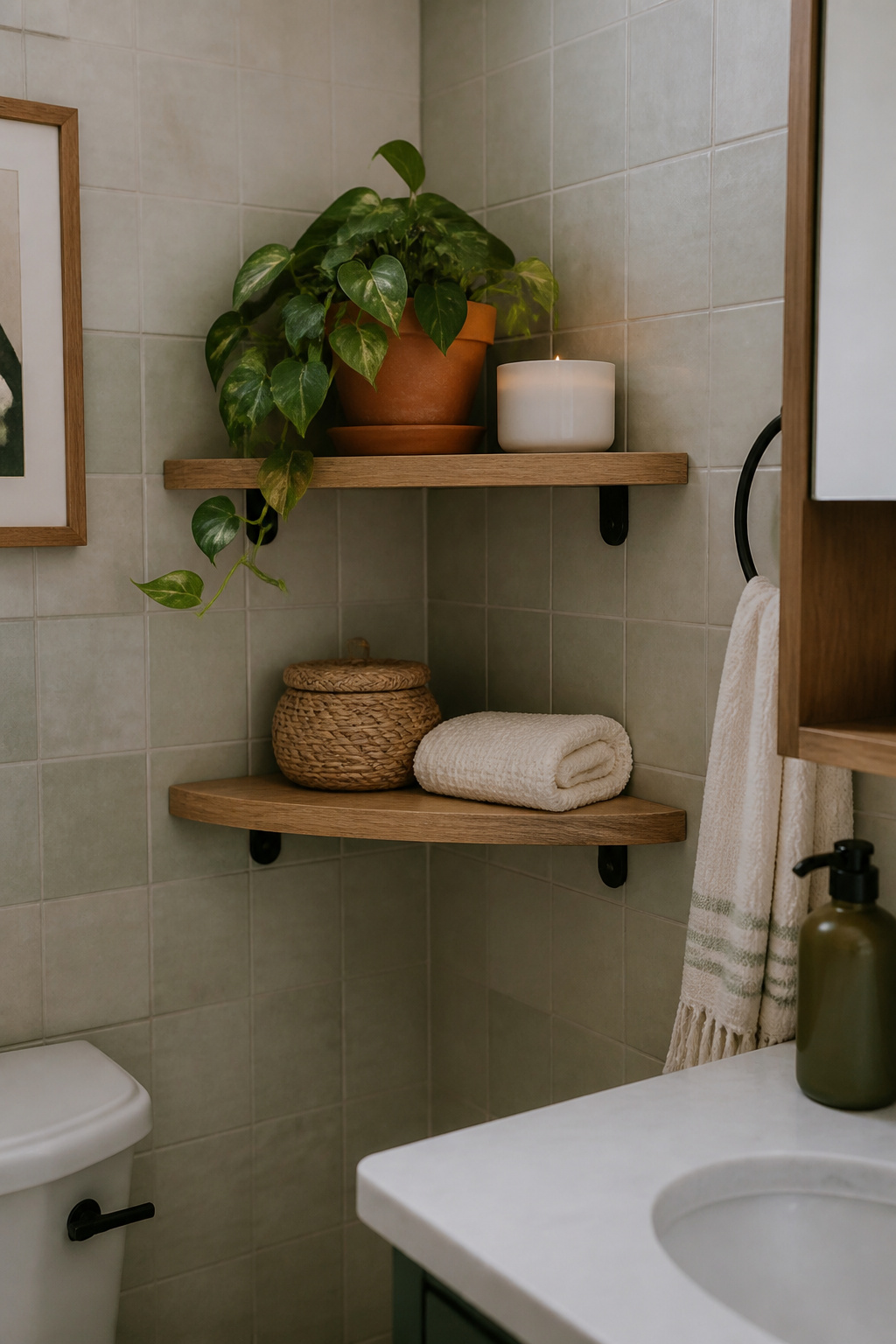
In wellness design frameworks — both Feng Shui and biophilic design — corners are treated as stagnant zones that benefit from activation. Putting something intentional in a bathroom corner (a plant, a curated shelf grouping, a sculptural basket) shifts the spatial energy and the visual reading of the room. This is partly aesthetic principle, partly the demonstrable psychological effect of live plants: even a single small trailing pothos on a corner shelf measurably reduces cortisol in enclosed spaces.
Installation Options for Corner Small Bathroom Storage
For installation: wall-mounted triangular corner shelves hold 5 to 20 pounds with proper anchoring into adjacent wall studs or with appropriate hollow-wall anchors for tile. Tension-pole caddies install tool-free in five minutes and hold 3 to 4 tiers — but they require flat floors and ceilings (textured tile floors and sloped ceilings both cause problems). Freestanding corner units support 20 to 50 pounds and need nothing more than a non-slip pad on wet tile. If you’re renting, the tension-pole or freestanding approach covers you without touching the walls.
The styling principle that separates an intentional corner shelf from an overflow shelf: limit items to three to five per surface, choose materials that connect to something already in the bathroom (bamboo shelves echo bamboo accessories, matte black brackets connect to hardware finishes), and leave deliberate negative space. a broader look at small bathroom inspiration has a good range of corner zone ideas if you’re thinking about the room as a whole.
8. Pull-Out Cabinet Inserts That Unlock Deep Under-Sink Space
Standard vanity base cabinets run 20 to 24 inches deep. The average arm’s comfortable reach into a cabinet is 12 to 15 inches. The back 8 to 12 inches are effectively a dead zone — items stored there get forgotten, expire, or get purchased again because you couldn’t find the first one. Full-extension pull-out inserts are the most effective small bathroom storage upgrade for deep cabinets: the entire cabinet floor comes forward to the door opening in one smooth pull.
Rev-A-Shelf’s 486-30VSBSC is the precision solution: U-shaped to accommodate the drain pipe, sized for a minimum cabinet opening of 24.75 inches wide by 18.75 inches deep by 14.5 inches tall, with BLUMOTION soft-close Blum slides and natural maple construction. The two included acrylic bins and four adjustable dividers turn the pull-out into an organized system, not just a sliding shelf. The 5SB Series is Rev-A-Shelf’s universal cleaning caddy pull-out — reduced depth and height for tighter cabinets, full-extension concealed slides.
Installation in an existing cabinet takes 45 to 90 minutes with a drill and a level — no cabinet removal required. The critical measurement is the door opening width at the narrowest point (often the face frame), not the cabinet box interior. The pull-out must be 1 inch narrower than this measurement for smooth operation. For double-door cabinets with a center stile (the vertical divider), a U-shaped organizer accommodates it without modification in most cases.
These upgrades make a real difference to the quality of your bathroom storage overall. If you want a broader picture of how cabinet choices affect the whole room, bathroom cabinet designs that actually maximize function covers the full range of options.
9. Wicker and Rattan Baskets: Natural Storage for Small Bathrooms
Plastic bins organize. Wicker baskets do something else — they bring the visual warmth and tactile quality of natural materials into a room that is otherwise predominantly hard surfaces. For a wellness-oriented bathroom, this distinction matters. Biophilic design research consistently shows that natural textures — wicker, wood grain, stone, linen — lower perceived stress in interior spaces. The bathroom, where the morning routine sets the mental tone for the day, is a high-leverage environment for this effect.
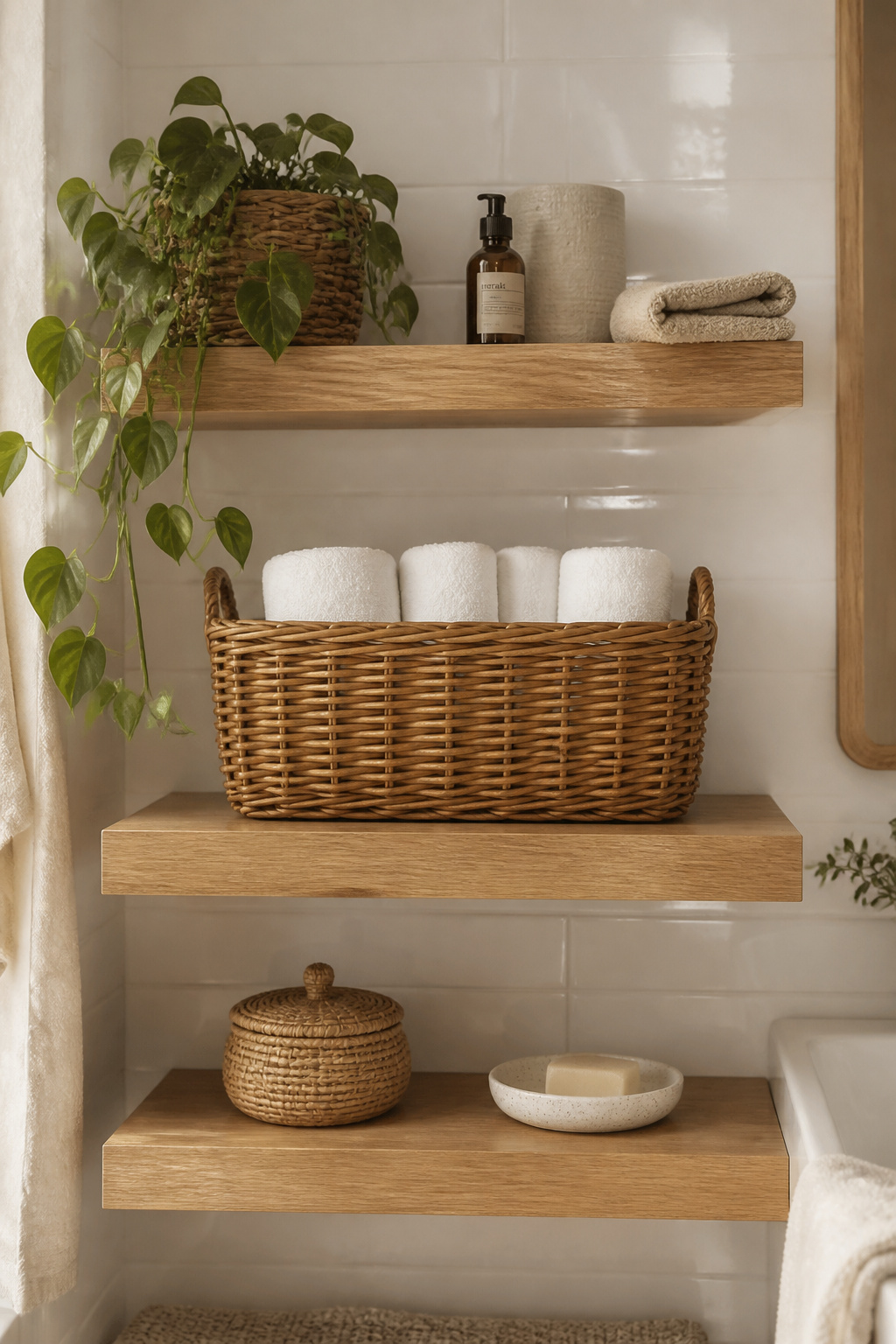
Rattan is among the most sustainable storage materials available: some species grow at 3 to 4 centimeters per day, require no pesticides or herbicides, and are fully biodegradable at end of life. The honey-brown tones integrate with ceramic, marble, wood, and matte tile without visual conflict — they work in virtually every bathroom palette.
For small bathroom storage sizing: on floating toilet shelves with 8-inch depth, a basket approximately 9 by 6 by 4 inches fits cleanly and holds rolled washcloths, cotton rounds, or small soaps. Under a freestanding vanity, a medium basket around 12 by 8 by 6 inches holds spare toilet rolls or cleaning supplies while staying low-profile. Counter-top baskets should stay small — no larger than 6 by 4 inches — to avoid dominating a small vanity surface.
Protecting Natural Small Bathroom Storage Baskets from Humidity
The protection step: apply clear lacquer, shellac, or water-based varnish to all basket surfaces before first use, coating both inside and outside. Allow 24 hours to dry fully. The high humidity in a bathroom (70 to 90% RH during a shower) gradually breaks down any sealant; an annual maintenance coat extends basket life from 1 to 2 years to 5 to 8 years. If the bathroom has poor ventilation, synthetic rattan (PE resin wicker) is visually indistinguishable from natural rattan but is fully waterproof and never needs sealing.
10. Drawer Dividers That Transform a Chaotic Vanity Drawer
An organized vanity drawer is one of the most impactful small bathroom storage interventions you can make for under $35. The research in behavioral design is fairly clear: unorganized storage increases decision fatigue, and starting the morning hunting through a chaotic drawer sets a deficit before the day has properly begun. A $20 to $35 bamboo divider system that turns a 15-minute rummage into a 10-second retrieval is a genuine morning wellness intervention.
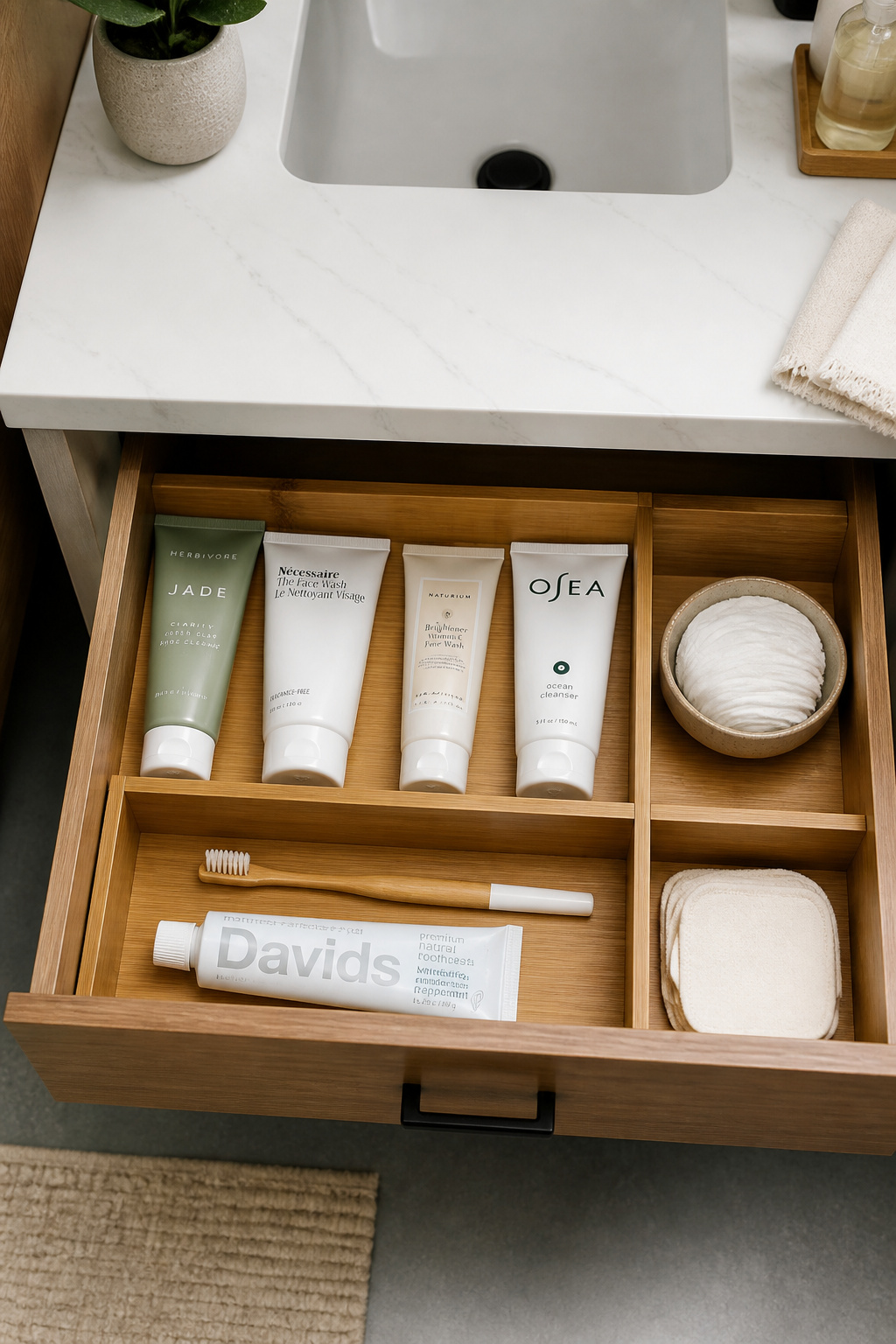
SpaceAid’s bamboo adjustable dividers expand from 17 to 22 inches, are 2.35 inches wide, spring-loaded for tool-free installation, and include label inserts. The material matters: they’re made from natural formaldehyde-free bamboo — a direct advantage over plastic alternatives that may off-gas in the enclosed drawer environment. Mythco’s version includes a drawer liner and inserts; the liner prevents items from sliding and protects the drawer floor from any incidental moisture. Standard bathroom vanity drawer heights run 4 to 5 inches; dividers with a 2.5 to 4-inch profile fit correctly without looking like kitchen utensil hardware in the wrong room.
The edit-first principle applies here before any organizing begins: empty the drawer, discard anything expired (most cosmetics and skincare have 12 to 24-month open lifespans — check them), and return only items you use at least twice a week. Most bathroom drawers shed 30 to 40% of their contents in this pass. The items that remain define the organization needed. Trying to organize before editing simply redistributes clutter with better aesthetics.
Group items by morning routine stage rather than product category: face cleanse cluster, moisturize cluster, hair cluster. This retrieval-by-task approach cuts average drawer interaction time significantly versus organizing by product type. It’s the difference between organized bathroom vanity ideas and a tidier version of the same chaos.
11. Wall-Mounted Dispensers and Magnetic Strips to Free Your Counter
Visual clutter on horizontal surfaces — and the bathroom counter is the most loaded horizontal surface in any small bathroom storage setup — correlates with elevated cortisol in multiple documented studies. That pile of bottles, the scattered makeup, the three types of face wash competing for the same inch of counter: it’s not just inconvenient, it’s physiologically costly. The cleaner the counter, the calmer the space, and the calmer the morning.
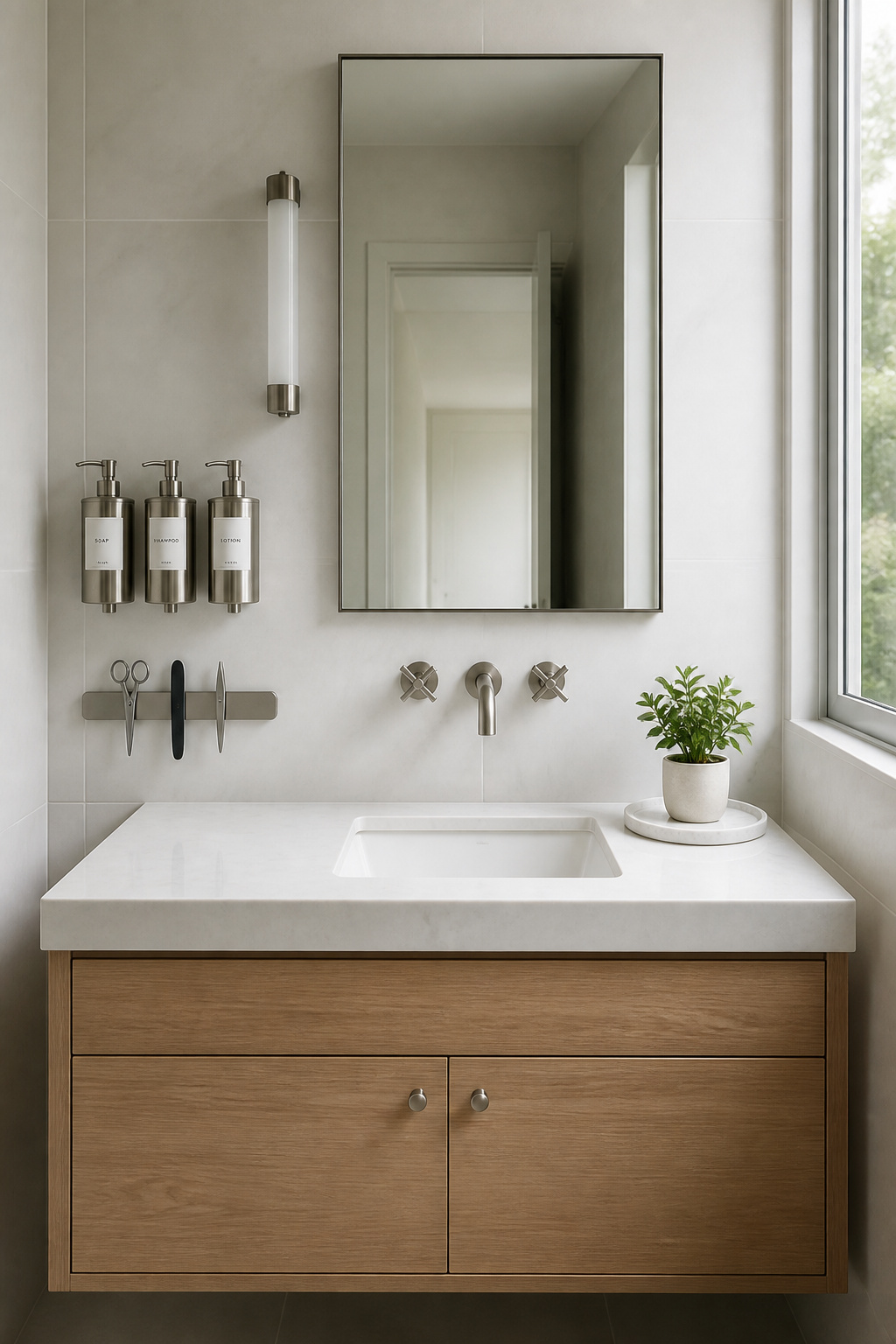
Wall-Mounted Hardware in a Small Bathroom Storage Strategy
Wall-mounted soap, shampoo, and face wash dispensers remove the most common counter occupants entirely. Adhesive-mounted dispensers use industrial-grade foam tape rated above 15 pounds per square inch — adequate for a 500ml dispenser (approximately 1.5 pounds when full) — but adhesives lose strength in consistently humid environments and typically need reapplication every six to twelve months. Drill-mounted dispensers (two screw anchors into tile or drywall) are permanently reliable and the better choice for homeowners. Stainless steel dispenser bodies resist bacterial biofilm better than ABS plastic, which can harbor growth in its microscratches over time. For renters, 3M Command strips rated to 5 pounds work as a short-term approach; budget for reapplication every four to six months in a steam-heavy shower environment.
For metal grooming tools — scissors, nail files, tweezers, bobby pins, small hair clips — a 12 to 18-inch stainless steel magnetic strip (the same product used in kitchens for knife storage) mounts beside the mirror and holds up to 20 to 30 pounds of magnetic load; far more than any grooming tool collection will approach. Non-metallic tools (wooden brushes, plastic combs) belong in the drawer or a basket — the strip is strictly for items with a metal component.
The result is a counter that gets wiped in 30 seconds because there’s nothing to move. That reduced friction is itself part of why wellness-forward bathroom design ideas consistently prioritize clear surfaces above almost any other feature.
12. Freestanding Linen Towers as Slim Bathroom Storage Solutions
A freestanding linen tower is the most space-efficient small bathroom storage furniture piece available. It occupies roughly 1 square foot of floor area. In return, it provides 40 to 60 inches of usable vertical storage, typically spread across a combination of open shelves, a closed cabinet section, and a display zone. That is the highest storage-to-footprint ratio of any freestanding bathroom furniture, which is why it’s the first piece designers reach for when working with a small bathroom that needs more capacity without expanding its footprint.
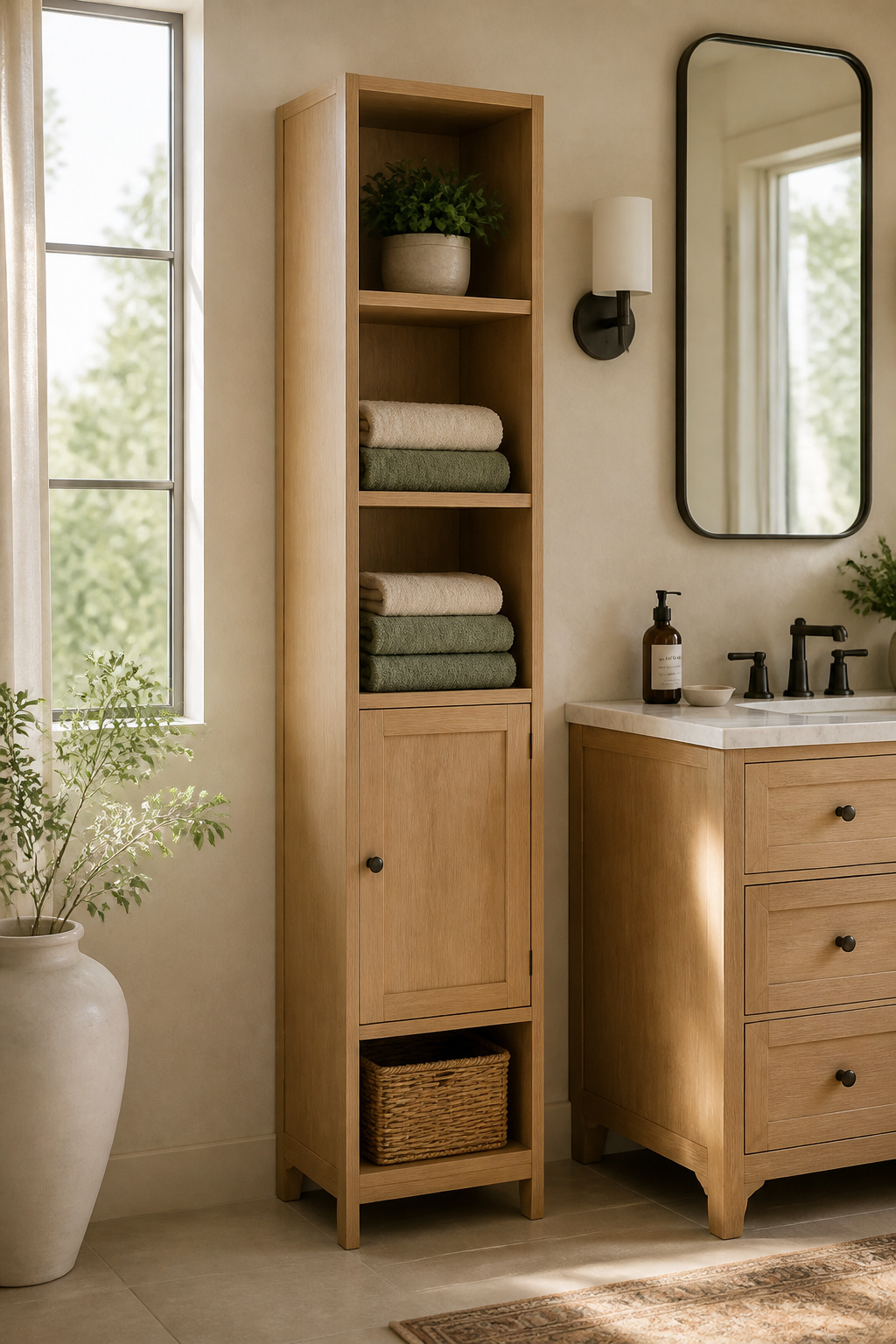
Standard dimensions: 12 to 13 inches wide by 13 inches deep by 67 to 72 inches tall. Palace Imports makes a solid wood version at 16.5 inches wide by 71.5 inches tall. The standard configuration offers eye-level open shelves for display and frequently accessed towels, a closed cabinet mid-section for medications and toiletries that don’t need to be visible, and an open lower shelf for baskets or toilet roll storage.
Why Material Choice Matters for Your Small Bathroom Storage Tower
Material is a genuine wellness decision here. Solid kiln-dried wood lasts 15 to 20 years with normal care, doesn’t swell irreversibly, and emits nothing. Standard MDF, by contrast, absorbs bathroom moisture like a sponge and — if standard-grade — releases formaldehyde at an accelerated rate in warm, humid conditions. Even moisture-resistant MDF grades (MR50) are not fully waterproof. If the budget doesn’t stretch to solid wood, look for CARB Phase 2 certification or GREENGUARD Gold on any composite wood product — these labels verify formaldehyde emissions below 0.05 ppm.
Styling the tower so it reads as furniture rather than utility comes down to curation of the open shelves: towels in one color family, one small plant, one or two decorative objects, and deliberate empty space. The closed section holds everything with a visual cost. Matching the tower finish to the existing vanity connects it to the room’s palette as an intentional piece rather than a later addition.
13. Tension Rod Systems Under the Sink for Spray Bottles and Bins
A spring tension curtain rod costs $3 to $8 at a dollar store or hardware store. Installed across the width of the under-sink cabinet — 16 to 28 inches is the standard adjustable range — positioned 6 to 8 inches below the cabinet ceiling, it creates an immediate hanging rail for cleaning spray bottles. Their trigger handles drape directly over the rod; the bottles hang upright, completely off the cabinet floor, using only the previously wasted space in the first 4 to 6 inches behind the cabinet door.
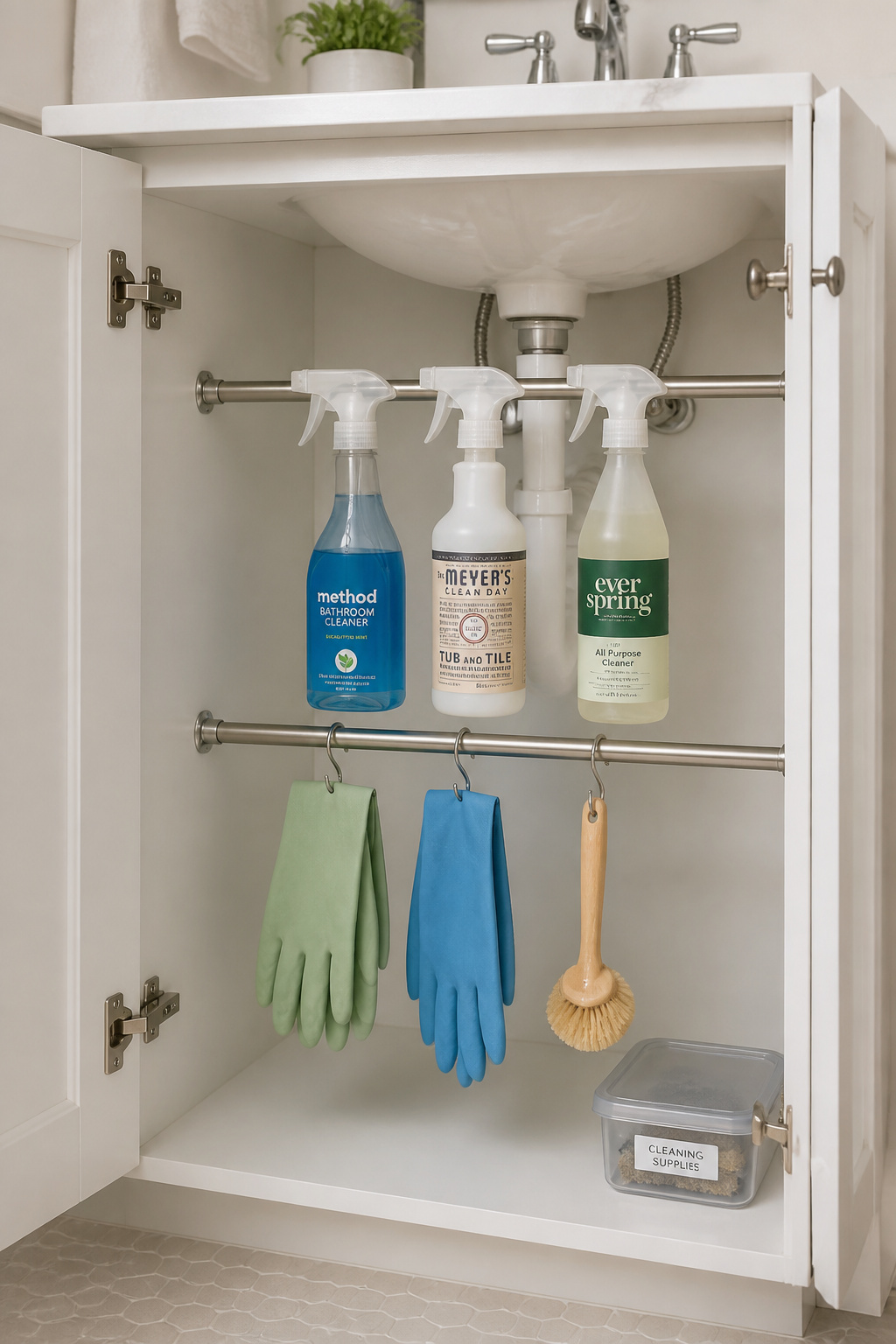
No drilling. No tools. No commitment. The entire installation takes 60 seconds, and the rod comes out just as fast if you decide to reorganize. For renters, it’s the only under-sink storage upgrade that leaves zero evidence. For everyone else, it’s simply the highest-value-per-dollar small bathroom storage trick available.
A double-rod configuration doubles the functionality: install a second rod parallel to the first, about 6 inches lower, for a second hanging tier. The upper rod holds tall spray bottles; the lower rod holds smaller items or is an S-hook rail for scrub brushes, dish gloves (which drape naturally over the rod), or small clips. Six stainless S-hooks cost about $5 and extend every rod’s capability indefinitely.
Load limit per rod: three to four standard spray bottles is comfortable; heavier bottles and glass containers should stay on the cabinet floor rather than hang. The goal is to get the regularly used items off the floor and into the door zone — where they’re visible and accessible without kneeling — while the floor remains clear for larger backup containers in sealed bins.
14. Rust-Free Tiered Shower Caddies That Actually Stay in Place
Shower caddy selection is a small bathroom storage decision that has a clear right answer. The failure pattern of most caddies is predictable: surface rust appears at the shelf lips and joints within 6 to 18 months, leaves orange stains on tile grout, and makes the caddy look worse than no caddy at all. This happens because most budget-price shower caddies are made from 201-grade stainless steel or chrome-plated carbon steel — materials that cut production cost by reducing corrosion resistance.
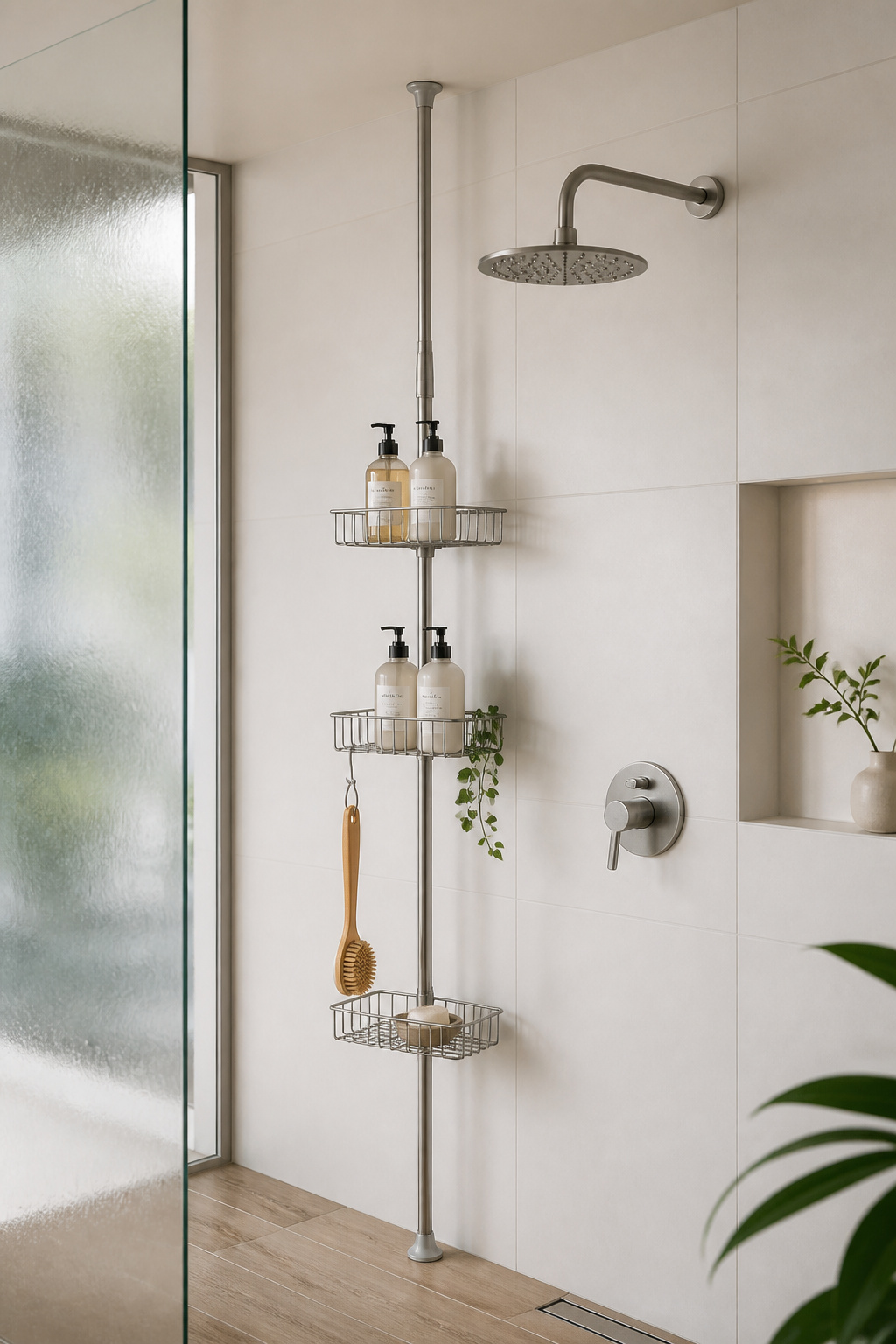
The grade distinction is specific: 304 stainless steel contains 18% chromium plus 8 to 10.5% nickel. That nickel content is what forms the passive oxide layer that self-repairs when scratched and resists chlorine compounds and hard water minerals. 201-grade stainless cuts nickel content (replacing it with manganese to reduce cost) and fails significantly faster in wet environments. Chrome-plated carbon steel is worse still — once the chrome layer chips or scratches, which happens to nearly every caddy within months of regular use, the underlying carbon steel rusts rapidly. When shopping: ‘304 grade’, ’18/8′, or ‘SUS304’ in the product specifications all indicate the correct alloy. ‘Stainless steel’ without a grade number is a reason to keep looking.
Teak is the other trustworthy material: naturally occurring tectoquinone oils make it self-sealing in wet environments with no treatment required. For mounting: tension-pole caddies install in five minutes and hold three to four tiers with a 15 to 25-pound capacity — the main failure mode is a textured tile floor where the pole base slips; a non-slip rubber pad fixes this. Adhesive-mount single shelves hold well on smooth tile and glass but will fail on textured or porous surfaces. Over-showerhead mounts need no installation at all but are limited by standard shower arm diameter (0.5-inch NPT in most residential settings).
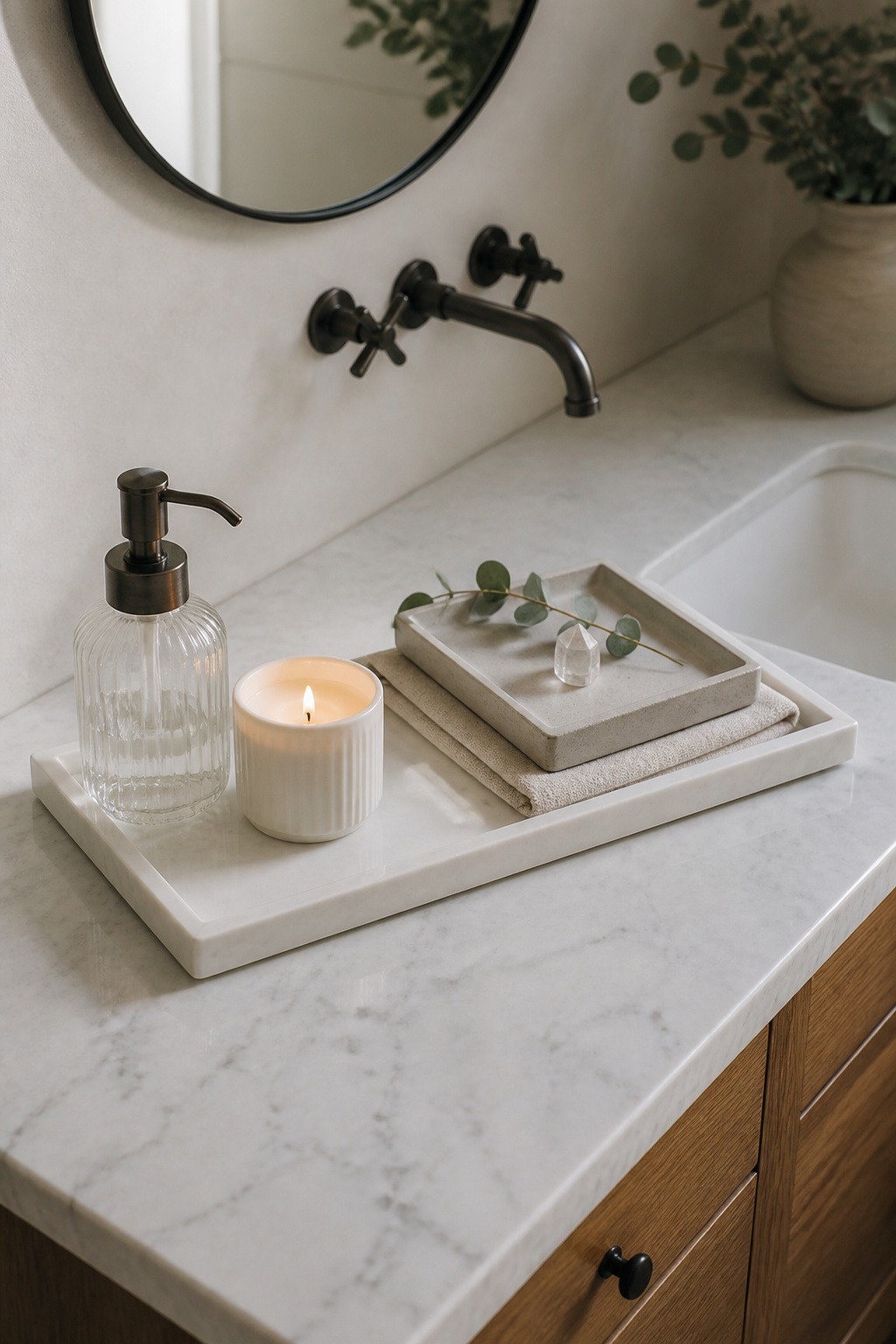
15. Vanity Trays and Tray Stacking: Compact Bathroom Storage for Open Shelves
In small bathroom storage styling, six items on a tray look different from six items scattered across a shelf — even when the items are identical. The brain groups objects sharing a container as a single unit rather than counting them individually, which is why a loaded tray reads as ‘curated display’ while the same objects loose read as ‘stuff left out.’ This is the core principle behind the vanity tray as a storage tool: it organizes without adding structure, and it makes editing visible by defining a boundary beyond which nothing belongs.
Material Hierarchy for Wellness-Focused Small Bathroom Storage Trays
For material choice, the wellness hierarchy is fairly clear. Genuine marble trays (non-resin, non-ceramic — check this when buying) have zero off-gassing, are naturally antimicrobial, cool to the touch, and have enough weight to stay put on any surface. West Elm’s Foundations Marble Vanity Tray in 12-by-6-inch format is a widely cited quality example. Concrete trays are a contemporary alternative: fully cured concrete emits nothing, has excellent weight stability that resists tipping, and develops character with use; a 9-by-18.5-inch extended format works along a longer counter zone. Ceramic trays are water and mildew-resistant by nature and have no chemical concerns. Bamboo trays are the most tactilely warm and environmentally conscious option but need a coat of food-safe mineral oil to handle incidental water contact. Resin ‘marble-look’ trays should be approached with caution — potential BPA or plasticizer content makes them the least suitable choice in Margot’s non-toxic material framework.
The tray stacking method creates visual interest without adding clutter: place a small tray (roughly 6 by 4 inches) on a riser or folded washcloth on top of a medium tray (9 by 6 inches), creating two display levels within one contained grouping. On open shelves, keep one-third of each tray surface empty — a full tray is just a contained mess. The goal is a display that reads as a thoughtful arrangement, which is exactly what luxury bathroom accessories for a genuine spa sanctuary covers in more depth.
How to Build the Right Small Bathroom Storage System for Your Space
The most common small bathroom storage mistake is shopping first. You walk into a home store, buy three organizers that look like they’ll help, and come home to find they don’t fit the shelf, accommodate the pipe, or solve the actual problem. The edit-first approach sidesteps this entirely.
Start any small bathroom storage project by removing every item from the bathroom and sorting into three categories: daily use, weekly use, and rarely or never. Discard anything expired or unused — most people eliminate 30 to 40% of bathroom contents at this stage. What remains is the inventory your storage system needs to handle, not the theoretical maximum. Only once you know exactly what stays do you measure the spaces, identify the gaps, and choose solutions.
The rental versus ownership distinction drives which solutions make sense. Renters should lean entirely on damage-free options: tension rods, freestanding ladder racks, over-door organizers, and freestanding linen towers — all removable, all adaptable to the next space. Homeowners can invest in permanent solutions that pay long-term dividends: a recessed shower niche, a recessed medicine cabinet, under-sink pull-out inserts, and wall-mounted dispensers. These carry real resale value and compound their benefit daily.
For shared bathrooms, the most reliable organization principle is assigned zones rather than shared shelves — one basket or tray per person, labeled clearly, placed in a defined spot. Shared surfaces drift back to chaos reliably; individual zones hold their organization because each person has ownership of their space.
The common thread through all 15 of these ideas is that good small bathroom storage isn’t about acquiring more containers. It’s about using the vertical, corner, behind-door, and under-sink space that already exists — and pairing that with fewer, better-chosen items in the room.