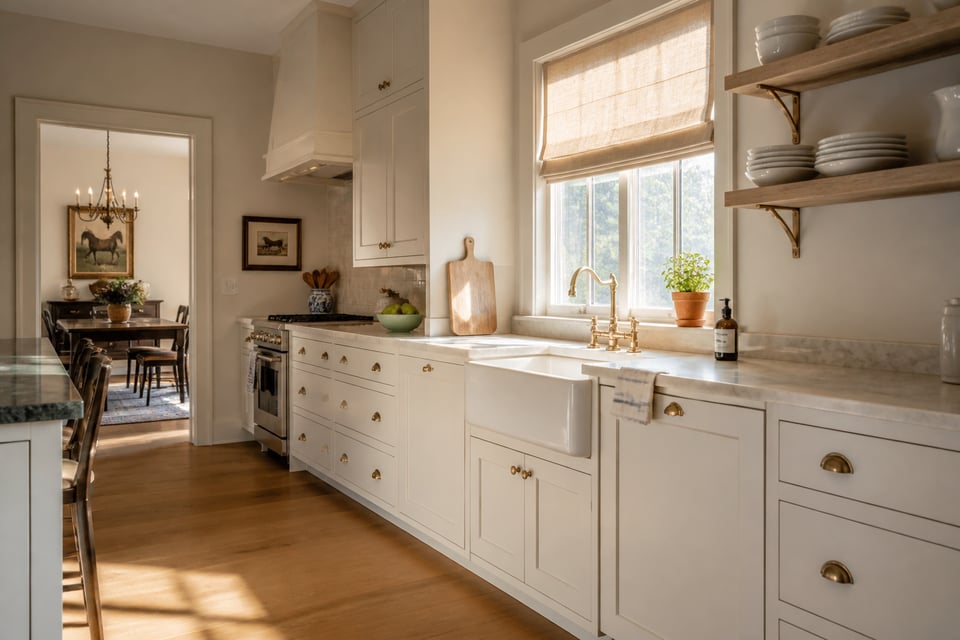
There is a reason traditional kitchen cabinets from the Georgian, Colonial, and Craftsman eras are still being built today. They were never designed around fashion — they were designed around permanence. The Shakers building cabinet work in New England in the 1800s were not trying to create a style; they were building furniture that would outlast them. What we now call traditional kitchen cabinets is simply the accumulated result of that care.
Fourteen years renovating historic homes has given me a working understanding of what separates authentic period cabinetry from a convincing reproduction — and what details homeowners most often miss. The choices that matter most are rarely the expensive ones. Door profile, construction method, hardware finish: these decisions determine whether a kitchen reads as genuinely period-appropriate or as something pulled from a showroom.
The sixteen ideas below cover the full range of traditional kitchen styles, from Shaker flat-panel work in white oak to Victorian beaded-inset cabinetry to the unfitted kitchen tradition that predates the built-in era entirely.
1. Shaker-Style Traditional Kitchen Cabinets in White Oak
The Shakers arrived in America from England in 1774 and settled mainly in New England, Kentucky, and Ohio. By the early 1800s, their communal workshops were producing furniture built on a simple thesis: no unnecessary ornament, only honest, durable construction. The five-piece flat-panel door — a recessed centre surrounded by squared stiles and rails — was not an aesthetic choice. It was a moral one. Which probably explains why it has outlasted every kitchen trend since.
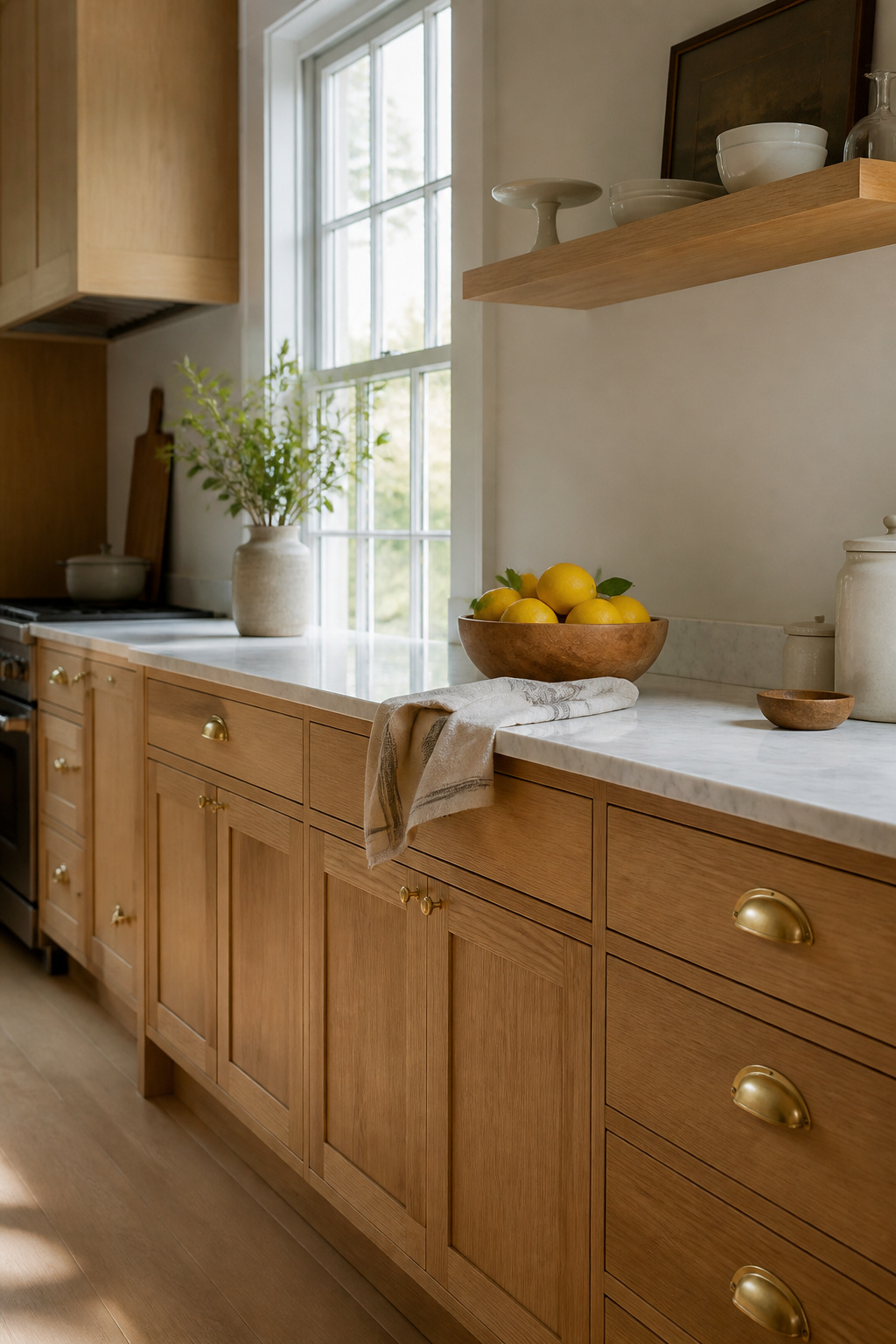
The five-piece construction allows the wood to move seasonally without cracking — a structural advantage that more elaborate door styles sacrifice. Original Shaker work used maple, cherry, and pine. Contemporary Shaker cabinetwork has largely moved to white oak, specifically quarter-sawn, where the growth rings run perpendicular to the face and reveal those silvery, iridescent ray fleck streaks. Quarter-sawn costs about 15-25% more than flat-sawn, but the dimensional stability and visual character make it worth specifying for cabinet doors. For hardware, choose nothing that draws more attention than the joinery: brushed brass cup pulls at 3-inch centres or simple round ceramic knobs. Bar pulls and edge pulls break the Shaker vocabulary.
You can explore diverse traditional kitchen cabinet styles to see how Shaker relates to the broader family of period cabinet forms before settling on a direction.
2. Raised-Panel Doors in Cherry for a Heritage Kitchen
Stile-and-rail door construction came into common use around 1700. The raised-panel door — where the centre field sits proud of the surrounding frame — developed as the craft became more sophisticated and as clients willing to pay for it became more common. In Colonial America, owning raised-panel cabinetry was a direct indicator of affluence. Every panel had to be shaped by hand with moulding planes, and the cost reflected that. The raised field typically sits 3/8 to 1/2 inch above the frame surface, and it is the shadow line at that edge that gives a period kitchen its visual weight.
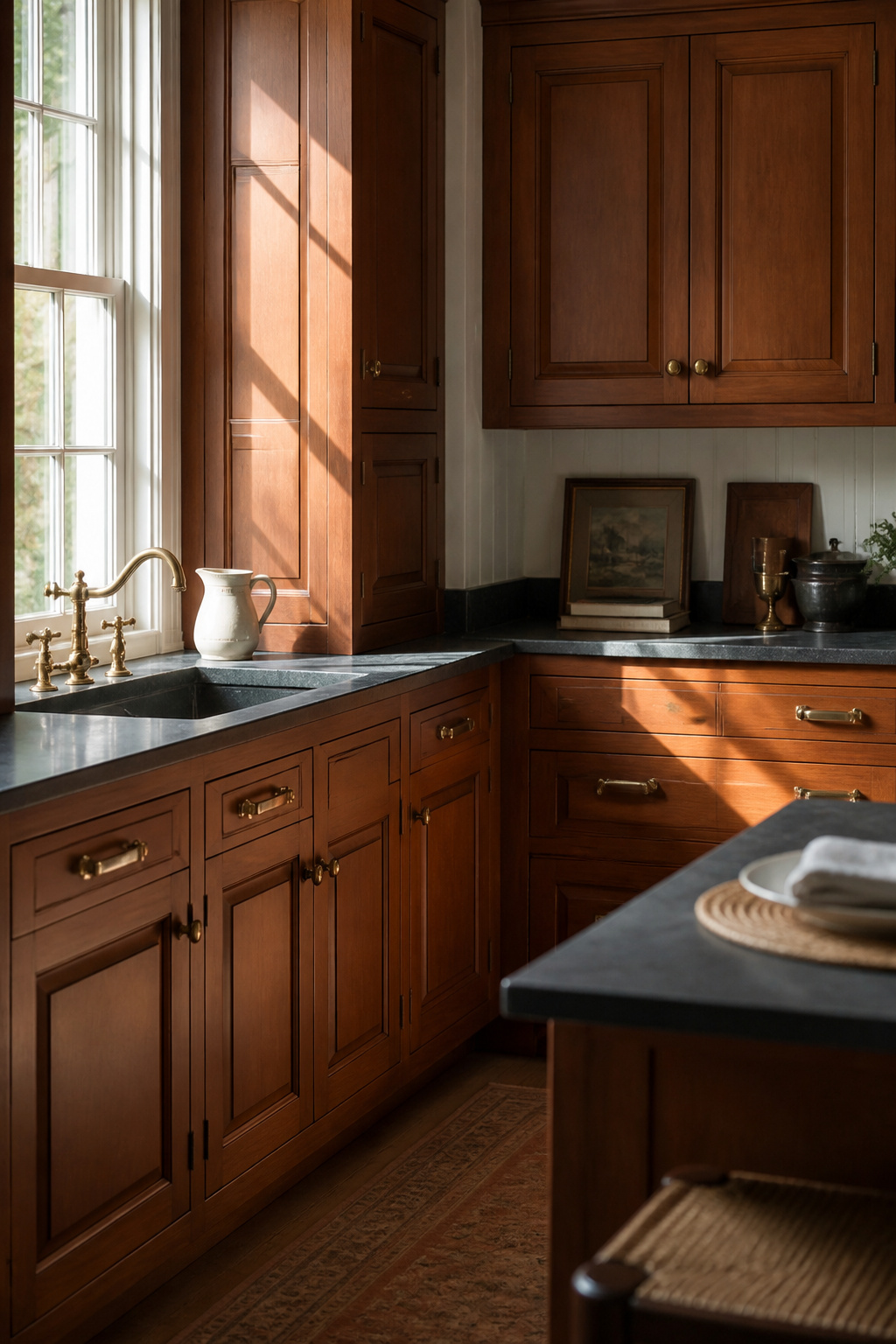
American black cherry is the most period-appropriate species for Colonial and Federal-era raised-panel work. It begins as warm pinkish-tan when freshly milled and deepens to reddish-amber over three to five years of light exposure. Mahogany is a beautiful alternative with finer, more uniform grain, but most architectural mahogany available today is imported — cherry is grown in Appalachian forests and is native to the tradition. Pair raised-panel cherry cabinets with marble or soapstone countertops, not quartz: the uniformity of engineered stone fights natural wood variation in a way that is immediately apparent. Hardware should be unlacquered brass or oil-rubbed bronze — the warmth of cherry needs warm metal.
Understanding the elements of traditional kitchen design helps place the raised-panel door in the full period vocabulary before making decisions about mouldings, hardware, and countertop material alongside it.
3. Inset Cabinetry: the Mark of True Traditional Kitchen Craftsmanship
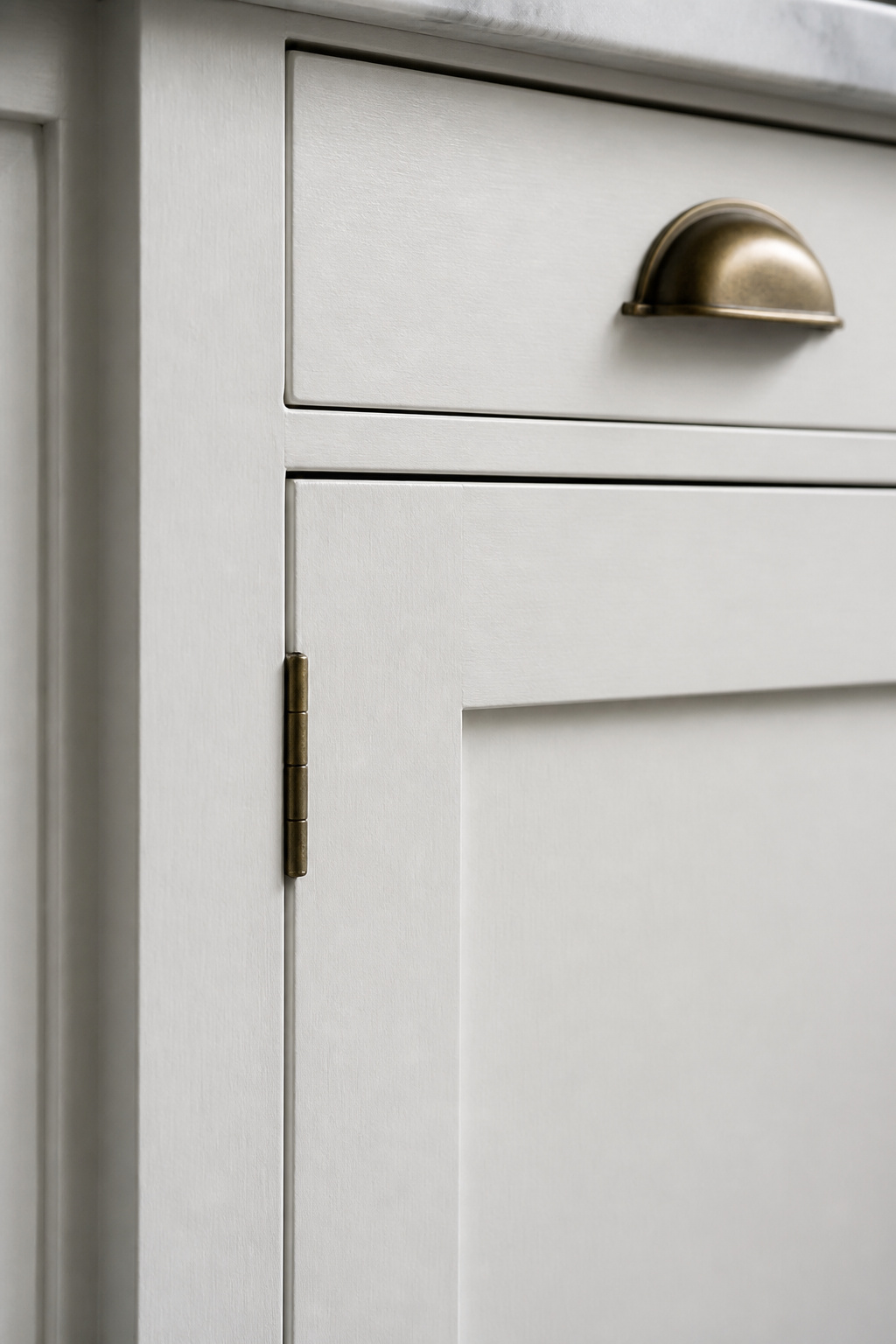
Before the mass-production era arrived after World War II, virtually every American kitchen cabinet was built inset — the door sitting inside the face frame rather than overlapping it. Each piece was fitted to a specific opening with an even reveal around the perimeter, typically 1/8 inch. Getting that reveal consistent requires precision that overlay construction simply does not demand, which is why overlay won the post-war industrial contest: it is faster and cheaper.
Is the Premium Worth It?
Inset cabinetry costs 15-30% more than comparable overlay work per linear foot — but buys three things: a furniture-like visual quality where no mechanism is exposed, precision joinery that reveals its quality up close, and construction that tends to last longer because tighter joints tolerate racking better over decades. For historic renovation specifically, inset is not optional if you want the result to be coherent. Overlay cabinets in a home with authentic period millwork — divided-light windows, turned stair balusters, backband door casings — look wrong in a way that visitors notice even when they cannot name it.
Wood movement is the practical challenge: in climates with significant humidity swings, inset doors can swell slightly in summer. Plan a 1/8-inch reveal in dry climates, 3/16-inch in humid ones. Dura Supreme (Minnesota) and Kennebec Company (Maine) are two American cabinet makers with strong reputations for quality inset work. Crown Point Cabinetry in New Hampshire specialises specifically in period reproduction cabinetry, including beaded-inset construction, and offers detailed online configurators.
4. Crown Moulding Details That Elevate Kitchen Cabinet Design
The easiest way to distinguish a custom kitchen from a builder kitchen is the crown moulding — or the absence of it. Stock cabinets stop at a flat top edge; custom work runs moulding from cabinet top to ceiling, completing the architectural connection that makes cabinetry read as built-in rather than installed. The profile you choose matters as much as whether you use it at all.
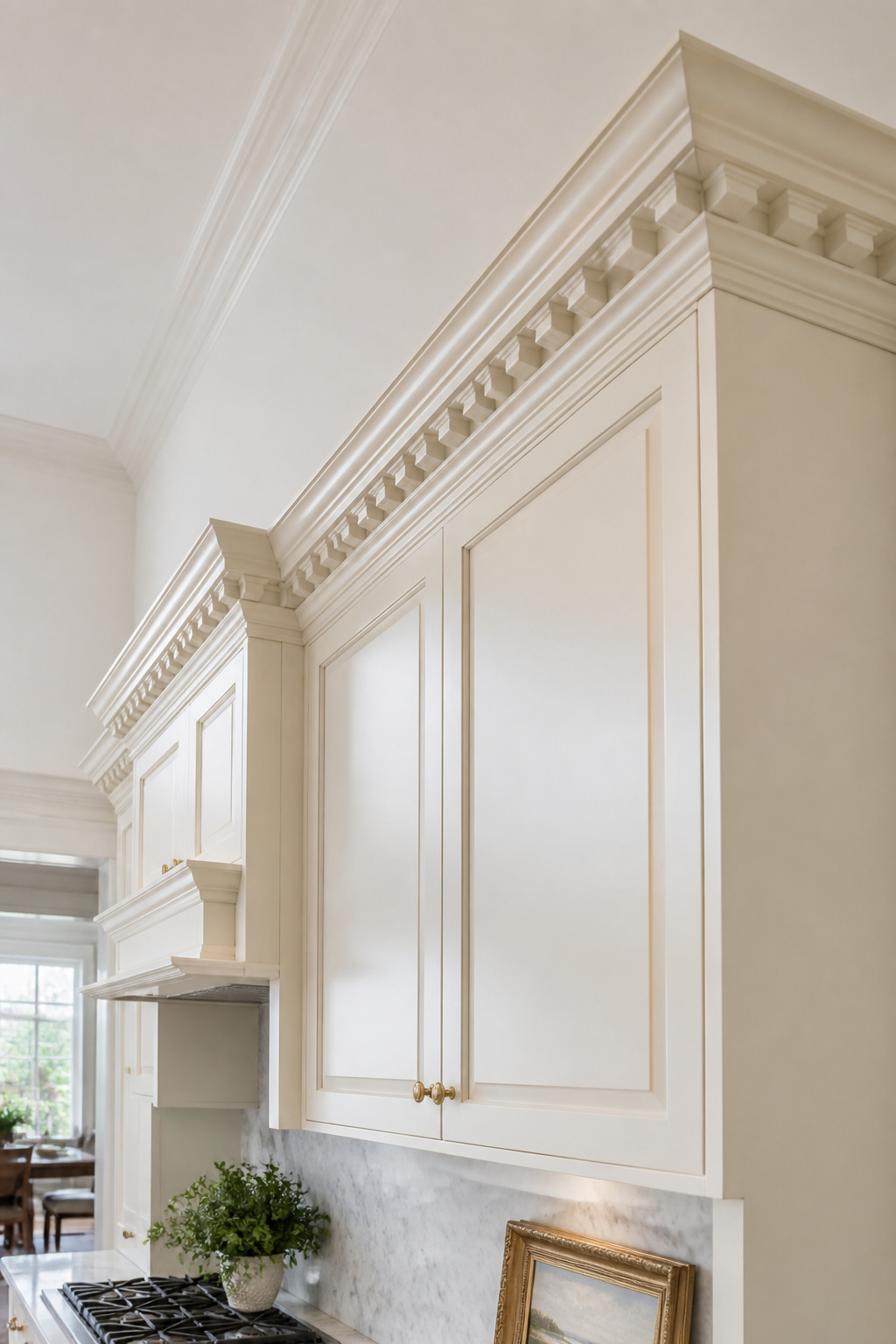
Dentil moulding — evenly-spaced rectangular blocks along the profile — appeared in Georgian and Neoclassical American interiors and pairs naturally with raised-panel cherry or mahogany cabinetry. Cove moulding has a concave curve that suits Federal, Colonial Revival, and English Cottage-style kitchens. Stepped moulding is the most architecturally neutral option and can be built to any height using standard stock profiles.
Sizing and Installation
The general rule: 1 inch of crown height for every foot of ceiling height. Eight-foot ceilings call for 5-6 inch crown; nine-foot ceilings suit 6-8 inch. Going larger creates a top-heavy appearance that subsequent adjustments cannot fix. When a significant gap exists between cabinet tops and ceiling, a two-part approach works well: a flat riser board against the cabinet top, then a smaller crown against the ceiling. Adding crown to existing stock cabinets is one of the most cost-effective upgrades available — paint-grade poplar profiles run $3-8 per linear foot. Inside corners should be coped rather than mitred: coped joints tolerate seasonal movement where mitred joints open up over time.
5. Glass-Front Traditional Kitchen Cabinets for Display Storage
Glass-front cabinets have appeared in serious kitchens since at least the Victorian era, when displaying fine china — transferware, ironstone, blue-and-white porcelain — was an important social signal. The framing pattern determines the period character more than the glass type itself.
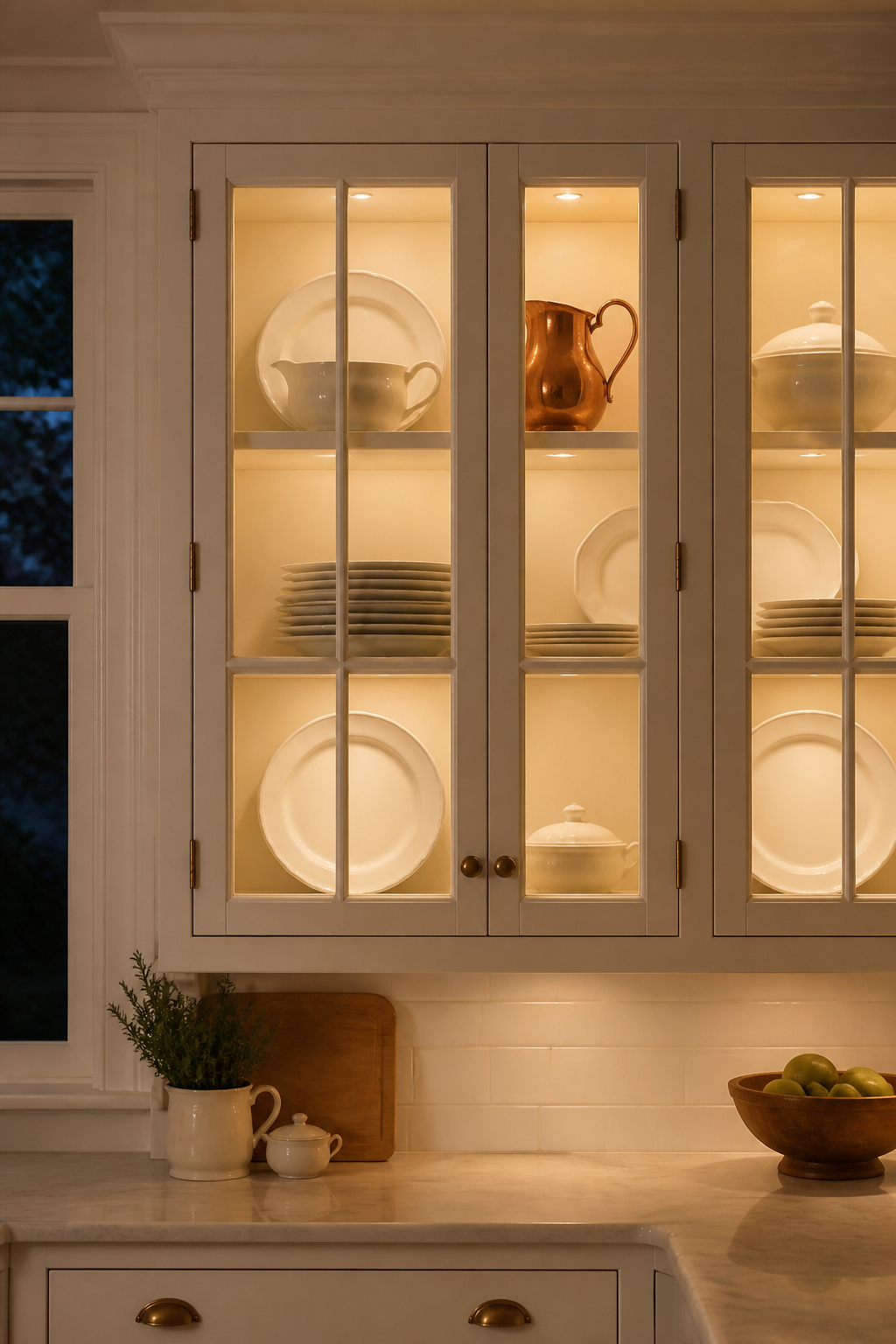
Traditional mullion patterns include prairie (small squares at the border with a large central opening), divided-light grid, and the mission cross. Prairie and divided-light read as formal and Heritage; mission suits Craftsman kitchens specifically. Seeded glass — with visible air bubbles creating surface texture — is an excellent practical choice: it provides enough obscurity that the interior does not need to be perfectly styled at all times while reading as period-appropriate. Limit glass-front doors to 20-30% of total upper cabinet space; too much glass creates visual noise rather than elegance. Paint the inside of glass-front cabinets a shade or two deeper than the cabinet exterior — this creates depth and makes displayed objects read against a defined background. Interior LED strip lights along the top edge, on a dimmer, allow full brightness for entertaining and low ambient light in the evenings.
6. Painted Traditional Kitchen Cabinets in Classic Creams and Whites
Painted cabinetry has a longer history than the assumption that wood should be shown. The Shakers painted their maple and pine work in earthy reds and muted greens. Georgian and Colonial kitchens used grained and painted woodwork as standard practice in all but the most affluent homes. What we call heritage whites and creams are, in most cases, direct references to colours that were on kitchen woodwork two hundred years ago.
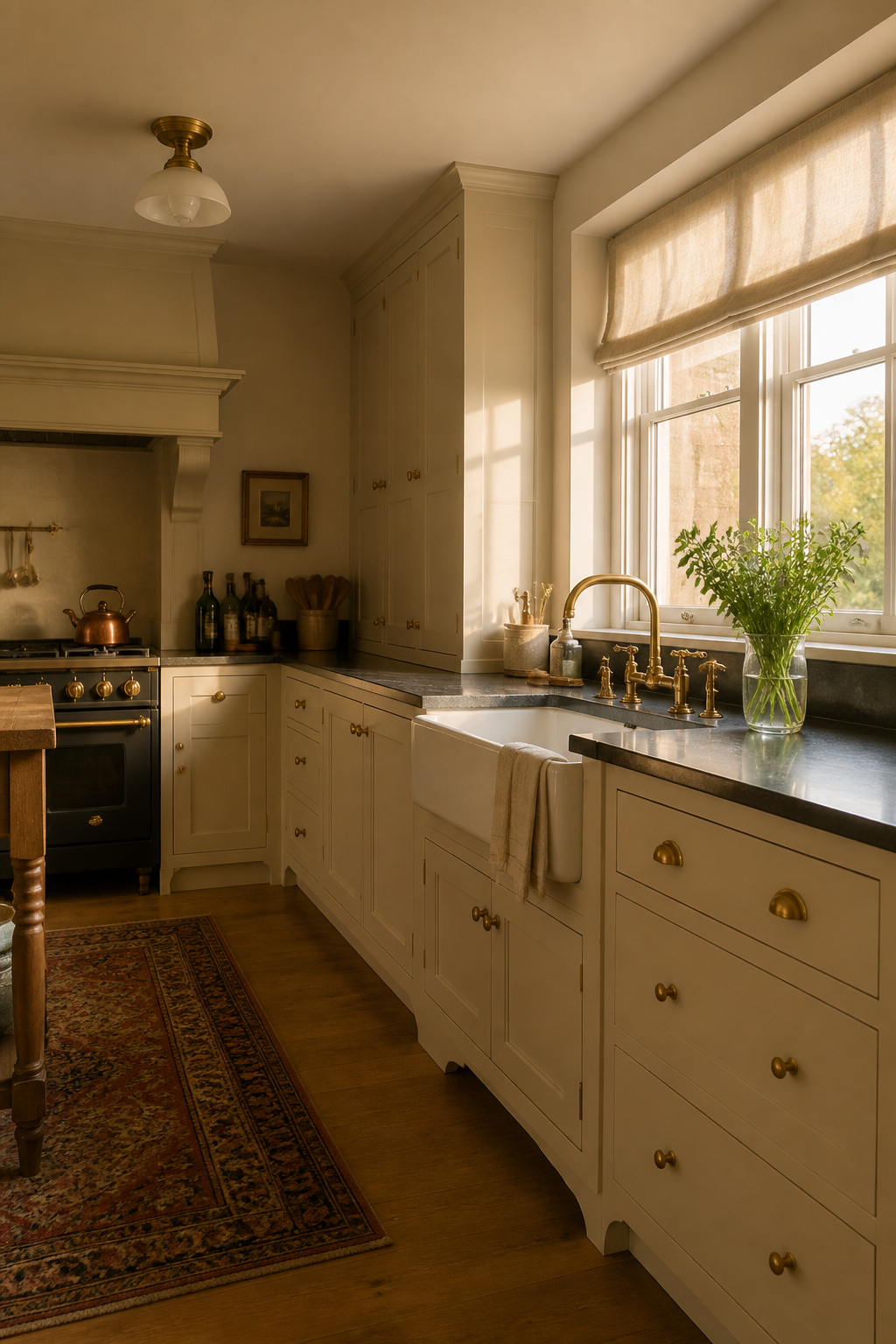
Benjamin Moore White Dove (OC-17) is a warm, slightly off-white that does not fight aged stone, brick, or wood tones — consistently used by historic preservation designers for exactly that reason. Ballet White (OC-9) is particularly effective in kitchens with wooden floors and brass hardware: warm without going yellow. Farrow & Ball School House White references Edwardian and Victorian institutional interiors. There is a broader exploration of kitchen design decor rooted in culinary heritage that addresses the full colour and finish palette for traditional kitchens.
Getting the Finish Right
For cabinet doors, use a satin alkyd finish — not standard latex wall paint. Alkyd finishes cross-link as they cure and become harder and more washable than comparable latex sheens. Benjamin Moore Advance and Sherwin-Williams Emerald Urethane are both self-levelling water-based alkyds that produce a hard, smooth surface. Professional HVLP spraying beats brush painting for cabinets: the cost premium is typically $800-2,000 for a full kitchen but eliminates brush marks that no amount of careful brushwork can entirely avoid.
7. Beaded-Inset Cabinetry for a Victorian-Era Kitchen
Beaded inset is inset construction with one additional detail: a small rounded bead routed into the inner edge of the face frame, running continuously around every door and drawer opening. The bead is typically 1/4 or 3/8 inch in diameter — small enough to register as a shadow line at normal viewing distance, visible enough up close to signal hand-crafted quality. Before mass-produced cabinetry arrived mid-20th century, virtually every American kitchen was built this way. It was not a style choice; it was simply how cabinetry was made.
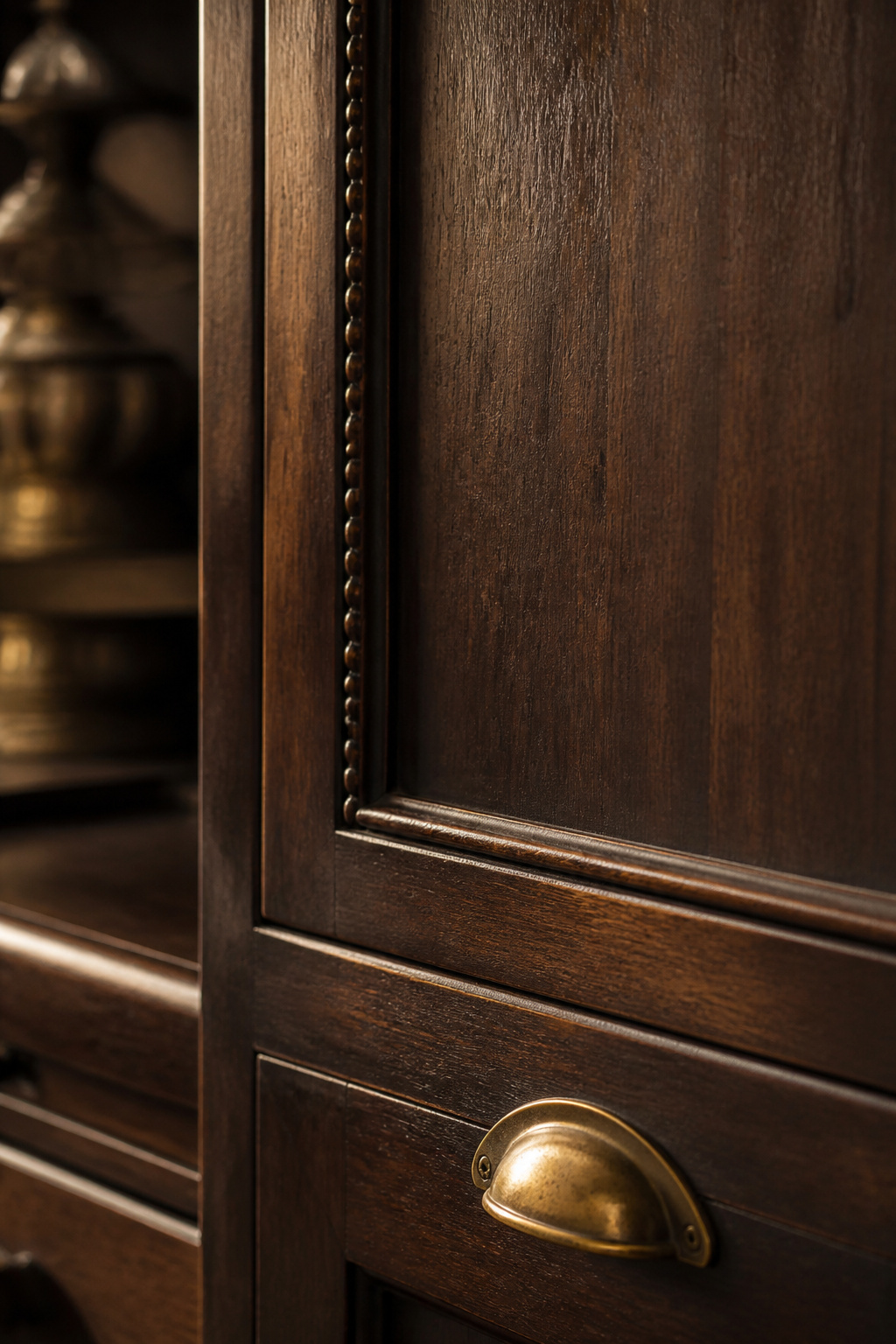
The visual difference between standard inset and beaded inset is subtle in photographs but immediately apparent in person. Standard inset shows a plain flat reveal around each door — clean, precise, and modern in feeling even when the door style is traditional. The bead adds a rounded profile that catches light at different times of day and creates visual depth that matches the moulding profiles throughout the rest of a period house. Crown Point Cabinetry in Claremont, New Hampshire, is the most visible American specialist for this kind of period reproduction work. Kennebec Company in Bath, Maine, is another serious option. If working with a local cabinet maker, specify the bead profile in writing — quarter-round, cove, or astragal — and request a sample door before approving the full run.
8. Dark Stained Traditional Kitchen Cabinets in Walnut or Mahogany
Dark wood kitchen cabinetry was the standard through most of the Victorian and Edwardian eras. Oak, mahogany, and pine were finished with deep varnish or shellac. The Arts & Crafts movement codified the fumed-oak look specifically: ammonia vapour applied to white oak develops a rich grey-brown tone without stain, and this technique is experiencing a revival. A deliberate dark kitchen today stands out as considered rather than dated.
American black walnut ranges from pale brown to dark chocolate with dark streaks; it is best finished with a clear coat rather than stain, since the natural variation is the point. Walnut lightens with UV exposure over time, shifting toward golden brown unless protected with UV-inhibiting topcoats. Mahogany has finer, straighter grain, stains exceptionally well, and maintains its colour more consistently. For a kitchen where colour stability matters over years, mahogany is the safer choice. Both species score 900-1,100 on the Janka hardness scale — adequate for cabinetry. Pair dark cabinets with Carrara or Calacatta marble countertops and keep walls in the warm off-white range. Also: under-cabinet task lighting is not optional in a dark kitchen. Dark surfaces absorb light, and a walnut kitchen without proper task lighting is genuinely unpleasant to work in.
9. Two-Tone Traditional Kitchen Cabinets With a Contrasting Island
The fitted, everything-matches kitchen is a post-WWII invention. Before 1940, kitchens were furnished with pieces in whatever finishes the owner had accumulated — a painted cream dresser, a scrubbed pine table, dark oak scullery cupboards. Nothing was expected to match. Two-tone cabinetry in a traditional kitchen is not a contemporary experiment; it is a formal acknowledgment of how kitchens actually looked for most of the past three centuries.
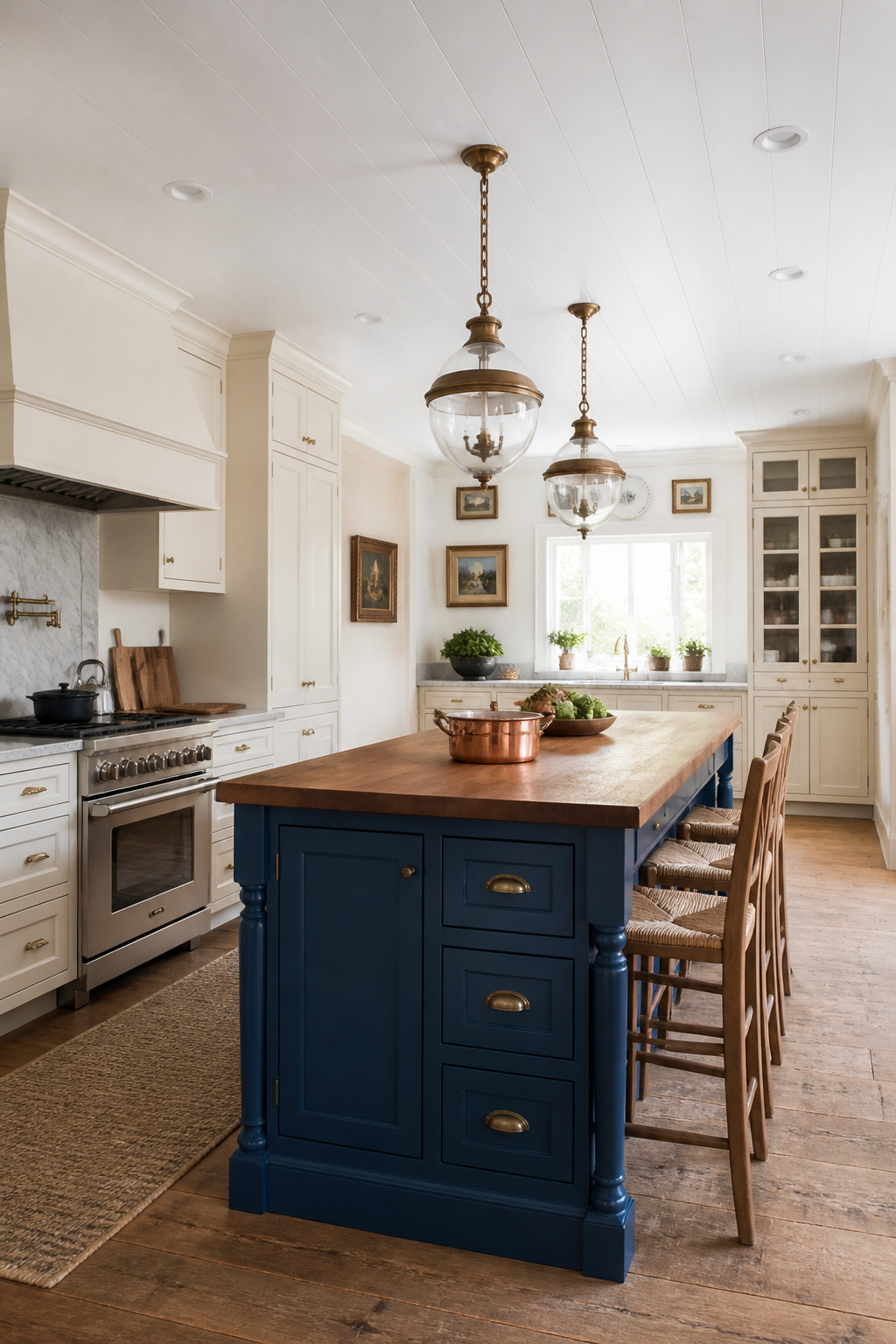
The most successful traditional two-tone application puts the contrasting colour on the island. A darker, richer colour there reads as a separate piece of furniture in the centre of the room, which is historically accurate — islands in traditional kitchens were often exactly that: a worktable or butcher block unit that arrived independently of the built cabinetry. The distribution matters: a 60/40 split, with 60% of the cabinet surface in the lighter colour and 40% in the darker accent, works better than equal division. Keep the door profile consistent across both colours — the same raised-panel or Shaker door in both finishes reads as designed. Use the same hardware finish but different hardware style on the island to reinforce its identity as a separate piece.
10. Open Shelving Mixed With Traditional Kitchen Cabinetry
Open shelving in the kitchen is not a trend imported from social media — it is the original form of kitchen storage. Irish and English pine dressers with plate racks date from the 18th century. Welsh dressers, Colonial plate rails near the ceiling, Scandinavian pine shelving — all predate enclosed cabinet storage by generations. In a traditional kitchen, open shelving should reference this heritage rather than looking like a styled installation.
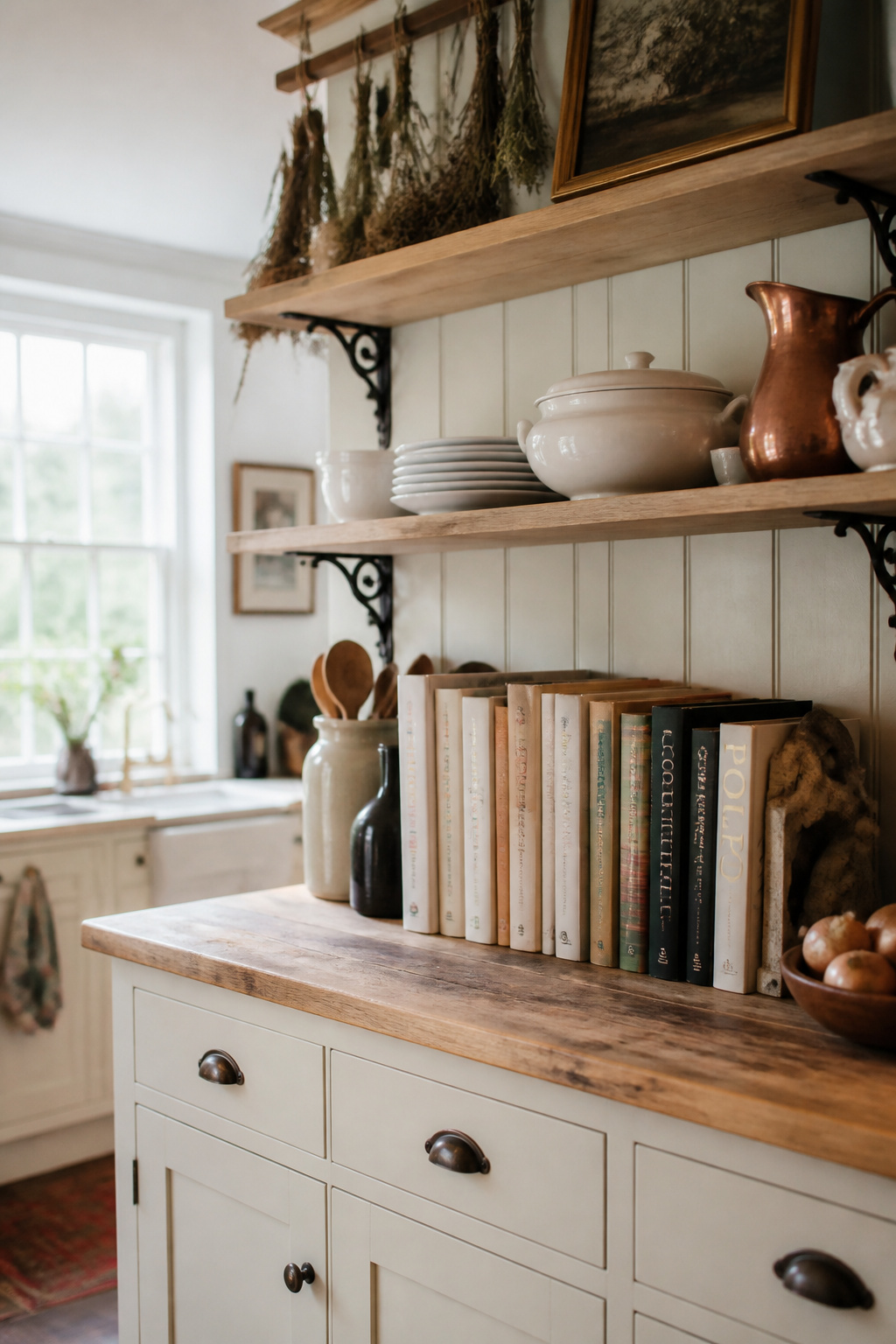
The Irish and English dresser model is the best functional precedent: enclosed lower section for everyday storage, three open shelves above for display. Shelf depth for plate storage runs 10-12 inches; display-only shelves work at 8-10 inches. Vertical spacing of 10-12 inches accommodates dinner plates stored upright; allow one bay at 16 inches for serving platters. Bracket style should match the period: simple wrought-iron brackets for farmhouse and Colonial kitchens, scrolled or carved wooden brackets for Victorian work. For styling, ironstone, creamware, and transferware are the most visually successful items — their limited colour palette creates cohesion without effort. Copper and brass vessels age well and add warmth. Books with attractive spines add personality and make the shelf feel inhabited rather than installed.
11. Furniture-Leg Details and Fluted Pilasters on Traditional Kitchen Cabinets
Standard base cabinets sit on a continuous toe kick that visually welds all the cabinetry into one undifferentiated mass. In a traditional kitchen, this reads as institutional. Furniture legs break that connection: even simple turned legs at the front corners of a base cabinet run — 4-6 inches of visible hardwood leg — changes the visual read of the entire kitchen from installed to furnished.
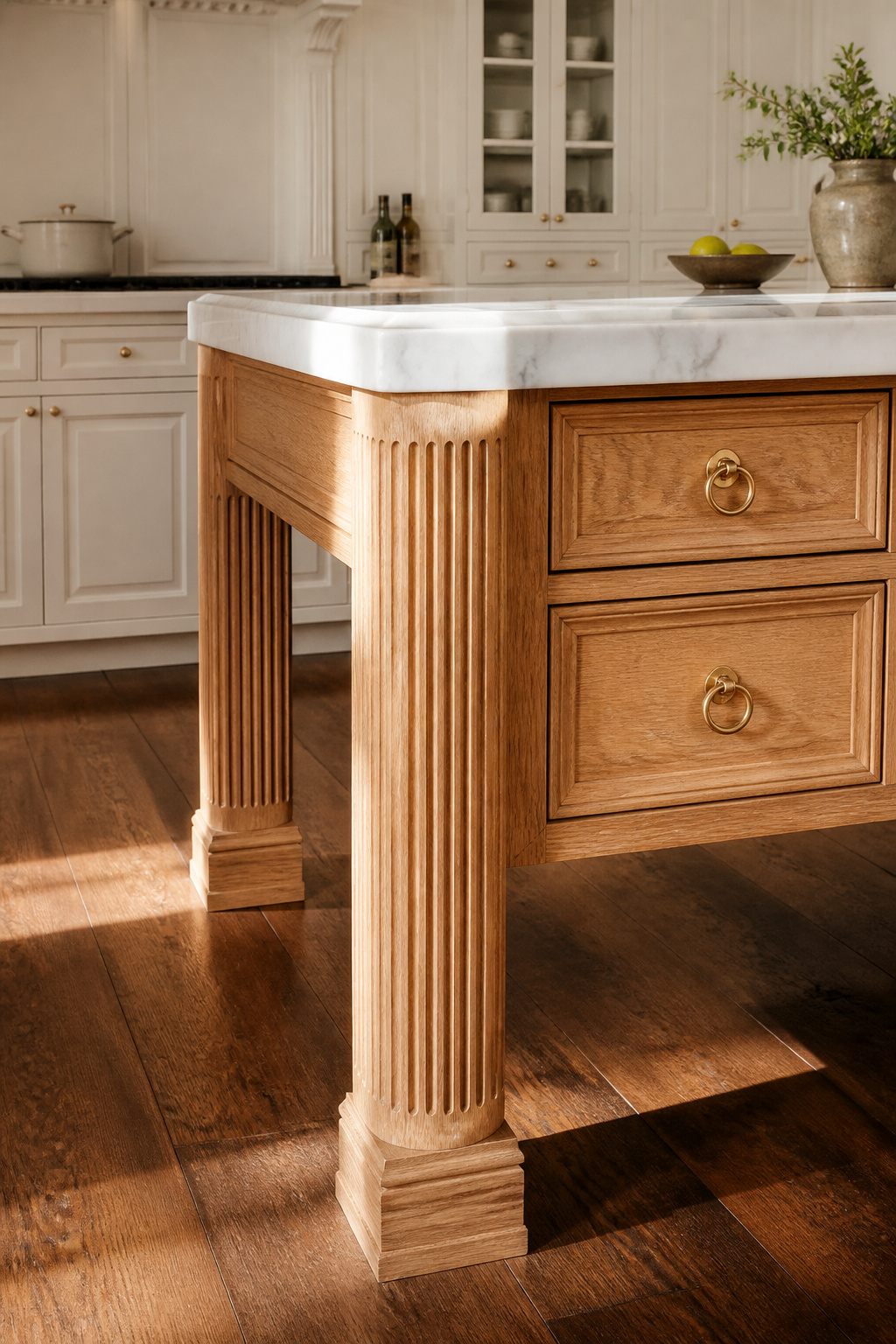
The technique is most dramatic on a kitchen island, where all four sides are visible — adding furniture legs makes the island look like a piece of furniture that happens to be functioning as an island, which is the goal of the unfitted aesthetic applied within a mostly fitted scheme. Fluted pilasters — flat column-forms with vertical parallel grooves — reference classical Greek and Roman column forms and appear in Georgian, Colonial, and Federal-style kitchens between cabinet runs and flanking the range.
Adding Legs to Existing Stock Cabinets
Furniture legs can be retrofitted to existing stock cabinets by removing the factory toe kick, shimming the cabinet box up on a plywood platform, and applying purchased legs at the corners. This retrofit also requires adding a finished decorative panel at exposed end sections, since stock cabinet sides are not finished for visibility. Osborne Wood Products (Toccoa, Georgia) and Architectural Depot both supply leg-and-pilaster kits in multiple profiles — bun foot, turned, tapered square, fluted column — to match different period styles. Pick one profile and apply it consistently; mixing a turned round leg on one section with a tapered square leg on another creates immediate visual incoherence.
12. Traditional Kitchen Cabinets With Decorative Corbels and Bracket Shelves
Corbels originated in pre-medieval Europe as structural stone supports where ceiling beams met interior walls. By the Georgian era they had become primarily decorative, referencing classical Greek and Roman architecture in carved wood form. The acanthus leaf corbel derives directly from the Corinthian column capital and has been reproduced in wood, stone, and plaster ever since.
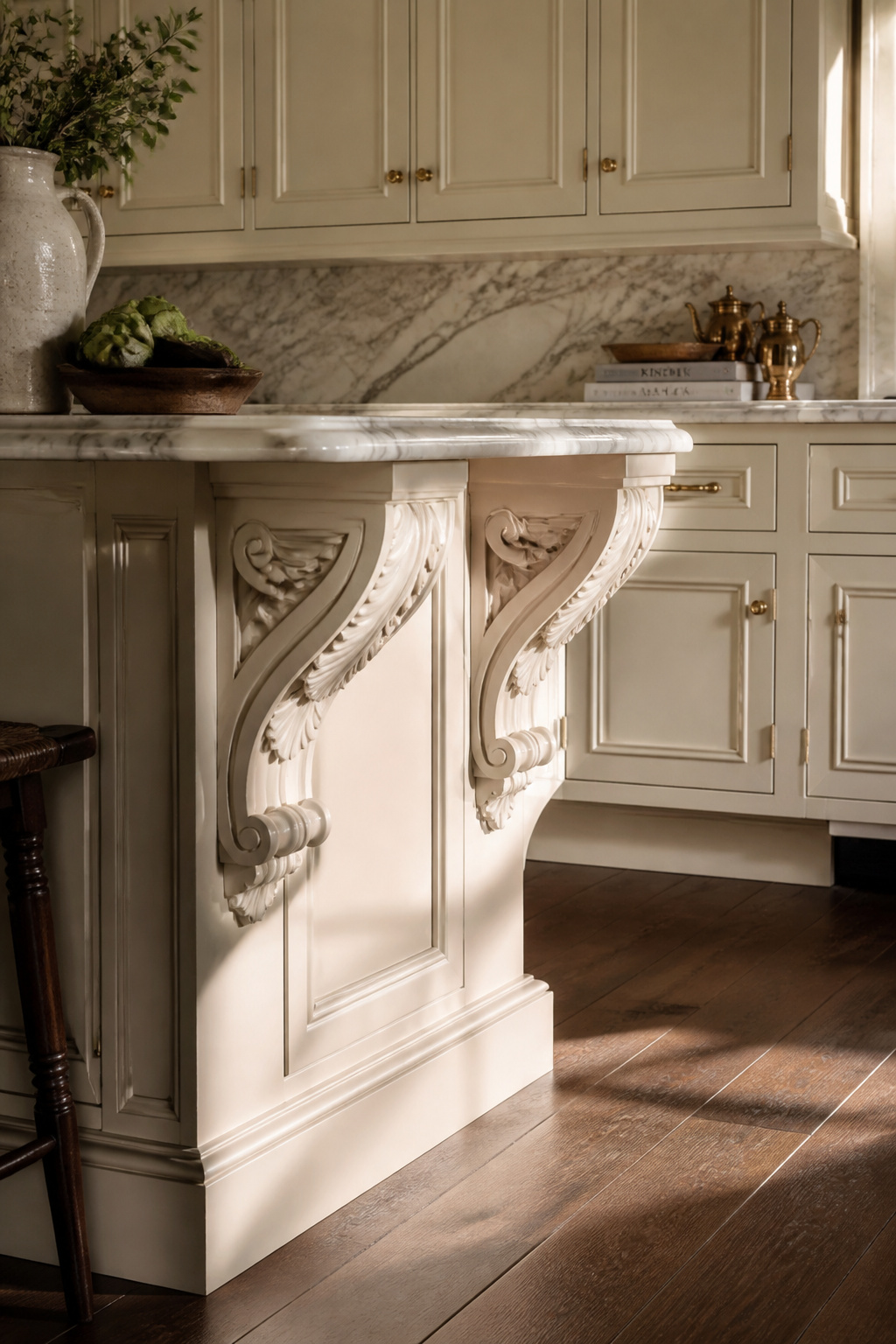
In kitchen cabinetry, corbels work best at transition points. The most effective single application is at the end of a peninsula or island, where the counter overhangs without visible support. Range hood corbels frame the hood and direct the eye upward, especially effective when the hood is in a darker material than the perimeter cabinets. Corbel size should be proportional to the overhang it supports: a 12-inch overhang looks right with an 8-10 inch corbel; a 6-inch overhang needs a 5-6 inch corbel. Style should match door profile complexity: simple S-scroll brackets pair with Shaker and Craftsman doors; carved acanthus leaf corbels suit Georgian and Victorian raised-panel work. Osborne Wood’s classical corbel collection and Custom Turnings both offer wide selections in multiple profiles and species, available unfinished for painting or staining to match.
13. Traditional Kitchen Cabinets Paired With a Classic Apron-Front Sink
The apron-front sink — farmhouse sink, Belfast sink, butler’s sink — originated in late 17th-century Ireland and Britain and was the standard kitchen sink form through the Victorian and Edwardian eras. The wide exposed apron allowed the user to stand closer to the basin, reducing back strain during long washing sessions. That practical function still makes sense, which explains why the form has never disappeared.
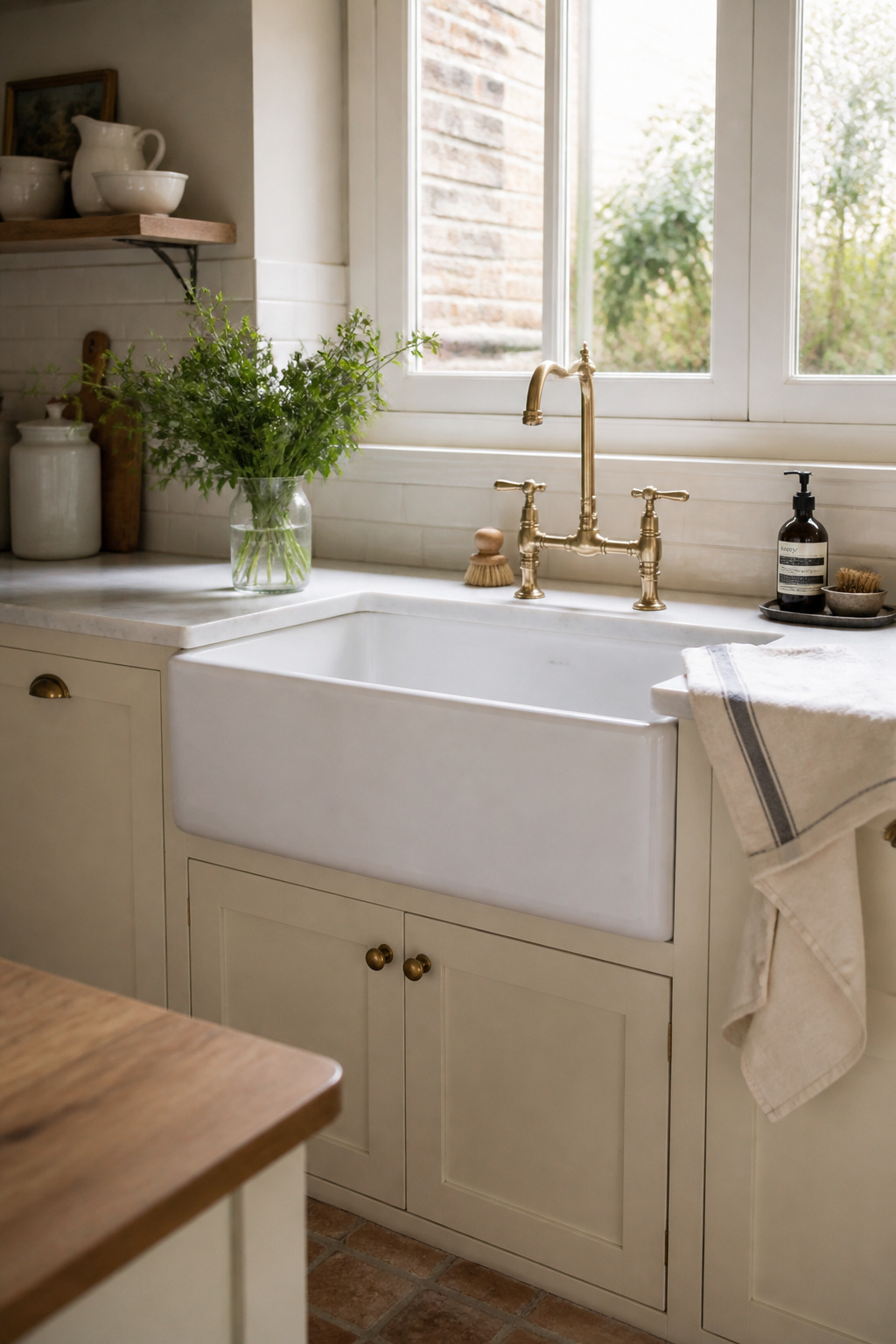
Fireclay sinks were produced in the English Midlands from the 18th century onward, chosen for resistance to the harsh cleaning chemicals and heavy use of a working scullery. The phrase “butler’s sink” was popularised in 1872; “Belfast sink” in 1929. In American homes, cast iron with porcelain enamel was the standard through the early 20th century. The varied regional traditions of traditional kitchen styles from farmhouse to French country trace how these sink and cabinetry traditions converged in American kitchen design.
Today, fireclay has become the dominant choice for traditional kitchen work. A 33-inch fireclay sink weighs approximately 100 lbs empty and over 200 lbs filled. BOCCHI, Rohl, and Shaws of Darlington are the most specified quality brands. The cabinet modification requirements matter: the face frame must be notched or removed to allow the apron to protrude (most manufacturers specify a minimum 36-inch base cabinet opening for a 33-inch sink), and a support structure of 2×4 or 2×6 lumber must be built inside to carry the weight. Specify the sink model before ordering the base cabinet, and verify the apron protrusion dimension — typically 3/4 to 1 inch proud of the cabinet face — against your specific sink before cutting anything.
14. Unfitted Kitchen Style With Free-Standing Traditional Cabinetry
The fitted kitchen — where every unit is built-in and aligned in continuous runs — is a 20th-century invention. The Frankfurt Kitchen, designed by Margarete Schütte-Lihotzky in 1926, introduced the concept of built-in cabinetry. Post-WWII suburban construction made it the standard. Before 1926, kitchens were furnished with free-standing pieces, exactly as every other room in the house was furnished.
Hoosier Cabinets — manufactured from before 1900 through WWII by Indiana companies including Hoosier Manufacturing, Sellers, and McDougall — were the dominant standalone kitchen storage unit in American homes for that period. An original in usable condition is available through antique dealers in the $200-800 range depending on configuration. The most successful unfitted kitchens combine one or two genuine antique pieces with purpose-built cabinetry that complements rather than matches them. Paint is the great unifier: paint the custom cabinetry in a cream or off-white that could plausibly have been the antique piece’s original colour, and the visual distinction between old and new becomes far less apparent. The guide on how to update your traditional kitchen with modern touches addresses the specific challenge of integrating period pieces with contemporary kitchen function. For countertops, a consistent material across the standalone pieces — soapstone or butcher block throughout — creates cohesion even when the cabinet forms vary.
15. Traditional Kitchen Cabinets in Deep Green, Navy, or Slate Blue
Deep, saturated cabinet colours have deep roots in Victorian and Colonial interior design. Victorian kitchens were routinely painted in hunter green, olive, dark burgundy, and navy — driven by the availability of durable mineral pigments and the practical reality that a working Victorian kitchen accumulated significant grime. The Colonial American palette ran to olive green, rust red, and mustard yellow with a characteristically muted, grayed-out quality typical of 18th-century natural pigments. What reads as bold today was once simply how kitchens were painted.
Forest green is the most versatile of the three jewel tones — it works with both light oak floors (reads as English country house) and dark walnut floors (reads as formal Victorian), and is comfortable with brass, bronze, and copper hardware. For forest green, Farrow & Ball Calke Green (No. 80) is the standard reference; Benjamin Moore Backwoods (No. 2140-10) is a more accessible alternative. Navy suits coastal, Georgian Revival, and Colonial kitchens best — Farrow & Ball Hague Blue (No. 30) is the most specified shade, though it can feel oppressive in rooms with limited natural light. Slate blue is the most forgiving for darker rooms: Farrow & Ball Mizzle (No. 266) photographs as blue but reads warmer in person; Benjamin Moore Van Deusen Blue (HC-156) is a reliable alternative. In all cases, limit the deep colour to lower cabinets, the island, or one accent run — painting all surfaces in a jewel tone in a smaller kitchen feels enclosed rather than rich.
16. Traditional Cabinet Hardware: Bin Pulls, Cup Pulls, and Escutcheons
Cabinet hardware is the most cost-effective upgrade in a traditional kitchen renovation and the detail most often mishandled. Getting it right requires knowing which pull and knob forms belong to which era — because using the wrong hardware on period-style cabinetry produces the same effect as hanging the right picture in the wrong frame.
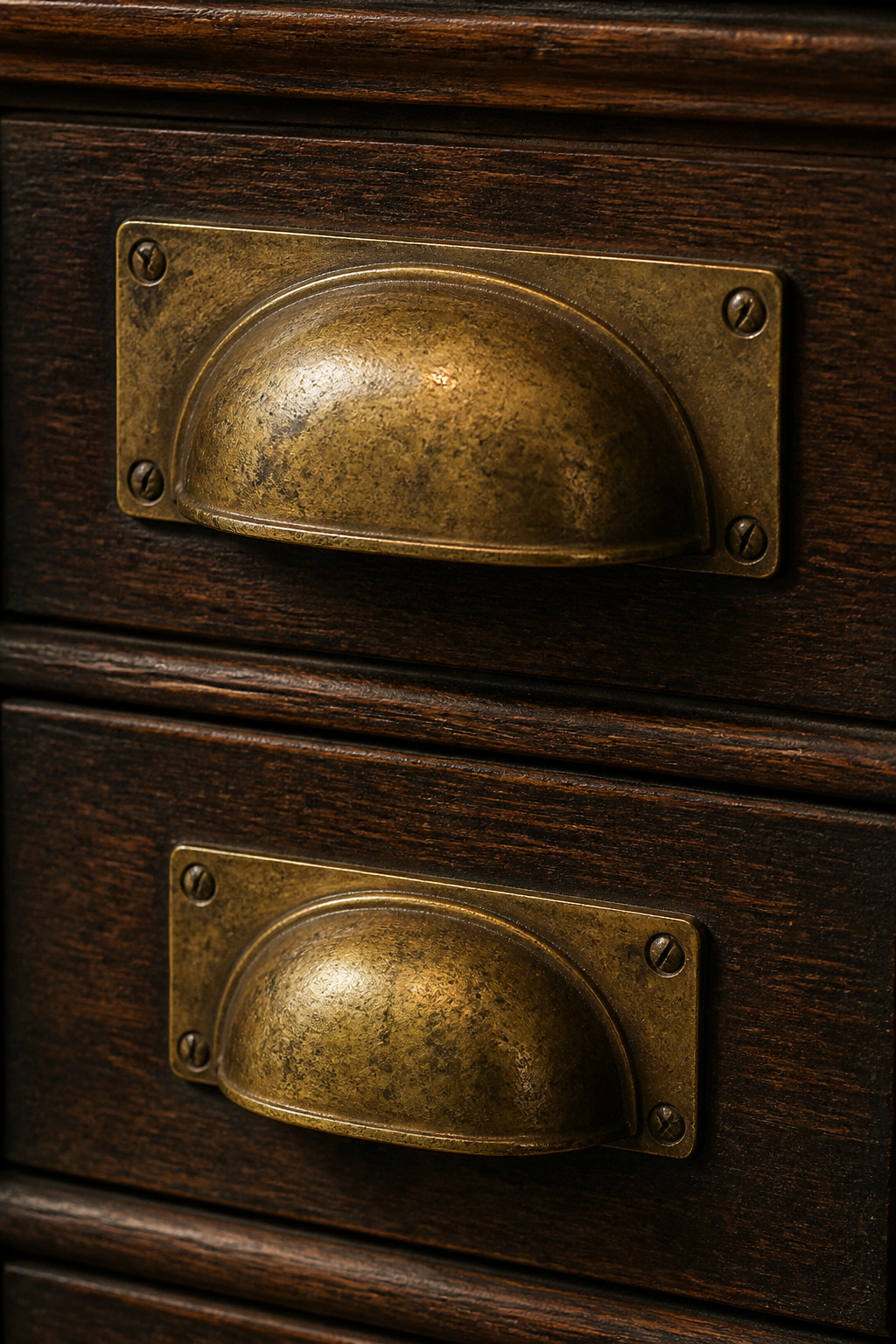
The William & Mary period (1680-1730) produced teardrop and pendant pulls in cast brass. Georgian and Regency work (1730-1830) is the origin of the bail pull — a U-shaped handle suspended from two posts on a decorative oval backplate. The Victorian era (1837-1901) brought mass production and bin pulls, cup pulls, and glass knobs to a wider market. The bin pull — a D-shaped bar below a curved backplate — was popularised in Victorian farmhouse kitchens. The Arts & Crafts movement (1890s-1920s) answered Victorian excess with hammered copper and bronze in simple forms.
Matching Hardware to Period
Cup pulls belong in Shaker, Colonial, and Federal-era kitchen interpretations. Bail handles suit formal Colonial Revival and Georgian work. Bin pulls are correct for farmhouse, country Victorian, and Craftsman kitchens. For sourcing, House of Antique Hardware (Portland, Oregon) carries one of the largest collections of reproduction period hardware, including Georgian bail pulls and Craftsman copper knobs. Antique Hardware Supply and Paxton Hardware (Baltimore) are both well-regarded specialists. Specify unlacquered brass wherever possible — it patinas naturally to a warm, antique tone over years of use, which is correct and desirable. Lacquered brass stays artificially bright and can flake at the coating edge as it ages. And under no circumstances: stainless steel or brushed nickel on period-style traditional cabinets. Cool metals undermine every traditional detail in the room.
Choosing the Right Traditional Kitchen Cabinet Style for Your Home
The most common error in a traditional kitchen renovation is deciding on the aesthetic before understanding what the home’s architecture actually calls for. The door profile and construction method should be chosen in reference to the house’s period — not a magazine or a showroom.
Colonial and Federal homes suit raised-panel doors in cherry with bail hardware, or Shaker flat-panel work in maple — inset construction is correct for both. Victorian homes call for beaded-inset construction with raised-panel or Gothic-arch panel doors, dark finishes or richly painted cabinets, and bin pull hardware. Arts & Crafts and Craftsman homes want Shaker or simple flat-panel doors in white oak, hammered copper or bronze hardware, and simple cove or flat crown moulding. Colonial Revival and Georgian Revival homes of the 1910s-1940s suit raised-panel or mullion-glass doors in cherry or painted finish, dentil crown moulding, and bail handle hardware in aged brass.
Start with the door profile. It is the most visible decision and establishes the period vocabulary that all subsequent choices follow. Budget for inset construction if the home is pre-WWII and the rest of the millwork is period-appropriate — the disconnect between overlay cabinets and authentic period architecture is not subtle. And consider the specialist suppliers — Crown Point, Kennebec, Dura Supreme — who offer design consultation alongside product. The details that define a genuinely traditional kitchen are specific, not complicated. Getting them right the first time is considerably less expensive than correcting them afterward.