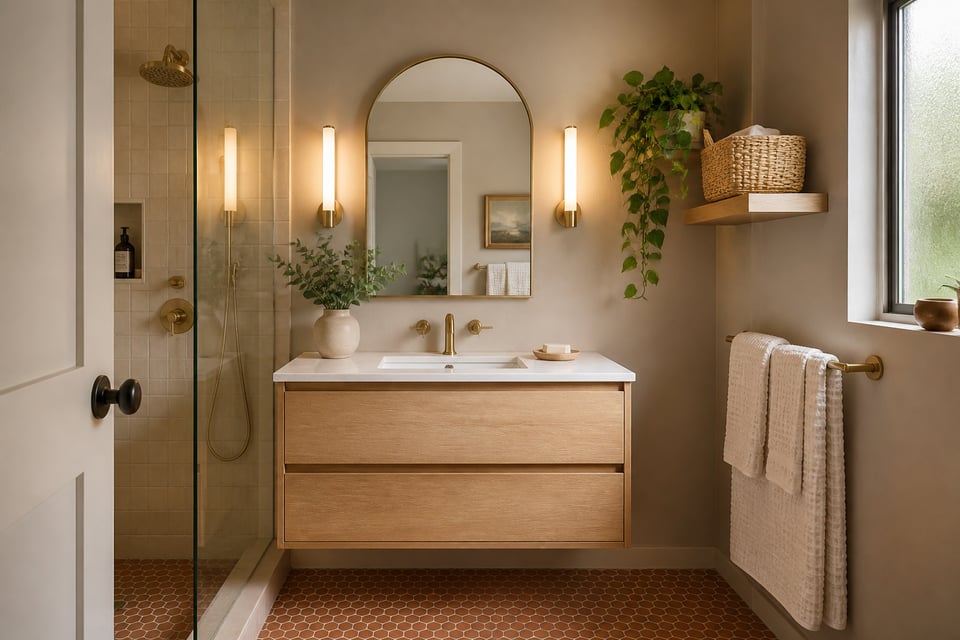
The bathroom is the smallest room in most homes and the one visited most often — upwards of six or seven times a day. Yet it’s the room we’re most likely to leave unfinished, perpetually somewhere between “functional” and “I’ll deal with it eventually.” In my work as a wellness design consultant, I’ve seen how much the state of a small bathroom affects daily mood. The cold tile, the clinical overhead light, the shower caddy clanking with every reach — these small sensory aggressions accumulate. Small bathroom decor doesn’t require gutting the room or spending a fortune. It requires a different kind of attention: treating this intimate space as deserving of the same care you’d give any other room in the home.
These 18 small bathroom decor ideas work with the specific constraints of compact spaces — limited floor area, hard surfaces everywhere, humidity, variable light. Some cost almost nothing; a few involve one structural change that pays dividends for decades. All of them are grounded in the same principle: a calmer bathroom supports a calmer daily routine, and small bathroom design choices compound in a way that transforms how the room actually feels to be in.
1. Warm Neutral Wall Paint That Makes Small Bathroom Decor Feel Airy
Paint is the right place to start with small bathroom decorating — it changes the light quality, the temperature of the room, and the way every other surface reads, all for the lowest investment per square foot of any change you can make.
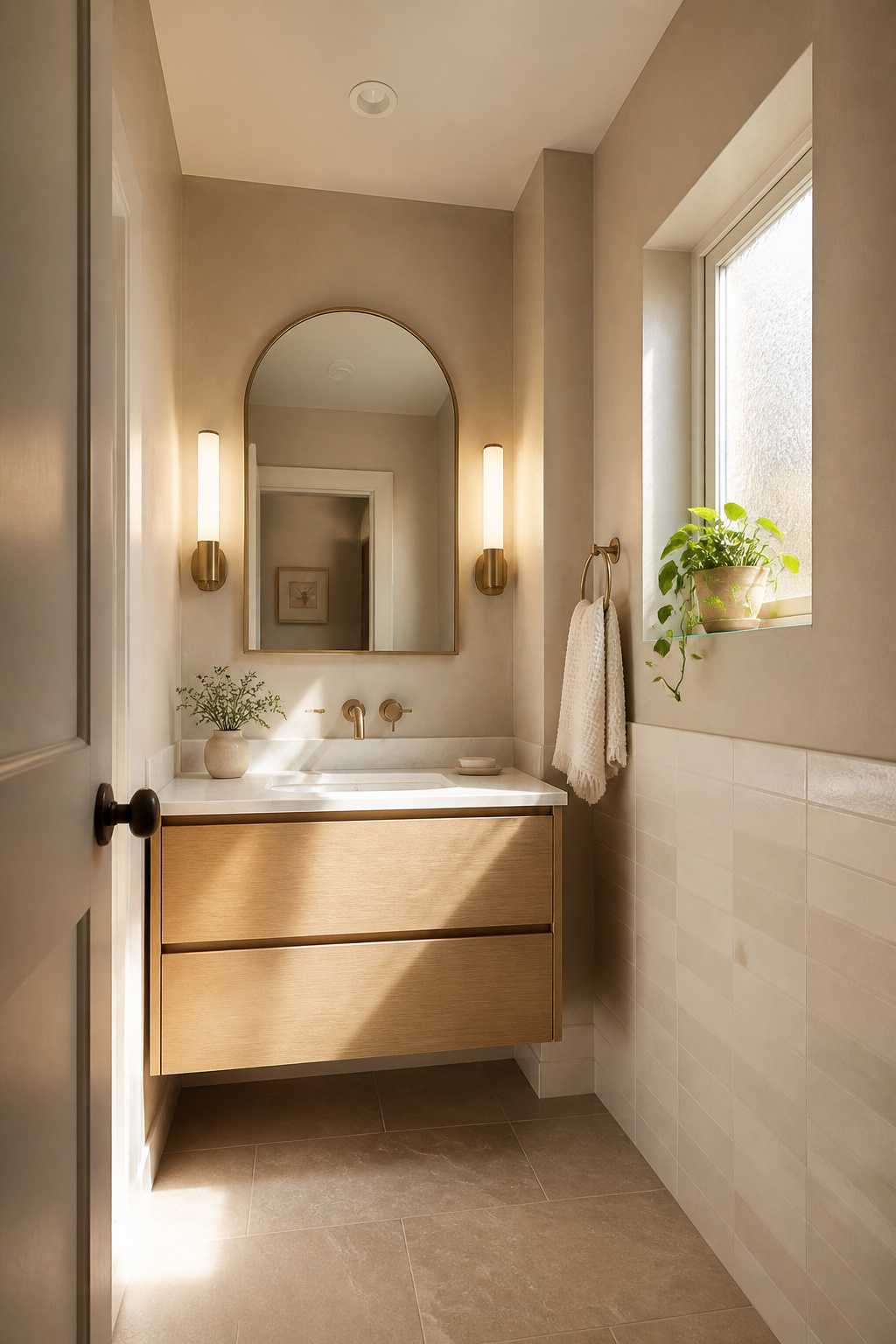
The common instinct is to reach for stark white in a small bathroom, reasoning that bright walls will make the space feel larger. That logic holds in daylight, but most bathrooms run on artificial light for half or more of their daily use. Under warm LED or incandescent task lighting, a cool white with blue or grey undertones reads as faintly clinical. It might look sharp in a showroom but, in a small bathroom with a single overhead fixture, it picks up blue frequencies and the room starts to feel like a consultation office.
Warm whites and greige tones behave differently. A paint like Benjamin Moore Natural Linen (LRV 65, warm yellow-beige undertones) or Sherwin-Williams Turbinado absorbs artificial light and returns it as warmth — the same glow-from-within quality that makes a room feel like a candle-lit space rather than an examined one. Farrow & Ball’s Dimity and Skimming Stone are in a similar register: light enough to lift a small room, warm enough to feel genuinely inhabitable. Warm brass hardware and natural stone accessories pair best with warm-undertoned walls — the tonal family stays coherent, and the room reads as a considered whole.
Testing Before You Commit
The practical test: paint 6×6 inch samples on two adjacent walls — not one. The corner where two painted walls meet reveals undertones more honestly than any flat swatch. Leave them for 48 hours and check morning light, midday, and evening. If the colour reads radically differently at 8 a.m. versus 8 p.m., the undertone is ambiguous and the room will feel inconsistent throughout the day. Avoid paints with strong blue, green, or purple undertones in bathrooms — these undertones amplify under halogen or cool LED task lighting and push the room toward that medicinal register. Peel-and-stick sample cards from companies like Clare Paint are a cleaner option than brushed swatches if you want a truer preview without painting over existing colour.
2. Floating Vanity Installation to Open Up Floor Space
A floating vanity is one of those changes that works at a neurological level before you consciously process what’s different. The floor runs uninterrupted from wall to wall beneath the cabinet, and the eye registers the full room width — not a fractured segment interrupted by legs or a plinth.
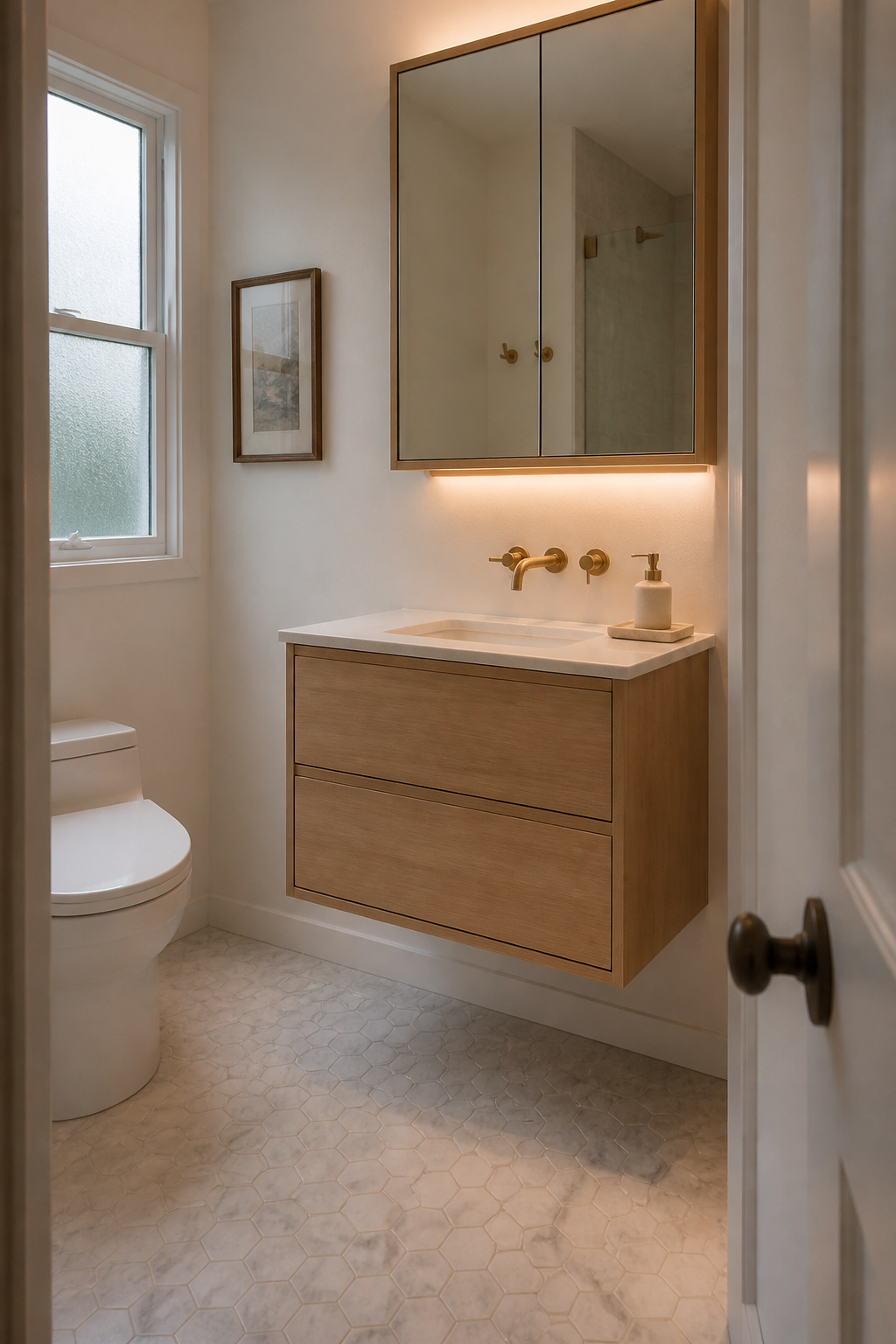
Standard freestanding vanities sit 6–8 inches above the finished floor on legs or a base; a floating vanity mounts at 14–16 inches of visible clearance beneath the cabinet body. In a bathroom under 50 square feet, that uninterrupted floor plane measurably changes the feeling of the room. It’s the same principle used in commercial hotel bathrooms — spaces where the floor is always designed as a continuous surface. For anyone exploring the best small bathroom decor approaches for a compact floor plan, the spatial return on a floating vanity is hard to match with any decorative change alone. There’s also useful detail in vanity ideas for tiny bathrooms on how to balance scale with function in tight spaces.
The installation requires hitting wall studs or installing structural blocking between them. The mounting ledger (a horizontal hanger board) needs to cross at least two studs, typically 16 inches on centre. A stone countertop adds substantial weight — a 36×22 inch marble top alone runs 60–80 lbs — so the mounting system needs to be rated accordingly. Heavy-duty French cleat systems handle 300 lbs and are the reliable choice for topped vanities.
Materials and Moisture Resistance
For material, solid teak or marine-grade painted MDF holds up best in bathroom humidity. Standard particleboard will swell at cut edges over time. If budget steers you toward a flat-pack floating cabinet, seal all cut edges with waterproof wood glue or silicone before installation. The extra 20 minutes at that stage pays off across years of daily shower steam.
3. Natural Woven Baskets as Visible Bathroom Storage
Most bathrooms are acoustically and visually hard — tile, glass, metal, mirror — and woven baskets do something none of those surfaces can: they absorb both light and sound and return a sense of settled, organic warmth. The brain reads organic, imperfect materials differently from manufactured surfaces, and the response is a measurable reduction in ambient alertness. This is why a single seagrass basket on a shelf can shift the whole feeling of small bathroom decor away from purely functional.
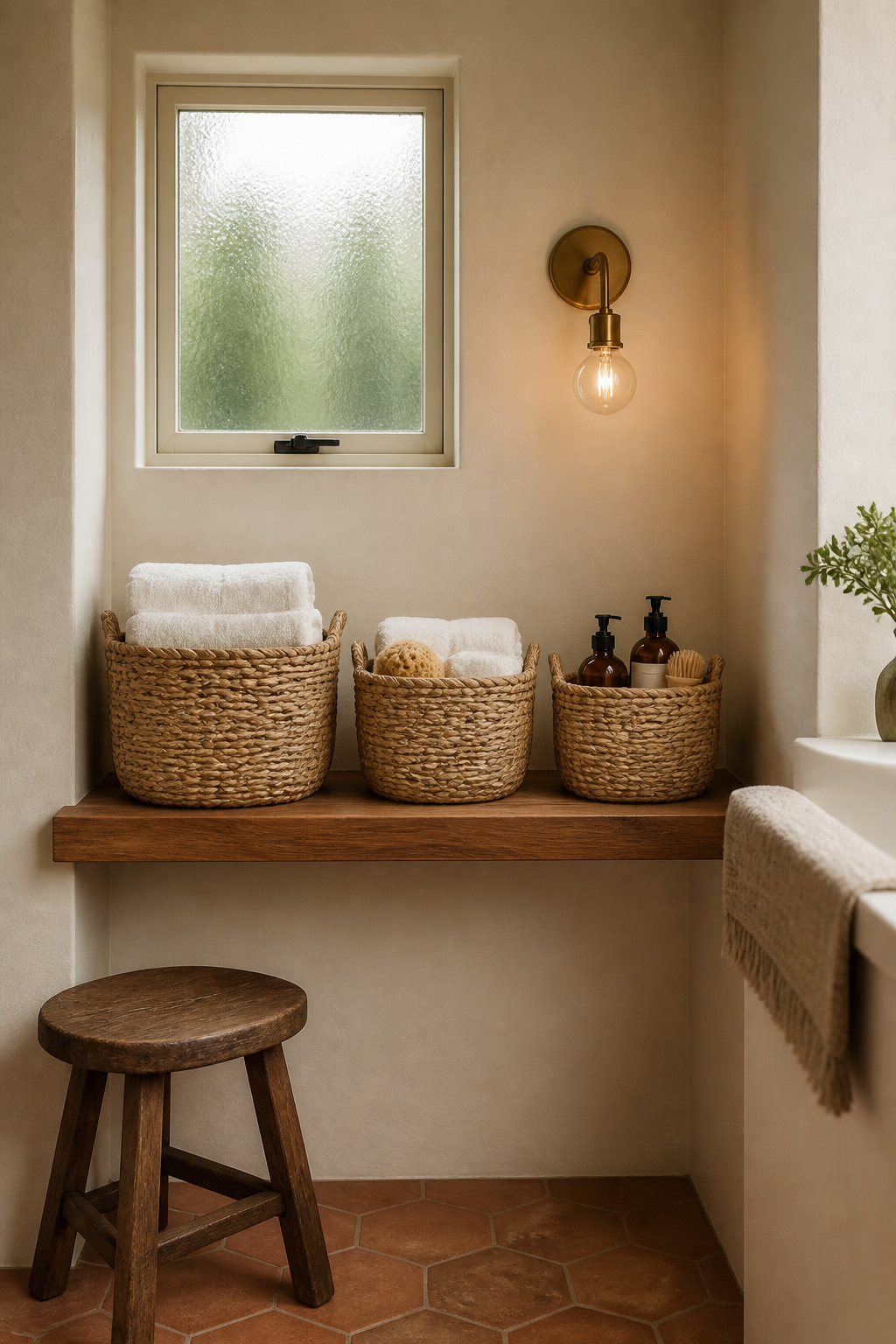
Seagrass is the most reliable natural fibre for bathroom conditions. It grows in water and tolerates high humidity without degrading, moulding, or developing the musty odour that jute or sisal acquire within months in a steam-heavy room. Properly lacquered rattan is the next best choice; unfinished rattan in a poorly ventilated bathroom will develop surface mildew at the base. Water hyacinth is beautiful and affordable but performs best on open shelves where air circulates freely — avoid it in closed under-sink cabinetry where moisture has nowhere to go.
The styling principle: odd-number groupings of three (large, medium, small) at varying heights on a shelf read as curated rather than stored. Leave 2–3 inches between baskets. Open-top versions work well for daily items — extra hand towels and toilet rolls; lidded versions protect products from shower steam. If you’re working through small bathroom ideas and need more structural storage thinking, small bathroom storage solutions that actually work covers the full range.
4. Vertical Tile Patterns That Elongate Small Bathroom Spaces
Tile direction is one of the most overlooked spatial tools in bathroom design — and one of the cheapest to get right at the specification stage. The eye follows grout lines. In a standard horizontal brick-bond layout, the dominant lines run left to right, which reads as width. Set the same tiles vertically, and the dominant lines run floor to ceiling — the room appears taller.
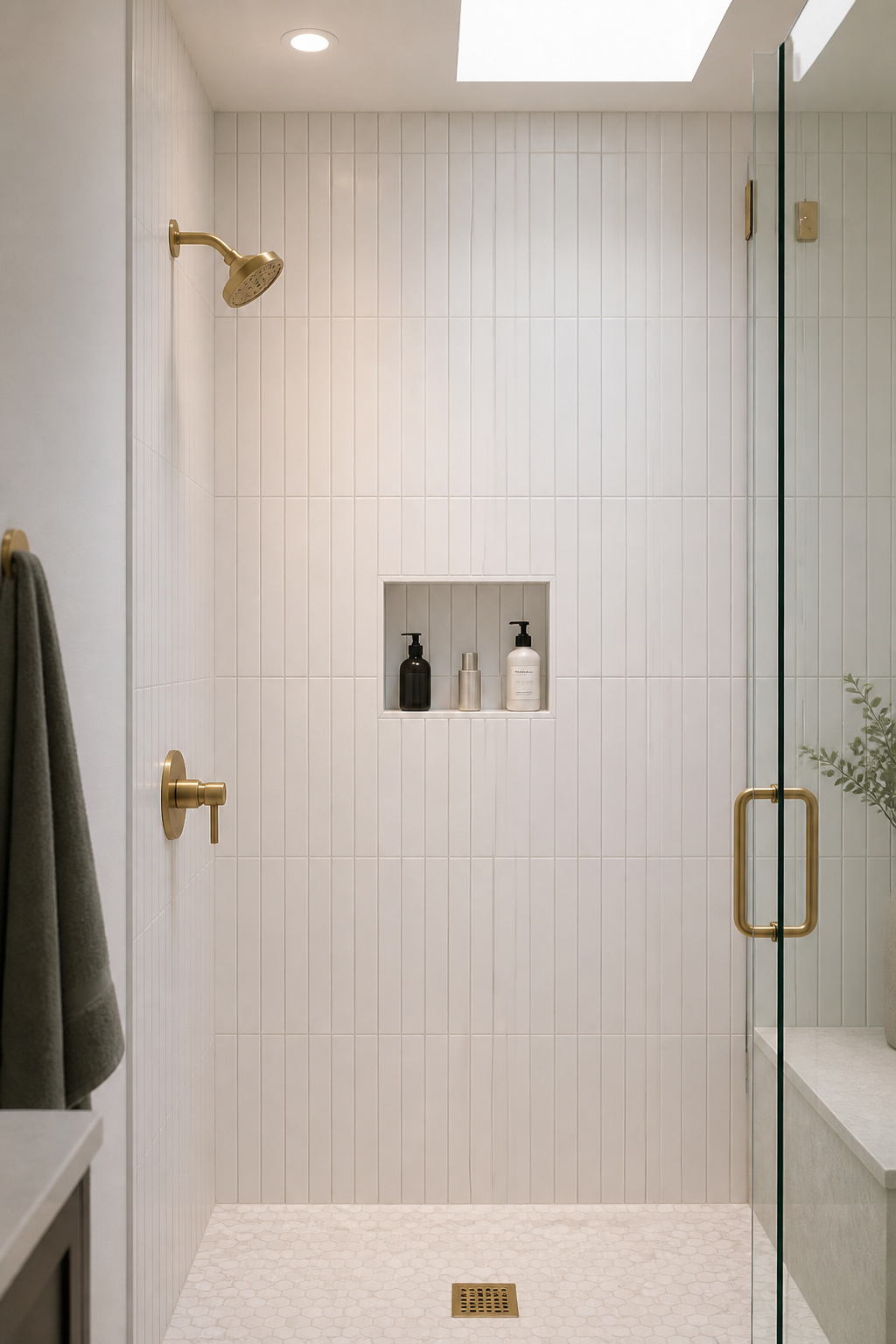
Research into visual perception confirms that vertical line patterns in tight spaces increase perceived ceiling height by 10–15% compared to horizontal patterns. The effect is strongest with rectangular tiles. Classic 3×6 inch subway tile in vertical stack bond is the most widely available and the most forgiving to install. Longer format tiles — 4×12, 4×16, or 3×12 plank formats — amplify the elongation because the greater length-to-width ratio makes the vertical direction more emphatic.
Getting Grout Right
Grout colour decision comes down to intent. Matching grout to tile colour — cream tile with cream grout, white tile with white grout — creates a monolithic surface where the eye reads a single plane rather than a grid. That’s maximum elongating effect with minimum visual noise, which suits small bathroom decor that prioritises calm over graphic pattern. Contrasting grout emphasises the tile grid, adding character but increasing busyness in a tight space. A tonal match — grout one or two shades darker than the tile — threads the needle neatly, letting the tile’s shape register while keeping the grid from dominating. The tile format direction alone costs nothing extra at the installation stage; it’s a specification choice that dramatically changes what the room does spatially.
5. Potted Plants and Biophilic Greenery for Air-Purifying Beauty
A single plant in a bathroom changes it. The presence of a living organism, even a pothos trailing over a shelf, triggers a neurological reduction in threat-detection activity. The brain’s response to living plants is to register them as safe, known territory — and in a small bathroom that’s enclosed, hard-surfaced, and functionally demanding, that signal genuinely matters.
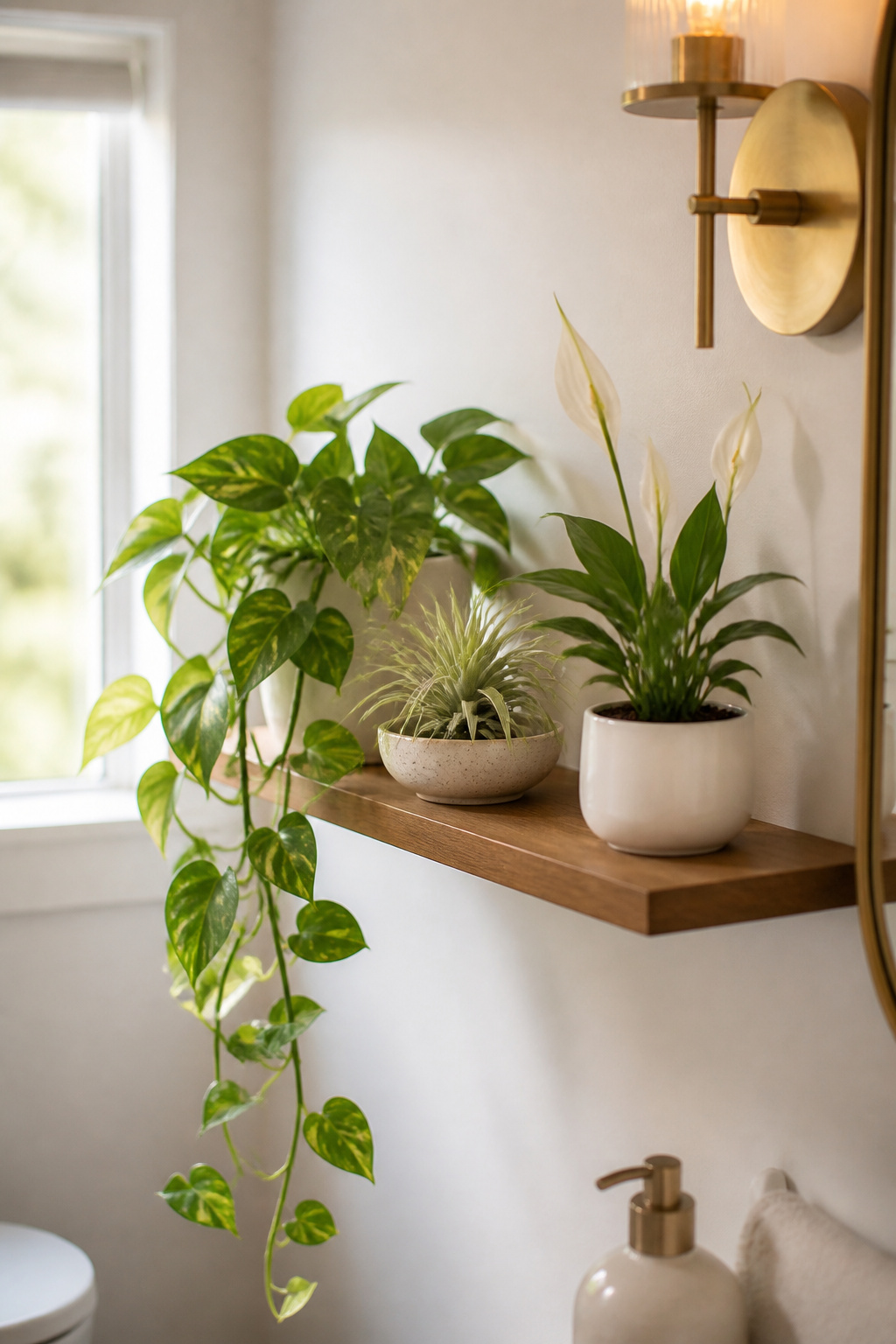
The 1989 NASA Clean Air Study identified plant species that remove formaldehyde, benzene, and trichloroethylene from sealed test chambers. Real-world VOC removal is slower than lab conditions suggest, but the biological reality — plants are actively processing the air — holds up. Peace lily (Spathiphyllum) tolerates low light, loves humidity, and its white blooms add visual softness. Pothos (Epipremnum aureum) is the most forgiving option, tolerating irregular watering and minimal light; its trailing form drapes beautifully from a wall-mounted shelf above vanity height. Air plants (Tillandsia) are genuinely maintenance-free in a steamy bathroom — they absorb moisture directly from the air and need only occasional misting or a brief soak every two weeks.
Placement Without Sacrificing Counter Space
The key for a small bathroom is placement that doesn’t cost you counter space. A wall-mounted plant shelf at 60–70 inches height — above the mirror line — draws the eye upward and keeps every surface below clear. Over-toilet shelving at 66–72 inches is the most space-neutral plant location in a compact bathroom; one Boston fern at this height adds genuine lushness without occupying an inch of the functional zone. For very limited space, a single magnetic tile-mount planter with an air plant requires no shelf, no counter, and no floor space at all.
6. Frameless Glass Shower Enclosure for a Seamless Visual Flow
A standard framed shower enclosure has aluminium channels running at every edge — top rail, bottom track, vertical mullion at the door, horizontal rail across the mid-panel. In a small bathroom, these channels segment the room into compartments and make the shower feel like a separate insert rather than an integrated part of the space.
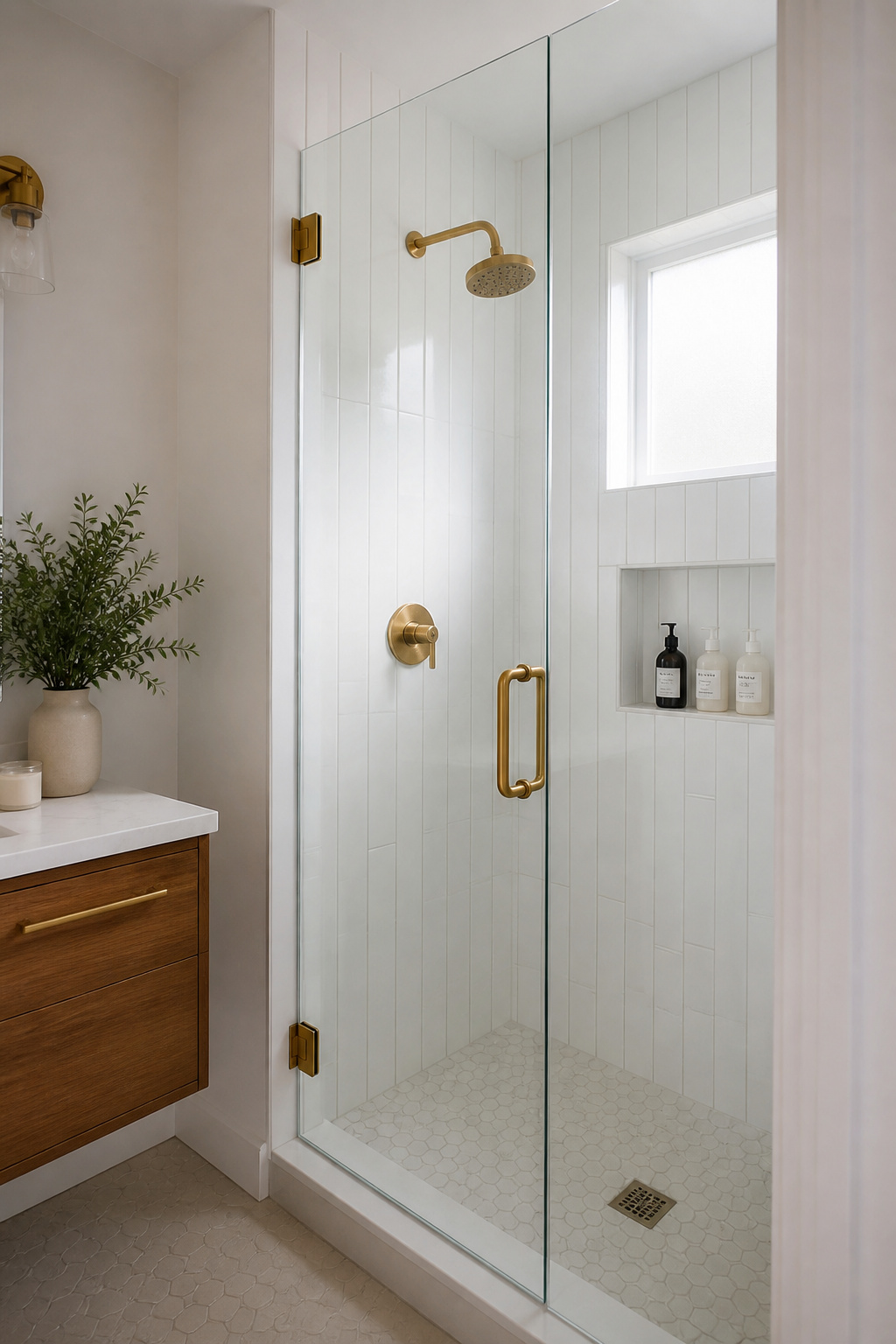
Frameless glass removes all of that visual interruption. A single transparent plane from floor to ceiling lets the eye read through the glass to the tile behind, adding the shower’s footprint to the perceived room volume. The frameless look is also genuinely easier to maintain — no aluminium tracks collecting soap scum, no plastic seals discolouring at the corners.
Glass Thickness and Hardware
Glass thickness: 3/8-inch tempered safety glass is the standard for residential frameless enclosures and handles doors up to 36 inches wide and full-height panels without flexing noticeably. Half-inch glass (12.7mm) adds rigidity and a more luxurious feel but costs 20–30% more and requires heavier hardware. The minimum to avoid is 1/4-inch — it meets some building codes but flexes visibly when the door opens, undermining the frameless quality entirely. For hardware finish, brushed brass or matte black coordinate naturally with a warm-materials small bathroom decor palette. A hydrophobic glass coating (ClearShield or Diamon-Fusion, applied post-installation) is worth the additional cost in hard-water areas — it reduces mineral spotting dramatically and makes cleaning take seconds rather than scrubbing. For more ideas on maximising a small shower space, shower design ideas for small bathrooms covers the full planning range.
7. Small Bathroom Decor With Warm Metal Hardware Accents
Chrome dominated bathroom hardware for most of the 2000s and 2010s — and it’s still everywhere. It reflects light with a cool, high-contrast mirror quality that reads as hard and functional rather than warm and intentional. Replacing it is one of the most noticeable single-day upgrades available in small bathroom decor.
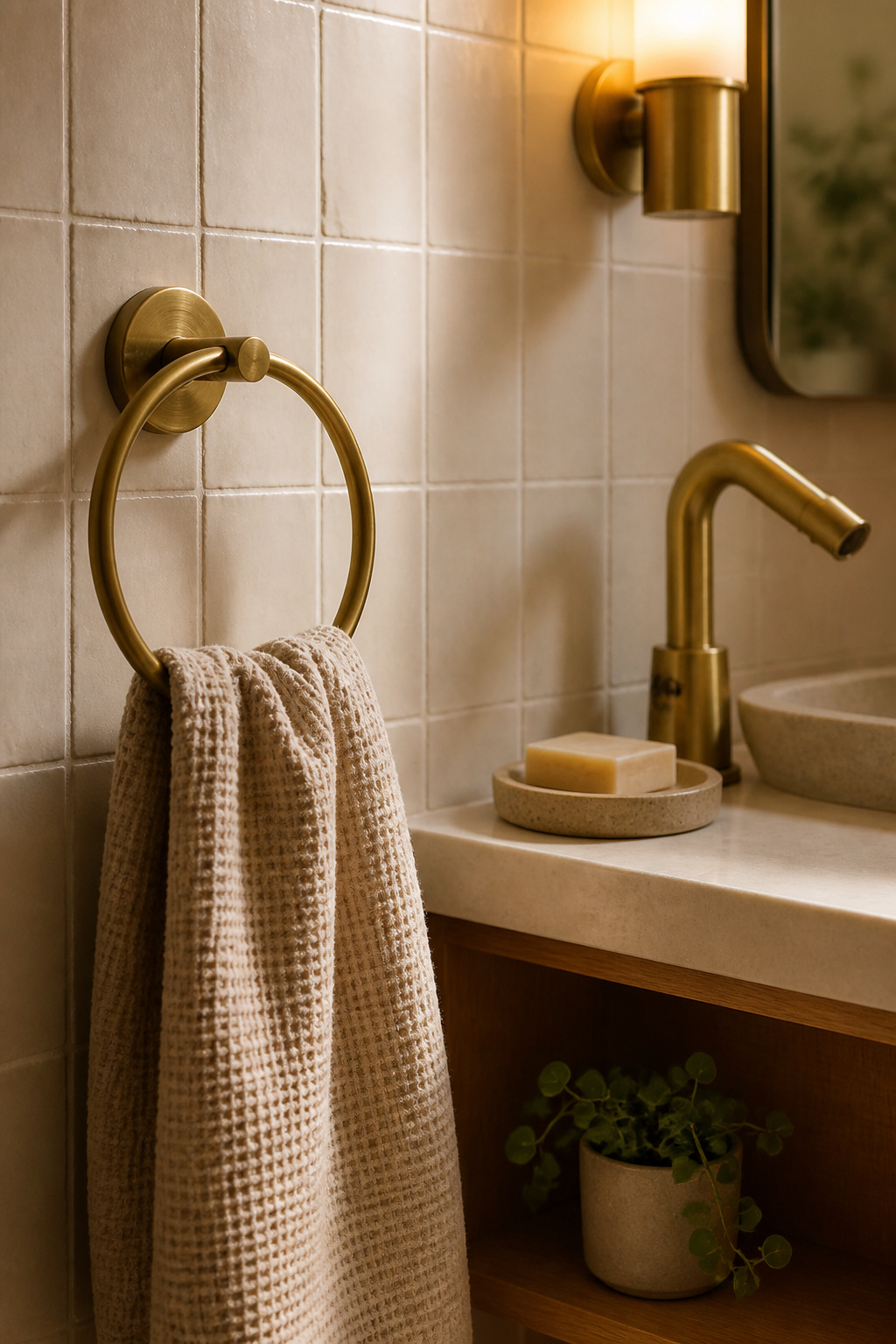
Brushed brass and unlacquered bronze do something different from chrome. They diffuse light rather than mirror it, producing a warmer glow that reads as more settled and home-like. Unlacquered brass has what makers call a “living finish” — it patinas over time as the copper content oxidises, developing richer amber tones that become more beautiful and individual with age. From a wellness design perspective, warm metal tones align with the broader palette of natural materials — wood, stone, woven fibre — and contribute to the non-clinical atmosphere a small bathroom needs.
Coordination: the reliable approach is one dominant finish (brushed brass for towel bars, the mirror frame, and robe hook) and one accent (matte black for the faucet and flush plate). All plumbing fixtures — faucet, shower valve, tub spout — should match each other. Decorative hardware can flex more freely.
The Two-Metal Rule
In a small bathroom, the limit is two metal families. Three competing finishes in a tight space create visual static rather than the layered richness that mixed metals achieve in larger rooms. Unlacquered brass patinas toward aged bronze over 2–3 years, which means a bathroom with unlacquered brass fixtures and oil-rubbed bronze accessories will actually grow more coordinated over time. This is the opposite of the colour-matching anxiety that drives people toward matching chrome sets — the living quality of warm metals means the room develops into itself rather than fading.
8. Oversized Mirror That Doubles the Visual Depth of the Room
The most common mirror mistake in small bathrooms is choosing one that’s the same width as the sink. It looks appropriately proportioned against the basin and then disappears against the full width of the vanity cabinet and the wall above it. The result is a mirror that fails at its primary spatial job.
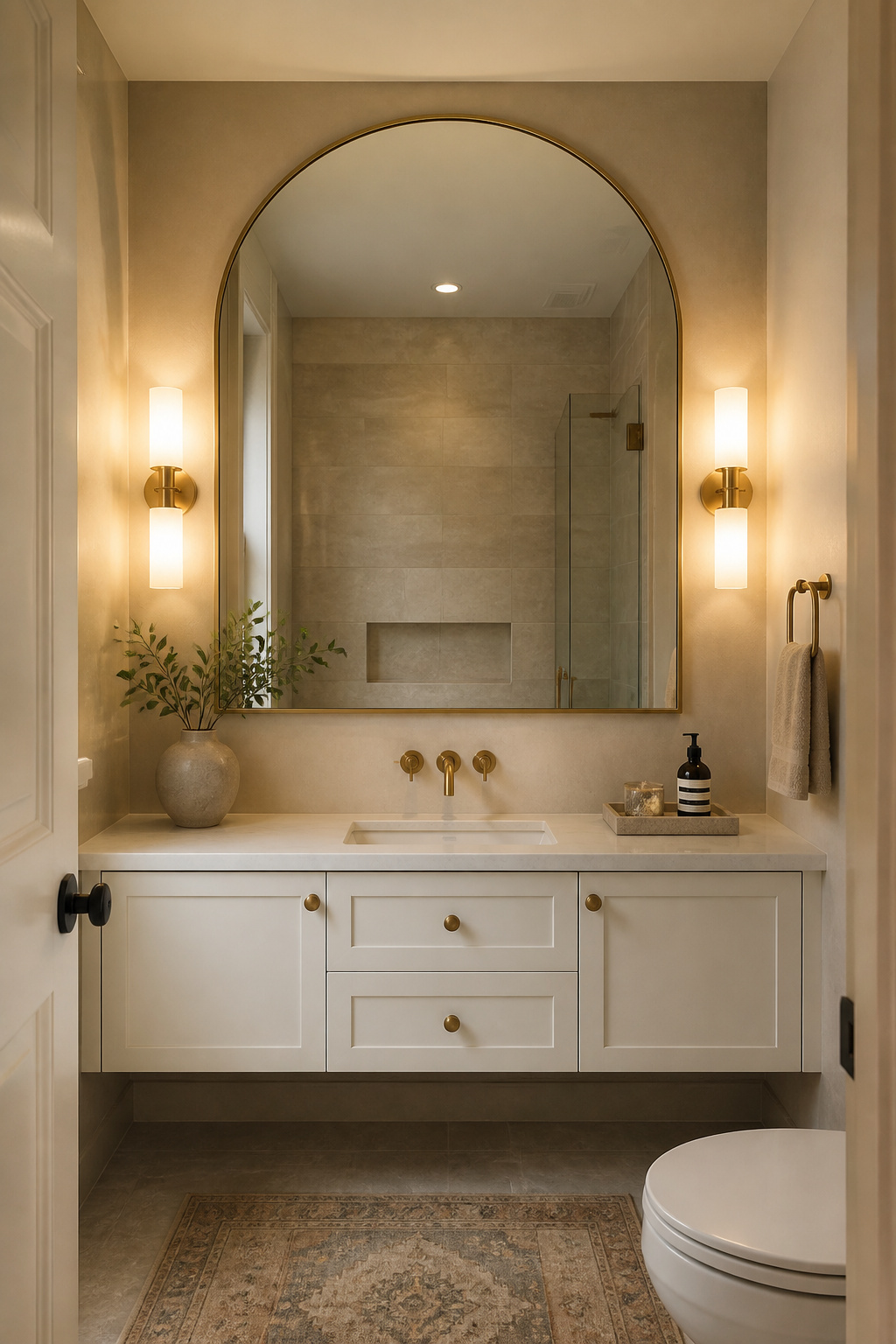
A mirror reflects the opposite wall — the larger the mirror, the more of that opposite wall appears in the reflection, and the more the room seems to extend beyond its actual boundaries. In a 6×8 bathroom, a full-width mirror above the vanity reflecting a wall of tile or painted wall on the opposite side effectively doubles the perceived depth of the room. The practical sizing rule: mirror width should be 70–80% of the vanity cabinet width, not the sink basin width. In practice, this often means going larger than feels comfortable at the hardware store. Trust the dimension rather than the instinct — a mirror that feels slightly oversized in isolation will feel exactly right installed with the full wall context around it.
Shape and Functional Upgrades
Shape choices: rectangular mirrors suit any style and offer maximum reflective surface. Arched mirrors — increasingly popular in wellness-influenced bathrooms — add the soft curve of an organic form and can be pushed to 70% of available wall height for more drama without a hard-edged rectangle’s visual weight. For more shape and style options, bathroom mirror ideas to reflect your style covers everything from full-wall options to antiqued-glass choices. For function alongside form: LED-backlit mirrors (light from around or behind the frame) replace the need for separate vanity light fixtures — a genuine space simplification in a small bathroom. Anti-fog coating via a heating element behind the glass is worth the upgrade in any bathroom where ventilation is limited.
9. Layered Linen and Cotton Textiles for Tactile Warmth
Most bathrooms are 80–90% hard surfaces — tile, glass, metal, stone — and the sensory register of that hardness accumulates during a daily routine that’s supposed to be restorative. Textile layers are the fastest, lowest-commitment route to changing that register. They also mark the point where small bathroom decor stops being about space and starts being about how the room actually feels to live in.
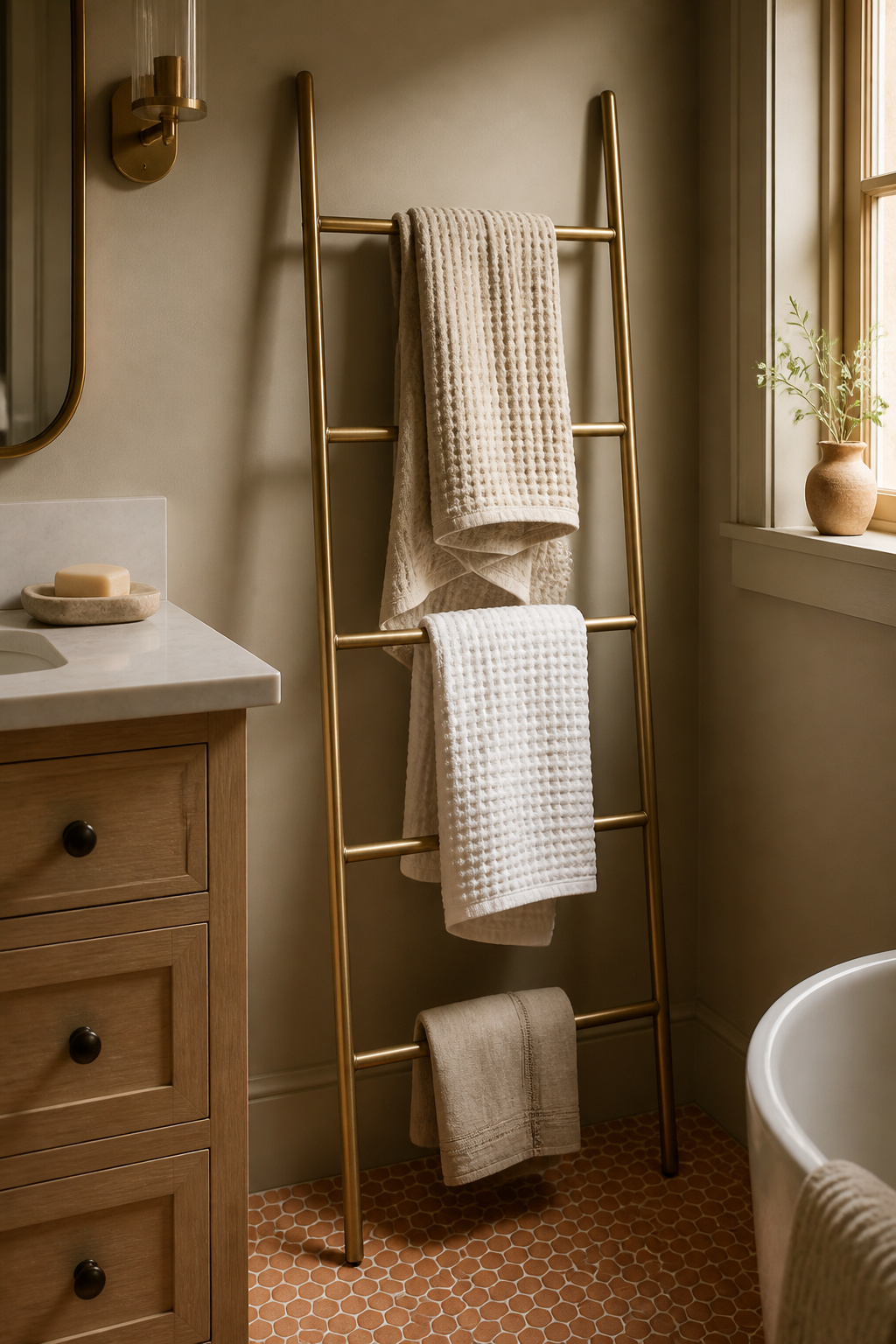
For wellness-focused small bathroom decorating, GOTS certification (Global Organic Textile Standard) matters more here than almost anywhere else in the home. A GOTS-certified towel guarantees no azo dyes (linked to skin sensitisation), no formaldehyde finishing agents, and no synthetic pesticide residues from cotton cultivation. In a bathroom where textiles are in close skin contact in humid conditions — pressed against damp skin, heated, reused daily — these guarantees are practically relevant, not just marketing language.
Choosing the Right Weave
For everyday towels, Turkish cotton (long-staple Aegean cotton) is the most practical choice for a small bathroom: it dries quickly between uses, develops more absorbency over successive washes, and hangs with an elegant drape on a bar. Egyptian cotton offers superior initial softness and thickness but dries more slowly — better for a guest bathroom than a daily-use space with limited air circulation. Waffle-weave towels are the quick-drying champion in humid, poorly ventilated bathrooms; their honeycomb structure maximises airflow and resists the mildew odour that terry towels develop in still, moist air. For layering: use one dominant neutral tone across all towels — natural white, oatmeal, or sand — and introduce variation through weave rather than colour. One waffle-weave hand towel alongside one terry bath towel reads as curated; a range of different-toned towels from different purchases reads as accumulation.
10. Open Shelving With Curated Products for Minimalist Small Bathroom Decorating
Open shelving in a small bathroom is a high-stakes design choice. Unlike a closed cabinet where the interior is invisible, every item on an open shelf is part of the room’s design. The payoff when done well is a calm, organised bathroom that looks designed rather than arranged. This is where small bathroom decor either communicates intention or reveals the absence of it.
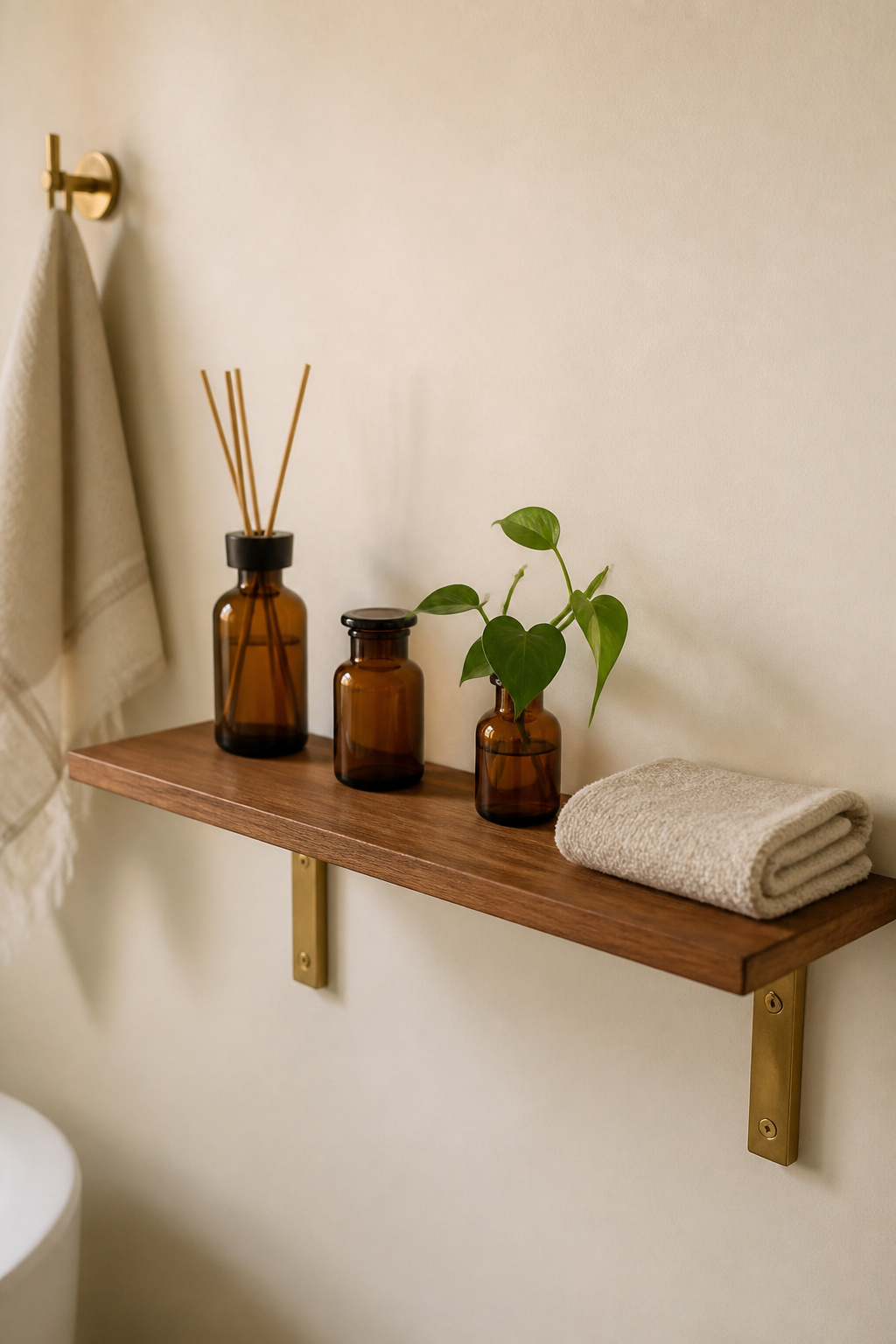
The discipline required: only put on open shelves what you use daily and are willing to look at. Decanting daily products into matching amber or clear glass vessels (a pump dispenser for liquid soap, a small jar for cotton rounds, a carafe for a single body oil) transforms the functional surface into a still life.
Shelf Materials That Hold Up
For shelf materials, teak is the gold standard in wet environments — its natural silica and oil content make it one of the most inherently water-resistant woods available. Tempered glass (10mm minimum) looks clean and visually lightweight; a floating glass shelf appears to hover, which is useful in a small bathroom where heavy wall elements create a closed-in feeling. Powder-coated steel in matte black or raw finish is the strongest and most affordable structural option; choose matte over gloss, which shows water marks more readily in humid air. Style with the odd-number rule: three items (tall, medium, short) per shelf, height variation creating a natural silhouette. Reserve one shelf for function, one for display — mixing purpose and decoration on every shelf creates the clutter that defeats the entire project. For a well-organised vanity storage approach to complement open shelving, organised bathroom vanity storage approaches this from the functional side.
11. Natural Stone Accessories for a Grounding, Spa-Like Surface
The difference between a travertine soap dish and a plastic one isn’t merely aesthetic — it’s sensory in a more fundamental way. Weight is the primary signal. A travertine soap dish weighs four to six times more than an equivalent resin piece; that heft communicates permanence and quality in a way that visual appearance alone cannot. It’s one of the most concentrated upgrades available in small bathroom decor for a modest outlay.
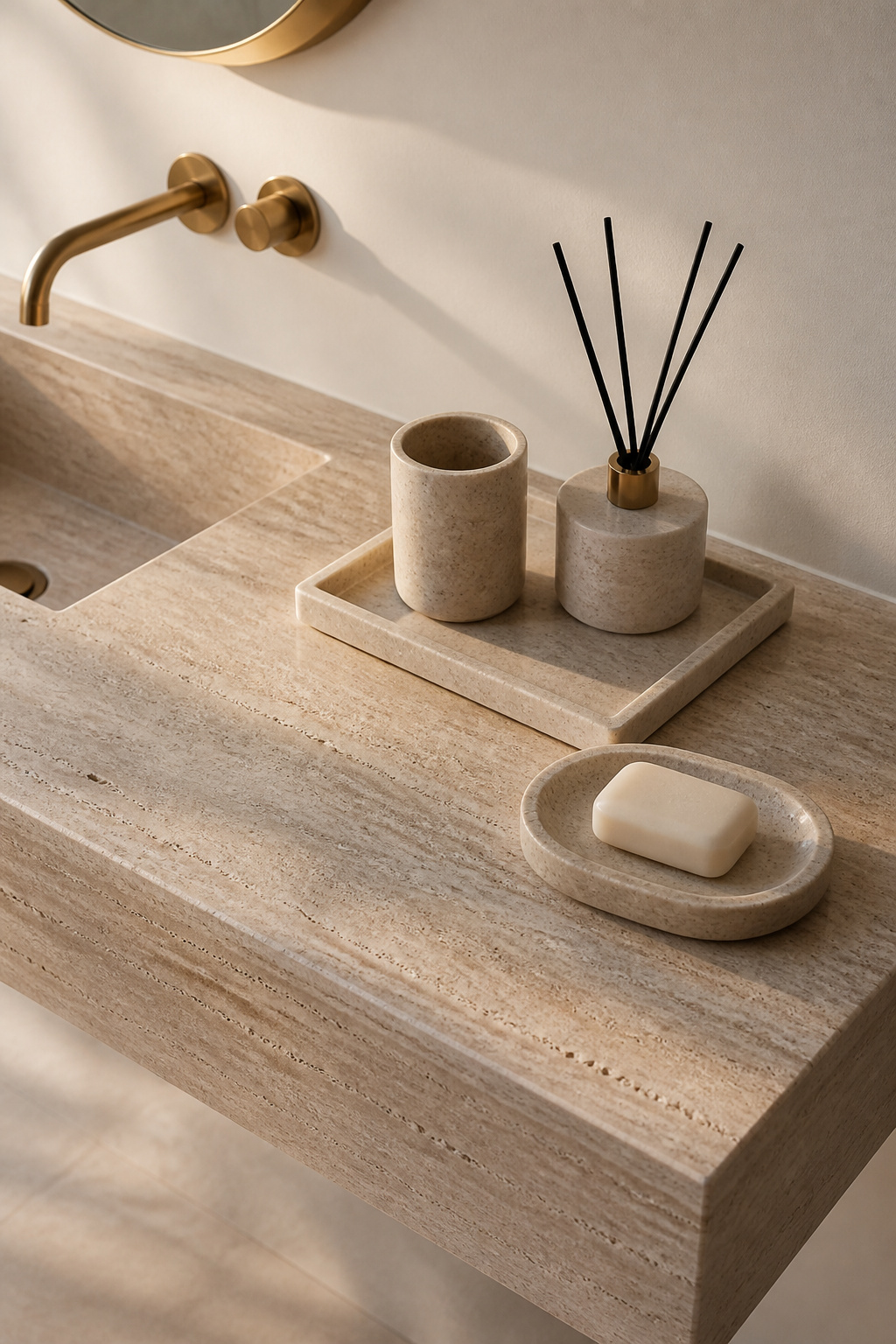
Natural stone also has inherent colour variation: no two travertine pieces share exactly the same pattern of veining. This natural uniqueness makes a stone accessory feel irreplaceable in a way that injection-moulded plastic never can be. Alabaster adds a further quality — it’s semi-translucent, and when used as a vessel or candle base, it glows warmly in a way no synthetic material replicates.
Maintenance and Stone Selection
The maintenance reality is worth understanding before purchasing. Marble is the most beautiful and the most demanding — it’s calcium carbonate, which etches (develops dull white marks) when exposed to acidic products: citrus soaps, bleach cleaners, even toothpaste. Honed travertine is more forgiving: less prone to etching, available in a matte finish that doesn’t show surface wear as readily. Soapstone and alabaster are among the most forgiving stone options — non-porous or nearly so, resistant to the chemicals that damage polished stones. For a cohesive vanity surface: choose one stone family and stay with it. A coordinated set of four — soap dish, rectangular tray, tumbler, and a small vessel for a reed diffuser base — covers all functional needs. Avoid mixing warm ivory marble with cool grey marble on the same surface, which reads as unintentional rather than curated. For more ways to build a spa-like accessory collection, luxury bathroom accessories for a spa feel offers a comprehensive selection.
12. Recessed Shower Niche for Clutter-Free Shelf-Free Storage
Of all the visual noise in a small shower, the caddy is the loudest. A stainless tension pole introduces a foreign object that connects floor to ceiling — it’s in the peripheral vision throughout every shower, and even when neatly organised it looks like storage rather than design.
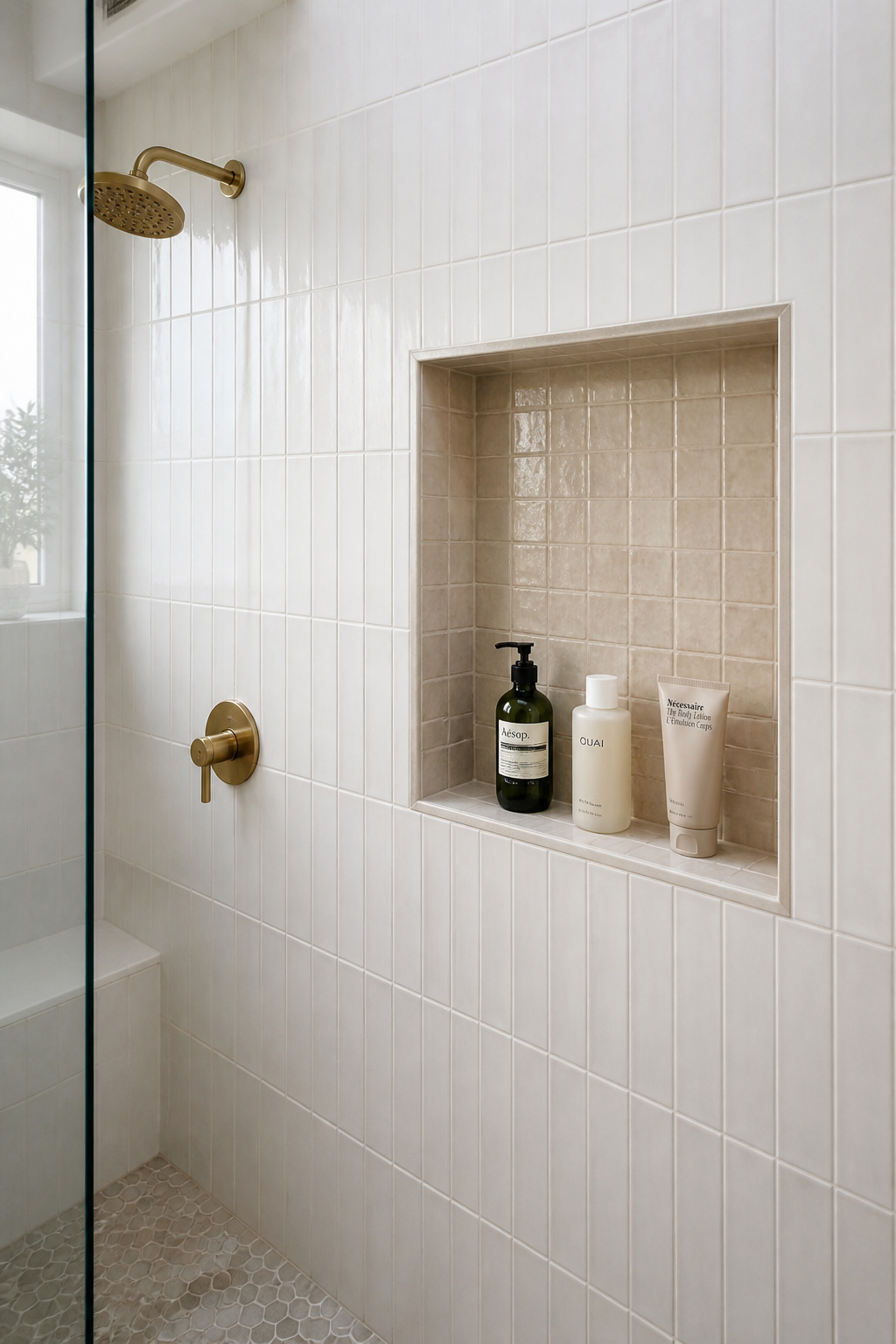
A recessed niche is architecturally different in kind from any storage add-on. Flush with the shower wall plane, it reads as a sculptural architectural detail when empty and contains products within the wall depth when in use — projecting nothing into the shower space. In a 36-inch square shower stall, removing a projecting caddy adds 4–6 usable inches to the floor zone.
Waterproofing and Placement
The most practical prefabricated option is the Schluter KERDI-BOARD-SN system, available in 12×6, 12×12, 12×20, and 12×28 inch sizes. Each unit includes integrated waterproof KERDI-BAND flanges that seal into the surrounding wall assembly — waterproofing is built in rather than applied as a separate step. The standard niche depth is 3.5 inches, fitting between 16-inch on-centre stud framing without structural modification. Tiling decisions: matching the niche interior to the surrounding shower tile makes it feel built-in; using an accent tile inside (a different colour or smaller format) turns it into a design feature. Placement: the ergonomic sweet spot is 48–54 inches from the floor, on the wall perpendicular to the showerhead — this minimises direct spray filling the shelf. Do not tile the niche before waterproofing the interior; water infiltrates through tile grout and causes mould and tile delamination.
13. Tiny Bathroom Decor With Bold Patterned Floor Tiles
The reasoning for putting pattern on the floor rather than the walls comes down to how visual weight operates in enclosed spaces. Patterned walls advance toward you — they reduce perceived depth and make the room feel smaller. Patterned floors recede, drawing the eye down and outward, leaving the vertical surfaces available for the space-expanding techniques that need to work uninterrupted.
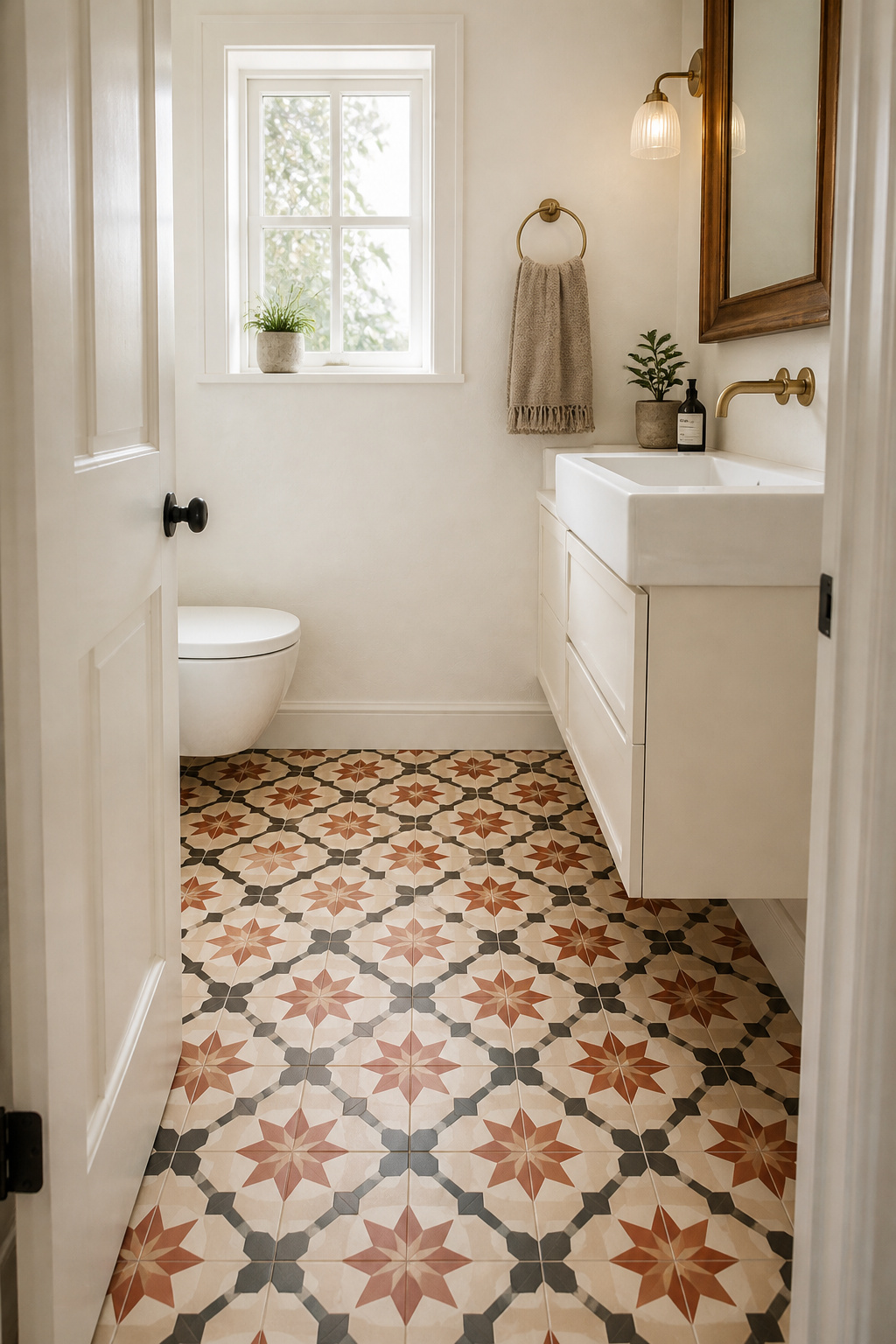
A geometric or floral floor pattern acts as an anchor — it gives the room a destination without requiring anything else to carry the design. A plain white bathroom with a stunning encaustic cement tile floor looks considered and complete; the floor does the creative work and the walls remain calm around it. This is some of the most effective tiny bathroom decor available — high visual return without overwhelming the space.
Three Formats That Work Best
Penny round tiles (3/4 to 1 inch diameter) create a soft, organic mosaic. Their small scale adds texture without visual aggression. Grout choice is critical — there’s more grout per square foot than with any other format, so the grout effectively becomes part of the pattern. A grout matched to the tile’s background colour creates a quiet, tonal effect; contrasting grout makes each circle distinct and more graphic. Encaustic cement tiles (typically 4×4 or 8×8 inch squares with handmade geometric patterns) need sealing before grouting and annually thereafter — the cement surface is porous and will absorb grout colour permanently if laid unsealed. Zellige (hand-cut Moroccan clay tiles in 1×1 or 2×2 inch format) have natural colour variation and imperfect edges that catch light differently throughout the day. Their handmade character suits a wellness-focused small bathroom particularly well; paired with warm neutral walls and natural stone accessories, zellige floor tiles make a small space feel genuinely artisanal.
14. Warm-Toned Lighting Fixtures to Mimic Natural Light
Bathroom lighting is the design element most frequently specified last and regretted first. The standard builder-grade setup — a single recessed downlight directly above the vanity mirror — is the worst possible configuration for a functional grooming space. It illuminates the top of the head and creates deep shadows under the brow bones, nose, and chin.
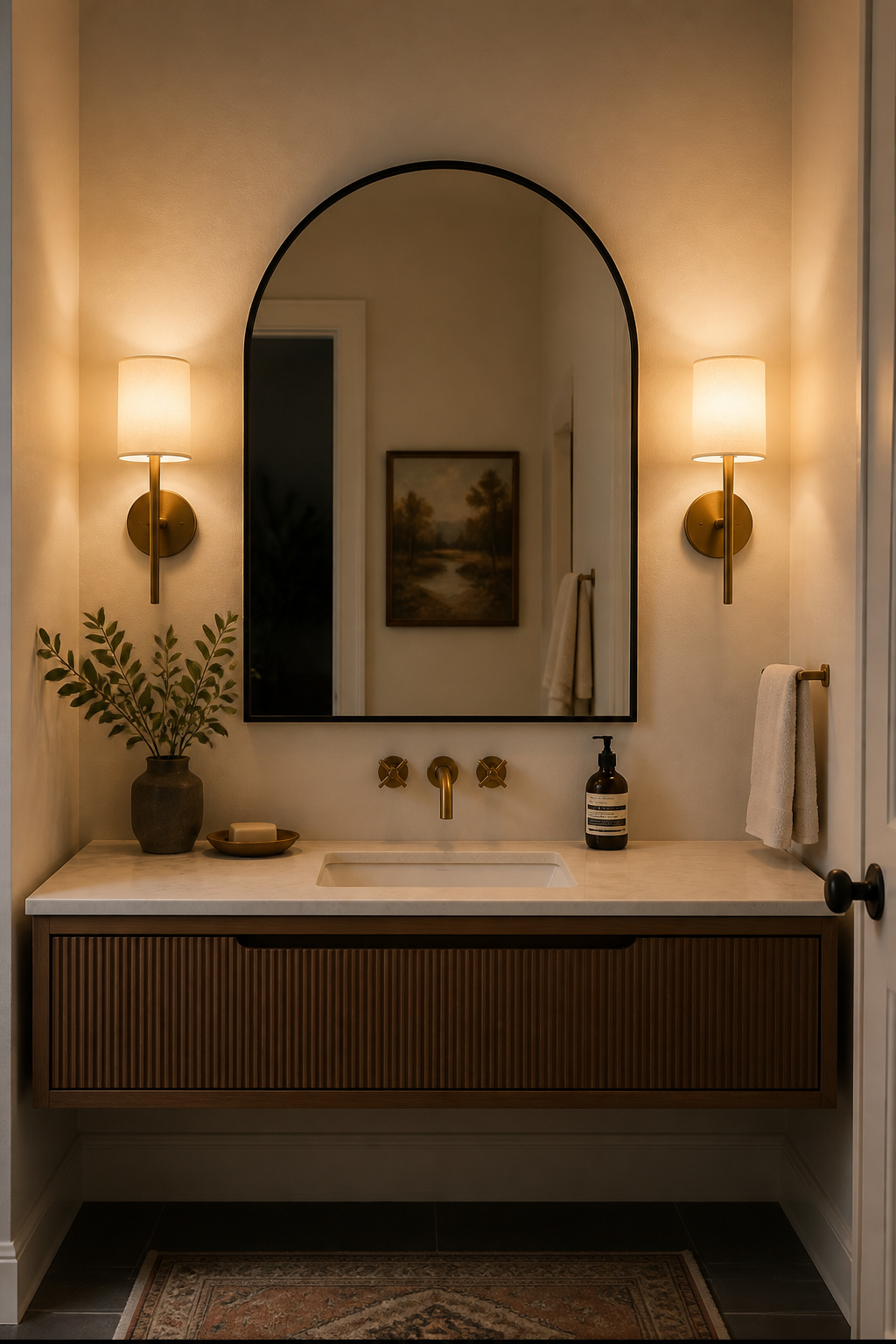
The fix is side-mounted sconces flanking the mirror at approximately 60–65 inches from the floor (centre of fixture at eye level). This is the Hollywood dressing-room setup — light from both sides simultaneously, eliminating all facial shadows. In a small bathroom where the walls flanking the mirror are narrow, a single LED-backlit mirror with light emanating from around the frame achieves a similar wraparound effect without requiring additional wall space.
Colour Temperature and CRI
Colour temperature matters enormously. Anything above 3500K reads as cool white — accurate for colour rendering but fatiguing, and it makes skin tones look grey. The sweet spot for small bathroom decor and daily routine is 2700K–3000K: warm enough to be genuinely flattering, accurate enough for tasks. Pair this with a CRI (Colour Rendering Index) of 90 or higher — at CRI 80 (the standard for budget LEDs), colours look subtly desaturated; at CRI 95+, the room reads as naturally lit. A dimmer switch on the ambient circuit — a $15–30 upgrade over a standard switch — creates three functional states from a single installation: full brightness for getting ready, mid-level for general use, and low-level for night-time visits. That single change meaningfully extends the experiential range of any bathroom.
15. Wainscoting and Shiplap Paneling for Tactile Wall Interest
Flat painted walls in a small bathroom have no architectural depth. They absorb light evenly and return nothing in the way of shadow, texture, or rhythm — which makes them functional but visually inert. Wall paneling introduces a repeating line pattern that creates depth and interest across the room without adding visual mass the way that additional furniture or accessories would.
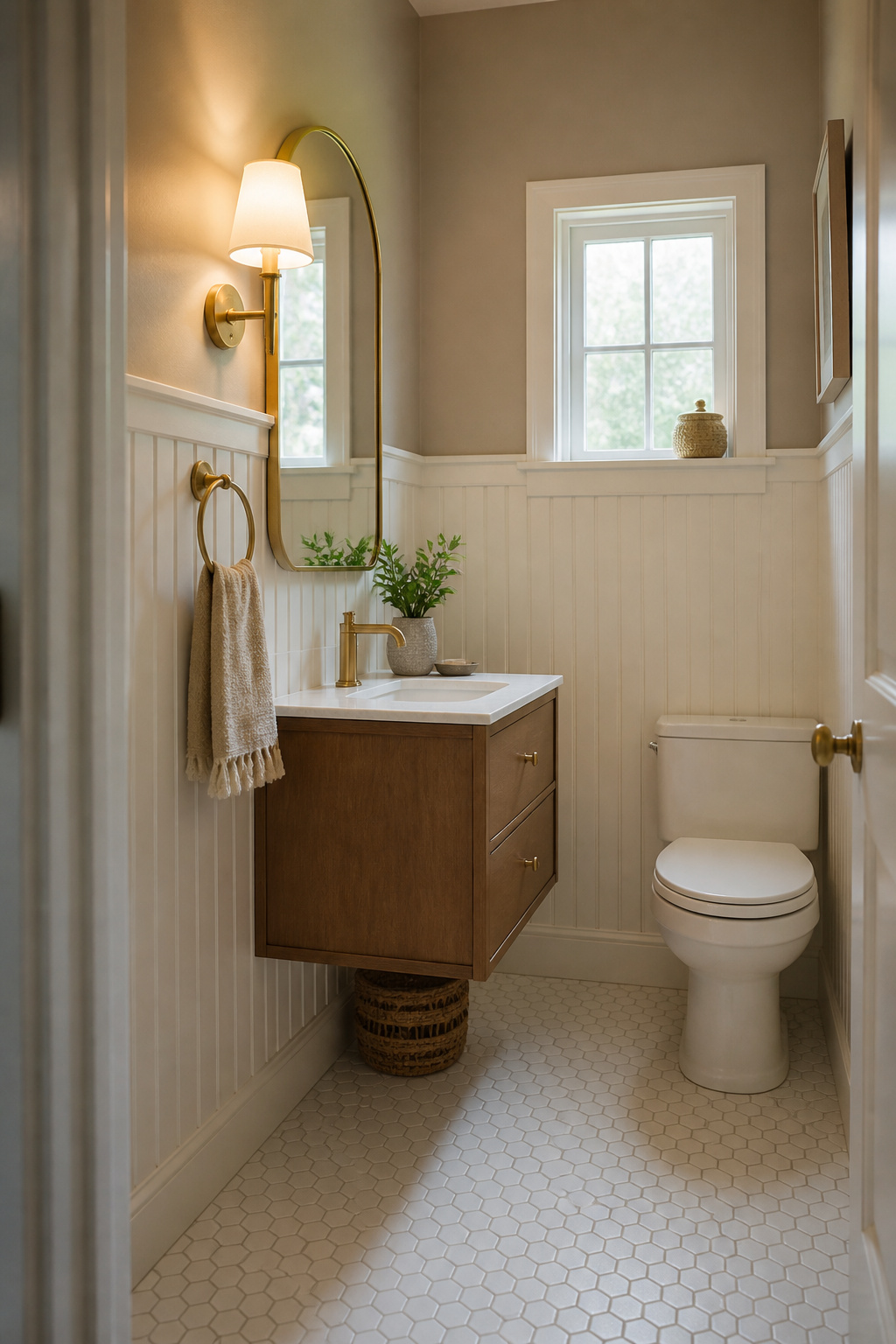
Beadboard wainscoting — narrow vertical grooves, the classic cottage and Craftsman material — creates a gentle texture that reads as warm and domestic. It suits the natural-materials palette of a wellness bathroom without requiring commitment to a specific decorating style. Board-and-batten paneling is more contemporary: wider flat boards with narrower strips covering the seams create a bolder, more graphic vertical rhythm that works particularly well against an arched mirror or with rounded ceramic accessories.
Panel Height and Material Choice
Panel height in a small bathroom: the standard convention is one-third of wall height, which puts the top rail at approximately 32 inches in an 8-foot room. In a small bathroom where the vanity countertop sits at 34–36 inches, matching the panel top to the countertop height creates a visual datum line that ties furniture and wall together. Going to 48 inches — roughly halfway up the wall — is the bolder architectural choice. Full-height paneling can work in bathrooms approaching 60 square feet, but tends to feel overwhelming in bathrooms under 40 square feet. For material in a steam-exposed bathroom: PVC beadboard is completely inert to moisture — it won’t swell, warp, or grow mould, making it the reliable choice in any bathroom with a shower. The trade-off is a slight softness that makes it more susceptible to dents than MDF. Moisture-resistant (green-core) MDF is denser, takes paint more finely, and creates a more refined finish — the right choice for a half bath or a bathroom with adequate ventilation. Whatever material you use, seal every cut edge before installation and paint with a semi-gloss or satin finish.
16. Small Bathroom Decor With a Single Overscaled Botanical Print
The instinct in a small bathroom is to hang small things — a collection of framed prints, a gallery wall, a grid of four matched pieces. The instinct is wrong. Multiple small artworks in a small bathroom require the eye to resolve a complex arrangement: every frame edge competes for attention, the spacing between pieces becomes a design decision in itself, and the cumulative visual work is exhausting rather than calming.
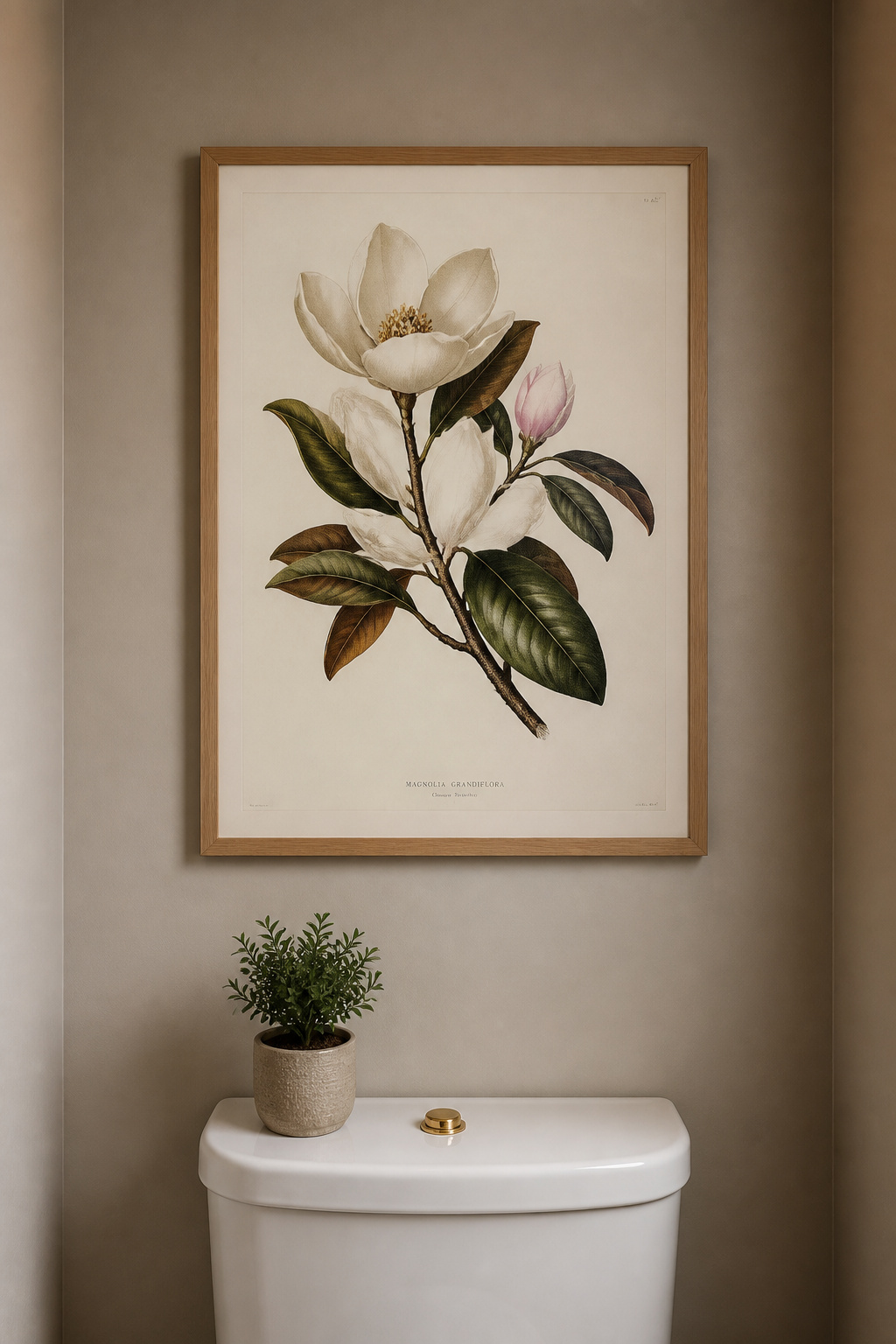
A single large artwork — 18×24 inches or larger — commands the space with a clarity that multiple smaller pieces cannot. The eye arrives at one thing, takes it in, and rests. Environmental psychology research by Roger Ulrich and Rachel Kaplan demonstrates that exposure to nature imagery — even in print form — reduces physiological stress markers including heart rate and blood pressure. This is one of the most evidence-grounded approaches in small bathroom decor for a wellness-oriented space: an investment in a quality botanical print is both an aesthetic choice and a measurable environmental intervention. Botanical illustrations — fern fronds, eucalyptus branch studies, magnolia blooms — combine fine art quality with the psychological benefit of nature representation and reward close observation during the quiet moments of a daily routine.
Frame and Format for Humid Environments
For a bathroom environment: choose canvas prints over paper where possible. Canvas tolerates humidity without requiring glazing, and the absence of glass eliminates the reflective surface that can be disruptive in a small bathroom with directional task lighting. If framing a paper print, use a sealed frame with a sealed interior rebate — unsealed raw wood frames warp in bathroom steam within 12–18 months. Hanging height: 57 inches to the centre of the artwork is the standard art-hanging convention and works naturally above a toilet tank or on any clear wall space. Giclee printing on archival paper with UV-protective coating maintains colour stability without requiring UV-protective glass — the best quality format for a bathroom art print.
17. Soft Undyed Cotton Bath Mats and Rugs for Ground-Level Warmth
Cold tile is a physiological stress trigger. The sharp thermal contrast between warm shower steam and bare cold floor is a jarring sensory transition, and it happens at the moment the bathroom routine should be winding down toward calm. A generous bath mat absorbs that transition, providing warm softness at the moment of greatest sensory need.
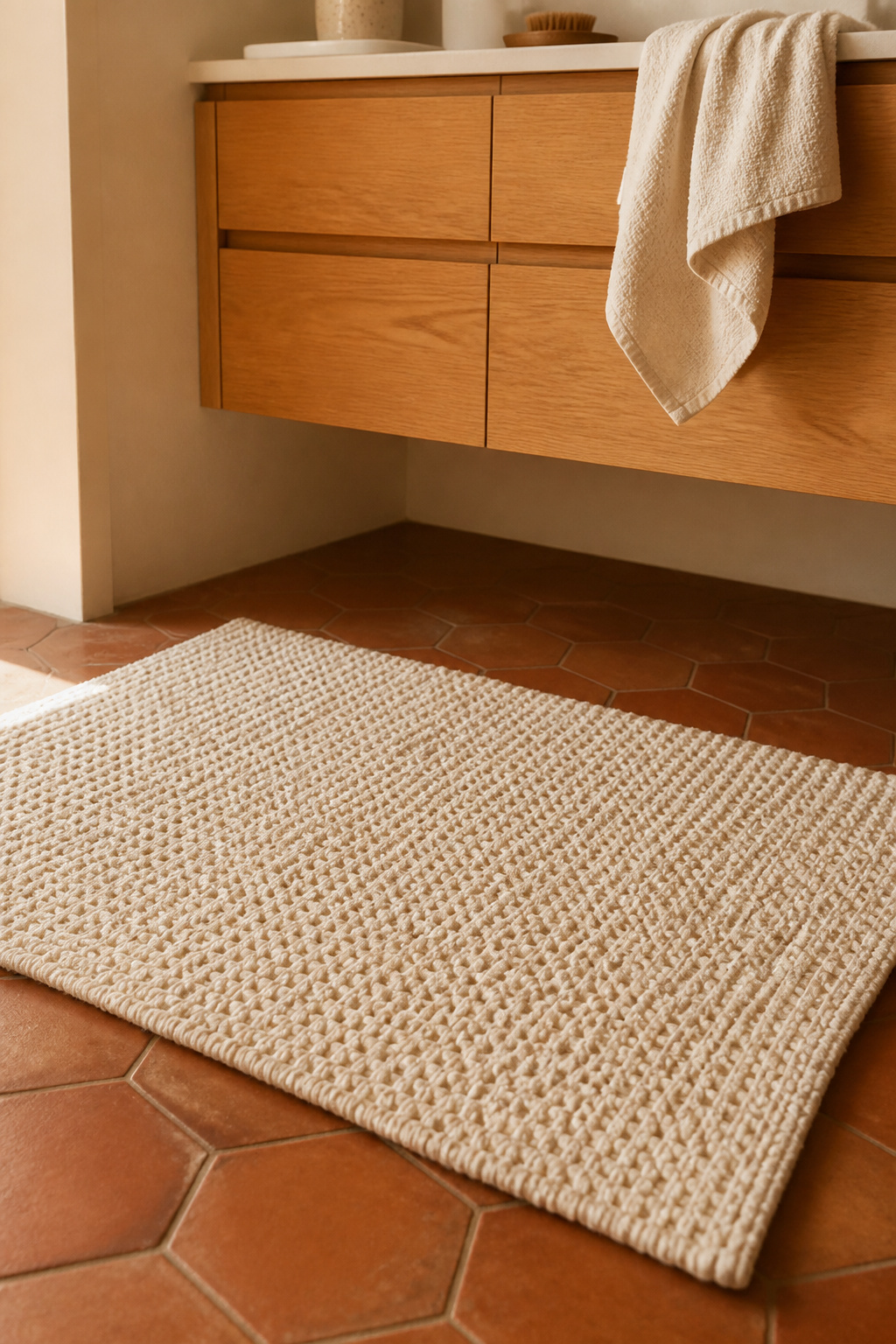
Standard bath mat sizing: 20×32 inches at the shower exit is correctly proportioned for most small bathrooms — large enough to land both feet comfortably, compact enough not to consume the visible floor in a way that defeats the space-expanding techniques that are doing other work. A 30×50 inch mat in a 40-square-foot bathroom covers so much floor that it overwrites the floating vanity and patterned tile decisions designed to make the room feel larger.
Certification and Non-Slip Backing
OEKO-TEX Standard 100 certification matters for bath mats in the same way it matters for towels — perhaps more. Bath mats are in direct contact with bare damp feet; any dye residue, formaldehyde finishing agent, or heavy metal pigment is more readily absorbed through damp skin. OEKO-TEX tests the finished textile for over 100 harmful substances, and certification guarantees the mat is free of all of them. Natural undyed cotton — raw white, oatmeal, or sand — also coordinates with virtually any neutral bathroom palette without competing for visual attention. For backing: natural rubber latex is the most durable and grip-effective non-slip option. Avoid synthetic rubber (SBR) or vinyl backing — both degrade in the wash and can leave sticky residue on tile over time. TPE (thermoplastic elastomer) is the latex-free alternative with similar grip performance and better wash durability — worth seeking for anyone with latex sensitivities. Wash at 40°C maximum; high heat degrades both cotton fibres and latex backing far faster than normal use.
18. Scent as Decor: Reed Diffusers and Natural Candles That Complete the Space
Scent is the most underused element of small bathroom design and the most immediately affecting. The olfactory system connects directly to the limbic system — the brain’s emotional centre — bypassing the analytical cortex entirely. A bathroom with a considered, consistent scent becomes a ritual space; the smell itself signals the transition from the rest of the day into the slower, quieter frequency of a personal routine.
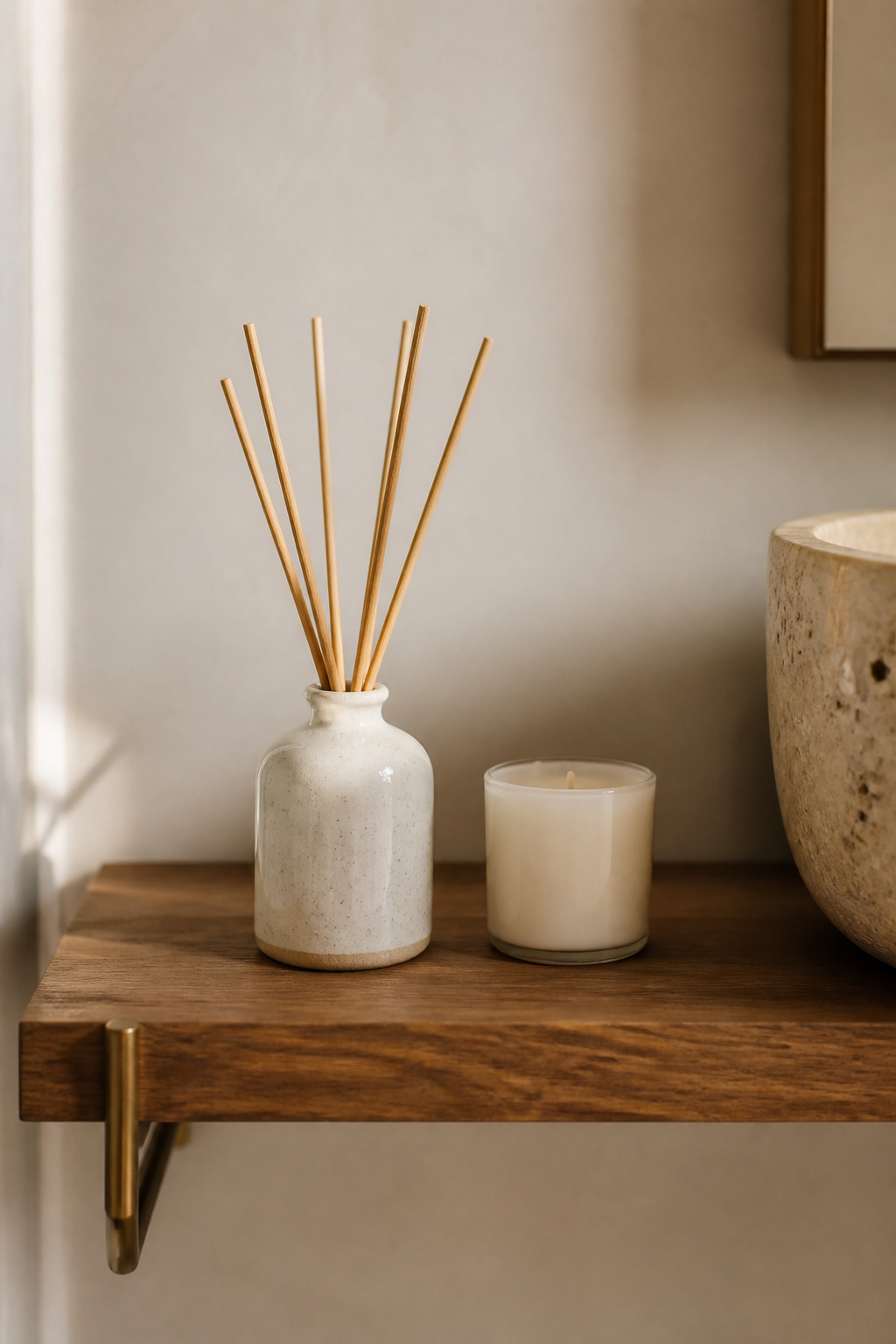
For a small bathroom, a reed diffuser is the most practical format: no electricity required (safe in any wet environment), continuous low-level fragrance without needing to be switched on, and no fire risk. A 200ml bottle with 6–8 reeds in a bathroom under 50 square feet lasts approximately three months. Flipping the reeds weekly refreshes the fragrance output. Electric ultrasonic diffusers add humidity to the air — in a small bathroom already running humid from daily showers, this increases the moisture load and is generally not the right choice.
Soy wax candles are a different category: not a continuous decor element but a deliberate ritual enhancement for a slow evening bath. One good candle placed safely away from splashing transforms a functional bathroom visit into a genuinely sensory experience. For daily background scent, however, a reed diffuser handles the job without supervision.
Choosing Non-Toxic Fragrance
Conventional fragrance oils often contain phthalates — synthetic fragrance carriers that are endocrine disruptors absorbed through skin and inhalation — and synthetic musks (persistent environmental chemicals). Look for diffuser oils labelled phthalate-free, or choose formulations made with 100% essential oils in a carrier oil (fractionated coconut or sweet almond). Lavender and eucalyptus are the most research-supported bathroom scents — lavender for cortisol reduction, eucalyptus for mental clarity; bergamot improves mood measurably in clinical settings. Place the diffuser on a shelf away from direct shower splash — constant water contact dilutes the oil and promotes mould growth in the reed sticks within weeks.
Your Approach to Small Bathroom Decorating: Starting With What Matters
Not all 18 of these ideas are for every bathroom — and not all of them belong to the same moment in a bathroom’s life. Some interventions are structural and permanent; others are essentially immediate. The decision about where to start depends on your specific layout, your biggest daily frustration, and your realistic budget. That’s the honest beginning of any useful small bathroom decorating plan.
The highest-impact-per-dollar tier: paint in a warm neutral, an oversized mirror, and warm 2700K–3000K LED bulbs in whatever fixture already exists. These three changes together cost under $500 and address the three things most responsible for a small bathroom feeling clinical — colour temperature, reflective surface, and light quality. They’re also entirely reversible, which makes them the right place to begin any small bathroom decor project.
If you’re ready for one structural commitment, make it the recessed shower niche. It removes the single loudest source of visual clutter in most small showers and creates a transformation disproportionate to its cost — typically $200–$400 in materials for the Schluter system plus tile. Everything else in a well-tiled shower looks better once the caddy is gone.
For a bathroom that needs a sensory reset more than a design overhaul: introduce scent (a phthalate-free reed diffuser), softness (OEKO-TEX cotton mat and GOTS-certified towels), and life (one potted plant that genuinely suits the light conditions). These three address the senses that most small bathroom decor ignores entirely — smell, touch, and the biophilic response to living things. The combined effect is a space that feels meaningfully different before a single tile has changed. A calm small bathroom doesn’t require a complete renovation. It requires choices that compound — each one reinforcing the warmth, the quiet, and the sense of deliberate care that a daily sanctuary deserves.